Quantum Thermal Logic Gates
Pith reviewed 2026-06-27 23:55 UTC · model grok-4.3
The pith
Coupled quantum dots produce heat currents that implement Boolean logic gates with a one-to-one match to classical electronic circuits.
A machine-rendered reading of the paper's core claim, the machinery that carries it, and where it could break.
Core claim
In a coupled quantum-dot system tunnel-coupled to metallic thermal reservoirs, the heat current can be engineered so that its steady-state values directly encode the truth tables of classical logic gates, producing a one-to-one structural correspondence with conventional electronic logic circuits.
What carries the argument
Heat current through the coupled quantum-dot system tunnel-coupled to metallic thermal reservoirs, used to generate distinct high and low output levels that map to Boolean 0 and 1.
If this is right
- Classical logic circuit designs can be directly translated into quantum thermal versions.
- Multiple gates can be cascaded using heat currents as the interconnect signal.
- Logic operations become possible in nano-electronic devices that use only thermal reservoirs and quantum dots.
- The architecture provides a concrete experimental path for testing thermal logic in existing quantum-dot setups.
Where Pith is reading between the lines
- Such gates might allow logic circuits to operate with lower dissipation if thermal transport can be made more efficient than charge transport.
- Hybrid devices could combine thermal logic sections with conventional electronic sections on the same chip.
- Testing would require checking whether reservoir back-action remains negligible when gates are placed close together.
Load-bearing premise
Heat currents through the quantum dots can be made to produce clean, cascadable Boolean outputs without dominant interference or leakage that would scramble the intended logic mapping.
What would settle it
Measurement showing that quantum interference or phonon leakage causes the heat current to take intermediate values instead of two distinct levels that match the classical truth table for any gate.
Figures
read the original abstract
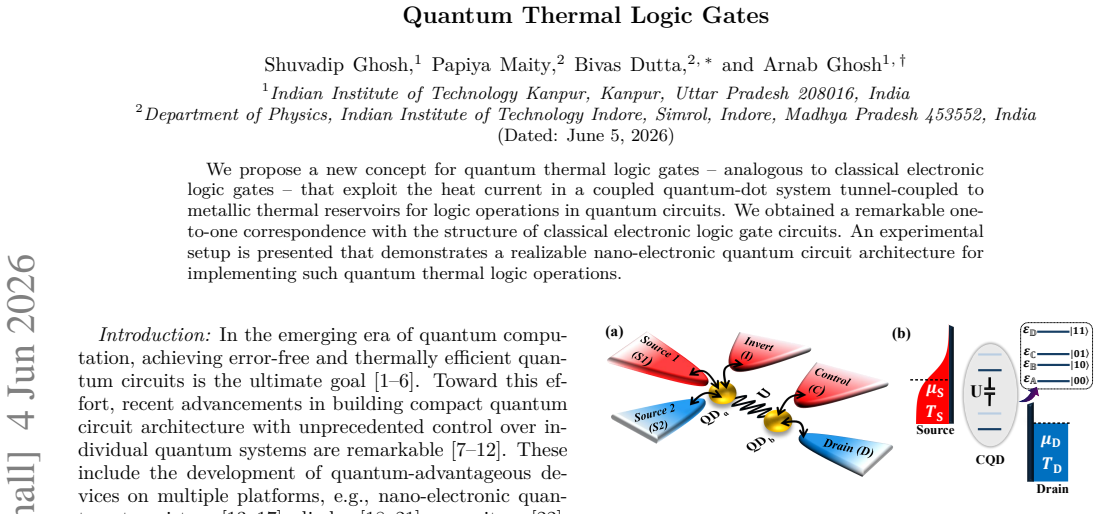
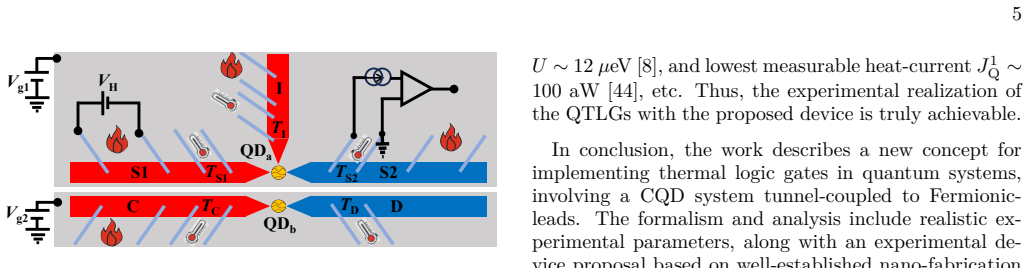
We propose a new concept for quantum thermal logic gates -- analogous to classical electronic logic gates -- that exploit the heat current in a coupled quantum-dot system tunnel-coupled to metallic thermal reservoirs for logic operations in quantum circuits. We obtained a remarkable one-to-one correspondence with the structure of classical electronic logic gate circuits. An experimental setup is presented that demonstrates a realizable nano-electronic quantum circuit architecture for implementing such quantum thermal logic operations.
Editorial analysis
A structured set of objections, weighed in public.
Referee Report
Summary. The manuscript proposes a new concept for quantum thermal logic gates that exploit heat currents in a coupled quantum-dot system tunnel-coupled to metallic thermal reservoirs, claiming a one-to-one correspondence with the structure of classical electronic logic gate circuits and presenting a realizable nano-electronic experimental setup for implementation in quantum circuits.
Significance. If the one-to-one mapping is rigorously derived from transport equations and the setup is shown to produce clean, cascadable Boolean heat-current outputs, the work could open a pathway for thermal logic operations in mesoscopic systems. The use of standard quantum-dot + reservoir geometries is a potential strength if the correspondence is not defined by construction.
major comments (2)
- [Abstract] Abstract: the claim of a 'remarkable one-to-one correspondence' with classical logic gate circuits is asserted without any equations, derivations, master-equation solutions, or rate-equation analysis; the central claim therefore rests on an unshown mapping between steady-state heat currents and Boolean outputs.
- No analysis is supplied demonstrating that coherent interference between dot levels, phonon-assisted leakage, or finite-temperature reservoir back-action remain negligible across the regime needed for cascaded gate operation; this is load-bearing for the realizability and cascadability assertions.
minor comments (1)
- [Abstract] The abstract would benefit from a concise statement of the operating temperature range or tunnel-coupling strengths required for the proposed logic levels.
Simulated Author's Rebuttal
We thank the referee for the detailed comments. We address each major point below, clarifying the content of the manuscript and indicating where revisions will strengthen the presentation.
read point-by-point responses
-
Referee: [Abstract] Abstract: the claim of a 'remarkable one-to-one correspondence' with classical logic gate circuits is asserted without any equations, derivations, master-equation solutions, or rate-equation analysis; the central claim therefore rests on an unshown mapping between steady-state heat currents and Boolean outputs.
Authors: The abstract is a concise summary. The one-to-one structural correspondence is obtained in the main text by solving the rate equations for the steady-state heat currents through the coupled quantum-dot system for each input combination; these currents directly reproduce the Boolean truth tables of the corresponding classical gates. The mapping follows from the topology of the dot-reservoir network rather than being imposed by hand. We will revise the abstract to explicitly reference the sections containing the rate-equation analysis and resulting current expressions. revision: yes
-
Referee: No analysis is supplied demonstrating that coherent interference between dot levels, phonon-assisted leakage, or finite-temperature reservoir back-action remain negligible across the regime needed for cascaded gate operation; this is load-bearing for the realizability and cascadability assertions.
Authors: The proposal is formulated in the sequential-tunneling regime (weak dot-reservoir coupling relative to level spacing), where coherent interference is suppressed by the Markovian reservoir coupling. Phonon-assisted processes are omitted because the model contains no explicit electron-phonon interaction. For cascadability the output heat current is routed through an intermediate metallic reservoir that thermalizes before serving as input to the next gate. We will add a dedicated paragraph in the revised manuscript that quantifies the relevant parameter window (tunnel rates, temperatures, and level detunings) under which these approximations hold and discuss the conditions required for reliable cascading. revision: yes
Circularity Check
No circularity: proposal presents model without reducing claimed correspondence to input definitions
full rationale
The provided abstract and context describe a proposal for quantum thermal logic gates based on heat currents in coupled quantum dots, claiming a one-to-one structural correspondence with classical gates. No equations, parameter fits, or derivation steps are exhibited that would allow verification of self-definitional mapping, fitted inputs renamed as predictions, or load-bearing self-citations. The central claim is presented as obtained from the physical setup rather than by construction, and the skeptic concerns address feasibility rather than definitional circularity. Without explicit reduction of any output to its own inputs via the paper's equations, the derivation chain cannot be shown to collapse.
Axiom & Free-Parameter Ledger
Reference graph
Works this paper leans on
-
[1]
Maurand and X
R. Maurand and X. Jehl, Transistor qubits heat up, Na- ture Electronics5, 131 (2022)
2022
-
[2]
M. A. Aamir, P. Jamet Suria, J. A. Mar´ ın Guzm´ an, C. Castillo-Moreno, J. M. Epstein, N. Yunger Halpern, and S. Gasparinetti, Thermally driven quantum refriger- ator autonomously resets a superconducting qubit, Na- ture Physics21, 318 (2025)
2025
-
[3]
M. S. Blok and G. T. Landi, Quantum thermodynamics for quantum computing, Nature Physics21, 187 (2025)
2025
-
[4]
Karimi, G
B. Karimi, G. O. Steffensen, A. P. Higginbotham, C. M. Marcus, A. Levy Yeyati, and J. P. Pekola, Bolometric detection of josephson radiation, Nature Nanotechnology 19, 1613 (2024)
2024
-
[5]
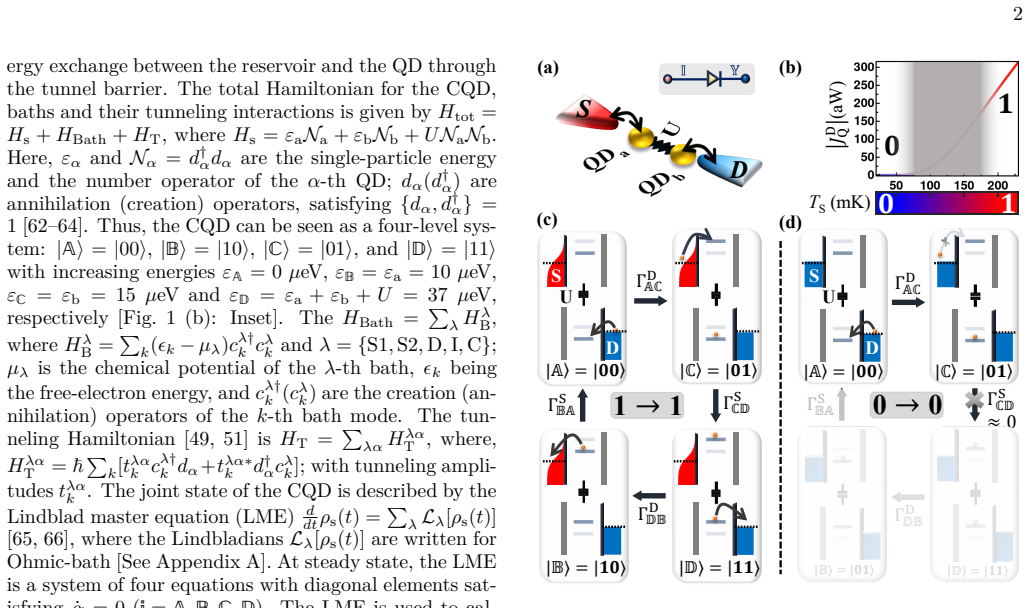
Simbierowicz, M
S. Simbierowicz, M. Borrelli, V. Monarkha, V. Nuuti- nen, and R. E. Lake, Inherent thermal-noise problem in addressing qubits, PRX Quantum5, 030302 (2024)
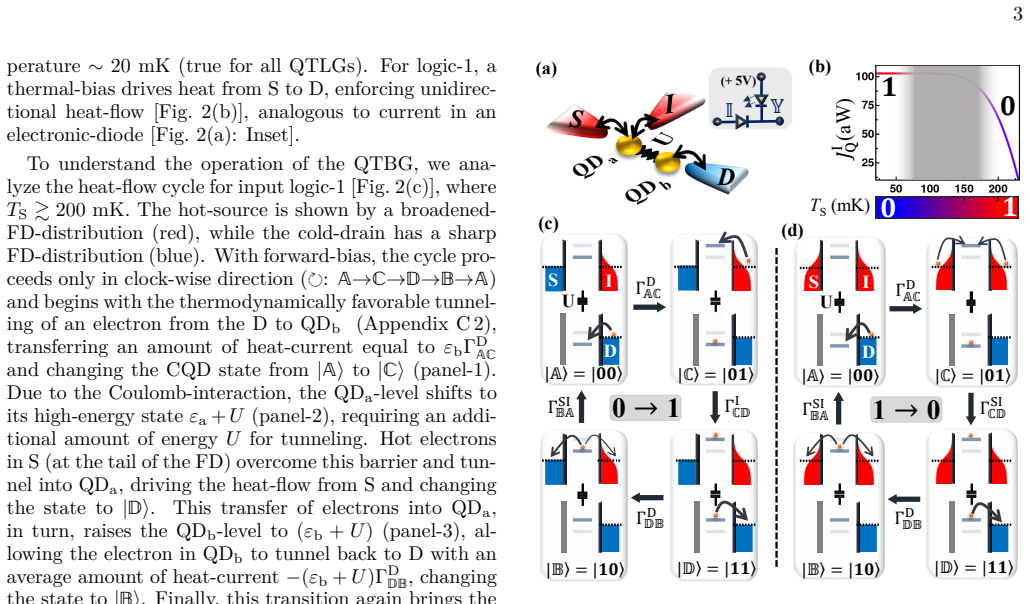
2024
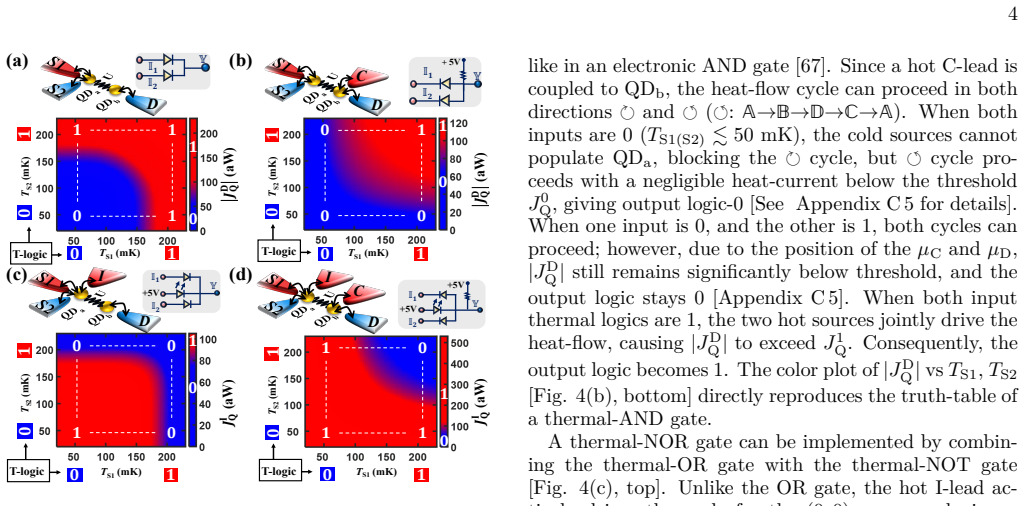
-
[6]
V. Champain, G. Boschetto, H. Niebojewski, B. Bertrand, L. Mauro, M. Bassi, V. Schmitt, X. Jehl, S. Zihlmann, R. Maurand, Y. M. Niquet, C. B. Winkel- mann, S. D. Franceschi, B. Martinez, and B. Brun, A heat-resilient hole spin qubit in silicon (2025), arXiv:2509.15823
arXiv 2025
-
[7]
Roßnagel, S
J. Roßnagel, S. T. Dawkins, K. N. Tolazzi, O. Abah, E. Lutz, F. Schmidt-Kaler, and K. Singer, A single-atom heat engine, Science352, 325 (2016)
2016
-
[8]
Thierschmann, R
H. Thierschmann, R. S´ anchez, B. Sothmann, F. Arnold, C. Heyn, W. Hansen, H. Buhmann, and L. W. Molenkamp, Three-terminal energy harvester with cou- pled quantum dots, Nature Nanotechnology10, 854 (2015)
2015
-
[9]
Jezouin, F
S. Jezouin, F. D. Parmentier, A. Anthore, U. Gennser, A. Cavanna, Y. Jin, and F. Pierre, Quantum limit of heat flow across a single electronic channel, Science342, 601 (2013)
2013
-
[10]
Banerjee, M
M. Banerjee, M. Heiblum, A. Rosenblatt, Y. Oreg, D. E. Feldman, A. Stern, and V. Umansky, Observed quanti- zation of anyonic heat flow, Nature545, 75 (2017)
2017
-
[11]
Dutta, V
B. Dutta, V. Umansky, M. Banerjee, and M. Heiblum, Isolated ballistic non-abelian interface channel, Science 377, 1198 (2022)
2022
-
[12]
N. M. Myers, O. Abah, and S. Deffner, Quantum thermo- dynamic devices: From theoretical proposals to experi- mental reality, AVS Quantum Science4, 027101 (2022), and the references therein
2022
-
[13]
Joulain, J
K. Joulain, J. Drevillon, Y. Ezzahri, and J. Ordonez- Miranda, Quantum thermal transistor, Phys. Rev. Lett. 116, 200601 (2016)
2016
-
[14]
Dutta, D
B. Dutta, D. Majidi, A. Garc´ ıa Corral, P. A. Erdman, S. Florens, T. A. Costi, H. Courtois, and C. B. Winkel- mann, Direct probe of the seebeck coefficient in a kondo- correlated single-quantum-dot transistor, Nano Letters 19, 506 (2019). 6
2019
-
[15]
M. L. Perrin, E. Burzur´ ı, and H. S. J. van der Zant, Single-molecule transistors, Chem. Soc. Rev.44, 902 (2015)
2015
-
[16]
N. Gupt, S. Bhattacharyya, B. Das, S. Datta, V. Mukher- jee, and A. Ghosh, Floquet quantum thermal transistor, Phys. Rev. E106, 024110 (2022)
2022
-
[17]
R. T. Wijesekara, S. D. Gunapala, and M. Premaratne, Darlington pair of quantum thermal transistors, Phys. Rev. B104, 045405 (2021)
2021
-
[18]
M. L. Perrin, E. Gal´ an, R. Eelkema, J. M. Thijssen, F. Grozema, and H. S. J. van der Zant, A gate-tunable single-molecule diode, Nanoscale8, 8919 (2016)
2016
-
[19]
Ghosh, N
S. Ghosh, N. Gupt, and A. Ghosh, Universal behavior of the coulomb-coupled fermionic thermal diode, Entropy 24(2022)
2022
-
[20]
W. Khan, P. P. Potts, S. Lehmann, C. Thelander, K. A. Dick, P. Samuelsson, and V. F. Maisi, Efficient and continuous microwave photoconversion in hybrid cavity- semiconductor nanowire double quantum dot diodes, Na- ture Communications12, 5130 (2021)
2021
-
[21]
Upadhyay, D
R. Upadhyay, D. S. Golubev, Y.-C. Chang, G. Thomas, A. Guthrie, J. T. Peltonen, and J. P. Pekola, Mi- crowave quantum diode, Nature Communications15, Ar- ticle number: 44908 (2024)
2024
-
[22]
Moskalets, P
M. Moskalets, P. Samuelsson, and M. B¨ uttiker, Quan- tized dynamics of a coherent capacitor, Phys. Rev. Lett. 100, 086601 (2008)
2008
-
[23]
Campaioli, S
F. Campaioli, S. Gherardini, J. Q. Quach, M. Polini, and G. M. Andolina, Colloquium: Quantum batteries, Rev. Mod. Phys.96, 031001 (2024)
2024
-
[24]
Ferraro, F
D. Ferraro, F. Cavaliere, M. G. Genoni, G. Benenti, and M. Sassetti, Opportunities and challenges of quantum batteries, Nature Reviews Physics8, 115 (2026)
2026
-
[25]
Kosloff and A
R. Kosloff and A. Levy, Quantum heat engines and re- frigerators: Continuous devices, Annu. Rev. Phys. Chem. 65, 365 (2014)
2014
-
[26]
Ghosh, C
A. Ghosh, C. L. Latune, L. Davidovich, and G. Kur- izki, Catalysis of heat-to-work conversion in quantum machines, Proceedings of the National Academy of Sci- ences114, 12156 (2017)
2017
-
[27]
Ghosh, D
A. Ghosh, D. Gelbwaser-Klimovsky, W. Niedenzu, A. I. Lvovsky, I. Mazets, M. O. Scully, and G. Kurizki, Two- level masers as heat-to-work converters, Proceedings of the National Academy of Sciences115, 9941 (2018)
2018
-
[28]
Binder, L
F. Binder, L. A. Correa, C. Gogolin, J. Anders, and G. Adesso, Thermodynamics in the quantum regime: Fundamental aspects and new directions (Springer, 2019) and the references therein
2019
-
[29]
Maity, P
A. Maity, P. Chaki, A. Ghoshal, and U. Sen, Quantum heat transformers, New Journal of Physics28, 014501 (2025)
2025
-
[30]
Kurizki and A
G. Kurizki and A. Kofman,Thermodynamics and Control of Open Quantum Systems(Cambridge University Press, 2022)
2022
-
[31]
Giazotto, T
F. Giazotto, T. T. Heikkil¨ a, A. Luukanen, A. M. Savin, and J. P. Pekola, Opportunities for mesoscopics in ther- mometry and refrigeration: Physics and applications, Rev. Mod. Phys.78, 217 (2006)
2006
-
[32]
J. P. Pekola, K. P. Hirvi, J. P. Kauppinen, and M. A. Paalanen, Thermometry by arrays of tunnel junctions, Phys. Rev. Lett.73, 2903 (1994)
1994
-
[33]
Nahum and J
M. Nahum and J. M. Martinis, Ultrasensitive-hot- electron microbolometer, Applied Physics Letters63, 3075 (1993)
1993
-
[34]
Meschke, J
M. Meschke, J. T. Peltonen, H. Courtois, and J. P. Pekola, Calorimetric readout of a superconducting proximity-effect thermometer, Journal of Low Temper- ature Physics154, 190 (2009)
2009
-
[35]
Halbertal, J
D. Halbertal, J. Cuppens, M. Ben Shalom, L. Embon, N. Shadmi, Y. Anahory, H. R. Naren, J. Sarkar, A. Uri, Y. Ronen, Y. Myasoedov, L. S. Levitov, E. Joselevich, A. K. Geim, and E. Zeldov, Nanoscale thermal imaging of dissipation in quantum systems, Nature539, 407 (2016)
2016
-
[36]
Karimi, F
B. Karimi, F. Brange, P. Samuelsson, and J. P. Pekola, Reaching the ultimate energy resolution of a quantum detector, Nature Communications11, 367 (2020)
2020
-
[37]
J. P. Pekola and B. Karimi, Colloquium: Quantum heat transport in condensed matter systems, Rev. Mod. Phys. 93, 041001 (2021)
2021
-
[38]
Majidi, J
D. Majidi, J. P. Bergfield, V. Maisi, J. H¨ ofer, H. Cour- tois, and C. B. Winkelmann, Heat transport at the nanoscale and ultralow temperatures—implications for quantum technologies, Applied Physics Letters124, 140504 (2024)
2024
-
[39]
Dutta, J
B. Dutta, J. T. Peltonen, D. S. Antonenko, M. Meschke, M. A. Skvortsov, B. Kubala, J. K¨ onig, C. B. Winkel- mann, H. Courtois, and J. P. Pekola, Thermal conduc- tance of a single-electron transistor, Phys. Rev. Lett. 119, 077701 (2017)
2017
-
[40]
L. Cui, W. Jeong, S. Hur, M. Matt, J. C. Kl¨ ockner, F. Pauly, P. Nielaba, J. C. Cuevas, E. Meyhofer, and P. Reddy, Quantized thermal transport in single-atom junctions, Science355, 1192 (2017)
2017
-
[41]
Mosso, U
N. Mosso, U. Drechsler, F. Menges, P. Nirmalraj, S. Karg, H. Riel, and B. Gotsmann, Heat transport through atomic contacts, Nature Nanotechnology12, 430 (2017)
2017
-
[42]
Josefsson, A
M. Josefsson, A. Svilans, A. M. Burke, E. A. Hoff- mann, S. Fahlvik Svensson, C. Thelander, M. Leijnse, and H. Linke, A quantum-dot heat engine operating close to the thermodynamic efficiency limits, Nature Nan- otechnology13, 920 (2018)
2018
-
[43]
Volosheniuk, R
S. Volosheniuk, R. Conte, E. Pyurbeeva, T. Baum, M. Vilas-Varela, S. Fern´ andez, D. Pe˜ na, H. S. J. van der Zant, and P. Gehring, A single-molecule quantum heat engine, Nano Letters26, 984 (2026)
2026
-
[44]
Dutta, D
B. Dutta, D. Majidi, N. W. Talarico, N. Lo Gullo, H. Courtois, and C. B. Winkelmann, Single-quantum-dot heat valve, Phys. Rev. Lett.125, 237701 (2020)
2020
-
[45]
Maillet, D
O. Maillet, D. Subero, J. T. Peltonen, D. S. Golubev, and J. P. Pekola, Electric field control of radiative heat trans- fer in a superconducting circuit, Nature Communications 11, 4326 (2020)
2020
-
[46]
Ronzani, B
A. Ronzani, B. Karimi, J. Senior, Y.-C. Chang, J. T. Peltonen, C. Chen, and J. P. Pekola, Tunable photonic heat transport in a quantum heat valve, Nature Physics 14, 991 (2018)
2018
-
[47]
Campbell et
S. Campbell et. al., Roadmap on quantum thermodynam- ics, Quantum Science and Technology11, 012501 (2026), and the references therein
2026
-
[48]
Tiwari, S
D. Tiwari, S. Bhattacharya, and S. Banerjee, Quan- tum thermal analogs of electric circuits: A universal ap- proach, Phys. Rev. Lett.135, 020404 (2025)
2025
-
[49]
L. Wang, Z. Wang, C. Wang, and J. Ren, Cycle flux ranking of network analysis in quantum thermal devices, Phys. Rev. Lett.128, 067701 (2022)
2022
-
[50]
Tesser, B
L. Tesser, B. Bhandari, P. A. Erdman, E. Paladino, R. Fazio, and F. Taddei, Heat rectification through single 7 and coupled quantum dots, New Journal of Physics24, 035001 (2022)
2022
-
[51]
N. Gupt, S. Ghosh, and A. Ghosh, Graph theoretic analysis of three-terminal quantum dot thermocouples: Onsager relations and spin-thermoelectric effects, Phys. Rev. B109, 125124 (2024)
2024
-
[52]
Ghosh, N
S. Ghosh, N. Gupt, and A. Ghosh, Inverse current in coupled transport: A quantum thermodynamic model, Phys. Rev. Res.8, 023166 (2026)
2026
-
[53]
Wang and B
L. Wang and B. Li, Thermal logic gates: Computation with phonons, Phys. Rev. Lett.99, 177208 (2007)
2007
-
[54]
Paolucci, G
F. Paolucci, G. Marchegiani, E. Strambini, and F. Gi- azotto, Phase-tunable thermal logic: Computation with heat, Phys. Rev. Appl.10, 024003 (2018)
2018
-
[55]
Ruokola and T
T. Ruokola and T. Ojanen, Single-electron heat diode: Asymmetric heat transport between electronic reser- voirs through coulomb islands, Phys. Rev. B83, 241404 (2011)
2011
-
[56]
J. V. Koski, A. Kutvonen, I. M. Khaymovich, T. Ala- Nissila, and J. P. Pekola, On-chip maxwell’s demon as an information-powered refrigerator, Phys. Rev. Lett.115, 260602 (2015)
2015
-
[57]
Thierschmann, F
H. Thierschmann, F. Arnold, M. Mitterm¨ uller, L. Maier, C. Heyn, W. Hansen, H. Buhmann, and L. W. Molenkamp, Thermal gating of charge currents with coulomb coupled quantum dots, New Journal of Physics 17, 113003 (2015)
2015
-
[58]
Zhang, X
Y. Zhang, X. Zhang, Z. Ye, G. Lin, and J. Chen, Three- terminal quantum-dot thermal management devices, Ap- plied Physics Letters110, 153501 (2017)
2017
-
[59]
R. S. Whitney, R. S´ anchez, and J. Splettstoesser, Quan- tum thermodynamics of nanoscale thermoelectrics and electronic devices, inThermodynamics in the Quan- tum Regime: Fundamental Aspects and New Directions, edited by F. Binder, L. A. Correa, C. Gogolin, J. An- ders, and G. Adesso (Springer International Publishing, Cham, 2018) pp. 175–206
2018
-
[60]
S´ anchez and M
R. S´ anchez and M. B¨ uttiker, Optimal energy quanta to current conversion, Phys. Rev. B83, 085428 (2011)
2011
-
[61]
E. Pyurbeeva and R. Kosloff, Quantum dot ther- mal machines—a guide to engineering, Entropy28, 10.3390/e28010002 (2026)
-
[62]
Ghosh, S
A. Ghosh, S. S. Sinha, and D. S. Ray, Fermionic oscillator in a fermionic bath, Phys. Rev. E86, 011138 (2012)
2012
-
[63]
N. Gupt, S. Bhattacharyya, and A. Ghosh, Statistical generalization of regenerative bosonic and fermionic stir- ling cycles, Phys. Rev. E104, 054130 (2021)
2021
-
[64]
G. G. Damas, R. J. de Assis, and N. G. de Almeida, Cooling with fermionic thermal reservoirs, Phys. Rev. E 107, 034128 (2023)
2023
-
[65]
Breuer and F
H.-P. Breuer and F. Petruccione,The Theory of Open Quantum Systems(Oxford University Press, 2007)
2007
-
[66]
Strasberg,Quantum Stochastic Thermodynamics: Foundations and Selected Applications(Oxford Univer- sity Press, 2022)
P. Strasberg,Quantum Stochastic Thermodynamics: Foundations and Selected Applications(Oxford Univer- sity Press, 2022)
2022
-
[67]
Millman and C
J. Millman and C. Halkias,Integrated Electronics: Analog and Digital Circuits and Systems, Electrical Engineering Series (McGraw-Hill, 1972)
1972
-
[68]
Dubos, H
P. Dubos, H. Courtois, B. Pannetier, F. K. Wilhelm, A. D. Zaikin, and G. Sch¨ on, Josephson critical current in a long mesoscopic s-n-s junction, Phys. Rev. B63, 064502 (2001)
2001
-
[69]
Esposito, K
M. Esposito, K. Lindenberg, and C. V. den Broeck, Entropy production as correlation between system and reservoir, New Journal of Physics12, 013013 (2010)
2010
-
[70]
G. T. Landi and M. Paternostro, Irreversible entropy pro- duction: From classical to quantum, Rev. Mod. Phys.93, 035008 (2021). Appendix A: Lindblad Master Equation and its Steady-state solution To derive the quantum master equation for our quantum thermal logic gates (QTLG) model, we start with the von-Neumann equation in the interaction picture for the ...
2021
-
[71]
1(b) of the main text
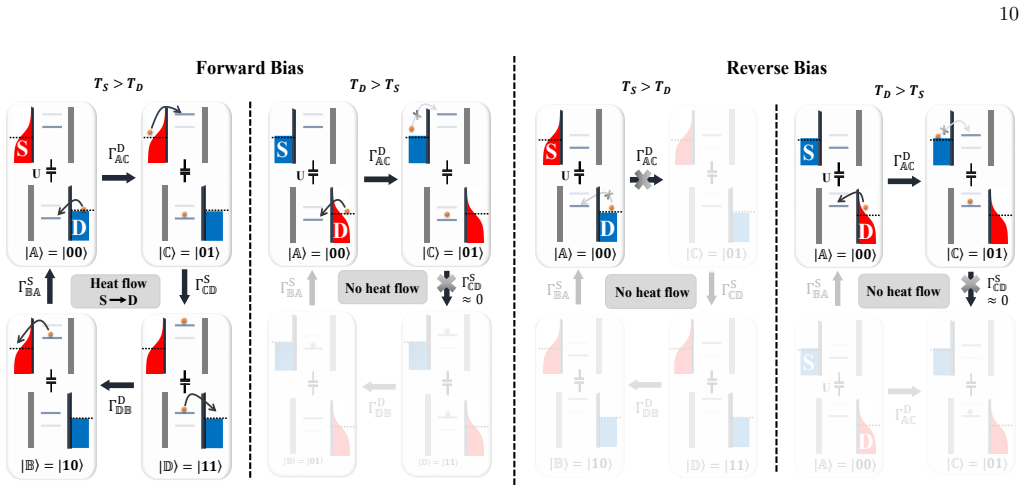
Detailed Operation of thermal diode Let us now describe the detailed operation of the thermal diode shown in Fig. 1(b) of the main text. Here, two QDs, QD a and QD b, are tunnel-coupled to the Source (S) and Drain (D) leads, respectively. Under forward-bias conditions, heat flows from the hot S lead to the cold D lead, whereas under reverse-bias condition...
-
[72]
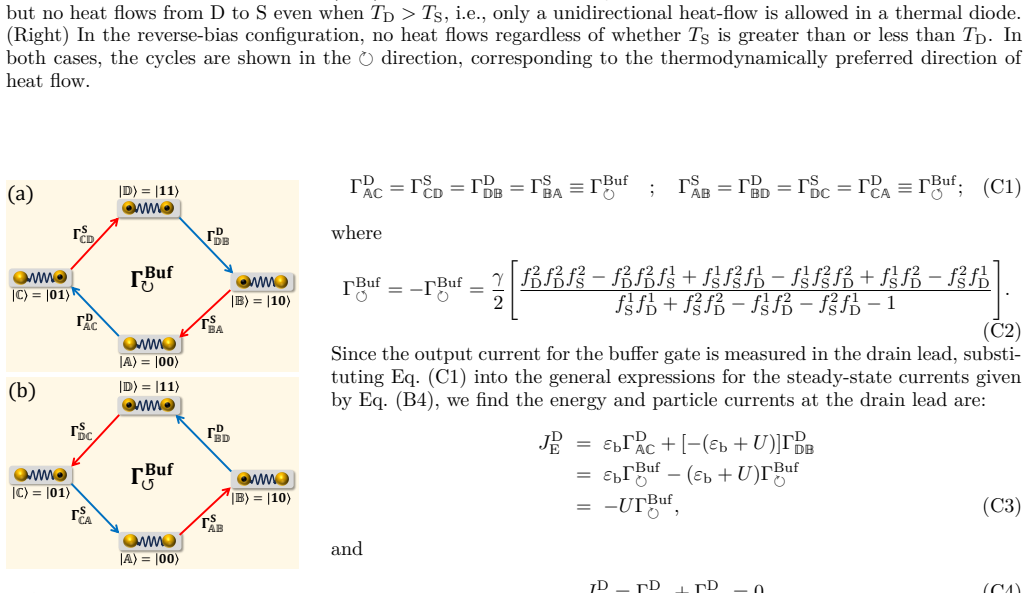
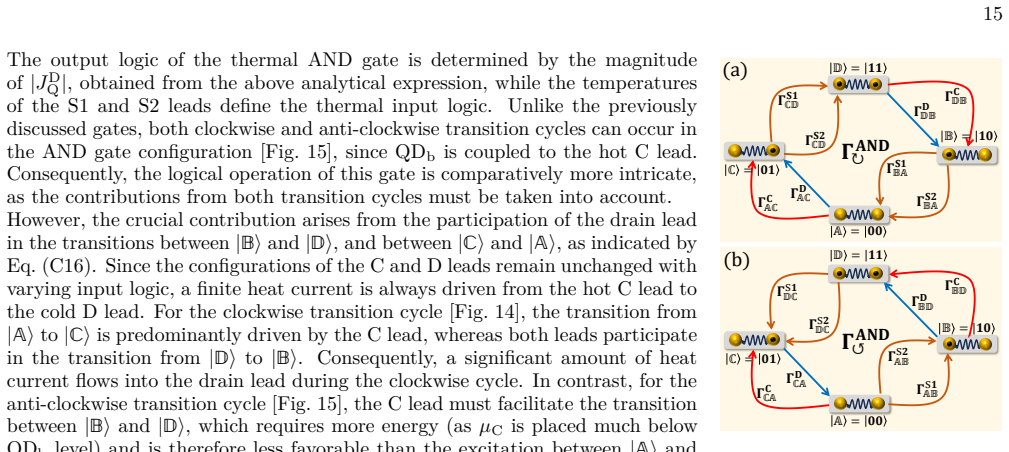
Thermal diode as Buffer Gate For the above diode model, the steady-state transition rates for the clockwise and anti-clockwise transition cycles are illustrated via a diagrammatic picture in Fig. 7. According to Eq. (A8), the transition rates satisfy the following relations 10 Forward Bias ۧ|𝔸 =ۧ|𝟎𝟎ۧ|ℂ =ۧ|𝟎𝟏 ۧ|𝔹 =ۧ|𝟏𝟎 Γ𝔸ℂ D Γℂ𝔻 S Γ𝔻𝔹 D Γ𝔹𝔸 S ۧ|𝔻 =ۧ|𝟏𝟏 U ۧ...
-
[73]
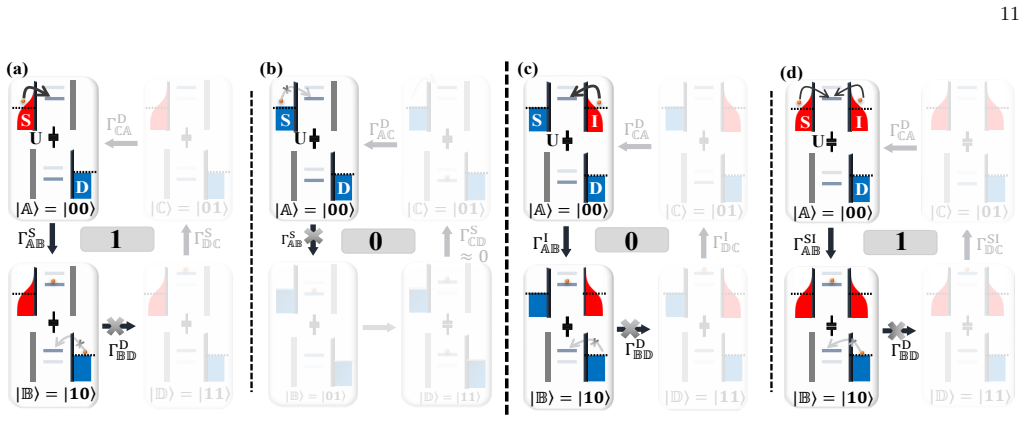
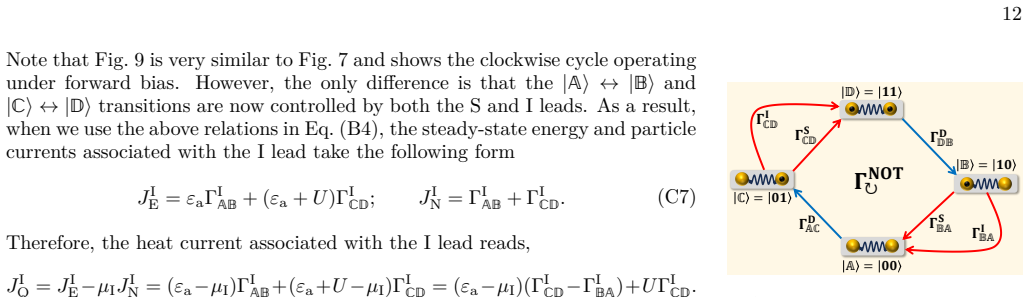
Thermal-NOT Gate By coupling an additional Invert lead (I) to QD a, characterized by temperatureT I and chemical potentialµI, we control the output thermal currentJ I Q at the I lead. This upgrades the thermal-diode model to a thermal-NOT gate: QDa is coupled to the source (S) and invert (I) leads, while QD b is coupled to the drain lead D; therefore, app...
-
[74]
10: Diagrammatic represen- tation for the clockwise transition cycle for the OR gate
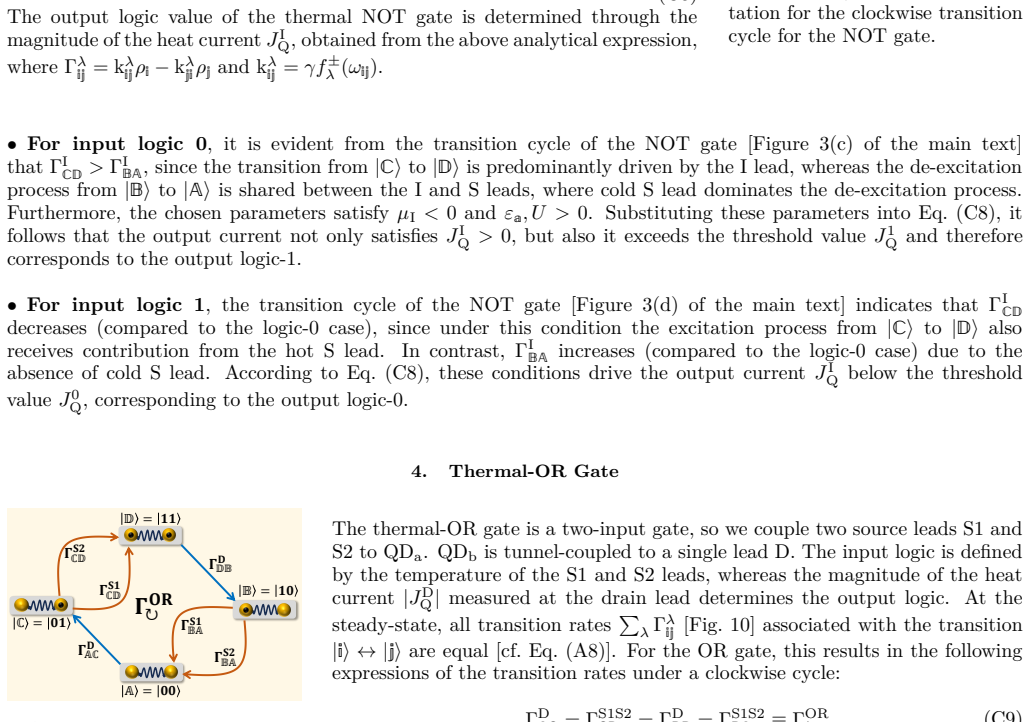
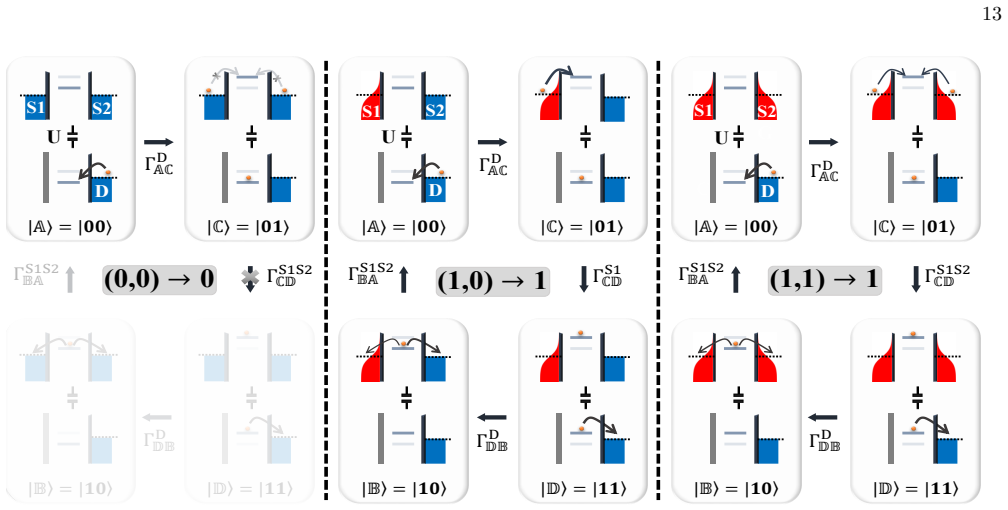
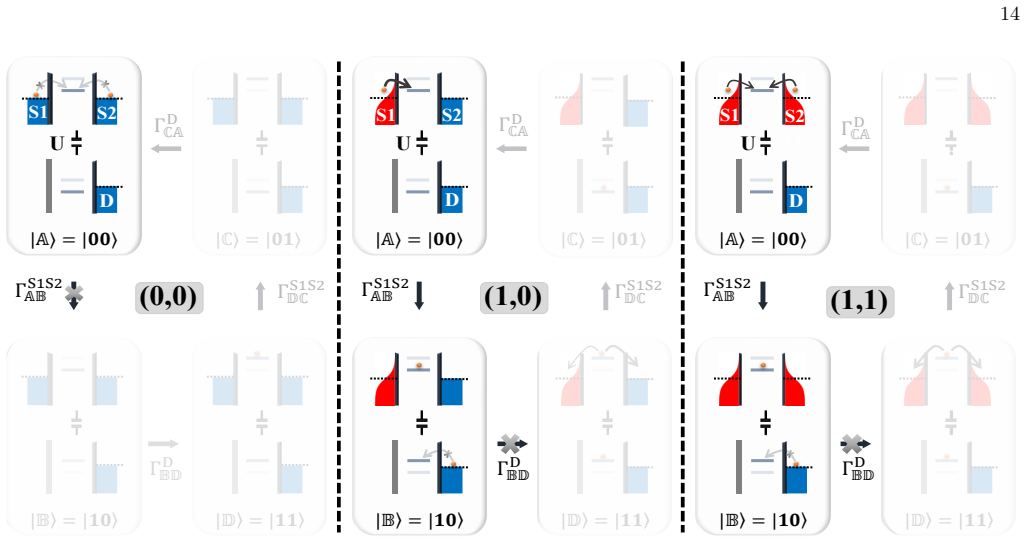
Thermal-OR Gate 𝔸 = 𝟎𝟎 ℂ = 𝟎𝟏 𝔹 = 𝟏𝟎 𝔻 = 𝟏𝟏 𝚪↻ 𝐎𝐑 𝚪𝔸ℂ 𝐃 𝚪ℂ𝔻 𝐒𝟐 𝚪𝔻𝔹 𝐃 𝚪𝔹𝔸 𝐒𝟏 𝚪𝔹𝔸 𝐒𝟐 𝚪ℂ𝔻 𝐒𝟏 FIG. 10: Diagrammatic represen- tation for the clockwise transition cycle for the OR gate. The thermal-OR gate is a two-input gate, so we couple two source leads S1 and S2 to QD a. QD b is tunnel-coupled to a single lead D. The input logic is defined by the temperatu...
-
[75]
In this configuration, QDa is tunnel-coupled to the source leads S1 and S2
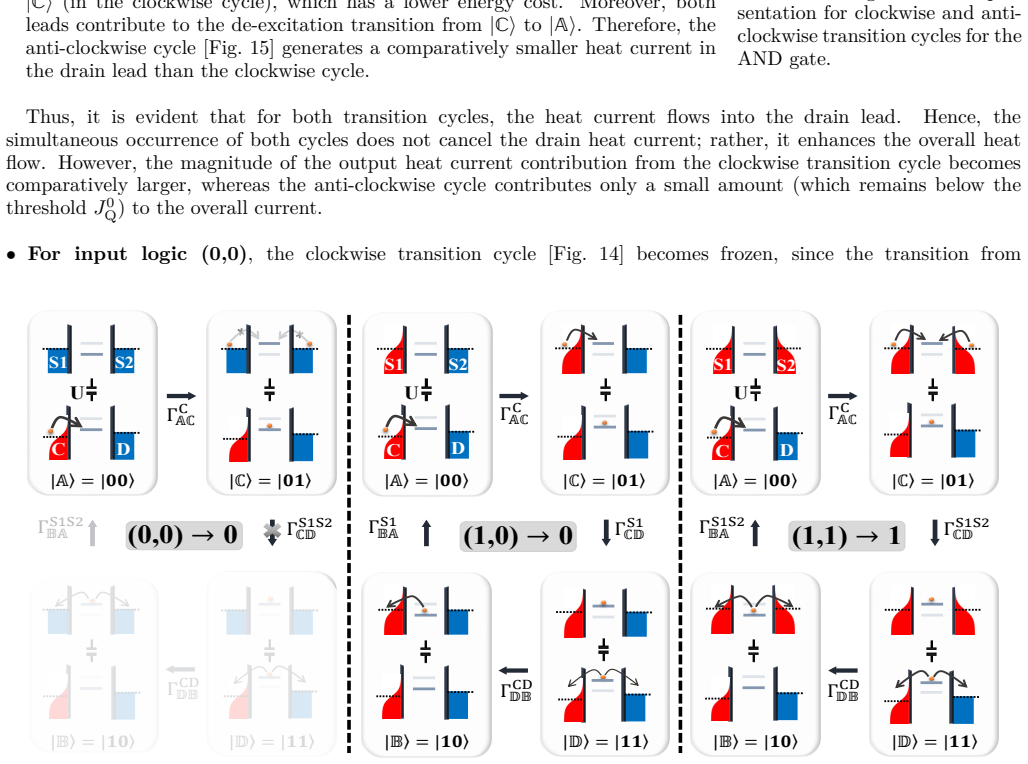
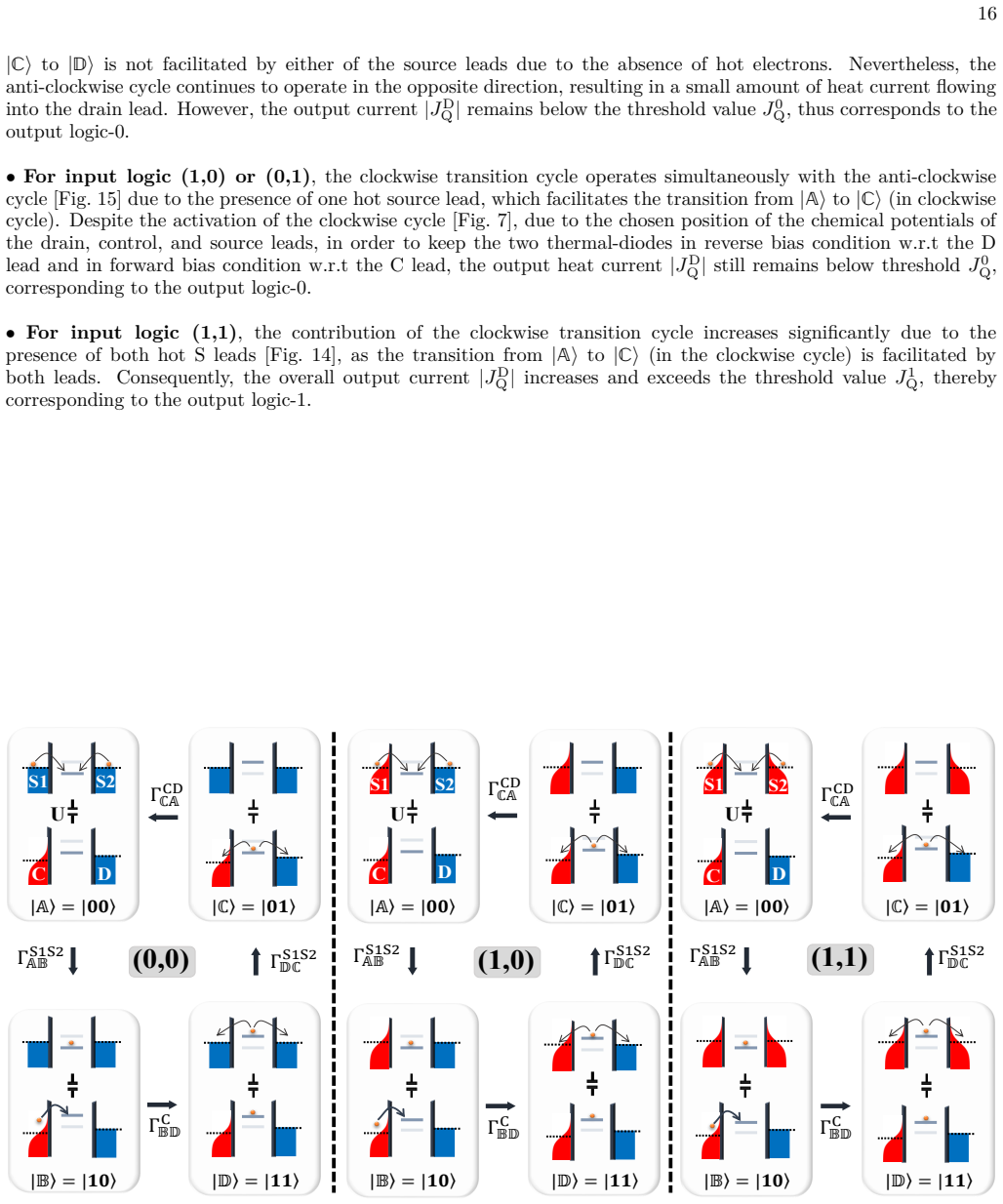
Thermal-AND Gate The thermal AND gate can be constructed from the OR-gate by introducing an additional control (C) lead attached to QDb. In this configuration, QDa is tunnel-coupled to the source leads S1 and S2. In contrast, QDb is tunnel-coupled to one drain lead D and a control lead C. Under these conditions, the steady-state transition rates [Fig. 13]...
-
[76]
16: Diagrammatic represen- tation of the clockwise transition cycle for the NOR gate
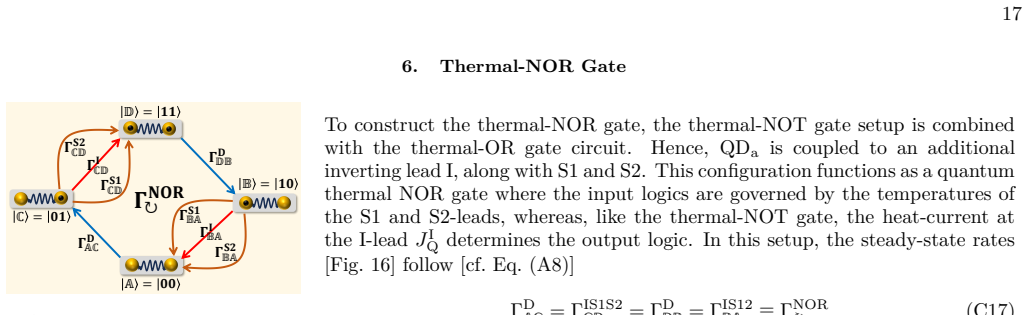
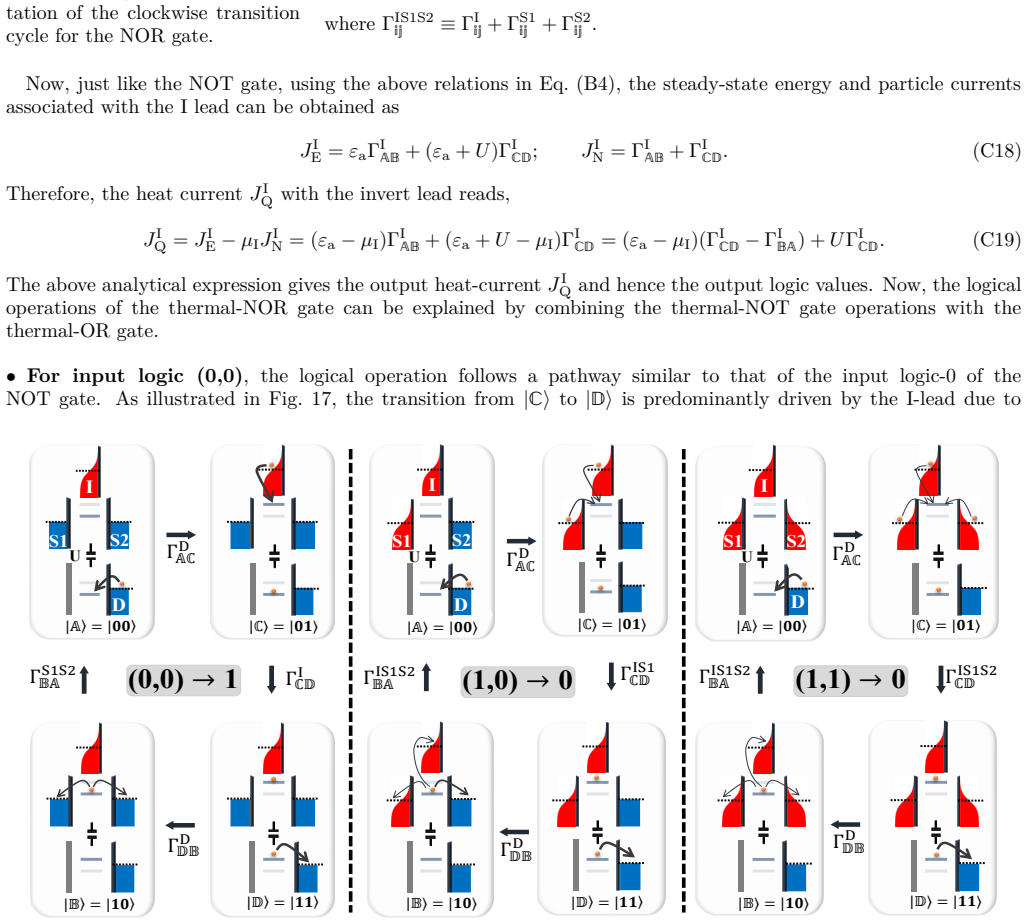
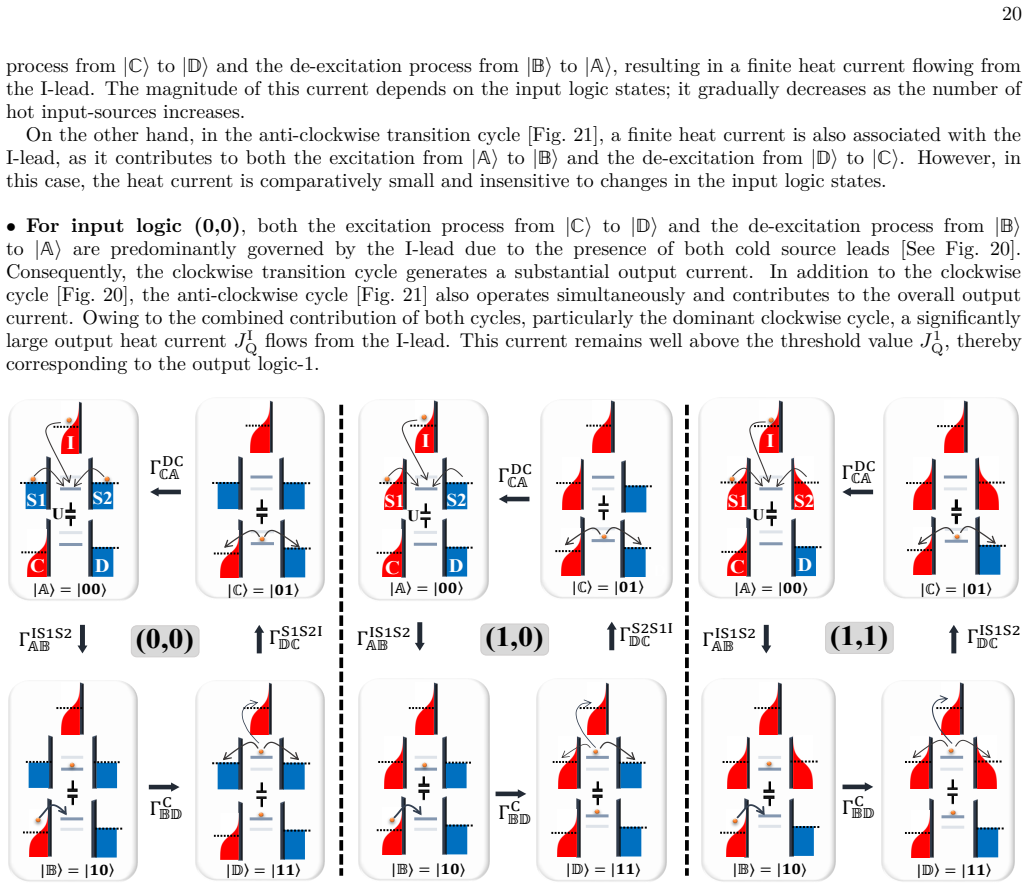
Thermal-NOR Gate 𝔸 = 𝟎𝟎 ℂ = 𝟎𝟏 𝔹 = 𝟏𝟎 𝔻 = 𝟏𝟏 𝚪↻ 𝐍𝐎𝐑 𝚪𝔸ℂ 𝐃 𝚪ℂ𝔻 𝐒𝟐 𝚪𝔻𝔹 𝐃 𝚪𝔹𝔸 𝐒𝟏 𝚪𝔹𝔸 𝐒𝟐 𝚪ℂ𝔻 𝐒𝟏 𝚪ℂ𝔻 𝐈 𝚪𝔹𝔸 𝐈 FIG. 16: Diagrammatic represen- tation of the clockwise transition cycle for the NOR gate. To construct the thermal-NOR gate, the thermal-NOT gate setup is combined with the thermal-OR gate circuit. Hence, QD a is coupled to an additional inverting lead...
-
[77]
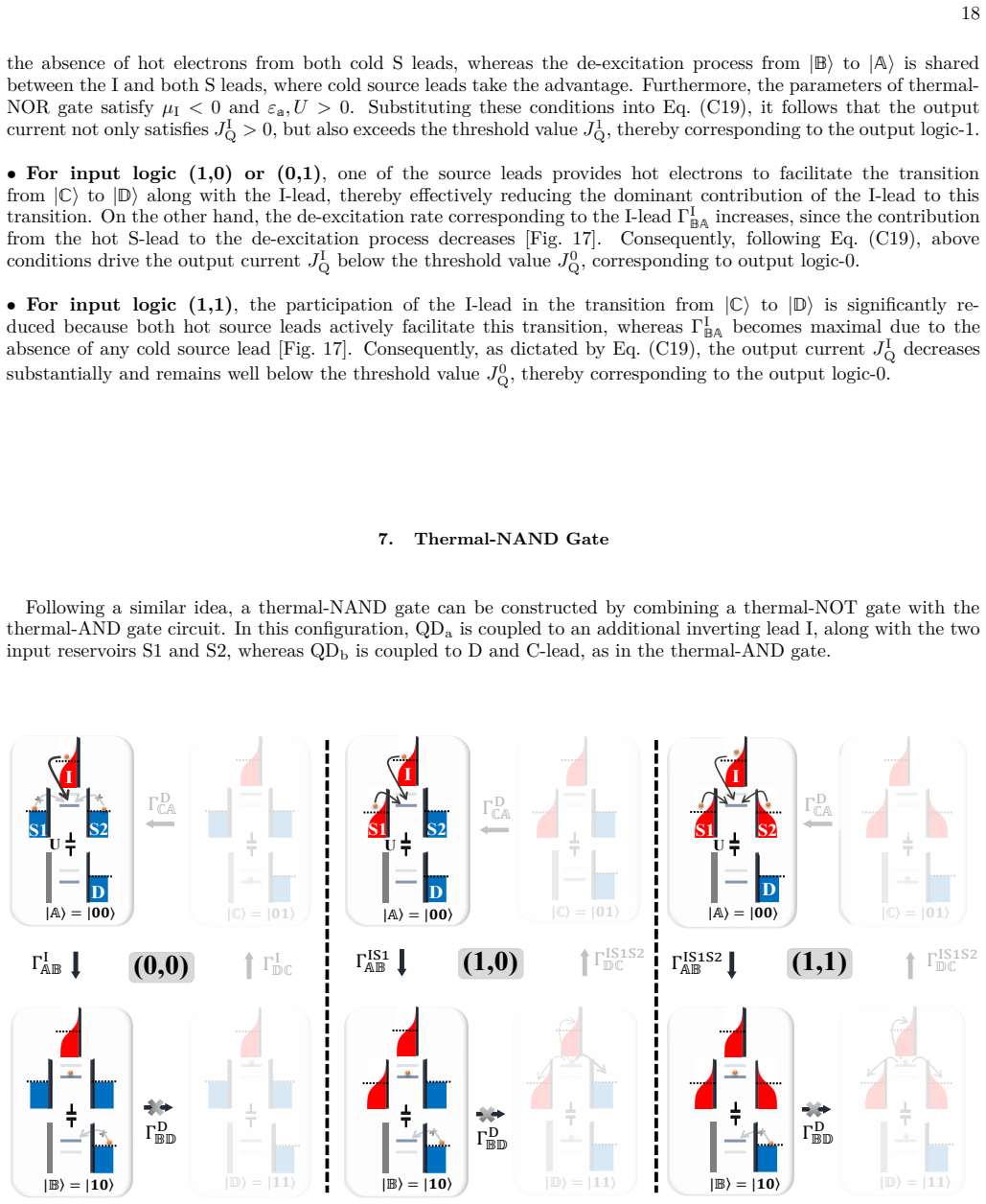
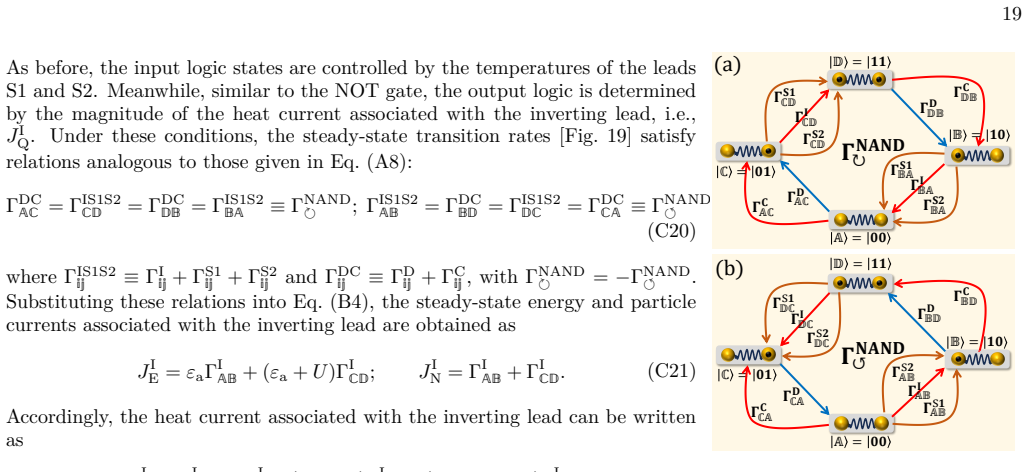
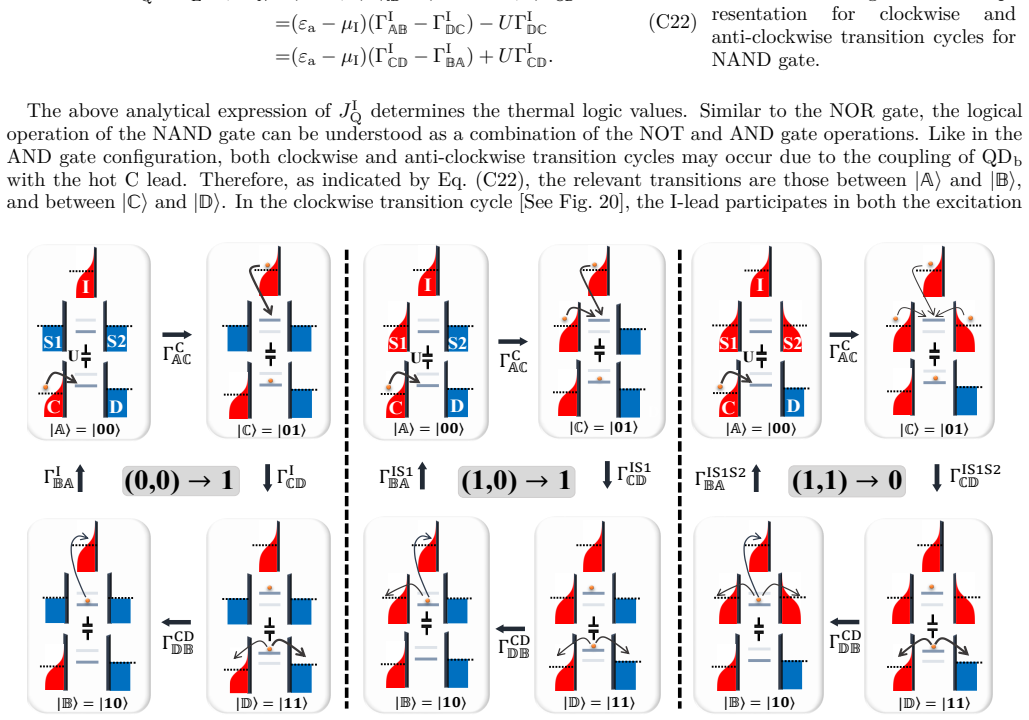
Thermal-NAND Gate Following a similar idea, a thermal-NAND gate can be constructed by combining a thermal-NOT gate with the thermal-AND gate circuit. In this configuration, QD a is coupled to an additional inverting lead I, along with the two input reservoirs S1 and S2, whereas QD b is coupled to D and C-lead, as in the thermal-AND gate. Dۧ|ℂ =ۧ|𝟎𝟏 Γℂ𝔸 D ...
discussion (0)
Sign in with ORCID, Apple, or X to comment. Anyone can read and Pith papers without signing in.