Superconducting triode effect in a quantum-dot Josephson junction with a biased top gate
Pith reviewed 2026-06-27 23:50 UTC · model grok-4.3
The pith
A biased top gate in an asymmetric quantum-dot Josephson junction breaks parity symmetry while preserving time-reversal symmetry, producing a tunable non-reciprocal supercurrent that reaches ideal unidirectional flow.
A machine-rendered reading of the paper's core claim, the machinery that carries it, and where it could break.
Core claim
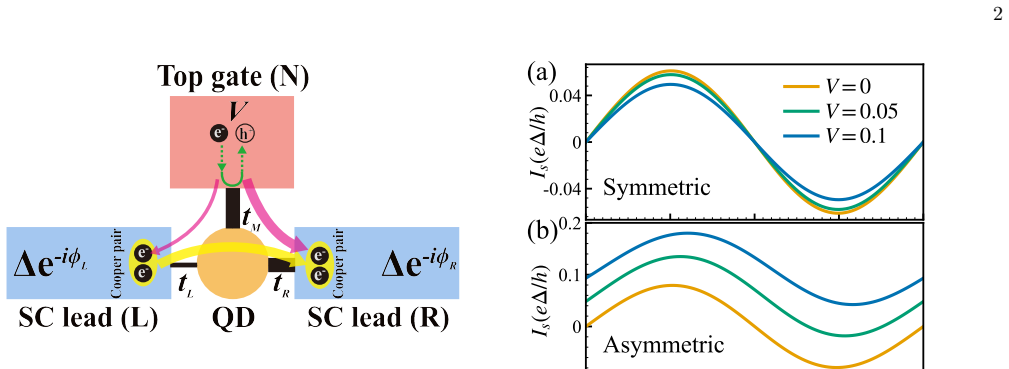
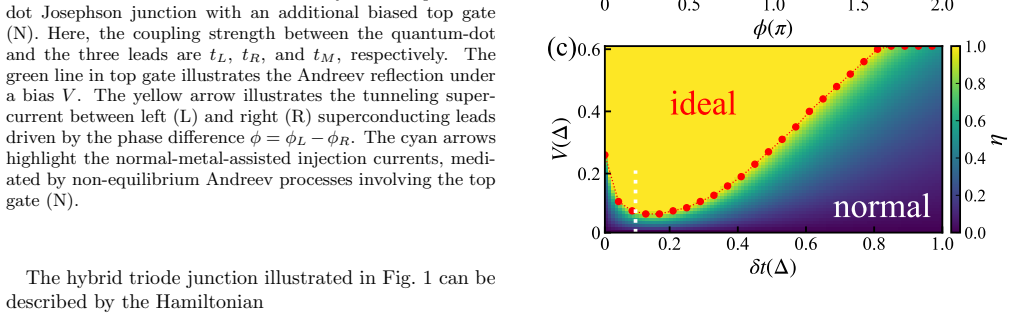
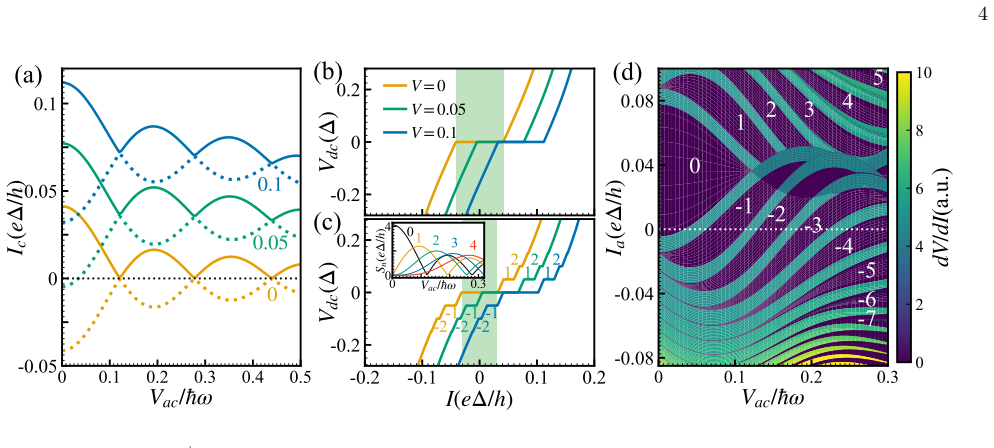
In an asymmetric quantum-dot Josephson junction coupled to a biased metallic top gate, the supercurrent exhibits a strong non-reciprocal effect that can be continuously manipulated via the top gate to achieve an ideal unidirectional supercurrent, manifesting a superconducting triode effect. Under radio-frequency radiation the junction further exhibits highly asymmetric Shapiro steps, realizing fully quantized supercurrent rectification. This mechanism breaks parity symmetry while explicitly preserving time-reversal symmetry, thereby providing an alternative physical origin for the superconducting diode effect observed in Josephson junctions that retain time-reversal symmetry.
What carries the argument
The asymmetric quantum-dot Josephson junction with a biased metallic top gate, which selectively breaks parity symmetry to generate gate-tunable non-reciprocal supercurrent while leaving time-reversal symmetry unbroken.
If this is right
- The top-gate voltage provides continuous tuning of the supercurrent non-reciprocity up to the ideal unidirectional limit.
- The same junction under radio-frequency drive produces highly asymmetric Shapiro steps that realize fully quantized supercurrent rectification.
- The construction supplies a symmetry-based route to the superconducting diode effect that does not require explicit breaking of time-reversal symmetry.
- The mechanism enables non-dissipative rectification suitable for superconducting electronics.
Where Pith is reading between the lines
- Gate control of directionality could be integrated into multi-terminal superconducting circuits to implement three-terminal supercurrent switches.
- The preservation of time-reversal symmetry suggests the triode effect may coexist with other time-reversal-invariant phenomena such as topological superconductivity.
- Similar top-gate architectures might be tested in different junction materials to determine how robust the parity-breaking mechanism remains against disorder.
- The quantized rectification under RF drive could be exploited for precise current standards in superconducting metrology.
Load-bearing premise
The observed non-reciprocity is produced solely by the parity-symmetry breaking induced by the top-gate bias in the asymmetric junction, without requiring any time-reversal-symmetry breaking.
What would settle it
Direct measurement showing that supercurrent remains strictly reciprocal (equal magnitude in both directions) when the top gate is biased in the asymmetric junction geometry would falsify the claim that parity breaking alone suffices for the triode effect.
Figures
read the original abstract
Non-reciprocal supercurrents enable non-dissipative rectification, holding great promise for superconducting electronics. Conventionally, this non-reciprocity, termed the superconducting diode effect, requires the simultaneous breaking of time-reversal and parity symmetries. Here, we propose a superconducting triode effect in an asymmetric quantum-dot Josephson junction coupled to an additional metallic top gate, which breaks the parity symmetry while explicitly preserving time-reversal symmetry. We demonstrate that the supercurrent across this junction exhibits a strong non-reciprocal effect that can be continuously manipulated via the top gate to achieve an ideal unidirectional supercurrent, thus manifesting a superconducting triode effect. Furthermore, under radio-frequency radiation, this junction exhibits highly asymmetric Shapiro steps, realizing fully quantized supercurrent rectification. Our work not only provides an alternative physical mechanism for the superconducting diode effect observed in Josephson junctions with explicit time-reversal symmetry, but also introduces a new tuning knob to manipulate supercurrent non-reciprocity.
Editorial analysis
A structured set of objections, weighed in public.
Referee Report
Summary. The manuscript proposes a superconducting triode effect in an asymmetric quantum-dot Josephson junction coupled to a biased metallic top gate. It claims that the top gate breaks parity symmetry while explicitly preserving time-reversal symmetry, enabling continuous tuning of a strongly non-reciprocal supercurrent to an ideal unidirectional limit; under RF radiation the junction further exhibits highly asymmetric Shapiro steps that realize fully quantized supercurrent rectification. This is presented as an alternative mechanism for the superconducting diode effect that does not require explicit breaking of time-reversal symmetry.
Significance. If the central claim were valid it would constitute a notable result by offering a new symmetry-breaking pattern and tuning parameter for non-reciprocal supercurrents in Josephson junctions. The manuscript does not report machine-checked proofs, reproducible code, or parameter-free derivations.
major comments (1)
- [Abstract and Hamiltonian/symmetry section] Abstract (and the section describing the model Hamiltonian and symmetry analysis of the CPR): the assertion that time-reversal symmetry is preserved while achieving |I_c^+| ≠ |I_c^-| (ideal unidirectional supercurrent and asymmetric Shapiro steps) is inconsistent with the standard TRS constraint I(φ) = −I(−φ) (or its gauge-equivalent form), which forces equal magnitudes of forward and reverse critical currents. The top-gate term or the full Hamiltonian must be shown explicitly to avoid implicit TRS breaking (e.g., via spin-orbit coupling or vector-potential contributions) if the claim is to stand.
Simulated Author's Rebuttal
We thank the referee for their careful reading of the manuscript and for identifying the key issue regarding time-reversal symmetry. We address this point directly below and agree that greater explicitness is needed.
read point-by-point responses
-
Referee: [Abstract and Hamiltonian/symmetry section] Abstract (and the section describing the model Hamiltonian and symmetry analysis of the CPR): the assertion that time-reversal symmetry is preserved while achieving |I_c^+| ≠ |I_c^-| (ideal unidirectional supercurrent and asymmetric Shapiro steps) is inconsistent with the standard TRS constraint I(φ) = −I(−φ) (or its gauge-equivalent form), which forces equal magnitudes of forward and reverse critical currents. The top-gate term or the full Hamiltonian must be shown explicitly to avoid implicit TRS breaking (e.g., via spin-orbit coupling or vector-potential contributions) if the claim is to stand.
Authors: We agree that the explicit form of the Hamiltonian and a detailed symmetry verification are required to substantiate the claim. The top-gate term is modeled as a real electrostatic potential V_g ho (where ho is the local density operator), which is invariant under the time-reversal operator T (with T i T^{-1} = -i and no magnetic or spin-orbit contributions). The full microscopic Hamiltonian (quantum-dot levels, superconducting leads, tunneling, and gate) is given in the model section and contains no vector-potential or imaginary terms. However, because the top gate is biased (finite DC voltage), the calculation is performed in a non-equilibrium steady state; the standard equilibrium CPR constraint I(φ) = -I(-φ) therefore does not directly apply to the measured current. We will revise the manuscript to (i) display the complete Hamiltonian, (ii) explicitly apply the TRS operator to each term, and (iii) clarify the non-equilibrium character of the biased-gate calculation. These additions will remove any ambiguity about implicit TRS breaking. revision: yes
Circularity Check
No significant circularity; derivation presented as independent of target result
full rationale
The provided abstract and context describe a model Hamiltonian with an explicit top-gate term asserted to break parity while preserving TRS, from which non-reciprocal supercurrent is claimed to emerge. No quoted equations reduce the claimed diode/triode effect to a fitted parameter, self-defined quantity, or load-bearing self-citation chain. No ansatz is smuggled via prior work, and no renaming of known results occurs. The central claim is framed as a consequence of the new setup rather than tautological by construction, making the derivation self-contained against the listed circularity patterns.
Axiom & Free-Parameter Ledger
axioms (1)
- domain assumption The biased top gate breaks parity symmetry while explicitly preserving time-reversal symmetry.
Reference graph
Works this paper leans on
-
[1]
F. Ando, Y. Miyasaka, T. Li, J. Ishizuka, T. Arakawa, Y. Shiota, T. Moriyama, Y. Yanase, and T. Ono, Obser- vation of superconducting diode effect, Nature584, 373 (2020)
2020
-
[2]
Davydova, S
M. Davydova, S. Prembabu, and L. Fu, Universal joseph- son diode effect, Sci. Adv.8, eabo0309 (2022)
2022
-
[3]
Daido, Y
A. Daido, Y. Ikeda, and Y. Yanase, Intrinsic supercon- ducting diode effect, Phys. Rev. Lett.128, 037001 (2022)
2022
-
[4]
Y.-Y. Lyu, J. Jiang, Y.-L. Wang, Z.-L. Xiao, S. Dong, Q.-H. Chen, M. V. Miloˇ sevi´ c, H. Wang, R. Divan, J. E. Pearson, P. Wu, F. M. Peeters, and W.-K. Kwok, Super- conducting diode effect via conformal-mapped nanoholes, Nat. Commun.12, 2703 (2021)
2021
-
[5]
H. Wu, Y. Wang, Y. Xu, P. K. Sivakumar, C. Pasco, U. Filippozzi, S. S. P. Parkin, Y.-J. Zeng, T. McQueen, and M. N. Ali, The field-free Josephson diode in a van der Waals heterostructure, Nature604, 653 (2022)
2022
-
[6]
Narita, J
H. Narita, J. Ishizuka, R. Kawarazaki, D. Kan, Y. Sh- iota, T. Moriyama, Y. Shimakawa, A. V. Ognev, A. S. Samardak, Y. Yanase, and T. Ono, Field-free supercon- ducting diode effect in noncentrosymmetric superconduc- tor/ferromagnet multilayers, Nat. Nanotechnol.17, 823 (2022)
2022
-
[7]
Jeon, J.-K
K.-R. Jeon, J.-K. Kim, J. Yoon, J.-C. Jeon, H. Han, A. Cottet, T. Kontos, and S. S. P. Parkin, Zero-field polarity-reversible Josephson supercurrent diodes en- abled by a proximity-magnetized Pt barrier, Nat. Mater. 21, 1008 (2022)
2022
-
[8]
Nadeem, M
M. Nadeem, M. S. Fuhrer, and X. Wang, The supercon- ducting diode effect, Nat. Rev. Phys.5, 558 (2023)
2023
-
[9]
Jiang and J
K. Jiang and J. Hu, Superconducting diode effects, Nat. Phys.18, 1145 (2022)
2022
-
[10]
J. Ma, R. Zhan, and X. Lin, Superconducting diode effects: Mechanisms, materials and applications, Adv. Phys. Res.4, 2400180 (2025)
2025
-
[11]
Zhang, Y
Y. Zhang, Y. Gu, P. Li, J. Hu, and K. Jiang, General the- ory of josephson diodes, Phys. Rev. X12, 041013 (2022)
2022
-
[12]
D. Shaffer and A. Levchenko, Theories of supercon- ducting diode effects (2025), arXiv:2510.25864 [cond- mat.supr-con]. 6
arXiv 2025
-
[13]
P. J. W. Moll and V. B. Geshkenbein, Evolution of su- perconducting diodes, Nat. Phys.19, 1379 (2023)
2023
-
[14]
Baumgartner, L
C. Baumgartner, L. Fuchs, A. Costa, S. Reinhardt, S. Gronin, G. C. Gardner, T. Lindemann, M. J. Manfra, P. E. Faria Junior, D. Kochan, J. Fabian, N. Paradiso, and C. Strunk, Supercurrent rectification and magne- tochiral effects in symmetric Josephson junctions, Nat. Nanotechnol.17, 39 (2022)
2022
-
[15]
B. Pal, A. Chakraborty, P. K. Sivakumar, M. Davydova, A. K. Gopi, A. K. Pandeya, J. A. Krieger, Y. Zhang, M. Date, S. Ju, N. Yuan, N. B. M. Schr¨ oter, L. Fu, and S. S. P. Parkin, Josephson diode effect from Cooper pair momentum in a topological semimetal, Nat. Phys.18, 1228 (2022)
2022
-
[16]
Sundaresh, J
A. Sundaresh, J. I. V¨ ayrynen, Y. Lyanda-Geller, and L. P. Rokhinson, Diamagnetic mechanism of critical current non-reciprocity in multilayered superconductors, Nat. Commun.14, 1628 (2023)
2023
-
[17]
F. Qin, W. Shi, T. Ideue, M. Yoshida, A. Zak, R. Tenne, T. Kikitsu, D. Inoue, D. Hashizume, and Y. Iwasa, Su- perconductivity in a chiral nanotube, Nat. Commun.8, 14465 (2017)
2017
-
[18]
Yasuda, H
K. Yasuda, H. Yasuda, T. Liang, R. Yoshimi, A. Tsukazaki, K. S. Takahashi, N. Nagaosa, M. Kawasaki, and Y. Tokura, Nonreciprocal charge transport at topological insulator/superconductor interface, Nat. Commun.10, 2734 (2019)
2019
-
[19]
J. Cui, P. Li, J. Zhou, W.-Y. He, X. Huang, J. Yi, J. Fan, Z. Ji, X. Jing, F. Qu, Z. G. Cheng, C. Yang, L. Lu, K. Suenaga, J. Liu, K. T. Law, J. Lin, Z. Liu, and G. Liu, Transport evidence of asymmetric spin–orbit coupling in few-layer superconducting 1td-mote2, Nat. Commun.10, 2044 (2019)
2044
-
[20]
Trahms, L
M. Trahms, L. Melischek, J. F. Steiner, B. Mahendru, I. Tamir, N. Bogdanoff, O. Peters, G. Reecht, C. B. Winkelmann, F. von Oppen, and K. J. Franke, Diode ef- fect in Josephson junctions with a single magnetic atom, Nature615, 628 (2023)
2023
-
[21]
D´ ıez-M´ erida, A
J. D´ ıez-M´ erida, A. D´ ıez-Carl´ on, S. Y. Yang, Y.-M. Xie, X.-J. Gao, J. Senior, K. Watanabe, T. Taniguchi, X. Lu, A. P. Higginbotham, K. T. Law, and D. K. Efetov, Symmetry-broken Josephson junctions and supercon- ducting diodes in magic-angle twisted bilayer graphene, Nat. Commun.14, 2396 (2023)
2023
-
[22]
F. K. de Vries, E. Portol´ es, G. Zheng, T. Taniguchi, K. Watanabe, T. Ihn, K. Ensslin, and P. Rickhaus, Gate- defined Josephson junctions in magic-angle twisted bi- layer graphene, Nat. Nanotechnol.16, 760 (2021)
2021
-
[23]
J.-X. Lin, P. Siriviboon, H. D. Scammell, S. Liu, D. Rhodes, K. Watanabe, T. Taniguchi, J. Hone, M. S. Scheurer, and J. Li, Zero-field superconducting diode ef- fect in small-twist-angle trilayer graphene, Nat. Phys.18, 1221 (2022)
2022
-
[24]
T. Le, Z. Pan, Z. Xu, J. Liu, J. Wang, Z. Lou, X. Yang, Z. Wang, Y. Yao, C. Wu, and X. Lin, Superconduct- ing diode effect and interference patterns in kagome CsV3Sb5, Nature630, 64 (2024)
2024
-
[25]
Y. M. Itahashi, T. Ideue, Y. Saito, S. Shimizu, T. Ouchi, T. Nojima, and Y. Iwasa, Nonreciprocal transport in gate-induced polar superconductor srtio 3, Sci. Adv.6, eaay9120 (2020)
2020
-
[26]
Y. Hou, F. Nichele, H. Chi, A. Lodesani, Y. Wu, M. F. Ritter, D. Z. Haxell, M. Davydova, S. Ili´ c, O. Glezakou- Elbert, A. Varambally, F. S. Bergeret, A. Kamra, L. Fu, P. A. Lee, and J. S. Moodera, Ubiquitous superconduct- ing diode effect in superconductor thin films, Phys. Rev. Lett.131, 027001 (2023)
2023
-
[27]
Gutfreund, H
A. Gutfreund, H. Matsuki, V. Plastovets, A. Noah, L. Gorzawski, N. Fridman, G. Yang, A. Buzdin, O. Millo, J. W. A. Robinson, and Y. Anahory, Direct observation of a superconducting vortex diode, Nat. Commun.14, 1630 (2023)
2023
-
[28]
J. J. He, Y. Tanaka, and N. Nagaosa, A phenomenolog- ical theory of superconductor diodes, New J. Phys.24, 053014 (2022)
2022
-
[29]
N. F. Q. Yuan and L. Fu, Supercurrent diode effect and finite-momentum superconductors, Proc. Natl. Acad. Sci. U.S.A.119, e2119548119 (2022)
2022
-
[30]
D. Wang, Q.-H. Wang, and C. Wu, Symmetry con- straints on direct-current josephson diodes (2022), arXiv:2209.12646 [cond-mat.supr-con]
arXiv 2022
-
[31]
Golod and V
T. Golod and V. M. Krasnov, Demonstration of a super- conducting diode-with-memory, operational at zero mag- netic field with switchable nonreciprocity, Nat. Commun. 13, 3658 (2022)
2022
-
[32]
S. Qi, J. Ge, C. Ji, Y. Ai, G. Ma, Z. Wang, Z. Cui, Y. Liu, Z. Wang, and J. Wang, High-temperature field- free superconducting diode effect in high-Tc cuprates, Nat. Commun.16, 531 (2025)
2025
-
[33]
J. Li, M. Zou, F. Guo, D. Zheng, Y. Zhang, Y. Du, F. Zhou, H. Zhang, W. Qi, T. Wang, Y. Yu, R. Wang, F. Fei, H. Geng, and F. Song, Field-free supercon- ducting diode effect of nbse2 induced by strain (2025), arXiv:2509.23707 [cond-mat.mtrl-sci]
arXiv 2025
-
[34]
Lou, J.-J
H.-X. Lou, J.-J. Chen, X.-G. Ye, Z.-B. Tan, A.-Q. Wang, Q. Yin, X. Liao, J.-Z. Fang, X.-Y. Liu, Y.-L. He, Z.-T. Zhang, C. Li, Z.-M. Wei, X.-M. Ma, D.-P. Yu, and Z.-M. Liao, Quantized radio-frequency rectification in a kagome superconductor Josephson diode, Nat. Nanotechnol.21, 554 (2026)
2026
-
[35]
H. Wang, Y. Zhu, Z. Bai, Z. Lyu, J. Yang, L. Zhao, X. J. Zhou, Q.-K. Xue, and D. Zhang, Quantum su- perconducting diode effect with perfect efficiency above liquid-nitrogen temperature, Nat. Phys.22, 47 (2026)
2026
-
[36]
M. H. Devoret and R. J. Schoelkopf, Superconducting circuits for quantum information: An outlook, Science 339, 1169 (2013)
2013
-
[37]
See Supplemental Material at [URL will be inserted by publisher] for detailed derivations of the non-equilibrium Keldysh Green’s functions, the analytical decoupling of the terminal-resolved supercurrents, and further numer- ical details
-
[38]
Mart´ ın-Rodero and A
´A. Mart´ ın-Rodero and A. L. Yeyati, Josephson and an- dreev transport through quantum dots, Adv. Phys.60, 899 (2011)
2011
-
[39]
A. A. Golubov, M. Y. Kupriyanov, and E. Il’ichev, The current-phase relation in josephson junctions, Rev. Mod. Phys.76, 411 (2004)
2004
-
[40]
Pillet, C
J.-D. Pillet, C. H. L. Quay, P. Morfin, C. Bena, A. L. Yey- ati, and P. Joyez, Andreev bound states in supercurrent- carrying carbon nanotubes revealed, Nat. Phys.6, 965 (2010)
2010
-
[41]
J. C. Cuevas, A. Mart´ ın-Rodero, and A. L. Yeyati, Hamil- tonian approach to the transport properties of supercon- ducting quantum point contacts, Phys. Rev. B54, 7366 (1996)
1996
-
[42]
J. C. Cuevas, J. Heurich, A. Mart´ ın-Rodero, A. Levy Yeyati, and G. Sch¨ on, Subharmonic shapiro 7 steps and assisted tunneling in superconducting point contacts, Phys. Rev. Lett.88, 157001 (2002)
2002
-
[43]
Sun, B.-g
Q.-f. Sun, B.-g. Wang, J. Wang, and T.-h. Lin, Elec- tron transport through a mesoscopic hybrid multitermi- nal resonant-tunneling system, Phys. Rev. B61, 4754 (2000)
2000
-
[44]
Y.-H. Li, J. Song, J. Liu, H. Jiang, Q.-F. Sun, and X. C. Xie, Doubled shapiro steps in a topological josephson junction, Phys. Rev. B97, 045423 (2018)
2018
-
[45]
Superconducting triode effect in a hybrid quantum-dot junction
S. Shapiro, Josephson currents in superconducting tun- neling: The effect of microwaves and other observations, Phys. Rev. Lett.11, 80 (1963). Supplemental material for “Superconducting triode effect in a hybrid quantum-dot junction” Yu-Hang Li, 1, 2 Xiaan Du, 3 Hua Jiang, 4, 2,∗ and X. C. Xie 4, 3, 5 1Department of Physics, Nankai University, Tianjin 300...
1963
-
[46]
J. C. Cuevas, A. Mart´ın-Rodero, and A. L. Yeyati, Hamiltonian approach to the transport properties of superconducting quantum point contacts, Phys. Rev. B54, 7366 (1996)
1996
-
[47]
Sun, B.-G
Q.-F. Sun, B.-G. Wang, J. Wang, and T.-H. Lin, Electron transport through a mesoscopic hybrid multiterminal resonant- tunneling system, Phys. Rev. B61, 4754 (2000)
2000
-
[48]
Y. H. Li, J. Song, J. Liu, H. Jiang, Q. F. Sun, and X. C. Xie, Doubled Shapiro steps in a topological Josephson junction, Phys. Rev. B97, 045423 (2018)
2018
discussion (0)
Sign in with ORCID, Apple, or X to comment. Anyone can read and Pith papers without signing in.