REVIEW 2 major objections 1 minor 49 references
Under limited labels for cardiac pathology prediction, anatomical representation outperforms classifier complexity.
Reviewed by Pith at T0; open to challenge. T0 means a machine referee read the full paper against a public rubric. the ladder, T0–T4 →
T0 review · grok-4.3
2026-06-29 19:34 UTC pith:GGYIITQQ
load-bearing objection The paper sets up a low-label benchmark on ACDC where anatomy-derived features from RV/MYO/LV beat complex models for 5-class pathology prediction, but the result rests on unverified assumptions about those features being sufficient. the 2 major comments →
Which Anatomy Matters Under Limited Labels? A Data-Efficient Anatomy-Aware Benchmark for Cardiac Pathology Prediction
The pith
A machine-rendered reading of the paper's core claim, the machinery that carries it, and where it could break.
Core claim
In a low-data anatomy-aware benchmark for 5-class cardiac pathology prediction on the ACDC MRI dataset, segmentation-derived patient descriptors from the right ventricle, myocardium, and left ventricle are compared across linear, kernel, and tree-based classifiers; under limited label settings, representation dominates complexity.
What carries the argument
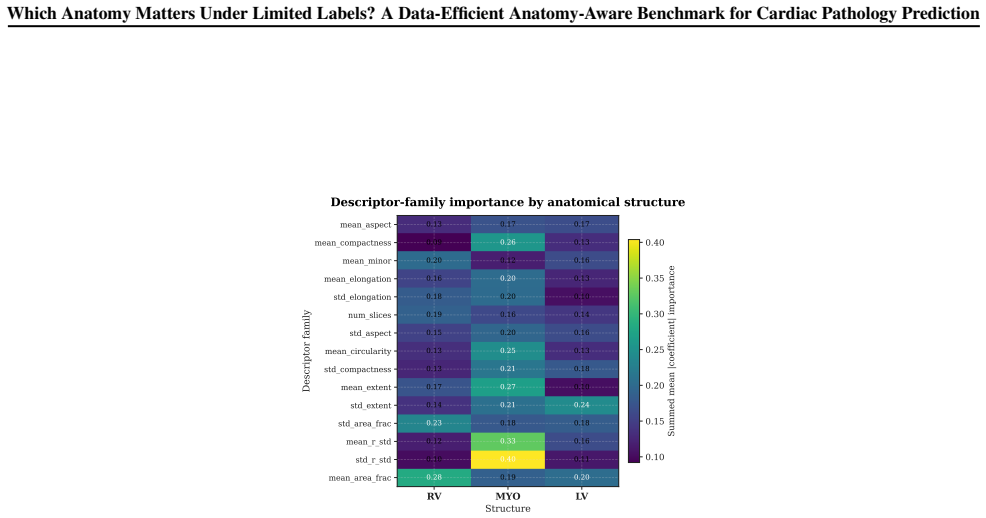
Anatomy-specific and multi-structure patient descriptors derived from segmentations of the right ventricle, myocardium, and left ventricle, used to isolate the contribution of representation versus classifier complexity.
Load-bearing premise
The segmentation-derived descriptors from the right ventricle, myocardium, and left ventricle capture the clinically meaningful anatomical information needed for the five pathology labels.
What would settle it
A controlled test showing that, with fixed anatomical descriptors, increasing classifier complexity produces consistent accuracy gains in the limited-label regime on the ACDC 5-class task would falsify the dominance claim.
If this is right
- Simpler classifiers paired with informative anatomical descriptors can match or exceed complex models when labels are scarce.
- Resource-limited clinical workflows can prioritize selection of relevant heart structures over adoption of larger models.
- The benchmark supplies a reproducible way to rank anatomy importance without requiring heavy computation.
- Performance gains in similar medical tasks may come from refining input descriptors rather than from architecture search.
Where Pith is reading between the lines
- The same representation-first approach could be tested on other imaging modalities or organs where segmentation masks are available.
- Automatic methods for discovering which anatomical regions matter most could build on the benchmark without manual structure selection.
- The result suggests re-examining deep learning defaults in medical imaging when label budgets are small and anatomy is well-defined.
Editorial analysis
A structured set of objections, weighed in public.
Referee Report
Summary. The manuscript introduces a low-data anatomy-aware benchmark for 5-class cardiac pathology prediction on the public ACDC MRI dataset. Using segmentation-derived patient descriptors from the right ventricle, myocardium, and left ventricle, it compares anatomy-specific and multi-structure representations across linear, kernel, and tree-based classifiers and reports that representation dominates complexity under limited label settings.
Significance. If the central empirical claim is confirmed with complete methodological details, the benchmark would provide useful guidance for prioritizing anatomical representation over model complexity in resource-constrained medical imaging settings. The reliance on a public dataset and the explicit focus on limited-label regimes are positive aspects of the work.
major comments (2)
- [Abstract] Abstract: the claim that representation dominates complexity is stated without any information on training-set sizes, cross-validation procedure, statistical testing, or exact feature definitions, preventing verification of the result.
- The central claim requires that the chosen segmentation-derived descriptors from RV/MYO/LV encode the clinically discriminative anatomical information for the 5-class labels. The manuscript should include validation or sensitivity analysis to descriptor choice; otherwise performance gaps may reflect incomplete feature sets rather than representation versus complexity.
minor comments (1)
- Provide the precise definitions of the patient descriptors and the extraction procedure from the segmentations.
Simulated Author's Rebuttal
We thank the referee for the constructive comments. We address each major point below and indicate the revisions planned for the manuscript.
read point-by-point responses
-
Referee: [Abstract] Abstract: the claim that representation dominates complexity is stated without any information on training-set sizes, cross-validation procedure, statistical testing, or exact feature definitions, preventing verification of the result.
Authors: We agree the abstract is high-level and omits these details. The full manuscript specifies training-set sizes (10-50 samples per class in the low-label regime), 5-fold cross-validation, statistical testing via paired t-tests with p<0.05, and exact features (EDV, ESV, EF, and myocardial mass for RV/MYO/LV) in Sections 3 and 4. We will revise the abstract to include a brief statement on the limited-label protocol and evaluation procedure. revision: yes
-
Referee: The central claim requires that the chosen segmentation-derived descriptors from RV/MYO/LV encode the clinically discriminative anatomical information for the 5-class labels. The manuscript should include validation or sensitivity analysis to descriptor choice; otherwise performance gaps may reflect incomplete feature sets rather than representation versus complexity.
Authors: The descriptors follow the standard ACDC clinical metrics (ventricular volumes, ejection fractions, wall thickness) that directly relate to the diagnostic criteria for the five classes. We acknowledge that an explicit sensitivity analysis would strengthen the argument. We will add an ablation experiment in the revised manuscript comparing the current feature set against reduced subsets and alternative shape-based descriptors to confirm robustness. revision: yes
Circularity Check
No circularity: empirical benchmark on public data with no derivations or self-referential steps
full rationale
The paper is an empirical study that extracts segmentation-derived descriptors from RV/MYO/LV on the public ACDC dataset, then compares linear/kernel/tree classifiers under limited labels. No equations, parameter fits, or predictions are defined in terms of themselves. No self-citations are invoked to justify uniqueness or load-bearing premises. The central claim (representation dominates complexity) rests on experimental comparisons rather than any reduction to inputs by construction. This is a standard non-circular benchmark setup.
Axiom & Free-Parameter Ledger
axioms (1)
- domain assumption Segmentation-derived descriptors from RV, myocardium and LV accurately encode the anatomical information needed for 5-class pathology prediction.
read the original abstract
Numerous medical imaging problems must be solved under limited labels and constrained compute, yet it remains unclear whether performance gains are driven mainly by more expressive models or by better representation of clinically meaningful anatomy. We study this question through a low-data anatomy-aware benchmark for 5-class cardiac pathology prediction on the public ACDC MRI dataset. Using segmentation-derived patient descriptors from the right ventricle, myocardium, and left ventricle, we compare anatomy-specific and multi-structure representations across linear, kernel, and tree-based classifiers. We find that under limited label settings, representation dominates complexity. These results suggest that in resource-constrained healthcare settings, identifying and representing the most informative anatomy may matter more than the increasing complexity of the model alone.
Figures



Reference graph
Works this paper leans on
-
[1]
Langley , title =
P. Langley , title =. Proceedings of the 17th International Conference on Machine Learning (ICML 2000) , address =. 2000 , pages =
2000
-
[2]
T. M. Mitchell. The Need for Biases in Learning Generalizations. 1980
1980
-
[3]
M. J. Kearns , title =
-
[4]
Machine Learning: An Artificial Intelligence Approach, Vol. I. 1983
1983
-
[5]
R. O. Duda and P. E. Hart and D. G. Stork. Pattern Classification. 2000
2000
-
[6]
Suppressed for Anonymity , author=
-
[7]
Newell and P
A. Newell and P. S. Rosenbloom. Mechanisms of Skill Acquisition and the Law of Practice. Cognitive Skills and Their Acquisition. 1981
1981
-
[8]
A. L. Samuel. Some Studies in Machine Learning Using the Game of Checkers. IBM Journal of Research and Development. 1959
1959
-
[9]
2018 , publisher=
Bernard, Olivier and Lalande, Alain and Zotti, Clement and Cervenansky, Frederick and Yang, Xin and Heng, Pheng-Ann and Cetin, Irem and Lekadir, Karim and Camara, Oscar and Ballester, Miguel Angel Gonzalez and others , journal=. 2018 , publisher=
2018
-
[10]
Machine learning , volume=
Support-Vector Networks , author=. Machine learning , volume=. 1995 , publisher=
1995
-
[11]
Machine learning , volume=
Random forests , author=. Machine learning , volume=. 2001 , publisher=
2001
-
[12]
The elements of statistical learning: Data mining, inference, and prediction , pages=
Random forests , author=. The elements of statistical learning: Data mining, inference, and prediction , pages=. 2008 , publisher=
2008
-
[13]
Advances in neural information processing systems , volume=
Selective classification for deep neural networks , author=. Advances in neural information processing systems , volume=
-
[14]
PloS one , volume=
Deep learning model calibration for improving performance in class-imbalanced medical image classification tasks , author=. PloS one , volume=. 2022 , publisher=
2022
-
[15]
2026 , publisher=
Jin, Cheng and Guo, Zhengrui and Lin, Yi and Luo, Luyang and Chen, Hao , journal=. 2026 , publisher=
2026
-
[16]
2021 , publisher=
Zhou, S Kevin and Greenspan, Hayit and Davatzikos, Christos and Duncan, James S and Van Ginneken, Bram and Madabhushi, Anant and Prince, Jerry L and Rueckert, Daniel and Summers, Ronald M , journal=. 2021 , publisher=
2021
-
[17]
NPJ digital medicine , volume=
Machine learning for medical imaging: methodological failures and recommendations for the future , author=. NPJ digital medicine , volume=. 2022 , publisher=
2022
-
[18]
2022 , publisher=
Cardiovascular pathology , author=. 2022 , publisher=
2022
-
[19]
Frontiers in medical technology , volume=
Recent technologies in cardiac imaging , author=. Frontiers in medical technology , volume=. 2023 , publisher=
2023
-
[20]
JACC: Cardiovascular Imaging , volume=
Flachskampf, Frank A and Biering-S. JACC: Cardiovascular Imaging , volume=. 2015 , publisher=
2015
-
[21]
, author=
Myocardial bridges: morphological and functional aspects. , author=. Heart , volume=. 1991 , publisher=
1991
-
[22]
2013 , publisher=
Applied logistic regression , author=. 2013 , publisher=
2013
-
[23]
jama , volume=
Development and validation of a deep learning algorithm for detection of diabetic retinopathy in retinal fundus photographs , author=. jama , volume=. 2016 , publisher=
2016
-
[24]
nature , volume=
Dermatologist-level classification of skin cancer with deep neural networks , author=. nature , volume=. 2017 , publisher=
2017
-
[25]
Journal of Investigative Dermatology , volume=
Interpretation of the outputs of a deep learning model trained with a skin cancer dataset , author=. Journal of Investigative Dermatology , volume=. 2018 , publisher=
2018
-
[26]
2017 , organization=
Isensee, Fabian and Jaeger, Paul F and Full, Peter M and Wolf, Ivo and Engelhardt, Sandy and Maier-Hein, Klaus H , booktitle=. 2017 , organization=
2017
-
[27]
2019 , publisher=
Khened, Mahendra and Kollerathu, Varghese Alex and Krishnamurthi, Ganapathy , journal=. 2019 , publisher=
2019
-
[28]
International Workshop on Statistical Atlases and Computational Models of the Heart , pages=
Automatic segmentation and disease classification using cardiac cine MR images , author=. International Workshop on Statistical Atlases and Computational Models of the Heart , pages=. 2017 , organization=
2017
-
[29]
Computerized Medical Imaging and Graphics , volume=
Automatic cardiac cine MRI segmentation and heart disease classification , author=. Computerized Medical Imaging and Graphics , volume=. 2021 , publisher=
2021
-
[30]
Medical Image Analysis , volume=
Explainable cardiac pathology classification on cine MRI with motion characterization by semi-supervised learning of apparent flow , author=. Medical Image Analysis , volume=. 2019 , publisher=
2019
-
[31]
2009 , publisher=
The elements of statistical learning: data mining, inference, and prediction , author=. 2009 , publisher=
2009
-
[32]
Information processing & management , volume=
A systematic analysis of performance measures for classification tasks , author=. Information processing & management , volume=. 2009 , publisher=
2009
-
[33]
Evaluation: from precision, recall and F-measure to ROC, informedness, markedness and correlation
EVALUATION: FROM PRECISION, RECALL AND F-MEASURE TO ROC, INFORMEDNESS, MARKEDNESS & CORRELATION , author=. arXiv preprint arXiv:2010.16061 , year=
work page Pith review arXiv 2010
-
[34]
IEEE Transactions on Medical Imaging , volume=
Deep learning-based detection and correction of cardiac MR motion artefacts during reconstruction for high-quality segmentation , author=. IEEE Transactions on Medical Imaging , volume=. 2020 , publisher=
2020
-
[35]
Image And Vision Computing , volume=
Segmentation-aware MRI subsampling for efficient cardiac MRI reconstruction with reinforcement learning , author=. Image And Vision Computing , volume=. 2024 , publisher=
2024
-
[36]
2020 , publisher=
Willemink, Martin J and Koszek, Wojciech A and Hardell, Cailin and Wu, Jie and Fleischmann, Dominik and Harvey, Hugh and Folio, Les R and Summers, Ronald M and Rubin, Daniel L and Lungren, Matthew P , journal=. 2020 , publisher=
2020
-
[37]
Radiology , volume=
Artificial intelligence in low-and middle-income countries: innovating global health radiology , author=. Radiology , volume=. 2020 , publisher=
2020
-
[38]
2024 , URL=
Yousef, Khalil and Schmollgruber, Shelley , journal=. 2024 , URL=
2024
-
[39]
Journal of Biomedical Informatics , volume=
Benchmark datasets driving artificial intelligence development fail to capture the needs of medical professionals , author=. Journal of Biomedical Informatics , volume=. 2023 , publisher=
2023
-
[40]
2021 , publisher=
Candemir, Sema and Nguyen, Xuan V and Folio, Les R and Prevedello, Luciano M , journal=. 2021 , publisher=
2021
-
[41]
NPJ digital medicine , volume=
Artificial intelligence for strengthening healthcare systems in low-and middle-income countries: a systematic scoping review , author=. NPJ digital medicine , volume=. 2022 , publisher=
2022
-
[42]
Cureus , volume=
A systematic review of the barriers to the implementation of artificial intelligence in healthcare , author=. Cureus , volume=. 2023 , publisher=
2023
-
[43]
Global health action , volume=
Medical mobile technologies--what is needed for a sustainable and scalable implementation on a global scale? , author=. Global health action , volume=. 2017 , publisher=
2017
-
[44]
Circulation , volume=
Ebstein’s anomaly , author=. Circulation , volume=. 2007 , publisher=
2007
-
[45]
Archives of Medical Research , volume=
Herrera-Bello, H. Archives of Medical Research , volume=. 2020 , publisher=
2020
-
[46]
Indian Journal of Thoracic and Cardiovascular Surgery , volume=
Ebstein’s anomaly in the neonate , author=. Indian Journal of Thoracic and Cardiovascular Surgery , volume=. 2021 , publisher=
2021
-
[47]
Chinese Medical Journal , volume=
Strategy and technique for surgical treatment of Ebstein’s anomaly , author=. Chinese Medical Journal , volume=. 2024 , publisher=
2024
-
[48]
2026 , publisher=
Adomat, Franziska and Schaub, Christof and Hoh, Tobias and Fischer, Xenia and Guggenberger, Roman and Manka, Robert and Eberhard, Matthias and Weber, Lucas , journal=. 2026 , publisher=
2026
-
[49]
Proceedings of the IEEE conference on computer vision and pattern recognition , pages=
Deep residual learning for image recognition , author=. Proceedings of the IEEE conference on computer vision and pattern recognition , pages=
discussion (0)
Sign in with ORCID, Apple, or X to comment. Anyone can read and Pith papers without signing in.