Gaussian Process Latent Factor Regression for Low-Data, High-Dimensional Output Problems
Pith reviewed 2026-06-28 03:12 UTC · model grok-4.3
The pith
Analytically marginalizing decoder weights in a latent Gaussian process model couples compression and prediction for high-dimensional outputs from few examples.
A machine-rendered reading of the paper's core claim, the machinery that carries it, and where it could break.
Core claim
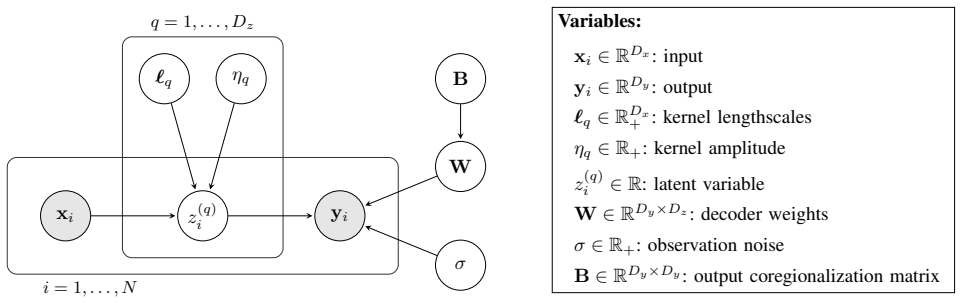
Each output dimension is expressed as a linear-Gaussian function of a low-dimensional latent variable whose dynamics follow a Gaussian process. The decoder weights are integrated out exactly, yielding a marginal likelihood that directly optimizes the latent representation for the prediction task rather than for input reconstruction. The resulting model scales to output dimensions in the thousands while remaining effective in the low-data regime.
What carries the argument
The analytic marginalization of the linear decoder weights within the Gaussian process latent factor model, which produces a single objective that jointly performs dimensionality reduction and regression.
If this is right
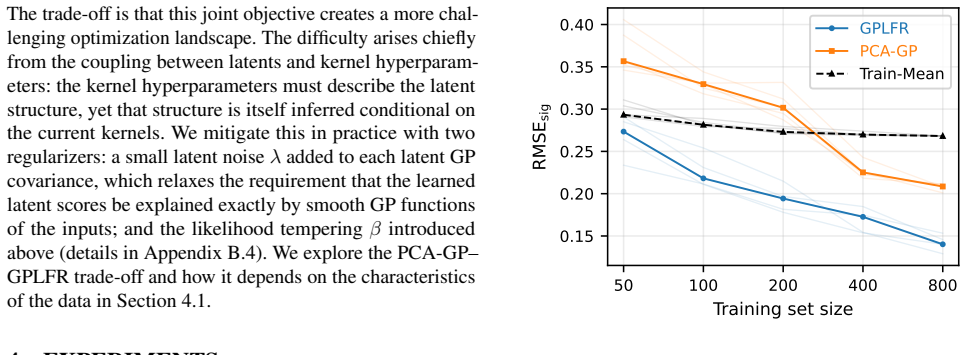
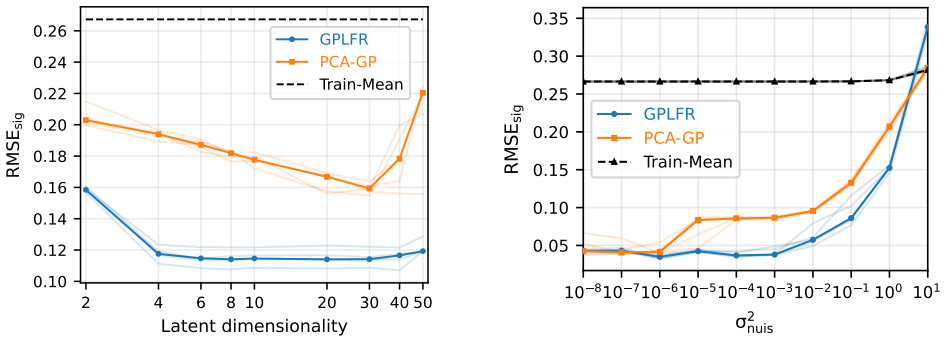
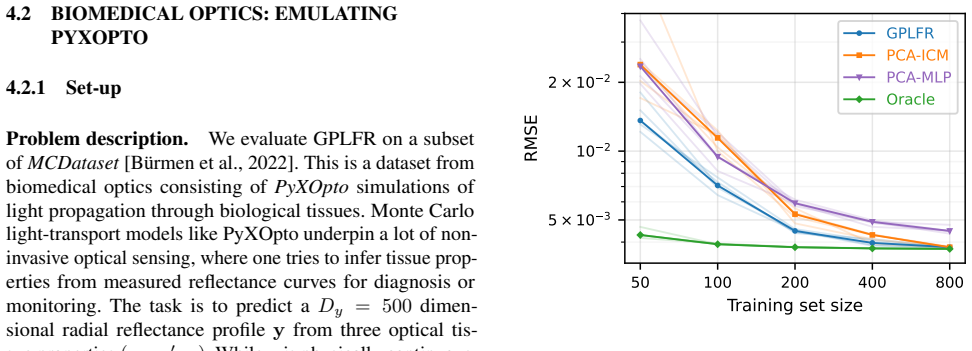
- The model outperforms standard compress-then-predict approaches on prediction accuracy.
- It enables emulation of high-dimensional climate simulations with limited training data.
- The approach remains computationally tractable for large output spaces.
Where Pith is reading between the lines
- Similar marginalization techniques could be applied to other latent variable models to improve prediction-focused compression.
- This framework might extend to non-Gaussian observation models if suitable approximations are developed.
- Applications in other scientific domains with high-dimensional sensor outputs could benefit from the joint optimization.
Load-bearing premise
High-dimensional outputs are well approximated by linear-Gaussian mappings from a low-dimensional Gaussian process latent state.
What would settle it
A direct comparison showing that GPLFR predictions on exoplanet climate data are no more accurate than those from PCA-GP, or that the marginal likelihood does not improve with the joint objective, would falsify the central claim.
Figures
read the original abstract
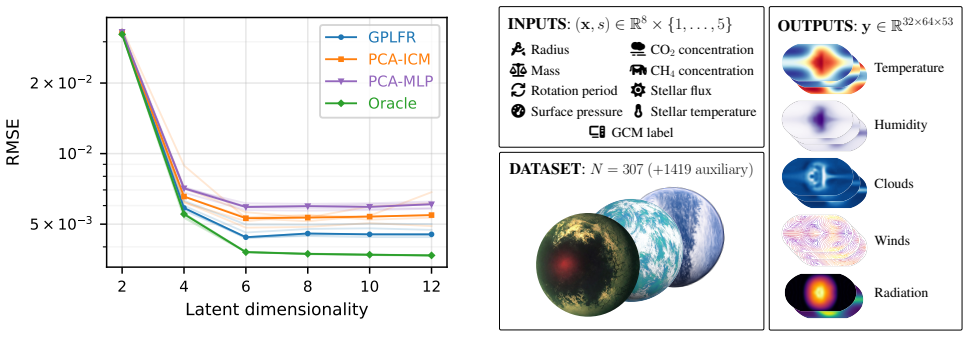
In the sciences, regression tasks often require predicting high-dimensional outputs from few training examples. Multi-output Gaussian processes excel in low-data regimes but typically struggle with high-dimensional outputs. Compress-then-predict pipelines such as PCA-GP (principal component analysis plus Gaussian process regression) handle high dimensionality, but rely on bases optimized for reconstruction rather than prediction. To address this gap, we propose a model that represents each output as a linear-Gaussian decoding of a low-dimensional latent state drawn from a Gaussian process prior. By analytically marginalizing the decoder weights, we couple compression and prediction in a single objective that scales to high-dimensional outputs. We refer to this model as Gaussian process latent factor regression (GPLFR). We demonstrate GPLFR by building the first spatially resolved emulator of global climate models for rocky exoplanets.
Editorial analysis
A structured set of objections, weighed in public.
Referee Report
Summary. The manuscript introduces Gaussian Process Latent Factor Regression (GPLFR) for low-data regression with high-dimensional outputs. Outputs are modeled as linear-Gaussian decodings of a low-dimensional latent state drawn from a Gaussian process prior; decoder weights are analytically marginalized to produce a single objective coupling latent compression with GP-based prediction. The resulting N imes N covariance yields O(N^{3} + N^{2}M) cost. The method is demonstrated by constructing the first spatially resolved emulator of global climate models for rocky exoplanets.
Significance. If the analytic marginalization and scaling hold, the work supplies a principled alternative to separate compress-then-predict pipelines by optimizing the latent representation directly for predictive performance. The trace(YᵀK^{-1}Y) construction reuses the GP covariance across all outputs, which is a concrete computational advantage for large M. The exoplanet climate application supplies a concrete, falsifiable test case in a domain where low-data high-dimensional emulation is practically relevant.
major comments (2)
- [§3.2] §3.2, Eq. (8)–(12): the claim that the marginal likelihood after integrating decoder weights is exactly the stated N imes N form must be accompanied by the explicit integration steps; without them it is unclear whether the trace term fully couples the GP prior to the high-dimensional outputs or whether additional approximations are introduced.
- [§5.3] §5.3, Table 2: the reported RMSE improvement over PCA-GP is given without error bars or cross-validation variance; because the central claim is improved predictive performance in the low-data regime, statistical significance of the difference must be shown.
minor comments (2)
- [Notation] Notation for the latent dimension and output dimension is introduced inconsistently between the abstract and §2; standardize to d and M throughout.
- [Figure 3] Figure 3 caption does not state the number of training points used for the exoplanet emulator; this value is load-bearing for the low-data claim.
Simulated Author's Rebuttal
We thank the referee for the positive evaluation and recommendation for minor revision. We address each major comment below.
read point-by-point responses
-
Referee: [§3.2] §3.2, Eq. (8)–(12): the claim that the marginal likelihood after integrating decoder weights is exactly the stated N×N form must be accompanied by the explicit integration steps; without them it is unclear whether the trace term fully couples the GP prior to the high-dimensional outputs or whether additional approximations are introduced.
Authors: We agree that the explicit integration steps should be provided for clarity. The marginalization over decoder weights W is exact (no approximations) and proceeds by completing the square in the joint Gaussian p(Y, W | latent factors, GP covariance). In the revised manuscript we will insert the full derivation immediately after Eq. (8), showing the Gaussian integral that yields the trace term Tr(Yᵀ K^{-1} Y) and confirming that the GP prior on the latent factors is directly coupled to all M outputs through this term. revision: yes
-
Referee: [§5.3] §5.3, Table 2: the reported RMSE improvement over PCA-GP is given without error bars or cross-validation variance; because the central claim is improved predictive performance in the low-data regime, statistical significance of the difference must be shown.
Authors: We accept the criticism. The numbers in Table 2 were obtained from a single fixed train-test split. In the revision we will recompute all results using 5-fold cross-validation on the exoplanet dataset, report mean RMSE together with standard deviation across folds, and add a paired statistical test (Wilcoxon signed-rank or t-test) to quantify the significance of the GPLFR improvement over PCA-GP. revision: yes
Circularity Check
No significant circularity
full rationale
The derivation centers on representing outputs as linear-Gaussian decodings of a low-dimensional GP latent state, followed by analytic marginalization of the decoder weights to obtain a single objective. This marginalization is a direct application of standard Bayesian linear regression identities, producing an N×N covariance whose trace and determinant terms are evaluated once and reused across outputs; the resulting O(N³ + N²M) scaling follows immediately from the model assumptions without any fitted parameter being relabeled as a prediction or any load-bearing step reducing to a self-citation. The construction remains internally consistent with the stated linear-Gaussian factor model and does not invoke uniqueness theorems or ansatzes from prior author work.
Axiom & Free-Parameter Ledger
axioms (1)
- domain assumption High-dimensional outputs admit an accurate linear-Gaussian decoding from low-dimensional latent states drawn from a Gaussian process prior
Reference graph
Works this paper leans on
-
[1]
Alvarez, Lorenzo Rosasco, and Neil D
Mauricio A. Alvarez, Lorenzo Rosasco, and Neil D. Lawrence. Kernels for Vector-Valued Functions : A Review , April 2012
2012
-
[2]
Prediction by Supervised Principal Components
Eric Bair, Trevor Hastie, Debashis Paul, and Robert Tibshirani. Prediction by Supervised Principal Components . Journal of the American Statistical Association, 101 0 (473): 0 119--137, March 2006. ISSN 0162-1459. doi:10.1198/016214505000000628
-
[3]
A General Framework for Updating Belief Distributions
Pier Giovanni Bissiri, Chris Holmes, and Stephen Walker. A General Framework for Updating Belief Distributions . Journal of the Royal Statistical Society Series B: Statistical Methodology, 78 0 (5): 0 1103--1130, November 2016. ISSN 1369-7412, 1467-9868. doi:10.1111/rssb.12158
-
[4]
Bruinsma, Eric Perim, Will Tebbutt, J
Wessel P. Bruinsma, Eric Perim, Will Tebbutt, J. Scott Hosking, Arno Solin, and Richard E. Turner. Scalable Exact Inference in Multi-Output Gaussian Processes , July 2020
2020
-
[5]
Miran B \"u rmen, Franjo Pernu s , and Peter Nagli c . MCDataset : A public reference dataset of Monte Carlo simulated quantities for multilayered and voxelated tissues computed by massively parallel PyXOpto Python package. Journal of Biomedical Optics, 27 0 (8): 0 083012, April 2022. ISSN 1083-3668, 1560-2281. doi:10.1117/1.JBO.27.8.083012
-
[6]
Manifold Gaussian Processes for Regression , April 2016
Roberto Calandra, Jan Peters, Carl Edward Rasmussen, and Marc Peter Deisenroth. Manifold Gaussian Processes for Regression , April 2016
2016
-
[7]
Efficient Modeling of Latent Information in Supervised Learning using Gaussian Processes
Zhenwen Dai, Mauricio \'A lvarez, and Neil Lawrence. Efficient Modeling of Latent Information in Supervised Learning using Gaussian Processes . Advances in Neural Information Processing Systems, 30, 2017
2017
-
[8]
Tobi Hammond, Thaddeus D. Komacek, Ravi K. Kopparapu, Thomas J. Fauchez, Avi M. Mandell, Eric T. Wolf, Vincent Kofman, Stephen R. Kane, Ted M. Johnson, Anmol Desai, Giada Arney, and Jaime S. Crouse. The Climates and Thermal Emission Spectra of Prime Nearby Temperate Rocky Exoplanet Targets . The Astrophysical Journal, 984 0 (2): 0 181, May 2025. ISSN 0004...
-
[9]
Jacob Haqq-Misra , Eric T. Wolf, Thomas J. Fauchez, Aomawa L. Shields, and Ravi K. Kopparapu. The Sparse Atmospheric Model Sampling Analysis ( SAMOSA ) Intercomparison : Motivations and Protocol Version 1.0: A CUISINES Model Intercomparison Project . The Planetary Science Journal, 3 0 (11): 0 260, November 2022. ISSN 2632-3338. doi:10.3847/PSJ/ac9479
-
[10]
Computer Model Calibration Using High-Dimensional Output
Dave Higdon, James Gattiker, Brian Williams, and Maria Rightley. Computer Model Calibration Using High-Dimensional Output . Journal of the American Statistical Association, 103 0 (482): 0 570--583, June 2008. ISSN 0162-1459. doi:10.1198/016214507000000888
-
[11]
Philip B. Holden, Neil R. Edwards, Paul H. Garthwaite, and Richard D. Wilkinson. Emulation and interpretation of high-dimensional climate model outputs. Journal of Applied Statistics, 42 0 (9): 0 2038--2055, September 2015. ISSN 0266-4763. doi:10.1080/02664763.2015.1016412
-
[12]
Fast Emulation , Modular Calibration , and Active Learning for Simulators with Functional Response , October 2025
Grant Hutchings, Derek Bingham, Kellin Rumsey, and Earl Lawrence. Fast Emulation , Modular Calibration , and Active Learning for Simulators with Functional Response , October 2025
2025
-
[13]
Reduced-rank regression for the multivariate linear model
Alan Julian Izenman. Reduced-rank regression for the multivariate linear model. Journal of Multivariate Analysis, 5 0 (2): 0 248--264, June 1975. ISSN 0047-259X. doi:10.1016/0047-259X(75)90042-1
-
[14]
\'A lvarez
Xiaoyu Jiang, Sokratia Georgaka, Magnus Rattray, and Mauricio A. \'A lvarez. Scalable Multi-Output Gaussian Processes with Stochastic Variational Inference , June 2025
2025
-
[15]
Thaddeus D. Komacek and Dorian S. Abbot. The atmospheric circulation and climate of terrestrial planets orbiting Sun-like and M-dwarf stars over a broad range of planetary parameters. The Astrophysical Journal, 871 0 (2): 0 245, February 2019. ISSN 0004-637X, 1538-4357. doi:10.3847/1538-4357/aafb33
-
[16]
Wolf, Jacob Haqq-Misra , Jun Yang, James F
Ravi kumar Kopparapu, Eric T. Wolf, Jacob Haqq-Misra , Jun Yang, James F. Kasting, Victoria Meadows, Ryan Terrien, and Suvrath Mahadevan. THE INNER EDGE OF THE HABITABLE ZONE FOR SYNCHRONOUSLY ROTATING PLANETS AROUND LOW-MASS STARS USING GENERAL CIRCULATION MODELS . The Astrophysical Journal, 819 0 (1): 0 84, March 2016. ISSN 0004-637X. doi:10.3847/0004-6...
-
[17]
Ravi kumar Kopparapu, Eric T. Wolf, Giada Arney, Natasha E. Batalha, Jacob Haqq-Misra , Simon L. Grimm, and Kevin Heng. Habitable Moist Atmospheres on Terrestrial Planets near the Inner Edge of the Habitable Zone around M Dwarfs . The Astrophysical Journal, 845 0 (1): 0 5, August 2017. ISSN 0004-637X. doi:10.3847/1538-4357/aa7cf9
-
[18]
Probabilistic Non-linear Principal Component Analysis with Gaussian Process Latent Variable Models
Neil Lawrence. Probabilistic Non-linear Principal Component Analysis with Gaussian Process Latent Variable Models . Journal of Machine Learning Research, 6 0 (60): 0 1783--1816, 2005. ISSN 1533-7928
2005
-
[19]
Shibo Li, Wei Xing, Robert M. Kirby, and Shandian Zhe. Scalable Gaussian Process Regression Networks . In Twenty- Ninth International Joint Conference on Artificial Intelligence , volume 3, pages 2456--2462, July 2020. doi:10.24963/ijcai.2020/340
-
[20]
Climate Transition to Temperate Nightside at High Atmosphere Mass
Evelyn Macdonald, Kristen Menou, Christopher Lee, and Adiv Paradise. Climate Transition to Temperate Nightside at High Atmosphere Mass . The Astrophysical Journal, 981 0 (1): 0 3, February 2025. ISSN 0004-637X. doi:10.3847/1538-4357/adb0cb
-
[21]
Mei Ting Mak, Denis Sergeev, Nathan Mayne, Nahum Banks, Jake Eager-Nash , James Manners, Giada Arney, Eric Hebrard, and Krisztian Kohary. 3D simulations of TRAPPIST-1e with varying CO2 , CH4 and haze profiles. Monthly Notices of the Royal Astronomical Society, 529 0 (4): 0 3971--3987, March 2024. ISSN 0035-8711, 1365-2966. doi:10.1093/mnras/stae741
-
[22]
Climate Diversity in the Solar-Like Habitable Zone due to Varying Background Gas Pressure
Adiv Paradise, Bo Lin Fan, Kristen Menou, and Christopher Lee. Climate Diversity in the Solar-Like Habitable Zone due to Varying Background Gas Pressure . Icarus, 358: 0 114301, April 2021. ISSN 00191035. doi:10.1016/j.icarus.2020.114301
-
[23]
ExoPlaSim : Extending the Planet Simulator for Exoplanets
Adiv Paradise, Evelyn Macdonald, Kristen Menou, Christopher Lee, and Bo Lin Fan. ExoPlaSim : Extending the Planet Simulator for Exoplanets . Monthly Notices of the Royal Astronomical Society, 511 0 (3): 0 3272--3303, February 2022 a . ISSN 0035-8711, 1365-2966. doi:10.1093/mnras/stac172
-
[24]
Fundamental challenges to remote sensing of exo-earths
Adiv Paradise, Kristen Menou, Christopher Lee, and Bo Lin Fan. Fundamental challenges to remote sensing of exo-earths. Monthly Notices of the Royal Astronomical Society, 512 0 (3): 0 3616--3626, May 2022 b . ISSN 0035-8711. doi:10.1093/mnras/stac724
-
[25]
Efficient Emulators for Multivariate Deterministic Functions
Jonathan Rougier. Efficient Emulators for Multivariate Deterministic Functions . Journal of Computational and Graphical Statistics, 17 0 (4): 0 827--843, December 2008. ISSN 1061-8600. doi:10.1198/106186008X384032
-
[26]
Denis E. Sergeev, Thomas J. Fauchez, Martin Turbet, Ian A. Boutle, Kostas Tsigaridis, Michael J. Way, Eric T. Wolf, Shawn D. Domagal-Goldman , Fran c ois Forget, Jacob Haqq-Misra , Ravi K. Kopparapu, F. Hugo Lambert, James Manners, and Nathan J. Mayne. The TRAPPIST-1 Habitable Atmosphere Intercomparison ( THAI ). II . Moist Cases-The Two Waterworlds . The...
-
[27]
Edward T. W. Stevenson, Mei Ting Mak, Eric T. Wolf, Denis E. Sergeev, Tobi Hammond, N. J. Mayne, and Miles Cranmer. ThousandWorlds : A benchmark for climate emulation of potentially habitable exoplanets. Submitted to the Fortieth Annual Conference on Neural Information Processing Systems (NeurIPS 2026), Evaluations and Datasets Track, in review
2026
-
[28]
Wolf, Ravi kumar Kopparapu, Geronimo L
Gabrielle Suissa, Eric T. Wolf, Ravi kumar Kopparapu, Geronimo L. Villanueva, Thomas Fauchez, Avi M. Mandell, Giada Arney, Emily A. Gilbert, Joshua E. Schlieder, Thomas Barclay, Elisa V. Quintana, Eric Lopez, Joseph E. Rodriguez, and Andrew Vanderburg. The First Habitable-zone Earth-sized Planet from TESS . III . Climate States and Characterization Prospe...
-
[29]
Yee Whye Teh, Matthias Seeger, and Michael I. Jordan. Semiparametric latent factor models. In International Workshop on Artificial Intelligence and Statistics , pages 333--340. PMLR, January 2005
2005
-
[30]
Knowles, and Zoubin Ghahramani
Andrew Gordon Wilson, David A. Knowles, and Zoubin Ghahramani. Gaussian Process Regression Networks , October 2011
2011
-
[31]
PLS-regression : A basic tool of chemometrics
Svante Wold, Michael Sj \"o str \"o m, and Lennart Eriksson. PLS-regression : A basic tool of chemometrics. Chemometrics and Intelligent Laboratory Systems, 58 0 (2): 0 109--130, October 2001. ISSN 0169-7439. doi:10.1016/S0169-7439(01)00155-1
-
[32]
E. T. Wolf, R. K. Kopparapu, and J. Haqq-Misra . Simulated Phase-dependent Spectra of Terrestrial Aquaplanets in M Dwarf Systems . The Astrophysical Journal, 877 0 (1): 0 35, May 2019. ISSN 0004-637X. doi:10.3847/1538-4357/ab184a
-
[33]
Eric T. Wolf. Assessing the Habitability of the TRAPPIST-1 System Using a 3D Climate Model . The Astrophysical Journal Letters, 839 0 (1): 0 L1, April 2017. ISSN 2041-8205. doi:10.3847/2041-8213/aa693a
-
[34]
Eric T. Wolf, Edward W. Schwieterman, Jacob Haqq-Misra , Thomas J. Fauchez, Sandra T. Bastelberger, Michaela Leung, Sarah Peacock, Geronimo L. Villanueva, and Ravi K. Kopparapu. Chemistry, Climate , and Transmission Spectra of TRAPPIST-1 e Explored with a Multimodel Sparse Sampled Ensemble . The Planetary Science Journal, 6 0 (10): 0 231, October 2025. IS...
-
[35]
[title in preparation]
Hannah Woodward et al. [title in preparation]. In preparation
-
[36]
Shandian Zhe, Wei Xing, and Robert M. Kirby. Scalable High-Order Gaussian Process Regression . In Proceedings of the Twenty-Second International Conference on Artificial Intelligence and Statistics , pages 2611--2620. PMLR, April 2019
2019
discussion (0)
Sign in with ORCID, Apple, or X to comment. Anyone can read and Pith papers without signing in.