A Population of Red Galaxies with Very Strong Emission Lines at z > 5 Revealed by the NIRCam Medium Bands: ''Classic'' LRDs, Dusty Star-Forming Galaxies, and a Missing Population of LRDs
Pith reviewed 2026-06-28 00:21 UTC · model grok-4.3
The pith
Medium-band NIRCam imaging finds compact red galaxies with strong emission lines at z>5 that classic LRD selections miss.
A machine-rendered reading of the paper's core claim, the machinery that carries it, and where it could break.
Core claim
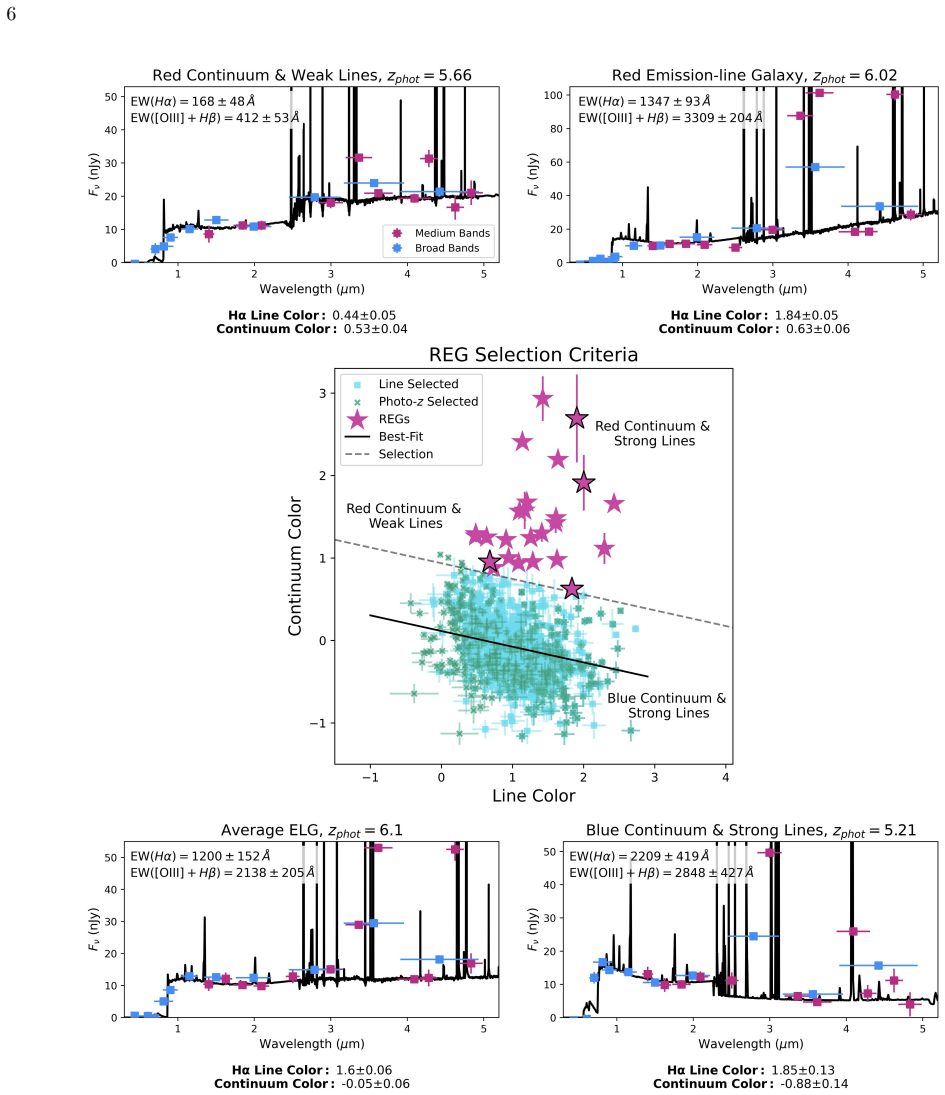
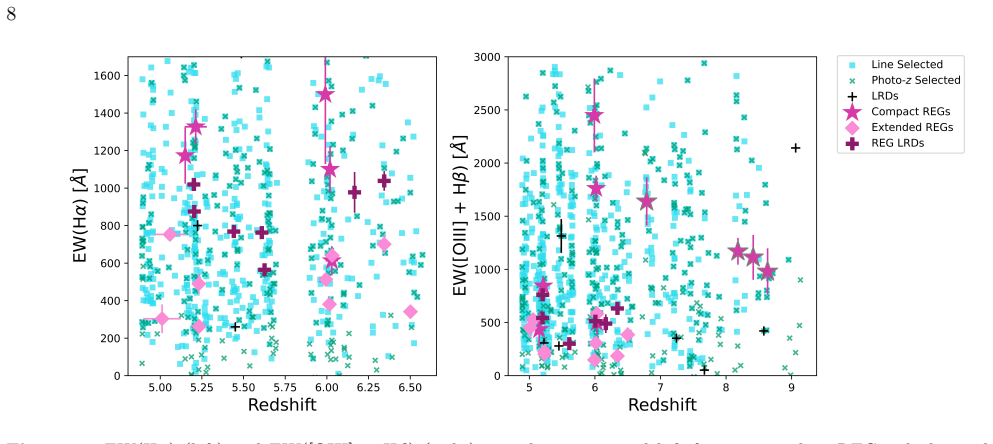
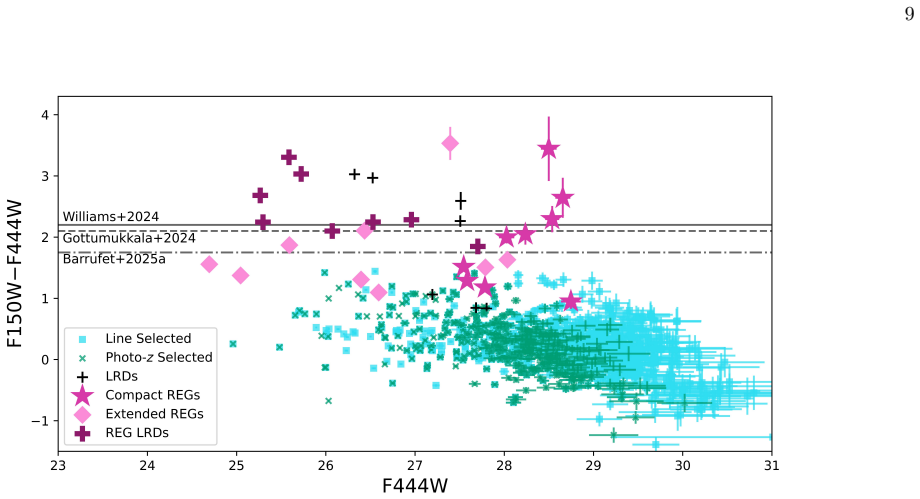
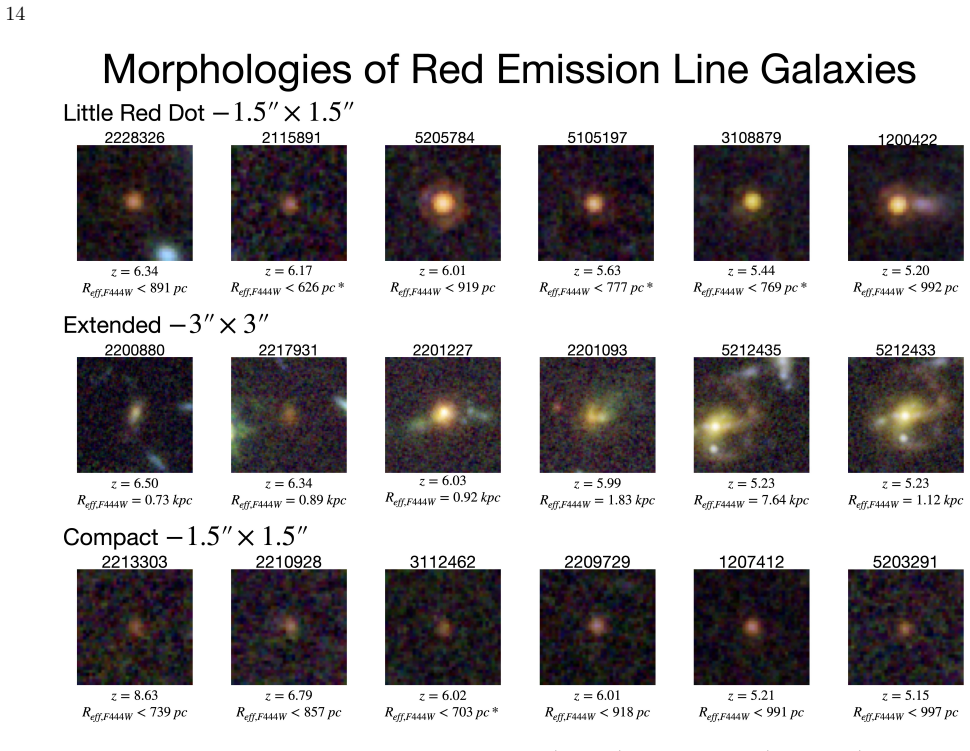
A sample of 26 Red Emission line Galaxies at 4.9 less than or equal to z less than or equal to 8.9 splits into three groups: classic LRDs that pass common literature color selections, extended REGs resolved in F444W and consistent with dusty star-forming galaxies, and compact REGs that remain unresolved in F444W yet fail LRD criteria due to faint continua, strong [OIII]+H-beta contamination, and UV/optical colors flatter than typical LRDs. The compact REGs are therefore interpreted as LRDs missed by standard selections.
What carries the argument
Red Emission line Galaxies (REGs), selected for red continuum color combined with high-equivalent-width H-alpha and [OIII]+H-beta lines, then subdivided by F444W spatial resolution and adherence to published LRD color criteria.
If this is right
- Standard color-based LRD samples at z greater than 5 are incomplete.
- Medium-band imaging recovers additional high-equivalent-width emission-line sources at these redshifts.
- The compact REGs extend the known LRD population rather than representing a new class.
- Existing high-redshift surveys may underestimate the space density of these red compact objects.
Where Pith is reading between the lines
- If the compact REGs belong to the LRD class, current number counts of LRDs at z greater than 5 are lower limits.
- Incorporating medium-band filters into future wide-field surveys could increase completeness for red compact sources.
- The observed color-line strength correlation may link dust content directly to the strength of recent star formation in these galaxies.
Load-bearing premise
The compact REGs share the same physical nature as classic LRDs despite their fainter continua and flatter colors.
What would settle it
Spectroscopy showing that the compact REGs have markedly lower dust attenuation or different line ratios than classic LRDs would indicate they form a separate population.
Figures





read the original abstract
The NIRCam medium-bands have proven to be efficient at identifying Emission Line Galaxies (ELGs) with high equivalent width (EW) H$\alpha$ and [OIII]+H$\beta$ emission lines. In this paper we exploit this efficiency to identify a sample of ELGs at $4.9 \lesssim z \lesssim 8.9$ using medium-band imaging from the CANUCS, Technicolor, and JUMPS surveys. We find that the ELGs exhibit a strong correlation between continuum color and emission line strength, such that galaxies with bluer UV/optical continua have stronger H$\alpha$ and [OIII]+H$\beta$ emission lines. We identify 26 galaxies that are outliers from this relation, which we call the Red Emission line Galaxies (REGs), because of their red continuum color and strong emission lines. We classify the REGs into three categories: 1) ''classic'' Little Red Dots (LRDs) selected with common literature criteria, 2) extended REGs, resolved in F444W and consistent with being Dusty Star Forming Galaxies (DSFGs), and 3) compact REGs, unresolved in F444W but not classified as LRDs. The compact REGs fail common LRD selections for several reasons, including faint continuua, contamination from emission lines (very strong [OIII]+H$\beta$), and UV/optical colors that are flatter than those of LRDs. We conclude that the compact REGs are likely LRDs that ''classic'' selection criteria miss, and are therefore missing from existing samples. Our results suggest that medium-band selection can provide more complete samples of these objects.
Editorial analysis
A structured set of objections, weighed in public.
Referee Report
Summary. The paper uses NIRCam medium-band imaging from the CANUCS, Technicolor, and JUMPS surveys to select Emission Line Galaxies (ELGs) at 4.9 ≲ z ≲ 8.9. It reports a correlation between continuum color and emission-line strength, identifies 26 outliers termed Red Emission line Galaxies (REGs), and classifies them into three groups: classic Little Red Dots (LRDs) meeting literature criteria, extended REGs consistent with Dusty Star-Forming Galaxies (DSFGs), and compact REGs that are unresolved in F444W but fail standard LRD selections owing to faint continua, strong [OIII]+Hβ contamination, and flatter UV/optical colors. The central claim is that the compact REGs are physically the same population as classic LRDs and are therefore missing from existing samples; medium-band selection is argued to yield more complete LRD samples.
Significance. If the compact REGs can be shown to share the same intrinsic (line-decontaminated) continuum slopes, dust attenuation, and line ratios as the classic LRD subsample, the result would be significant for demonstrating incompleteness in broadband LRD selections at z > 5 and for establishing medium-band photometry as a more complete selection tool. The reported color–line-strength correlation itself is a useful observational constraint on high-redshift ELG populations.
major comments (2)
- [classification of REGs / abstract] The conclusion that compact REGs are missed LRDs (abstract and classification section) rests on unresolved F444W morphology plus red color, yet the manuscript notes that these objects have flatter UV/optical colors than classic LRDs and fail LRD cuts partly because of that flatness and line contamination. No quantitative test is presented (e.g., histograms or Kolmogorov–Smirnov statistics) demonstrating that the line-corrected continuum slopes, A_V values, or [OIII]/Hα ratios of the compact REGs lie inside the distribution of the classic LRD subsample.
- [results on the color–line correlation] The sample of 26 REGs is defined as outliers from the reported continuum-color versus line-strength relation, but the text provides neither the functional form of the fitted relation, the outlier threshold (e.g., >3σ or >5σ), nor the uncertainties on the photometric colors and EWs used to identify the outliers.
minor comments (2)
- [sample selection] The abstract states the redshift range as 4.9 ≲ z ≲ 8.9; the corresponding section should explicitly list the photometric redshift or spectroscopic redshift quality cuts applied to arrive at this interval.
- [figures and methods] Figure captions and text should clarify whether the reported continuum colors are observed-frame or rest-frame and whether any line decontamination has been applied before the color measurement.
Simulated Author's Rebuttal
We thank the referee for their careful reading and constructive comments, which have helped us clarify the presentation of our results. We address each major comment below and will revise the manuscript accordingly.
read point-by-point responses
-
Referee: [classification of REGs / abstract] The conclusion that compact REGs are missed LRDs (abstract and classification section) rests on unresolved F444W morphology plus red color, yet the manuscript notes that these objects have flatter UV/optical colors than classic LRDs and fail LRD cuts partly because of that flatness and line contamination. No quantitative test is presented (e.g., histograms or Kolmogorov–Smirnov statistics) demonstrating that the line-corrected continuum slopes, A_V values, or [OIII]/Hα ratios of the compact REGs lie inside the distribution of the classic LRD subsample.
Authors: We agree that a quantitative comparison of the line-decontaminated continuum slopes, A_V, and line ratios would strengthen the claim that the compact REGs belong to the same population. While the current analysis emphasizes the shared compact morphology, red optical colors, and strong lines as the primary indicators, we will add histograms and a Kolmogorov-Smirnov test comparing the key decontaminated properties between the compact REGs and classic LRDs in the revised manuscript. revision: yes
-
Referee: [results on the color–line correlation] The sample of 26 REGs is defined as outliers from the reported continuum-color versus line-strength relation, but the text provides neither the functional form of the fitted relation, the outlier threshold (e.g., >3σ or >5σ), nor the uncertainties on the photometric colors and EWs used to identify the outliers.
Authors: We acknowledge that the details of the outlier identification were insufficiently specified. In the revised manuscript we will explicitly state the functional form of the fitted continuum-color versus line-strength relation, the outlier threshold adopted (objects lying more than 3σ from the relation), and the photometric uncertainties on colors and equivalent widths used to define the 26 REGs. revision: yes
Circularity Check
No circularity: purely observational classification from independent photometric data
full rationale
The paper performs an observational selection of ELGs from CANUCS/Technicolor/JUMPS medium-band imaging, identifies REG outliers from an empirical color-EW correlation, and classifies them by F444W morphology and color cuts drawn from external literature criteria for LRDs. No equations, fitted parameters, or self-citations are used to derive the central claim; the conclusion that compact REGs are missed LRDs is an interpretive statement resting on direct photometric properties rather than any reduction to prior inputs by construction. This matches the default expectation for non-circular observational studies.
Axiom & Free-Parameter Ledger
axioms (2)
- domain assumption Emission line strengths and continuum colors can be reliably measured from NIRCam medium-band photometry at z>5
- domain assumption Unresolved sources in F444W with red colors and strong lines share the same nature as classic LRDs
Forward citations
Cited by 1 Pith paper
-
A massive barred spiral galaxy at z = 5.102 discovered by JWST
Discovery and characterization of the highest-redshift barred spiral galaxy candidate at z=5.102, with bar length ~4.5 kpc, stellar mass 10^10.45 solar masses, SFR 144 solar masses per year, and evidence for AGN and i...
Reference graph
Works this paper leans on
-
[3]
Asada, Yoshihisa and Inayoshi, Kohei and Fei, Qinyue and Fujimoto, Seiji and Willott, Chris , month = may, year =. Origins of the. doi:10.48550/arXiv.2601.10573 , abstract =
work page internal anchor Pith review Pith/arXiv arXiv doi:10.48550/arxiv.2601.10573
-
[5]
The. arXiv e-prints , author =. 2026 , pages =. doi:10.48550/arXiv.2601.22214 , abstract =
-
[8]
The Astrophysical Journal , author =
The. The Astrophysical Journal , author =. 2017 , pages =. doi:10.3847/1538-4357/837/1/97 , abstract =
-
[9]
The Astrophysical Journal , author =
Four. The Astrophysical Journal , author =. 2011 , pages =. doi:10.1088/2041-8205/742/1/L13 , abstract =
-
[20]
The Astrophysical Journal , author =
Measuring. The Astrophysical Journal , author =. 2025 , pages =. doi:10.3847/2041-8213/ade887 , abstract =
-
[22]
arXiv.org , author =
Discovery of red galaxy candidates at z. arXiv.org , author =
-
[24]
2026 , pages =
arXiv e-prints , author =. 2026 , pages =
2026
-
[25]
The Astrophysical Journal , author =. 2024 , pages =. doi:10.3847/1538-4357/ad206f , abstract =
-
[28]
The Astrophysical Journal , author =
Disappearing. The Astrophysical Journal , author =. 2024 , pages =. doi:10.3847/1538-4357/ad02f8 , abstract =
-
[29]
The Astrophysical Journal , author =
A. The Astrophysical Journal , author =. 2024 , pages =. doi:10.3847/1538-4357/ad4265 , abstract =
-
[30]
Astronomy and Astrophysics , author =
Mysteries of. Astronomy and Astrophysics , author =. 2026 , pages =. doi:10.1051/0004-6361/202557061 , abstract =
-
[32]
The Astrophysical Journal , author =
An. The Astrophysical Journal , author =. 2025 , pages =. doi:10.3847/1538-4357/ad9920 , abstract =
-
[33]
Strength in Numbers: Red Galaxies Bolster the Cosmic Star Formation Rate Density at z > 3
Strength in. arXiv e-prints , author =. 2025 , pages =. doi:10.48550/arXiv.2508.05740 , abstract =
work page internal anchor Pith review Pith/arXiv arXiv doi:10.48550/arxiv.2508.05740 2025
-
[35]
arXiv e-prints , author =. 2026 , pages =. doi:10.48550/arXiv.2602.17499 , abstract =
-
[36]
Astronomy and Astrophysics , author =. 2025 , pages =. doi:10.1051/0004-6361/202452186 , abstract =
-
[37]
The Astrophysical Journal , author =. 2024 , pages =. doi:10.3847/1538-4357/ad1e5f , abstract =
-
[38]
Cycle 3 , author =
JWST Proposal. Cycle 3 , author =. 2024 , pages =
2024
-
[40]
An almost NIRCam-dark dusty star-forming galaxy at z=6.63
An almost. arXiv e-prints , author =. 2025 , pages =. doi:10.48550/arXiv.2511.08672 , abstract =
work page internal anchor Pith review Pith/arXiv arXiv doi:10.48550/arxiv.2511.08672 2025
-
[42]
The Astrophysical Journal , author =. 2024 , pages =. doi:10.3847/1538-4357/ad8b1c , abstract =
-
[43]
Astronomy and Astrophysics , author =
A remarkable ruby:. Astronomy and Astrophysics , author =. 2025 , pages =. doi:10.1051/0004-6361/202554681 , abstract =
-
[44]
The Astrophysical Journal , author =
Not-so-little. The Astrophysical Journal , author =. 2024 , pages =. doi:10.3847/2041-8213/ad738a , abstract =
-
[45]
Pseudo. arXiv e-prints , author =. 2026 , pages =. doi:10.48550/arXiv.2601.11466 , abstract =
work page internal anchor Pith review Pith/arXiv arXiv doi:10.48550/arxiv.2601.11466 2026
-
[46]
Brammer, Gabriel and Francesco, Valentino , year =. The
-
[47]
The Astrophysical Journal , author =. 2024 , pages =. doi:10.3847/1538-4357/ad64c2 , abstract =
-
[49]
Astronomy and Astrophysics , author =. 2023 , pages =. doi:10.1051/0004-6361/202346673 , abstract =
-
[50]
arXiv e-prints , author =. 2026 , pages =. doi:10.48550/arXiv.2601.20045 , abstract =
-
[51]
The Astrophysical Journal , author =
Improving. The Astrophysical Journal , author =. 2025 , pages =. doi:10.3847/2041-8213/adc388 , abstract =
-
[53]
The Astrophysical Journal , author =
2 mm. The Astrophysical Journal , author =. 2023 , pages =. doi:10.3847/1538-4357/acd763 , abstract =
-
[58]
Cycle 2 , author =
JWST Proposal. Cycle 2 , author =. 2023 , pages =
2023
-
[59]
Cycle 1 , author =
JWST Proposal. Cycle 1 , author =. 2017 , pages =
2017
-
[61]
Ganguly, Arpita and Xiao, Mengyuan and Oesch, Pascal A. and Dessauges-Zavadsky, Miroslava and Weibel, Andrea and Allen, Natalie and Bing, Longji and Bosman, Sarah and Brammer, Gabriel and Elbaz, David and Daddi, Emanuele and Magnelli, Benjamin and Miller, Tim B. and Tarrasse, Maxime , month = dec, year =. Stellar. doi:10.48550/arXiv.2512.15127 , abstract =
-
[63]
Astronomy and Astrophysics , author =. 2025 , pages =. doi:10.1051/0004-6361/202555816 , abstract =
-
[64]
Galactic Stellar and Substellar Initial Mass Function
Galactic. Publications of the Astronomical Society of the Pacific , author =. 2003 , pages =. doi:10.1086/376392 , abstract =
work page internal anchor Pith review doi:10.1086/376392 2003
-
[65]
The Astrophysical Journal , author =
The. The Astrophysical Journal , author =. 2000 , pages =. doi:10.1086/308692 , abstract =
work page internal anchor Pith review doi:10.1086/308692 2000
-
[66]
Monthly Notices of the Royal Astronomical Society , author =
Inferring the star formation histories of massive quiescent galaxies with. Monthly Notices of the Royal Astronomical Society , author =. 2018 , pages =. doi:10.1093/mnras/sty2169 , abstract =
work page internal anchor Pith review doi:10.1093/mnras/sty2169 2018
-
[70]
The Astrophysical Journal , author =
Spectral. The Astrophysical Journal , author =. 2023 , pages =. doi:10.3847/1538-4357/acfed4 , abstract =
-
[71]
The Astrophysical Journal , author =. 2008 , pages =. doi:10.1086/591786 , abstract =
work page internal anchor Pith review doi:10.1086/591786 2008
-
[72]
arXiv e-prints , author =. 2025 , pages =. doi:10.48550/arXiv.2511.07542 , abstract =
-
[77]
Monthly Notices of the Royal Astronomical Society , author =
Unveiling the hidden. Monthly Notices of the Royal Astronomical Society , author =. 2024 , pages =. doi:10.1093/mnras/stae754 , abstract =
-
[78]
Astronomy and Astrophysics , author =
Physical properties of extreme emission-line galaxies at z ∼ 4–9 from the. Astronomy and Astrophysics , author =. 2024 , pages =. doi:10.1051/0004-6361/202449904 , abstract =
-
[79]
Extreme equivalent width-selected low-mass starbursts at \ z=4-9\ : insights into their role in cosmic reionization , shorttitle =. arXiv e-prints , author =. 2025 , pages =. doi:10.48550/arXiv.2510.25647 , abstract =
work page internal anchor Pith review Pith/arXiv arXiv doi:10.48550/arxiv.2510.25647 2025
-
[80]
The Astrophysical Journal , author =
A. The Astrophysical Journal , author =. 2025 , pages =. doi:10.3847/1538-4357/adee0f , abstract =
-
[83]
The Astrophysical Journal , author =
The. The Astrophysical Journal , author =. 2025 , pages =. doi:10.3847/1538-4357/adbc7d , abstract =
-
[84]
The Astrophysical Journal , author =
Extremely. The Astrophysical Journal , author =. 2024 , pages =. doi:10.3847/1538-4357/ad167e , abstract =
-
[86]
Monthly Notices of the Royal Astronomical Society , author =
Quiescent or dusty?. Monthly Notices of the Royal Astronomical Society , author =. 2025 , pages =. doi:10.1093/mnras/staf013 , abstract =
-
[90]
Davis, Kelcey and Trump, Jonathan R. and Simons, Raymond C. and Mcgrath, Elizabeth J. and Wilkins, Stephen M. and Haro, Pablo Arrabal and Bagley, Micaela B. and Dickinson, Mark and FernÁndez, Vital and AmorÍn, Ricardo O. and Backhaus, Bren E. and Cleri, Nikko J. and Llerena, Mario and Brunker, Samantha W. and Barro, Guillermo and Bisigello, Laura and Broo...
-
[93]
Monthly Notices of the Royal Astronomical Society , author =
Extreme emission line galaxies detected in. Monthly Notices of the Royal Astronomical Society , author =. 2024 , pages =. doi:10.1093/mnras/stae2430 , abstract =
-
[94]
The Astrophysical Journal , author =
Beyond. The Astrophysical Journal , author =. 2023 , pages =. doi:10.3847/1538-4357/aca294 , abstract =
-
[95]
The Astrophysical Journal , author =
The. The Astrophysical Journal , author =. 2025 , pages =. doi:10.3847/1538-4357/ad8b30 , abstract =
-
[96]
The Astrophysical Journal , author =. 2025 , pages =. doi:10.3847/1538-4357/ade984 , abstract =
-
[97]
Antwi-Danso, Jacqueline and Papovich, Casey and Esdaile, James and Nanayakkara, Themiya and Glazebrook, Karl and Hutchison, Taylor A. and Whitaker, Katherine E. and Marsan, Z. Cemile and Diaz, Ruben J. and Marchesini, Danilo and Muzzin, Adam and Tran, Kim-Vy H. and Setton, David J. and Kaushal, Yasha and Speagle, Joshua S. and Cole, Justin , month = may, ...
-
[98]
The Astrophysical Journal , author =
Optically. The Astrophysical Journal , author =. 2019 , pages =. doi:10.3847/1538-4357/ab14f2 , abstract =
-
[99]
The Astrophysical Journal , author =
Two. The Astrophysical Journal , author =. 2023 , pages =. doi:10.3847/1538-4357/acef21 , abstract =
-
[100]
Astronomy & Astrophysics , author =
An optically dark merging system at. Astronomy & Astrophysics , author =. 2024 , pages =. doi:10.1051/0004-6361/202450541 , abstract =
-
[101]
Monthly Notices of the Royal Astronomical Society , author =. 2024 , pages =. doi:10.1093/mnras/stae1574 , abstract =
-
[102]
Monthly Notices of the Royal Astronomical Society , author =
Bursty star formation and galaxy–galaxy interactions in low-mass galaxies 1. Monthly Notices of the Royal Astronomical Society , author =. 2023 , pages =. doi:10.1093/mnras/stad3902 , abstract =
-
[103]
The Astrophysical Journal , author =
Dust extinction of the stellar continua in starburst galaxies:. The Astrophysical Journal , author =. 1994 , pages =. doi:10.1086/174346 , language =
-
[104]
Astronomy & Astrophysics , author =
Investigating the growth of little red dot descendants at. Astronomy & Astrophysics , author =. 2026 , pages =. doi:10.1051/0004-6361/202556303 , abstract =
-
[105]
Two Exciting High-redshift Galaxy Candidates Turn Out to Be Two Exciting Ultra-cool Brown Dwarfs
Bradač, Maruša and Willott, Chris and Asada, Yoshihisa and Albert, Loïc and Rihtaršič, Gregor and Harshan, Anishya and Judež, Jon and Martis, Nicholas S. and Ferrara, Andrea and. Two. 2026 , keywords =. doi:10.48550/ARXIV.2604.23668 , abstract =
work page internal anchor Pith review Pith/arXiv arXiv doi:10.48550/arxiv.2604.23668 2026
-
[106]
The Astropy Project: Sustaining and Growing a Community-oriented Open-source Project and the Latest Major Release (v5.0) of the Core Package. , keywords =. doi:10.3847/1538-4357/ac7c74 , archivePrefix =. 2206.14220 , primaryClass =
work page internal anchor Pith review Pith/arXiv arXiv doi:10.3847/1538-4357/ac7c74
-
[107]
The Astropy Project: Building an inclusive, open-science project and status of the v2.0 core package
The Astropy Project: Building an Open-science Project and Status of the v2.0 Core Package. , keywords =. doi:10.3847/1538-3881/aabc4f , archivePrefix =. 1801.02634 , primaryClass =
work page internal anchor Pith review Pith/arXiv arXiv doi:10.3847/1538-3881/aabc4f
-
[108]
Astropy: A Community Python Package for Astronomy
Astropy: A community Python package for astronomy. , keywords =. 2013. doi:10.1051/0004-6361/201322068 , archivePrefix =. 1307.6212 , primaryClass =
work page internal anchor Pith review Pith/arXiv arXiv doi:10.1051/0004-6361/201322068 2013
-
[109]
SExtractor: Software for source extraction. , keywords =. 1996. doi:10.1051/aas:1996164 , adsurl =
-
[110]
Quantifying the Observational Effort Required for the Radial Velocity Characterization of TESS Planets. , keywords =. 2018. doi:10.3847/1538-3881/aacea9 , archivePrefix =. 1807.01263 , primaryClass =
work page internal anchor Pith review Pith/arXiv arXiv doi:10.3847/1538-3881/aacea9 2018
-
[111]
X-Ray Scattering Echoes and Ghost Halos from the Intergalactic Medium: Relation to the Nature of AGN Variability. , keywords =. 2015. doi:10.1088/0004-637X/805/1/23 , archivePrefix =. 1503.01475 , primaryClass =
work page internal anchor Pith review Pith/arXiv arXiv doi:10.1088/0004-637x/805/1/23 2015
-
[112]
, keywords =
The 2013 Release of Cloudy. , keywords =. 2013
2013
-
[113]
1989", month =
T _ E X and LAT _ E X Macro Definition Files for Astronomical Publications. , year = "1989", month = "Mar", pages =
1989
-
[114]
LaTeX: A Document Preparation System. 1994
1994
-
[115]
Quasi-periodic Fast Propagating Magnetoacoustic Waves during the Magnetic Reconnection Between Solar Coronal Loops. , keywords =. 2018. doi:10.3847/2041-8213/aaf167 , archivePrefix =. 1811.08553 , primaryClass =
work page internal anchor Pith review Pith/arXiv arXiv doi:10.3847/2041-8213/aaf167 2018
-
[116]
Nominal values for selected solar and planetary quantities: IAU 2015 Resolution B3
Nominal Values for Selected Solar and Planetary Quantities: IAU 2015 Resolution B3. , keywords =. 2016. doi:10.3847/0004-6256/152/2/41 , archivePrefix =. 1605.09788 , primaryClass =
work page internal anchor Pith review Pith/arXiv arXiv doi:10.3847/0004-6256/152/2/41 2015
-
[117]
Swift X-Ray Observations of Classical Novae. II. The Super Soft Source Sample. , keywords =. 2011. doi:10.1088/0067-0049/197/2/31 , archivePrefix =. 1110.6224 , primaryClass =
work page internal anchor Pith review Pith/arXiv arXiv doi:10.1088/0067-0049/197/2/31 2011
-
[118]
Galaxy emission line classification using 3D line ratio diagrams
Galaxy Emission Line Classification Using Three-dimensional Line Ratio Diagrams. , keywords =. 2014. doi:10.1088/0004-637X/793/2/127 , archivePrefix =. 1406.5186 , primaryClass =
work page internal anchor Pith review Pith/arXiv arXiv doi:10.1088/0004-637x/793/2/127 2014
-
[119]
Roberts-Borsani, Guido and Treu, Tommaso and Shapley, Alice and Fontana, Adriano and Pentericci, Laura and Castellano, Marco and Morishita, Takahiro and Bergamini, Pietro and Rosati, Piero , urldate =. Between the Extremes: A. doi:10.3847/1538-4357/ad85d3 , shorttitle =
-
[120]
Testing the BH$^*$ Model: a UV-to-Optical Spectral Fitting of The Cliff
Mérida, Rosa M. and Sawicki, Marcin and Gaspar, Gaia and Willott, Chris J. and Iyer, Kartheik G. , urldate =. Testing the. doi:10.48550/arXiv.2605.07976 , shorttitle =. 2605.07976 , keywords =
work page internal anchor Pith review Pith/arXiv arXiv doi:10.48550/arxiv.2605.07976
-
[121]
Scholtz, Jan and Maiolino, Roberto and D'Eugenio, Francesco and Curtis-Lake, Emma and Carniani, Stefano and Charlot, Stephane and Curti, Mirko and Silcock, Maddie S. and Arribas, Santiago and Baker, William and Bhatawdekar, Rachana and Boyett, Kristan and Bunker, Andrew J. and Chevallard, Jacopo and Circosta, Chiara and Eisenstein, Daniel J. and Hainline,...
-
[122]
The Cluster Lensing and Supernova Survey with Hubble: An Overview , volume =
Postman, Marc and Coe, Dan and Benítez, Narciso and Bradley, Larry and Broadhurst, Tom and Donahue, Megan and Ford, Holland and Graur, Or and Graves, Genevieve and Jouvel, Stephanie and Koekemoer, Anton and Lemze, Doron and Medezinski, Elinor and Molino, Alberto and Moustakas, Leonidas and Ogaz, Sara and Riess, Adam and Rodney, Steve and Rosati, Piero and...
-
[123]
Wang, T. and Elbaz, D. and Schreiber, C. and Pannella, M. and Shu, X. and Willner, S. P. and Ashby, M. L. N. and Huang, J.-S. and Fontana, A. and Dekel, A. and Daddi, E. and Ferguson, H. C. and Dunlop, J. and Ciesla, L. and Koekemoer, A. M. and Giavalisco, M. and Boutsia, K. and Finkelstein, S. and Juneau, S. and Barro, G. and Koo, D. C. and Michałowski, ...
-
[124]
Smit, R. and Bouwens, R. J. and Labbé, I. and Zheng, W. and Bradley, L. and Donahue, M. and Lemze, D. and Moustakas, J. and Umetsu, K. and Zitrin, A. and Coe, D. and Postman, M. and Gonzalez, V. and Bartelmann, M. and Benítez, N. and Broadhurst, T. and Ford, H. and Grillo, C. and Infante, L. and Jimenez-Teja, Y. and Jouvel, S. and Kelson, D. D. and Lahav,...
-
[125]
and Franx, Marijn and Oesch, Pascal A
Smit, Renske and Bouwens, Rychard J. and Franx, Marijn and Oesch, Pascal A. and Ashby, Matthew L. N. and Willner, S. P. and Labbé, Ivo and Holwerda, Benne and Fazio, Giovanni G. and Huang, J.-S. , urldate =. High-precision Photometric Redshifts from Spitzer/. doi:10.1088/0004-637X/801/2/122 , shorttitle =
-
[126]
Stark, Daniel P. and Schenker, Matthew A. and Ellis, Richard and Robertson, Brant and. Keck Spectroscopy of 3 < z < 7 Faint Lyman Break Galaxies: The Importance of Nebular Emission in Understanding the Specific Star Formation Rate and Stellar Mass Density , volume =. doi:10.1088/0004-637X/763/2/129 , shorttitle =
discussion (0)
Sign in with ORCID, Apple, or X to comment. Anyone can read and Pith papers without signing in.