N-Player Binary Games with Unidirectional Dependencies: Cycle Robustness and Induced Indifference
Pith reviewed 2026-06-27 22:56 UTC · model grok-4.3
The pith
Non-zero boundary incentives linearize directed cycle games into O(N) feed-forward equilibrium resolution.
A machine-rendered reading of the paper's core claim, the machinery that carries it, and where it could break.
Core claim
Under the Robust Incentive Structure defined by non-zero boundary incentives, the topology linearizes to feed-forward propagation, yielding a unique equilibrium via strict dominance or a unique fully mixed equilibrium via induced payoff indifference governed by the Parity Condition, all in O(N) time for directed cycle graphical games.
What carries the argument
The Robust Incentive Structure, which uses non-zero boundary incentives to linearize the cycle topology into feed-forward propagation.
If this is right
- Strict dominance guarantees a unique equilibrium.
- Pure strategy equilibria are governed by the Parity Condition when strict dominance is absent.
- A unique fully mixed equilibrium is guaranteed via induced payoff indifference.
- Resolution is achieved in O(N) time under the robust regime.
- The transition-matrix formulation bounds the search tree for non-robust cases and enables inverse design of target equilibria in circular networks.
Where Pith is reading between the lines
- The same boundary-linearization idea could be tested on other cyclic or near-cyclic topologies that admit a small set of cut vertices.
- The parity and indifference rules might be used to construct explicit hard instances for general graphical games by embedding robust cycles.
- Mechanism designers could use the inverse-design procedure to set payoffs that force a desired equilibrium in circular supply or coordination networks.
- Empirical checks on randomly generated cycle games with controlled boundary values would directly measure how often the O(N) path is taken versus branching.
Load-bearing premise
The incentive structure must be robust with non-zero boundary incentives and the game must be strictly binary with unidirectional dependencies.
What would settle it
A concrete directed-cycle binary game instance with a zero boundary incentive that produces either multiple mixed equilibria or requires super-linear time to enumerate all equilibria would falsify the linearization claim.
Figures
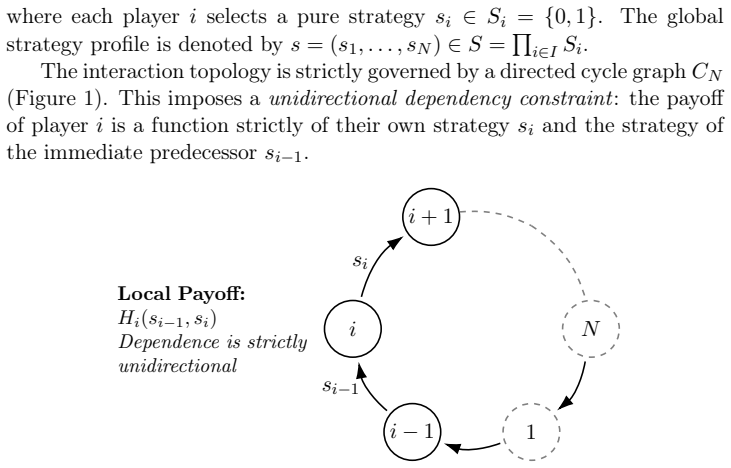
read the original abstract
The present study provides a closed-form characterisation of Nash equilibria in N-player binary games with unidirectional dependencies. While general network games are PPAD-complete, prior work has established that trees or paths admit polynomial-time solutions via dynamic programming. We provide a deterministic characterisation for the subclass of directed cycle graphical games, demonstrating that non-zero boundary incentives linearize the topology into a feed-forward propagation. Under this Robust Incentive Structure, resolution is achieved in O(N) time: strict dominance guarantees a unique equilibrium; in its absence, pure strategy equilibria are governed by the Parity Condition, while a unique fully mixed equilibrium is guaranteed via induced payoff indifference. For non-robust regimes, we deliver branching rules. The transition-matrix formulation evaluates the search tree size beforehand. This transparency enables the inverse design of target equilibria in circular networks, making explicit the mechanics that remain opaque in numerical solvers.
Editorial analysis
A structured set of objections, weighed in public.
Referee Report
Summary. The paper claims a closed-form characterisation of Nash equilibria for N-player binary games with unidirectional dependencies on directed cycles. Non-zero boundary incentives are said to induce a Robust Incentive Structure that linearizes the cycle into feed-forward propagation, yielding O(N) resolution: strict dominance for a unique equilibrium; the Parity Condition for pure-strategy equilibria; and induced payoff indifference for a unique fully mixed equilibrium. Branching rules with a transition-matrix formulation are supplied for non-robust regimes to pre-evaluate search-tree size and support inverse equilibrium design.
Significance. If the central derivations are correct, the result would extend known polynomial-time methods for trees and paths to directed cycles, a non-trivial subclass of network games that are PPAD-complete in general. The parameter-free character of the characterisation (no fitted parameters) and the explicit transition-matrix transparency for inverse design are genuine strengths that would be useful for both theory and applications.
major comments (1)
- [Abstract] Abstract: the load-bearing claim that 'non-zero boundary incentives linearize the topology into a feed-forward propagation' requires a uniform definition of 'boundary' incentives. In a directed cycle every node has a predecessor, so any cut or reference player must be specified explicitly; absent such a definition, internal zero-incentive nodes can arise and the linearization (hence the O(N) guarantee via strict dominance, Parity Condition, or induced indifference) does not hold for all instances.
minor comments (2)
- The abstract asserts that 'prior work has established that trees or paths admit polynomial-time solutions via dynamic programming' but supplies no citations; adding the relevant references would strengthen the positioning.
- The transition-matrix formulation is invoked to 'evaluate the search tree size beforehand' yet its explicit construction is not shown in the abstract; the full manuscript should include the matrix definition and the precise complexity bound it yields.
Simulated Author's Rebuttal
We thank the referee for their careful reading and for identifying a point that requires clarification in the abstract and manuscript. We address the comment below and will make the necessary revisions.
read point-by-point responses
-
Referee: [Abstract] Abstract: the load-bearing claim that 'non-zero boundary incentives linearize the topology into a feed-forward propagation' requires a uniform definition of 'boundary' incentives. In a directed cycle every node has a predecessor, so any cut or reference player must be specified explicitly; absent such a definition, internal zero-incentive nodes can arise and the linearization (hence the O(N) guarantee via strict dominance, Parity Condition, or induced indifference) does not hold for all instances.
Authors: We agree that an explicit definition of boundary incentives is required for the claim to be unambiguous. In the full manuscript the boundary incentives are those associated with a designated reference player (the 'cut' player), whose outgoing incentive parameter serves as the starting point for the unidirectional propagation; the cycle is thereby linearized by treating this player's action as the initial condition. The robust incentive structure is defined precisely when this boundary incentive is nonzero, which precludes internal zero-incentive nodes from breaking the propagation. We will revise the abstract and the opening paragraphs of Section 3 to state this definition uniformly and to note that the O(N) results (strict dominance, parity condition, induced indifference) apply under the resulting robust regime. The non-robust case is already handled separately via the branching rules and transition matrix. revision: yes
Circularity Check
No circularity; derivation rests on external robustness assumption
full rationale
The paper posits non-zero boundary incentives as an input assumption that enables linearization of the cycle into feed-forward propagation, from which the O(N) resolution, strict dominance, Parity Condition, and induced indifference follow as consequences. No equations or definitions in the abstract reduce the claimed results to fitted parameters, self-citations, or redefinitions of the target equilibria. The branching rules for non-robust cases are presented separately without claiming polynomial bounds. The derivation chain is therefore self-contained against the stated assumptions rather than tautological.
Axiom & Free-Parameter Ledger
axioms (1)
- standard math Existence of Nash equilibrium in finite normal-form games
invented entities (2)
-
Robust Incentive Structure
no independent evidence
-
Parity Condition
no independent evidence
Reference graph
Works this paper leans on
-
[1]
G. P. Cachon, S. Netessine, Game theory in supply chain analysis, in: D. Simchi-Levi, S. D. Wu, Z.-J. Shen (Eds.), Handbook of Quantitative Supply Chain Analysis: Modeling in the E-Business Era, Springer US, Boston, MA, 2004, pp. 13–65.doi:10.1007/978-1-4020-7953-5_2
-
[2]
W. Li, Y. Li, J. Chen, B. Chen, Strategic decentralization of self-branded and contract manufacturing businesses, European Journal of Operational Research 323 (3) (2025) 868–887.doi:10.1016/j.ejor.2025.01.017
-
[3]
D. Acemoglu, A. Ozdaglar, A. Tahbaz-Salehi, Systemic risk and stability in financial networks, American Economic Review 105 (2) (2015) 564– 608.doi:10.1257/aer.20130456
-
[4]
Goyal, Connections: An Introduction to the Economics of Net- works, Princeton University Press, Princeton, NJ, 2007.doi:10.1515/ 9781400829163
S. Goyal, Connections: An Introduction to the Economics of Net- works, Princeton University Press, Princeton, NJ, 2007.doi:10.1515/ 9781400829163
2007
-
[5]
X. Chen, X. Deng, S.-H. Teng, Settling the complexity of computing two-player Nash equilibria, Journal of the ACM 56 (3) (2009) 14:1–14:57. doi:10.1145/1516512.1516516
-
[6]
C. Daskalakis, P. W. Goldberg, C. H. Papadimitriou, The complexity of computing a Nash equilibrium, SIAM Journal on Computing 39 (1) (2009) 195–259.doi:10.1137/070699652
-
[7]
V. Bala, S. Goyal, Learning from neighbours, The Review of Economic Studies 65 (3) (1998) 595–621.doi:10.1111/1467-937X.00059. 29
-
[8]
J. Nash, Non-cooperative games, Annals of Mathematics 54 (2) (1951) 286–295.doi:10.2307/1969529
-
[9]
G. Gottlob, G. Greco, F. Scarcello, Pure nash equilibria: Hard and easy games, JournalofArtificialIntelligenceResearch24(2005)357–406.doi: 10.1613/jair.1683. 30
discussion (0)
Sign in with ORCID, Apple, or X to comment. Anyone can read and Pith papers without signing in.