EPISODE II: Variability in the CO and H₂O rovibrational absorption lines in a periodically variable protostar EC 53
Pith reviewed 2026-06-28 00:02 UTC · model grok-4.3
The pith
The weakening of CO and H2O absorption lines in protostar EC 53 during bursts is caused by an increase in hot continuum emission.
A machine-rendered reading of the paper's core claim, the machinery that carries it, and where it could break.
Core claim
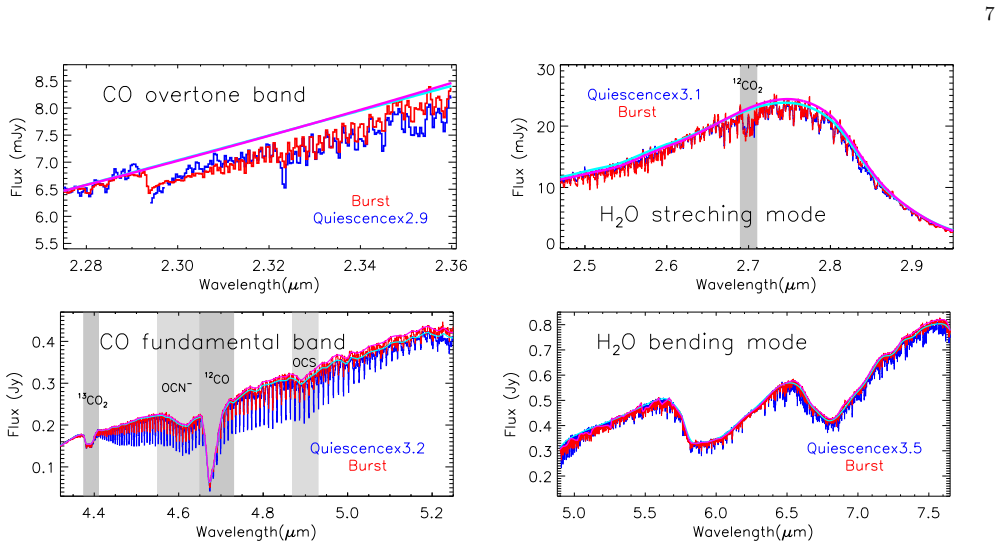
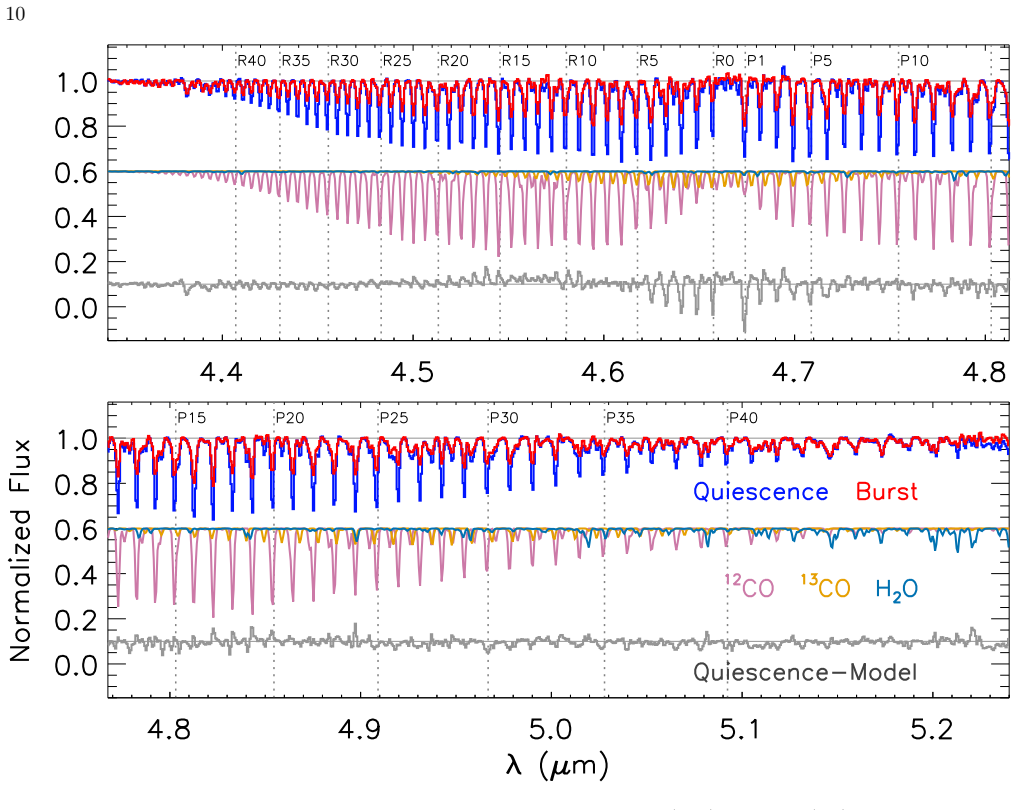
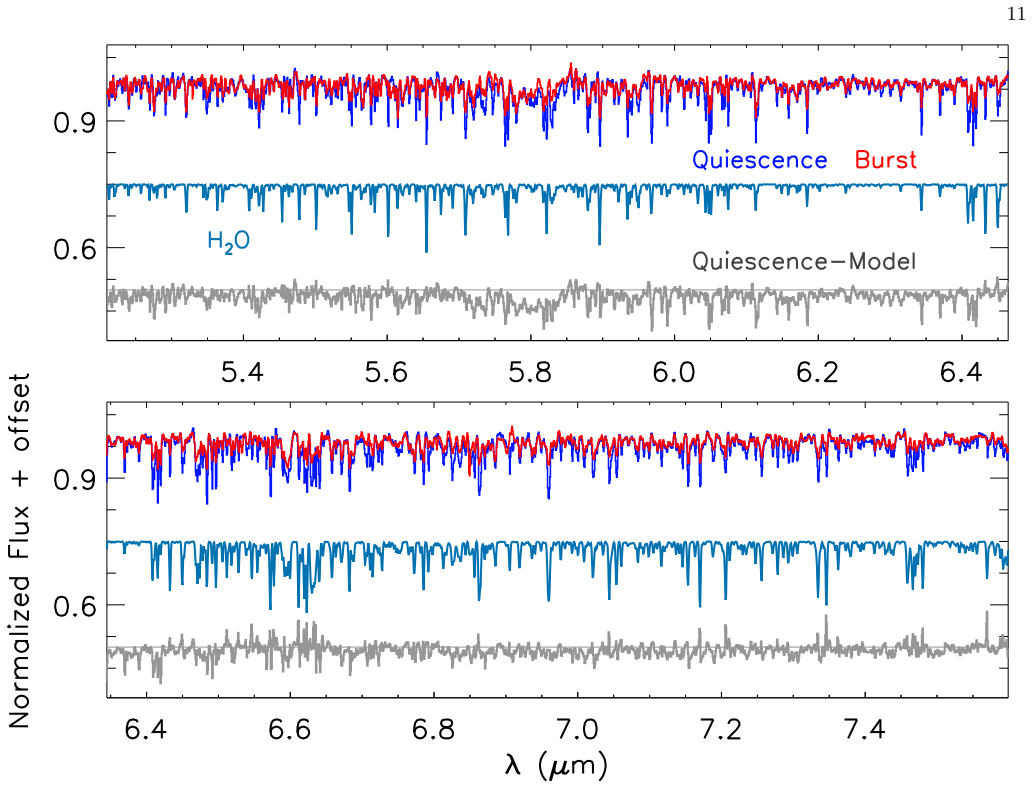
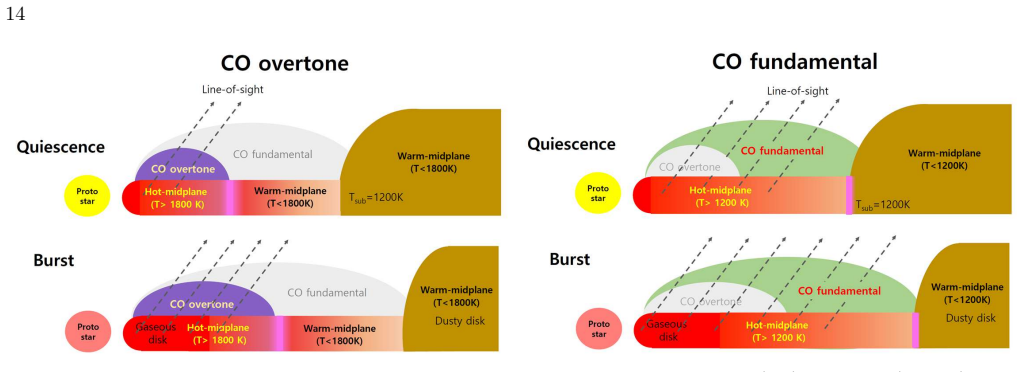
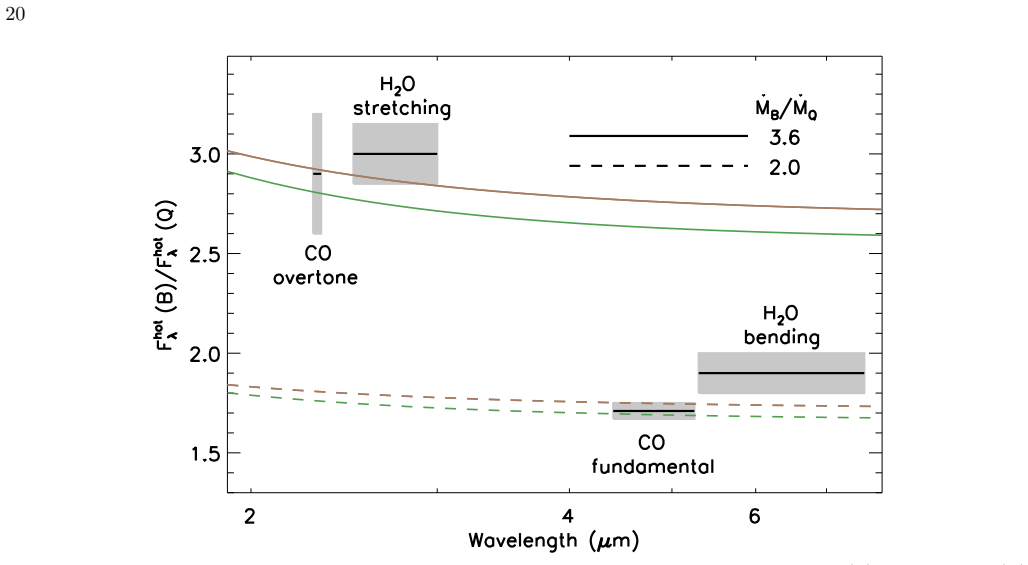
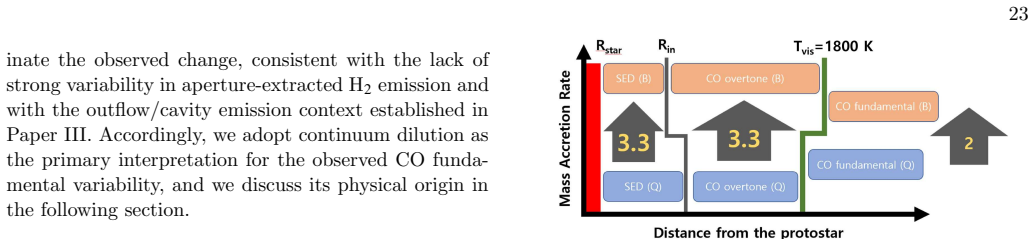
The central claim is that the observed weakening of the CO fundamental and H2O bending-mode absorption features by a factor of ~2 during the burst phase of EC 53 results from changes in the hot continuum level. LTE modeling shows temperatures consistent with different radii for overtone and fundamental. The relative veiling formalism measures burst-to-quiescent hot-continuum ratios of 2.9±0.2 and 1.71±0.11, which via viscous disk prescription imply accretion rate ratios of ~3.6 and ~2.0. This indicates that inner disk regions at different radii respond differently, supporting episodic mass buildup in quiescence and efficient transport in burst.
What carries the argument
Relative veiling, which compares the burst and quiescent spectra to measure the change in hot continuum excess while treating the quiescent spectrum as an internal reference.
Load-bearing premise
The column density, temperature, and velocity structure of the absorbing gas do not change substantially between the quiescent and burst epochs.
What would settle it
Spectra showing that the absorption line strengths cannot be reproduced by scaling only the continuum level while keeping the gas parameters fixed would falsify the explanation.
Figures
read the original abstract
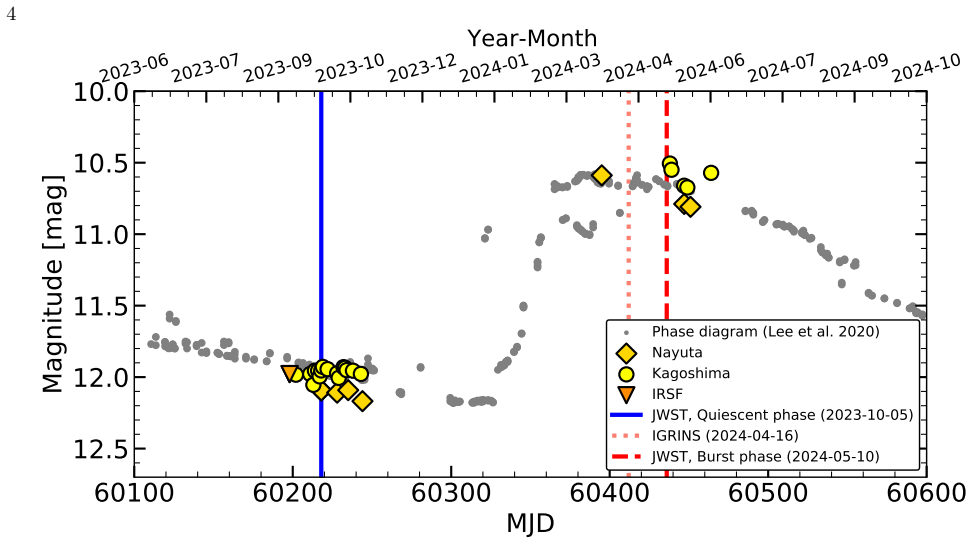
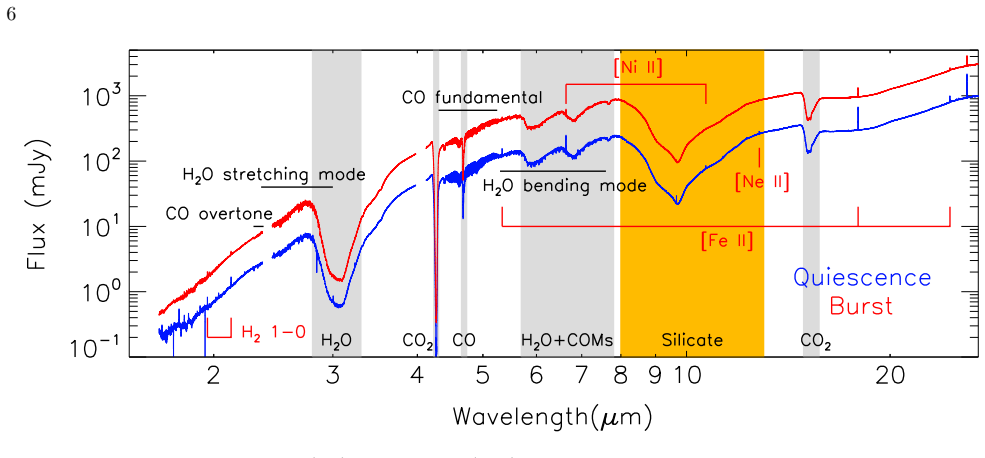
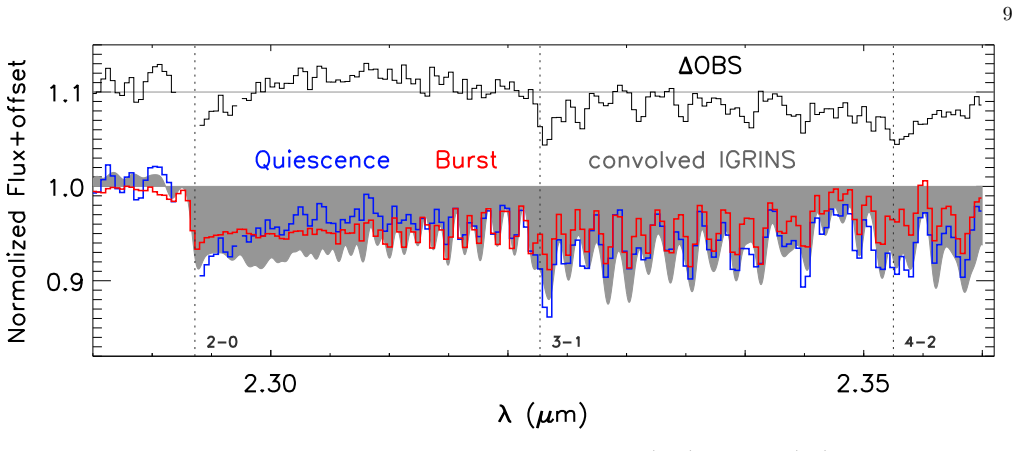
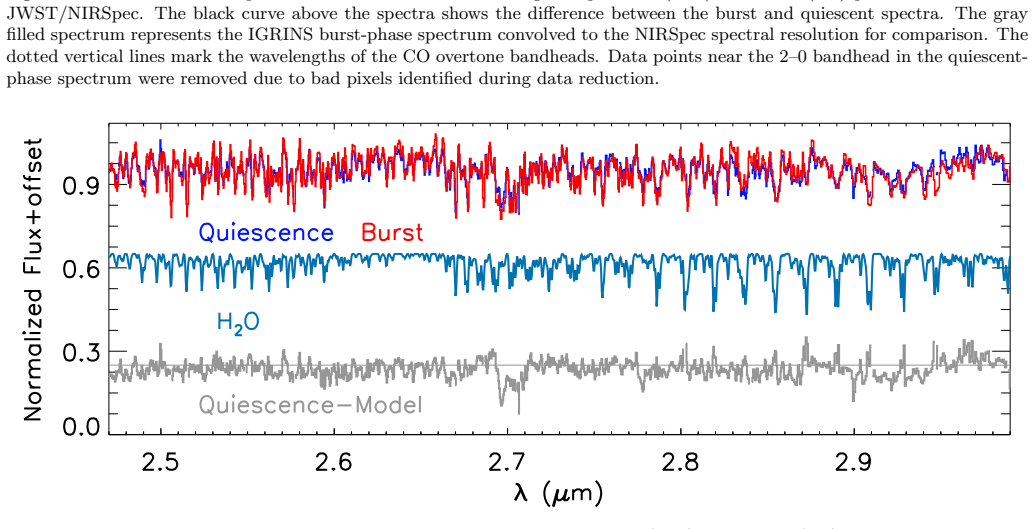
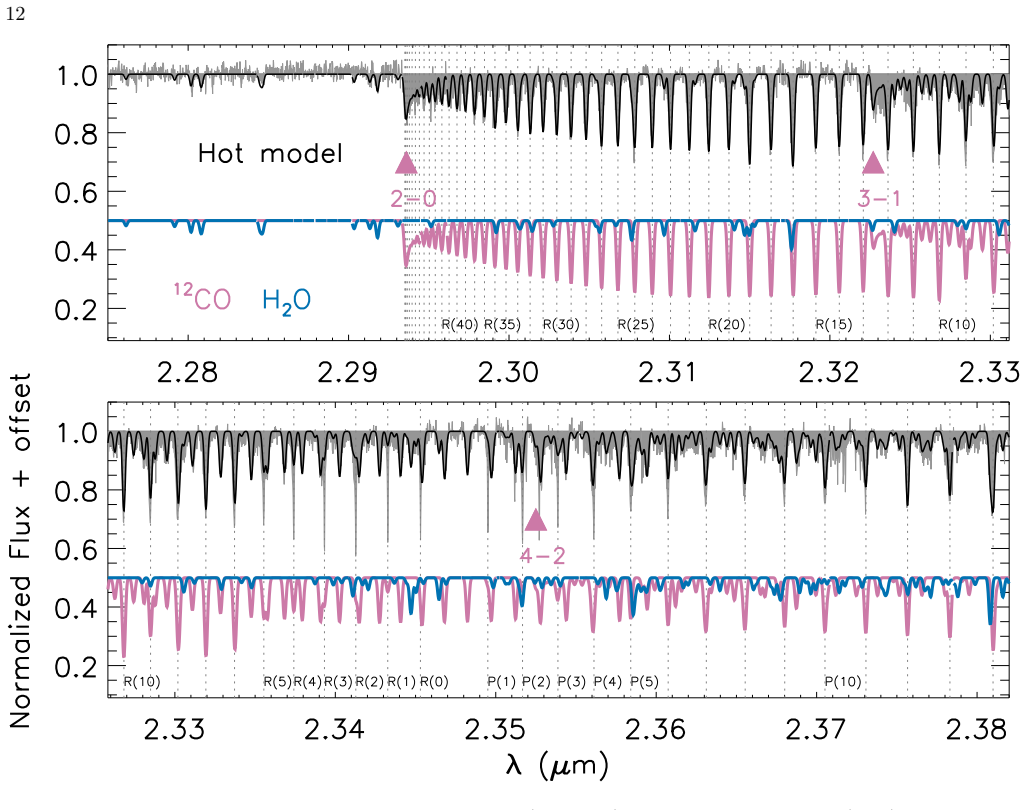
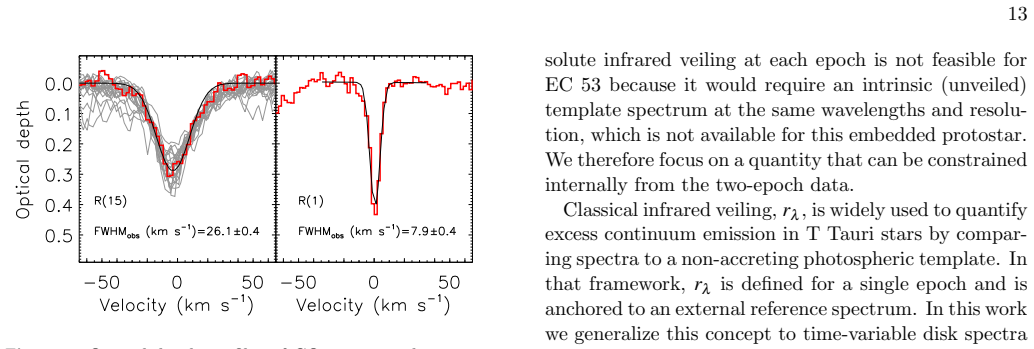
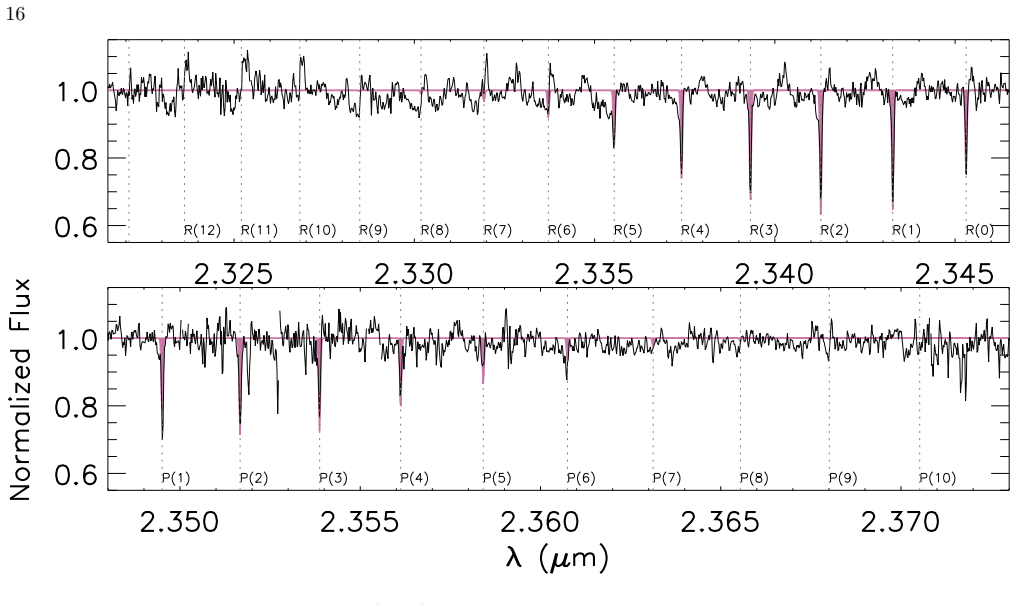
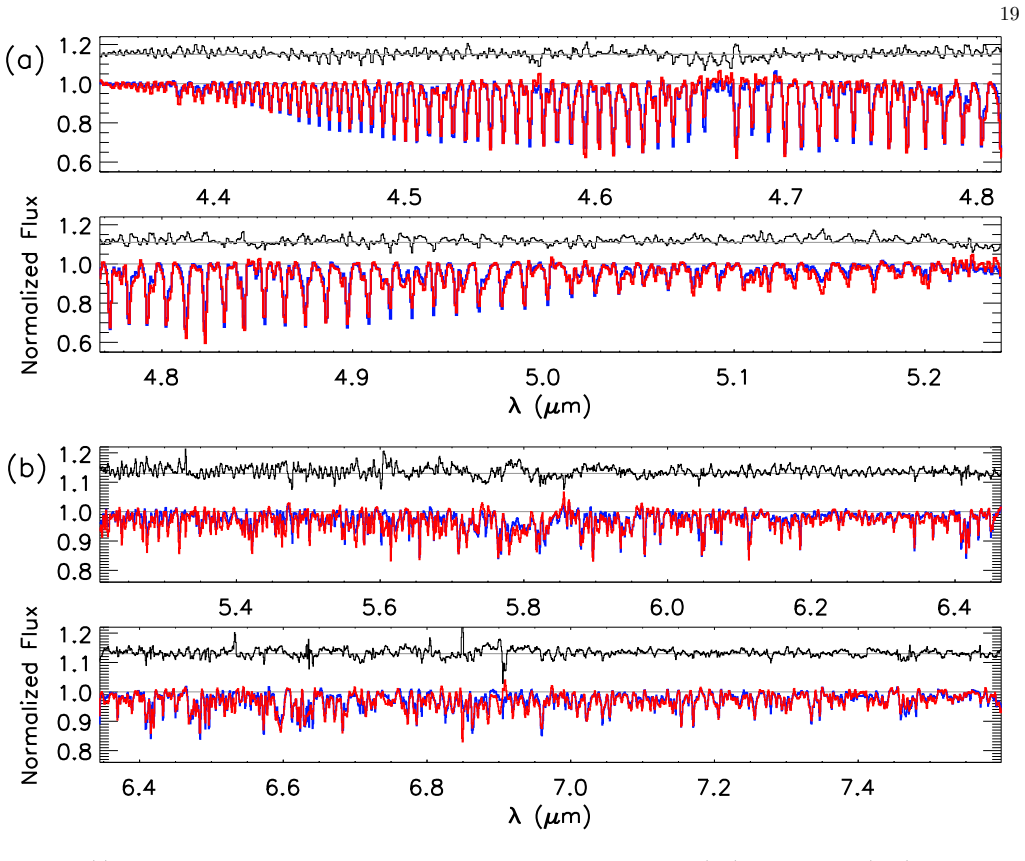
We present two-epoch JWST NIRSpec and MIRI observations of the young protostar EC 53 (V371 Ser), a periodically variable source with well-characterized quiescent and burst phases. The spectra in both epochs show absorption in the CO overtone ($\sim$2.3 $\mu$m) and fundamental ($\sim$4.6 $\mu$m) bands and the H$_2$O stretching ($\sim$2.7 $\mu$m) and bending ($\sim$6.0 $\mu$m) modes. We also obtained high-resolution ($R\approx45{,}000$) IGRINS spectra during the burst to constrain the CO overtone line profiles. LTE slab modeling yields gas temperatures of $\sim$1800 K (CO overtone) and $\sim$1200 K (CO fundamental), consistent with the overtone tracing hotter gas at smaller radii. The H$_2$O stretching-mode absorption shows no compelling evidence for variability, and the current JWST CO overtone data do not provide a robust constraint on overtone variability. In contrast, the CO fundamental and H$_2$O bending-mode features weaken by a factor of $\sim$2 during the burst, which is most naturally explained by continuum changes rather than large variations in absorbing gas. To quantify continuum dilution, we introduce a ``relative veiling'' that treats the quiescent spectrum as an internal reference and measures the change in the continuum excess between the two epochs. This formalism yields burst-to-quiescent hot-continuum ratios of $2.9\pm0.2$ for the CO overtone and $1.71\pm0.11$ for the CO fundamental. Using a viscous-disk prescription, these imply representative accretion-rate ratios of $\sim$3.6 and $\sim$2.0, respectively. The differing ratios suggest that inner-disk regions traced at different temperatures, and thus radii, respond differently across the burst cycle, consistent with episodic mass buildup in the inner disk during quiescence followed by more efficient transport through the innermost disk onto the protostar during the burst.
Editorial analysis
A structured set of objections, weighed in public.
Referee Report
Summary. The paper presents two-epoch JWST NIRSpec/MIRI spectra of the periodically variable protostar EC 53, showing CO overtone (~2.3 μm), fundamental (~4.6 μm), and H₂O stretching (~2.7 μm) and bending (~6.0 μm) absorption. LTE slab models yield T ≈ 1800 K (overtone) and T ≈ 1200 K (fundamental). The CO fundamental and H₂O bending features weaken by a factor of ~2 in the burst epoch; this is attributed to continuum dilution (not changes in the absorbing gas) via a new 'relative veiling' metric that uses the quiescent spectrum as reference. This yields burst-to-quiescent hot-continuum ratios of 2.9 ± 0.2 (overtone) and 1.71 ± 0.11 (fundamental), implying accretion-rate ratios ~3.6 and ~2.0 under a viscous-disk prescription. The differing ratios are interpreted as evidence for radius-dependent responses in the inner disk during episodic accretion.
Significance. If the interpretation holds, the result supplies direct multi-epoch spectroscopic evidence that continuum excess variations can dominate observed changes in molecular absorption depths during protostellar bursts, with implications for how inner-disk accretion responds differentially at different radii. The two-epoch JWST coverage, LTE temperature constraints, and internal-reference veiling approach are concrete strengths that allow quantitative comparison to viscous-disk models.
major comments (1)
- [analysis of CO fundamental and H₂O bending variability] The central attribution of the factor-of-~2 weakening in the CO fundamental and H₂O bending features to continuum dilution alone (abstract and associated analysis) requires that column density, temperature, and velocity structure of the absorbing gas are unchanged between epochs. High-resolution IGRINS spectra (R ≈ 45 000) exist only for the burst-phase CO overtone; the variable CO fundamental (~4.6 μm) and H₂O bending (~6.0 μm) lines are observed solely at lower JWST resolution, so any epoch-to-epoch change in line profile or width remains untested and directly undermines the assumption that the observed weakening is due entirely to continuum changes.
minor comments (2)
- The relative-veiling formalism is defined from the two observed spectra but would benefit from an explicit equation or step-by-step derivation in the methods to allow readers to reproduce the quoted ratios (2.9 ± 0.2 and 1.71 ± 0.11) from the spectra.
- The statement that the H₂O stretching mode shows 'no compelling evidence for variability' is useful but would be strengthened by a quantitative upper limit on any change in equivalent width or depth between epochs.
Simulated Author's Rebuttal
We thank the referee for their constructive review and for identifying a key limitation in our analysis. We address the major comment below.
read point-by-point responses
-
Referee: [analysis of CO fundamental and H₂O bending variability] The central attribution of the factor-of-~2 weakening in the CO fundamental and H₂O bending features to continuum dilution alone (abstract and associated analysis) requires that column density, temperature, and velocity structure of the absorbing gas are unchanged between epochs. High-resolution IGRINS spectra (R ≈ 45 000) exist only for the burst-phase CO overtone; the variable CO fundamental (~4.6 μm) and H₂O bending (~6.0 μm) lines are observed solely at lower JWST resolution, so any epoch-to-epoch change in line profile or width remains untested and directly undermines the assumption that the observed weakening is due entirely to continuum changes.
Authors: We agree that the lack of high-resolution spectra for the CO fundamental and H₂O bending lines across both epochs prevents a direct test of possible changes in velocity structure or line width. IGRINS data exist only for the burst-phase CO overtone. The JWST spectra are nevertheless well fit by the same LTE slab parameters in both epochs, and the weakening is uniform across each feature, which is more consistent with continuum dilution than with changes in the absorbing gas. We will revise the manuscript to state this assumption explicitly, discuss the limitation arising from the available data, and note that future high-resolution observations would strengthen the interpretation. revision: partial
Circularity Check
No significant circularity; measurements and standard model application are independent of target result
full rationale
The paper defines relative veiling directly from the two observed JWST spectra (quiescent as reference) to extract burst-to-quiescent continuum ratios, then applies a standard viscous-disk prescription to those measured ratios to obtain accretion-rate ratios. This chain does not reduce any claimed prediction or first-principles result to its own inputs by construction. The constancy of absorbing gas is an explicit modeling assumption rather than a derived quantity, and no self-citation load-bearing steps, uniqueness theorems, or ansatzes smuggled via citation appear in the derivation. The result remains falsifiable against external spectra or models.
Axiom & Free-Parameter Ledger
free parameters (2)
- LTE gas temperatures =
~1800 K and ~1200 K
- hot-continuum ratios =
2.9 and 1.71
axioms (2)
- domain assumption Local thermodynamic equilibrium applies to the absorbing gas slabs
- domain assumption Viscous-disk model relates excess continuum to accretion rate
invented entities (1)
-
relative veiling
no independent evidence
Reference graph
Works this paper leans on
-
[1]
Argyriou, I., Glasse, A., Law, D. R., et al. 2023, A&A, 675, A111, doi: 10.1051/0004-6361/202346489
-
[2]
Armitage, P. J. 2011, ARA&A, 49, 195, doi: 10.1146/annurev-astro-081710-102521
-
[4]
Baek, G., MacFarlane, B. A., Lee, J.-E., et al. 2020, ApJ, 895, 27, doi: 10.3847/1538-4357/ab8ad4
-
[5]
2016, ApJ, 821, 80, doi: 10.3847/0004-637X/821/2/80
Bai, X.-N. 2016, ApJ, 821, 80, doi: 10.3847/0004-637X/821/2/80
-
[6]
M., Bruderer, S., et al
Banzatti, A., Pontoppidan, K. M., Bruderer, S., et al. 2015, ApJL, 798, L16
2015
-
[7]
Banzatti, A., Meyer, M. R., Bruderer, S., et al. 2012, ApJ, 745, 90, doi: 10.1088/0004-637X/745/1/90
-
[8]
Banzatti, A., Abernathy, K. M., Brittain, S., et al. 2022, AJ, 163, 174, doi: 10.3847/1538-3881/ac52f0
-
[9]
Banzatti, A., Salyk, C., Pontoppidan, K. M., et al. 2025, AJ, 169, 165, doi: 10.3847/1538-3881/ada962
-
[10]
1996, , 117, 393, 10.1051/aas:1996164
Bertin, E., & Arnouts, S. 1996, A&AS, 117, 393, doi: 10.1051/aas:1996164 B¨oker, T., Arribas, S., L ¨utzgendorf, N., et al. 2022, A&A, 661, A82, doi: 10.1051/0004-6361/202142589
-
[11]
Bouvier, J., Alencar, S. H. P., Harries, T. J., Johns-Krull, C. M., & Romanova, M. M. 2007, in Protostars and Planets V, ed. B. Reipurth, D. Jewitt, & K. Keil, 479, doi: 10.48550/arXiv.astro-ph/0603498 32
work page internal anchor Pith review Pith/arXiv arXiv doi:10.48550/arxiv.astro-ph/0603498 2007
-
[12]
Bradley, L., Sip˝ ocz, B., Robitaille, T., et al. 2024, astropy/photutils: 2.0.2, 2.0.2, Zenodo, doi: 10.5281/zenodo.13989456
-
[13]
Brittain, S. D., Simon, T., Najita, J. R., & Rettig, T. W. 2007, ApJ, 659, 685, doi: 10.1086/511255
-
[14]
Brown, J. M., Pontoppidan, K. M., van Dishoeck, E. F., et al. 2013, ApJ, 770, 94, doi: 10.1088/0004-637X/770/2/94
-
[15]
2023, JWST Calibration Pipeline, 1.9.4, Zenodo, doi: 10.5281/zenodo.7577320
Bushouse, H., Eisenhamer, J., Dencheva, N., et al. 2023, JWST Calibration Pipeline, 1.9.4, Zenodo, doi: 10.5281/zenodo.7577320
-
[16]
1998, ApJ, 509, 802, doi: 10.1086/306527
Calvet, N., & Gullbring, E. 1998, ApJ, 509, 802, doi: 10.1086/306527
-
[17]
Variability of the inner dead zone edge in
Cecil, M., & Flock, M. 2024, A&A, 692, A171, doi: 10.1051/0004-6361/202451175
-
[18]
Connelley, M. S., & Reipurth, B. 2018, ApJ, 861, 145, doi: 10.3847/1538-4357/aaba7b Contreras Pe˜ na, C., Lucas, P. W., Kurtev, R., et al. 2017, MNRAS, 465, 3039, doi: 10.1093/mnras/stw2802
-
[19]
Donati, J. F., & Landstreet, J. D. 2009, ARA&A, 47, 333, doi: 10.1146/annurev-astro-082708-101833
-
[21]
2022, ApJ, 928, 81, doi: 10.3847/1538-4357/ac4790
Fiorellino, E., Park, S., K´ osp´ al,´A., & ´Abrah´ am, P. 2022, ApJ, 928, 81, doi: 10.3847/1538-4357/ac4790
-
[22]
Fischer, W. J., Hillenbrand, L. A., Herczeg, G. J., et al. 2022, arXiv e-prints, arXiv:2203.11257. https://arxiv.org/abs/2203.11257
arXiv 2022
-
[23]
Fischer, W. J., Megeath, S. T., Furlan, E., et al. 2017, ApJ, 840, 69, doi: 10.3847/1538-4357/aa6d69
-
[24]
2024, ApJ, 972, 149, doi: 10.3847/1538-4357/ad58b1
Doppmann, G. 2024, ApJ, 972, 149, doi: 10.3847/1538-4357/ad58b1
-
[25]
2022, ApJ, 937, 29, doi: 10.3847/1538-4357/ac8a9e
Francis, L., Johnstone, D., Lee, J.-E., et al. 2022, ApJ, 937, 29, doi: 10.3847/1538-4357/ac8a9e
-
[26]
Gardner, J. P., Mather, J. C., Clampin, M., et al. 2006, SSRv, 123, 485, doi: 10.1007/s11214-006-8315-7
-
[27]
Gordon, I. E., Rothman, L. S., Hargreaves, R. J., et al. 2026, JQSRT, 353, 109807, doi: 10.1016/j.jqsrt.2026.109807
-
[28]
Goto, M., Reg´ aly, Z., Dullemond, C. P., et al. 2011, ApJ, 728, 5, doi: 10.1088/0004-637X/728/1/5
-
[29]
2016, Astronomy and Computing, 16, 41, doi: 10.1016/j.ascom.2016.04.001
Greenfield, P., & Miller, T. 2016, Astronomy and Computing, 16, 41, doi: 10.1016/j.ascom.2016.04.001
-
[30]
2016, ARA&A, 54, 135, doi: 10.1146/annurev-astro-081915-023347
Hartmann, L., Herczeg, G., & Calvet, N. 2016, ARA&A, 54, 135, doi: 10.1146/annurev-astro-081915-023347
-
[31]
Hartmann, L., & Kenyon, S. J. 1996, ARA&A, 34, 207, doi: 10.1146/annurev.astro.34.1.207
-
[32]
Pontoppidan, K. M. 2011, A&A, 533, A112, doi: 10.1051/0004-6361/201016246
-
[33]
J., Chen, Y., Donati, J.-F., et al
Herczeg, G. J., Chen, Y., Donati, J.-F., et al. 2023, ApJ, 956, 102, doi: 10.3847/1538-4357/acf468
-
[34]
Hodapp, K. W. 1999, AJ, 118, 1338, doi: 10.1086/301003
-
[35]
W., Chini, R., Watermann, R., & Lemke, R
Hodapp, K. W., Chini, R., Watermann, R., & Lemke, R. 2012, ApJ, 744, 56, doi: 10.1088/0004-637X/744/1/56
-
[36]
Johns-Krull, C. M. 2007, ApJ, 664, 975, doi: 10.1086/519017
-
[37]
2024, igrins/plp, 3.0.0 Zenodo, doi: 10.5281/zenodo.11080095
Kaplan, K., Lee, J.-J., Sawczynec, E., & Kim, H.-J. 2024, igrins/plp, 3.0.0, Zenodo, doi: 10.5281/zenodo.11080095
-
[38]
EPISODE IV: Ice Inventory in the Envelope of EC 53
Kim, J., Lee, J.-E., Kim, C.-H., et al. 2026, arXiv e-prints, arXiv:2604.08769, doi: 10.48550/arXiv.2604.08769
work page internal anchor Pith review Pith/arXiv arXiv doi:10.48550/arxiv.2604.08769 2026
-
[39]
1999, MNRAS, 309, 447, doi: 10.1046/j.1365-8711.1999.02853.x
Knigge, C. 1999, MNRAS, 309, 409, doi: 10.1046/j.1365-8711.1999.02839.x K´ osp´ al,´A., ´Abrah´ am, P., Akimkin, V. V., et al. 2025, A&A, 703, A20, doi: 10.1051/0004-6361/202556016
-
[40]
Kratter, K., & Lodato, G. 2016, ARA&A, 54, 271, doi: 10.1146/annurev-astro-081915-023307
-
[41]
Kraus, M., Kr¨ugel, E., Thum, C., & Geballe, T. R. 2000, A&A, 362, 158, doi: 10.48550/arXiv.astro-ph/0008213
work page internal anchor Pith review Pith/arXiv arXiv doi:10.48550/arxiv.astro-ph/0008213 2000
-
[42]
Kron, R. G. 1980, ApJS, 43, 305, doi: 10.1086/190669
-
[43]
Labdon, A., Kraus, S., Davies, C. L., et al. 2021, A&A, 646, A102, doi: 10.1051/0004-6361/202039370
-
[44]
2021, A&A, 656, A57, doi: 10.1051/0004-6361/202140614
Labiano, A., Argyriou, I., ´Alvarez-M´ arquez, J., et al. 2021, A&A, 656, A57, doi: 10.1051/0004-6361/202140614
-
[45]
Law, D. R., E. Morrison, J., Argyriou, I., et al. 2023, AJ, 166, 45, doi: 10.3847/1538-3881/acdddc
-
[46]
Lee, J.-E., Park, S., Green, J. D., et al. 2015, ApJ, 807, 84, doi: 10.1088/0004-637X/807/1/84
-
[47]
2026a, Nature, 649, 853, doi: 10.1038/s41586-025-09939-3
Lee, J.-E., Kim, C.-H., Kim, J., et al. 2026a, Nature, 649, 853, doi: 10.1038/s41586-025-09939-3
-
[48]
2020a, ApJ, 889, 20, doi: 10.3847/1538-4357/ab5a7e
Lee, S., Lee, J.-E., Aikawa, Y., Herczeg, G., & Johnstone, D. 2020a, ApJ, 889, 20, doi: 10.3847/1538-4357/ab5a7e
-
[49]
2016, ApJ, 826, 179, doi: 10.3847/0004-637X/826/2/179
Lee, S., Lee, J.-E., Park, S., et al. 2016, ApJ, 826, 179, doi: 10.3847/0004-637X/826/2/179
-
[50]
2026b, ApJ, 1000, 83, doi: 10.3847/1538-4357/ae4234
Lee, S., Lee, J.-E., Kim, C.-H., et al. 2026b, ApJ, 1000, 83, doi: 10.3847/1538-4357/ae4234
-
[51]
2020b, ApJ, 903, 5, doi: 10.3847/1538-4357/abb6fe
Lee, Y.-H., Johnstone, D., Lee, J.-E., et al. 2020b, ApJ, 903, 5, doi: 10.3847/1538-4357/abb6fe
-
[52]
Li, J., Boogert, A., & Tielens, A. G. G. M. 2024, ApJS, 273, 32, doi: 10.3847/1538-4365/ad571a
-
[53]
Liu, H., Herczeg, G. J., Johnstone, D., et al. 2022, ApJ, 936, 152, doi: 10.3847/1538-4357/ac84d2
-
[54]
Manara, C. F., Ansdell, M., Rosotti, G. P., et al. 2023, in Astronomical Society of the Pacific Conference Series, Vol. 534, Protostars and Planets VII, ed. S. Inutsuka, Y. Aikawa, T. Muto, K. Tomida, & M. Tamura, 539, doi: 10.48550/arXiv.2203.09930 33
-
[55]
Mulders, G. D., Pascucci, I., Ciesla, F. J., & Fernandes, R. B. 2021, ApJ, 920, 66, doi: 10.3847/1538-4357/ac178e
-
[56]
2024, in Society of Photo-Optical Instrumentation Engineers (SPIE) Conference Series, Vol
Nagayama, T., & Nakaya, H. 2024, in Society of Photo-Optical Instrumentation Engineers (SPIE) Conference Series, Vol. 13096, Ground-based and Airborne Instrumentation for Astronomy X, ed. J. J
2024
-
[57]
Bryant, K. Motohara, & J. R. D. Vernet, 130963I, doi: 10.1117/12.3016593
-
[58]
2003, in Society of Photo-Optical Instrumentation Engineers (SPIE) Conference Series, Vol
Nagayama, T., Nagashima, C., Nakajima, Y., et al. 2003, in Society of Photo-Optical Instrumentation Engineers (SPIE) Conference Series, Vol. 4841, Instrument Design and Performance for Optical/Infrared Ground-based Telescopes, ed. M. Iye & A. F. M. Moorwood, 459–464, doi: 10.1117/12.460770
-
[59]
Najita, J., Carr, J. S., & Mathieu, R. D. 2003, ApJ, 589, 931, doi: 10.1086/374809
-
[60]
Najita, J. R., Carr, J. S., Glassgold, A. E., & Valenti, J. A. 2007, in Protostars and Planets V, ed. B. Reipurth, D. Jewitt, & K. Keil, 507, doi: 10.48550/arXiv.0704.1841
work page internal anchor Pith review Pith/arXiv arXiv doi:10.48550/arxiv.0704.1841 2007
-
[61]
Offner, S. S. R., Robitaille, T. P., Hansen, C. E., McKee, C. F., & Klein, R. I. 2012, ApJ, 753, 98, doi: 10.1088/0004-637X/753/2/98 Ortiz-Le´ on, G. N., Dzib, S. A., Kounkel, M. A., et al. 2017, ApJ, 834, 143, doi: 10.3847/1538-4357/834/2/143
-
[62]
Park, C., Jaffe, D. T., Yuk, I.-S., et al. 2014, in Society of Photo-Optical Instrumentation Engineers (SPIE) Conference Series, Vol. 9147, Ground-based and Airborne Instrumentation for Astronomy V, ed. S. K. Ramsay, I. S. McLean, & H. Takami, 91471D, doi: 10.1117/12.2056431
-
[63]
Pontoppidan, K. M., Blake, G. A., & Smette, A. 2011, ApJ, 733, 84, doi: 10.1088/0004-637X/733/2/84
-
[64]
M., Salyk, C., Banzatti, A., et al
Pontoppidan, K. M., Salyk, C., Banzatti, A., et al. 2024, ApJ, 963, 158, doi: 10.3847/1538-4357/ad20f0
-
[65]
1996, ApJ, 473, 422, doi: 10.1086/178155
Popham, R., Kenyon, S., Hartmann, L., & Narayan, R. 1996, ApJ, 473, 422, doi: 10.1086/178155
-
[66]
Pringle, J. E. 1981, ARA&A, 19, 137, doi: 10.1146/annurev.aa.19.090181.001033
-
[67]
Salyk, C., Blake, G. A., Boogert, A. C. A., & Brown, J. M. 2011, ApJ, 743, 112, doi: 10.1088/0004-637X/743/2/112
-
[68]
Smith, S. A., Romero-Mirza, C. E., Banzatti, A., et al. 2025, ApJL, 984, L51, doi: 10.3847/2041-8213/adcab8
-
[69]
2005, in High Resolution Infrared Spectroscopy in Astronomy, ed
Thi, W.-F., Bik, A., & Waters, R. 2005, in High Resolution Infrared Spectroscopy in Astronomy, ed. H. U. K ¨aufl, R. Siebenmorgen, & A. Moorwood, 260–263, doi: 10.1007/10995082 41
-
[70]
Tofflemire, B. M., Manara, C. F., Banzatti, A., et al. 2025, ApJ, 985, 224, doi: 10.3847/1538-4357/adcc23
-
[71]
2024, Comets III, 767, doi: 10.2458/azu{ }uapress{ }9780816553631-ch023
Turner, N. J., Fromang, S., Gammie, C., et al. 2014, in Protostars and Planets VI, ed. H. Beuther, R. S. Klessen, C. P. Dullemond, & T. Henning, 411–432, doi: 10.2458/azu uapress 9780816531240-ch018 van der Plas, G., van den Ancker, M. E., Waters, L. B. F. M., & Dominik, C. 2015, A&A, 574, A75, doi: 10.1051/0004-6361/201425052 van Gelder, M. L., Francis, ...
work page doi:10.2458/azu 2014
-
[72]
2015, PASP, 127, 646, doi: 10.1086/682281
Wells, M., Pel, J.-W., Glasse, A., et al. 2015, PASP, 127, 646, doi: 10.1086/682281
-
[73]
2017, ApJ, 849, 69, doi: 10.3847/1538-4357/aa8c0a
Yoo, H., Lee, J.-E., Mairs, S., et al. 2017, ApJ, 849, 69, doi: 10.3847/1538-4357/aa8c0a
-
[74]
2021, ApJ, 919, 116, doi: 10.3847/1538-4357/ac1358
Yoon, S.-Y., Lee, J.-E., Lee, S., et al. 2021, ApJ, 919, 116, doi: 10.3847/1538-4357/ac1358
-
[75]
Yuk, I.-S., Jaffe, D. T., Barnes, S., et al. 2010, in Society of Photo-Optical Instrumentation Engineers (SPIE) Conference Series, Vol. 7735, Ground-based and Airborne Instrumentation for Astronomy III, ed. I. S. McLean, S. K. Ramsay, & H. Takami, 77351M, doi: 10.1117/12.856864
-
[76]
2009, ApJL, 694, L64, doi: 10.1088/0004-637X/694/1/L64
Zhu, Z., Espaillat, C., Hinkle, K., et al. 2009, ApJL, 694, L64, doi: 10.1088/0004-637X/694/1/L64
discussion (0)
Sign in with ORCID, Apple, or X to comment. Anyone can read and Pith papers without signing in.