Distilling first-principles accuracy into compact machine learning potentials for condensed-phase chemistry
Pith reviewed 2026-06-27 20:48 UTC · model grok-4.3
The pith
Knowledge distillation from transfer-learned teacher models produces compact student ML potentials that match first-principles accuracy on condensed-phase observables while reducing inference cost by roughly an order of magnitude.
A machine-rendered reading of the paper's core claim, the machinery that carries it, and where it could break.
Core claim
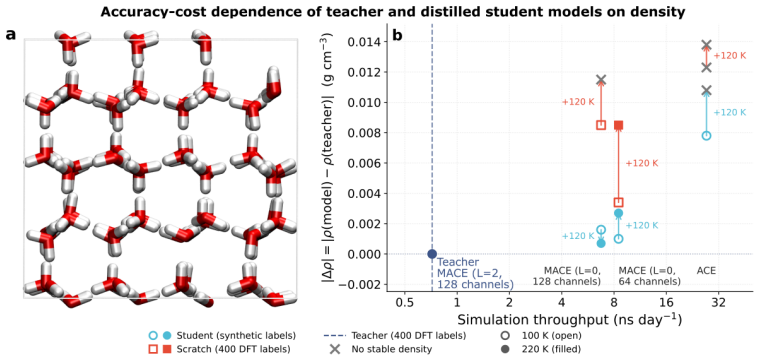
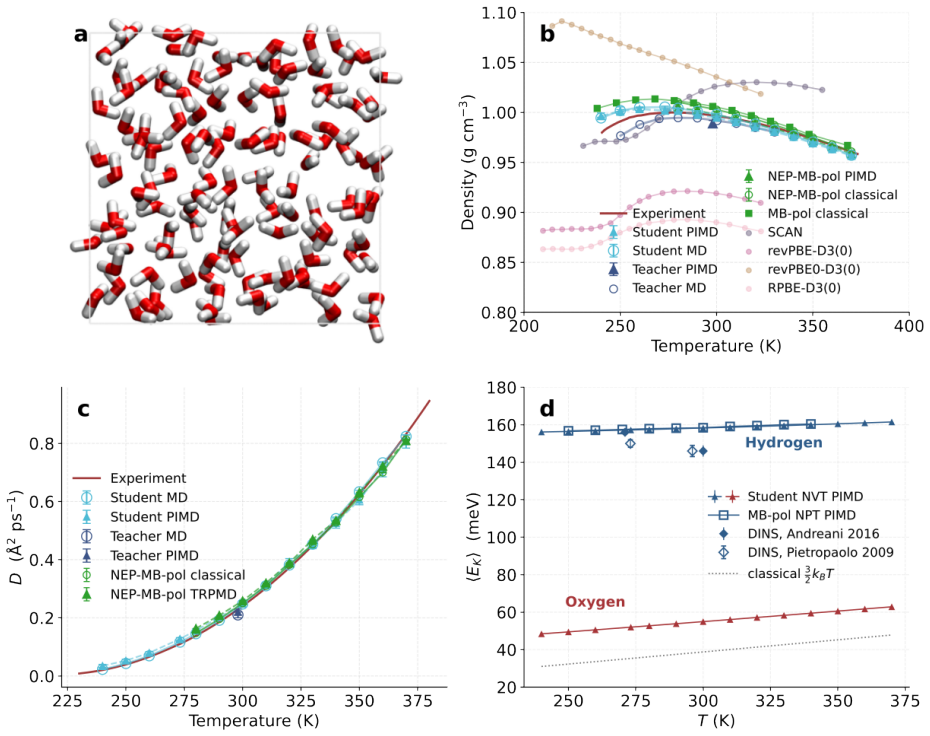
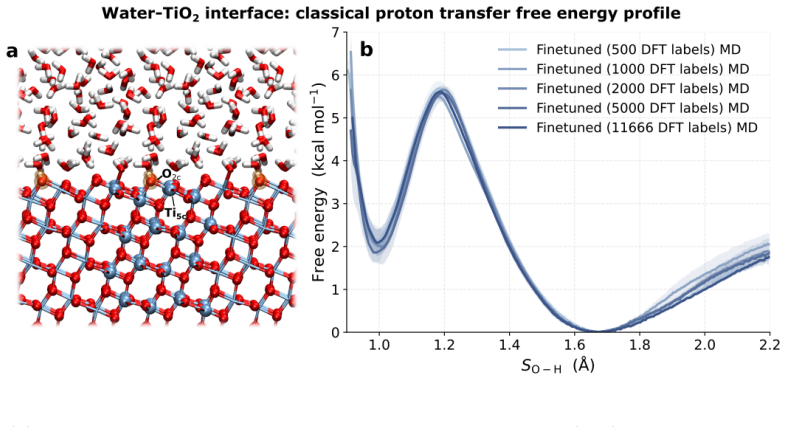
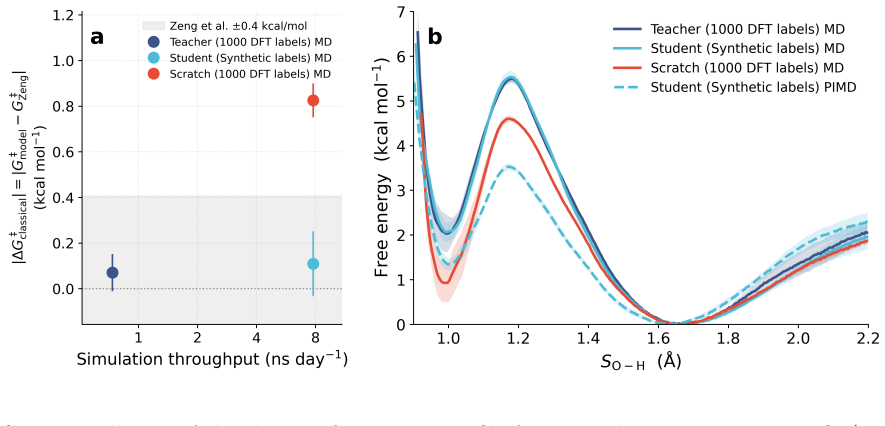
The central claim is that compact student models obtained by knowledge distillation from larger transfer-learned teachers reproduce the target observables of their teachers more reliably than models of the same size trained directly on the limited reference data, as demonstrated for NPT simulations of ice Ih, classical and path-integral simulations of liquid water over 240-370 K, and path-integral umbrella sampling of water dissociation at the anatase TiO2(101)/water interface.
What carries the argument
Knowledge distillation from transfer-learned teacher models to compact student models for machine learning interatomic potentials.
If this is right
- The liquid-water student reproduces thermodynamic, structural, transport, and nuclear quantum properties over the full temperature range studied.
- Distillation makes PIMD umbrella sampling practical at the TiO2/water interface and shows nuclear quantum effects lower the dissociation barrier by roughly 2 kcal/mol while shifting the molecular-dissociated free energy difference into agreement with solid-state 17O NMR measurements.
- Students reduce production simulation cost by roughly an order of magnitude compared with the teachers.
- The method applies across problems of increasing sampling complexity from finite-temperature NPT simulations to reaction free-energy calculations.
Where Pith is reading between the lines
- The same distillation step could be applied to other condensed-phase systems once suitable teachers exist.
- It may reduce the volume of high-level reference calculations needed when building accurate potentials for new materials.
- The workflow could be tested on catalytic reactions beyond water dissociation to check whether the cost reduction scales to more complex interfaces.
Load-bearing premise
The teacher models obtained via transfer learning already deliver first-principles accuracy on the condensed-phase systems, and this accuracy transfers to students via distillation without introducing systematic biases that affect the target observables.
What would settle it
A side-by-side test in which a student model deviates from an experimental observable by more than the teacher while a same-size model trained directly on the reference data matches the teacher as closely as the distilled student does.
Figures
read the original abstract
Accurate machine learning interatomic potentials (MLIPs) have made first-principles-quality potential energy surfaces increasingly accessible for condensed-phase chemistry, but their inference cost can still limit the sampling needed to compute experimentally relevant observables. In this work, we combine transfer learning and knowledge distillation to construct compact "student" models that retain the accuracy of much larger "teacher" models obtained by applying transfer learning to foundation models. The resulting students reduce production simulation cost by roughly an order of magnitude, making high-accuracy sampling practical for challenging condensed-phase problems. We demonstrate this across three problems of increasing sampling complexity: finite-temperature NPT simulations of ice Ih, classical and path-integral simulations of liquid water over 240-370 K, and path-integral umbrella-sampling simulations of water dissociation at the anatase TiO2(101)/water interface. In all cases, the distilled students reproduce the target observables of their teachers more reliably than models of the same size trained directly on the limited reference data. The liquid-water student, distilled from a {\Delta}-learned CCSD(T)-quality teacher, reproduces thermodynamic, structural, transport, and nuclear quantum properties over the full temperature range studied. At the TiO2/water interface, distillation makes PIMD umbrella sampling practical and shows that nuclear quantum effects lower the dissociation barrier by roughly 2 kcal/mol and shift the molecular-dissociated free energy difference into quantitative agreement with recent solid-state 17O NMR measurements. Our work demonstrates how knowledge distillation can make accurate MLIPs practical for the sampling methods needed to connect condensed-phase reaction thermodynamics with experiment, notably for interfacial chemistry and catalysis.
Editorial analysis
A structured set of objections, weighed in public.
Referee Report
Summary. The paper claims that transfer learning from foundation models combined with Δ-learning produces high-accuracy teacher MLIPs, which can then be distilled into compact student models that reproduce target observables (thermodynamics, structure, transport, NQEs) more reliably than same-size models trained directly on limited reference data. Demonstrations cover NPT simulations of ice Ih, classical/PIMD liquid water (240-370 K), and PIMD umbrella sampling of water dissociation at the anatase TiO2(101)/water interface, where the distilled student enables practical sampling and yields NQE-induced barrier lowering of ~2 kcal/mol with quantitative agreement to solid-state 17O NMR.
Significance. If the premise that the Δ-learned teachers deliver unbiased first-principles accuracy on condensed-phase observables holds, the approach would make high-accuracy sampling practical for systems requiring extensive configuration space exploration, such as interfacial reactions, by reducing inference cost by an order of magnitude while preserving teacher fidelity. The multi-system demonstration including path-integral methods and direct experimental comparison is a strength.
major comments (2)
- [Abstract / Teacher model construction] Abstract and teacher-construction sections: the central claim that distilled students outperform direct training because they inherit first-principles accuracy requires independent verification that the teachers themselves are free of systematic errors in many-body or long-range regimes for the condensed-phase targets. No quantitative benchmarks against direct CCSD(T) cluster calculations, experimental RDFs, or diffusion constants for the teachers are referenced; without these, superiority over direct training on limited data could be an artifact of training on a flawed teacher rather than a genuine distillation benefit.
- [TiO2/water interface results] Results on TiO2/water interface: the reported ~2 kcal/mol NQE lowering of the dissociation barrier and shift into quantitative agreement with 17O NMR must be supported by explicit free-energy difference values, statistical uncertainties, and convergence checks for both teacher and student; if these are absent or rely solely on the teacher without cross-validation, the experimental match cannot be attributed unambiguously to distillation.
minor comments (1)
- [Abstract] Abstract lacks any numerical error metrics, data-set sizes, or validation protocols for the student-teacher comparisons, making it difficult to assess the strength of the reported superiority.
Simulated Author's Rebuttal
We thank the referee for the constructive feedback and for recognizing the potential impact of the distillation approach. Below we respond point-by-point to the two major comments, providing the strongest honest defense supported by the manuscript while acknowledging where additional clarification or revision is warranted.
read point-by-point responses
-
Referee: [Abstract / Teacher model construction] Abstract and teacher-construction sections: the central claim that distilled students outperform direct training because they inherit first-principles accuracy requires independent verification that the teachers themselves are free of systematic errors in many-body or long-range regimes for the condensed-phase targets. No quantitative benchmarks against direct CCSD(T) cluster calculations, experimental RDFs, or diffusion constants for the teachers are referenced; without these, superiority over direct training on limited data could be an artifact of training on a flawed teacher rather than a genuine distillation benefit.
Authors: The Δ-learning procedure used to construct the teachers is explicitly designed to remove systematic errors of the base foundation model toward CCSD(T) quality on the target systems; this is documented in the methods and supported by the cited prior work on the same Δ-learning protocol. Direct CCSD(T) calculations on the full condensed-phase configurations remain computationally prohibitive, which is precisely why the distillation strategy is valuable. The manuscript demonstrates that students distilled from these teachers systematically outperform same-size models trained directly on the identical limited reference data across multiple observables, providing evidence that the benefit arises from the higher-fidelity teacher target rather than from an artifact. To address the referee’s concern, we will add explicit cross-references in the revised manuscript to the quantitative CCSD(T) cluster benchmarks and experimental comparisons already reported for the teacher-construction methodology in our prior publications. revision: partial
-
Referee: [TiO2/water interface results] Results on TiO2/water interface: the reported ~2 kcal/mol NQE lowering of the dissociation barrier and shift into quantitative agreement with 17O NMR must be supported by explicit free-energy difference values, statistical uncertainties, and convergence checks for both teacher and student; if these are absent or rely solely on the teacher without cross-validation, the experimental match cannot be attributed unambiguously to distillation.
Authors: We agree that explicit numerical values, error bars, and convergence diagnostics are required for unambiguous attribution. The current manuscript reports the NQE-induced barrier lowering as “roughly 2 kcal/mol” and states quantitative agreement with NMR; in the revised version we will expand the relevant results section (and associated supplementary figures) to tabulate the precise free-energy differences ΔF with statistical uncertainties obtained from both teacher and student PIMD umbrella sampling, together with the block-averaging and convergence checks performed for each. This will allow readers to verify that the reported NQE shift and experimental agreement are reproduced by the distilled student at the same level of statistical rigor as the teacher. revision: yes
Circularity Check
No significant circularity detected
full rationale
The paper presents an empirical methodology combining transfer learning and knowledge distillation to create compact student MLIPs from larger teacher models. Central claims rest on direct comparisons of student performance against both the teacher models and equivalently sized models trained directly on reference data, with validation against external experimental observables such as 17O NMR measurements. No equations, predictions, or uniqueness claims reduce by construction to fitted parameters, self-definitions, or self-citation chains. The superiority of distillation is demonstrated through independent testing rather than being forced by the training procedure itself. The derivation chain is self-contained against external benchmarks.
Axiom & Free-Parameter Ledger
free parameters (2)
- student model architecture and size
- distillation hyperparameters
axioms (2)
- domain assumption Transfer learning from foundation models yields CCSD(T)-quality teachers for the condensed-phase systems studied.
- domain assumption The limited reference data is representative of the target condensed-phase observables.
Reference graph
Works this paper leans on
-
[1]
V. L. Deringer, A. P. Bart´ ok, N. Bernstein, D. M. Wilkins, M. Ceriotti, and G. Cs´ anyi, Chemical Reviews121, 10073 (2021)
2021
-
[2]
Behler, Chemical Reviews121, 10037 (2021)
J. Behler, Chemical Reviews121, 10037 (2021)
2021
-
[3]
Y. Zuo, C. Chen, X. Li, Z. Deng, Y. Chen, J. Behler, G. Cs´ anyi, A. V. Shapeev, A. P. Thompson, M. A. Wood, and S. P. Ong, The Journal of Physical Chemistry A124, 731 (2020)
2020
-
[4]
X. Fu, Z. Wu, W. Wang, T. Xie, S. Keten, R. Gomez-Bombarelli, and T. Jaakkola, Trans- actions on Machine Learning Research (2023)
2023
-
[5]
Leimeroth, L
N. Leimeroth, L. C. Erhard, K. Albe, and J. Rohrer, Modelling and Simulation in Materials Science and Engineering33, 065012 (2025)
2025
-
[6]
Wines and K
D. Wines and K. Choudhary, ACS Materials Letters7, 2105 (2025)
2025
-
[7]
D. E. Shaw, P. Maragakis, K. Lindorff-Larsen, S. Piana, R. O. Dror, M. P. Eastwood, J. A. Bank, J. M. Jumper, J. K. Salmon, Y. Shan, and W. Wriggers, Science330, 341 (2010)
2010
-
[8]
H´ enin, T
J. H´ enin, T. Leli` evre, M. R. Shirts, O. Valsson, and L. Delemotte, Living Journal of Com- putational Molecular Science4, 1583 (2022)
2022
-
[9]
T. E. Markland and M. Ceriotti, Nature Reviews Chemistry2, 0109 (2018)
2018
-
[10]
R. Jacobs, D. Morgan, S. Attarian, J. Meng, C. Shen, Z. Wu, C. Y. Xie, J. H. Yang, N. Artrith, B. Blaiszik, G. Ceder, K. Choudhary, G. Csanyi, E. D. Cubuk, B. Deng, R. Drautz, X. Fu, J. Godwin, V. Honavar, O. Isayev, A. Johansson, B. Kozinsky, S. Mar- tiniani, S. P. Ong, I. Poltavsky, K. J. Schmidt, S. Takamoto, A. Thompson, J. Westermayr, and B. M. Wood,...
arXiv 2025
-
[11]
Batzner, A
S. Batzner, A. Musaelian, L. Sun, M. Geiger, J. P. Mailoa, M. Kornbluth, N. Molinari, T. E. Smidt, and B. Kozinsky, Nature Communications13, 2453 (2022)
2022
-
[12]
Batatia, D
I. Batatia, D. P. Kovacs, G. N. C. Simm, C. Ortner, and G. Csanyi, inAdvances in Neural Information Processing Systems, edited by A. H. Oh, A. Agarwal, D. Belgrave, and K. Cho (2022)
2022
-
[13]
Thrun, inAdvances in Neural Information Processing Systems, Vol
S. Thrun, inAdvances in Neural Information Processing Systems, Vol. 8 (MIT Press, 1995). 29
1995
-
[14]
J. S. Smith, B. T. Nebgen, R. Zubatyuk, N. Lubbers, C. Devereux, K. Barros, S. Tretiak, O. Isayev, and A. E. Roitberg, Nature Communications10, 2903 (2019)
2019
-
[15]
M. S. Chen, J. Lee, H.-Z. Ye, T. C. Berkelbach, D. R. Reichman, and T. E. Markland, Journal of Chemical Theory and Computation19, 4510 (2023)
2023
-
[16]
Ramakrishnan, P
R. Ramakrishnan, P. O. Dral, M. Rupp, and O. A. von Lilienfeld, Journal of Chemical Theory and Computation11, 2087 (2015)
2087
-
[17]
Nandi, C
A. Nandi, C. Qu, P. L. Houston, R. Conte, and J. M. Bowman, The Journal of Chemical Physics154, 051102 (2021)
2021
-
[18]
J. Daru, H. Forbert, J. Behler, and D. Marx, Physical Review Letters129, 226001 (2022)
2022
-
[19]
O’Neill, B
N. O’Neill, B. X. Shi, W. J. Baldwin, W. C. Witt, G. Cs´ anyi, J. D. Gale, A. Michaelides, and C. Schran, Journal of Chemical Theory and Computation21, 11710 (2025)
2025
-
[20]
C. Qu, A. Nandi, P. L. Houston, Q. Yu, R. Conte, and J. M. Bowman, The Journal of Physical Chemistry Letters16, 12393 (2025)
2025
-
[21]
H. Kaur, F. D. Pia, I. Batatia, X. R. Advincula, B. X. Shi, J. Lan, G. Cs´ anyi, A. Michaelides, and V. Kapil, Faraday Discussions256, 120 (2025)
2025
-
[22]
Fine-tuning foun- dation models of materials interatomic potentials with frozen transfer learning,
M. Radova, W. G. Stark, C. S. Allen, R. J. Maurer, and A. P. Bart´ ok, “Fine-tuning foun- dation models of materials interatomic potentials with frozen transfer learning,” (2025), arXiv:2502.15582 [cond-mat]
arXiv 2025
-
[23]
Novelli, G
P. Novelli, G. Meanti, P. J. Buigues, L. Rosasco, M. Parrinello, M. Pontil, and L. Bonati, npj Computational Materials11, 293 (2025)
2025
-
[24]
The Good, the Bad, and the Ugly of Atom- istic Learning for
M. J. Gawkowski, M. Li, B. X. Shi, and V. Kapil, “The Good, the Bad, and the Ugly of Atom- istic Learning for ”Clusters-to-Bulk” Generalization,” (2025), arXiv:2509.16601 [physics]
arXiv 2025
-
[25]
X. Liu, K. Zeng, Z. Luo, Y. Wang, T. Zhao, and Z. Xu, Journal of Applied Physics139 (2026), 10.1063/5.0299305
-
[26]
M.-P. V. Christiansen and B. Hammer, The Journal of Chemical Physics162, 184701 (2025)
2025
-
[27]
Pitfield, M.-P
J. Pitfield, M.-P. V. Christiansen, and B. Hammer, Physical Chemistry Chemical Physics 28, 912 (2026)
2026
-
[28]
Chanussot, A
L. Chanussot, A. Das, S. Goyal, T. Lavril, M. Shuaibi, M. Riviere, K. Tran, J. Heras- Domingo, C. Ho, W. Hu, A. Palizhati, A. Sriram, B. Wood, J. Yoon, D. Parikh, C. L. Zitnick, and Z. Ulissi, ACS Catalysis11, 6059 (2021)
2021
-
[29]
Chen and S
C. Chen and S. P. Ong, Nature Computational Science2, 718 (2022). 30
2022
-
[30]
B. Deng, P. Zhong, K. Jun, J. Riebesell, K. Han, C. J. Bartel, and G. Ceder, Nature Machine Intelligence5, 1031 (2023)
2023
-
[31]
Y. Park, J. Kim, S. Hwang, and S. Han, Journal of Chemical Theory and Computation20, 4857 (2024)
2024
-
[32]
Batatia, P
I. Batatia, P. Benner, Y. Chiang, A. M. Elena, D. P. Kov´ acs, J. Riebesell, X. R. Advincula, M. Asta, M. Avaylon, W. J. Baldwin, F. Berger, N. Bernstein, A. Bhowmik, F. Bigi, S. M. Blau, V. C˘ arare, M. Ceriotti, S. Chong, J. P. Darby, S. De, F. Della Pia, V. L. Deringer, R. Elijoˇ sius, Z. El-Machachi, E. Fako, F. Falcioni, A. C. Ferrari, J. L. A. Gardn...
2025
-
[33]
E. C.-Y. Yuan, Y. Liu, J. Chen, P. Zhong, S. Raja, T. Kreiman, S. Vargas, W. Xu, M. Head- Gordon, C. Yang, S. M. Blau, B. Cheng, A. Krishnapriyan, and T. Head-Gordon, Nature Reviews Chemistry10, 212 (2026)
2026
-
[34]
UMA: A Family of Universal Models for Atoms,
B. M. Wood, M. Dzamba, X. Fu, M. Gao, M. Shuaibi, L. Barroso-Luque, K. Abdelmaqsoud, V. Gharakhanyan, J. R. Kitchin, D. S. Levine, K. Michel, A. Sriram, T. Cohen, A. Das, A. Rizvi, S. J. Sahoo, Z. W. Ulissi, and C. L. Zitnick, “UMA: A Family of Universal Models for Atoms,” (2026), arXiv:2506.23971 [cs]
arXiv 2026
-
[35]
Cheng, G
B. Cheng, G. Mazzola, C. J. Pickard, and M. Ceriotti, Nature585, 217 (2020)
2020
-
[36]
Kapil, C
V. Kapil, C. Schran, A. Zen, J. Chen, C. J. Pickard, and A. Michaelides, Nature609, 512 (2022)
2022
-
[37]
Qamar, M
M. Qamar, M. Mrovec, Y. Lysogorskiy, A. Bochkarev, and R. Drautz, Journal of Chemical Theory and Computation19, 5151 (2023). 31
2023
-
[38]
J. T. Willman, R. Perriot, and C. Ticknor, The Journal of Chemical Physics161, 064303 (2024)
2024
-
[39]
K. Song, R. Zhao, J. Liu, Y. Wang, E. Lindgren, Y. Wang, S. Chen, K. Xu, T. Liang, P. Ying, N. Xu, Z. Zhao, J. Shi, J. Wang, S. Lyu, Z. Zeng, S. Liang, H. Dong, L. Sun, Y. Chen, Z. Zhang, W. Guo, P. Qian, J. Sun, P. Erhart, T. Ala-Nissila, Y. Su, and Z. Fan, Nature Communications15, 10208 (2024)
2024
-
[40]
X. Zhou, Y. Liu, B. Tang, J. Wang, H. Dong, X. Xiu, S. Chen, and Z. Fan, Journal of Applied Physics137, 014305 (2025)
2025
-
[41]
Buciluˇ a, R
C. Buciluˇ a, R. Caruana, and A. Niculescu-Mizil, inProceedings of the 12th ACM SIGKDD International Conference on Knowledge Discovery and Data Mining, KDD ’06 (Association for Computing Machinery, New York, NY, USA, 2006) pp. 535–541
2006
-
[42]
Distilling the Knowledge in a Neural Network,
G. Hinton, O. Vinyals, and J. Dean, “Distilling the Knowledge in a Neural Network,” (2015), arXiv:1503.02531 [stat]
Pith/arXiv arXiv 2015
-
[43]
J. Gou, B. Yu, S. J. Maybank, and D. Tao, International Journal of Computer Vision129, 1789 (2021)
2021
-
[44]
I. Amin, S. Raja, and A. Krishnapriyan, “Towards Fast, Specialized Machine Learning Force Fields: Distilling Foundation Models via Energy Hessians,” (2025), arXiv:2501.09009 [physics]
arXiv 2025
-
[45]
Cattin, T
C. Cattin, T. Pl´ e, O. Adjoua, N. Gouraud, L. Lagard` ere, and J.-P. Piquemal, The Journal of Physical Chemistry Letters17, 1288 (2026)
2026
-
[46]
N. Gouraud, C. Cattin, T. Pl´ e, O. Adjoua, L. Lagard` ere, and J.-P. Piquemal, “Faster Molecular Dynamics with Neural Network Potentials via Distilled Multiple Time-Stepping and Non-Conservative Forces,” (2026), arXiv:2602.14975 [physics]
Pith/arXiv arXiv 2026
-
[47]
N. Matsumura, Y. Yoshimoto, Y. Iwasaki, M. Yamazaki, and Y. Sakai, “Knowledge Distilla- tion Framework for Accelerating High-Accuracy Neural Network-Based Molecular Dynamics Simulations,” (2025), arXiv:2506.15337 [cs]
arXiv 2025
-
[48]
Distillation of atomistic foundation models across architectures and chemical domains,
J. L. A. Gardner, D. F. T. du Toit, C. B. Mahmoud, Z. F. Beaulieu, V. Juraskova, L.- B. Pa¸ sca, L. A. M. Rosset, F. Duarte, F. Martelli, C. J. Pickard, and V. L. Deringer, “Distillation of atomistic foundation models across architectures and chemical domains,” (2025), arXiv:2506.10956 [physics]. 32
arXiv 2025
-
[49]
F. D. Pia, B. X. Shi, V. Kapil, A. Zen, D. Alf` e, and A. Michaelides, Chemical Science16, 11419 (2025)
2025
-
[50]
Magd˘ au, D
I.-B. Magd˘ au, D. J. Arismendi-Arrieta, H. E. Smith, C. P. Grey, K. Hermansson, and G. Cs´ anyi, npj Computational Materials9, 146 (2023)
2023
-
[51]
Montero de Hijes, C
P. Montero de Hijes, C. Dellago, R. Jinnouchi, and G. Kresse, The Journal of Chemical Physics161, 131102 (2024)
2024
-
[52]
Holten, C
V. Holten, C. E. Bertrand, M. A. Anisimov, and J. V. Sengers, The Journal of Chemical Physics136, 094507 (2012)
2012
-
[53]
D. E. Hare and C. M. Sorensen, The Journal of Chemical Physics87, 4840 (1987)
1987
-
[54]
D. R. Lide,CRC Handbook of Chemistry and Physics, 85th Edition(CRC Press, 2004)
2004
-
[55]
Grimme, J
S. Grimme, J. Antony, S. Ehrlich, and H. Krieg, The Journal of Chemical Physics132, 154104 (2010)
2010
-
[56]
Yeh and G
I.-C. Yeh and G. Hummer, The Journal of Physical Chemistry B108, 15873 (2004)
2004
-
[57]
M. Holz, S. R. Heil, and A. Sacco, Physical Chemistry Chemical Physics (2000), 10.1039/b005319h
-
[58]
W. S. Price, H. Ide, and Y. Arata, The Journal of Physical Chemistry A103, 448 (1999)
1999
-
[59]
Kapil, A
V. Kapil, A. Cuzzocrea, and M. Ceriotti, The Journal of Physical Chemistry B122, 6048 (2018)
2018
-
[60]
Andreani, G
C. Andreani, G. Romanelli, and R. Senesi, The Journal of Physical Chemistry Letters7, 2216 (2016)
2016
-
[61]
Pietropaolo, R
A. Pietropaolo, R. Senesi, C. Andreani, and J. Mayers, Brazilian Journal of Physics39, 318 (2009)
2009
-
[62]
Ceriotti, J
M. Ceriotti, J. Cuny, M. Parrinello, and D. E. Manolopoulos, Proceedings of the National Academy of Sciences110, 15591 (2013)
2013
-
[63]
M. J. Gillan, D. Alf` e, and A. Michaelides, The Journal of Chemical Physics144, 130901 (2016)
2016
-
[64]
Palos, E
E. Palos, E. F. Bull-Vulpe, X. Zhu, H. Agnew, S. Gupta, S. Saha, and F. Paesani, Journal of Chemical Theory and Computation20, 9269 (2024)
2024
-
[65]
K. Xu, T. Liang, N. Xu, P. Ying, S. Chen, N. Wei, J. Xu, and Z. Fan, npj Computational Materials11, 279 (2025)
2025
-
[66]
Marsalek and T
O. Marsalek and T. E. Markland, The Journal of Physical Chemistry Letters8, 1545 (2017). 33
2017
-
[67]
Cheng, J
B. Cheng, J. Behler, and M. Ceriotti, The Journal of Physical Chemistry Letters7, 2210 (2016)
2016
-
[68]
Z. Zeng, F. Wodaczek, K. Liu, F. Stein, J. Hutter, J. Chen, and B. Cheng, Nature Commu- nications14, 6131 (2023)
2023
-
[69]
Fujishima and K
A. Fujishima and K. Honda, Nature238, 37 (1972)
1972
-
[70]
T. L. Thompson and J. T. Yates, Chemical Reviews106, 4428 (2006)
2006
-
[71]
Zhang, B
B. Zhang, B. Sun, F. Liu, T. Gao, and G. Zhou, Science China Materials67, 424 (2024)
2024
-
[72]
Y. Lai, J. Huang, Z. Cui, M. Ge, K.-Q. Zhang, Z. Chen, and L. Chi, Small12, 2203 (2016)
2016
-
[73]
K. Liu, M. Cao, A. Fujishima, and L. Jiang, Chemical Reviews114, 10044 (2014)
2014
-
[74]
Jafari, B
S. Jafari, B. Mahyad, H. Hashemzadeh, S. Janfaza, T. Gholikhani, and L. Tayebi, Interna- tional Journal of Nanomedicine15, 3447 (2020)
2020
-
[75]
Kumar, N
N. Kumar, N. S. Chauhan, A. Mittal, and S. Sharma, BioMetals31, 147 (2018)
2018
-
[76]
M. A. Henderson, Surface Science Reports46, 1 (2002)
2002
-
[77]
Diebold, Surface Science Reports48, 53 (2003)
U. Diebold, Surface Science Reports48, 53 (2003)
2003
-
[78]
Ketteler, S
G. Ketteler, S. Yamamoto, H. Bluhm, K. Andersson, D. E. Starr, D. F. Ogletree, H. Oga- sawara, A. Nilsson, and M. Salmeron, The Journal of Physical Chemistry C111, 8278 (2007)
2007
-
[79]
M. F. C. Andrade, H.-Y. Ko, L. Zhang, R. Car, and A. Selloni, Chemical Science11, 2335 (2020)
2020
-
[80]
L. Wang, M. Ceriotti, and T. E. Markland, The Journal of Chemical Physics141, 104502 (2014)
2014
discussion (0)
Sign in with ORCID, Apple, or X to comment. Anyone can read and Pith papers without signing in.