CoMetaPNS: Continually Meta-learning Personalized Neural Surrogates for Cardiac Electrophysiology Simulations
Pith reviewed 2026-06-27 22:21 UTC · model grok-4.3
The pith
A continual Bayesian Gaussian Mixture Model over a memory buffer lets meta-learned neural surrogates personalize cardiac simulations from sequential unlabeled data without catastrophic forgetting.
A machine-rendered reading of the paper's core claim, the machinery that carries it, and where it could break.
Core claim
By leveraging a continual Bayesian Gaussian Mixture Model over a memory buffer, the framework can infer the identifiers and relationships of data over time, enabling effective continual meta-learning for personalized neural surrogates in cardiac electrophysiology simulations that integrate new information without requiring explicit task identifiers or full prior data access.
What carries the argument
Continual Bayesian Gaussian Mixture Model over a memory buffer that clusters sequential data to infer task identifiers and relationships for meta-learning.
If this is right
- Superior simulation forecasting accuracy on synthetic cardiac data relative to baselines that require full retraining.
- Improved computational scalability by avoiding repeated training on all accumulated data.
- Resilience to catastrophic forgetting when new unlabeled data sources arrive sequentially.
- Effective operation on unlabeled sequential data without needing explicit task boundaries.
Where Pith is reading between the lines
- The same memory-buffered clustering step could support continual meta-learning in other simulation domains that receive streaming personalized data.
- Automatic source identification may lessen dependence on hand-labeled task boundaries across continual learning applications.
- Empirical checks on real rather than synthetic cardiac recordings would reveal whether clustering accuracy survives natural physiological variability.
Load-bearing premise
The approach assumes that a continual Bayesian Gaussian Mixture Model can reliably cluster and identify data sources over time from a memory buffer without explicit task identifiers or full prior data access.
What would settle it
A test showing that the Bayesian mixture model assigns a large fraction of new data to incorrect clusters or fails to flag novel sources, producing degraded personalization accuracy on both recent and earlier cardiac simulation tasks.
Figures
read the original abstract
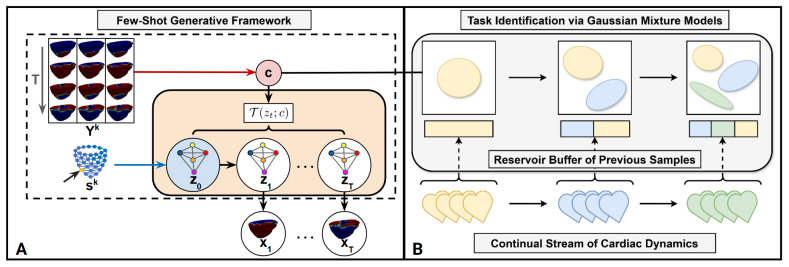
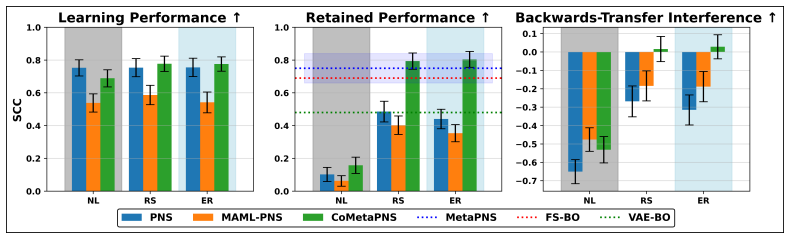
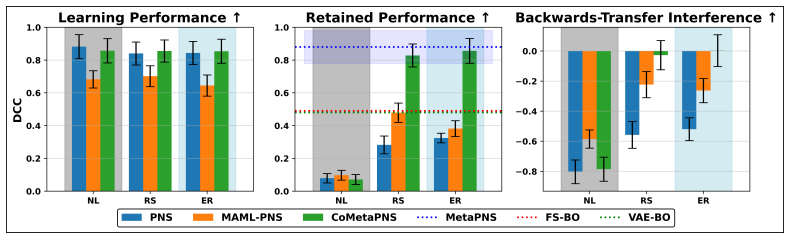
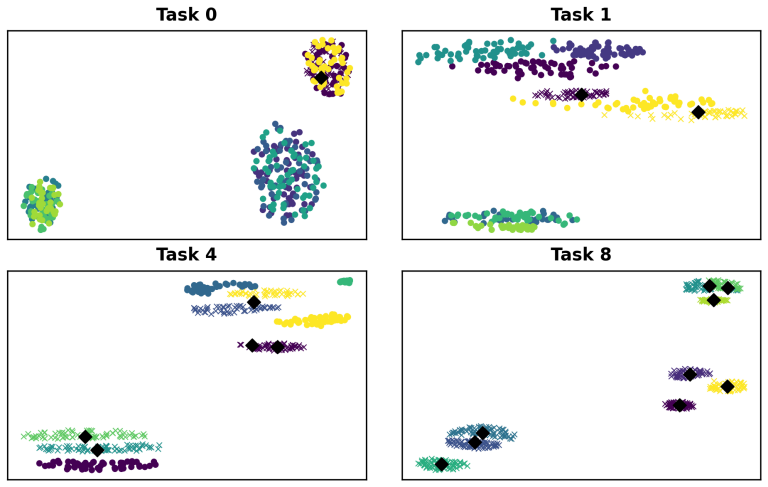
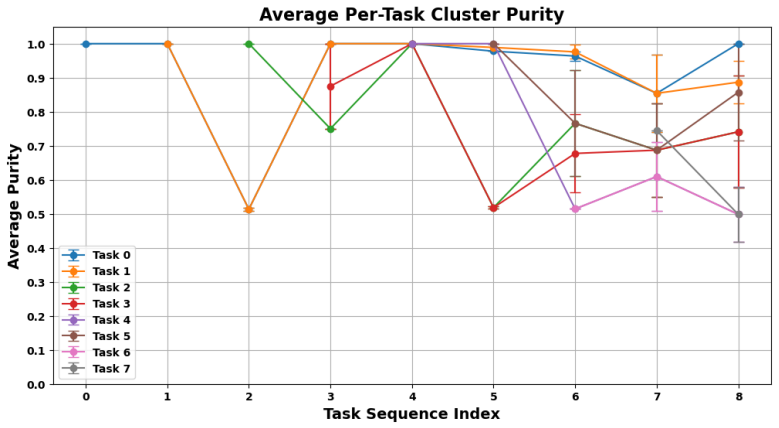
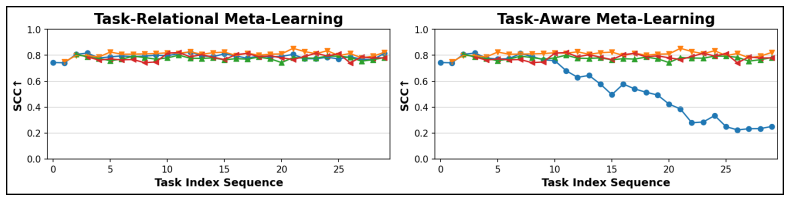
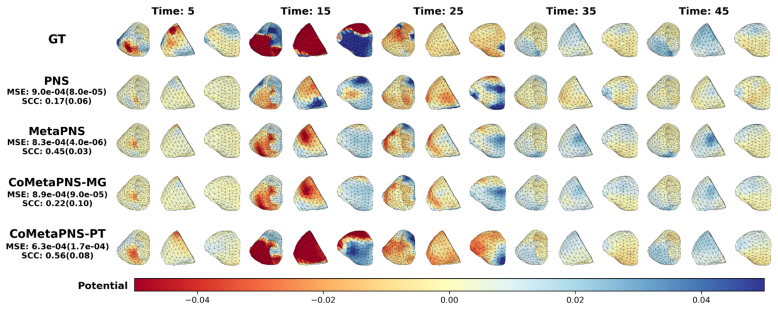
Personalized virtual heart simulations face challenges in model personalization and computational cost. While neural surrogates offer state-of-the-art solutions, they typically address either efficient personalization or training generalizable models. Recent work reframes this by learning the process of personalizing a surrogate using limited subject-specific context data, through few-shot generative modeling with set-conditioned surrogates and meta-learned amortized inference. These methods, however, assume a static and diverse training distribution with known task identifiers. When new data becomes available, they require costly retraining with all prior data to avoid catastrophic forgetting - a phenomena where the model forgets earlier tasks when trained on new ones. This is a major limitation in clinical settings where often unlabeled data arrives sequentially and full retraining is infeasible. This paper presents a new continual meta-learning framework to achieve personalized neural surrogates able to not only continually integrate information but also identify whether incoming data stems from a known or unknown dynamics source. By leveraging a continual Bayesian Gaussian Mixture Model over a memory buffer, our framework can infer the identifiers and relationships of data over time - required for effective meta-learning. Empirical results on synthetic cardiac data demonstrate superior simulation forecasting, computational scalability, and resilience to catastrophic forgetting compared to existing baselines.
Editorial analysis
A structured set of objections, weighed in public.
Referee Report
Summary. The paper presents CoMetaPNS, a continual meta-learning framework for personalized neural surrogates in cardiac electrophysiology. It addresses limitations of prior few-shot generative modeling approaches by handling sequential unlabeled data without task identifiers or full retraining, using a continual Bayesian Gaussian Mixture Model over a memory buffer to infer data identifiers and relationships. This enables ongoing integration while avoiding catastrophic forgetting. The framework is evaluated on synthetic cardiac data, where it reportedly outperforms baselines in simulation forecasting accuracy, computational scalability, and forgetting resistance.
Significance. If the empirical claims hold after addressing validation gaps, the work would meaningfully extend meta-learning techniques to continual settings in a high-stakes domain, directly tackling the retraining infeasibility noted in clinical personalization workflows. The explicit handling of unknown dynamics sources via the memory-buffered GMM is a targeted contribution, and the focus on synthetic data allows controlled testing of the continual aspect. However, the absence of real patient data or detailed controls limits translational significance until further validation.
major comments (2)
- [Abstract] Abstract: the central claim that the continual Bayesian GMM over a memory buffer 'can infer the identifiers and relationships of data over time - required for effective meta-learning' is load-bearing, yet no clustering accuracy metrics, ablation on mixture components, or validation against ground-truth dynamics sources are reported; without this, it is impossible to confirm that gains in forecasting and forgetting resistance arise from successful identification rather than other components.
- [Abstract] Abstract (empirical results paragraph): the superiority claims for 'simulation forecasting, computational scalability, and resilience to catastrophic forgetting' rest on synthetic data only, but the abstract supplies no baseline methods, quantitative metrics (e.g., MSE, forgetting measure), number of sequential tasks, or controls for buffer size and mixture components; this prevents assessment of whether the data supports the framework's advantages.
minor comments (1)
- [Abstract] The abstract would be clearer if it briefly defined the memory buffer size and number of mixture components used in the reported experiments.
Simulated Author's Rebuttal
We thank the referee for the constructive feedback on our manuscript. The comments highlight opportunities to strengthen the abstract's clarity and supporting evidence. We respond to each major comment below and will revise the manuscript accordingly.
read point-by-point responses
-
Referee: [Abstract] Abstract: the central claim that the continual Bayesian GMM over a memory buffer 'can infer the identifiers and relationships of data over time - required for effective meta-learning' is load-bearing, yet no clustering accuracy metrics, ablation on mixture components, or validation against ground-truth dynamics sources are reported; without this, it is impossible to confirm that gains in forecasting and forgetting resistance arise from successful identification rather than other components.
Authors: We acknowledge that direct metrics on the clustering performance of the Bayesian GMM (such as accuracy against ground-truth task identifiers in the synthetic setup) are not reported in the abstract and would provide stronger evidence for the mechanism. The manuscript's primary evaluations focus on end-to-end performance in forecasting accuracy and forgetting resistance as indirect validation of the identification process. To address this concern, we will add clustering accuracy results, an ablation on the number of mixture components, and explicit validation against known dynamics sources in a revised version of the paper, including updates to the abstract. revision: yes
-
Referee: [Abstract] Abstract (empirical results paragraph): the superiority claims for 'simulation forecasting, computational scalability, and resilience to catastrophic forgetting' rest on synthetic data only, but the abstract supplies no baseline methods, quantitative metrics (e.g., MSE, forgetting measure), number of sequential tasks, or controls for buffer size and mixture components; this prevents assessment of whether the data supports the framework's advantages.
Authors: We agree that the abstract is concise and omits specific experimental details such as exact baseline names, quantitative values (e.g., MSE or forgetting measures), the number of sequential tasks, and controls for buffer size or mixture components. These details are provided in the experimental sections of the full manuscript, where we compare against relevant baselines on synthetic cardiac data with known ground-truth dynamics. We will revise the abstract to incorporate key quantitative metrics, the number of tasks, and mention of controls to better support the claims while maintaining conciseness. The use of synthetic data is intentional to enable controlled evaluation of continual adaptation with verifiable task relationships. revision: yes
Circularity Check
No load-bearing circularity; continual GMM inference is an independent component
full rationale
The paper introduces a continual Bayesian Gaussian Mixture Model over a memory buffer as the mechanism to infer identifiers and relationships from sequential unlabeled data, enabling the meta-learning framework. This is presented as a distinct architectural addition rather than a quantity derived by construction from prior fits, self-citations, or ansatzes. The abstract references recent work on set-conditioned surrogates and meta-learned inference only to contrast assumptions (static distribution, known task IDs), without making the new continual results dependent on those citations. No equations or claims reduce predictions to inputs by definition, and empirical results on synthetic data are offered as external validation. This yields at most a minor self-citation that is not load-bearing for the central claim.
Axiom & Free-Parameter Ledger
free parameters (2)
- memory buffer size
- number of mixture components
axioms (1)
- domain assumption Sequential data arrives from a mixture of unknown dynamics sources that can be modeled by an incrementally updated Bayesian Gaussian Mixture Model.
invented entities (1)
-
Continual Bayesian Gaussian Mixture Model over memory buffer
no independent evidence
Reference graph
Works this paper leans on
-
[1]
M. F. Kasim and D. Watson-Parris and L. Deaconu and S. Oliver and H. Hatfield and D. H. Froula and G. Gregori and M. Jarvis and S. Khatiwala and J. Korenaga and J. Topp-Mugglestone and E. Viezzer and S. M. Vinko , Journal =. Building high accuracy emulators for scientific simulations with deep neural architecture search , pages =
-
[2]
2020 , publisher=
Electromechanical Wave Imaging in the clinic: localization of atrial and ventricular arrhythmias and quantification of cardiac resynchronization therapy response , author=. 2020 , publisher=
2020
-
[3]
Nature biomedical engineering , volume=
Personalized virtual-heart technology for guiding the ablation of infarct-related ventricular tachycardia , author=. Nature biomedical engineering , volume=. 2018 , publisher=
2018
-
[4]
Nature communications , volume=
Arrhythmia risk stratification of patients after myocardial infarction using personalized heart models , author=. Nature communications , volume=. 2016 , publisher=
2016
-
[5]
Chaos, Solitons & Fractals , volume=
A simple two-variable model of cardiac excitation , author=. Chaos, Solitons & Fractals , volume=. 1996 , publisher=
1996
-
[6]
Progress in biophysics and molecular biology , volume=
Electromechanical model of excitable tissue to study reentrant cardiac arrhythmias , author=. Progress in biophysics and molecular biology , volume=. 2004 , publisher=
2004
-
[7]
Philosophical Transactions of the Royal Society A , volume=
Creation and application of virtual patient cohorts of heart models , author=. Philosophical Transactions of the Royal Society A , volume=. 2020 , publisher=
2020
-
[8]
Computers in biology and medicine , volume=
Rethinking multiscale cardiac electrophysiology with machine learning and predictive modelling , author=. Computers in biology and medicine , volume=. 2019 , publisher=
2019
-
[9]
International Conference on Functional Imaging and Modeling of the Heart , pages=
Ep-net 2.0: out-of-domain generalisation for deep learning models of cardiac electrophysiology , author=. International Conference on Functional Imaging and Modeling of the Heart , pages=. 2021 , organization=
2021
-
[10]
Deep Learning for Model Correction in Cardiac Electrophysiological Imaging , author=
-
[11]
Frontiers in physiology , volume=
An Implementation of Patient-Specific Biventricular Mechanics Simulations With a Deep Learning and Computational Pipeline , author=. Frontiers in physiology , volume=. 2021 , publisher=
2021
-
[12]
Frontiers in physiology , volume=
POD-enhanced deep learning-based reduced order models for the real-time simulation of cardiac electrophysiology in the left atrium , author=. Frontiers in physiology , volume=. 2021 , publisher=
2021
-
[13]
Medical image analysis , volume=
Quantifying the uncertainty in model parameters using Gaussian process-based Markov chain Monte Carlo in cardiac electrophysiology , author=. Medical image analysis , volume=. 2018 , publisher=
2018
-
[14]
International Conference on Medical Image Computing and Computer-Assisted Intervention , pages=
Strain-based regional nonlinear cardiac material properties estimation from medical images , author=. International Conference on Medical Image Computing and Computer-Assisted Intervention , pages=. 2012 , organization=
2012
-
[15]
IEEE transactions on biomedical engineering , volume=
Personalization of cardiac motion and contractility from images using variational data assimilation , author=. IEEE transactions on biomedical engineering , volume=. 2011 , publisher=
2011
-
[16]
Journal of the mechanical behavior of biomedical materials , volume=
Velocity-based cardiac contractility personalization from images using derivative-free optimization , author=. Journal of the mechanical behavior of biomedical materials , volume=. 2015 , publisher=
2015
-
[17]
Medical image analysis , volume=
Patient-specific electromechanical models of the heart for the prediction of pacing acute effects in CRT: a preliminary clinical validation , author=. Medical image analysis , volume=. 2012 , publisher=
2012
-
[18]
International Conference on Medical Image Computing and Computer-Assisted Intervention , pages=
Fast data-driven calibration of a cardiac electrophysiology model from images and ECG , author=. International Conference on Medical Image Computing and Computer-Assisted Intervention , pages=. 2013 , organization=
2013
-
[19]
Medical image analysis , volume=
Embedding high-dimensional bayesian optimization via generative modeling: parameter personalization of cardiac electrophysiological models , author=. Medical image analysis , volume=. 2020 , publisher=
2020
-
[20]
International Conference on Medical Image Computing and Computer-Assisted Intervention , pages=
Spatially-adaptive multi-scale optimization for local parameter estimation: application in cardiac electrophysiological models , author=. International Conference on Medical Image Computing and Computer-Assisted Intervention , pages=. 2016 , organization=
2016
-
[21]
IEEE transactions on medical imaging , volume=
Spatially adaptive multi-scale optimization for local parameter estimation in cardiac electrophysiology , author=. IEEE transactions on medical imaging , volume=. 2017 , publisher=
2017
-
[22]
International Conference on Medical Image Computing and Computer-Assisted Intervention , pages=
High-dimensional bayesian optimization of personalized cardiac model parameters via an embedded generative model , author=. International Conference on Medical Image Computing and Computer-Assisted Intervention , pages=. 2018 , organization=
2018
-
[23]
Frontiers in Physiology , volume=
Bayesian Calibration of Electrophysiology Models Using Restitution Curve Emulators , author=. Frontiers in Physiology , volume=. 2021 , publisher=
2021
-
[24]
Medical image analysis , volume=
A self-taught artificial agent for multi-physics computational model personalization , author=. Medical image analysis , volume=. 2016 , publisher=
2016
-
[25]
Artificial Intelligence for Computational Modeling of the Heart , pages=
Machine learning methods for robust parameter estimation , author=. Artificial Intelligence for Computational Modeling of the Heart , pages=. 2020 , publisher=
2020
-
[26]
IEEE Transactions on Biomedical Engineering , volume=
Noninvasive personalization of a cardiac electrophysiology model from body surface potential mapping , author=. IEEE Transactions on Biomedical Engineering , volume=. 2016 , publisher=
2016
-
[27]
arXiv preprint arXiv:2004.05439 , year=
Meta-learning in neural networks: A survey , author=. arXiv preprint arXiv:2004.05439 , year=
-
[28]
International conference on machine learning , pages=
Model-agnostic meta-learning for fast adaptation of deep networks , author=. International conference on machine learning , pages=. 2017 , organization=
2017
-
[29]
International conference on learning representations , year=
Optimization as a model for few-shot learning , author=. International conference on learning representations , year=
-
[30]
Advances in neural information processing systems , volume=
Prototypical networks for few-shot learning , author=. Advances in neural information processing systems , volume=
-
[31]
arXiv preprint arXiv:1805.09921 , year=
Meta-learning probabilistic inference for prediction , author=. arXiv preprint arXiv:1805.09921 , year=
-
[32]
The Variational Homoencoder: Learning to learn high capacity generative models from few examples
The variational homoencoder: Learning to learn high capacity generative models from few examples , author=. arXiv preprint arXiv:1807.08919 , year=
work page internal anchor Pith review Pith/arXiv arXiv
-
[33]
Neural processes , author=. arXiv preprint arXiv:1807.01622 , year=
work page internal anchor Pith review Pith/arXiv arXiv
-
[34]
Auto-Encoding Variational Bayes
Auto-encoding variational bayes , author=. arXiv preprint arXiv:1312.6114 , year=
work page internal anchor Pith review Pith/arXiv arXiv
-
[35]
2009 IEEE International Symposium on Biomedical Imaging: From Nano to Macro , pages=
Tetrahedral mesh generation from volumetric binary and grayscale images , author=. 2009 IEEE International Symposium on Biomedical Imaging: From Nano to Macro , pages=. 2009 , organization=
2009
-
[36]
Triangulated Surface Mesh Simplification , YEAR =
Fernando Cacciola , BOOKTITLE =. Triangulated Surface Mesh Simplification , YEAR =
-
[37]
Proceedings Visualization'98 (Cat
Fast and memory efficient polygonal simplification , author=. Proceedings Visualization'98 (Cat. No. 98CB36276) , pages=. 1998 , organization=
1998
-
[38]
The IEEE Conference on Computer Vision and Pattern Recognition (CVPR) , pages=
SplineCNN: Fast geometric deep learning with continuous B-spline kernels , author=. The IEEE Conference on Computer Vision and Pattern Recognition (CVPR) , pages=
-
[39]
Empirical Evaluation of Gated Recurrent Neural Networks on Sequence Modeling
Empirical evaluation of gated recurrent neural networks on sequence modeling , author=. arXiv preprint arXiv:1412.3555 , year=
work page internal anchor Pith review Pith/arXiv arXiv
-
[40]
International Conference on Medical Image Computing and Computer-Assisted Intervention , pages=
Label-Free Physics-Informed Image Sequence Reconstruction with Disentangled Spatial-Temporal Modeling , author=. International Conference on Medical Image Computing and Computer-Assisted Intervention , pages=. 2021 , organization=
2021
-
[41]
International Conference on Medical Image Computing and Computer-Assisted Intervention , pages=
Learning geometry-dependent and physics-based inverse image reconstruction , author=. International Conference on Medical Image Computing and Computer-Assisted Intervention , pages=. 2020 , organization=
2020
-
[42]
IEEE transactions on systems, man, and cybernetics , volume=
A threshold selection method from gray-level histograms , author=. IEEE transactions on systems, man, and cybernetics , volume=. 1979 , publisher=
1979
-
[43]
Adam: A Method for Stochastic Optimization
Adam: A method for stochastic optimization , author=. arXiv preprint arXiv:1412.6980 , year=
work page internal anchor Pith review Pith/arXiv arXiv
-
[44]
Bergquist and W.W
J.A. Bergquist and W.W. Good and B. Zenger and J.D. Tate and L.C. Rupp and R.S. MacLeod. The electrocardiographic forward problem: A benchmark study. Comput Biol Med. 2021
2021
-
[45]
Multiplicative interactions and where to find them , author =
-
[46]
Advances in Neural Information Processing Systems , publisher =
Meta-Learning Dynamics Forecasting Using Task Inference , author =. Advances in Neural Information Processing Systems , publisher =
-
[47]
International Conference on Machine Learning , pages =
Generalizing to new physical systems via context-informed dynamics model , author =. International Conference on Machine Learning , pages =
-
[48]
Sequential Latent Variable Models for Few-Shot High-Dimensional Time-Series Forecasting , author =
-
[49]
N-BEATS: Neural basis expansion analysis for interpretable time series forecasting , author =
-
[50]
Advances in Neural Information Processing Systems , volume = 34, pages =
LEADS: Learning dynamical systems that generalize across environments , author =. Advances in Neural Information Processing Systems , volume = 34, pages =
-
[51]
Elements of physical biology , author =
-
[52]
International conference on machine learning , pages =
Model-agnostic meta-learning for fast adaptation of deep networks , author =. International conference on machine learning , pages =
-
[53]
Advances in Neural Information Processing Systems , volume = 33, pages =
On the modularity of hypernetworks , author =. Advances in Neural Information Processing Systems , volume = 33, pages =
-
[54]
A disentangled recognition and nonlinear dynamics model for unsupervised learning , author =
-
[55]
Improved training of wasserstein gans , author =
-
[56]
ODE2VAE: Deep generative second order ODEs with Bayesian neural networks , author =
-
[57]
Advances in Neural Information Processing Systems , publisher =
A Recurrent Latent Variable Model for Sequential Data , author =. Advances in Neural Information Processing Systems , publisher =
-
[58]
Proceedings of the AAAI Conference on Artificial Intelligence , volume = 31, number = 11, doi =
Structured Inference Networks for Nonlinear State Space Models , author =. Proceedings of the AAAI Conference on Artificial Intelligence , volume = 31, number = 11, doi =
-
[59]
Deep Kalman Filters , author =
-
[60]
doi:10.48550/arXiv.2111.05458 , note =
Which priors matter? Benchmarking models for learning latent dynamics , author =. doi:10.48550/arXiv.2111.05458 , note =
-
[61]
Proceedings of the 20th International Conference on Artificial Intelligence and Statistics , publisher =
Linderman, Scott and Johnson, Matthew and Miller, Andrew and Adams, Ryan and Blei, David and Paninski, Liam , year = 2017, month =. Proceedings of the 20th International Conference on Artificial Intelligence and Statistics , publisher =
2017
-
[62]
Proceedings of the AAAI Conference on Artificial Intelligence , volume = 35, number = 8, pages =
Deep switching auto-regressive factorization: Application to time series forecasting , author =. Proceedings of the AAAI Conference on Artificial Intelligence , volume = 35, number = 8, pages =
-
[63]
International conference on machine learning , pages =
Switching linear dynamics for variational bayes filtering , author =. International conference on machine learning , pages =
-
[64]
Sequential neural processes , author =
-
[65]
Spatio-temporal graph convolutional networks: A deep learning framework for traffic forecasting , author =
-
[66]
International Conference on Machine Learning , pages =
Collapsed amortized variational inference for switching nonlinear dynamical systems , author =. International Conference on Machine Learning , pages =
-
[67]
Latent Matters: Learning Deep-State-Space Models , author =
-
[68]
Learning Interpretable Deep State Space Model for Probabilistic Time Series Forecasting , author =
-
[69]
DEEP VARIATIONAL BAYES FILTERS: UNSUPERVISED LEARNING OF STATE SPACE MODELS FROM RAW DATA , author =
-
[70]
Deep State Space Models for Time Series Forecasting , author =
-
[71]
Filtering variational objectives , author =
-
[72]
Chen, Ricky T. Q. , title=. 2018 , url=
2018
-
[73]
Advances in neural information processing systems , volume=
Neural ordinary differential equations , author=. Advances in neural information processing systems , volume=
-
[74]
Searching for Activation Functions
Searching for activation functions , author=. arXiv preprint arXiv:1710.05941 , year=
work page internal anchor Pith review Pith/arXiv arXiv
-
[75]
arXiv preprint arXiv:2008.12595 , year=
Dynamical variational autoencoders: A comprehensive review , author=. arXiv preprint arXiv:2008.12595 , year=
-
[76]
1925 , publisher=
Elements of physical biology , author=. 1925 , publisher=
1925
-
[77]
Three scenarios for continual learning
Three scenarios for continual learning , author=. arXiv preprint arXiv:1904.07734 , year=
work page internal anchor Pith review Pith/arXiv arXiv 1904
-
[78]
arXiv preprint arXiv:2205.00865 , year=
WeatherBench Probability: A benchmark dataset for probabilistic medium-range weather forecasting along with deep learning baseline models , author=. arXiv preprint arXiv:2205.00865 , year=
-
[79]
A Simple Neural Attentive Meta-Learner
A simple neural attentive meta-learner , author=. arXiv preprint arXiv:1707.03141 , year=
work page internal anchor Pith review Pith/arXiv arXiv
-
[80]
Learning to Learn without Forgetting by Maximizing Transfer and Minimizing Interference
Learning to learn without forgetting by maximizing transfer and minimizing interference , author=. arXiv preprint arXiv:1810.11910 , year=
work page internal anchor Pith review Pith/arXiv arXiv
discussion (0)
Sign in with ORCID, Apple, or X to comment. Anyone can read and Pith papers without signing in.