REVIEW 3 major objections 5 minor 26 references
Shapley values meet audio: a framework for explaining multimodal AI
Reviewed by Pith at T0; open to challenge. T0 means a machine referee read the full paper against a public rubric. the ladder, T0–T4 →
T0 review · glm-5.2
2026-07-05 08:30 UTC pith:BJ46YYMH
load-bearing objection Open-source toolkit for Shapley-value explainability of text+audio MLLMs; empirical claims are preliminary and partly confounded by SGPA segmentation. the 3 major comments →
Bridging Traditional Explainability Methods and Multimodal Multilingual Models: An XAI-Based Analysis
The pith
A machine-rendered reading of the paper's core claim, the machinery that carries it, and where it could break.
Core claim
The paper's central technical contribution is SGPA, which makes Shapley value computation tractable for audio by replacing hundreds of native encoder frames with a handful of word-aligned segments. The central empirical finding is that input modality — whether information arrives as text or speech — systematically shifts how the model distributes attribution, with speech producing higher-entropy, more volatile patterns. The paper also demonstrates that linguistic heuristics (syntactic centrality) are unreliable proxies for model attention, and that this unreliability is itself language-dependent.
What carries the argument
Spectrogram-Guided Phonetic Alignment (SGPA): a preprocessing pipeline that (1) decomposes transcripts into characters, (2) uses Wav2Vec2 CTC alignment to estimate character-level timestamps, (3) refines boundaries using short-time energy and spectral flux to avoid cutting through phonetic transitions, and (4) aggregates into word-level segments. This is combined with three SV estimators: exact computation, Monte Carlo with first-order omission, and Complementary Contributions with Neyman allocation. The utility function compares model responses using TF-IDF cosine similarity.
Load-bearing premise
The load-bearing premise is that SGPA's word-aligned segmentation is a meaningful player definition for the cooperative game. The paper itself acknowledges that SGPA 'fundamentally alters attribution statistics by modifying the segmentation of the game.' Since the model internally processes audio using its own tokenization scheme — which need not align with word boundaries — the Shapley values computed over SGPA segments measure a different game than the one defined by the模型-
What would settle it
If SV computed over SGPA word-aligned segments diverges systematically from SV computed over model-native audio units in ways that change qualitative conclusions about modality effects, then SGPA's redefined game is not a faithful proxy for model behavior.
If this is right
- If SGPA is a valid proxy, SV-based explainability can be systematically applied to voice-enabled AI systems, enabling audits of how audio inputs drive model decisions in customer service, healthcare, and other deployment scenarios.
- The finding that modality drives attribution volatility suggests that text-only explainability studies may not transfer to speech-input settings — models may process the 'same' information differently depending on whether it arrives as text or audio.
- The language-specific misalignment between syntactic importance and attribution scores implies that explainability metrics developed for English may not generalize, requiring language-specific interpretability frameworks.
- The interleaving asymmetry finding — that early modality acts as an attribution anchor in mixed text-audio inputs — has direct implications for prompt design in multimodal systems.
Editorial analysis
A structured set of objections, weighed in public.
Referee Report
Summary. This manuscript presents a framework for computing Shapley value (SV) attributions for multimodal large language models (MLLMs) that process both text and audio. The work introduces three main contributions: (1) the mllm-shap Python package implementing multiple SV approximation strategies (exact, Monte Carlo, complementary contributions, and Neyman allocation) adapted for variable-length multimodal sequences; (2) Spectrogram-Guided Phonetic Alignment (SGPA), a preprocessing method that reduces audio coalition space by mapping dense audio tokenizations to word-aligned segments; and (3) empirical experiments on the LFM2-Audio-1.5B model across modality configurations (text/speech input-output) and languages (English, Spanish, French), finding that input modality drives attribution volatility and that syntactic importance proxies poorly predict model attention. The paper also provides a companion GUI and reproducible experimental infrastructure with checkpointing and artifact versioning.
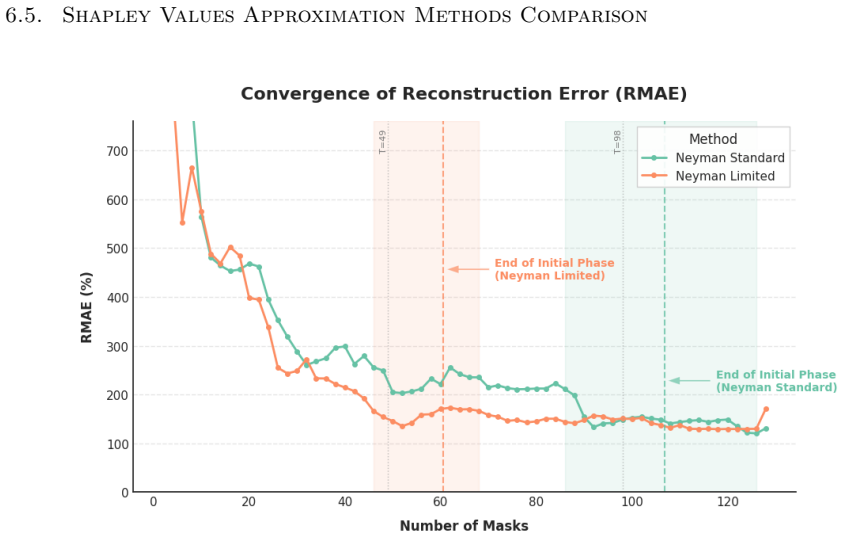
Significance. The manuscript makes a genuine engineering contribution by providing an open-source, pip-installable package (mllm-shap) with a GUI for multimodal SV computation, along with published datasets and reproducible infrastructure. The SGPA method addresses a real computational bottleneck (10-50x coalition reduction), and the authors deserve credit for transparently documenting SGPA's non-neutrality in Section 6.6 with controlled diagnostics (Table 6.4). The Neyman estimator benchmarking (Section 6.5) against exact SV ground truth on 27 samples provides falsifiable convergence evidence. However, the empirical claims rest on a single model with limited sample sizes, and the central comparative claim about modality effects is confounded by an asymmetric segmentation design that the paper acknowledges but does not fully resolve.
major comments (3)
- §9.2.2, Table 9.5: The headline claim that 'input modality is a primary driver of attribution volatility' rests on comparing T2T (native subword tokenization, ~7-27 tokens/sample per Table 8.2) against S2T/S2S (SGPA word-aligned segments, ~5-10 segments/sample). These are structurally different cooperative games with different player counts and granularities. The paper's own §6.6 diagnostics (Table 6.4) confirm SGPA significantly alters attribution statistics (normalized entropy p<0.01, Cohen's d=-1.37 for SM2S). Since SGPA is applied only to audio, the observed entropy shift between T2T and speech modes conflates genuine modality effects with segmentation granularity differences. The one metric showing significant cross-modality differences (normalized entropy, Table 9.5) is precisely the metric most sensitive to partition structure, while Gini and top-20-mass—which are more length-rob—
- §7, normalized entropy definition: The paper normalizes entropy by √n to address length differences, but this does not correct for the structural difference in game partition between subword tokens and word-level segments. A concrete control is needed: a condition where text is also segmented at word level (matching SGPA granularity) would allow disentangling modality effects from segmentation artifacts. Without this control, the modality claim cannot be separated from the segmentation confound. The authors should either add this control or substantially soften the claim from 'input modality is a primary driver' to 'input modality and segmentation granularity jointly affect attribution patterns.'
- §9.2-9.3, Tables 9.5 and 9.6: Many statistical tests yield non-significant results or NaN entries due to normality violations (Table 9.5: 4 of 12 Gini/top-20-mass entries are NaN; all multilingual comparisons in §9.3.2 yield non-significant p-values). The paper acknowledges these limitations in §9.2.3 and §9.3.3, but the Summary (§10) still states that 'input modality is a significant driver of attribution volatility' without adequate qualification. The claims in §10 should be brought into closer alignment with the statistical evidence actually presented in Chapter 9.
minor comments (5)
- §5.2.1, Eq. (5.6): The SGPA boundary cost weights α=0.8 and β=0.2 are described as 'empirically determined' on English samples, with a note that cross-lingual investigation is needed. Since experiments include Spanish and French, some discussion of whether these weights transfer would strengthen the paper.
- Table 9.2: The linguistic analysis assigns 'apt' and 'cha' (subword fragments of 'Recaptcha') the dependency label ROOT and dobj respectively, which appears to be a spaCy parsing artifact from subword tokenization. This should be noted as a limitation of applying dependency parsing to subword units.
- §5.1.1: The utility function U3 uses TF-IDF over the set of all model responses D={R_S | S⊂N}, which means the vocabulary and IDF weights change as the sampling budget changes. This dependency should be noted as a potential source of instability in approximate SV.
- The manuscript appears to be a thesis (with 'student record book numbers' and a thesis supervisor), which explains its length and structure. The AI usage declaration is commendable in its transparency.
- Several references have incomplete formatting (e.g., 'Foundation 2025' for the TF-IDF Wikipedia citation).
Simulated Author's Rebuttal
We thank the referee for a careful and substantive review. The referee raises three major comments, all concerning the same core issue: the confounding of modality effects with segmentation granularity differences (SGPA word-aligned segments for audio vs. native subword tokenization for text) in our headline claim about input modality driving attribution volatility. We agree with the substance of all three comments and will revise the manuscript accordingly. Specifically, we will (1) soften the modality claim in the Summary to acknowledge that segmentation granularity and modality are jointly confounded, (2) add discussion of the limitation that a word-level text control condition is needed to fully disentangle these effects, and (3) align the Summary claims with the statistical evidence actually presented. We cannot run the proposed word-level text control experiment within the current revision cycle due to compute constraints, which we acknowledge as a standing limitation.
read point-by-point responses
-
Referee: §9.2.2, Table 9.5: The headline claim that 'input modality is a primary driver of attribution volatility' rests on comparing T2T (native subword tokenization, ~7-27 tokens/sample) against S2T/S2S (SGPA word-aligned segments, ~5-10 segments/sample). These are structurally different cooperative games with different player counts and granularities. The paper's own §6.6 diagnostics confirm SGPA significantly alters attribution statistics. Since SGPA is applied only to audio, the observed entropy shift between T2T and speech modes conflates genuine modality effects with segmentation granularity differences. The one metric showing significant cross-modality differences (normalized entropy) is precisely the metric most sensitive to partition structure, while Gini and top-20-mass are more length-robust.
Authors: The referee is correct on all points. The comparison between T2T (native subword tokenization) and speech modes (SGPA word-aligned segments) does conflate modality effects with segmentation granularity differences, and our own §6.6 diagnostics (Table 6.4) confirm that SGPA significantly alters attribution statistics including normalized entropy (Cohen's d = -1.37 for SM2S). We acknowledge that normalized entropy is indeed the metric most sensitive to partition structure, which is precisely the metric that shows significant cross-modality differences in Table 9.5. The more length-robust metrics (Gini, top-20-mass) either violate normality assumptions or yield non-significant results. This is a genuine confound that we cannot fully resolve with the current experimental design. We will revise the manuscript to explicitly state this confound in §9.2.2 and §9.2.3, noting that the observed entropy differences may reflect segmentation granularity differences rather than (or in addition to) genuine modality effects. revision: yes
-
Referee: §7, normalized entropy definition: The paper normalizes entropy by √n to address length differences, but this does not correct for the structural difference in game partition between subword tokens and word-level segments. A concrete control is needed: a condition where text is also segmented at word level (matching SGPA granularity) would allow disentangling modality effects from segmentation artifacts. Without this control, the modality claim cannot be separated from the segmentation confound. The authors should either add this control or substantially soften the claim.
Authors: We agree that a word-level text segmentation control is the correct experimental design to disentangle modality from segmentation effects, and that √n normalization does not correct for the structural partition difference between subword tokens and word-level segments. We cannot add this control experiment within the current revision cycle due to compute constraints (the experimental infrastructure requires substantial model call budgets, as documented in Appendix F and Table 9.3). However, we will substantially soften the claim throughout the manuscript. Specifically, in the Abstract we will change 'input modality is a primary driver of attribution volatility' to language indicating that input modality and segmentation granularity jointly affect attribution patterns. In §9.2.3 (Conclusions), we will add an explicit discussion of this confound as a primary limitation. In §10 (Summary), we will qualify the modality claim accordingly. We will also add the word-level text control to §11 (Future Work) as a priority experiment. We note that the package infrastructure already supports configurable segmentation, so this experiment is feasible in principle once compute resources are available. revision: partial
-
Referee: §9.2-9.3, Tables 9.5 and 9.6: Many statistical tests yield non-significant results or NaN entries due to normality violations. The paper acknowledges these limitations in §9.2.3 and §9.3.3, but the Summary (§10) still states that 'input modality is a significant driver of attribution volatility' without adequate qualification. The claims in §10 should be brought into closer alignment with the statistical evidence actually presented in Chapter 9.
Authors: The referee is correct that the Summary overstates the statistical evidence. In §9.2, only normalized entropy shows significant cross-modality differences (and as discussed above, this metric is confounded by segmentation granularity), while Gini and top-20-mass either violate normality or are non-significant. In §9.3, all multilingual comparisons yield non-significant p-values. The Summary's statement that 'input modality is a significant driver of attribution volatility' does not adequately reflect this evidence base. We will revise §10 to align with the actual statistical findings: we will qualify the modality claim to note that it rests primarily on normalized entropy differences (which are themselves confounded by segmentation), acknowledge that Gini and top-20-mass metrics do not reach significance, and note that multilingual comparisons yielded no significant differences. We will also add explicit qualification that these findings are preliminary and based on a single model with limited sample sizes. revision: yes
- We cannot run the proposed word-level text segmentation control experiment within the current revision cycle due to compute constraints. The experimental runs require substantial model call budgets (e.g., T2T on multi_sentence averages ~1174 calls per sample, Table 9.3), and our hardware resources (Appendix B) are fully allocated. We acknowledge this as a genuine limitation and will add it to Future Work, but we cannot resolve it now.
Circularity Check
No circularity found — derivation chain relies on external theory and standard methods; empirical claims are independently tested
full rationale
The paper's derivation chain is self-contained and non-circular. All load-bearing theoretical components — Shapley value theory (Shapley 1951), MC approximation (Horovicz and Goldshmidt 2024), CC and Neyman allocation (Zhang et al. 2023) — come from external sources with no author overlap. SGPA is a novel preprocessing method defined independently of any experimental claim; it is not a fitted parameter renamed as a prediction. The utility function U3 (TF-IDF cosine similarity) is a standard NLP measure defined independently of the modality conclusions. The headline empirical claim ('input modality is a primary driver of attribution volatility') is supported by paired t-tests on computed SV distributions (Table 9.5), not by definition or by a fitted parameter. The skeptic's concern about SGPA segmentation confounding cross-modality comparisons is a validity/correctness issue — the paper compares different cooperative games (native subword tokens vs. word-aligned segments) — but this is not circularity: SGPA is not defined in terms of the modality claim, and no parameter is fitted to force the conclusion. The paper explicitly discloses this limitation in §6.6 and §4.2. No step in the derivation reduces to its inputs by construction.
Axiom & Free-Parameter Ledger
free parameters (5)
- alpha (SGPA boundary cost weight) =
0.8
- beta (SGPA boundary cost weight) =
0.2
- delta (SGPA search window) =
not stated
- m_init (Neyman initial sample count) =
max(2, floor(m/(2n^2)))
- Default sampling budget (3n^2) =
3n^2
axioms (4)
- standard math Shapley value axioms (Efficiency, Symmetry, Null player, Linearity) uniquely define a fair allocation.
- domain assumption The utility function U(S) = CS(h(R_S), h(R_N)) (TF-IDF cosine similarity of model responses) is a meaningful proxy for model output quality.
- ad hoc to paper Word-aligned audio segments are valid players for the cooperative game, even though they do not correspond to the model's internal audio tokenization.
- domain assumption Model responses are sufficiently deterministic under temperature=0, top_k=1 to treat SV variance as dominated by sampling scheme rather than model stochasticity.
invented entities (3)
-
Spectrogram-Guided Phonetic Alignment (SGPA)
independent evidence
-
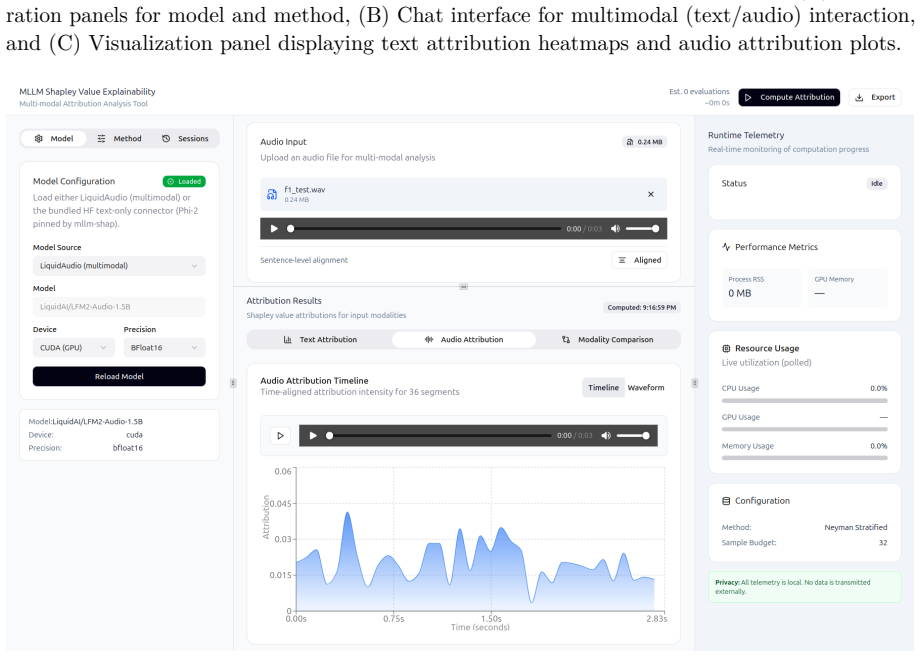
mllm-shap Python package
independent evidence
-
Limited Neyman variant
independent evidence
read the original abstract
Multimodal Large Language Models (MLLMs) effectively integrate text and audio to interpret context in complex interactive dialogues. However, the internal mechanisms by which heterogeneous modalities influence model behavior remain opaque. While Shapley Values (SV) provide a robust, model-agnostic framework for local explainability in text-based NLP, their extension to multimodal data is hindered by cross-channel dependencies, intricate dialogue structures, and the prohibitive computational complexity of dense audio representations. In this work, we formalize a multimodal extension of the Shapley Value framework, treating discrete text tokens and aligned audio segments as cooperative features. To ensure computational feasibility, we deploy a suite of efficient estimation strategies: exact SV computation for low-dimensional inputs and sampling-based approximations - including Monte Carlo permutations and stratified sampling with Neyman-optimal allocation - to minimize variance under constrained computational budgets. To resolve the granularity mismatch between modalities, we propose Spectrogram-Guided Phonetic Alignment (SGPA), a novel preprocessing method that maps high-frequency audio streams to interpretable, word-aligned segments. Our contribution is twofold: first, we provide an open-source, model-agnostic Python package and a companion GUI for the computation and interactive visualization of multimodal attributions. Second, we evaluate our framework using curated subsets of the VoiceBench and Infinity Instruct datasets across diverse multilingual scenarios. Our experimental results reveal that input modality is a primary driver of attribution volatility and demonstrate that standard syntactic importance proxies often fail to predict model attention in multimodal, cross-lingual contexts.
Figures









Reference graph
Works this paper leans on
-
[1]
Tests Figure 4.1: Release notes, allowing users to track introduced changes
https://pawlo77.github.io/MLLM-Shap/ 128 IV. Tests Figure 4.1: Release notes, allowing users to track introduced changes. Figure 4.2: The documentation page includes illustrative examples with code, explanatory comments, and expected outputs, helping users quickly and clearly understand how to use the API. also made on experiments results, as part of thei...
-
[2]
Automated tests– Integrated into the repository’s Continuous Integration and Con- tinuous Deployment (CI/CD) workflow2 via the pytest3 framework, this suite comprises approximately 400 unit tests. It validates critical system components, including masking logic, deterministic calculation accuracy, and data integrity. Passing the full test suite is a manda...
- [3]
-
[4]
https://pypi.org/project/pytest/ 129 D. Package reference Figure 4.3: Detailed documentation of part of theBaseMllmChat abstract class, showing the get_conversation and add_audio methods as implemented by theLiquidAudioChat class. It includes input arguments with types, expected output type and description, possible exceptions, and, when available, usage ...
-
[5]
Quality tests– These ensure that each package contributor writes high-quality code aligned with industry standards such as PEP-8 (Rossum et al. 2001). They utilize tools like flake8, autoflake, isort, and pylint for linting and code quality checks,black for automatic formatting, bandit for security checks, andmypy to ensure type annotations are present th...
work page 2001
-
[6]
https://pypi.org 130 E. GUI reference and requirements alignment This appendix provides the implementation-oriented details of the GUI, including the technol- ogy stack, deployment topology, and a full mapping of features to requirements referenced in Chapter 4. I. Implementation architecture and deployment The application is implemented using a modern cl...
work page 2013
-
[7]
https://www.postgresql.org
-
[8]
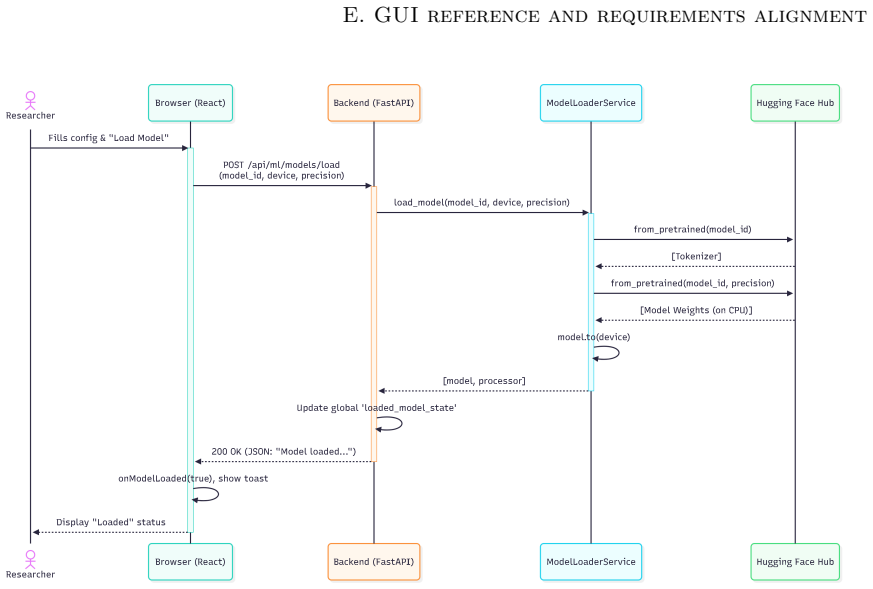
https://nginx.org 131 E. GUI reference and requirements alignment Figure 5.1: Unified Modeling Language (UML) Sequence diagram detailing the process of requesting a model load on desired device. other paths are handled directly as static content. This consolidates access behind a single external port and simplifies future Transport Layer Security (TLS) ha...
-
[9]
https://colab.research.google.com
-
[10]
https://hpc.mini.pw.edu.pl
-
[11]
https://www.plgrid.pl
-
[12]
Computational Resources Analysis II
https://github.com/Pawlo77/MLLM-Shap/blob/main/paper/pl_grid/wniosek.pdf 135 F. Computational Resources Analysis II. Resource Estimation As the compute requirements represent a significant risk, as outlined in Tables 3.3 and 3.1 in Appendix C, an initial assessment of those requirements was conducted. To estimate the computational resources required for t...
work page 2024
-
[13]
https://pypi.org/project/nltk/
-
[14]
https://pypi.org/project/lingua/
-
[15]
https://huggingface.co/papluca/xlm-roberta-base-language-detection
-
[16]
Dataset construction and preprocessing details segmentation
https://github.com/WangHelin1997/SpeechTasks 139 G. Dataset construction and preprocessing details segmentation. Finally, Supervised Fine-Tuning (SFT) datasets fulfill the outlined criteria, as they aim to improve model performance in areas where existing knowledge remains incomplete. Utilizing the open-source llm-datasets5 library, theInfinity Instruct(L...
work page 2025
-
[17]
https://github.com/mlabonne/llm-datasets
-
[18]
https://huggingface.co/datasets/Pawlo77/mllm-shap
-
[19]
SS stands for entries included inVoiceBench__single_sentenceand MS -VoiceBench__multi_sentence
https://huggingface.co/datasets/BAAI/Infinity-Instruct 140 Table 7.1: Summary statistics of the datasets from the original sources. SS stands for entries included inVoiceBench__single_sentenceand MS -VoiceBench__multi_sentence. Note that entries in our final datasets may originate from multiple source datasets simultaneously; therefore, theRowscolumn for ...
-
[20]
Additionally, conversation length was limited to 8 messages, corresponding to 4 human-LLM turns
The dataset was filtered to include only English, French, and Spanish entries - total644, 478 remain. Additionally, conversation length was limited to 8 messages, corresponding to 4 human-LLM turns. After that we have dataset of637,557rows
-
[21]
Using the predefined topic labels, all entries semantically related toformal logic,logical reasoning,mathematics, andprogrammingwere removed. Smaller models are not expected to handle these topics effectively, therefore that decision has been made in order to reduce bias in that research, as well as to simplify task for TTS pipeline (having it recite math...
-
[22]
Up to 500 characters from concatenated prompts have been input into the system for comparison
Prompt deduplication was carried out usingSemHash (van Dongen and Tulkens 2025), which employs static embedding models and Approximate Nearest Neighbours (Indyk and Motwani 1998) for efficient semantic text deduplication. Up to 500 characters from concatenated prompts have been input into the system for comparison. Total entries remaining281,737
work page 2025
-
[23]
Non-English entries were verified for correct language classification. Any rows with mis- matchedlanguagepredictionscomparedtotheiroriginalannotationswereremoved, resulting in new size of208,270rows
-
[24]
This yielded our base dataset of62,730observations
All entries containing sentences of length exceeding 200 characters have been filtered out. This yielded our base dataset of62,730observations. We further create the multi-lingual dataset from this dataset,InfinityInstruct__multi_lingual, which includes single turn conversations from French, Spanish and English (each language has 34 unique entries). Each ...
-
[25]
https://pypi.org/project/sentence-transformers/
-
[26]
All presented entries have similarity exceeding0.7
https://pypi.org/project/googletrans/ 142 Table 7.3: Partial list of topics related to logic, mathematics, and programming that were filtered out during pre processing. All presented entries have similarity exceeding0.7. logical reasoning deductive reasoning inductive reasoning analogical reasoning causal reasoning common sense reasoning ethical reasoning...
discussion (0)
Sign in with ORCID, Apple, or X to comment. Anyone can read and Pith papers without signing in.