AI-Integrated Learning Management System for Middle School: A Longitudinal Study of Learning Outcomes Through High School and Beyond
Pith reviewed 2026-07-01 00:59 UTC · model grok-4.3
The pith
Policy-gated AI assistance added to middle-school LMS produces lasting gains in outcomes through high school and post-high school pathways.
A machine-rendered reading of the paper's core claim, the machinery that carries it, and where it could break.
Core claim
The central claim is that sustained, bounded AI support delivered through an LMS in middle school can change academic outcomes as measured through high school and into post-high school pathways, by delivering timely formative feedback and adaptive recommendations while maintaining privacy constraints for minors.
What carries the argument
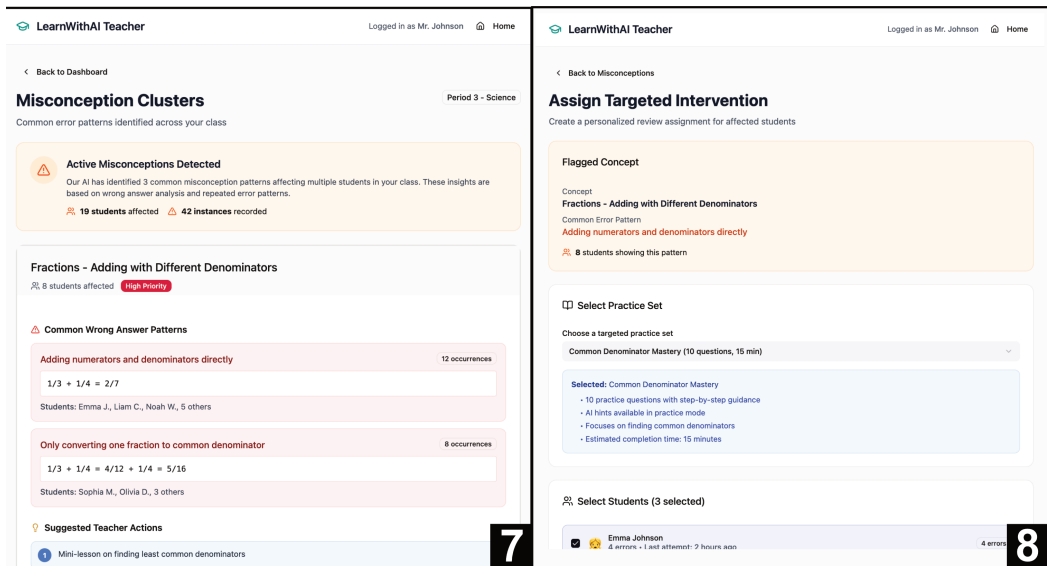
The policy-gated AI assistance layer that supplies formative feedback, hinting, mastery-based adaptive practice recommendations, and teacher-facing misconception summaries while enforcing data minimization, role-based access, and auditable interaction logs.
If this is right
- Students receive corrective input while still confused rather than after misconceptions have hardened.
- Teachers obtain class-level summaries of struggle patterns instead of triaging every individual question.
- Daily traces of attempts, revisions, and pacing become usable for separating short-term tool effects from longer-run trajectory changes.
- Privacy protections remain intact through role-based controls and full logging of AI interactions.
- The platform can be evaluated for effects on post-high school pathways in addition to immediate grades.
Where Pith is reading between the lines
- The same bounded-assistance model might be tested in high school or elementary settings to check age-specific effects.
- If linkage to later records proves feasible, the study could identify which features of the AI layer drive the longest-term differences.
- Success would require ongoing checks that AI outputs stay accurate as student cohorts and curricula evolve.
Load-bearing premise
The assumption that policy-gated AI can supply accurate feedback and recommendations without introducing new misconceptions and that fine-grained learning traces can be reliably linked to institutional outcomes years later without privacy violations.
What would settle it
A controlled comparison showing no difference in high school performance metrics, graduation rates, or post-secondary enrollment between students exposed to the AI-integrated LMS in middle school and a matched group without it.
Figures


read the original abstract
Middle school is a key window for building core academic skills and the learning routines students carry into later grades, yet many students still fall behind because help is often limited and comes too late, after they have already been stuck for a while. Learning Management Systems (LMSs) are now standard infrastructure for distributing materials, collecting work, assessing students' tasks, and recording grades, but in most deployments they still behave more like workflow tools than instructional supports. The result is the usual bottleneck: students keep practicing through confusion, teachers triage questions, and feedback that could have corrected the misunderstanding arrives after the misconception has already hardened. To address this gap, we propose an AI-integrated LMS for middle school instruction, paired with a longitudinal study design to test whether sustained, bounded AI support changes outcomes through high school and into post-high school pathways. The proposed platform adds policy-gated AI assistance to everyday coursework, delivering formative feedback and hinting, recommending spaced review and adaptive practice based on mastery, and providing teacher-facing dashboards that summarize misconception patterns and flag sustained struggle. Because the platform is intended for minors, the design is privacy-first, using data minimization, role-based access control, age-appropriate response constraints, and auditable logs of AI interactions. Beyond short-term performance, the evaluation plan links fine-grained learning traces (attempts, revisions, help-seeking, and pacing) to institutional outcomes where feasible, so we can separate tool adoption effects from longer-run changes in learning trajectories.
Editorial analysis
A structured set of objections, weighed in public.
Referee Report
Summary. The manuscript proposes an AI-integrated Learning Management System (LMS) for middle school that incorporates policy-gated AI assistance for formative feedback, hinting, spaced review, adaptive practice based on mastery, and teacher-facing dashboards summarizing misconception patterns. It pairs this platform with a longitudinal study design to test whether sustained, bounded AI support changes learning outcomes through high school and into post-high school pathways, with a privacy-first architecture using data minimization, role-based access, age-appropriate constraints, and auditable logs.
Significance. If executed as described, the proposal could generate rare longitudinal evidence on AI-assisted learning trajectories spanning multiple years, addressing the current dominance of short-term evaluations in the field. The privacy-first constraints and explicit plan to separate tool-adoption effects from trajectory changes are constructive elements that strengthen the design's relevance for real-world deployment with minors.
major comments (2)
- [Abstract (evaluation plan)] Abstract (evaluation plan paragraph): the plan to link fine-grained learning traces (attempts, revisions, help-seeking, pacing) to institutional outcomes years later provides no concrete mechanism for data linkage, consent maintenance, or attrition handling under privacy constraints; this linkage is load-bearing for the central claim of measuring longer-run changes in trajectories.
- [Abstract (platform design)] Abstract (platform design paragraph): the description of policy-gated AI for accurate formative feedback and adaptive recommendations contains no validation plan, accuracy metrics, or safeguards against introducing misconceptions; without such provisions the hypothesis that bounded AI support will improve outcomes rests on an untested assumption.
minor comments (1)
- [Abstract] The abstract would be clearer if it stated explicit research questions or primary outcome measures for the longitudinal component.
Simulated Author's Rebuttal
We thank the referee for the constructive feedback and for noting the potential significance of the longitudinal design. We address each major comment below.
read point-by-point responses
-
Referee: [Abstract (evaluation plan)] Abstract (evaluation plan paragraph): the plan to link fine-grained learning traces (attempts, revisions, help-seeking, pacing) to institutional outcomes years later provides no concrete mechanism for data linkage, consent maintenance, or attrition handling under privacy constraints; this linkage is load-bearing for the central claim of measuring longer-run changes in trajectories.
Authors: We agree the abstract provides no concrete mechanisms. The manuscript emphasizes privacy-first principles but does not detail linkage protocols. We will revise the evaluation section to specify IRB-approved secure data enclaves for de-identified linkage, annual digital re-consent via parent portals, and attrition handling via inverse probability weighting combined with sensitivity analyses, all while enforcing data minimization and role-based access. revision: yes
-
Referee: [Abstract (platform design)] Abstract (platform design paragraph): the description of policy-gated AI for accurate formative feedback and adaptive recommendations contains no validation plan, accuracy metrics, or safeguards against introducing misconceptions; without such provisions the hypothesis that bounded AI support will improve outcomes rests on an untested assumption.
Authors: The referee is correct that the abstract omits validation details. As a design proposal, the platform is described at a high level. We will add a validation subsection outlining expert review of AI outputs for accuracy metrics (e.g., inter-rater agreement with teachers), small-scale pilots measuring misconception introduction rates, and safeguards including retrieval-augmented generation from approved materials plus mandatory teacher override for flagged cases. revision: yes
Circularity Check
No circularity: proposal paper with no derivations or fitted results
full rationale
The manuscript is a forward-looking proposal describing a platform design and study protocol rather than reporting completed empirical results or presenting any mathematical derivations. No equations, parameters, self-citations forming load-bearing arguments, or reductions of predictions to inputs exist. The central claim is explicitly framed as a hypothesis to be tested by the described longitudinal design. This is the most common honest finding for non-empirical proposal papers.
Axiom & Free-Parameter Ledger
Reference graph
Works this paper leans on
-
[1]
B. S. Bloom. The 2 sigma problem: The search for methods of group instruction as effective as one- to-one tutoring.Educational Researcher, 13(6):4–16,
-
[2]
Available:https://journals.sagepub.com/ doi/pdf/10.3102/0013189X013006004
-
[3]
doi: 10.3389/fp- syg.2021.746289
Hammerstein S, König C, Dreisörner T, Frey A Ef- fects of COVID-19-related school closures on student achievement: A systematic review. doi: 10.3389/fp- syg.2021.746289. Available:https://pubmed.ncbi. nlm.nih.gov/34603162/
work page doi:10.3389/fp- 2021
-
[4]
J. S. Eccles and R. W. Roeser. Schools as de- velopmental contexts during adolescence.Journal of Research on Adolescence, 21(1):225–241, 2011. Available:https://onlinelibrary.wiley.com/ doi/epdf/10.1111/j.1532-7795.2010.00725.x
-
[5]
D. S. Yeager and G. M. Walton. Social-psychological interventions in education: They’re not magic.Re- view of Educational Research, 81(2):267–301, 2011. Available:https://journals.sagepub.com/doi/ pdf/10.3102/0034654311405999
-
[6]
Balfanz, R., Herzog, L., & Mac Iver, D. J. Prevent- ing student disengagement and keeping students on the graduation path in urban middle-grades schools: Early identification and effective interventionsEdu- cational Psychologist, 42(4):223–235, 2007. Available: https://doi.org/10.1080/00461520701621079. 13
-
[7]
& Bichsel, Jacque- line
Dahlstrom, Eden & Brooks, D. & Bichsel, Jacque- line. The Current Ecosystem of Learning Man- agement Systems in Higher Education: Stu- dent, Faculty, and IT Perspectives Available: https://www.researchgate.net/publication/ 281111565_The_Current_Ecosystem_of_Learning_ Management_Systems_in_Higher_Education_ Student_Faculty_and_IT_Perspectives
-
[8]
Hattie and H
J. Hattie and H. Timperley. The power of feed- back.Review of Educational Research, 77(1):81–112,
-
[9]
Available:https://journals.sagepub.com/ doi/abs/10.3102/003465430298487
-
[10]
K. VanLehn. The Relative Effectiveness of Human Tutoring, Intelligent Tutoring Systems, and Other Tutoring SystemsEducational Psychologist, 46:197– 221, 2011. Available:https://www.researchgate. net/publication/233237328_The_Relative_ Effectiveness_of_Human_Tutoring_Intelligent_ Tutoring_Systems_and_Other_Tutoring_Systems
-
[11]
W. Ma, O. O. Adesope, J. C. Nesbit, and Q. Liu. Intelligent tutoring systems and learning outcomes: A meta-analysis.Journal of Educational Psychology, 106(4):901–918, 2014. Available:https://doi.org/ 10.1037/a0037123
-
[12]
Pane, J. F., Griffin, B. A., McCaffrey, D. F., & Karam, R. Effectiveness of Cognitive Tutor Alge- bra I at Scale. Educational Evaluation and Policy Analysis.Educational Evaluation and Policy Anal- ysis, 36(2):127–144, 2014. Available:https://doi. org/10.3102/0162373713507480
-
[13]
Holstein, K., McLaren, B. M., & Aleven, V. Co- Designing a Real-Time Classroom Orchestration Tool to Support Teacher–AI Complementarity Journal of Learning Analytics, 6(2), 27–52. Available:https: //doi.org/10.18608/jla.2019.62.3
-
[14]
Kenneth R. Koedinger, Elizabeth A. McLaughlin, Ju- lianna Zhuxin Jia, and Norman L. Bier Is the doer effect a causal relationship? how can we tell and why it’s important In Proceedings of the Sixth Interna- tional Conference on Learning Analytics & Knowl- edge (LAK ’16). Available:https://doi.org/10. 1145/2883851.2883957
- [15]
-
[16]
S. A. Karabenick. Seeking help in large college classes: A person-centered approach.Contemporary Educational Psychology, 28(1):37–58, 2003. Avail- able:https://www.sciencedirect.com/science/ article/pii/S0361476X02000127
2003
-
[17]
A New Paradigm for Intelligent Tutoring Systems: Example- Tracing Tutors.International Journal of Artifi- cial Intelligence in Education, 2009
Aleven, Vincent & Mclaren, Bruce & Sewall, Jonathan & Koedinger, Kenneth. A New Paradigm for Intelligent Tutoring Systems: Example- Tracing Tutors.International Journal of Artifi- cial Intelligence in Education, 2009. Available: https://www.researchgate.net/publication/ 220049888_A_New_Paradigm_for_Intelligent_ Tutoring_Systems_Example-Tracing_Tutors
2009
-
[18]
ChatGPT for good? On opportunities and challenges of large language models for education,
Enkelejda Kasneci, Kathrin Sessler, Stefan Küche- mann, Maria Bannert, Daryna Dementieva, Frank Fischer, Urs Gasser, Georg Groh, Stephan Günne- mann, Eyke Hüllermeier, Stephan Krusche, Gitta Ku- tyniok, Tilman Michaeli, Claudia Nerdel, Jürgen Pf- effer, Oleksandra Poquet, Michael Sailer, Albrecht Schmidt, Tina Seidel, Matthias Stadler, Jochen Weller, Joch...
-
[19]
Artificial Intelligence in Education: Promises and Implications for Teaching and Learning
Holmes, Wayne & Bialik, Maya & Fadel, Charles. Artificial Intelligence in Education: Promises and Implications for Teaching and Learning. Cen- ter for Curriculum Redesign, 2019. Available: https://www.researchgate.net/publication/ 332180327_Artificial_Intelligence_in_ Education_Promise_and_Implications_for_ Teaching_and_Learning
2019
-
[20]
Persistence and fadeout of educational- intervention effects: Mechanisms and potential solu- tions
Bailey DH, Duncan GJ, Cunha F, Foorman BR, Yeager DS. Persistence and fadeout of educational- intervention effects: Mechanisms and potential solu- tions. Psychol Sci Public Interest. 2020 Oct;21(2):55-
2020
-
[21]
Available:https://pubmed.ncbi.nlm.nih.gov/ 33414687/. 14
discussion (0)
Sign in with ORCID, Apple, or X to comment. Anyone can read and Pith papers without signing in.