A Dataset for Dynamic Human Preferences for Vision Language Models
Pith reviewed 2026-06-28 10:17 UTC · model grok-4.3
The pith
A new benchmark and dataset test vision language models on adapting to dynamic human preferences given in context.
A machine-rendered reading of the paper's core claim, the machinery that carries it, and where it could break.
Core claim
The authors establish a dynamic multi-modal human-preference dataset generated via an automated pipeline that introduces controlled variations on image dependence, which supports evaluation of vision language models' capacity to interpret and act on preferences supplied in context at inference time, together with performance results for current state-of-the-art models on the benchmark.
What carries the argument
The automated pipeline that generates the benchmark dataset with systematic variations on image dependence to create test cases for in-context dynamic preferences.
If this is right
- State-of-the-art vision language models can now be scored on their ability to adapt to preferences supplied at inference time.
- The benchmark separates dynamic, in-context preference following from static capabilities learned during training.
- Performance gaps identified by the dataset can guide development of prompting or fine-tuning methods for better real-time adaptation.
- The automated generation process enables scalable creation of additional test variations without manual labeling.
Where Pith is reading between the lines
- Widespread use of the benchmark might surface the need for models that maintain user-specific context across multiple turns of interaction.
- The dataset could be extended to measure preference conflicts or changes over longer sessions, revealing limits not tested in the initial version.
- If models improve on this benchmark, applications such as personalized image assistants or editing tools could become more reliable for individual users.
Load-bearing premise
The automated pipeline produces test cases that accurately represent genuine dynamic human preferences users would express in real interactive settings.
What would settle it
Human raters could review a sample of the generated test cases and report whether they match preferences they would actually state in similar image-based interaction scenarios; low agreement would undermine the benchmark.
Figures
read the original abstract
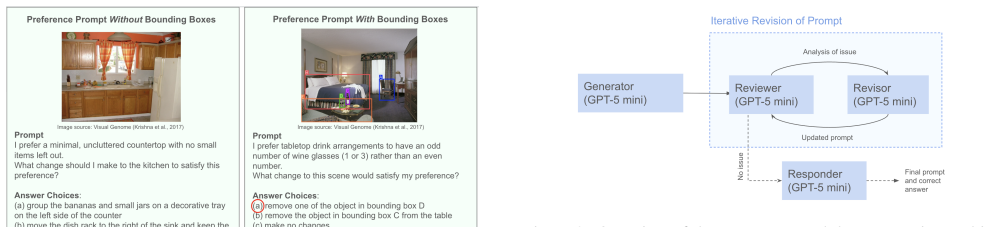
Given the increased adoption of Vision Language Models (VLMs) in human-interactive settings, it is important that we evaluate how well these models can adapt to real-time preferences for different users. While an increasing number of vision-language benchmarks have recently been introduced, they focus largely on evaluating static capabilities and generally-held preferences learned from extensive training data. This work introduces a new benchmark for evaluating the ability of VLMs to understand dynamic human-preferences, i.e. preferences that are passed in-context at inference time. We provide an automated pipeline for generating this benchmark with variations on image dependence, a dynamic multi-modal human-preference dataset, and evaluations of state-of-the-art models on the novel benchmark.
Editorial analysis
A structured set of objections, weighed in public.
Referee Report
Summary. The paper introduces a new benchmark for evaluating Vision Language Models (VLMs) on their ability to understand dynamic human preferences provided in-context at inference time, rather than static capabilities or generally-held preferences. It describes an automated pipeline for generating the benchmark with variations on image dependence, releases a dynamic multi-modal human-preference dataset, and reports evaluations of state-of-the-art models on the benchmark.
Significance. If the pipeline and dataset are shown to produce valid representations of real dynamic preferences, the work would address a meaningful gap in VLM evaluation for interactive settings. The automated pipeline and public dataset are strengths that could support reproducible research on in-context preference adaptation.
major comments (1)
- [Abstract and pipeline description] The automated pipeline is presented as generating valid test cases for dynamic in-context preferences, but the manuscript provides no description of validation steps such as human evaluation, inter-annotator agreement, or comparison against real user behavior data. This directly undermines the central claim that the benchmark measures understanding of dynamic human preferences rather than artificial constructs (see abstract and pipeline section).
Simulated Author's Rebuttal
We thank the referee for highlighting the need for validation of the automated pipeline. We address the single major comment below and will incorporate changes in the revision.
read point-by-point responses
-
Referee: [Abstract and pipeline description] The automated pipeline is presented as generating valid test cases for dynamic in-context preferences, but the manuscript provides no description of validation steps such as human evaluation, inter-annotator agreement, or comparison against real user behavior data. This directly undermines the central claim that the benchmark measures understanding of dynamic human preferences rather than artificial constructs (see abstract and pipeline section).
Authors: We agree that the manuscript lacks any description of validation for the generated preferences. The pipeline relies on automated, rule-based modifications to create variations in image dependence and in-context preference statements, but without human evaluation or comparison to real user data, the claim that these represent dynamic human preferences is not yet substantiated. In the revised version we will add a dedicated subsection on validation, including a human study on a sampled subset with inter-annotator agreement statistics and qualitative comparison to real preference elicitation scenarios. revision: yes
Circularity Check
No circularity: dataset/benchmark creation with no derivations or fitted predictions
full rationale
The paper introduces a benchmark, automated pipeline, and dataset for dynamic in-context human preferences in VLMs, followed by model evaluations. No equations, derivations, parameters, or predictions are present that could reduce to inputs by construction. The contribution is empirical resource creation rather than a claimed derivation chain; the automated pipeline is presented as a generation method without any self-referential fitting or uniqueness theorems. This matches the default case of a self-contained dataset paper with no load-bearing circular steps.
Axiom & Free-Parameter Ledger
Reference graph
Works this paper leans on
-
[1]
Nocaps: Novel object caption- ing at scale
Harsh Agrawal, Karan Desai, Yufei Wang, Xinlei Chen, Rishabh Jain, Mark Johnson, Dhruv Batra, Devi Parikh, Ste- fan Lee, and Peter Anderson. Nocaps: Novel object caption- ing at scale. InProceedings of the IEEE/CVF international conference on computer vision, pages 8948–8957, 2019. 1
2019
-
[2]
Vqa: Visual question answering
Stanislaw Antol, Aishwarya Agrawal, Jiasen Lu, Margaret Mitchell, Dhruv Batra, C Lawrence Zitnick, and Devi Parikh. Vqa: Visual question answering. InProceedings of the IEEE international conference on computer vision, pages 2425– 2433, 2015. 1
2015
-
[3]
Qwen-VL: A Versatile Vision-Language Model for Understanding, Localization, Text Reading, and Beyond
Jinze Bai, Shuai Bai, Shusheng Yang, Shijie Wang, Sinan Tan, Peng Wang, Junyang Lin, Chang Zhou, and Jingren Zhou. Qwen-vl: A versatile vision-language model for un- derstanding, localization, text reading, and beyond.arXiv preprint arXiv:2308.12966, 2023. 3
work page internal anchor Pith review Pith/arXiv arXiv 2023
-
[4]
Microsoft COCO Captions: Data Collection and Evaluation Server
Xinlei Chen, Hao Fang, Tsung-Yi Lin, Ramakrishna Vedan- tam, Saurabh Gupta, Piotr Doll ´ar, and C Lawrence Zitnick. Microsoft coco captions: Data collection and evaluation server.arXiv preprint arXiv:1504.00325, 2015. 1
work page internal anchor Pith review Pith/arXiv arXiv 2015
-
[5]
Instructblip: Towards general-purpose vision- language models with instruction tuning.Advances in neural information processing systems, 36:49250–49267, 2023
Wenliang Dai, Junnan Li, Dongxu Li, Anthony Tiong, Junqi Zhao, Weisheng Wang, Boyang Li, Pascale N Fung, and Steven Hoi. Instructblip: Towards general-purpose vision- language models with instruction tuning.Advances in neural information processing systems, 36:49250–49267, 2023. 3
2023
-
[6]
Understanding dataset difficulty withV-usable information
Kawin Ethayarajh, Yejin Choi, and Swabha Swayamdipta. Understanding dataset difficulty withV-usable information. InProceedings of the 39th International Conference on Ma- chine Learning, pages 5988–6008. PMLR, 2022. 2
2022
-
[7]
Making the v in vqa matter: Elevating the role of image understanding in visual question answer- ing
Yash Goyal, Tejas Khot, Douglas Summers-Stay, Dhruv Ba- tra, and Devi Parikh. Making the v in vqa matter: Elevating the role of image understanding in visual question answer- ing. InProceedings of the IEEE conference on computer vision and pattern recognition, pages 6904–6913, 2017. 1
2017
-
[8]
Hallusionbench: an advanced diagnos- tic suite for entangled language hallucination and visual il- lusion in large vision-language models
Tianrui Guan, Fuxiao Liu, Xiyang Wu, Ruiqi Xian, Zongxia Li, Xiaoyu Liu, Xijun Wang, Lichang Chen, Furong Huang, Yaser Yacoob, et al. Hallusionbench: an advanced diagnos- tic suite for entangled language hallucination and visual il- lusion in large vision-language models. InProceedings of the IEEE/CVF conference on computer vision and pattern recognition,...
2024
-
[9]
Tianrui Guan, Yurou Yang, Harry Cheng, Muyuan Lin, Richard Kim, Rajasimman Madhivanan, Arnie Sen, and Di- nesh Manocha. Loc-zson: Language-driven object-centric zero-shot object retrieval and navigation.arXiv preprint arXiv:2405.05363, 2024. 1
-
[10]
Evoke: Evoking critical thinking abilities in llms via reviewer-author prompt editing
Xinyu Hu, Pengfei Tang, Simiao Zuo, Zihan Wang, Bowen Song, Qiang Lou, Jian Jiao, and Denis Charles. Evoke: Evoking critical thinking abilities in llms via reviewer-author prompt editing. InInternational Conference on Learning Representations, pages 7583–7603, 2024. 2
2024
-
[11]
Why vision language models struggle with visual arithmetic? to- wards enhanced chart and geometry understanding
Kung-Hsiang Huang, Can Qin, Haoyi Qiu, Philippe Laban, Shafiq Joty, Caiming Xiong, and Chien-Sheng Wu. Why vision language models struggle with visual arithmetic? to- wards enhanced chart and geometry understanding. InFind- ings of the Association for Computational Linguistics: ACL 2025, pages 4830–4843, 2025. 1
2025
-
[12]
Gqa: A new dataset for real-world visual reasoning and compositional question answering
Drew A Hudson and Christopher D Manning. Gqa: A new dataset for real-world visual reasoning and compositional question answering. InProceedings of the IEEE/CVF con- ference on computer vision and pattern recognition, pages 6700–6709, 2019. 1
2019
-
[13]
Physical Intelligence, Kevin Black, Noah Brown, James Darpinian, Karan Dhabalia, Danny Driess, Adnan Esmail, Michael Equi, Chelsea Finn, Niccolo Fusai, et al.π 0.5: a vision-language-action model with open-world generaliza- tion.arXiv preprint arXiv:2504.16054, 20235. 1
work page internal anchor Pith review Pith/arXiv arXiv
-
[14]
Beavertails: Towards improved safety align- ment of llm via a human-preference dataset.Advances in Neural Information Processing Systems, 36:24678–24704,
Jiaming Ji, Mickel Liu, Josef Dai, Xuehai Pan, Chi Zhang, Ce Bian, Boyuan Chen, Ruiyang Sun, Yizhou Wang, and Yaodong Yang. Beavertails: Towards improved safety align- ment of llm via a human-preference dataset.Advances in Neural Information Processing Systems, 36:24678–24704,
-
[15]
Ryo Kamoi, Yusen Zhang, Sarkar Snigdha Sarathi Das, Ran- ran Haoran Zhang, and Rui Zhang. Visonlyqa: Large vision language models still struggle with visual perception of geo- metric information.arXiv preprint arXiv:2412.00947, 2024. 1
-
[16]
OpenVLA: An Open-Source Vision-Language-Action Model
Moo Jin Kim, Karl Pertsch, Siddharth Karamcheti, Ted Xiao, Ashwin Balakrishna, Suraj Nair, Rafael Rafailov, Ethan Foster, Grace Lam, Pannag Sanketi, et al. Openvla: An open-source vision-language-action model.arXiv preprint arXiv:2406.09246, 2024. 1
work page internal anchor Pith review Pith/arXiv arXiv 2024
-
[17]
Shamma, Michael S
Ranjay Krishna, Yuke Zhu, Oliver Groth, Justin Johnson, Kenji Hata, Joshua Kravitz, Stephanie Chen, Yannis Kalan- tidis, Li-Jia Li, David A. Shamma, Michael S. Bernstein, and Li Fei-Fei. Visual genome: Connecting language and vision using crowdsourced dense image annotations.International Journal of Computer Vision, 123:32–73, 2017. 2, 3, 4
2017
-
[18]
SEED-Bench: Benchmarking Multimodal LLMs with Generative Comprehension
Bohao Li, Rui Wang, Guangzhi Wang, Yuying Ge, Yix- iao Ge, and Ying Shan. Seed-bench: Benchmarking mul- timodal llms with generative comprehension.arXiv preprint arXiv:2307.16125, 2023. 1
work page internal anchor Pith review Pith/arXiv arXiv 2023
-
[19]
Omnibench: Towards the future of uni- versal omni-language models,
Yizhi Li, Yinghao Ma, Ge Zhang, Ruibin Yuan, Kang Zhu, Hangyu Guo, Yiming Liang, Jiaheng Liu, Zekun Wang, Jian Yang, et al. Omnibench: Towards the future of universal omni-language models.arXiv preprint arXiv:2409.15272,
-
[20]
Microsoft coco: Common objects in context
Tsung-Yi Lin, Michael Maire, Serge Belongie, James Hays, Pietro Perona, Deva Ramanan, Piotr Doll´ar, and C Lawrence Zitnick. Microsoft coco: Common objects in context. In European conference on computer vision, pages 740–755. Springer, 2014. 1
2014
-
[21]
Improved baselines with visual instruction tuning, 2023
Haotian Liu, Chunyuan Li, Yuheng Li, and Yong Jae Lee. Improved baselines with visual instruction tuning, 2023. 3
2023
-
[22]
Visual instruction tuning, 2023
Haotian Liu, Chunyuan Li, Qingyang Wu, and Yong Jae Lee. Visual instruction tuning, 2023
2023
-
[23]
Llava-next: Im- proved reasoning, ocr, and world knowledge, 2024
Haotian Liu, Chunyuan Li, Yuheng Li, Bo Li, Yuanhan Zhang, Sheng Shen, and Yong Jae Lee. Llava-next: Im- proved reasoning, ocr, and world knowledge, 2024. 3
2024
-
[24]
Mmbench: Is your multi-modal model an all-around player? InEuropean conference on computer vi- sion, pages 216–233
Yuan Liu, Haodong Duan, Yuanhan Zhang, Bo Li, Songyang Zhang, Wangbo Zhao, Yike Yuan, Jiaqi Wang, Conghui He, 5 Ziwei Liu, et al. Mmbench: Is your multi-modal model an all-around player? InEuropean conference on computer vi- sion, pages 216–233. Springer, 2024. 1, 3
2024
-
[25]
Wildvision: Evaluat- ing vision-language models in the wild with human prefer- ences.Advances in Neural Information Processing Systems, 37:48224–48255, 2024
Yujie Lu, Dongfu Jiang, Wenhu Chen, William Yang Wang, Yejin Choi, and Bill Yuchen Lin. Wildvision: Evaluat- ing vision-language models in the wild with human prefer- ences.Advances in Neural Information Processing Systems, 37:48224–48255, 2024. 2
2024
-
[26]
Self-refine: It- erative refinement with self-feedback.Advances in neural information processing systems, 36:46534–46594, 2023
Aman Madaan, Niket Tandon, Prakhar Gupta, Skyler Hal- linan, Luyu Gao, Sarah Wiegreffe, Uri Alon, Nouha Dziri, Shrimai Prabhumoye, Yiming Yang, et al. Self-refine: It- erative refinement with self-feedback.Advances in neural information processing systems, 36:46534–46594, 2023. 2
2023
-
[27]
Docvlm: Make your vlm an efficient reader
Mor Shpigel Nacson, Aviad Aberdam, Roy Ganz, Elad Ben Avraham, Alona Golts, Yair Kittenplon, Shai Mazor, and Ron Litman. Docvlm: Make your vlm an efficient reader. InProceedings of the Computer Vision and Pattern Recognition Conference, pages 29005–29015, 2025. 1
2025
-
[28]
Gpt-4 technical report, 2024
OpenAI. Gpt-4 technical report, 2024. 1, 3
2024
-
[29]
Gpt-4.1, 2025
OpenAI. Gpt-4.1, 2025. 3
2025
-
[30]
Gpt-5 mini, 2025
OpenAI. Gpt-5 mini, 2025. 3
2025
-
[31]
o4-mini, 2025
OpenAI. o4-mini, 2025. 3
2025
-
[32]
You only look once: Unified, real-time object de- tection
Joseph Redmon, Santosh Divvala, Ross Girshick, and Ali Farhadi. You only look once: Unified, real-time object de- tection. InProceedings of the IEEE conference on computer vision and pattern recognition, pages 779–788, 2016. 3
2016
-
[33]
Gemini robotics: Bringing ai into the physical world, 2025
Gemini Robotics. Gemini robotics: Bringing ai into the physical world, 2025. 1
2025
-
[34]
Instructblip-vicuna-7b
Salesforce. Instructblip-vicuna-7b. 3
-
[35]
Qwen3 technical report, 2025
Qwen Team. Qwen3 technical report, 2025. 3
2025
-
[36]
Xiaoshi Wu, Yiming Hao, Keqiang Sun, Yixiong Chen, Feng Zhu, Rui Zhao, and Hongsheng Li. Human preference score v2: A solid benchmark for evaluating human preferences of text-to-image synthesis.arXiv preprint arXiv:2306.09341,
work page internal anchor Pith review Pith/arXiv arXiv
-
[37]
Mmmu: A massive multi-discipline multimodal understanding and reasoning benchmark for ex- pert agi
Xiang Yue, Yuansheng Ni, Kai Zhang, Tianyu Zheng, Ruoqi Liu, Ge Zhang, Samuel Stevens, Dongfu Jiang, Weiming Ren, Yuxuan Sun, et al. Mmmu: A massive multi-discipline multimodal understanding and reasoning benchmark for ex- pert agi. InProceedings of the IEEE/CVF conference on computer vision and pattern recognition, pages 9556–9567,
-
[38]
Learning multi- dimensional human preference for text-to-image generation
Sixian Zhang, Bohan Wang, Junqiang Wu, Yan Li, Tingt- ing Gao, Di Zhang, and Zhongyuan Wang. Learning multi- dimensional human preference for text-to-image generation. InProceedings of the IEEE/CVF Conference on Computer Vision and Pattern Recognition, pages 8018–8027, 2024. 2
2024
-
[39]
Zicheng Zhang, Haoning Wu, Erli Zhang, Guangtao Zhai, and Weisi Lin. Q-bench ++: A benchmark for multi-modal foundation models on low-level vision from single images to pairs.IEEE Transactions on Pattern Analysis and Machine Intelligence, 46(12):10404–10418, 2024. 1
2024
-
[40]
Vlm-guided explicit-implicit complementary novel class semantic learn- ing for few-shot object detection.Expert Systems with Ap- plications, 256:124926, 2024
Taijin Zhao, Heqian Qiu, Yu Dai, Lanxiao Wang, Hefei Mei, Fanman Meng, Qingbo Wu, and Hongliang Li. Vlm-guided explicit-implicit complementary novel class semantic learn- ing for few-shot object detection.Expert Systems with Ap- plications, 256:124926, 2024. 1 6
2024
discussion (0)
Sign in with ORCID, Apple, or X to comment. Anyone can read and Pith papers without signing in.