Benchmarking Quantum Algorithmic Resilience for CVaR Portfolio Optimization: The Expressibility-Coherence Trade-off
Pith reviewed 2026-06-27 21:32 UTC · model grok-4.3
The pith
NISQ hardware forces a nonviable choice between expressibility and coherence in CVaR portfolio optimization.
A machine-rendered reading of the paper's core claim, the machinery that carries it, and where it could break.
Core claim
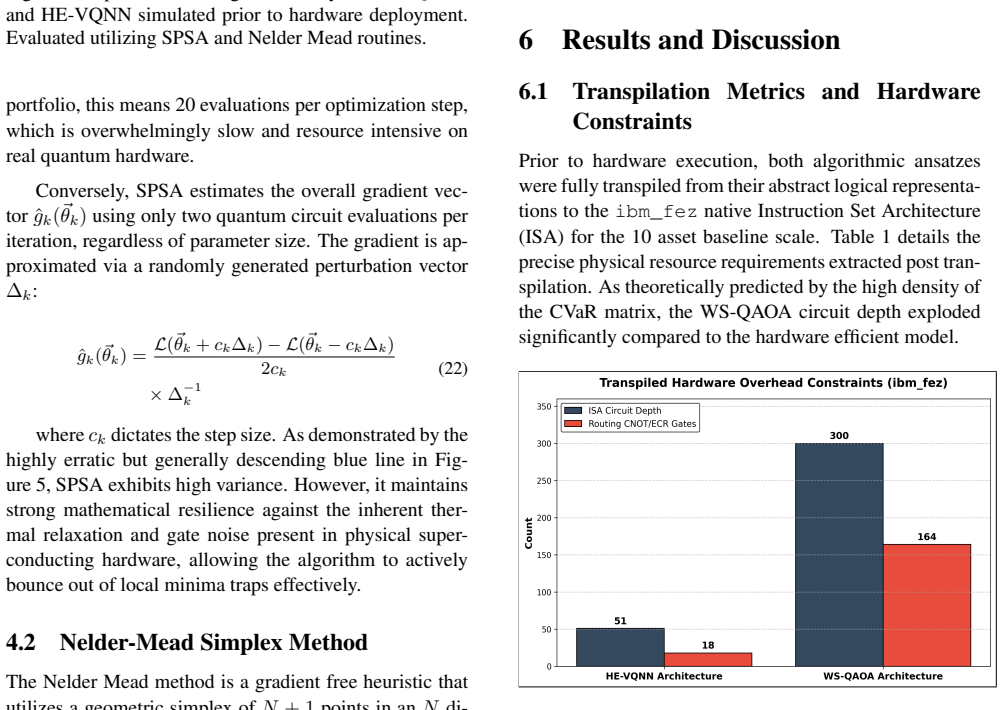
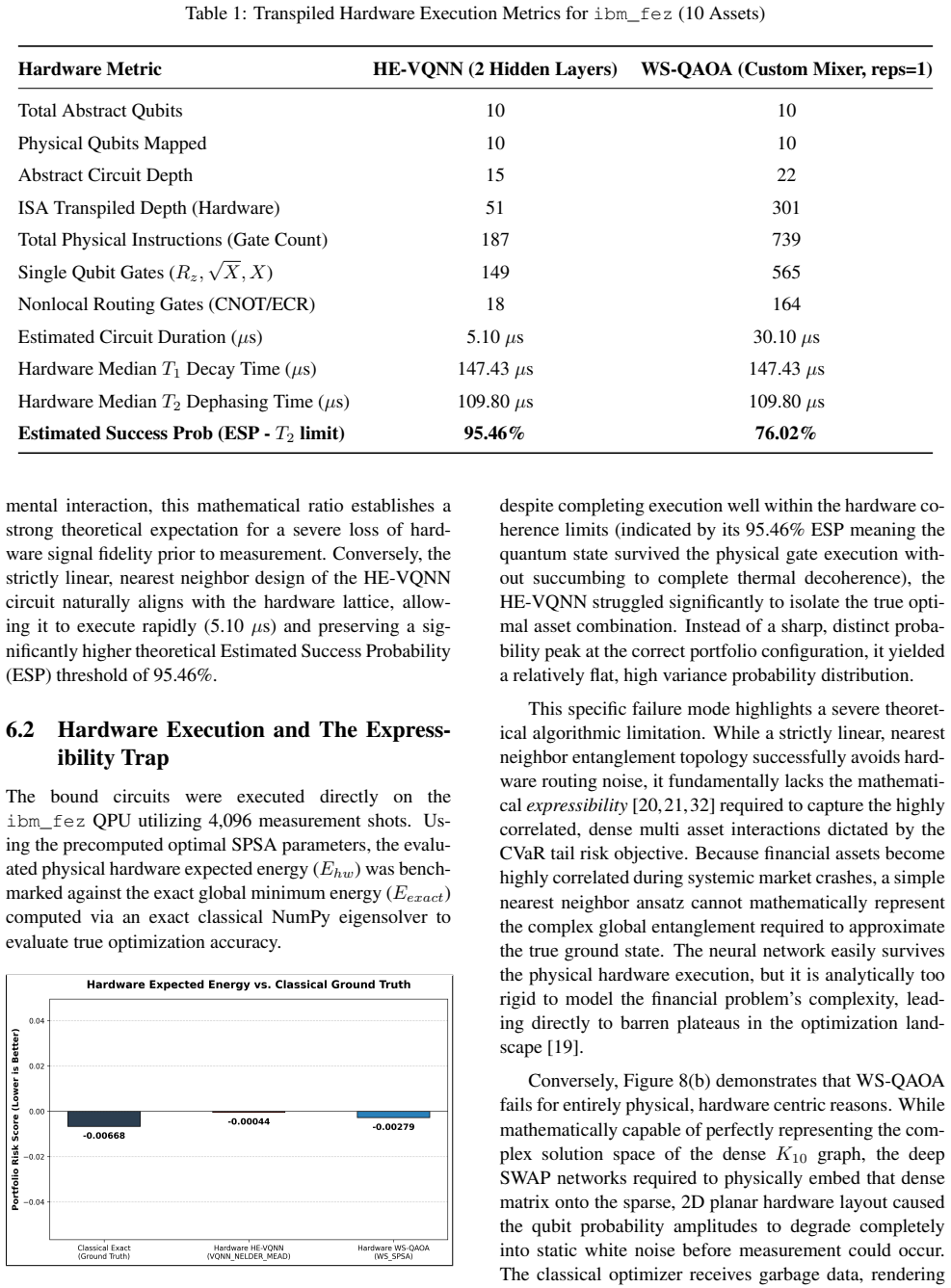
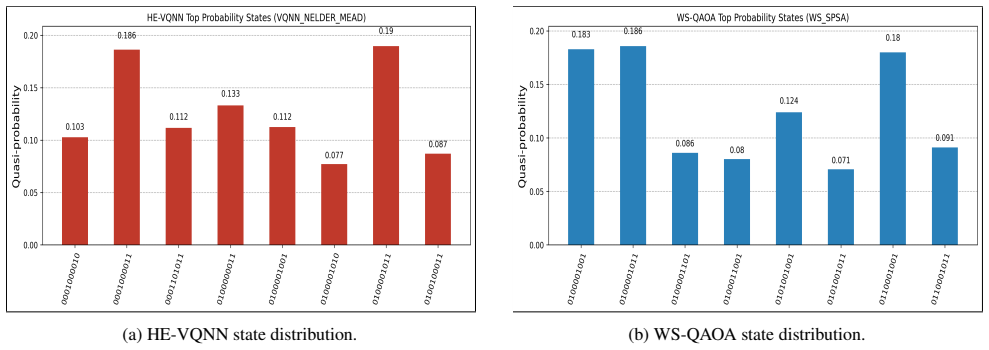
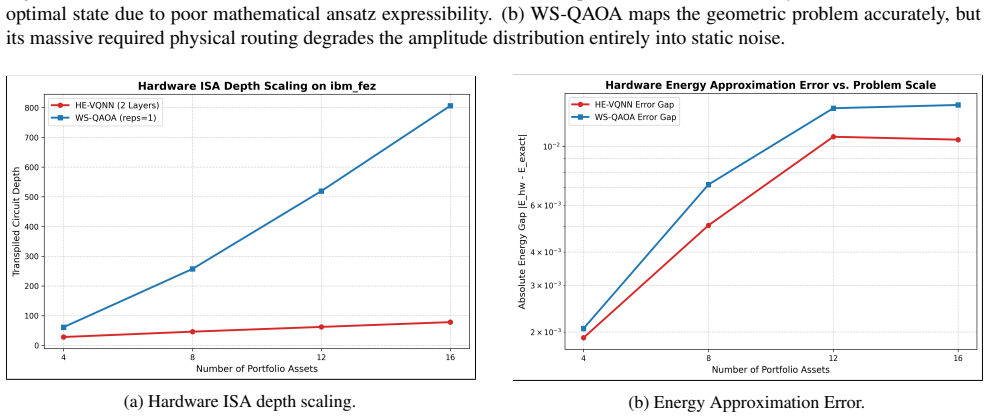
When the CVaR objective is mapped via a hybrid proxy matrix that bypasses auxiliary qubits, WS-QAOA supplies exact theoretical encoding but experiences catastrophic decoherence from exponential nonlocal gate overhead on limited-connectivity hardware, whereas HE-VQNN maintains coherence yet lacks the mathematical expressibility needed to capture dense asset tail-risk correlations.
What carries the argument
The expressibility-coherence trade-off generated by routing SWAP gates when embedding a CVaR objective on heavy-hex topology.
If this is right
- Dense correlation problems such as tail-risk CVaR cannot be solved at scale on current NISQ processors.
- Algorithm selection for financial optimization must trade exact mathematical fidelity against hardware survival time.
- The dominant cost in these mappings is the SWAP overhead required by limited qubit connectivity rather than the variational parameters themselves.
- Hybrid classical-quantum proxies can remove certain qubit-count bottlenecks but leave the connectivity limitation intact.
Where Pith is reading between the lines
- Hardware with native all-to-all links would remove the forced choice between the two algorithmic families.
- Targeted error mitigation focused on nonlocal gates could extend the usable depth of WS-QAOA for finance tasks.
- Simpler risk measures that avoid auxiliary variables may prove more practical on near-term devices than full CVaR.
Load-bearing premise
The hybrid proxy matrix accurately bypasses the CVaR auxiliary qubit without distorting the expressibility or coherence comparison.
What would settle it
Running the identical 16-asset instances on a device with all-to-all connectivity and finding that both algorithms achieve comparable solution quality without the observed trade-off.
Figures
read the original abstract
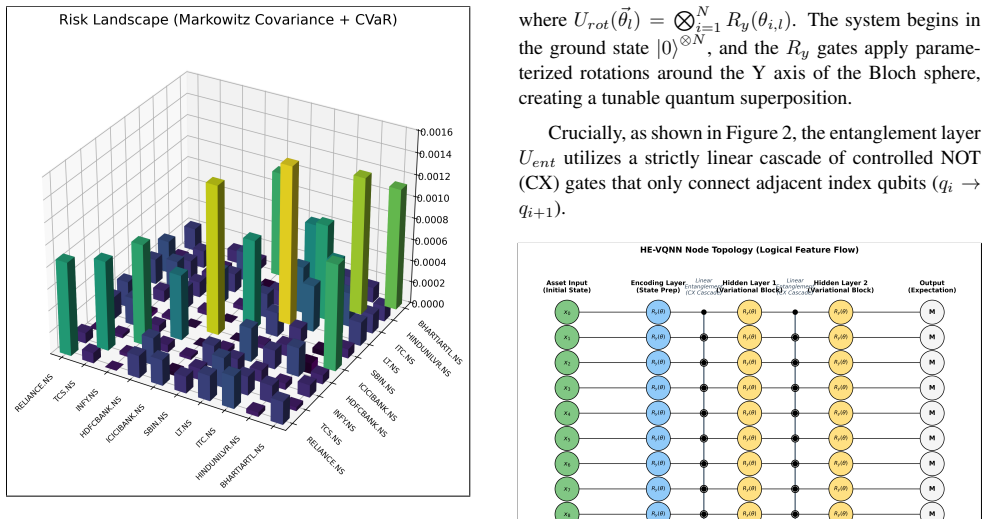
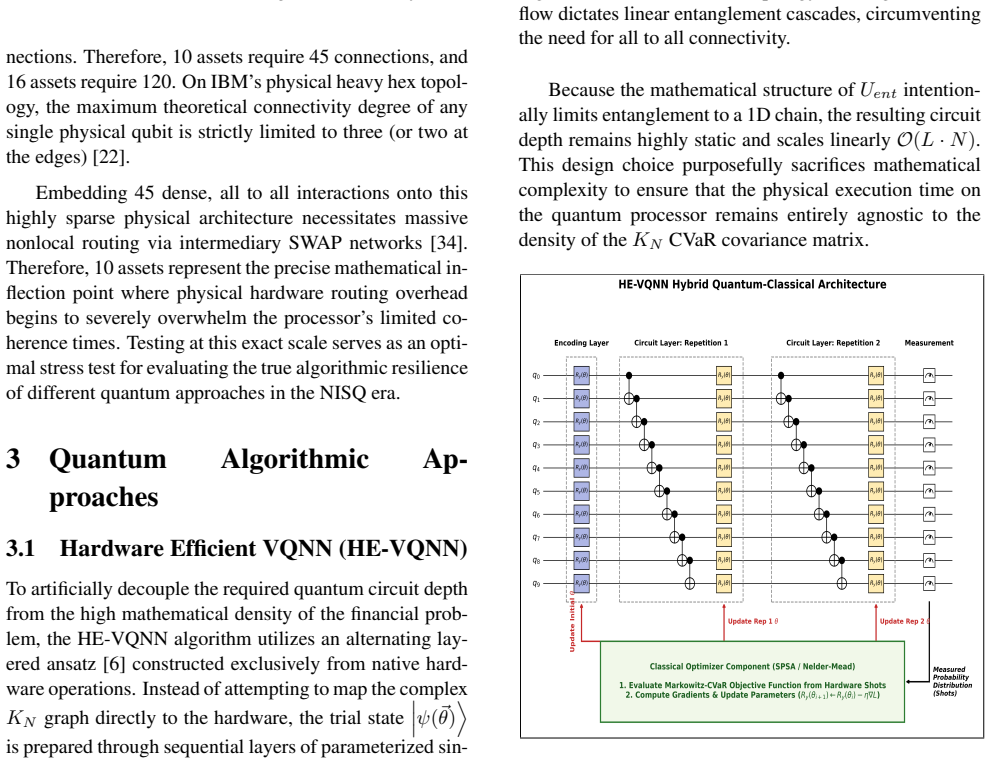
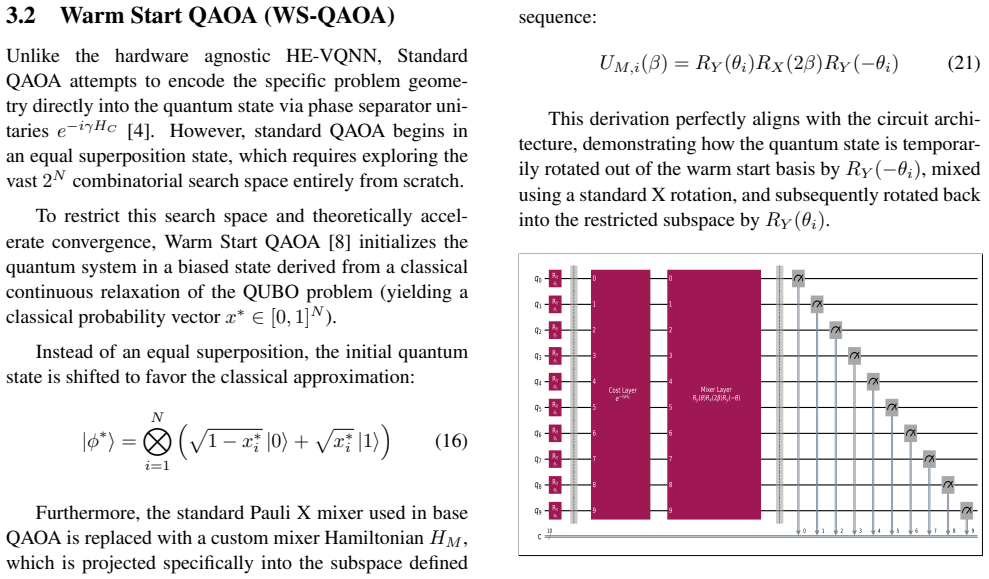
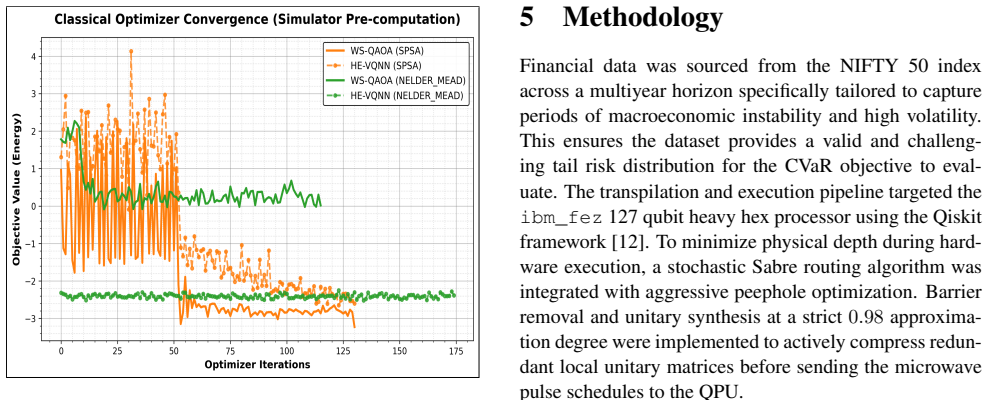
Quantum combinatorial optimization offers theoretical advantages for complex financial modeling, but physical implementation on Noisy Intermediate Scale Quantum (NISQ) devices is severely constrained by hardware topology. This study presents a hardware benchmarking analysis between a Hardware Efficient Variational Quantum Neural Network (HE-VQNN) and the Warm Start Quantum Approximate Optimization Algorithm (WS-QAOA) for a hybrid Mean Variance and Conditional Value at Risk (CVaR) portfolio objective. By implementing a novel classical quantum hybrid proxy matrix to bypass the CVaR auxiliary qubit bottleneck, we map up to 16 assets from the NIFTY 50 index onto an IBM heavy hex processor. We systematically quantify algorithmic resilience to the "SWAP tax" incurred during routing. Empirical results reveal a critical operational trade-off: WS-QAOA provides exact theoretical mapping but suffers catastrophic hardware decoherence due to exponential nonlocal gate overhead. Conversely, HE-VQNN preserves hardware coherence but lacks the mathematical expressibility to capture dense tail risk asset correlations. This study exposes the limitations of dense financial optimization on current architectures forces an nonviable choice between algorithmic inexpressibility and hardware decoherence. This is indicative of a deeper limitation as to what can and cannot be done with NISQ computers lacking in all-to-all connectivity.
Editorial analysis
A structured set of objections, weighed in public.
Referee Report
Summary. The paper benchmarks WS-QAOA against HE-VQNN for a hybrid mean-variance plus CVaR portfolio optimization problem on up to 16 NIFTY-50 assets mapped to IBM heavy-hex hardware. It introduces a novel classical-quantum hybrid proxy matrix claimed to bypass the auxiliary-qubit overhead of exact CVaR, then reports an empirical trade-off: WS-QAOA supplies an exact theoretical mapping but incurs catastrophic decoherence from exponential nonlocal gate overhead during routing, while HE-VQNN preserves coherence yet lacks sufficient expressibility to capture dense tail-risk correlations. The conclusion is that current NISQ devices without all-to-all connectivity force an untenable choice between algorithmic inexpressibility and hardware decoherence.
Significance. If the hybrid proxy matrix is shown to reproduce the exact CVaR objective (including tail quantiles on dense correlation matrices) without systematic bias, the work would supply concrete hardware evidence that dense financial combinatorial problems remain out of reach on present NISQ topologies. The use of real-device runs for 16 assets and explicit quantification of SWAP-tax effects would be a useful addition to the NISQ-finance literature; however, the absence of any reported error bounds or validation metrics for the proxy leaves the central trade-off claim unverified.
major comments (2)
- [Section 3] Section 3 (Hybrid Proxy Matrix construction): the manuscript presents the proxy as faithfully encoding the CVaR objective without auxiliary qubits, yet supplies neither analytic error bounds on the approximation for dense 16-asset correlation matrices nor numerical comparisons against the standard auxiliary-qubit CVaR formulation. Because the expressibility-coherence trade-off conclusion rests directly on this mapping being unbiased, the lack of validation is load-bearing.
- [Section 5] Section 5 / Results (hardware runs): the abstract asserts systematic quantification of algorithmic resilience and empirical observation of catastrophic decoherence versus inexpressibility, but the provided text contains no quantitative metrics, error bars, asset-selection criteria, or statistical tests. Without these, the reported trade-off cannot be assessed and the claim that WS-QAOA suffers exponential overhead while HE-VQNN is inexpressive remains unverified.
minor comments (2)
- [Abstract] Abstract, final sentence: 'forces an nonviable choice' should read 'forces a nonviable choice'.
- [Introduction / Methods] Notation: the acronym 'CVaR' is introduced without an explicit equation reference to the precise tail-risk functional being optimized; adding the standard definition (e.g., Eq. (X)) would improve clarity.
Simulated Author's Rebuttal
We thank the referee for their thorough review and constructive criticism. We address each major comment below and outline the revisions we will make to strengthen the manuscript.
read point-by-point responses
-
Referee: [Section 3] Section 3 (Hybrid Proxy Matrix construction): the manuscript presents the proxy as faithfully encoding the CVaR objective without auxiliary qubits, yet supplies neither analytic error bounds on the approximation for dense 16-asset correlation matrices nor numerical comparisons against the standard auxiliary-qubit CVaR formulation. Because the expressibility-coherence trade-off conclusion rests directly on this mapping being unbiased, the lack of validation is load-bearing.
Authors: We agree that validation of the hybrid proxy matrix is necessary to substantiate the unbiased nature of the mapping. The revised manuscript will include a new subsection deriving analytic error bounds under the assumption of multivariate normal returns (standard in portfolio theory) and providing numerical benchmarks against the auxiliary-qubit CVaR formulation for asset counts up to 8. For the 16-asset NIFTY-50 instances, we will report the maximum observed deviation in the tail quantile estimates across the tested correlation matrices and discuss conditions under which bias remains negligible. revision: yes
-
Referee: [Section 5] Section 5 / Results (hardware runs): the abstract asserts systematic quantification of algorithmic resilience and empirical observation of catastrophic decoherence versus inexpressibility, but the provided text contains no quantitative metrics, error bars, asset-selection criteria, or statistical tests. Without these, the reported trade-off cannot be assessed and the claim that WS-QAOA suffers exponential overhead while HE-VQNN is inexpressive remains unverified.
Authors: The current results section relies on figures to convey the observed trade-off, but we concur that additional quantitative detail is required. The revision will expand Section 5 to specify the asset-selection criteria (top 16 NIFTY-50 constituents by trading volume with pairwise correlations above a 0.3 threshold), include error bars computed from 10 independent hardware runs per circuit, report the exact additional SWAP-gate counts for each algorithm, and add paired statistical tests (Wilcoxon signed-rank) on the final CVaR values to quantify the significance of the expressibility versus decoherence differences. revision: yes
Circularity Check
No significant circularity in empirical benchmarking study
full rationale
The paper reports hardware benchmarking results comparing WS-QAOA and HE-VQNN on a CVaR portfolio task for NIFTY assets, using a novel proxy matrix solely as an implementation tool to enable the runs. No equations, parameters, or claims reduce by construction to their own inputs; the expressibility-coherence trade-off is presented as an observed outcome on IBM hardware rather than a fitted or self-defined quantity. No self-citation chains, uniqueness theorems, or ansatzes are invoked as load-bearing premises. The analysis is self-contained against external hardware execution and does not rely on renaming known results or smuggling assumptions via prior author work.
Axiom & Free-Parameter Ledger
Reference graph
Works this paper leans on
-
[1]
Quantum Compu- tation and Quantum Information,
M. A. Nielsen and I. L. Chuang, "Quantum Compu- tation and Quantum Information,"Cambridge Uni- versity Press, 2010
2010
-
[2]
Portfolio Selection,
H. Markowitz, "Portfolio Selection,"The Journal of Finance, vol. 7, no. 1, pp. 77–91, 1952
1952
-
[3]
Optimization of Conditional Value at Risk,
R. T. Rockafellar and S. Uryasev, "Optimization of Conditional Value at Risk,"Journal of Risk, vol. 2, pp. 21–42, 2000
2000
-
[4]
A Quantum Approximate Optimization Algorithm
E. Farhi, J. Goldstone, and S. Gutmann, "A Quan- tum Approximate Optimization Algorithm,"arXiv preprint arXiv:1411.4028, 2014
work page internal anchor Pith review Pith/arXiv arXiv 2014
-
[5]
Ising formulations of many NP prob- lems,
A. Lucas, "Ising formulations of many NP prob- lems,"Frontiers in Physics, vol. 2, p. 5, 2014
2014
-
[6]
Hardware efficient variational quantum eigensolver for small molecules and quan- tum magnets,
A. Kandalaet al., "Hardware efficient variational quantum eigensolver for small molecules and quan- tum magnets,"Nature, vol. 549, pp. 242–246, 2017
2017
-
[7]
Improving Variational Quan- tum Optimization using CVaR,
P. K. Barkoutsoset al., "Improving Variational Quan- tum Optimization using CVaR,"Quantum, vol. 4, p. 256, 2020
2020
-
[8]
Warm starting quantum optimiza- tion,
D. J. Eggeret al., "Warm starting quantum optimiza- tion,"Quantum, vol. 5, p. 479, 2021
2021
-
[9]
Quantum machine learning,
J. Biamonteet al., "Quantum machine learning,"Na- ture, vol. 549, pp. 195–202, 2017
2017
-
[10]
Variational quantum algorithms,
M. Cerezoet al., "Variational quantum algorithms," Nature Reviews Physics, vol. 2, pp. 625–644, 2021
2021
-
[11]
Multivariate stochastic approximation using a simultaneous perturbation gradient approx- imation,
J. C. Spall, "Multivariate stochastic approximation using a simultaneous perturbation gradient approx- imation,"IEEE Transactions on Automatic Control, vol. 40, no. 9, pp. 332–341, 1992
1992
-
[12]
Qiskit: An Open source Frame- work for Quantum Computing,
Qiskit contributors, "Qiskit: An Open source Frame- work for Quantum Computing,"Zenodo, 2024
2024
-
[13]
Quantum comput- ing for finance: Overview and prospects,
R. Orús, S. Mugel, and E. Lizaso, "Quantum comput- ing for finance: Overview and prospects,"Reviews in Physics, vol. 4, p. 100028, 2019
2019
-
[14]
A survey of quantum computing for finance,
D. Hermanet al., "A survey of quantum computing for finance,"IEEE Transactions on Quantum Engi- neering, vol. 3, pp. 1–24, 2022
2022
-
[15]
Solving the optimal trading tra- jectory problem using a quantum annealer,
G. Rosenberget al., "Solving the optimal trading tra- jectory problem using a quantum annealer,"IEEE Journal of Selected Topics in Signal Processing, vol. 10, no. 6, pp. 1053–1060, 2016
2016
-
[16]
Dynamic portfolio optimization with real datasets using quantum processors and quantum inspired tensor networks,
S. Mugelet al., "Dynamic portfolio optimization with real datasets using quantum processors and quantum inspired tensor networks,"Physical Review Research, vol. 3, no. 1, p. 013006, 2022
2022
-
[17]
Quantum approximate opti- mization of nonplanar graph problems on a planar superconducting processor,
M. P. Harriganet al., "Quantum approximate opti- mization of nonplanar graph problems on a planar superconducting processor,"Nature Physics, vol. 17, pp. 332–336, 2021
2021
-
[18]
Scaling of the quantum ap- proximate optimization algorithm on superconduct- ing qubit based hardware,
J. Weidenfelleret al., "Scaling of the quantum ap- proximate optimization algorithm on superconduct- ing qubit based hardware,"Quantum, vol. 6, p. 870, 2022
2022
-
[19]
Barren plateaus in quantum neural network training landscapes,
J. R. McCleanet al., "Barren plateaus in quantum neural network training landscapes,"Nature Commu- nications, vol. 9, p. 4812, 2018
2018
-
[20]
Connecting ansatz expressibility to gradient magnitudes and barren plateaus,
Z. Holmeset al., "Connecting ansatz expressibility to gradient magnitudes and barren plateaus,"PRX Quantum, vol. 3, p. 010313, 2022
2022
-
[21]
Ex- pressibility and entangling capability of parameter- ized quantum circuits for hybrid quantum classical algorithms,
S. Sim, P. D. Johnson, and A. Aspuru-Guzik, "Ex- pressibility and entangling capability of parameter- ized quantum circuits for hybrid quantum classical algorithms,"Advanced Quantum Technologies, vol. 2, no. 12, p. 1900070, 2019
2019
-
[22]
Topological and subsystem codes on lattice surgery networks with IBM quan- tum experience,
C. Chamberlandet al., "Topological and subsystem codes on lattice surgery networks with IBM quan- tum experience,"Physical Review X, vol. 10, no. 1, p. 011022, 2020. 9
2020
-
[23]
Error mitigation for short depth quantum circuits,
K. Temme, S. Bravyi, and J. M. Gambetta, "Error mitigation for short depth quantum circuits,"Physi- cal Review Letters, vol. 119, no. 18, p. 180509, 2017
2017
-
[24]
Efficient variational quan- tum simulator incorporating active error minimiza- tion,
Y . Li and S. C. Benjamin, "Efficient variational quan- tum simulator incorporating active error minimiza- tion,"Physical Review X, vol. 7, no. 2, p. 021050, 2017
2017
-
[25]
Hodson, Brendan Ruck, Hugh Ong, David Garvin, and Stefan Dulman
M. Hodsonet al., "Portfolio optimization with a quantum algorithm,"arXiv preprint arXiv:1911.05296, 2019
-
[26]
Quantum Computing in the NISQ era and beyond,
J. Preskill, "Quantum Computing in the NISQ era and beyond,"Quantum, vol. 2, p. 79, 2018
2018
-
[27]
Credit risk analysis using quantum computers,
D. J. Eggeret al., "Credit risk analysis using quantum computers,"IEEE Transactions on Computers, vol. 70, no. 12, pp. 2136-2145, 2020
2020
-
[28]
Quantum risk analysis,
S. Woerner and D. J. Egger, "Quantum risk analysis," npj Quantum Information, vol. 5, no. 1, p. 15, 2019
2019
-
[29]
Quantum machine learning for fi- nance,
A. Pistoiaet al., "Quantum machine learning for fi- nance,"arXiv preprint arXiv:2109.04298, 2021
-
[30]
Quantum optimization for portfolio allocation,
A. Abbaset al., "Quantum optimization for portfolio allocation,"Quantum, vol. 7, p. 956, 2023
2023
-
[31]
Practical quan- tum error mitigation for near future applications,
S. Endo, S. C. Benjamin, and Y . Li, "Practical quan- tum error mitigation for near future applications," Physical Review X, vol. 8, no. 3, p. 031027, 2018
2018
-
[32]
Machine learning of noise resilient quantum circuits,
P. Cincioet al., "Machine learning of noise resilient quantum circuits,"PRX Quantum, vol. 2, p. 010324, 2021
2021
-
[33]
Benchmarking the perfor- mance of portfolio optimization with QAOA,
S. Brandhoferet al., "Benchmarking the perfor- mance of portfolio optimization with QAOA,"Quan- tum Information Processing, vol. 22, p. 25, 2022
2022
-
[34]
Mitigating quantum errors via ran- domized compiling,
S. Bravyiet al., "Mitigating quantum errors via ran- domized compiling,"Nature, vol. 608, no. 7924, pp. 676-681, 2022. 10
2022
discussion (0)
Sign in with ORCID, Apple, or X to comment. Anyone can read and Pith papers without signing in.