On the effect of higher order symmetry energy corrections in Skyrme models for neutron star matter
Pith reviewed 2026-06-27 18:57 UTC · model grok-4.3
The pith
Higher-order isospin corrections in Skyrme models alter neutron star composition under beta equilibrium but leave the bulk equation of state largely unchanged.
A machine-rendered reading of the paper's core claim, the machinery that carries it, and where it could break.
Core claim
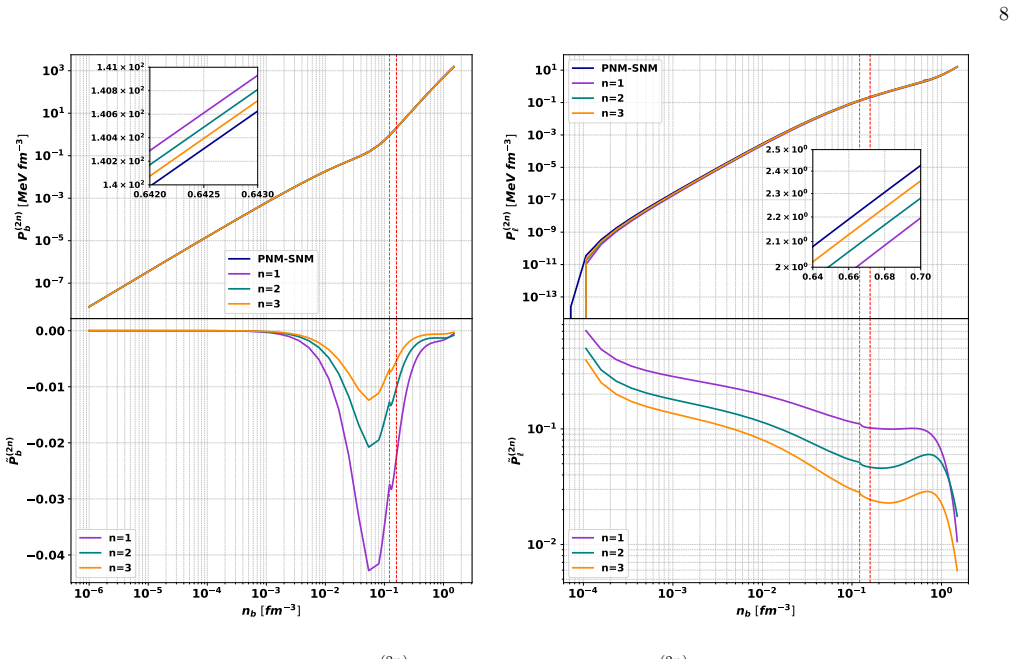
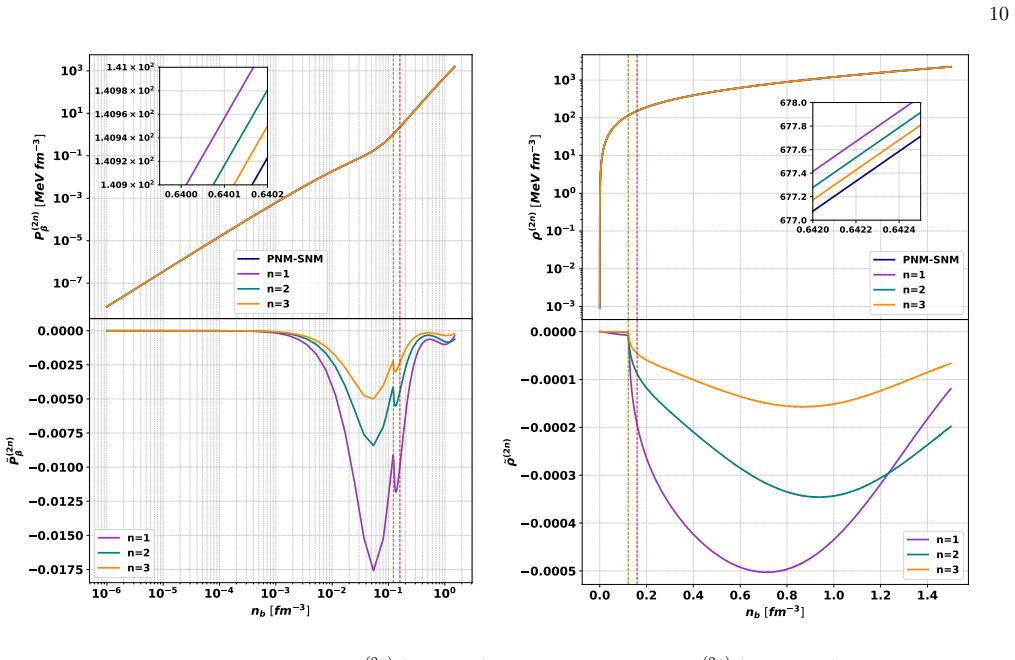
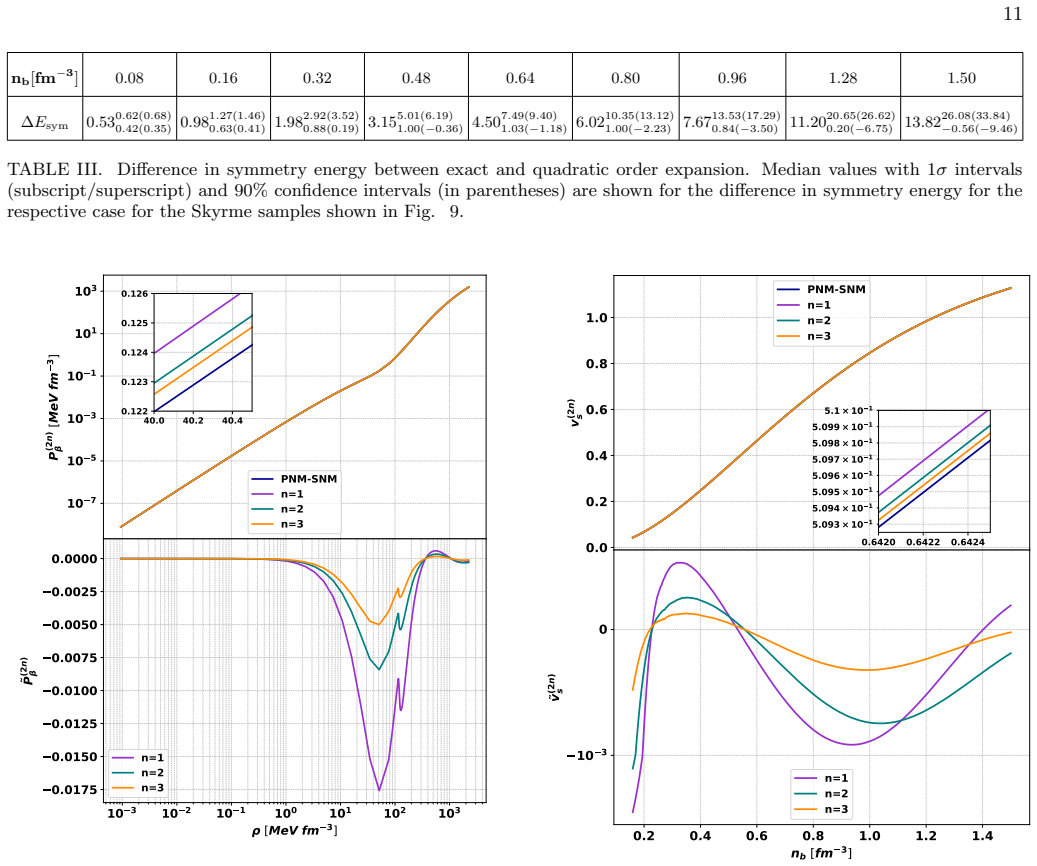
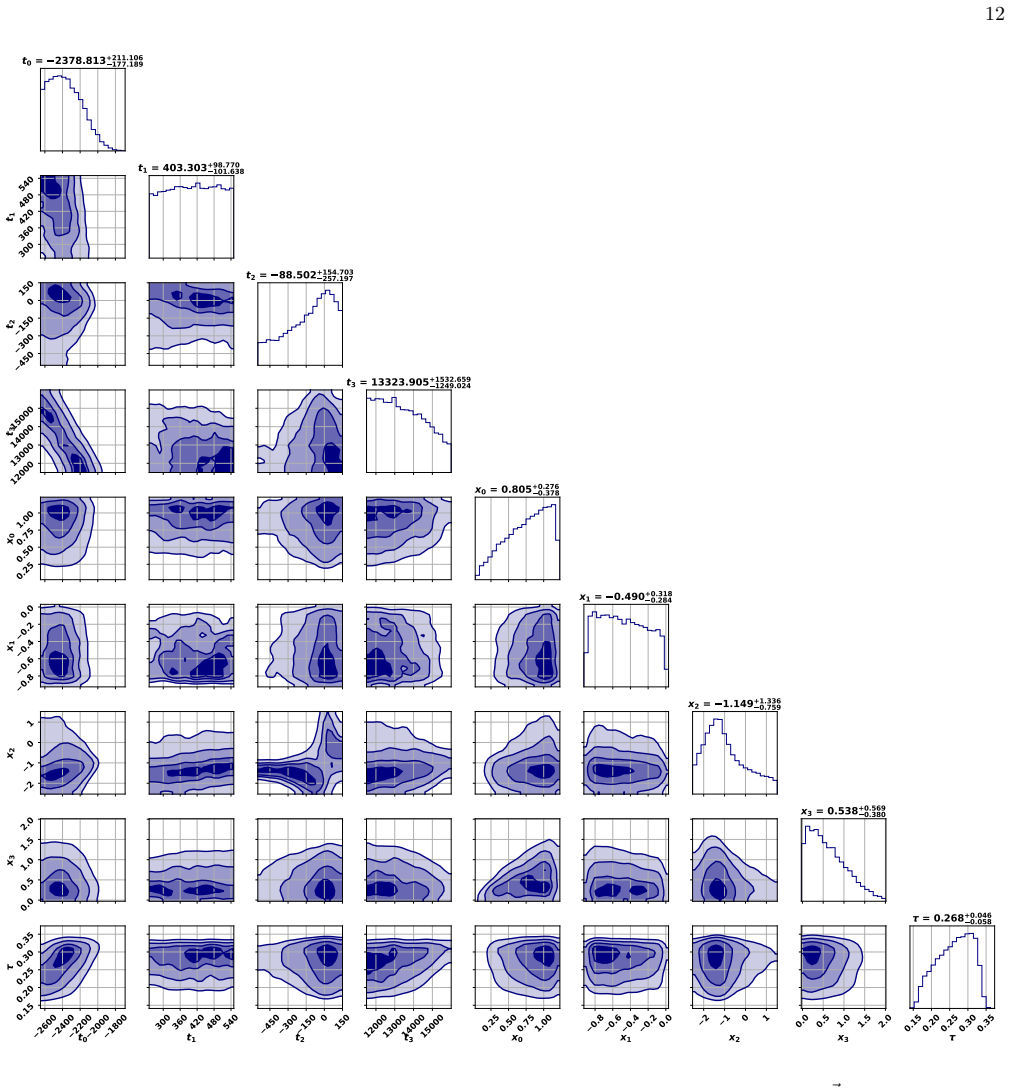
Within Skyrme-like interactions the energy per nucleon is expanded beyond the usual quadratic term in the isospin asymmetry parameter; when this expansion is evaluated for a population of parametrizations that satisfy saturation bounds, causality, and the two-solar-mass constraint, the higher-order contributions modify composition-sensitive quantities at supra-nuclear densities while the beta-equilibrated equation of state itself remains comparatively insensitive.
What carries the argument
The power-series expansion of the energy per nucleon with respect to the isospin asymmetry parameter, carried to orders beyond the conventional quadratic symmetry-energy term, inside Skyrme effective interactions.
If this is right
- The neutron-proton chemical potential difference is altered at high density.
- The equilibrium proton fraction changes, which modifies leptonic properties.
- The density threshold for the direct Urca process shifts.
- Energy density, pressure, and sound speed of the beta-equilibrated EOS remain nearly the same.
Where Pith is reading between the lines
- Cooling curves of young neutron stars could be affected through changes in Urca emissivity.
- Models of neutron-star merger ejecta may need to incorporate higher-order isospin terms for accurate composition.
- Similar expansions could be tested in other effective interactions such as relativistic mean-field models.
Load-bearing premise
The population of Skyrme parametrizations, selected only by saturation-density bounds, thermodynamic stability, causality, and two-solar-mass support, adequately represents the models relevant to neutron-star cores.
What would settle it
A measurement or simulation that finds the proton fraction or direct-Urca threshold in beta-equilibrated matter at two to three times nuclear saturation density to be insensitive to the inclusion of cubic and quartic isospin terms.
Figures
read the original abstract
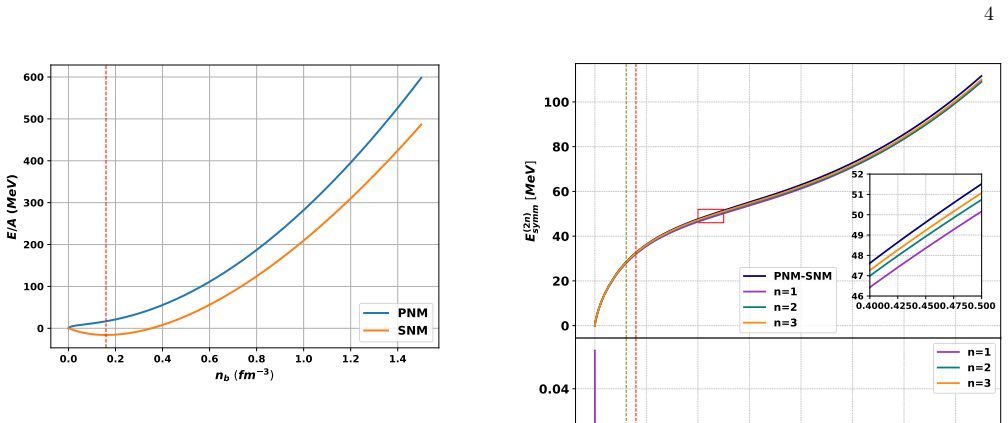
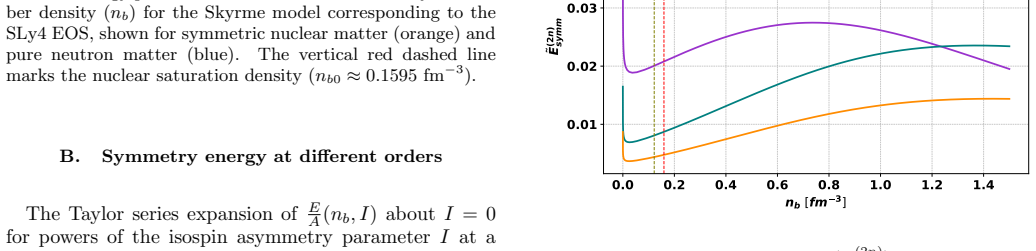
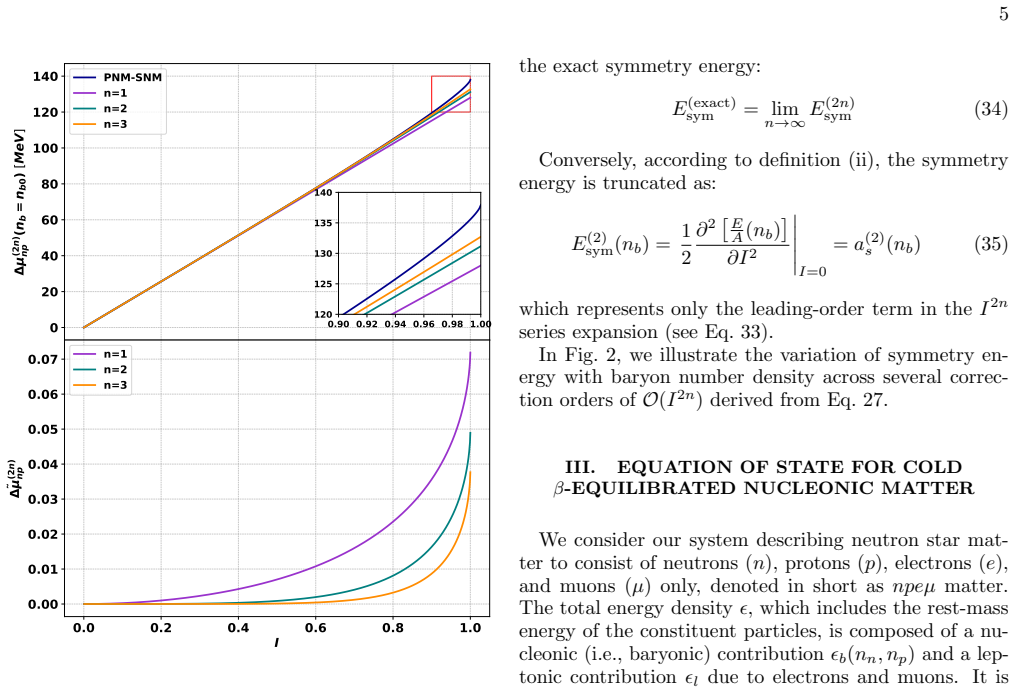
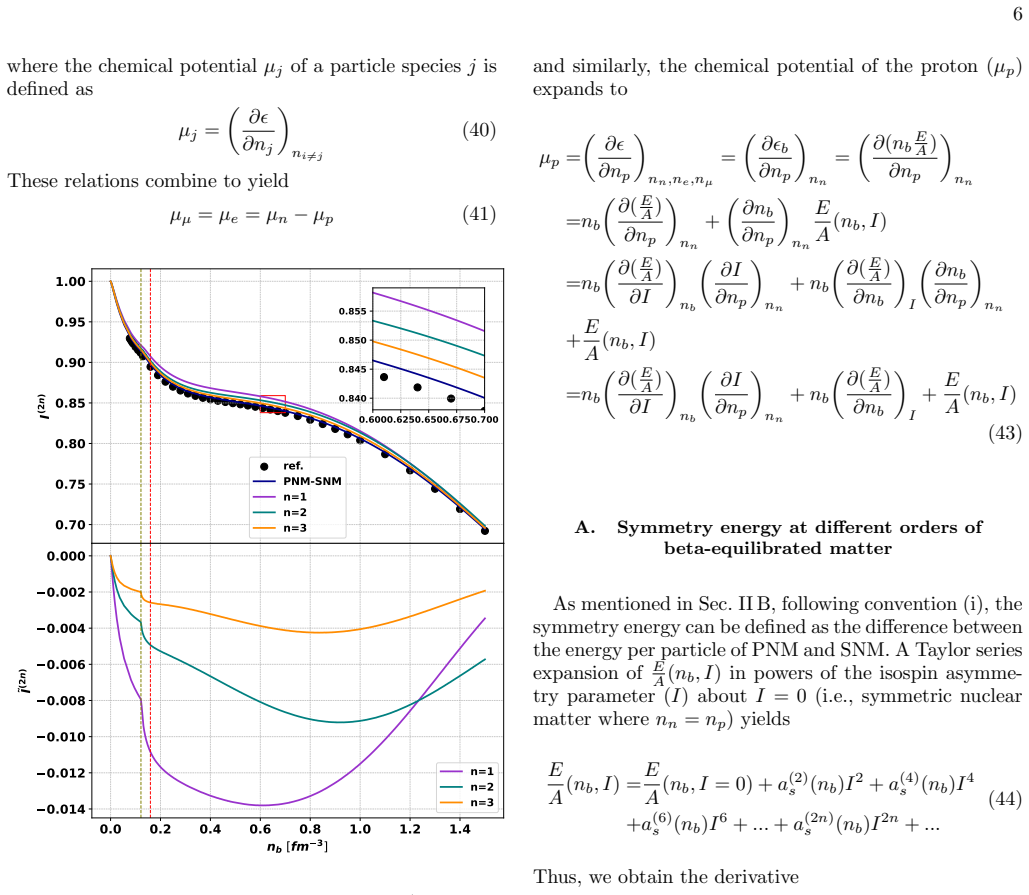
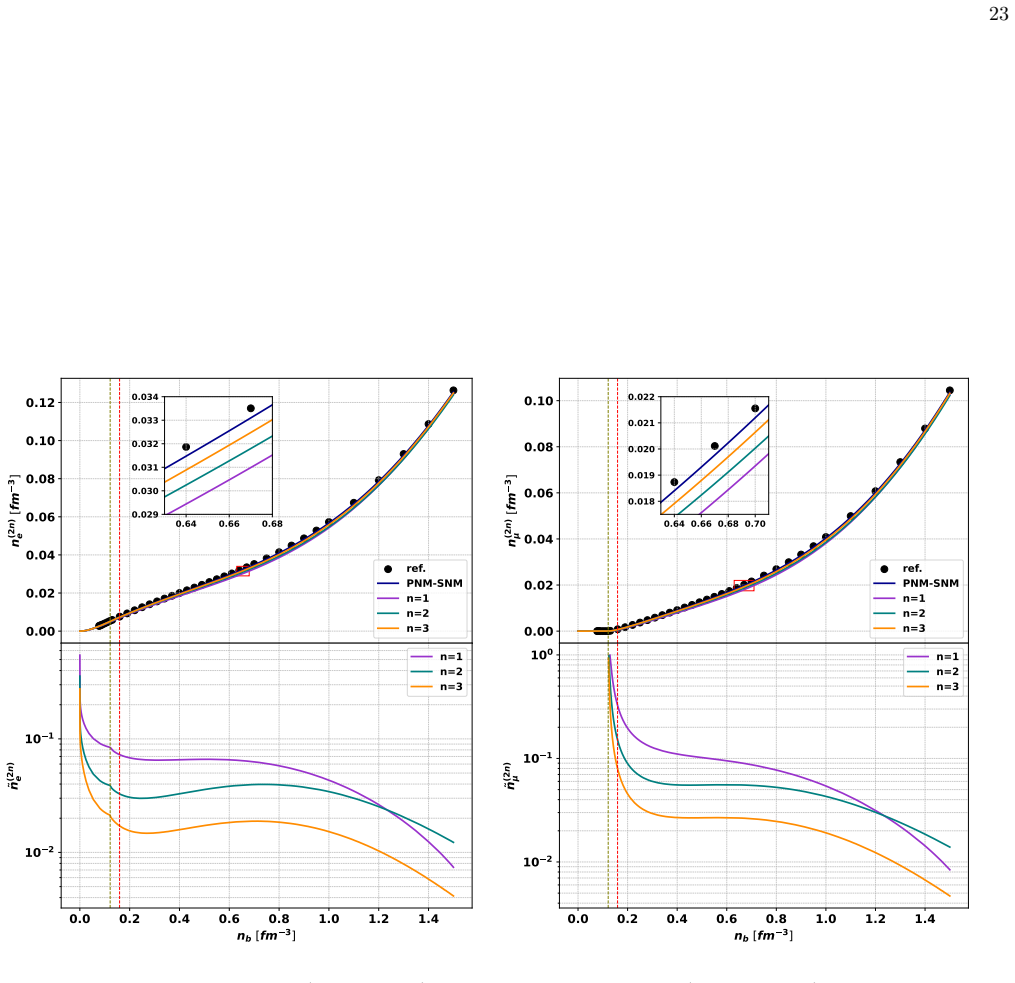
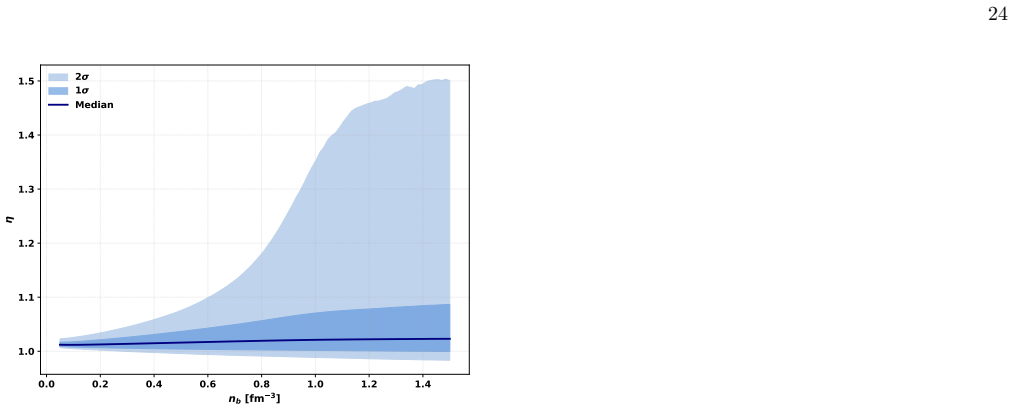
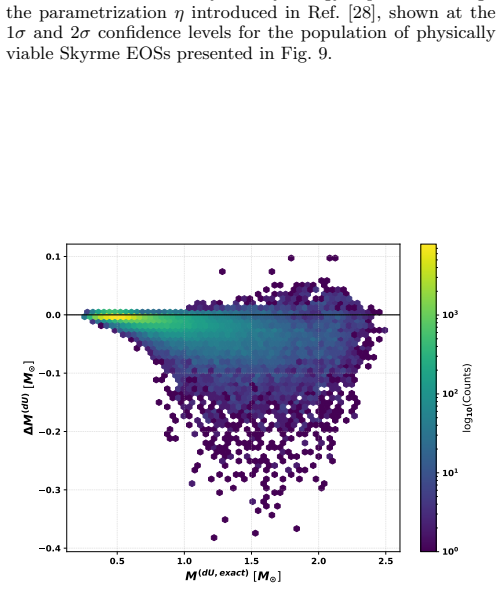
Neutron stars consist of cold, dense, neutron-rich nuclear matter under charge neutrality and $\beta$-equilibrium. In most nuclear equation of state (EOS) studies, the isospin dependence of asymmetric nuclear matter is described using the conventional quadratic/parabolic approximation to the nuclear symmetry energy. However, its validity in the highly neutron-rich inner core of neutron stars remains uncertain. In this work, we systematically investigate the role of higher-order isospin corrections to the symmetry energy within the framework of Skyrme-like effective nuclear interactions. We first analyze the standard SLy4 parametrization and quantify deviations arising from successive higher-order terms in the expansion of the energy per nucleon with respect to the isospin asymmetry parameter. We then extend the analysis to a large population of physically viable Skyrme EOSs sampled over a broad parameter space constrained by conventional nuclear saturation density bounds, thermodynamic stability, and causality, as well as the requirement to support astrophysical neutron-star mass observations exceeding $2\text{M}_{\odot}$. We find that higher-order isospin corrections become increasingly important at supra-nuclear densities and can significantly modify composition-sensitive quantities under $\beta$-equilibrium, including the neutron-proton chemical potential difference, proton fraction, leptonic sector properties, and the direct-Urca process. In contrast, the $\beta$-equilibrated EOS, energy density, pressure, and sound speed remain comparatively insensitive to these corrections for most viable EOSs. Our results demonstrate that while the quadratic approximation captures bulk thermodynamic behavior reasonably well, higher-order isospin contributions play a non-negligible role in determining the detailed composition and microscopic properties of dense matter in neutron-star interiors.
Editorial analysis
A structured set of objections, weighed in public.
Referee Report
Summary. The manuscript claims that higher-order isospin corrections to the symmetry energy in Skyrme-like interactions become increasingly important at supra-nuclear densities in neutron-star matter. For the SLy4 parametrization and a population of viable Skyrme EOSs sampled under saturation, stability, causality, and 2M⊙ constraints, these corrections significantly modify β-equilibrium composition quantities such as the neutron-proton chemical potential difference, proton fraction, leptonic properties, and the direct Urca process, while the β-equilibrated EOS, energy density, pressure, and sound speed remain comparatively insensitive for most models.
Significance. If the sampled population adequately represents physically relevant models, the result highlights that the conventional quadratic approximation to the symmetry energy is sufficient for bulk thermodynamic properties but insufficient for detailed composition and microphysical processes in neutron-star cores. This has implications for modeling neutron-star cooling via the direct Urca process. The systematic use of a large population of EOSs is a positive aspect of the analysis.
major comments (2)
- [abstract and sampling paragraph] Abstract and sampling paragraph: The population of Skyrme parametrizations is generated by varying parameters inside bounds set only by saturation density, thermodynamic stability, causality, and maximum mass >2 M⊙. No additional filters from finite-nucleus data, heavy-ion flow, or ab-initio neutron-matter calculations at 2–4 n_sat are imposed. This is load-bearing for the central claim, because unphysical correlations between the quartic and sextic isospin coefficients could be retained in the allowed volume, rendering the reported differential sensitivity (composition affected, bulk EOS insensitive) an artifact of the sampling rather than a generic feature.
- [abstract] Abstract: The conclusion that higher-order corrections 'can significantly modify' composition-sensitive quantities 'for most viable EOSs' rests on results shown across this population; without demonstrating that the sampled set excludes the unphysical correlations noted above, the distinction between composition and bulk thermodynamics cannot be taken as robust.
minor comments (1)
- [abstract] The abstract would benefit from stating the size of the sampled population and the quantitative thresholds used to declare quantities 'comparatively insensitive' (e.g., maximum fractional change in pressure or sound speed across the ensemble).
Simulated Author's Rebuttal
We thank the referee for their careful reading of the manuscript and for highlighting important issues regarding the sampling procedure and the robustness of our conclusions. We address each major comment below and outline planned revisions.
read point-by-point responses
-
Referee: [abstract and sampling paragraph] Abstract and sampling paragraph: The population of Skyrme parametrizations is generated by varying parameters inside bounds set only by saturation density, thermodynamic stability, causality, and maximum mass >2 M⊙. No additional filters from finite-nucleus data, heavy-ion flow, or ab-initio neutron-matter calculations at 2–4 n_sat are imposed. This is load-bearing for the central claim, because unphysical correlations between the quartic and sextic isospin coefficients could be retained in the allowed volume, rendering the reported differential sensitivity (composition affected, bulk EOS insensitive) an artifact of the sampling rather than a generic feature.
Authors: We acknowledge that the sampling relies solely on the listed constraints and does not incorporate additional filters from finite-nucleus properties, heavy-ion data, or ab-initio neutron-matter calculations. This choice was made to explore the broadest set of Skyrme models consistent with saturation properties, stability, causality, and the 2 M⊙ mass requirement. We agree that unphysical correlations between higher-order isospin coefficients could persist and that this limits the generality of the claim. In revision we will expand the sampling section to explicitly discuss this limitation, qualify the results as applying to models within the adopted constraints, and add a brief analysis of parameter variations to illustrate that the reported differential sensitivity is not driven by a single narrow correlation. revision: partial
-
Referee: [abstract] Abstract: The conclusion that higher-order corrections 'can significantly modify' composition-sensitive quantities 'for most viable EOSs' rests on results shown across this population; without demonstrating that the sampled set excludes the unphysical correlations noted above, the distinction between composition and bulk thermodynamics cannot be taken as robust.
Authors: We agree that the strength of the distinction between composition-sensitive and bulk quantities depends on the representativeness of the sampled population. Without additional constraints it is not possible to demonstrate that unphysical correlations have been excluded. We will therefore revise the abstract and the concluding paragraphs to qualify the statements, replacing the unqualified claim with language that ties the findings explicitly to the population of models satisfying the stated constraints. We will also add a short subsection examining whether the observed pattern persists when the quartic and sextic coefficients are varied independently within the allowed ranges. revision: partial
Circularity Check
No significant circularity; direct evaluation of extended Skyrme functionals on externally constrained samples.
full rationale
The paper computes beta-equilibrium quantities by direct substitution of higher-order isospin terms into the Skyrme energy functional (abstract and sampling paragraph). The sampled parameter sets are generated from independent external bounds (saturation density, stability, causality, 2 M⊙) rather than from the target composition or Urca observables. No self-definitional loops, fitted inputs renamed as predictions, or load-bearing self-citations appear in the derivation chain. The reported differential sensitivity between composition and bulk thermodynamics therefore follows from explicit evaluation rather than from any reduction to the inputs by construction.
Axiom & Free-Parameter Ledger
free parameters (1)
- Skyrme interaction parameters
axioms (2)
- domain assumption Skyrme effective interactions remain valid at densities several times nuclear saturation
- domain assumption The isospin expansion of the energy per nucleon can be meaningfully extended to high-order terms at supra-nuclear densities
Reference graph
Works this paper leans on
-
[1]
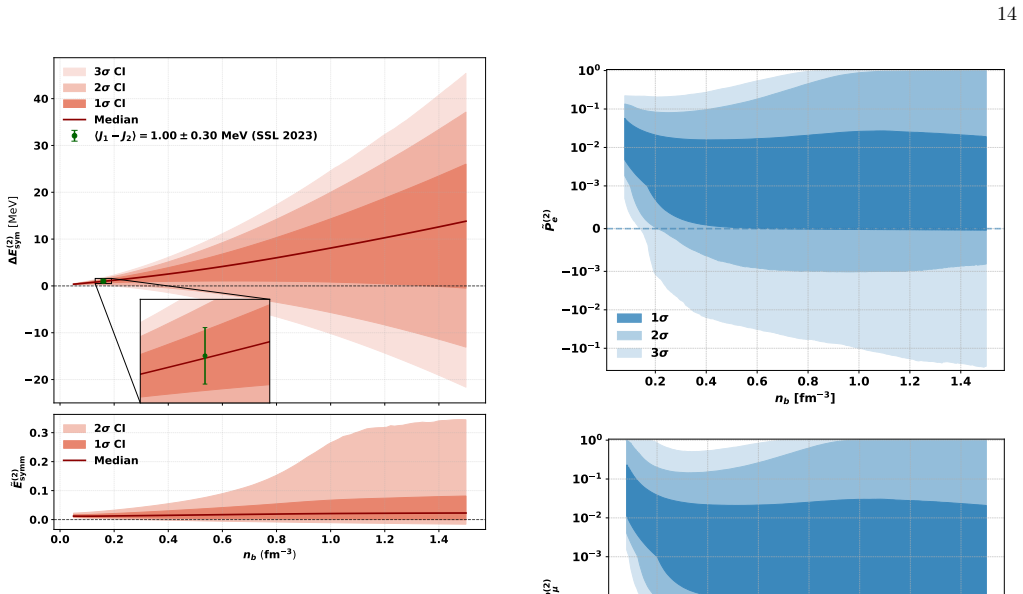
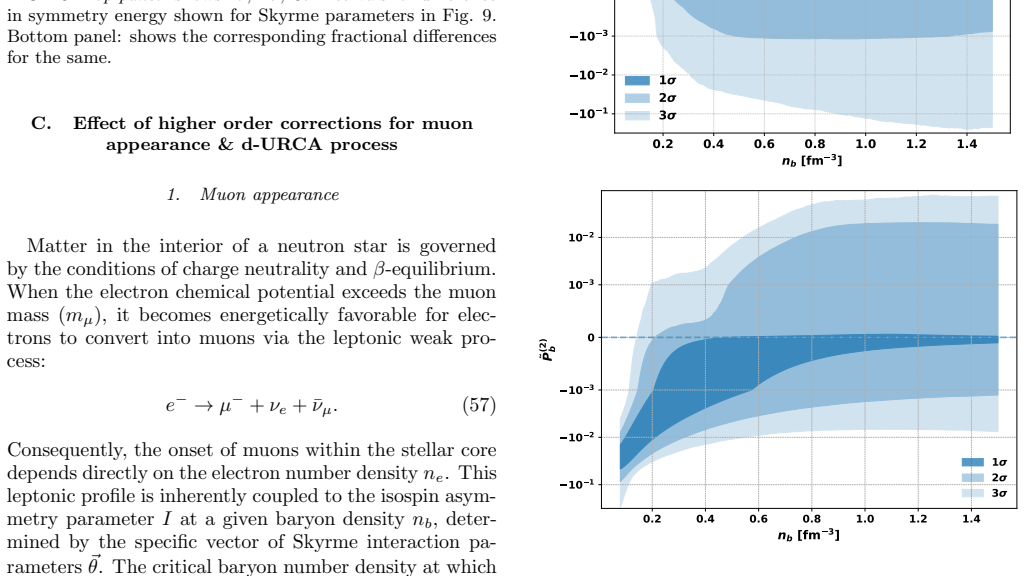
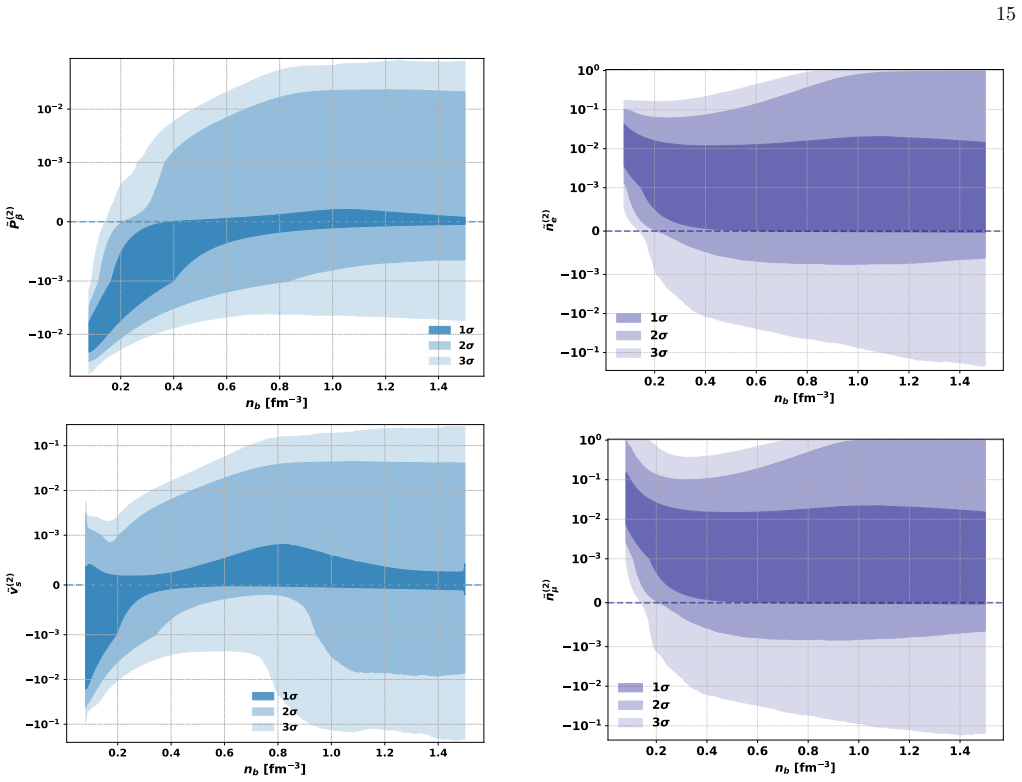
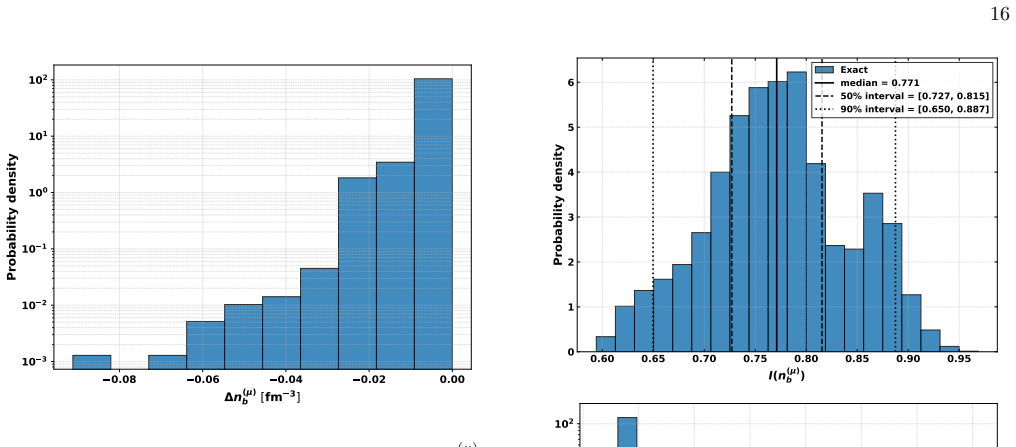
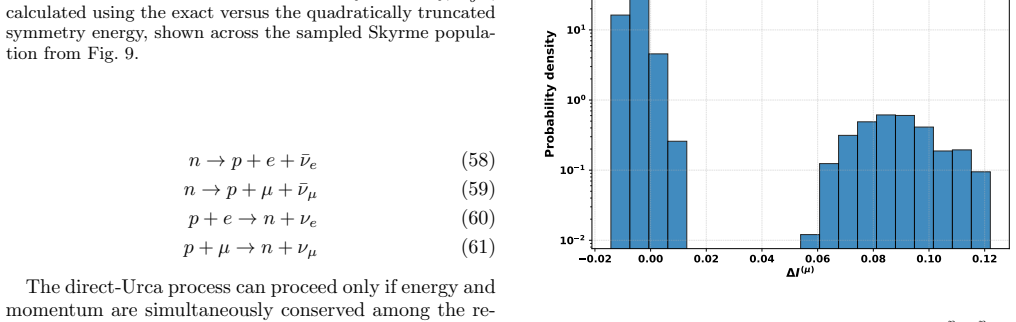
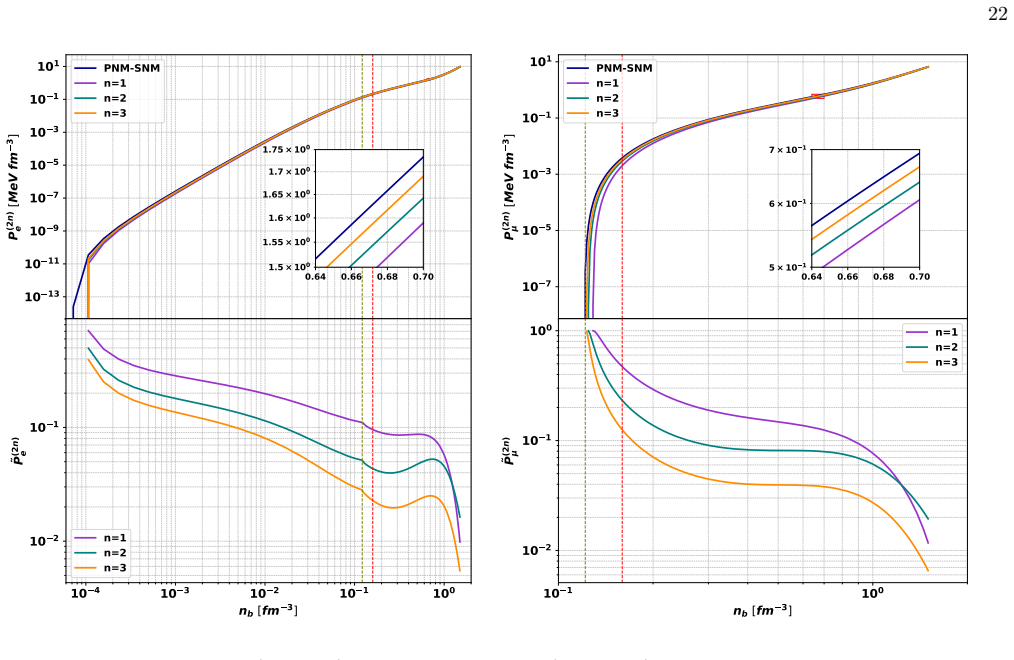
Muon appearance Matter in the interior of a neutron star is governed by the conditions of charge neutrality andβ-equilibrium. When the electron chemical potential exceeds the muon mass (m µ), it becomes energetically favorable for elec- trons to convert into muons via the leptonic weak pro- cess: e− →µ − +ν e + ¯νµ.(57) Consequently, the onset of muons wi...
-
[2]
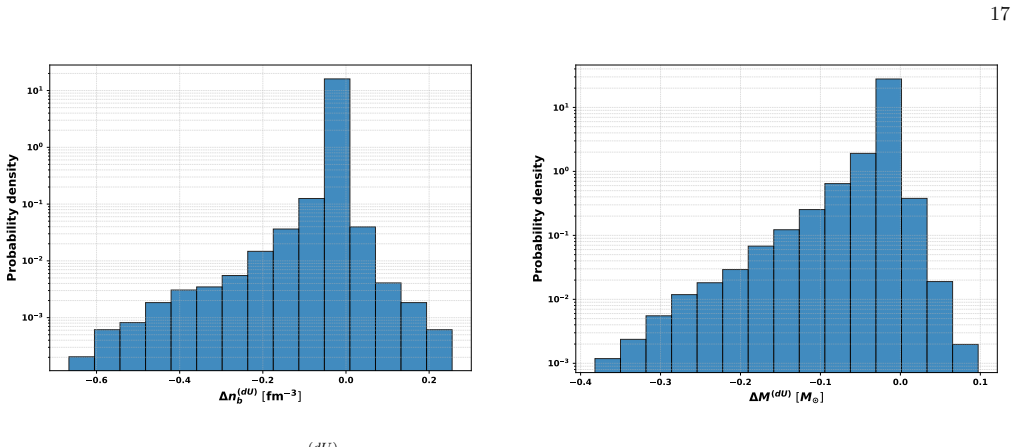
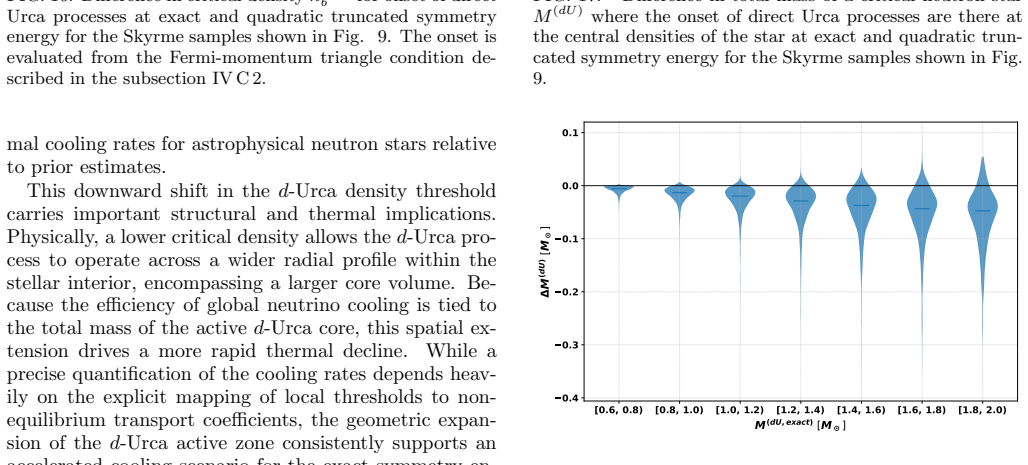
Direct URCA process For a cold neutron star relevant for most of the as- tronomically old populations, Fermi momenta (k F ) of different constituent particle species of the neutron star matter determines the onset of direct-Urca process [28– 30]. This involves weak-interactions of either electron or muon species in one of the following channels 16 0.08 0....
1982
-
[3]
J. M. Lattimer and M. Prakash, The Physics of Neutron Stars, Science304, 536 (2004), arXiv:astro-ph/0405262 [astro-ph]
Pith/arXiv arXiv 2004
-
[4]
W. Busza, K. Rajagopal, and W. van der Schee, Heavy Ion Collisions: The Big Picture and the Big Questions, Annual Review of Nuclear and Particle Science68, 339 (2018), arXiv:1802.04801 [hep-ph]
Pith/arXiv arXiv 2018
-
[5]
J. M. Lattimer and M. Prakash, Neutron star observa- tions: Prognosis for equation of state constraints, Physics Reports442, 109 (2007), arXiv:astro-ph/0612440 [astro- ph]
Pith/arXiv arXiv 2007
-
[6]
J. D. Walecka, Equation of state for neutron matter at finite T in a relativistic mean-field theory, Physics Letters B59, 109 (1975)
1975
-
[7]
B. D. Serot and J. D. Walecka, Properties of finite nuclei in a relativistic quantum field theory, Physics Letters B 87, 172 (1979)
1979
-
[8]
H. A. Bethe, Theory of nuclear matter, Annual Review of Nuclear and Particle Science21, 93 (1971)
1971
-
[9]
C.-H. Lee, T. T. S. Kuo, G. Q. Li, and G. E. Brown, Nuclear symmetry energy, Phys. Rev. C57, 3488 (1998)
1998
-
[10]
Katayama and K
T. Katayama and K. Saito, Properties of dense, asym- metric nuclear matter in dirac-brueckner-hartree-fock ap- proach, Phys. Rev. C88, 035805 (2013)
2013
-
[11]
Sammarruca, Recent advances in microscopic ap- proaches to nuclear matter and symmetry energy, Sym- metry6, 851 (2014)
F. Sammarruca, Recent advances in microscopic ap- proaches to nuclear matter and symmetry energy, Sym- metry6, 851 (2014)
2014
-
[12]
V. R. Pandharipande and R. B. Wiringa, Variations on a theme of nuclear matter, Rev. Mod. Phys.51, 821 (1979)
1979
- [13]
-
[14]
Skyrme, The effective nuclear potential, Nuclear Physics9, 615 (1958)
T. Skyrme, The effective nuclear potential, Nuclear Physics9, 615 (1958)
1958
-
[15]
Vautherin and D
D. Vautherin and D. M. Brink, Hartree-fock calculations with skyrme’s interaction. i. spherical nuclei, Phys. Rev. C5, 626 (1972)
1972
-
[16]
Chabanat, P
E. Chabanat, P. Bonche, P. Haensel, J. Meyer, and R. Schaeffer, A Skyrme parametrization from subnuclear to neutron star densities, Nuclear Physics A627, 710 (1997)
1997
-
[17]
Gonzalez-Boquera, M
C. Gonzalez-Boquera, M. Centelles, X. Vi˜ nas, and A. Rios, Higher-order symmetry energy and neutron star core-crust transition with gogny forces, Phys. Rev. C96, 065806 (2017)
2017
-
[18]
F. Douchin and P. Haensel, A unified equation of state of dense matter and neutron star structure, Astrophysics and Astronomy380, 151 (2001), arXiv:astro-ph/0111092 [astro-ph]
Pith/arXiv arXiv 2001
-
[19]
B. Sun, S. Bhattiprolu, and J. M. Lattimer, Com- piled properties of nucleonic matter and nuclear and neutron star models from nonrelativistic and relativis- tic interactions, Phys. Rev. C109, 055801 (2024), arXiv:2311.00843 [nucl-th]
arXiv 2024
-
[20]
Chabanat, P
E. Chabanat, P. Bonche, P. Haensel, J. Meyer, and R. Schaeffer, A skyrme parametrization from subnuclear to neutron star densities part ii. nuclei far from stabili- ties, Nuclear Physics A635, 231 (1998)
1998
-
[21]
C. J. Horowitz, J. Piekarewicz, and B. Reed, Insights into nuclear saturation density from parity-violating electron scattering, Phys. Rev. C102, 044321 (2020)
2020
-
[22]
Drischler, K
C. Drischler, K. Hebeler, and A. Schwenk, Chiral inter- actions up to next-to-next-to-next-to-leading order and nuclear saturation, Phys. Rev. Lett.122, 042501 (2019)
2019
-
[23]
Chen and J
W.-C. Chen and J. Piekarewicz, Building relativistic mean field models for finite nuclei and neutron stars, Phys. Rev. C90, 044305 (2014)
2014
-
[24]
P. B. Demorest, T. Pennucci, S. M. Ransom, M. S. E. Roberts, and J. W. T. Hessels, A two-solar-mass neutron star measured using Shapiro delay, Nature (London)467, 1081 (2010), arXiv:1010.5788 [astro-ph.HE]
Pith/arXiv arXiv 2010
-
[25]
J. Antoniadis, P. C. C. Freire, N. Wex, T. M. Tauris, R. S. Lynch, M. H. van Kerkwijk, M. Kramer, C. Bassa, V. S. Dhillon, T. Driebe, J. W. T. Hessels, V. M. Kaspi, V. I. Kondratiev, N. Langer, T. R. Marsh, M. A. McLaugh- lin, T. T. Pennucci, S. M. Ransom, I. H. Stairs, J. van Leeuwen, J. P. W. Verbiest, and D. G. Whelan, A Massive Pulsar in a Compact Rel...
Pith/arXiv arXiv 2013
-
[26]
R. W. Romani, D. Kandel, A. V. Filippenko, T. G. Brink, and W. Zheng, PSR J0952-0607: The Fastest and Heavi- est Known Galactic Neutron Star, Astroph. Journal Let- ters934, L17 (2022), arXiv:2207.05124 [astro-ph.HE]
arXiv 2022
-
[27]
Baldo and G
M. Baldo and G. Burgio, The nuclear symmetry energy, Progress in Particle and Nuclear Physics91, 203 (2016)
2016
-
[28]
J. M. Lattimer, Constraints on nuclear symmetry energy parameters, Particles6, 30–56 (2023)
2023
-
[29]
C. A. Raithel and F. ¨Ozel, Measurement of the Nuclear Symmetry Energy Parameters from Gravitational-wave Events, Astrophys. J.885, 121 (2019), arXiv:1908.00018 [astro-ph.HE]
arXiv 2019
-
[30]
A. W. Steiner, High-density symmetry energy and di- rect Urca process, Phys. Rev. C74, 045808 (2006), arXiv:nucl-th/0607040 [nucl-th]
Pith/arXiv arXiv 2006
-
[31]
J. M. Lattimer, C. J. Pethick, M. Prakash, and P. Haensel, Direct urca process in neutron stars, Phys. Rev. Lett.66, 2701 (1991)
1991
-
[32]
J. M. Lattimer and Y. Lim, Constraining the Symme- try Parameters of the Nuclear Interaction, Astrophys. J. 771, 51 (2013), arXiv:1203.4286 [nucl-th]
Pith/arXiv arXiv 2013
-
[33]
M. G. Alford, A. Haber, S. P. Harris, and Z. Zhang, Beta Equilibrium Under Neutron Star Merger Condi- 20 tions, Universe7, 399 (2021), arXiv:2108.03324 [nucl-th]
arXiv 2021
-
[34]
R. F. Sawyer, Bulk viscosity of hot neutron-star matter and the maximum rotation rates of neutron stars, Phys. Rev. D39, 3804 (1989)
1989
-
[35]
P. Haensel, K. P. Levenfish, and D. G. Yakovlev, Bulk viscosity in superfluid neutron star cores. I. Direct Urca processes in npemu matter, A&A357, 1157 (2000), arXiv:astro-ph/0004183 [astro-ph]
Pith/arXiv arXiv 2000
-
[36]
P. B. Jones, Bulk viscosity of neutron-star matter, Phys. Rev. D64, 084003 (2001)
2001
-
[37]
D. A. Baiko, P. Haensel, and D. G. Yakovlev, Thermal conductivity of neutrons in neutron star cores, A&A374, 151 (2001), arXiv:astro-ph/0105105 [astro-ph]
Pith/arXiv arXiv 2001
-
[38]
P. S. Shternin and D. G. Yakovlev, Electron-muon heat conduction in neutron star cores via the exchange of transverse plasmons, Phys. Rev. D75, 103004 (2007), arXiv:0705.1963 [astro-ph]
Pith/arXiv arXiv 2007
-
[39]
P. S. Shternin and D. G. Yakovlev, Shear viscosity in neutron star cores, Phys. Rev. D78, 063006 (2008), arXiv:0808.2018 [astro-ph]
Pith/arXiv arXiv 2008
-
[40]
D. M. Siegel, r-Process nucleosynthesis in gravitational- wave and other explosive astrophysical events, Nature Reviews Physics4, 306 (2022)
2022
-
[41]
B. D. Metzger, Kilonovae, Living Reviews in Relativity 23, 1 (2020), arXiv:1910.01617 [astro-ph.HE]. 21 VI. APPENDIX A. Self-consistent solution for the isospin asymmetry parameter For a fixed baryon number densityn B, the isospin asymmetry parameterIis determined self-consistently by simultaneously imposing the conditions of charge neu- trality andβ-equi...
arXiv 2020
-
[42]
Specifically, the tolerance tol(I) was varied to ensure that the calculated muon threshold density remains sta- ble within the desired precision
Muon-threshold convergence test To assess the numerical accuracy of the self-consistent solution for the nuclear asymmetry parameterI, we mon- itored the convergence of the baryon number density at which muons first appear inβ-equilibrated matter. Specifically, the tolerance tol(I) was varied to ensure that the calculated muon threshold density remains st...
discussion (0)
Sign in with ORCID, Apple, or X to comment. Anyone can read and Pith papers without signing in.