Hidden Conformal Boundary Data in Finite-Temperature Stabilizer Entropy
Pith reviewed 2026-06-27 18:36 UTC · model grok-4.3
The pith
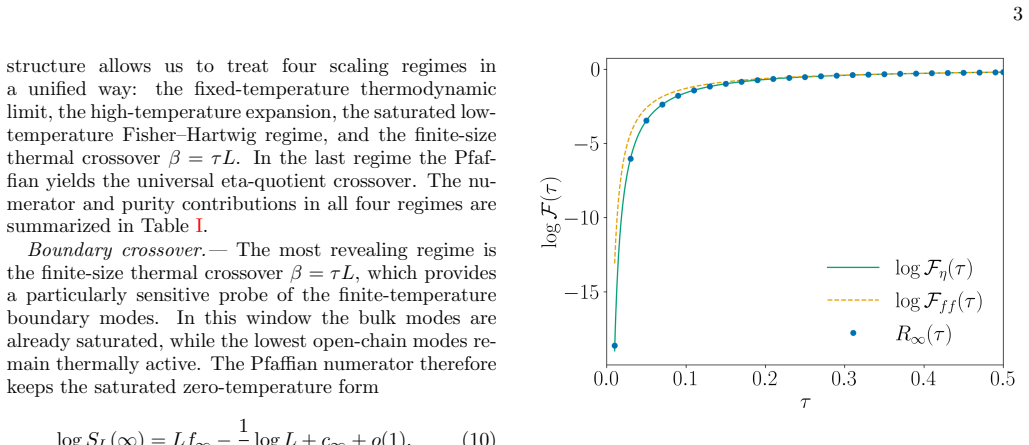
The sum of absolute values of all square minors of the finite-temperature correlation matrix for the open Ising chain reduces exactly to a single Pfaffian whose crossover scaling is a level-eight eta quotient.
A machine-rendered reading of the paper's core claim, the machinery that carries it, and where it could break.
Core claim
The exponentially large sum over absolute values of all square minors of the finite-temperature correlation matrix is exactly equal to a single Pfaffian. This Pfaffian representation exposes a block Toeplitz-Hankel structure whose large-size scaling in the inverse-temperature-proportional-to-size crossover window factorizes into a saturated extensive contribution and a universal finite-size scaling function that is a level-eight eta quotient rather than the ordinary free-boundary Majorana thermal factor. The deviation from the standard factor is exponentially small at low temperature but controls the high-temperature crossover and supplies a Cardy-like asymptotic for the spectrum of Pauli-st
What carries the argument
Exact reduction of the sum of absolute values of all square minors of the correlation matrix to a single Pfaffian, followed by block Toeplitz-Hankel analysis that identifies the scaling function as a level-eight eta quotient.
If this is right
- The stabilizer entropy factorizes into saturated extensive and universal finite-size parts when inverse temperature is proportional to system size.
- The universal scaling function is a level-eight eta quotient rather than the ordinary free-boundary Majorana thermal factor.
- The deviation is exponentially hidden at low temperature but dominates the high-temperature crossover.
- The high-temperature crossover yields a Cardy-like asymptotic for the Pauli-string expectation-weight spectrum.
Where Pith is reading between the lines
- The Pfaffian reduction may extend to other free-fermion observables whose correlation matrices admit similar minor-sum representations.
- The level-eight eta quotient points to a boundary condition whose conformal data appears only in this particular combination of thermal and stabilizer quantities.
- At high temperature the Pauli-string weight spectrum may be measurable in quantum simulators as an independent check on the asymptotic form.
Load-bearing premise
The sum over absolute values of all square minors of the finite-temperature correlation matrix reduces exactly to a single Pfaffian without requiring additional model-specific cancellations.
What would settle it
Direct numerical computation of the sum of absolute values of minors for small open Ising chains at finite temperature and comparison with the value of the corresponding Pfaffian.
Figures
read the original abstract
We study the finite-temperature stabilizer R\'enyi entropy of the open critical quantum spin chains. At R\'enyi index one half, this observable probes the distribution of thermal Pauli-string expectation values and can be written as a sum over absolute values of all square minors of a finite-temperature correlation matrix for the transverse-field Ising chain. We show that this exponentially large sum is exactly reducible to a single Pfaffian. The Pfaffian representation reveals a block Toeplitz--Hankel structure and allows us to extract the large-size scaling in several thermal regimes. In the crossover window where the inverse temperature is proportional to the system size, the stabilizer entropy factorizes into a saturated extensive contribution and a universal finite-size scaling function. We find that this scaling function is a level-eight eta quotient, rather than the ordinary free-boundary Majorana thermal factor. The deviation is exponentially hidden at low temperature but controls the high-temperature crossover, where it gives a Cardy-like asymptotic for the Pauli-string expectation-weight spectrum. These results show that finite-temperature stabilizer entropy reveals hidden defect-like conformal data invisible to ordinary thermodynamic probes.
Editorial analysis
A structured set of objections, weighed in public.
Referee Report
Summary. The manuscript investigates the finite-temperature stabilizer Rényi entropy of open critical quantum spin chains, particularly the transverse-field Ising model. It asserts that at Rényi index one half, this entropy, which is a sum over absolute values of all square minors of the finite-temperature correlation matrix, reduces exactly to a single Pfaffian. This reduction reveals a block Toeplitz-Hankel structure, enabling the analysis of large-size scaling. In the regime where the inverse temperature is proportional to the system size, the entropy factorizes into a saturated extensive contribution and a universal finite-size scaling function identified as a level-eight eta quotient, which deviates from the ordinary free-boundary Majorana thermal factor and reveals hidden conformal boundary data.
Significance. If the Pfaffian reduction is rigorously established, the work is significant for providing an exact analytical handle on a complex sum that encodes the distribution of thermal Pauli-string expectation values. The discovery of a level-eight eta quotient in the crossover regime suggests that stabilizer entropy can access conformal data associated with boundaries or defects that are not apparent in standard thermodynamic quantities. This could have implications for understanding finite-temperature effects in quantum many-body systems and the role of stabilizer entropy as a probe of universal physics. The exact nature of the reduction, if proven without approximations, would strengthen the results considerably.
major comments (2)
- [Abstract and §3] Abstract and §3 (Pfaffian reduction): The assertion that the exponentially large sum over absolute values of square minors of the correlation matrix is exactly reducible to a single Pfaffian lacks the explicit algebraic identity, derivation steps, or small-L numerical verification; this is load-bearing for the block Toeplitz-Hankel structure, the factorization claim, and the subsequent eta-quotient identification.
- [§5] §5 (crossover window analysis): The factorization into a saturated extensive contribution plus a universal finite-size scaling function given by a level-eight eta quotient (rather than the ordinary free-boundary Majorana factor) depends directly on the validity of the Pfaffian reduction without residual cancellations; the absence of confirmation for this identity leaves the claim of hidden conformal boundary data unsupported.
minor comments (1)
- [Notation and definitions] The notation for the finite-temperature correlation matrix and the precise definition of the square minors should be stated explicitly with an equation reference to improve clarity and reproducibility.
Simulated Author's Rebuttal
We thank the referee for their thorough review and for identifying the need for more explicit details on the Pfaffian reduction, which is indeed central to our claims. We will address these points by adding the required derivations and verifications in the revised manuscript.
read point-by-point responses
-
Referee: [Abstract and §3] Abstract and §3 (Pfaffian reduction): The assertion that the exponentially large sum over absolute values of square minors of the correlation matrix is exactly reducible to a single Pfaffian lacks the explicit algebraic identity, derivation steps, or small-L numerical verification; this is load-bearing for the block Toeplitz-Hankel structure, the factorization claim, and the subsequent eta-quotient identification.
Authors: We agree with the referee that the manuscript would benefit from a more detailed presentation of the Pfaffian reduction. In the revised version, we will insert a dedicated subsection in §3 providing the explicit algebraic identity that equates the sum over absolute values of square minors to the Pfaffian. This will include the step-by-step derivation based on the properties of the correlation matrix for the transverse-field Ising model. Furthermore, we will add a new figure or table showing numerical agreement between the direct sum and the Pfaffian for small system sizes (e.g., L ≤ 10) at various temperatures to verify the exact reduction without approximations. revision: yes
-
Referee: [§5] §5 (crossover window analysis): The factorization into a saturated extensive contribution plus a universal finite-size scaling function given by a level-eight eta quotient (rather than the ordinary free-boundary Majorana factor) depends directly on the validity of the Pfaffian reduction without residual cancellations; the absence of confirmation for this identity leaves the claim of hidden conformal boundary data unsupported.
Authors: The referee correctly notes the dependence on the Pfaffian reduction. Once the explicit derivation and numerical verification are included as described above, the factorization in the crossover regime will be rigorously supported, confirming that there are no residual cancellations affecting the scaling function. We will also expand §5 to explicitly state how the block Toeplitz-Hankel structure leads to the eta quotient identification, and contrast it with the free-boundary case to highlight the hidden conformal data. revision: yes
Circularity Check
No circularity: Pfaffian reduction presented as model-derived identity, not tautology or self-citation.
full rationale
The paper asserts an exact algebraic reduction of the sum of absolute square-minor determinants to a single Pfaffian for the open TFIM finite-temperature correlation matrix. This is framed as a mathematical identity enabling subsequent Toeplitz-Hankel and eta-quotient analysis, rather than a fitted parameter, self-defined quantity, or load-bearing self-citation. No equations in the abstract or described chain reduce the claimed result to its own inputs by construction. The derivation chain remains self-contained against external algebraic verification; the reduction stands or falls independently of the later scaling claims.
Axiom & Free-Parameter Ledger
axioms (2)
- standard math The sum of absolute values of all square minors of a skew-symmetric matrix equals the Pfaffian of that matrix.
- domain assumption The finite-temperature correlation matrix of the open transverse-field Ising chain possesses a block Toeplitz-Hankel structure.
Forward citations
Cited by 1 Pith paper
-
Unitary Designs from Doped Matchgate Circuits
Doped matchgate circuits achieve approximate parity-preserving 2-designs in polylogarithmic depth using a sparse number of non-Gaussian gates, with the design formation mapped exactly to a birth-death Markov chain.
Reference graph
Works this paper leans on
-
[1]
The Resource Theory of Stabilizer Computation
V. Veitch, S. H. Mousavian, D. Gottesman, and J. Emerson, The resource theory of stabilizer quantum computation, https://doi.org/10.1088/1367-2630/16/1/013009 New J. Phys. 16, 013009 (2014) , [ https://arxiv.org/abs/1307.7171 arXiv:1307.7171 ]
work page internal anchor Pith review Pith/arXiv arXiv doi:10.1088/1367-2630/16/1/013009 2014
-
[2]
Application of a resource theory for magic states to fault-tolerant quantum computing
M. Howard and E. Campbell, Application of a resource theory for magic states to fault-tolerant quantum computing, https://doi.org/10.1103/PhysRevLett.118.090501 Phys. Rev. Lett. 118, 090501 (2017) , [ https://arxiv.org/abs/1609.07488 arXiv:1609.07488 ]
work page internal anchor Pith review Pith/arXiv arXiv doi:10.1103/physrevlett.118.090501 2017
-
[3]
Z.-W. Liu and A. Winter, Many-body quantum magic, https://doi.org/10.1103/PRXQuantum.3.020333 PRX Quantum 3, 020333 (2022) , [ https://arxiv.org/abs/2010.13817 arXiv:2010.13817 ]
-
[4]
S. F. E. Oliviero, L. Leone, and A. Hamma, Stabilizer R\'enyi entropy, https://doi.org/10.1103/PhysRevLett.128.050402 Phys. Rev. Lett. 128, 050402 (2022) , [ https://arxiv.org/abs/2106.12587 arXiv:2106.12587 ]
-
[5]
T. Haug and L. Piroli, Stabilizer entropies and nonstabilizerness monotones, https://doi.org/10.22331/q-2023-08-28-1092 Quantum 7, 1092 (2023) , [ https://arxiv.org/abs/2303.10152 arXiv:2303.10152 ]
-
[6]
L. Leone and L. Bittel, Stabilizer entropies are monotones for magic-state resource theory, https://doi.org/10.1103/PhysRevA.110.L040403 Phys. Rev. A 110, L040403 (2024) , [ https://arxiv.org/abs/2404.11652 arXiv:2404.11652 ]
-
[7]
S. F. E. Oliviero, L. Leone, and A. Hamma, Magic-state resource theory for the ground state of the transverse-field Ising model, https://doi.org/10.1103/PhysRevA.106.042426 Phys. Rev. A 106, 042426 (2022) , [ https://arxiv.org/abs/2205.02247 arXiv:2205.02247 ]
-
[8]
T. Haug and L. Piroli, Quantifying nonstabilizerness of matrix product states, https://doi.org/10.1103/PhysRevB.107.035148 Phys. Rev. B 107, 035148 (2023) , [ https://arxiv.org/abs/2207.13076 arXiv:2207.13076 ]
-
[9]
P. S. Tarabunga, E. Tirrito, T. Chanda, and M. Dalmonte, Many-body magic via Pauli-Markov chains: From criticality to gauge theories, https://doi.org/10.1103/PRXQuantum.4.040317 PRX Quantum 4, 040317 (2023) , [ https://arxiv.org/abs/2305.18541 arXiv:2305.18541 ]
-
[10]
P. S. Tarabunga, Critical behaviors of non-stabilizerness in quantum spin chains, https://doi.org/10.22331/q-2024-07-17-1413 Quantum 8, 1413 (2024) , [ https://arxiv.org/abs/2309.00676 arXiv:2309.00676 ]
-
[11]
S. Sarkar, G. Biswas, J.-Y. Wu, and A. Biswas, Reduced-state stabilizer R\'enyi entropy as a probe of quantum criticality in the transverse ANNNI model and the quantum compass model, [ https://arxiv.org/abs/2605.18391 arXiv:2605.18391 ]
-
[12]
G. Lami and M. Collura, Nonstabilizerness via perfect Pauli sampling of matrix product states, https://doi.org/10.1103/PhysRevLett.131.180401 Phys. Rev. Lett. 131, 180401 (2023) , [ https://arxiv.org/abs/2303.05536 arXiv:2303.05536 ]
-
[13]
G. Lami and M. Collura, Unveiling the stabilizer group of a matrix product state, https://doi.org/10.1103/PhysRevLett.133.010602 Phys. Rev. Lett. 133, 010602 (2024) , [ https://arxiv.org/abs/2401.16481 arXiv:2401.16481 ]
-
[14]
P. S. Tarabunga, E. Tirrito, M. C. Ba\ nuls, and M. Dalmonte, Nonstabilizerness via matrix product states in the Pauli basis, https://doi.org/10.1103/PhysRevLett.133.010601 Phys. Rev. Lett. 133, 010601 (2024) , [ https://arxiv.org/abs/2401.16498 arXiv:2401.16498 ]
- [15]
-
[16]
X. Turkeshi, A. Dymarsky, and P. Sierant, Pauli spectrum and nonstabilizerness of typical quantum many-body states, https://doi.org/10.1103/PhysRevB.111.054301 Phys. Rev. B 111, 054301 (2025) , [ https://arxiv.org/abs/2312.11631 arXiv:2312.11631 ]
-
[17]
T. Haug, S. Lee, and M. S. Kim, Efficient quantum algorithms for stabilizer entropies, https://doi.org/10.1103/PhysRevLett.132.240602 Phys. Rev. Lett. 132, 240602 (2024) , [ https://arxiv.org/abs/2305.19152 arXiv:2305.19152 ]
-
[18]
Y.-M. Ding, Z. Wang, and Z. Yan, Evaluating many-body stabilizer R\'enyi entropy by sampling reduced Pauli strings: Singularities, volume law, and nonlocal magic, https://doi.org/10.1103/pyzr-jmvw PRX Quantum 6, 030328 (2025) , [ https://arxiv.org/abs/2501.12146 arXiv:2501.12146 ]
-
[19]
M. Collura, J. De Nardis, V. Alba, and G. Lami, The non-stabilizerness of fermionic Gaussian states, https://doi.org/10.22331/q-2026-03-23-2036 Quantum 10, 2036 (2026) , [ https://arxiv.org/abs/2412.05367 arXiv:2412.05367 ]
-
[20]
M. Viscardi, M. Dalmonte, A. Hamma, and E. Tirrito, Interplay of entanglement structures and stabilizer entropy in spin models, https://doi.org/10.21468/SciPostPhysCore.9.1.012 SciPost Phys. Core 9, 012 (2026) , [ https://arxiv.org/abs/2503.08620 arXiv:2503.08620 ]
-
[21]
C. Fan, X. Qian, H.-C. Zhang, R.-Z. Huang, M. Qin, and T. Xiang, Disentangling critical quantum spin chains with Clifford circuits, https://doi.org/10.1103/PhysRevB.111.085121 Phys. Rev. B 111, 085121 (2025) , [ https://arxiv.org/abs/2411.12683 arXiv:2411.12683 ]
-
[22]
M. Frau, P. S. Tarabunga, M. Collura, E. Tirrito, and M. Dalmonte, Stabilizer disentangling of conformal field theories, https://doi.org/10.21468/SciPostPhys.18.5.165 SciPost Phys. 18, 165 (2025) , [ https://arxiv.org/abs/2411.11720 arXiv:2411.11720 ]
-
[23]
D. Rattacaso, L. Leone, S. F. E. Oliviero, and A. Hamma, Stabilizer entropy dynamics after a quantum quench, https://doi.org/10.1103/PhysRevA.108.042407 Phys. Rev. A 108, 042407 (2023) , [ https://arxiv.org/abs/2304.13768 arXiv:2304.13768 ]
-
[24]
X. Turkeshi, E. Tirrito, and P. Sierant, Magic spreading in random quantum circuits, https://doi.org/10.1038/s41467-025-57704-x Nat. Commun. 16, 2575 (2025)
-
[25]
C. D. White, C. Cao, and B. Swingle, Conformal field theories are magical, https://doi.org/10.1103/PhysRevB.103.075145 Phys. Rev. B 103, 075145 (2021) , [ https://arxiv.org/abs/2007.01303 arXiv:2007.01303 ]
-
[26]
M. Hoshino, M. Oshikawa, and Y. Ashida, Stabilizer R\'enyi entropy and conformal field theory, https://doi.org/10.1103/ylsz-dm3y Phys. Rev. X 16, 011037 (2026) , [ https://arxiv.org/abs/2503.13599 arXiv:2503.13599 ]
-
[27]
M. Hoshino and Y. Ashida, Stabilizer R\'enyi entropy encodes fusion rules of topological defects and boundaries, https://doi.org/10.1103/1tyr-rlbb Phys. Rev. Lett. 136, 080402 (2026) , [ https://arxiv.org/abs/2507.10656 arXiv:2507.10656 ]
-
[28]
E. A. Ramirez Trino, M. A. Rajabpour, Stabilizer--Shannon R\'enyi equivalence: Exact results for quantum critical chains, [ https://arxiv.org/abs/2509.10700 arXiv:2509.10700 ]
-
[29]
Entanglement entropy and conformal field theory
P. Calabrese and J. Cardy, Entanglement entropy and conformal field theory, https://doi.org/10.1088/1751-8113/42/50/504005 J. Phys. A 42, 504005 (2009) , [ https://arxiv.org/abs/0905.4013 arXiv:0905.4013 ]
work page internal anchor Pith review Pith/arXiv arXiv doi:10.1088/1751-8113/42/50/504005 2009
-
[30]
Shannon and entanglement entropies of one- and two-dimensional critical wave functions
J.-M. St\'ephan, S. Furukawa, G. Misguich, and V. Pasquier, Shannon and entanglement entropies of one- and two-dimensional critical wave functions, https://doi.org/10.1103/PhysRevB.80.184421 Phys. Rev. B 80, 184421 (2009) , [ https://arxiv.org/abs/0906.1153 arXiv:0906.1153 ]
work page internal anchor Pith review Pith/arXiv arXiv doi:10.1103/physrevb.80.184421 2009
-
[31]
Phase transition in the R\'enyi-Shannon entropy of Luttinger liquids
J.-M. St\'ephan, G. Misguich, and V. Pasquier, Phase transition in the R\'enyi-Shannon entropy of Luttinger liquids, https://doi.org/10.1103/PhysRevB.84.195128 Phys. Rev. B 84, 195128 (2011) , [ https://arxiv.org/abs/1104.2544 arXiv:1104.2544 ]
work page internal anchor Pith review Pith/arXiv arXiv doi:10.1103/physrevb.84.195128 2011
-
[32]
Shannon and R\'enyi mutual information in quantum critical spin chains
J.-M. St\'ephan, Shannon and R\'enyi mutual information in quantum critical spin chains, https://doi.org/10.1103/PhysRevB.90.045424 Phys. Rev. B 90, 045424 (2014) , [ https://arxiv.org/abs/1403.6157 arXiv:1403.6157 ]
work page internal anchor Pith review Pith/arXiv arXiv doi:10.1103/physrevb.90.045424 2014
-
[33]
F. C. Alcaraz and M. A. Rajabpour, Universal behavior of the Shannon mutual information of critical quantum chains, https://doi.org/10.1103/PhysRevLett.111.017201 Phys. Rev. Lett. 111, 017201 (2013) , [ https://arxiv.org/abs/1305.1239 arXiv:1305.1239 ]
work page internal anchor Pith review Pith/arXiv arXiv doi:10.1103/physrevlett.111.017201 2013
-
[34]
F. C. Alcaraz and M. A. Rajabpour, Universal behavior of the Shannon and R\'enyi mutual information of quantum critical chains, https://doi.org/10.1103/PhysRevB.90.075132 Phys. Rev. B 90, 075132 (2014) , [ https://arxiv.org/abs/1405.1074 arXiv:1405.1074 ]
work page internal anchor Pith review Pith/arXiv arXiv doi:10.1103/physrevb.90.075132 2014
-
[35]
J. L. Cardy, Operator content of two-dimensional conformally invariant theories, https://doi.org/10.1016/0550-3213(86)90552-3 Nucl. Phys. B 270, 186 (1986)
-
[36]
J. L. Cardy, Boundary conditions, fusion rules and the Verlinde formula, https://doi.org/10.1016/0550-3213(89)90521-X Nucl. Phys. B 324, 581 (1989)
-
[37]
I. Affleck and A. W. W. Ludwig, Universal noninteger ground-state degeneracy in critical quantum systems, https://doi.org/10.1103/PhysRevLett.67.161 Phys. Rev. Lett. 67, 161 (1991)
-
[38]
J. Cardy, Boundary conformal field theory, [ https://arxiv.org/abs/hep-th/0411189 arXiv:hep-th/0411189 ]
-
[39]
Kramers-Wannier duality from conformal defects
J. Fr\"ohlich, J. Fuchs, I. Runkel, and C. Schweigert, Kramers--Wannier duality from conformal defects, https://doi.org/10.1103/PhysRevLett.93.070601 Phys. Rev. Lett. 93, 070601 (2004) , [ https://arxiv.org/abs/cond-mat/0404051 arXiv:cond-mat/0404051 ]
work page internal anchor Pith review Pith/arXiv arXiv doi:10.1103/physrevlett.93.070601 2004
-
[40]
D. A. Korbany, M. J. Gullans, and L. Piroli, Long-range nonstabilizerness and phases of matter, https://doi.org/10.1103/1hlj-h6t9 Phys. Rev. Lett. 135, 160404 (2025) , [ https://arxiv.org/abs/2502.19504 arXiv:2502.19504 ]
-
[41]
F. Ballar Trigueros and J. A. Mar\'in Guzm\'an, Nonstabilizerness and error resilience in noisy quantum circuits, [ https://arxiv.org/abs/2506.18976 arXiv:2506.18976 ]
-
[42]
Efficient witnessing and testing of magic in mixed quantum states
T. Haug and P. S. Tarabunga, Efficient witnessing and testing of magic in mixed quantum states, https://doi.org/10.1038/s41534-026-01189-z npj Quantum Inf. 12, 40 (2026) , [ https://arxiv.org/abs/2504.18098 arXiv:2504.18098 ]
work page internal anchor Pith review Pith/arXiv arXiv doi:10.1038/s41534-026-01189-z 2026
-
[43]
E. Lieb, T. Schultz, and D. Mattis, Two soluble models of an antiferromagnetic chain, https://doi.org/10.1016/0003-4916(61)90115-4 Ann. Phys. 16, 407 (1961)
-
[44]
Calculation of reduced density matrices from correlation functions
I. Peschel, Calculation of reduced density matrices from correlation functions, https://doi.org/10.1088/0305-4470/36/14/101 J. Phys. A 36, L205 (2003) , [ https://arxiv.org/abs/cond-mat/0212631 arXiv:cond-mat/0212631 ]
work page internal anchor Pith review Pith/arXiv arXiv doi:10.1088/0305-4470/36/14/101 2003
-
[45]
Reduced density matrices and entanglement entropy in free lattice models
I. Peschel and V. Eisler, Reduced density matrices and entanglement entropy in free lattice models, https://doi.org/10.1088/1751-8113/42/50/504003 J. Phys. A 42, 504003 (2009) , [ https://arxiv.org/abs/0906.1663 arXiv:0906.1663 ]
work page internal anchor Pith review Pith/arXiv arXiv doi:10.1088/1751-8113/42/50/504003 2009
-
[46]
See Supplemental Material for details on the exact diagonalization of the open critical Ising chain, the finite-temperature Majorana correlation matrix, the purity product and its scaling limits, the Pfaffian representation of the absolute-minor sum, the block Toeplitz--Hankel structure, the four scaling regimes, the large-\( \) leading-minor diagnostic, ...
-
[47]
B.-Q. Jin and V. E. Korepin, Quantum spin chain, Toeplitz determinants and the Fisher--Hartwig conjecture, https://doi.org/10.1023/B:JOSS.0000037230.37166.42 J. Stat. Phys. 116, 79 (2004)
-
[48]
A. R. Its, F. Mezzadri, and M. Y. Mo, Entanglement entropy in quantum spin chains with finite range interaction, https://doi.org/10.1007/s00220-008-0566-6 Commun. Math. Phys. 284, 117 (2008) , [ https://arxiv.org/abs/0708.0161 arXiv:0708.0161 ]
work page internal anchor Pith review Pith/arXiv arXiv doi:10.1007/s00220-008-0566-6 2008
-
[49]
Asymptotics of Toeplitz, Hankel, and Toeplitz+Hankel determinants with Fisher-Hartwig singularities
P. Deift, A. Its, and I. Krasovsky, Asymptotics of Toeplitz, Hankel, and Toeplitz+Hankel determinants with Fisher--Hartwig singularities, https://doi.org/10.4007/annals.2011.174.2.12 Ann. of Math. 174, 1243 (2011) , [ https://arxiv.org/abs/0905.0443 arXiv:0905.0443 ]
work page internal anchor Pith review Pith/arXiv arXiv doi:10.4007/annals.2011.174.2.12 2011
-
[50]
D. A. Ivanov, A. G. Abanov, and V. V. Cheianov, Counting free fermions on a line: Toeplitz determinants and Fisher--Hartwig asymptotics, https://doi.org/10.1088/1751-8113/46/8/085003 J. Phys. A 46, 085003 (2013) , [ https://arxiv.org/abs/1112.2530 arXiv:1112.2530 ]
work page internal anchor Pith review Pith/arXiv arXiv doi:10.1088/1751-8113/46/8/085003 2013
-
[51]
Full Counting Statistics in the Transverse Field Ising Chain
S. Groha, F. H. L. Essler, and P. Calabrese, Full counting statistics in the transverse field Ising chain, https://doi.org/10.21468/SciPostPhys.4.6.043 SciPost Phys. 4, 043 (2018) , [ https://arxiv.org/abs/1803.09755 arXiv:1803.09755 ]
work page internal anchor Pith review Pith/arXiv arXiv doi:10.21468/scipostphys.4.6.043 2018
-
[52]
M. A. Rajabpour, M. A. Seifi Mirjafarlou, and R. Khasseh, Explicit Pfaffian formula for amplitudes of fermionic Gaussian pure states in arbitrary Pauli bases, https://doi.org/10.1103/PhysRevB.111.235102 Phys. Rev. B 111, 235102 (2025) , [ https://arxiv.org/abs/2502.04857 arXiv:2502.04857 ]
-
[53]
Y. Choi, B. C. Rayhaun, and Y. Zheng, Noninvertible symmetry-resolved Affleck--Ludwig--Cardy formula and entanglement entropy from the boundary tube algebra, https://doi.org/10.1103/PhysRevLett.133.251602 Phys. Rev. Lett. 133, 251602 (2024) , [ https://arxiv.org/abs/2409.02806 arXiv:2409.02806 ]
-
[54]
O. Diatlyk, H. Khanchandani, F. K. Popov, and Y. Wang, Effective field theory of conformal boundaries, https://doi.org/10.1103/PhysRevLett.133.261601 Phys. Rev. Lett. 133, 261601 (2024)
-
[55]
N. Dowling, P. Kos, and X. Turkeshi, Magic resources of the Heisenberg picture, https://doi.org/10.1103/p7xt-s9nz Phys. Rev. Lett. 135, 050401 (2025) , [ https://arxiv.org/abs/2408.16047 arXiv:2408.16047 ]
discussion (0)
Sign in with ORCID, Apple, or X to comment. Anyone can read and Pith papers without signing in.