On The Nature of Einstein Probe Transient EP250916a: Insights from X-ray, Optical, and Radio Observations
Pith reviewed 2026-06-27 17:45 UTC · model grok-4.3
The pith
Multi-wavelength observations of EP250916a support classification as a low-luminosity hard-state black hole X-ray binary candidate.
A machine-rendered reading of the paper's core claim, the machinery that carries it, and where it could break.
Core claim
The combination of a long-lasting outburst, a hard nonthermal X-ray spectrum, a weak QPO detection, the absence of coherent timing features, and faint potential optical counterparts disfavors a stellar-flare or extragalactic origin and supports an accreting compact-object scenario. Comparisons with similar faint, hard-state transients place EP250916a within a growing population of low-luminosity, hard-state black hole X-ray binary candidates.
What carries the argument
Broadband spectral modeling with a nonthermal power-law plus partial-covering absorption, together with timing analysis that isolates the weak QPO while excluding coherent pulsations or bursts.
If this is right
- EP250916a joins a growing sample of faint hard-state transients that can be discovered by sensitive wide-field X-ray monitors.
- The two-stage decay and persistent hardness imply accretion flow behavior that persists at low luminosities.
- Absence of radio emission is consistent with the hard state at these faint levels.
- Optical counterparts remain faint, suggesting the systems are either distant or have low-mass companions.
Where Pith is reading between the lines
- Rapid multi-wavelength campaigns may become essential for classifying the increasing number of faint transients found by new monitors.
- Distinguishing black holes from neutron stars in this low-luminosity regime could require deeper timing or infrared observations.
- The source may represent a bridge between bright outbursting binaries and quiescent black hole systems.
Load-bearing premise
The observed hard spectrum without a thermal disk, weak QPO, and lack of radio or strong optical emission are distinctive enough to assign the source specifically to the black hole X-ray binary class rather than a neutron-star system or another transient type.
What would settle it
Detection of coherent pulsations or thermonuclear X-ray bursts in additional observations would indicate a neutron star accretor instead.
Figures
read the original abstract
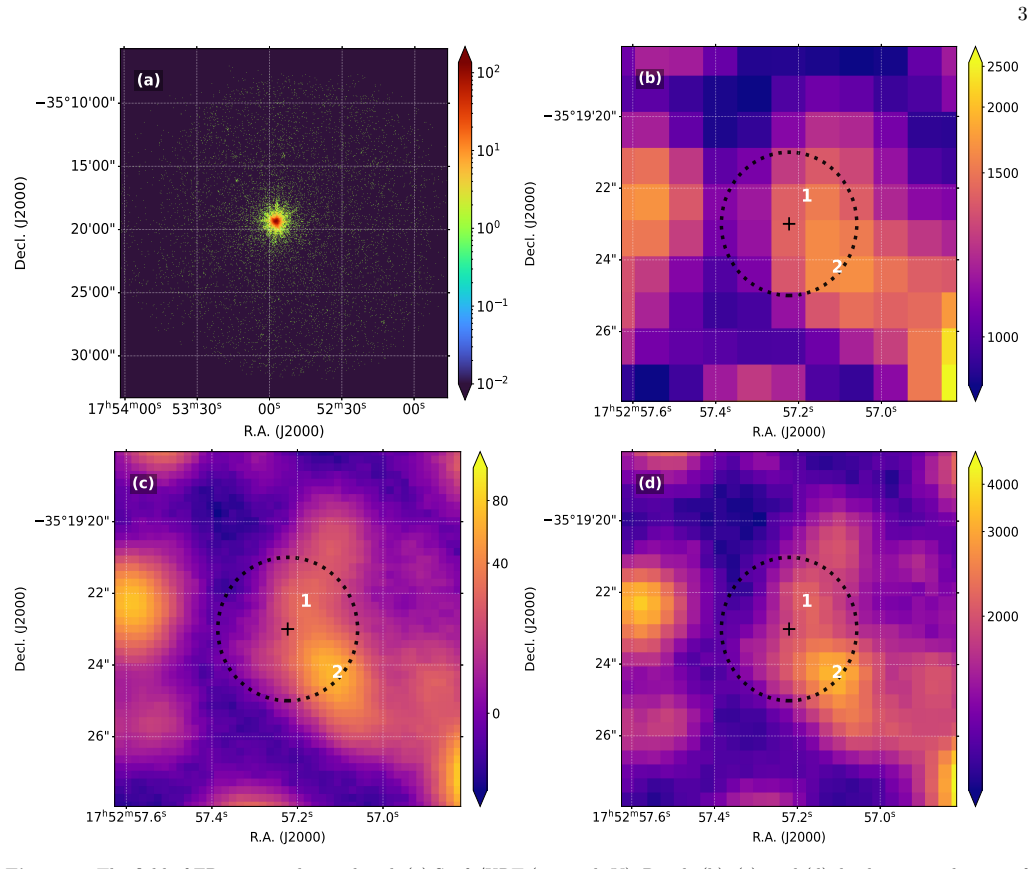
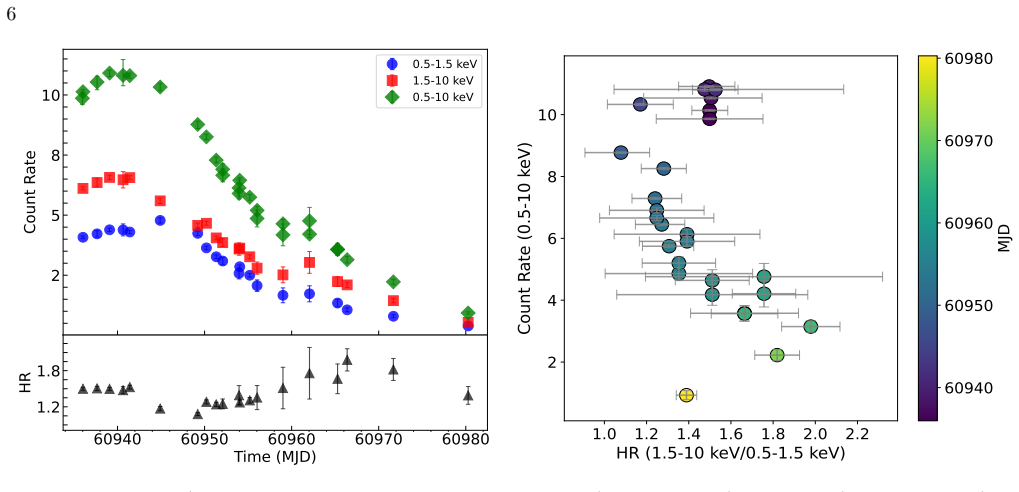
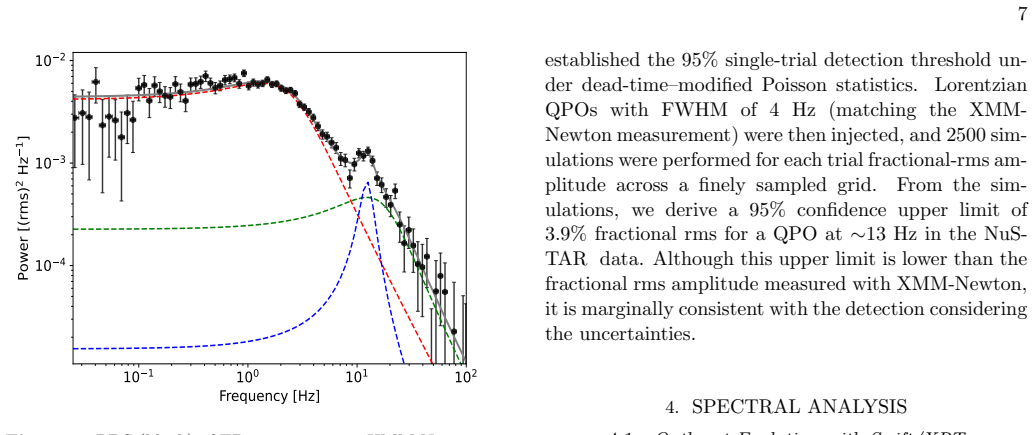
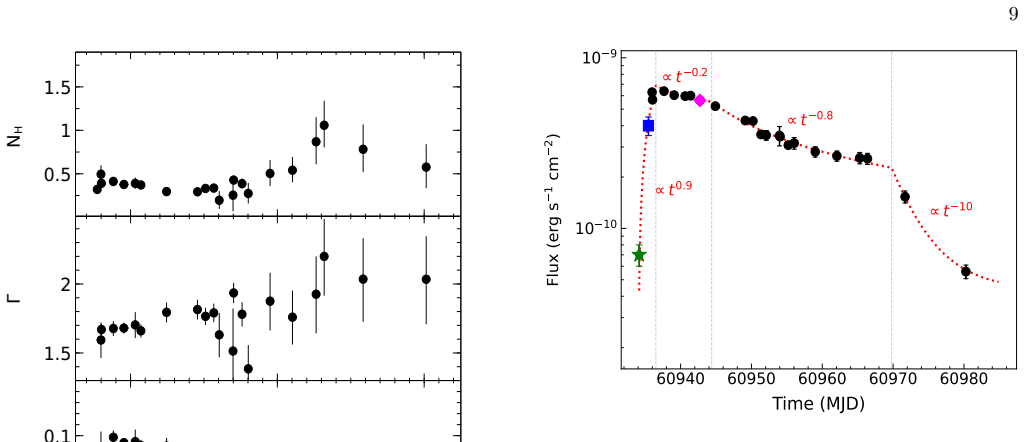
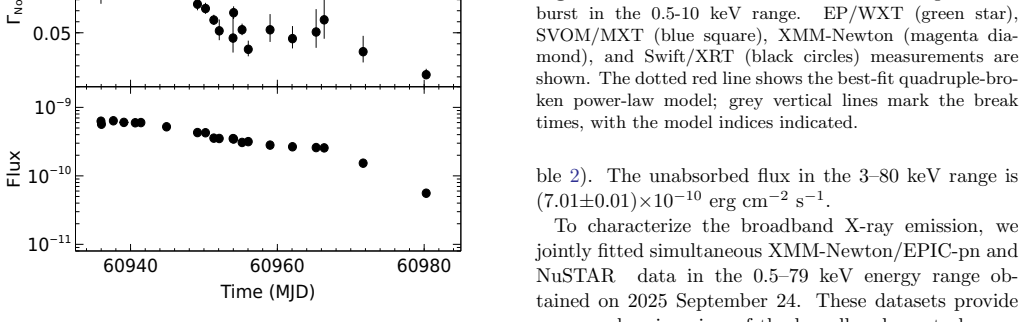
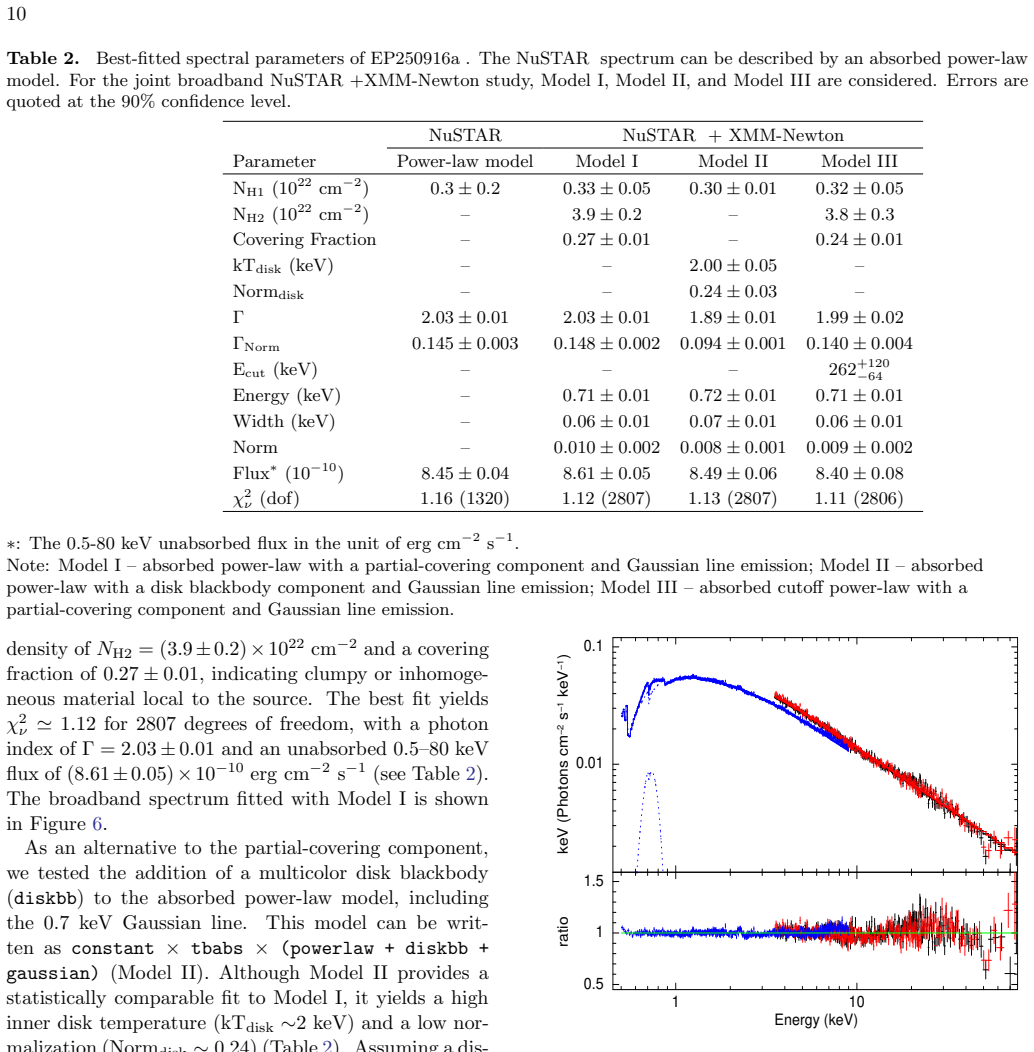
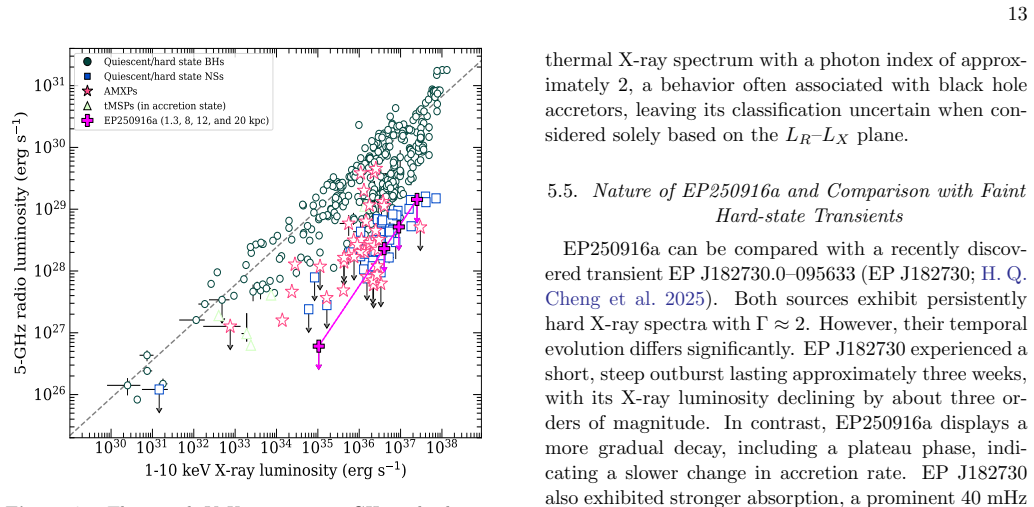
We report multi-wavelength studies of the transient EP250916a, detected by the Einstein Probe on 2025 September 16. Located at low Galactic latitude, the source exhibited a rapid X-ray brightening, reaching an unabsorbed 0.5--10 keV flux of $(6.4 \pm 0.1) \times 10^{-10}$ erg cm$^{-2}$ s$^{-1}$, followed by a plateau and a two-stage decay lasting over 40 days. Swift/XRT monitoring shows a persistently hard spectrum ($\Gamma \approx 1.6$--2.2) with only modest softening during decay, while a NuSTAR observation confirms a hard-state continuum extending up to 70 keV. Timing analysis of XMM-Newton data reveals a weak quasi-periodic oscillation (QPO) at $\sim$13 Hz. No other coherent pulsations or thermonuclear bursts are detected. Broadband spectral modeling favors a nonthermal power-law continuum with partial-covering absorption, and shows no significant thermal disk component. Optical imaging obtained with NOT/ALFOSC, LCO, and GaiaDR3 identifies two faint sources within the 2 arcsec Swift/XRT positional uncertainty. A MeerKAT observation at 1.28 GHz yielded no radio counterpart, with a 3$\sigma$ upper limit of 60 $\mu$Jy beam$^{-1}$. The combination of a long-lasting outburst, a hard nonthermal X-ray spectrum, a weak QPO detection, the absence of coherent timing features, and faint potential optical counterparts disfavors a stellar-flare or extragalactic origin and supports an accreting compact-object scenario. Comparisons with similar faint, hard-state transients place EP250916a within a growing population of low-luminosity, hard-state black hole X-ray binary candidates.
Editorial analysis
A structured set of objections, weighed in public.
Referee Report
Summary. The manuscript presents multi-wavelength observations of the Einstein Probe transient EP250916a, including Swift/XRT monitoring showing a long outburst (>40 days) with persistently hard spectrum (Γ ≈ 1.6–2.2), NuSTAR confirmation of hard continuum to 70 keV, XMM-Newton detection of a weak ~13 Hz QPO with no coherent pulsations or bursts, faint optical candidates from NOT/ALFOSC/LCO/Gaia, and a MeerKAT radio non-detection (3σ limit 60 μJy). The authors conclude these properties disfavor stellar-flare or extragalactic origins and support classification as a low-luminosity hard-state black hole X-ray binary candidate.
Significance. If the classification is robust, the work adds a well-observed member to the population of faint hard-state X-ray transients, providing constraints on accretion states at low luminosities and the observational distinction between compact-object classes. The multi-band coverage (X-ray timing/spectral, optical, radio) is a clear strength for future comparisons.
major comments (2)
- [Abstract] Abstract (final paragraph): The claim that the combination of properties 'disfavors' a neutron-star origin and supports a black-hole X-ray binary rests on qualitative similarity to 'similar faint, hard-state transients' without a control sample, overlap metrics, or quantitative likelihoods separating the observed Γ range, weak QPO, and non-detections from atoll-source or other NS hard-state properties. This is load-bearing for the central classification.
- [Abstract] Abstract (luminosity and comparisons): The source is placed in the 'low-luminosity' category and compared to known objects, yet the unabsorbed flux is given without a distance estimate, luminosity conversion, or justification for the Galactic-distance assumption despite the low Galactic latitude; this directly affects the luminosity class and population placement.
minor comments (1)
- [Abstract] The partial-covering absorption model and lack of thermal disk component are mentioned but would benefit from explicit parameter values or fit statistics in the main text for reproducibility.
Simulated Author's Rebuttal
We thank the referee for their careful and constructive review of our manuscript. We address the two major comments point by point below, with revisions indicated where the manuscript will be updated.
read point-by-point responses
-
Referee: [Abstract] Abstract (final paragraph): The claim that the combination of properties 'disfavors' a neutron-star origin and supports a black-hole X-ray binary rests on qualitative similarity to 'similar faint, hard-state transients' without a control sample, overlap metrics, or quantitative likelihoods separating the observed Γ range, weak QPO, and non-detections from atoll-source or other NS hard-state properties. This is load-bearing for the central classification.
Authors: We agree that the classification argument is qualitative and relies on consistency with the properties of known faint hard-state black hole candidates rather than a statistical control sample or quantitative separation from neutron-star atoll sources. The combination of a >40-day hard-state outburst, persistently hard spectrum, weak ~13 Hz QPO without coherent pulsations or bursts, and radio non-detection is presented as more aligned with black hole systems, but we recognize the overlap possible with some neutron-star hard states. We have revised the abstract to emphasize the candidate nature of the classification and added a paragraph in the discussion section comparing the observed properties to both black hole and neutron star systems at low luminosities, while noting the absence of definitive discriminants such as dynamical mass measurements. revision: partial
-
Referee: [Abstract] Abstract (luminosity and comparisons): The source is placed in the 'low-luminosity' category and compared to known objects, yet the unabsorbed flux is given without a distance estimate, luminosity conversion, or justification for the Galactic-distance assumption despite the low Galactic latitude; this directly affects the luminosity class and population placement.
Authors: The reported value is the observed unabsorbed flux; the 'low-luminosity' descriptor and population comparison are based on the flux level matching that of known faint Galactic X-ray binaries. We have added explicit justification in the introduction and discussion for the Galactic-distance assumption: the low Galactic latitude, the transient X-ray behavior, and spectral/timing properties are characteristic of Galactic compact-object systems rather than extragalactic sources. No precise distance is available from the current data (no bright optical counterpart for spectroscopy and no Gaia parallax detection), so a numerical luminosity is not computed. We note that an extragalactic distance would yield an unrealistically high luminosity inconsistent with the observed flux and lack of other extragalactic indicators. revision: yes
Circularity Check
No circularity: classification rests on direct empirical comparison to external literature
full rationale
The paper reports multi-wavelength observations (X-ray spectra, timing, optical counterparts, radio non-detection) and classifies the transient by qualitative similarity to known faint hard-state sources in the published literature. No equations, fitted parameters, or derivations are present that reduce to the paper's own inputs by construction. No self-citation chains, uniqueness theorems, or ansatzes are invoked as load-bearing steps. The central claim is an interpretive comparison to independently observed objects and is therefore self-contained against external benchmarks.
Axiom & Free-Parameter Ledger
free parameters (1)
- Photon index Gamma =
1.6-2.2
axioms (2)
- domain assumption Low Galactic latitude and lack of extragalactic signatures imply the source is Galactic.
- domain assumption Absence of radio detection and specific timing features rules out alternative classes when compared to known objects.
Reference graph
Works this paper leans on
-
[1]
Arnaud, K. A. 1996, in Astronomical Society of the Pacific Conference Series, Vol. 101, Astronomical Data Analysis Software and Systems V, ed. G. H. Jacoby & J. Barnes, 17 Astropy Collaboration, Robitaille, T. P., Tollerud, E. J., et al. 2013, A&A, 558, A33, doi: 10.1051/0004-6361/201322068 Astropy Collaboration, Price-Whelan, A. M., Sip˝ ocz, B. M., et a...
-
[2]
International Journal of Modern Physics D , keywords =
Atteia, J.-L., Cordier, B., & Wei, J. 2022, International Journal of Modern Physics D, 31, 2230008, doi: 10.1142/S0218271822300087
-
[3]
B., et al., 2009, @doi [ ] 10.1088/0004-637x/697/2/1071 , 697, 1071–1102
Atwood, W. B., Abdo, A. A., Ackermann, M., et al. 2009, ApJ, 697, 1071, doi: 10.1088/0004-637X/697/2/1071
-
[5]
2022, bersavosh/XRB-LrLx pub: update 20220908, v220908 Zenodo, doi: 10.5281/zenodo.7059313
Bahramian, A., & Rushton, A. 2022, bersavosh/XRB-LrLx pub: update 20220908, v220908 Zenodo, doi: 10.5281/zenodo.7059313
-
[6]
Belloni, T., Psaltis, D., & van der Klis, M. 2002, ApJ, 572, 392, doi: 10.1086/340290
-
[7]
Belloni, T. M. 2010, in Lecture Notes in Physics, Berlin Springer Verlag, ed. T. Belloni, Vol. 794, 53, doi: 10.1007/978-3-540-76937-8 3
-
[8]
2018, ApJ, 856, 180, doi: 10.3847/1538-4357/aab35a
Camilo, F., Scholz, P., Serylak, M., et al. 2018, ApJ, 856, 180, doi: 10.3847/1538-4357/aab35a
-
[9]
2022, PASP, 134, 114501, doi: 10.1088/1538-3873/ac9642
Carroll, B. W., & Ostlie, D. A. 2006, An introduction to modern astrophysics and cosmology CASA Team, Bean, B., Bhatnagar, S., et al. 2022, PASP, 134, 114501, doi: 10.1088/1538-3873/ac9642
work page internal anchor Pith review doi:10.1088/1538-3873/ac9642 2006
- [10]
-
[11]
Chen, W., Shrader, C. R., & Livio, M. 1997, ApJ, 491, 312, doi: 10.1086/304921
-
[12]
Cheng, H. Q., Zhao, Q. C., Tao, L., et al. 2025, ApJL, 991, L41, doi: 10.3847/2041-8213/adf104
-
[13]
2025, The Astronomer’s Telegram, 17396, 1
Coleiro, A., Maggi, P., Cangemi, F., & Lachaud, C. 2025, The Astronomer’s Telegram, 17396, 1
2025
-
[14]
2013, MNRAS, 428, 2500, doi: 10.1093/mnras/sts215
Corbel, S., Coriat, M., Brocksopp, C., et al. 2013, MNRAS, 428, 2500, doi: 10.1093/mnras/sts215
-
[15]
M., Casares, J., Mu˜ noz-Darias, T., et al
Corral-Santana, J. M., Casares, J., Mu˜ noz-Darias, T., et al. 2016, A&A, 587, A61, doi: 10.1051/0004-6361/201527130
-
[16]
M., Casares, J., Mu˜ noz-Darias, T., et al
Corral-Santana, J. M., Casares, J., Mu˜ noz-Darias, T., et al. 2013, Science, 339, 1048, doi: 10.1126/science.1228222
-
[17]
Dai, C. Y., Wu, Q. Y., Li, D. Y., Pan, H. W., & Einstein Probe Team. 2025b, GRB Coordinates Network, 41861, 1 D’Avanzo, P. 2015, Journal of High Energy Astrophysics, 7, 73, doi: 10.1016/j.jheap.2015.07.002 Di Salvo, T., Papitto, A., Marino, A., Iaria, R., & Burderi, L. 2023, in Handbook of X-ray and Gamma-ray Astrophysics, 147, doi: 10.1007/978-981-16-454...
-
[18]
2007, A&A Rv, 15, 1, doi: 10.1007/s00159-007-0006-1
Done, C., Gierli´ nski, M., & Kubota, A. 2007, A&A Rv, 15, 1, doi: 10.1007/s00159-007-0006-1
-
[19]
2001, A&A, 373, 251, doi: 10.1051/0004-6361:20010632
Dubus, G., Hameury, J.-M., & Lasota, J.-P. 2001, A&A, 373, 251, doi: 10.1051/0004-6361:20010632
-
[20]
2025, The Open Journal of Astrophysics, 8, 62, doi: 10.33232/001c.138448
El-Badry, K. 2025, The Open Journal of Astrophysics, 8, 62, doi: 10.33232/001c.138448
-
[21]
2009, MNRAS, 400, 1181, doi: 10.1111/j.1365-2966.2009.15528.x
Evans, P. A., Beardmore, A. P., Page, K. L., et al. 2009, MNRAS, 397, 1177, doi: 10.1111/j.1365-2966.2009.14913.x Gaia Collaboration, Vallenari, A., Brown, A. G. A., et al. 2023, A&A, 674, A1, doi: 10.1051/0004-6361/202243940
-
[22]
Gehrels, N., Chincarini, G., Giommi, P., et al. 2004, ApJ, 611, 1005, doi: 10.1086/422091
-
[23]
Goad, M. R., Tyler, L. G., Beardmore, A. P., et al. 2007, A&A, 476, 1401, doi: 10.1051/0004-6361:20078436 G¨ unther, H. M., Pasham, D., Binks, A., et al. 2024, ApJ, 977, 6, doi: 10.3847/1538-4357/ad8b2c G¨ uver, T., &¨Ozel, F. 2009, MNRAS, 400, 2050, doi: 10.1111/j.1365-2966.2009.15598.x
-
[24]
Harrison, F. A., Craig, W. W., Christensen, F. E., et al. 2013, ApJ, 770, 103, doi: 10.1088/0004-637X/770/2/103
-
[25]
Heywood, I. 2020, oxkat: Semi-automated imaging of MeerKAT observations,, Astrophysics Source Code Library, record ascl:2009.003 HI4PI Collaboration, Ben Bekhti, N., Fl¨ oer, L., et al. 2016, A&A, 594, A116, doi: 10.1051/0004-6361/201629178
-
[26]
2005, Ap&SS, 300, 107, doi: 10.1007/s10509-005-1197-4
Homan, J., & Belloni, T. 2005, Ap&SS, 300, 107, doi: 10.1007/s10509-005-1197-4
-
[27]
Astronomical Data Analysis Software and Systems XXX , year = 2022, editor =
Hugo, B. V., Perkins, S., Merry, B., Mauch, T., & Smirnov, O. M. 2022, in Astronomical Society of the Pacific Conference Series, Vol. 532, Astronomical Society of the Pacific Conference Series, ed. J. E. Ruiz, F. Pierfedereci, & P. Teuben, 541, doi: 10.48550/arXiv.2206.09179
-
[28]
M., Sbarufatti, B., et al
Illiano, G., Zanon, A. M., Sbarufatti, B., et al. 2025, The Astronomer’s Telegram, 17397, 1
2025
-
[29]
Ingram, A. R., & Motta, S. E. 2019, NewAR, 85, 101524, doi: 10.1016/j.newar.2020.101524
-
[30]
Jaisawal, G. K., & Naik, S. 2015, MNRAS, 448, 620, doi: 10.1093/mnras/stv029
-
[31]
Jaisawal, G. K., Naik, S., Ho, W. C. G., et al. 2020, MNRAS, 498, 4830, doi: 10.1093/mnras/staa2604
-
[32]
Jaisawal, G. K., Wilson-Hodge, C. A., Fabian, A. C., et al. 2019, ApJ, 885, 18, doi: 10.3847/1538-4357/ab4595
-
[33]
K., Chenevez, J., Strohmayer, T
Jaisawal, G. K., Chenevez, J., Strohmayer, T. E., et al. 2025b, ApJ, 986, 16, doi: 10.3847/1538-4357/adcc24
-
[34]
Jana, A., Naik, S., Jaisawal, G. K., et al. 2022, MNRAS, 511, 3922, doi: 10.1093/mnras/stac315
-
[35]
Jana, A., Jaisawal, G. K., Naik, S., et al. 2021, Research in Astronomy and Astrophysics, 21, 125, doi: 10.1088/1674-4527/21/5/125
-
[36]
2001, A&A, 365, L1, doi: 10.1051/0004-6361:20000036
Jansen, F., Lumb, D., Altieri, B., et al. 2001, A&A, 365, L1, doi: 10.1051/0004-6361:20000036 16
-
[37]
MeerKAT Science: On the Pathway to the SKA , year = 2016, month = jan, eid =
Jonas, J., & MeerKAT Team. 2016, in MeerKAT Science: On the Pathway to the SKA, 1, doi: 10.22323/1.277.0001
-
[38]
King, A. R., & Ritter, H. 1998, MNRAS, 293, L42, doi: 10.1046/j.1365-8711.1998.01295.x
-
[39]
doi:10.1111/j.1745-3933.2005.00057.x , eprint =
King, A. R., & Wijnands, R. 2006, MNRAS, 366, L31, doi: 10.1111/j.1745-3933.2005.00126.x
-
[40]
2015, Journal of High Energy Astrophysics, 7, 148, doi: 10.1016/j.jheap.2015.04.006
Komossa, S. 2015, Journal of High Energy Astrophysics, 7, 148, doi: 10.1016/j.jheap.2015.04.006
-
[41]
Kouveliotou, C., Wijers, R. A. M. J., & Woosley, S. 2012, Gamma-ray Bursts
2012
-
[42]
W., Mierle, K., Blanton, M., & Roweis, S
Lang, D., Hogg, D. W., Mierle, K., Blanton, M., & Roweis, S. 2010, AJ, 139, 1782, doi: 10.1088/0004-6256/139/5/1782
-
[43]
Lewin, W. H. G., van Paradijs, J., & van den Heuvel, E. P. J. 1997, X-ray Binaries
1997
-
[44]
2012, Nature, 485, 478, doi: 10.1038/nature11063
Maehara, H., Shibayama, T., Notsu, S., et al. 2012, Nature, 485, 478, doi: 10.1038/nature11063
-
[45]
2025, ApJ, 980, 268, doi: 10.3847/1538-4357/ada698
Mao, X., Liu, H.-Y., Wang, S., et al. 2025, ApJ, 980, 268, doi: 10.3847/1538-4357/ada698
-
[46]
2009, PASJ, 61, 999, doi: 10.1093/pasj/61.5.999
Matsuoka, M., Kawasaki, K., Ueno, S., et al. 2009, PASJ, 61, 999, doi: 10.1093/pasj/61.5.999
-
[47]
eROSITA Science Book: Mapping the Structure of the Energetic Universe
Merloni, A., Predehl, P., Becker, W., et al. 2012, arXiv e-prints, arXiv:1209.3114, doi: 10.48550/arXiv.1209.3114
work page internal anchor Pith review Pith/arXiv arXiv doi:10.48550/arxiv.1209.3114 2012
-
[48]
Migliari, S., & Fender, R. P. 2006, MNRAS, 366, 79, doi: 10.1111/j.1365-2966.2005.09777.x
-
[49]
Giustini, M., & Kuulkers, E. 2017, MNRAS, 468, 981, doi: 10.1093/mnras/stx466 Nasa High Energy Astrophysics Science Archive Research Center (Heasarc). 2014, HEAsoft: Unified Release of FTOOLS and XANADU,, Astrophysics Source Code Library, record ascl:1408.004 http://ascl.net/1408.004
-
[50]
R., McKinley, B., Hurley-Walker, N., et al
Offringa, A. R., McKinley, B., Hurley-Walker, N., et al. 2014, MNRAS, 444, 606, doi: 10.1093/mnras/stu1368
-
[51]
2021, ApJ, 906, 72, doi: 10.3847/1538-4357/abc8f5
Okamoto, S., Notsu, Y., Maehara, H., et al. 2021, ApJ, 906, 72, doi: 10.3847/1538-4357/abc8f5
-
[52]
2005, A&A, 430, L9, doi: 10.1051/0004-6361:200400117
Porquet, D., Grosso, N., Burwitz, V., et al. 2005, A&A, 430, L9, doi: 10.1051/0004-6361:200400117
-
[53]
2004, A&A, 418, 927, doi: 10.1051/0004-6361:20035798
Revnivtsev, M., Sazonov, S., Jahoda, K., & Gilfanov, M. 2004, A&A, 418, 927, doi: 10.1051/0004-6361:20035798
-
[54]
Russell, D. M., Fender, R. P., Hynes, R. I., et al. 2006, MNRAS, 371, 1334, doi: 10.1111/j.1365-2966.2006.10756.x
-
[55]
A., Vierdayanti, K., & Premadi, P
Saraswati, T. A., Vierdayanti, K., & Premadi, P. W. 2025, MNRAS, 537, 1146, doi: 10.1093/mnras/staf042
-
[56]
Shaw, A. W., Miller, J. M., Grinberg, V., et al. 2022, MNRAS, 516, 124, doi: 10.1093/mnras/stac2213 Str¨ uder, L., Briel, U., Dennerl, K., et al. 2001, A&A, 365, L18, doi: 10.1051/0004-6361:20000066
-
[57]
Gladstone, J. C. 2016, ApJS, 222, 15, doi: 10.3847/0067-0049/222/2/15 van Hoof, P. A. M. 2018, Galaxies, 6, 63, doi: 10.3390/galaxies6020063
-
[58]
Verner, D. A., Ferland, G. J., Korista, K. T., & Yakovlev, D. G. 1996, ApJ, 465, 487, doi: 10.1086/177435
work page internal anchor Pith review doi:10.1086/177435 1996
-
[59]
Wagner, R. M., Foltz, C. B., Shahbaz, T., et al. 2001, ApJ, 556, 42, doi: 10.1086/321572
-
[60]
J., et al
Walter, R., Bodaghee, A., Barlow, E. J., et al. 2004, The Astronomer’s Telegram, 229, 1
2004
-
[61]
2019, ApJ, 877, 116, doi: 10.3847/1538-4357/ab1c61
Wang, S., & Chen, X. 2019, ApJ, 877, 116, doi: 10.3847/1538-4357/ab1c61
-
[62]
White, N. E., Swank, J. H., & Holt, S. S. 1983, ApJ, 270, 711, doi: 10.1086/161162
-
[63]
Wilms, J., Allen, A., & McCray, R. 2000, ApJ, 542, 914, doi: 10.1086/317016
work page internal anchor Pith review doi:10.1086/317016 2000
-
[64]
Winkler, C., Courvoisier, T. J.-L., Di Cocco, G., et al. 2003, A&A, 411, L1, doi: 10.1051/0004-6361:20031288
-
[65]
2022, in Handbook of X-ray and Gamma-ray Astrophysics, ed
Yuan, W., Zhang, C., Chen, Y., & Ling, Z. 2022, in Handbook of X-ray and Gamma-ray Astrophysics, ed. C. Bambi & A. Sangangelo, 86, doi: 10.1007/978-981-16-4544-0 151-1
-
[66]
2025, Galaxies, 13, 111, doi: 10.3390/galaxies13050111
Zhu, H., & Wang, W. 2025, Galaxies, 13, 111, doi: 10.3390/galaxies13050111
discussion (0)
Sign in with ORCID, Apple, or X to comment. Anyone can read and Pith papers without signing in.