A nuclear clock based on ²²⁹Th
Pith reviewed 2026-06-27 17:09 UTC · model grok-4.3
The pith
A nuclear clock has been operated by locking a VUV laser to the isomeric transition in a 229Th-doped crystal.
A machine-rendered reading of the paper's core claim, the machinery that carries it, and where it could break.
Core claim
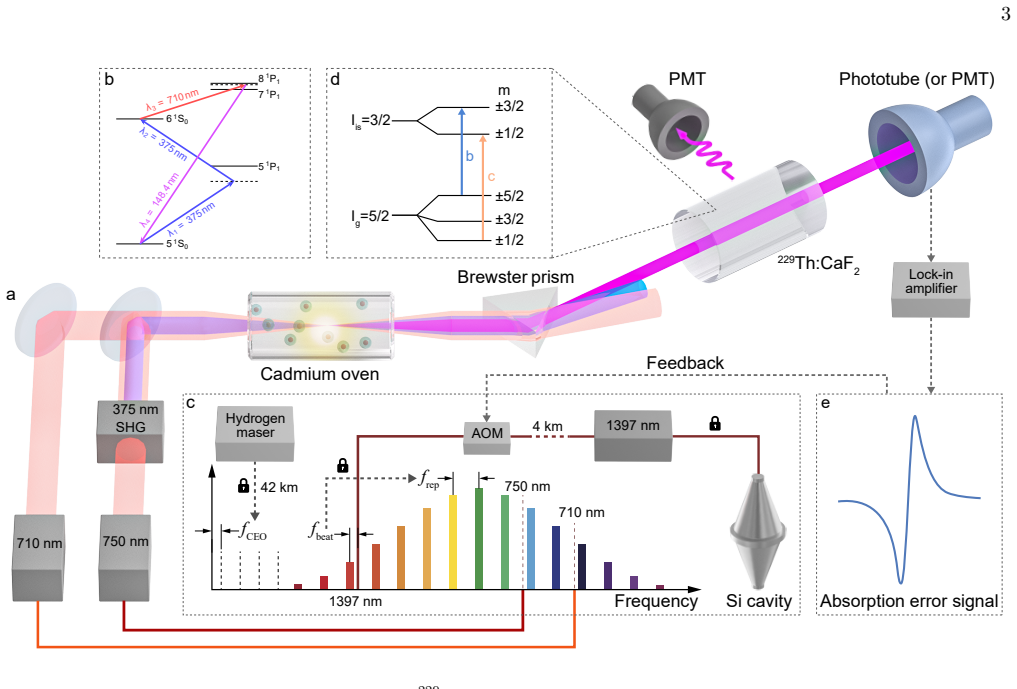
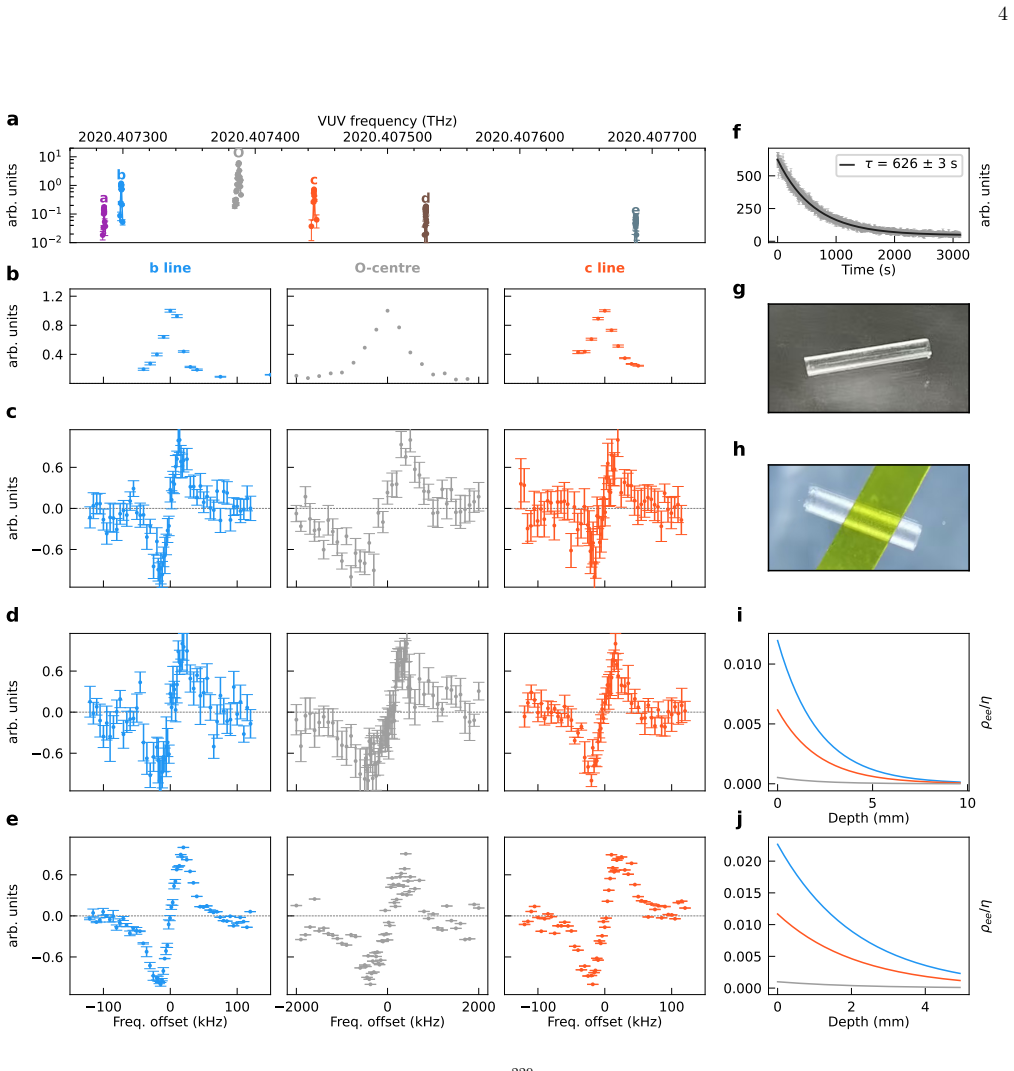
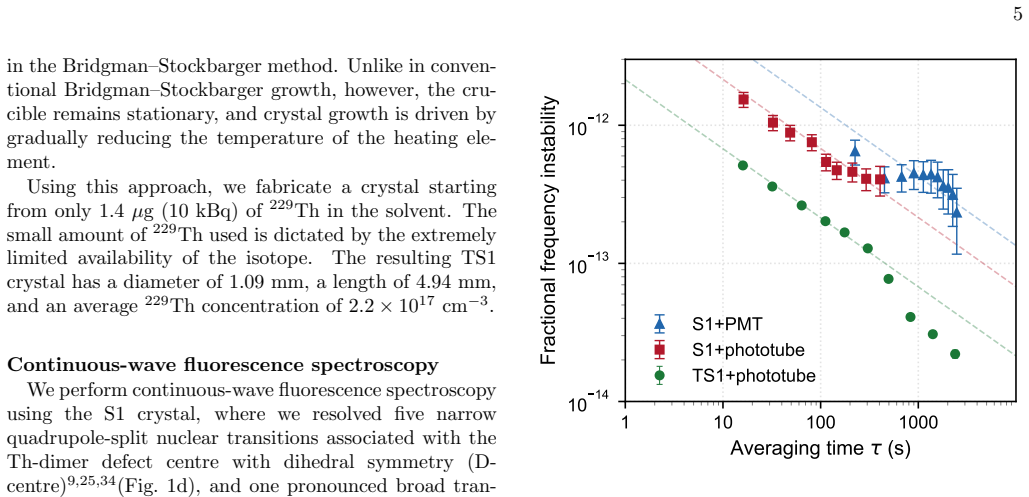
The authors demonstrate the operation of a 229Th nuclear clock by stabilizing a continuous-wave narrow-linewidth 148.4 nm vacuum-ultraviolet laser to a resolved nuclear transition in a solid-state host. This is enabled by fast frequency discrimination based on phototube photocurrent readout of the transmitted VUV power from a home-grown 229Th:CaF2 crystal. The clock reaches a fractional frequency instability of 2×10^{-12}/√(τ/s) and nuclear-clock frequencies measured with two distinct crystals agree at the 10^{-13} level.
What carries the argument
Locking a VUV laser to the absorption feature of the 229Th nuclear isomeric transition in a CaF2 crystal host, using phototube detection for the error signal.
If this is right
- The nuclear transition serves as a stable frequency discriminator for clock operation.
- Frequency reproducibility across distinct crystals shows solid-state nuclear references are viable.
- The approach extends quantum metrology to nuclear transitions.
- Opens platform for compact clocks and precision tests of fundamental physics.
Where Pith is reading between the lines
- If the identification holds, comparing the nuclear clock to existing optical clocks could test for variations in fundamental constants at new levels.
- The solid-state host may allow integration into smaller devices than current atomic clocks.
- Long-term operation could reveal if the nuclear transition offers better immunity to certain environmental perturbations.
- Further work might use the clock to probe nuclear properties directly through frequency measurements.
Load-bearing premise
The absorption feature to which the laser is locked is produced by the nuclear isomeric transition in 229Th rather than by an overlapping electronic transition, impurity, or crystal defect.
What would settle it
If independent spectroscopy or measurements with a 229Th-free crystal show no absorption at 148.4 nm, or if the locked frequency shifts in a manner inconsistent with nuclear transition properties, the claim would be falsified.
Figures
read the original abstract
Atomic clocks have made time and frequency the most precisely measured quantities in physics, progressing from microwave standards that realize the SI second to optical clocks that now reach unprecedented levels of precision. A nuclear clock would shift the frequency reference from an electronic transition to the uniquely low-lying, laser-accessible isomeric transition in the $^{229}$Th nucleus, offering a route to compact, robust timekeeping and sensitive tests of fundamental physics. However, turning recent advances in spectroscopy of the $^{229}$Th nuclear resonance into clock operation requires the nuclear transition to serve as a stable discriminator for steering a traceable oscillator. Here we demonstrate the operation of a $^{229}$Th nuclear clock by stabilizing a continuous-wave narrow-linewidth 148.4 nm vacuum-ultraviolet (VUV) laser to a resolved nuclear transition in a solid-state host. This clock operation is enabled by fast frequency discrimination based on phototube photocurrent readout of the transmitted VUV power. The 10 $\mu$W VUV laser, generated by four-wave mixing in cadmium vapour, provides a high-signal-to-noise absorption signal from a home-grown $^{229}$Th:CaF$_2$ crystal, allowing the laser to be locked to a weakly temperature-sensitive nuclear transition. The clock reaches a fractional frequency instability of $2\times10^{-12}/\sqrt{\tau/s} $, where $\tau$ is the averaging time. Remarkably, nuclear-clock frequencies measured with two distinct crystals agree at the $10^{-13}$ level, demonstrating the reproducibility of solid-state nuclear frequency references. By making a laser-addressed atomic nucleus an operational clock reference, this work extends quantum metrology from electronic to nuclear transitions, and opens a new platform for compact clocks, solid-state nuclear quantum sensors and precision tests of fundamental physics.
Editorial analysis
A structured set of objections, weighed in public.
Referee Report
Summary. The manuscript reports the first operation of a nuclear clock by locking a narrow-linewidth 148.4 nm VUV laser, generated via four-wave mixing, to a resolved absorption feature in home-grown ²²⁹Th:CaF₂ crystals. Frequency discrimination uses phototube readout of transmitted power; the resulting clock achieves 2×10^{-12}/√(τ/s) instability and shows 10^{-13} reproducibility between two distinct crystals, with the feature described as weakly temperature-sensitive.
Significance. If the locked feature is confirmed as the nuclear isomeric transition, the work would constitute a major advance by extending quantum metrology to a nuclear reference, demonstrating solid-state reproducibility at the 10^{-13} level, and opening routes to compact clocks and fundamental-physics tests. The use of a solid-state host and direct photocurrent locking are technically enabling steps.
major comments (2)
- [Abstract and locking description] Abstract and section describing the frequency lock: the assignment of the observed 148.4 nm absorption to the ²²⁹Th nuclear transition rests on wavelength coincidence, inter-crystal reproducibility at 10^{-13}, and weak temperature sensitivity, but provides no magnetic-field shift data, isotopic comparison, or linewidth arguments that would discriminate against overlapping electronic, impurity, or defect lines. This identification is load-bearing for the central claim that the device is a nuclear clock.
- [Abstract and results on instability] Abstract and instability reporting: the quoted fractional frequency instability of 2×10^{-12}/√(τ/s) is presented without an error budget, without specification of the independent frequency reference against which the locked laser was compared, and without verification that the locked feature is nuclear (e.g., via field or temperature dependence). These omissions prevent quantitative assessment of the result.
Simulated Author's Rebuttal
We thank the referee for their careful review and for recognizing the potential significance of this work. We address the two major comments below. Our responses focus on the evidence presented in the manuscript while acknowledging where additional data or clarifications would strengthen the claims.
read point-by-point responses
-
Referee: [Abstract and locking description] Abstract and section describing the frequency lock: the assignment of the observed 148.4 nm absorption to the ²²⁹Th nuclear transition rests on wavelength coincidence, inter-crystal reproducibility at 10^{-13}, and weak temperature sensitivity, but provides no magnetic-field shift data, isotopic comparison, or linewidth arguments that would discriminate against overlapping electronic, impurity, or defect lines. This identification is load-bearing for the central claim that the device is a nuclear clock.
Authors: The identification relies on the precise match of the observed wavelength to the established ²²⁹Th nuclear isomeric transition frequency from prior spectroscopy, combined with the 10^{-13} reproducibility across two independently grown crystals (unlikely for unrelated impurity or defect lines) and the explicitly weak temperature dependence reported in the manuscript, which aligns with expectations for a nuclear transition in a solid host rather than typical electronic transitions. Linewidth arguments are included in the full text, showing consistency with the nuclear transition subject to solid-state broadening. We agree that magnetic-field shift measurements or isotopic comparisons would offer stronger discrimination and were not performed here; we can expand the discussion section in revision to more explicitly address possible alternative assignments and their relative likelihood based on the existing data. revision: partial
-
Referee: [Abstract and results on instability] Abstract and instability reporting: the quoted fractional frequency instability of 2×10^{-12}/√(τ/s) is presented without an error budget, without specification of the independent frequency reference against which the locked laser was compared, and without verification that the locked feature is nuclear (e.g., via field or temperature dependence). These omissions prevent quantitative assessment of the result.
Authors: The quoted instability is obtained from Allan deviation analysis of the locked laser frequency, with the comparison performed against a traceable optical frequency comb referenced to the SI second (details in the methods). We acknowledge that the abstract omits an explicit error budget and a concise statement of the reference; these will be added to the revised abstract and main text. Verification that the locked feature is nuclear is tied to the identification evidence discussed in the first response, including the reported weak temperature sensitivity. We will incorporate a summarized error budget in the revision. revision: yes
- Magnetic-field shift data or isotopic comparison measurements on the observed absorption feature, which were not performed in this study.
Circularity Check
No circularity: direct experimental measurements of laser lock and instability.
full rationale
The paper reports an experimental demonstration in which a VUV laser is locked to an observed absorption feature in two Th:CaF2 crystals, with fractional frequency instability measured directly from the stabilized oscillator output and reproducibility checked by comparing the two crystals. No derivation chain exists in which a claimed prediction or first-principles result is obtained by fitting a parameter to a subset of the same data and then re-expressing that fit as an independent result. No self-citation is invoked as the sole justification for a uniqueness theorem or ansatz that would force the central claim. The identification of the feature as nuclear is presented as an experimental premise supported by wavelength match and reproducibility, but this is a verification question rather than a circular reduction of any derived quantity to its inputs.
Axiom & Free-Parameter Ledger
axioms (1)
- domain assumption The 148.4 nm absorption line observed in ²²⁹Th:CaF₂ is the nuclear isomeric transition (not an electronic or defect line).
Forward citations
Cited by 3 Pith papers
-
Generation of continuous-wave laser light at 148.4 nm using cavity-enhanced second harmonic generation in $BaMgF_4$
First experimental generation of 148.4 nm CW VUV laser light via cavity-enhanced SHG in BaMgF4 crystal, yielding 16 pW output power.
-
Record nonlinear conversion efficiency in the production of high spectral purity vacuum ultraviolet laser at 148 nm
Demonstration of record conversion efficiency for a 148 nm VUV frequency comb using 16th-harmonic generation in a bulk-grown QPM crystal.
-
The $^{229}$Th Isomer: Nuclear Structure, Clocks, and Tests of Fundamental Physics
Review of the 229Th isomer covering spectroscopy, nuclear structure models, and applications to fundamental physics tests.
Reference graph
Works this paper leans on
-
[1]
& Reich, C
Kroger, L. & Reich, C. Features of the low-energy level scheme of 229Th as observed in theα-decay of 233U.Nucl. Phys. A259, 29–60 (1976)
1976
-
[2]
Beck, B.et al.Energy splitting of the ground-state dou- blet in the nucleus 229Th.Phys. Rev. Lett.98, 142501 (2007)
2007
-
[3]
Seiferle, B.et al.Energy of the 229Th nuclear clock tran- sition.Nature573, 243–246 (2019)
2019
-
[4]
Masuda, T.et al.X-ray pumping of the 229Th nuclear clock isomer.Nature573, 238–242 (2019)
2019
-
[5]
Sikorsky, T.et al.Measurement of the 229Th isomer energy with a magnetic microcalorimeter.Phys. Rev. Lett.125, 142503 (2020)
2020
-
[6]
Kraemer, S.et al.Observation of the radiative decay of the 229Th nuclear clock isomer.Nature617, 706–710 (2023)
2023
-
[7]
Tiedau, J.et al.Laser excitation of the Th-229 nucleus. Phys. Rev. Lett.132, 182501 (2024)
2024
-
[8]
Elwell, R.et al.Laser excitation of the 229Th nuclear isomeric transition in a solid-state host.Phys. Rev. Lett. 133, 013201 (2024)
2024
-
[9]
Zhang, C.et al.Frequency ratio of the 229mTh nuclear isomeric transition and the 87Sr atomic clock.Nature 633, 63–70 (2024)
2024
-
[10]
Beeks, K.et al.The thorium-229 low-energy isomer and the nuclear clock.Nat. Rev. Phys.3, 238–248 (2021)
2021
-
[11]
& Helmer, R
Reich, C. & Helmer, R. Energy separation of the doublet of intrinsic states at the ground state of 229Th.Phys. Rev. Lett.64, 271 (1990)
1990
-
[12]
& Reich, C
Helmer, R. & Reich, C. An excited state of 229Th at 3.5 eV.Phys. Rev. C49, 1845 (1994)
1994
-
[13]
Yamaguchi, A.et al.Laser spectroscopy of triply charged 229Th isomer for a nuclear clock.Nature629, 62–66 (2024)
2024
-
[14]
& Tamm, C
Peik, E. & Tamm, C. Nuclear laser spectroscopy of the 3.5 eV transition in Th-229.Europhys. Lett.61, 181 (2003)
2003
-
[15]
G.et al.Constraining the evolution of the fundamental constants with a solid-state optical fre- quency reference based on the 229Th nucleus.Phys
Rellergert, W. G.et al.Constraining the evolution of the fundamental constants with a solid-state optical fre- quency reference based on the 229Th nucleus.Phys. Rev. Lett.104, 200802 (2010)
2010
-
[16]
Phys.14, 083019 (2012)
Kazakov, G.et al.Performance of a 229Thorium solid- state nuclear clock.New J. Phys.14, 083019 (2012)
2012
-
[17]
Rep.13, 3897 (2023)
Beeks, K.et al.Growth and characterization of thorium- doped calcium fluoride single crystals.Sci. Rep.13, 3897 (2023)
2023
-
[18]
229ThF4 thin films for solid-state nuclear clocks.Nature636, 603–608 (2024)
Zhang, C.et al. 229ThF4 thin films for solid-state nuclear clocks.Nature636, 603–608 (2024)
2024
-
[19]
S.et al.Temperature sensitivity of a Thorium-229 solid-state nuclear clock.Phys
Higgins, J. S.et al.Temperature sensitivity of a Thorium-229 solid-state nuclear clock.Phys. Rev. Lett. 134, 113801 (2025)
2025
-
[20]
Terhune, J.et al.Photo-induced quenching of the 229Th isomer in a solid-state host.Phys. Rev. Res.7, L022062 (2025)
2025
-
[21]
Schaden, F.et al.Laser-induced quenching of the Th-229 nuclear clock isomer in calcium fluoride.Phys. Rev. Res. 7, L022036 (2025)
2025
-
[22]
Thielking, J.et al.Laser spectroscopic characterization 8 of the nuclear-clock isomer 229mTh.Nature556, 321–325 (2018)
2018
-
[23]
Commun.15, 5536 (2024)
Hiraki, T.et al.Controlling 229Th isomeric state popu- lation in a VUV transparent crystal.Nat. Commun.15, 5536 (2024)
2024
-
[24]
Guan, M.et al.X-ray-induced quenching of the 229Th clock isomer in caf 2 (2025). 2505.03852
arXiv 2025
-
[25]
arXiv preprint arXiv:2509.00041(2025)
Hiraki, T.et al.Laser M¨ ossbauer spectroscopy of 229Th. arXiv preprint arXiv:2509.00041(2025). 2509.00041
arXiv 2025
-
[26]
C., Morgan, H
Perera, U. C., Morgan, H. W. T., Hudson, E. R. & Dere- vianko, A. Host-dependent frequency offsets in 229Th nuclear clockwork.Physical Review Letters135, 123001 (2025)
2025
-
[27]
Ooi, T.et al.Frequency reproducibility of solid-state thorium-229 nuclear clocks.Nature650, 72–78 (2026)
2026
-
[28]
Elwell, R.et al.Laser-based conversion electron m¨ oss- bauer spectroscopy of 229ThO2.Nature648, 300–305 (2025)
2025
-
[29]
Morgan, H. W. T.et al.Proposal and theoretical in- vestigation of 229Th-doped nonlinear optical crystals for compact solid-state clocks.Applied Physics Letters126, 111101 (2025)
2025
-
[30]
Xiao, Q.et al.Proposal for the generation of continuous- wave vacuum-ultraviolet laser light for Th-229 isomer precision spectroscopy.Physical Review Applied25, 024034 (2026)
2026
-
[31]
Xiao, Q.et al.Continuous-wave narrow-linewidth vac- uum ultraviolet laser source.Nature650, 852–856 (2026)
2026
-
[32]
Penyazkov, G., Yu, Y., Skripnikov, L. V. & Ding, S. The- oretical study of transition matrix elements in cadmium for vacuum-ultraviolet generation in 229Th nuclear clock applications.Phys. Rev. A112, 022807 (2025)
2025
-
[33]
Lal, V.et al.Continuous-wave laser source at the 148 nm nuclear transition of Th-229.Optica12, 1971–1974 (2025)
1971
-
[34]
Morawetz, I.et al.Continuous-wave nuclear laser ab- sorption spectroscopy of Thorium-229.arXiv preprint arXiv:2604.16640(2026). 2604.16640
Pith/arXiv arXiv 2026
-
[35]
Technol.6, 034002 (2021)
Peik, E.et al.Nuclear clocks for testing fundamental physics.Quantum Sci. Technol.6, 034002 (2021)
2021
-
[36]
Flambaum, V. V. Enhanced effect of temporal variation of the fine structure constant and the strong interaction in 229Th.Phys. Rev. Lett.97, 092502 (2006)
2006
-
[37]
& Friar, J
Hayes, A. & Friar, J. Sensitivity of nuclear transition frequencies to temporal variation of the fine structure constant or the strong interaction.Phys. Lett. B650, 229–232 (2007)
2007
-
[38]
C., Dzuba, V
Berengut, J. C., Dzuba, V. A., Flambaum, V. V. & Por- sev, S. G. Proposed experimental method to determine αsensitivity of splitting between ground and 7.6 eV iso- meric states in 229Th.Phys. Rev. Lett.102, 210801 (2009)
2009
-
[39]
Commun.16, 9147 (2025)
Beeks, K.et al.Fine-structure constant sensitivity of the Th-229 nuclear clock transition.Nat. Commun.16, 9147 (2025)
2025
-
[40]
Lin, Y.et al.A 87Sr optical lattice clock with 2.9× 10⁻¹⁷ uncertainty and its absolute frequency measure- ment.Metrologia58, 035010 (2021)
2021
-
[41]
Chen, Z.-A.et al.A laser with instability reaching 4× 10⁻¹⁷ based on a 10-cm-long silicon cavity at sub-5-K temperatures.Science Bulletin70, 3337–3344 (2025)
2025
-
[42]
Bridgman, P. W. Certain physical properties of single crystals of tungsten, antimony, bismuth, tellurium, cad- mium, zinc, and tin. InProceedings of the American academy of arts and sciences, vol. 60, 305–383 (JSTOR, 1925)
1925
-
[43]
Stockbarger, D. C. The production of large single crystals of lithium fluoride.Review of Scientific Instruments7, 133–136 (1936)
1936
-
[44]
Su, L.et al.Growth, characterization and optical quality of CaF2 single crystals grown by the temperature gradi- ent technique.Materials Research Bulletin40, 619–628 (2005)
2005
-
[45]
Beeks, K.et al.Growth and characterization of thorium- doped calcium fluoride single crystals.Scientific Reports 13, 3897 (2023)
2023
-
[46]
Gong, Q.et al.Structures and properties of high- concentration doped Th:CaF 2 single crystals for solid- state nuclear clock materials.Inorganic Chemistry63, 3807–3814 (2024)
2024
discussion (0)
Sign in with ORCID, Apple, or X to comment. Anyone can read and Pith papers without signing in.