REVIEW 2 major objections 2 minor 71 references
Reviewed by Pith at T0; open to challenge.
T0 means a machine referee read the full paper against a public rubric. The mark states how deep the mechanical check went, never who wrote it. the ladder, T0–T4 →
T0 review · grok-4.3
Silicon spin-qubit VQE reaches chemically accurate H2 energies under defined levels of gate-voltage noise and miscalibration.
2026-06-27 18:00 UTC pith:EMW2XJZN
load-bearing objection The paper runs a useful end-to-end noise simulation for silicon spin-qubit VQE and flags concrete tolerance windows, but the random-telegraph model leaves out 1/f spectra and valley effects that could move the numbers. the 2 major comments →
Impact of gate-voltage noise on silicon spin-qubit variational quantum eigensolvers
The pith
A machine-rendered reading of the paper's core claim, the machinery that carries it, and where it could break.
Core claim
Linking three-dimensional electrostatics to effective g-factors and exchange couplings, then propagating static miscalibrations and random-telegraph voltage noise through VQE circuits, identifies operating regimes of miscalibration strength and noise switching time that remain compatible with chemically accurate hydrogen-molecule energy estimates.
What carries the argument
Hardware-algorithm co-simulation framework that maps gate-electrode voltages to effective qubit parameters and injects random-telegraph noise into control pulses.
Load-bearing premise
The random-telegraph noise model together with the electrostatics-to-parameter mapping captures the dominant charge-noise effects present in real silicon quantum-dot devices.
What would settle it
An experiment that measures VQE-computed H2 energies on actual silicon devices while deliberately varying controlled gate-voltage noise amplitudes and switching times, then checks whether accuracy remains inside the simulated thresholds.
If this is right
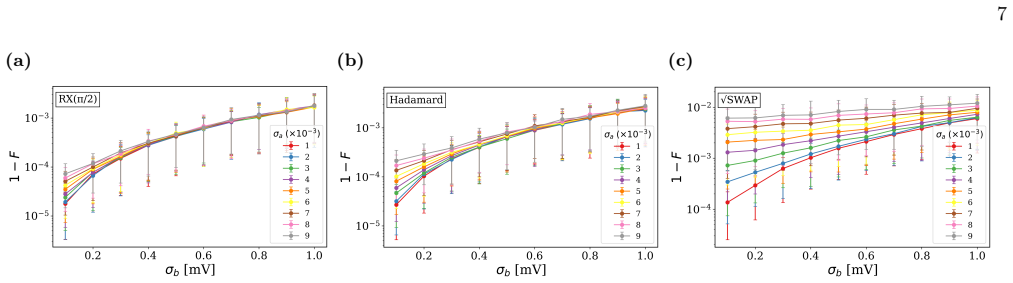
- Exchange-based two-qubit gates are roughly an order of magnitude more sensitive to the modeled noise than ESR-driven single-qubit rotations.
- Quantum process tomography and Kraus-operator analysis separate coherent and incoherent error contributions and quantify the fraction correctable by a compensating unitary.
- Statistical post-processing that uses the full distribution of noisy energy estimates can further improve final accuracy.
- Regimes of miscalibration strength and noise switching time exist that still allow chemically accurate H2 results.
Where Pith is reading between the lines
- The same framework could be used to set device fabrication tolerances for larger molecular simulations.
- Extending the noise models to include additional sources such as nuclear-spin or phonon effects would test the robustness of the identified accuracy windows.
Editorial analysis
A structured set of objections, weighed in public.
Referee Report
Summary. The manuscript presents a hardware-algorithm co-simulation framework for silicon spin-qubit processors. It links 3D electrostatics to effective g-factors and exchange couplings, propagates gate-voltage noise (static scaling/offset errors and random-telegraph fluctuations) through realistic control pulses, and evaluates the impact on VQE for H2 ground-state energy estimation. Key findings include that exchange-based two-qubit gates are roughly an order of magnitude more sensitive to noise than ESR single-qubit rotations, and identification of miscalibration strengths and noise switching times compatible with chemically accurate energy estimates.
Significance. This work is significant for providing a concrete link between device-level physics and algorithmic performance in a promising platform for scalable quantum computing. The use of process tomography and Kraus operators to separate coherent and incoherent errors, along with the suggestion of statistical post-processing, adds value. If the noise model holds, the identified regimes offer practical targets for hardware development.
major comments (2)
- [Noise modeling section] Noise modeling section: The random-telegraph noise model with tunable amplitudes and switching times is central to identifying the regimes compatible with chemical accuracy, but the manuscript provides no comparison to the 1/f spectra that dominate charge noise in real silicon quantum dots. Low-frequency components accumulate over VQE circuit depth and could shift or eliminate the reported switching-time windows.
- [Electrostatics-to-effective-parameter mapping] Electrostatics-to-effective-parameter mapping: The 3D electrostatics mapping to g-factors and exchange couplings omits voltage-induced modulation of valley splitting and the resulting spin-valley mixing. This omission is load-bearing for the quantitative claim that two-qubit gates are ~10× more sensitive than single-qubit rotations, because valley effects directly alter exchange and effective g.
minor comments (2)
- [Abstract] The abstract states that statistical post-processing based on the full distribution of noisy energy estimates 'could further improve accuracy,' but the main text should clarify whether this is demonstrated numerically or only proposed.
- [Methods] All noise parameters (amplitudes, switching times) should be listed with explicit units and ranges in a dedicated table or subsection for reproducibility.
Simulated Author's Rebuttal
We thank the referee for the constructive and detailed report. The comments identify important aspects of the noise modeling and device physics that warrant clarification and additional discussion. We address each major comment below and indicate the revisions planned for the manuscript.
read point-by-point responses
-
Referee: [Noise modeling section] Noise modeling section: The random-telegraph noise model with tunable amplitudes and switching times is central to identifying the regimes compatible with chemical accuracy, but the manuscript provides no comparison to the 1/f spectra that dominate charge noise in real silicon quantum dots. Low-frequency components accumulate over VQE circuit depth and could shift or eliminate the reported switching-time windows.
Authors: We agree that a direct comparison to 1/f spectra would strengthen the noise-model discussion. Our random-telegraph noise (RTN) implementation with continuously tunable switching times is intended to sample a broad range of correlation times, including the long-switching-time limit that approximates low-frequency behavior relevant to VQE circuit depths. Within the depths examined (tens to low hundreds of gates), the identified switching-time windows for chemical accuracy remain stable because the dominant error accumulation arises from the amplitude and correlation-time parameters already varied. Nevertheless, we will add a new paragraph in the noise-modeling section that (i) recalls the standard 1/f phenomenology in Si/SiGe dots, (ii) notes that a superposition of RTN processes can approximate 1/f spectra, and (iii) discusses how an explicit 1/f component might narrow the reported windows for deeper circuits. This addition will be accompanied by a brief supplemental figure showing the effect of an added 1/f tail on a representative VQE instance. revision: partial
-
Referee: [Electrostatics-to-effective-parameter mapping] Electrostatics-to-effective-parameter mapping: The 3D electrostatics mapping to g-factors and exchange couplings omits voltage-induced modulation of valley splitting and the resulting spin-valley mixing. This omission is load-bearing for the quantitative claim that two-qubit gates are ~10× more sensitive than single-qubit rotations, because valley effects directly alter exchange and effective g.
Authors: We acknowledge that voltage-dependent valley splitting and the consequent spin-valley mixing constitute an additional channel that can renormalize both exchange and effective g-factors. Our electrostatic-to-parameter mapping is deliberately restricted to the direct electrostatic contributions to the Zeeman and exchange terms obtained from the 3D Poisson solution; valley physics is treated as a fixed background parameter. Within this controlled approximation the factor-of-ten sensitivity difference between exchange and ESR gates is obtained from the pulse-level propagation of voltage noise and is therefore internally consistent. We do not claim that the numerical factor is universal once valley dynamics are restored. In the revised manuscript we will (i) state this modeling choice explicitly in the device-physics section, (ii) add a short paragraph quantifying the expected size of valley-induced corrections based on literature values for Si/SiGe dots, and (iii) qualify the sensitivity claim as holding inside the present electrostatic model. A full microscopic treatment that self-consistently includes voltage-tunable valley splitting lies beyond the scope of the present co-simulation framework. revision: partial
Circularity Check
No circularity: forward simulation of externally specified noise models
full rationale
The paper constructs a co-simulation pipeline that takes 3D electrostatics, maps them to effective g-factors and exchange couplings via standard device physics, injects independently defined random-telegraph noise with tunable amplitudes and switching times, and propagates the resulting errors through a standard VQE circuit for H2. None of the reported quantities (gate sensitivities, compatible miscalibration regimes, or chemical-accuracy thresholds) are obtained by fitting a parameter inside the paper and then relabeling that fit as a prediction. No self-citation chain is invoked to justify uniqueness or to close a derivation loop. The central results are therefore direct numerical outcomes of the chosen external models rather than tautological restatements of the inputs.
Axiom & Free-Parameter Ledger
free parameters (2)
- noise amplitude
- switching time
axioms (2)
- domain assumption The 3D electrostatic solver accurately predicts gate-voltage effects on qubit parameters.
- domain assumption Random-telegraph noise is an adequate statistical model for charge noise in silicon dots.
read the original abstract
Quantum computers offer a route to outperform classical methods in tasks such as molecular simulation, motivating hybrid algorithms like the Variational Quantum Eigensolver (VQE) for near-term devices. Silicon spin qubits are a promising platform for scalable quantum computation, but their performance is limited by hardware imperfections -- most notably charge-noise-induced potential fluctuations and static miscalibration of gate-electrode voltages -- which degrade quantum gate fidelities and, ultimately, algorithmic accuracy. Here we develop a hardware-algorithm co-simulation framework for silicon quantum-dot processors that links 3D electrostatics to effective $g$-factors and exchange couplings, and propagates voltage-level noise through realistic control pulses. Using VQE for $\mathrm{H}_2$ ground-state energy estimation as a circuit-level testbed, we study both static scaling/offset errors on the gate-electrode voltages and stochastic fluctuations modeled as random-telegraph noise with tunable amplitudes and switching times. At the gate level, we show that exchange-based two-qubit gates are roughly an order of magnitude more sensitive to these types of noise than ESR-driven single-qubit rotations. Quantum process tomography and Kraus-operator analysis further distinguish coherent and incoherent contributions and quantify the fraction of error that is, in principle, correctable by a compensating unitary. Embedding these noise models into the VQE circuit, we identify regimes of miscalibration strength and noise switching time compatible with chemically accurate energy estimates, and discuss how statistical post-processing based on the full distribution of noisy energy estimates could further improve accuracy.
Figures






Reference graph
Works this paper leans on
-
[1]
corrected
Coherent Error The presence of off-diagonal and correlated compo- nents in theχ-matrix suggests that the error channel contains a non-negligible coherent contribution. To iden- tify the leading coherent component in the small-noise regime, we examine the Kraus decomposition and fo- cus on the dominant, most unitary-like Kraus opera- tor. Using the procedu...
-
[2]
corrected
Unitary Correction of Coherent Errors We now apply the coherent-error extraction method of Sec. IIIC1 to quantify how much of the RTN-induced gate error can be removed by a unitary correction. When RTN is added to the control voltages, the key obser- vation is that a zero-mean voltage fluctuationδV(t) need not remain zero-mean once mapped through a non- l...
-
[3]
VQE with Voltage Miscalibration Building upon our analysis of gate fidelity under volt- age miscalibration, we now investigate its cumulative im- pact on a complete quantum algorithm. In Sec. III, we showed that different quantum gates display distinct sen- sitivities to two basic forms of voltage distortion: a scal- ing factora, sampled from a normal dis...
-
[4]
In our simulations, RTN is modeled as arising from multiple independent charge fluctuators distributed around the quantum-dot array
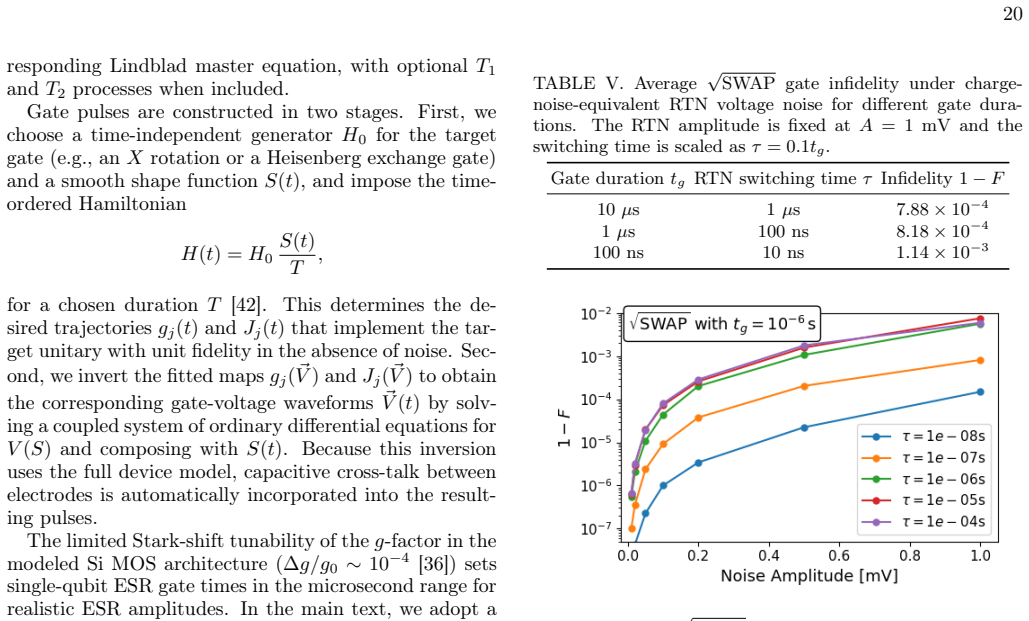
VQE with Random Telegraph Noise We now examine the effect of RTN on VQE perfor- mance. In our simulations, RTN is modeled as arising from multiple independent charge fluctuators distributed around the quantum-dot array. For each electrode, the effective gate-voltage noise is given by the averaged RTN signal in Eq. (4). IndependentRTNavg(t)sequences are ge...
-
[5]
Electrostatics and single-particle states The starting point is a three-dimensional electrostatic model of the Si/SiO2/metal stack, including all plunger, barrier, and tunnel gates, together with the global top gate and screening electrodes [Fig. 1]. For a grid of control-voltage settings( ⃗V , ⃗W), the Poisson equation is solved using a finite-difference...
-
[6]
Sampling these quantities over the voltage grid and fitting to smooth functional forms produces the effective dependenciesg j(⃗V)andJ j(⃗V) used in the main text and shown in Fig
Effective parameters and Hubbard model From the single-particle orbitals we extract local in- planeg-factors via a Stark-shift model, using the local electricfieldandconfinementanisotropy, andinterdotex- change couplings via Heitler–London or Hund–Mulliken approximations [40, 41]. Sampling these quantities over the voltage grid and fitting to smooth funct...
-
[7]
(A1) of Appendix A
Spin Hamiltonian and pulse design The effective spin Hamiltonian used in the simulations is given in Eq. (A1) of Appendix A. Time-dependent control enters through the global ESR fieldBrf(t), its frequency and phase(ω rf(t), ϕ(t)), and the local gate voltages ⃗V(t)that tuneg j(⃗V(t))andJ j(⃗V(t)). Spin dy- namics are simulated by numerically integrating th...
-
[8]
Process matrix and Kraus representation A general quantum operation acting on density op- erators is described by a completely positive, trace- preserving (CPTP) map E:ρ in 7→ρ out =E(ρ in).(D1) Any such map admits a Kraus decomposition [49] E(ρ) = X i KiρK † i , X i K † i Ki =I,(D2) where{K i}are the Kraus operators. To obtain a convenient representation...
-
[9]
In the Pauli basis this is defined via ρout = X m,n χerr mn ˜Em U ρ in U † ˜E† n,(D13) so thatχ err captures only the deviation from the ideal gate
Error process matrix To separate the intended unitary evolution from resid- ual noise, we construct anerror process matrixχ err by factoring out the target unitaryUfrom the reconstructed channel [51]. In the Pauli basis this is defined via ρout = X m,n χerr mn ˜Em U ρ in U † ˜E† n,(D13) so thatχ err captures only the deviation from the ideal gate. In the ...
-
[10]
Pauli transfer matrix and coherence angle For some analyses it is convenient to work in the Pauli transfer matrix (PTM) representation. Given a trace- preserving channelEand an orthonormal Pauli basis { ˜Eµ}, the PTM elements are defined as Nµν = 1 d Tr h ˜Eµ E( ˜Eν) i .(D15) Using the reconstructed process matrixχ, the PTM can be written as Nµν = 1 d X i...
-
[11]
Within the Born–Oppenheimer approximation [54], the nuclei are treated as fixed classical point charges and the nuclear kinetic energy is neglected
Electronic Hamiltonian The molecular Hamiltonian for a system ofKnuclei andNelectrons is H=− X i ℏ2 2me ∇2 i − X I ℏ2 2MI ∇2 I − X i,I e2 4πϵ0 ZI |ri −R I | + 1 2 X i̸=j e2 4πϵ0 1 |ri −r j| + 1 2 X I̸=J e2 4πϵ0 ZI ZJ |RI −R J | ,(F1) wherer i andR I denote electronic and nuclear positions, andZ I andM I are the nuclear charges and masses. Within the Born–...
-
[12]
In this work, the spin-orbitals are taken to be the Hartree–Fock molecular orbitals obtained from a re- stricted Hartree–Fock calculation in the STO-3G basis
Second Quantization In second-quantized form, the electronic Hamiltonian is expressed as H= X p,q hpq a† paq + 1 2 X p,q,r,s hpqrs a† pa† qaras,(F3) wherea † p anda p are fermionic creation and annihi- lation operators acting on spin-orbitals{ϕ p(x)}, with x= (r, σ)denoting the combined spatial and spin co- ordinate. In this work, the spin-orbitals are ta...
-
[13]
Mapping to Qubits The fermionic Hamiltonian can be mapped to a qubit Hamiltonian using transformations such as the Jordan– Wigner (JW) mapping [55], yielding H= X k hkPk,(F6) where theP k are tensor products of Pauli operators act- ing on qubits (Pauli strings), and the coefficientshk de- pend on the molecular geometry and basis set
-
[14]
occ” and “virt
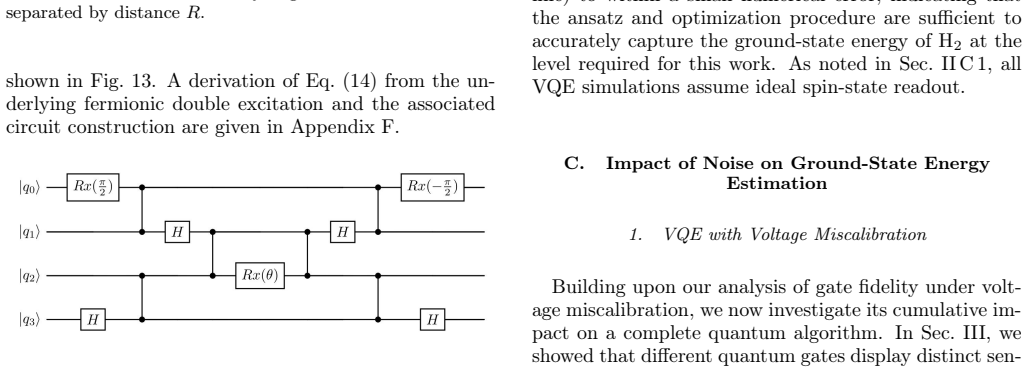
UCC Ansatz andH 2 Specialization A widely used chemically motivated ansatz is the uni- tary coupled-cluster (UCC) ansatz. Starting from a ref- erence state|ψ 0⟩(typically the Hartree–Fock state), the UCC wavefunction is |ψ(θ)⟩=e T−T † |ψ0⟩,(F7) whereTis a truncated cluster operator. For a UCCSD (singles and doubles) truncation, ˆT1 = X i∈occ X a∈virt tai ...
-
[15]
Steane, Reports on Progress in Physics61, 117 (1998)
A. Steane, Reports on Progress in Physics61, 117 (1998)
1998
-
[16]
R. P. Feynman, International Journal of Theoretical Physics21, 467 (1982)
1982
-
[17]
Mind the gaps: The fraught road to quantum advantage
J. Eisert and J. Preskill, arXiv preprint arXiv:2510.19928 (2025), 10.48550/arXiv.2510.19928, arXiv:2510.19928
work page internal anchor Pith review Pith/arXiv arXiv doi:10.48550/arxiv.2510.19928 2025
-
[18]
X. Mi, A. Bengtsson, P. V. Klimov, S. Hong, I. K. Droz- dov, J. Chau, G. Laun, L. T. A. N. Brandão, R. Per- alta, K. Anderson, M. Ansmann, F. Arute, J. C. Bardin, A. Bourassa, J. Bovaird, M. Broughton, B. B. Buckley, D. A. Buell, T. Burger,et al., Nature634, 328 (2024)
2024
-
[19]
T. D. Ladd, F. Jelezko, R. Laflamme, Y. Nakamura, C. Monroe, and J. L. O’Brien, Nature464, 45 (2010)
2010
-
[20]
Google Quantum AI and Collaborators, Nature646, 825 (2025)
2025
-
[21]
Y. Kim, A. Eddins, and S. e. a. Anand, Nature618, 500 (2023)
2023
-
[22]
Google Quantum AI and Collaborators, Nature638, 920 (2025)
2025
-
[23]
M. Liu, R. Shaydulin, P. Niroula, M. DeCross, S.-H. Hung, W. Y. Kon, E. Cervero-Martin, K. Chakraborty, O. Amer, S. Aaronson, A. Acharya, Y. Alexeev, K. J. Berg, S. Chakrabarti, F. J. Curchod, J. M. Dreiling, N. Erickson, C. Foltz, M. Foss-Feig, M.-H. Yung,et al., Nature640, 343 (2025)
2025
-
[24]
Bluvstein, S
D. Bluvstein, S. J. Evered, A. A. Geim, S. H. Li, H. Zhou, T. Manovitz, S. Ebadi, M. Cain, M. Kalinowski, D. Hangleiter, J. P. Bonilla Ataides, N. Maskara, I. Cong, X. Gao, P. Sales Rodriguez, T. Karolyshyn, G. Semegh- ini, M. J. Gullans, M. Greiner,et al., Nature626, 58 (2024)
2024
-
[25]
H. J. Manetsch, G. Nomura, E. Bataille, X. Lv, K. H. Leung, and M. Endres, Nature647, 60 (2025)
2025
-
[26]
A. W. Harrow, A. Hassidim, and S. Lloyd, Physical Re- view Letters103, 150502 (2009)
2009
-
[27]
P. W. Shor, inProceedings of the 35th Annual Symposium on Foundations of Computer Science (FOCS)(IEEE,
-
[28]
Cerezo, A
M. Cerezo, A. Arrasmith, R. Babbush, S. C. Benjamin, S. Endo, K. Fujii, J. R. McClean, K. Mitarai, X. Yuan, L. Cincio, and P. J. Coles, Nature Reviews Physics3, 625 (2021)
2021
-
[29]
Peruzzo, J
A. Peruzzo, J. McClean, P. Shadbolt, M.-H. Yung, X.-Q. Zhou, P. J. Love, A. Aspuru-Guzik, and J. L. O’Brien, Nature Communications5, 4213 (2014)
2014
-
[30]
Y. Cao, J. Romero, J. P. Olson, M. Degroote, P. D. John- son, M. Kieferová, I. D. Kivlichan, T. Menke, B. Per- opadre, N. P. D. Sawaya, S.-C. Sim, L. Veis, and A. Aspuru-Guzik, Chemical Reviews119, 10856 (2019)
2019
-
[31]
Mustafa, S
H. Mustafa, S. N. Morapakula, P. Jain, and S. Gan- guly, in2022 International Conference on Trends in Quantum Computing and Emerging Business Technolo- gies (TQCEBT)(2022) pp. 1–8
2022
-
[32]
D. A. Fedorov, B. Peng, N. Govind, S. Hirata, Y.Kawashima, H.Nakai, M.Otten, T.Yamamoto, S.Ya- mazaki, M. Yamanaka, R. Yuan, T. Sato, and K. Yao, Materials Theory6, 2 (2022)
2022
-
[33]
K. Bharti, A. Cervera-Lierta, T. H. Kyaw, T. Haug, S. Alperin-Lea, A. Anand, M. Degroote, H. Heimonen, J. S. Kottmann, T. Menke, W.-K. Mok, S.-C. Sim, L. C. Kwek, and A. Aspuru-Guzik, arXiv preprint arXiv:2101.08448 (2021), 10.48550/arxiv.2101.08448
-
[34]
Maurand, X
R. Maurand, X. Jehl, D. Kotekar-Patil, A. Corna, H. Bo- huslavskyi, R. Laviéville, L. Hutin, S. Barraud, M. Vinet, M. Sanquer, and S. De Franceschi, Nature Communica- tions7, 13575 (2016)
2016
-
[35]
Veldhorst, C
M. Veldhorst, C. H. Yang, J. C. C. Hwang, W. Huang, J. P. Dehollain, J. T. Muhonen, S. Simmons, A. Laucht, F. E. Hudson, K. M. Itoh, A. Morello, and A. S. Dzurak, Nature526, 410 (2015)
2015
-
[36]
Stano and D
P. Stano and D. Loss, Nature Reviews Physics4, 672 (2022)
2022
-
[37]
A. M. J. Zwerver, T. Krähenmann, T. F. Watson, L. Lampert, H. C. George, R. Pillarisetty, S. A. Bojarski, P. Amin, S. V. Amitonov, J. M. Boter, R. Caudillo, D. Correas-Serrano, J. P. Dehollain, G. Droulers, E. M. Henry, R. Kotlyar, M. Lodari, F. Lüthi, D. J. Micha- lak, others, and J. S. Clarke, Nature Electronics5, 184 (2022)
2022
-
[38]
S. G. J. Philipset al., Nature609, 919 (2022)
2022
-
[39]
Tanttu, W.H
T. Tanttu, W.H. Lim, J. Y.Huang, N.DumoulinStuyck, 27 W. Gilbert, R. Y. Su, M. Feng, J. D. Cifuentes, A. E. Seedhouse, S. K. Seritan, C. I. Ostrove, K. M. Rudinger, R. C. C. Leon, W. Huang, C. C. Escott, K. M. Itoh, N. V. Abrosimov, H.-J. Pohl, M. L. W. Thewalt, and A. S. Dzurak, Nature Physics20, 1804 (2024)
2024
-
[40]
A. R. Mills, C. R. Guinn, M. J. Gullans, A. J. Sigillito, M. M. Feldman, E. Nielsen, and J. R. Petta, Science Advances8, abn5130 (2022)
2022
-
[41]
Scarlino, M
T.F.Watson, S.G.J.Philips, E.Kawakami, D.R.Ward, P. Scarlino, M. Veldhorst, D. E. Savage, M. G. Lagally, M. Friesen, S. N. Coppersmith, M. A. Eriksson, and L. M. K. Vandersypen, Nature555, 633 (2018)
2018
-
[42]
Thorvaldson, D
I. Thorvaldson, D. Poulos, C. M. Moehle, S. H. Misha, H. Edlbauer, J. Reiner, H. Geng, B. Voisin, M. T. Jones, M. B. Donnelly, L. F. Peña, C. D. Hill, C. R. Myers, J. G. Keizer, Y. Chung, S. K. Gorman, L. Kranz, and M. Y. Simmons, Nature Nanotechnology20, 472 (2025)
2025
-
[43]
Paquelet Wuetz, D
B. Paquelet Wuetz, D. Degli Esposti, A.-M. J. Zwerver, S. V. Amitonov, M. Botifoll, J. Arbiol, A. Sammak, L. M. K. Vandersypen, M. Russ, and G. Scappucci, Na- ture Communications14, 1385 (2023)
2023
-
[44]
Culcer, X
D. Culcer, X. Hu, and S. Das Sarma, Applied Physics Letters95, 073102 (2009)
2009
-
[45]
E. J. Connors, J. Nelson, L. F. Edge, and J. M. Nichol, Nature Communications13, 940 (2022)
2022
-
[46]
Y. Kim, C. J. Wood, T. J. Yoder, S. T. Merkel, J. M. Gambetta, K. Temme, and A. Kandala, Nature Physics 19, 752 (2023)
2023
-
[47]
Fontana, N
E. Fontana, N. Fitzpatrick, D. M. Ramo, R. Duncan, and I. Rungger, Phys. Rev. A104, 022403 (2021)
2021
-
[48]
Friesen, P
M. Friesen, P. Rugheimer, D. E. Savage, M. G. Lagally, D. W. van der Weide, R. Joynt, and M. A. Eriksson, Phys. Rev. B67, 121301 (2003)
2003
-
[49]
M. M. E. K. Shehata, G. Simion, R. Li, F. A. Mo- hiyaddin, D. Wan, M. Mongillo, B. Govoreanu, I. Radu, K. De Greve, and P. Van Dorpe, Phys. Rev. B108, 045305 (2023)
2023
-
[50]
Veldhorst, J
M. Veldhorst, J. C. C. Hwang, C. H. Yang, A. W. Leen- stra, B. de Ronde, J. P. Dehollain, J. T. Muhonen, F. E. Hudson, K. M. Itoh, A. Morello, and A. S. Dzurak, Na- ture Nanotechnology9, 981 (2014)
2014
-
[51]
O’Brien, G
J. O’Brien, G. Pryde, A. Gilchrist, D. James, N. Lang- ford, T. Ralph, and A. White, Physical Review Letters 93, 080502 (2004)
2004
-
[52]
Mohseni, A
M. Mohseni, A. T. Rezakhani, and D. A. Lidar, Physical Review A: Atomic, Molecular, and Optical Physics77, 032322 (2008)
2008
-
[53]
Birner, T
S. Birner, T. Zibold, T. Andlauer, T. Kubis, M. Sabathil, A. Trellakis, and P. Vogl, IEEE Transactions on Electron Devices54, 2137 (2007)
2007
-
[54]
Burkard, D
G. Burkard, D. Loss, and D. P. DiVincenzo, Physical Review B59, 2070 (1999)
2070
-
[55]
Pedersen, C
J. Pedersen, C. Flindt, N. A. Mortensen, and A.-P. Jauho, Physical Review B76, 125323 (2007)
2007
-
[56]
Khromets, Z
B. Khromets, Z. D. Merino, and J. Baugh, inAddress- ing Modern Challenges in the Mathematical, Statistical, and Computational Sciences, edited by D. M. Kilgour, H. Kunze, R. N. Makarov, R. Melnik, and X. Wang (Springer Nature Switzerland, Cham, 2025) pp. 153–163
2025
-
[57]
Burkard, T
G. Burkard, T. D. Ladd, A. Pan, J. M. Nichol, and J. R. Petta, Reviews of Modern Physics95, 025003 (2023)
2023
-
[58]
Yoneda, K
J. Yoneda, K. Takeda, T. Otsuka, T. Nakajima, M. R. Delbecq, G. Allison, T. Honda, T. Kodera, S. Oda, Y. Hoshi, N. Usami, K. M. Itoh, and S. Tarucha, Nature Nanotechnology13, 102 (2018)
2018
-
[59]
M. Kępa, N. Focke, Ł. Cywiński, and J. A. Krzywda, Applied Physics Letters123, 034005 (2023)
2023
-
[60]
B. M. Freeman, J. S. Schoenfield, and H. Jiang, Applied Physics Letters108, 253108 (2016)
2016
-
[61]
Gauthier, S
O. Gauthier, S. Haendler, P. Scheer, A. Vernhet, Q. Rafhay, and C. Theodorou, Solid-State Electronics 194, 108320 (2022)
2022
-
[62]
A simple formula for the average gate fidelity of a quantum dynamical operation
M. A. Nielsen, “A simple formula for the average gate fidelity of a quantum dynamical operation,” (2002), arXiv:quant-ph/0205035 [quant-ph]
work page internal anchor Pith review Pith/arXiv arXiv 2002
-
[63]
M. A. Nielsen and I. L. Chuang,Quantum Computation and Quantum Information, 10th ed. (Cambridge Univer- sity Press, 2010)
2010
-
[64]
J. K. Iverson and J. Preskill, New Journal of Physics22, 073066 (2020)
2020
-
[65]
A. N. Korotkov, arXiv preprint arXiv:1309.6405 (2013), 10.48550/arXiv.1309.6405
work page internal anchor Pith review Pith/arXiv arXiv doi:10.48550/arxiv.1309.6405 2013
-
[66]
D. G. A. Smith, L. A. Burns, A. C. Simmonett, R. M. Parrish, M. C. Schieber, R. Galvelis, P. Kraus, H. Kruse, R. Di Remigio, A. Alenaizan, A. M. James, S. Lehtola, J. P. Misiewicz, M. Scheurer, R. A. Shaw, J. B. Schriber, Y. Xie, Z. L. Glick, D. A. Sirianni, and others, The Journal of Chemical Physics152, 184108 (2020)
2020
-
[67]
Khromets and J
B. Khromets and J. Baugh, Phys. Rev. A110, L040602 (2024)
2024
-
[68]
E. J. Brandas,Advances in Quantum Chemistry, 1st ed., edited by E. J. Brandas (Academic Press, 2021)
2021
-
[69]
P.JordanandE.Wigner,TheEuropeanPhysicalJournal A: Hadrons and Nuclei47, 631 (1928)
1928
-
[70]
Hempel, C
C. Hempel, C. Maier, J. Romero, J. McClean, T. Monz, H. Shen, P. Jurcevic, B. P. Lanyon, P. Love, R. Babbush, A. Aspuru-Guzik, R. Blatt, and C. F. Roos, Physical Review X8, 031022 (2018)
2018
-
[71]
Cheng and J
G. Cheng and J. Guo, APL Quantum2, 016101 (2025)
2025
discussion (0)
Sign in with ORCID, Apple, or X to comment. Anyone can read and Pith papers without signing in.