Relativistic Thermal Emission from Accretion Disks in Kerr-MOG Spacetimes
Pith reviewed 2026-06-27 15:56 UTC · model grok-4.3
The pith
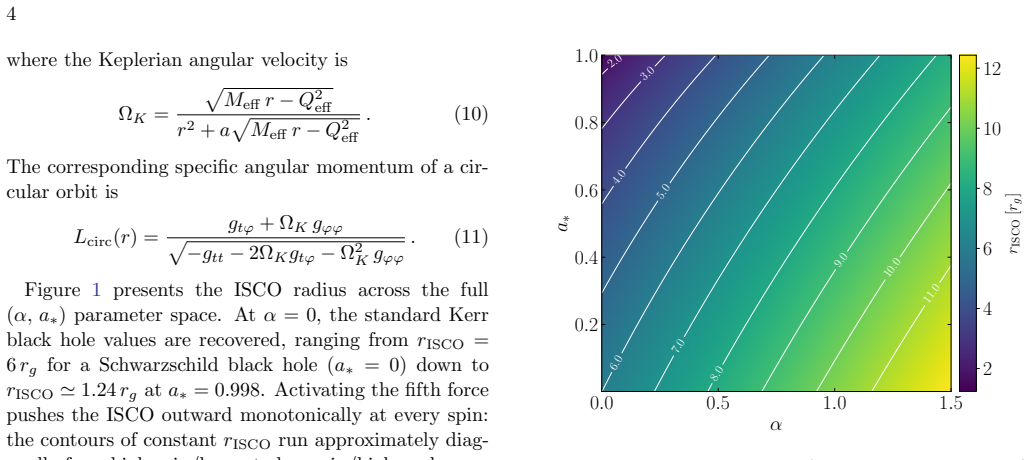
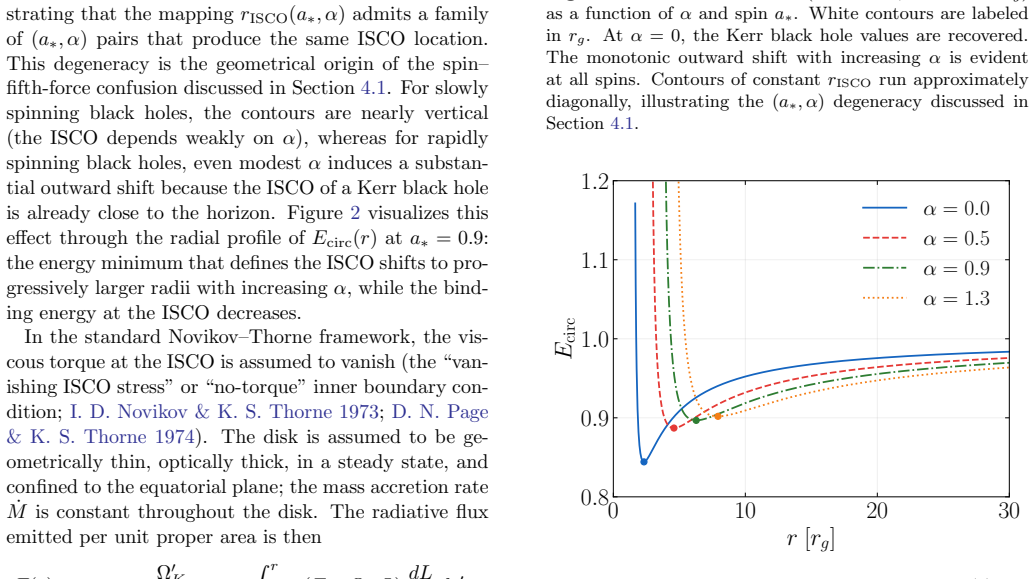
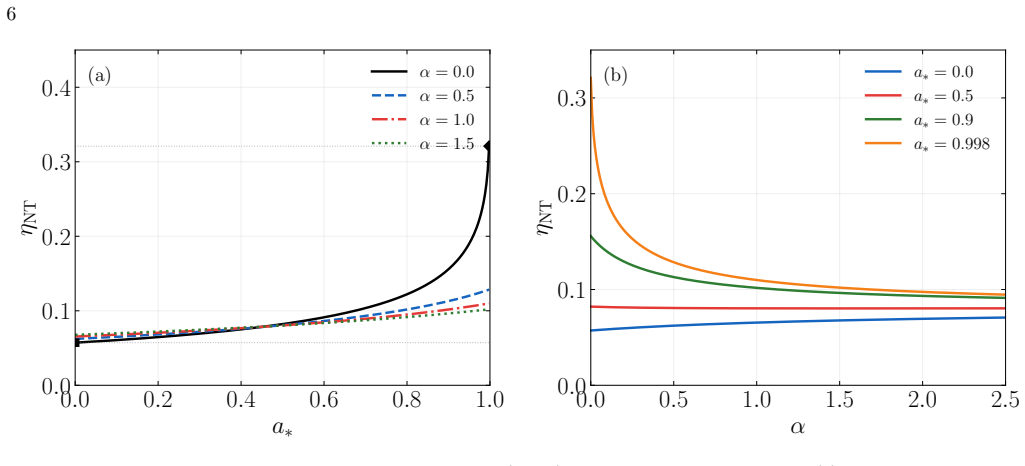
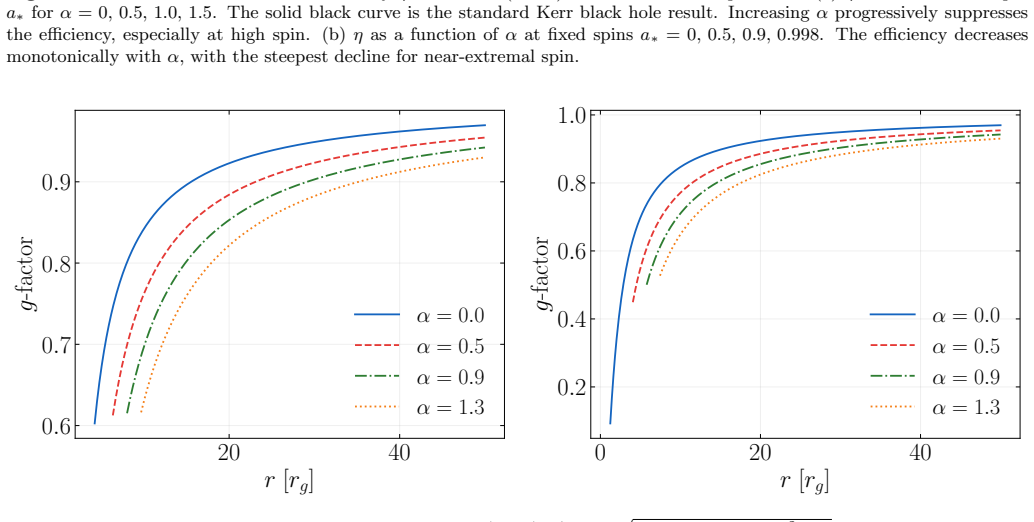
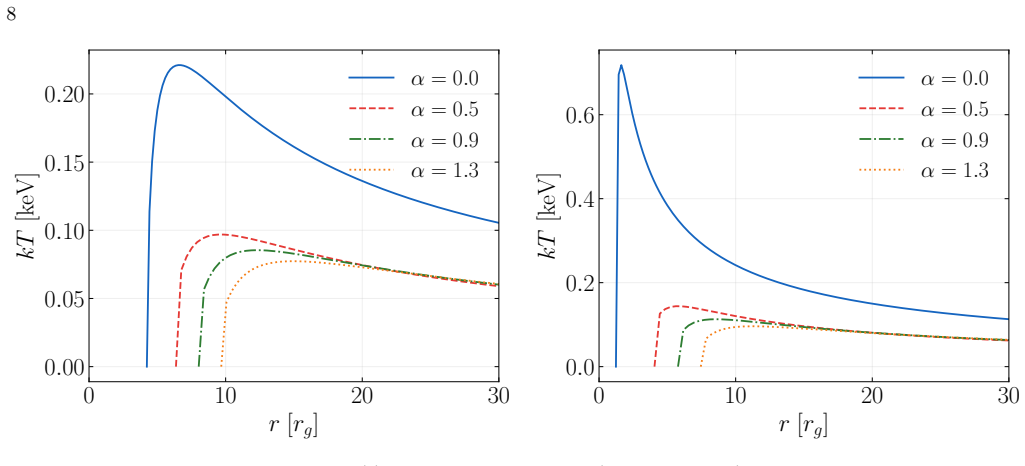
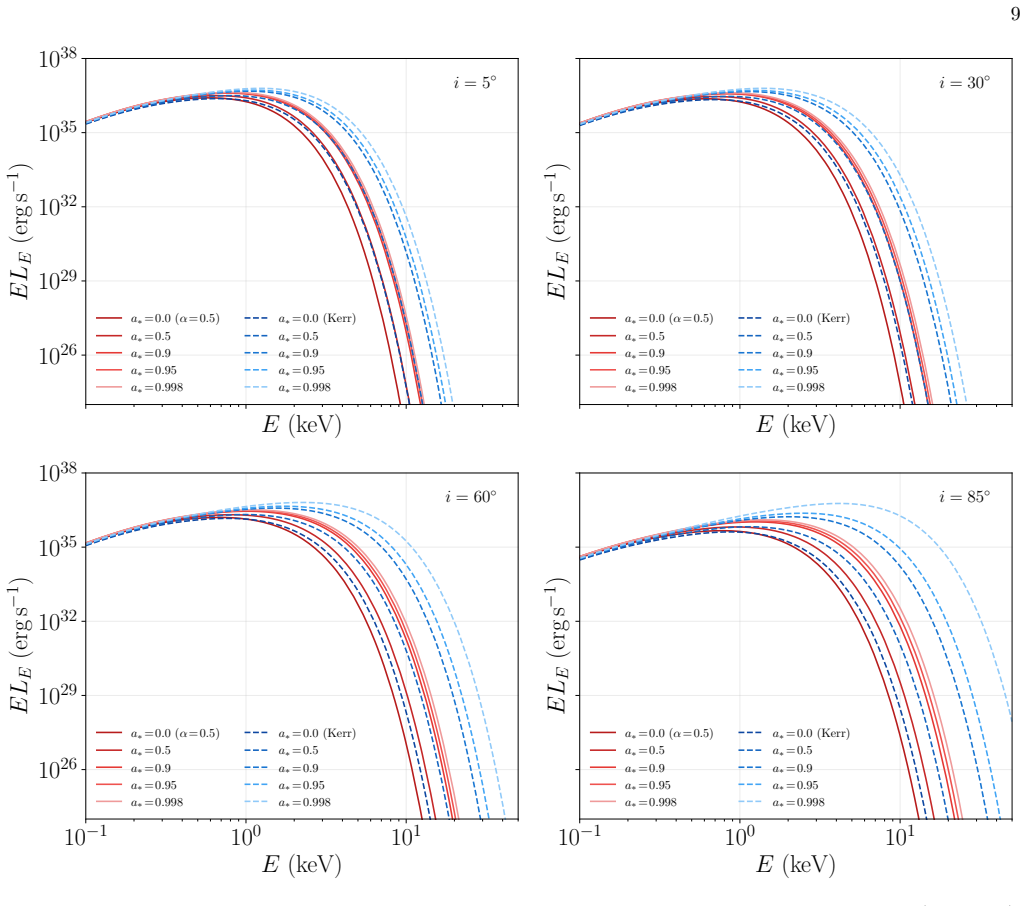
The fifth-force charge in Kerr-MOG black holes pushes the ISCO outward, lowers peak disk temperature, and softens the thermal continuum relative to Kerr at the same spin.
A machine-rendered reading of the paper's core claim, the machinery that carries it, and where it could break.
Core claim
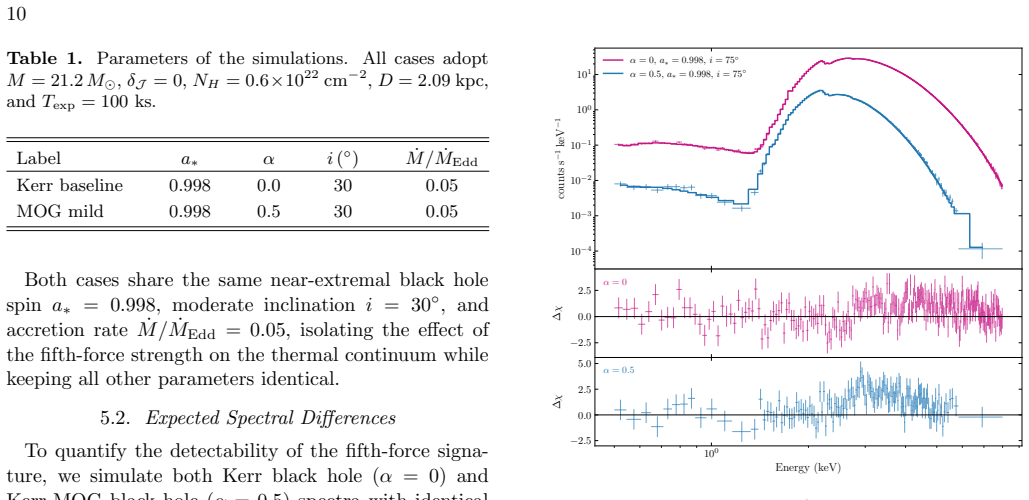
In the Kerr-MOG spacetime the repulsive fifth force generated by the vector field shifts the ISCO to larger radii, which lowers the maximum effective temperature of the Novikov-Thorne disk and softens the observed thermal spectrum; the deviation from Kerr is larger at high inclinations and is degenerate with a reduction in spin parameter.
What carries the argument
The Kerr-MOG metric with deformation parameter α, together with the re-derived ISCO radius, Novikov-Thorne flux, and relativistic transfer functions that incorporate the fifth-force effects.
If this is right
- Kerr-MOG spectra can be fit by lower-spin Kerr models, so independent spin measurements are required to separate the vector-field contribution.
- All computed quantities recover the standard Kerr black-hole predictions exactly when α vanishes.
- The dedicated XSPEC model kmspec allows direct fitting of observed thermal continua for constraints on α.
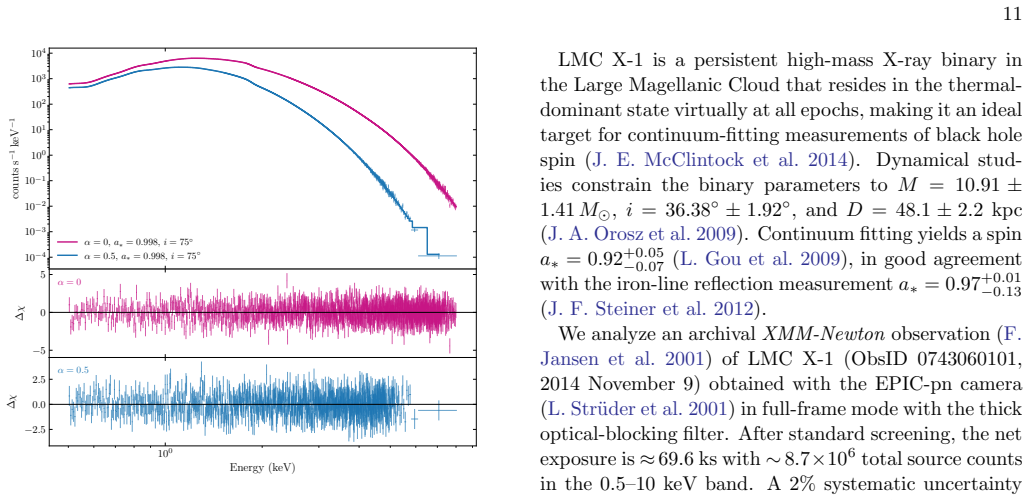
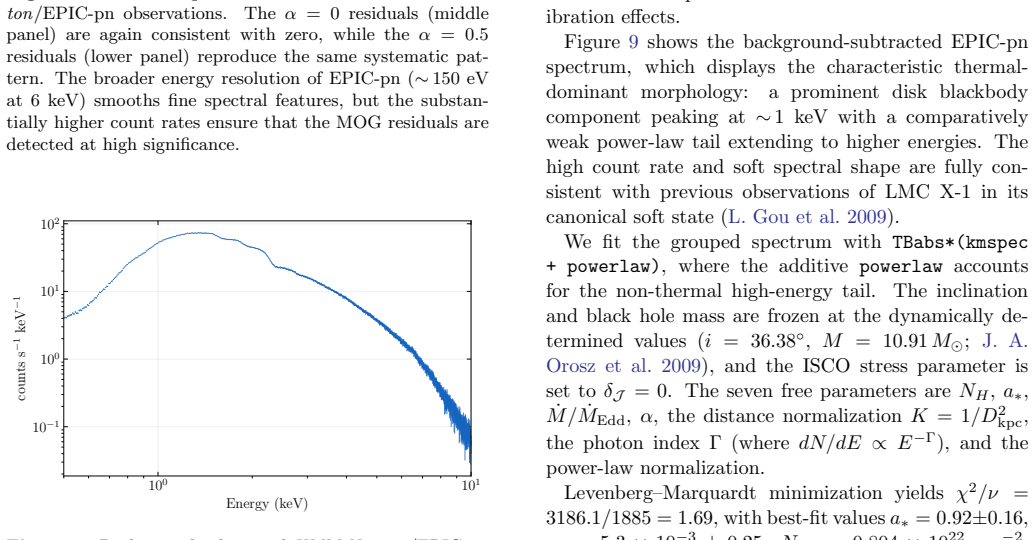
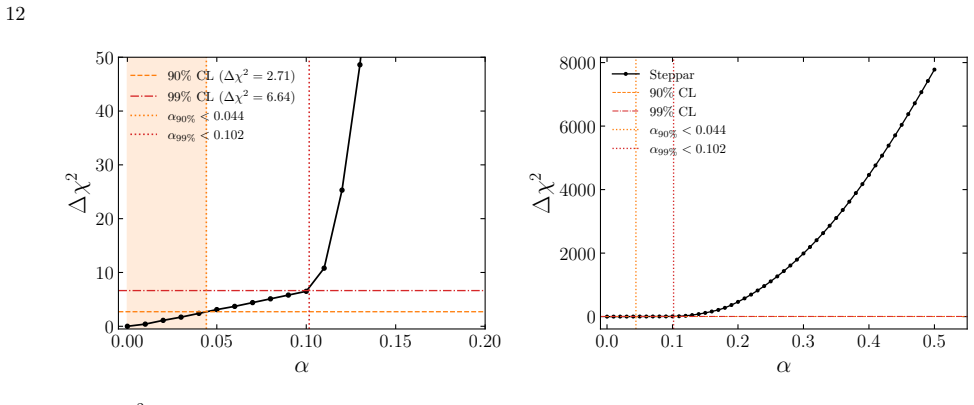
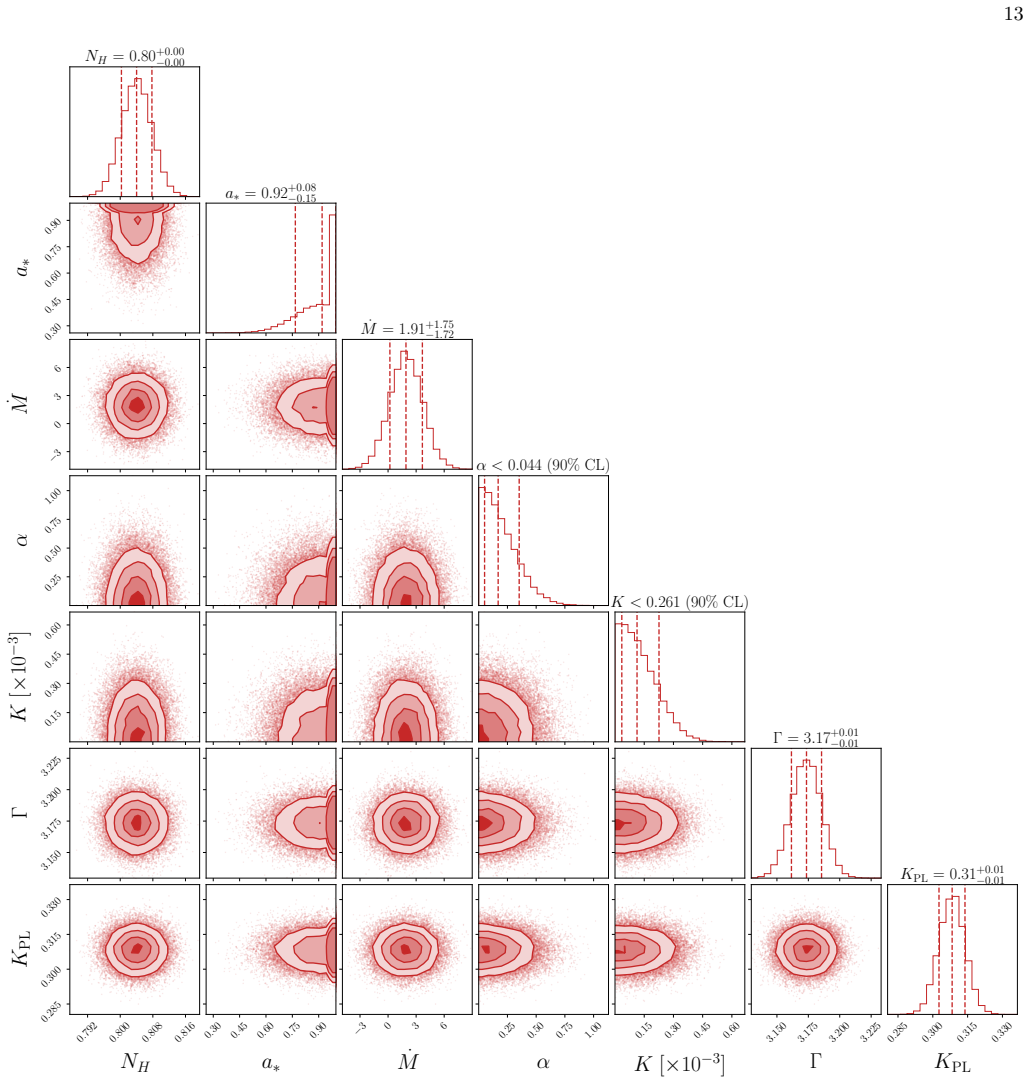
- Application to the 69.6 ks XMM-Newton observation of LMC X-1 yields α < 0.044 at 90 percent .
Where Pith is reading between the lines
- If the softening is confirmed in multiple sources, some apparently low-spin black holes could instead have higher spin together with small but nonzero α.
- The same metric modifications would be expected to affect iron-line profiles and other disk reflection features, offering an independent test.
- Extending the calculation to non-thin disks or including magnetic fields would show whether the fifth-force imprint survives in more realistic flow models.
Load-bearing premise
The Novikov-Thorne thin-disk model remains valid in the Kerr-MOG geometry without changes to disk structure or emissivity beyond the re-derived geodesics and flux.
What would settle it
A high-precision spectrum of a black hole candidate whose spin is independently measured by iron-line reflection that shows a harder continuum than expected for that spin under Kerr would falsify the softening prediction.
Figures
read the original abstract
In Scalar-Tensor-Vector Gravity (STVG, also known as MOG), a massive vector field $\phi_\mu$ generates a repulsive fifth force that endows rotating black holes with a gravitational charge $Q \propto \sqrt{\alpha}\,M$, modifying the near-horizon geometry through a single deformation parameter $\alpha$. We investigate how this vector-field coupling imprints itself on the thermal continuum emission of geometrically thin, optically thick accretion disks in the Kerr-MOG black hole. By re-deriving the innermost stable circular orbit (ISCO), the Novikov-Thorne radiative flux, the relativistic energy shift, and the null geodesic structure for the Kerr-MOG spacetime, we compute fully relativistic disk spectra across a broad range of spins, inclinations, and fifth-force strengths using a dedicated \textsc{xspec} spectral model (\texttt{kmspec}). We find that the fifth-force charge pushes the ISCO outward, lowers the peak disk temperature, and systematically softens the thermal continuum relative to its Kerr black hole counterpart at the same spin, with the deviation amplified at high observer inclinations. The resulting spectral modification closely mimics a reduction of spin in the pure Kerr black hole framework, indicating that independent spin measurements from, e.g., iron-line reflection spectroscopy are indispensable for disentangling the vector-field contribution. All results recover the standard Kerr black hole predictions when $\alpha = 0$, and the model is validated against independent analytic and numerical benchmarks to machine precision. Application to a 69.6~ks \textit{XMM-Newton} observation of LMC~X-1 yields $\alpha < 0.044$ at 90\% confidence, consistent with the Kerr metric and general relativity.
Editorial analysis
A structured set of objections, weighed in public.
Referee Report
Summary. The manuscript examines thermal continuum spectra from thin accretion disks around Kerr-MOG black holes in Scalar-Tensor-Vector Gravity. The authors re-derive the ISCO location, Novikov-Thorne flux, relativistic energy shifts, and null geodesics in the modified metric, implement these in a new XSPEC model (kmspec), and report that nonzero fifth-force parameter α shifts the ISCO outward, lowers peak temperature, and softens the spectrum relative to Kerr at fixed spin (with larger deviations at high inclination). The effect mimics a lower Kerr spin; application to a 69.6 ks XMM-Newton observation of LMC X-1 yields α < 0.044 (90% CL). All quantities recover the Kerr limit at α = 0 and are validated to machine precision.
Significance. If the central derivations hold, the work supplies a concrete, observationally testable signature of the MOG vector-field charge on disk emission and demonstrates the necessity of independent spin constraints (e.g., iron-line reflection) to break the degeneracy. Explicit credit is due for the machine-precision validation against analytic and numerical benchmarks and for the clean recovery of the α = 0 limit.
major comments (2)
- [Abstract (and associated derivations)] Abstract and the re-derivation sections: the ISCO and Novikov-Thorne flux are obtained under the assumption of geodesic motion in the Kerr-MOG metric. In the complete STVG theory, test particles carrying gravitational charge Q ∝ √α M experience an additional non-geodesic Lorentz-type force from the vector field φ_μ. The manuscript must demonstrate that this term either vanishes for equatorial circular orbits or produces only higher-order corrections; otherwise the reported outward ISCO shift and the resulting spectral softening rest on an incomplete equation of motion.
- [Observational application section] Application to LMC X-1 data: the reported α < 0.044 limit is obtained by fitting the new model while treating spin as a free parameter. Because the spectral softening is degenerate with a reduction in Kerr spin, the constraint on α is only robust once the spin is independently fixed (e.g., by reflection spectroscopy). The manuscript should quantify how the α upper bound changes when spin is held at the reflection value rather than left free.
minor comments (1)
- The abstract states that results are validated 'to machine precision'; a short appendix or subsection listing the specific analytic limits, numerical codes, and tolerance thresholds used for each re-derived quantity would improve reproducibility.
Simulated Author's Rebuttal
We thank the referee for the careful and constructive review of our manuscript. We address each major comment below and describe the revisions that will be incorporated to strengthen the presentation and robustness of the results.
read point-by-point responses
-
Referee: [Abstract (and associated derivations)] Abstract and the re-derivation sections: the ISCO and Novikov-Thorne flux are obtained under the assumption of geodesic motion in the Kerr-MOG metric. In the complete STVG theory, test particles carrying gravitational charge Q ∝ √α M experience an additional non-geodesic Lorentz-type force from the vector field φ_μ. The manuscript must demonstrate that this term either vanishes for equatorial circular orbits or produces only higher-order corrections; otherwise the reported outward ISCO shift and the resulting spectral softening rest on an incomplete equation of motion.
Authors: We acknowledge the importance of this point regarding the full STVG equations of motion. Our derivations follow the standard treatment in the Kerr-MOG literature, in which the vector-field effects are fully incorporated into the effective metric and test-particle motion is taken to be geodesic. To address the referee’s concern explicitly, we will add a short derivation in Section 2 showing that the radial component of the Lorentz-type force vanishes identically for equatorial circular orbits (u^r = 0, u^θ = 0) due to the symmetries of the vector field and the equatorial plane. This confirms that the ISCO location and Novikov-Thorne flux remain unchanged at the order considered. The revised manuscript will include this calculation and the associated equation-of-motion components. revision: yes
-
Referee: [Observational application section] Application to LMC X-1 data: the reported α < 0.044 limit is obtained by fitting the new model while treating spin as a free parameter. Because the spectral softening is degenerate with a reduction in Kerr spin, the constraint on α is only robust once the spin is independently fixed (e.g., by reflection spectroscopy). The manuscript should quantify how the α upper bound changes when spin is held at the reflection value rather than left free.
Authors: We agree that the degeneracy between α and spin is central and is already highlighted in the manuscript. To make the constraint more robust, we will add a new subsection (or appendix) that repeats the LMC X-1 fit with the black-hole spin fixed to the independent reflection-spectroscopy value reported in the literature. The resulting 90 % upper limit on α under this fixed-spin assumption will be reported together with the original free-spin result, thereby quantifying the effect of the degeneracy as requested. revision: yes
Circularity Check
No circularity: derivations follow from metric re-computation
full rationale
The paper re-derives ISCO location, Novikov-Thorne flux, energy shifts and null geodesics directly from the Kerr-MOG line element and effective potential, recovering the Kerr case at α=0 and validating against independent benchmarks to machine precision. The reported spectral softening is an output of these metric-derived quantities, not a fit or self-citation that forces the result by construction. The α<0.044 bound is obtained by fitting the new model to XMM-Newton data and is therefore an independent constraint rather than an input. No load-bearing step reduces to a self-definition, renamed known result, or author-only uniqueness theorem.
Axiom & Free-Parameter Ledger
free parameters (1)
- α
axioms (2)
- domain assumption The Kerr-MOG line element correctly encodes the fifth-force effects of the massive vector field
- domain assumption Geometrically thin, optically thick disk with Novikov-Thorne radiative efficiency applies
Reference graph
Works this paper leans on
-
[1]
Afrin, M., Vagnozzi, S., & Ghosh, S. G. 2023, Astrophys. J., 944, 149, doi: 10.3847/1538-4357/acb334
-
[2]
Akiyama, K., et al. 2019, Astrophys. J. Lett., 875, L1, doi: 10.3847/2041-8213/ab0ec7
-
[3]
Akiyama, K., et al. 2022, Astrophys. J. Lett., 930, L17, doi: 10.3847/2041-8213/ac6756
-
[4]
2013, JCAP, 08, 055, doi: 10.1088/1475-7516/2013/08/055
Bambi, C. 2013, JCAP, 08, 055, doi: 10.1088/1475-7516/2013/08/055
-
[5]
Bambi, C. 2017, Rev. Mod. Phys., 89, 025001, doi: 10.1103/RevModPhys.89.025001
-
[6]
Bambi, C., Cardenas-Avendano, A., Dauser, T., Garcia, J. A., & Nampalliwar, S. 2017, Astrophys. J., 842, 76, doi: 10.3847/1538-4357/aa74c0
-
[7]
Bardeen, J. M., Press, W. H., & Teukolsky, S. A. 1972, Astrophys. J., 178, 347, doi: 10.1086/151796
-
[8]
Bertone, G., Hooper, D., & Silk, J. 2005, Phys. Rept., 405, 279, doi: 10.1016/j.physrep.2004.08.031
-
[9]
Brownstein, J. R., & Moffat, J. W. 2007, Mon. Not. Roy. Astron. Soc., 382, 29, doi: 10.1111/j.1365-2966.2007.12275.x
-
[10]
Deng, X.-M., Xie, Y., & Huang, T.-Y. 2009, Phys. Rev. D, 79, 044014, doi: 10.1103/PhysRevD.79.044014
-
[11]
Done, C., Davis, S. W., Jin, C., Blaes, O., & Ward, M. 2012, Mon. Not. R. Astron. Soc., 420, 1848, doi: 10.1111/j.1365-2966.2011.20017.x
-
[12]
Gou, L., McClintock, J. E., Liu, J., & Narayan, R. 2009, Astrophys. J., 701, 1076, doi: 10.1088/0004-637X/701/2/1076
-
[13]
Green, M. A., Moffat, J. W., & Toth, V. T. 2018, Phys. Lett. B, 780, 300, doi: 10.1016/j.physletb.2018.03.015
-
[14]
Hussain, S., & Jamil, M. 2015, Phys. Rev. D, 92, 043008, doi: 10.1103/PhysRevD.92.043008
-
[15]
Iorio, L. 2008, Schol. Res. Exch., 2008, 238385, doi: 10.3814/2008/238385
-
[16]
2001, A&A, 365, L1, doi: 10.1051/0004-6361:20000036 16
Jansen, F., Lumb, D., Altieri, B., et al. 2001, Astron. Astrophys., 365, L1, doi: 10.1051/0004-6361:20000036
-
[17]
Jiang, H.-X., Liu, C., Dihingia, I. K., et al. 2023, arXiv e-prints, doi: 10.48550/arXiv.2312.04288
-
[18]
Johannsen, T., & Psaltis, D. 2011, Phys. Rev. D, 83, 124015, doi: 10.1103/PhysRevD.83.124015
-
[19]
Kocherlakota, P., & Rezzolla, L. 2022, Mon. Not. Roy. Astron. Soc., 513, 1229, doi: 10.1093/mnras/stac891
-
[20]
Kocherlakota, P., et al. 2021, Phys. Rev. D, 103, 104047, doi: 10.1103/PhysRevD.103.104047
-
[21]
Konoplya, R., Rezzolla, L., & Zhidenko, A. 2016, Phys. Rev. D, 93, 064015, doi: 10.1103/PhysRevD.93.064015
-
[22]
Kuang, X.-M., Tang, Z.-Y., Wang, B., & Wang, A. 2022, Phys. Rev. D, 106, 064012, doi: 10.1103/PhysRevD.106.064012
-
[23]
Lee, H.-C., & Han, Y.-J. 2017, Eur. Phys. J. C, 77, 655, doi: 10.1140/epjc/s10052-017-5152-7
-
[24]
Manfredi, L., Mureika, J., & Moffat, J. 2017, J. Phys. Conf. Ser., 942, 012014, doi: 10.1088/1742-6596/942/1/012014
-
[25]
McClintock, J. E., Narayan, R., & Steiner, J. F. 2014, Space Sci. Rev., 183, 295, doi: 10.1007/s11214-013-0003-9
-
[26]
E., Shafee, R., Narayan, R., et al
McClintock, J. E., Shafee, R., Narayan, R., et al. 2006, Astrophys. J., 652, 518, doi: 10.1086/508457
-
[27]
M., Yusef-Zadeh, F., Wardle, M., et al
Michail, J. M., Yusef-Zadeh, F., Wardle, M., et al. 2024, Astrophys. J., 971, 52, doi: 10.3847/1538-4357/ad5332
-
[28]
Miller, J. M., et al. 2025, Astrophys. J. Lett., 995, L14, doi: 10.3847/2041-8213/ae2123
-
[29]
Miller-Jones, J. C. A., Bahramian, A., Orosz, J. A., et al. 2021, Science, 371, 1046, doi: 10.1126/science.abb3363
-
[30]
Mizuno, Y., Younsi, Z., Fromm, C. M., et al. 2018, Nature Astron., 2, 585, doi: 10.1038/s41550-018-0449-5
-
[31]
Moffat, J. W. 2006, JCAP, 03, 004, doi: 10.1088/1475-7516/2006/03/004
-
[32]
Moffat, J. W. 2014, https://arxiv.org/abs/1410.2464
Pith/arXiv arXiv 2014
-
[33]
Moffat, J. W. 2015, Eur. Phys. J. C, 75, 130, doi: 10.1140/epjc/s10052-015-3352-6
-
[34]
Moffat, J. W. 2016, Phys. Lett. B, 763, 427, doi: 10.1016/j.physletb.2016.10.082
-
[35]
Moffat, J. W., & Rahvar, S. 2013, Mon. Not. Roy. Astron. Soc., 436, 1439, doi: 10.1093/mnras/stt1670
-
[36]
Mummery, A., Ingram, A., Davis, S., & Fabian, A. 2024, Mon. Not. R. Astron. Soc., 531, 3245, doi: 10.1093/mnras/stae1160
-
[37]
Mureika, J. R., Moffat, J. W., & Faizal, M. 2016, Phys. Lett. B, 757, 528, doi: 10.1016/j.physletb.2016.04.041
-
[38]
D., & Thorne, K
Novikov, I. D., & Thorne, K. S. 1973, in Black Holes, ed. C. DeWitt & B. S. DeWitt (New York: Gordon and Breach), 343–450
1973
-
[39]
A., Steeghs, D., McClintock, J
Orosz, J. A., Steeghs, D., McClintock, J. E., et al. 2009, Astrophys. J., 697, 573, doi: 10.1088/0004-637X/697/1/573 ¨Ozel, F., Psaltis, D., & Younsi, Z. 2022, Astrophys. J., 941, 88, doi: 10.3847/1538-4357/ac9fcb
-
[40]
Page, D. N., & Thorne, K. S. 1974, Astrophys. J., 191, 499, doi: 10.1086/152990 P´ erez, D., Lopez Armengol, F. G., & Romero, G. E. 2017, Phys. Rev. D, 95, 104047, doi: 10.1103/PhysRevD.95.104047
-
[41]
Podgorny, J., et al. 2023, Mon. Not. Roy. Astron. Soc., 526, 5964, doi: 10.1093/mnras/stad3103
-
[42]
Psaltis, D., Medeiros, L., Christian, P., et al. 2020, Phys. Rev. Lett., 125, 141104, doi: 10.1103/PhysRevLett.125.141104 16
-
[43]
Qin, X., Chen, S., Zhang, Z., & Jing, J. 2022, Astrophys. J., 938, 2, doi: 10.3847/1538-4357/ac8f49
-
[44]
Reynolds, C. S. 2014, Space Sci. Rev., 183, 277, doi: 10.1007/s11214-013-0006-6
-
[45]
Sharif, M., & Shahzadi, M. 2017, Eur. Phys. J. C, 77, 363, doi: 10.1140/epjc/s10052-017-4898-2
-
[46]
Sheoran, P., Herrera-Aguilar, A., & Nucamendi, U. 2018, Phys. Rev. D, 97, 124049, doi: 10.1103/PhysRevD.97.124049
-
[47]
Steiner, J. F., McClintock, J. E., Remillard, R. A., et al. 2010, Astrophys. J. Lett., 718, L117, doi: 10.1088/2041-8205/718/2/L117
-
[48]
Steiner, J. F., Reis, R. C., Fabian, A. C., et al. 2012, Mon. Not. Roy. Astron. Soc., 427, 2552, doi: 10.1111/j.1365-2966.2012.22128.x Str¨ uder, L., Briel, U., Dennerl, K., et al. 2001, Astron. Astrophys., 365, L18, doi: 10.1051/0004-6361:20000066
-
[49]
Tashiro, M., Maejima, H., Toda, K., Kelley, R., et al. 2020, Proc. SPIE, 11444, 114441E, doi: 10.1117/12.2565812
-
[50]
Tripathi, A., Abdikamalov, A. B., Ayzenberg, D., et al. 2022, JCAP, 01, 019, doi: 10.1088/1475-7516/2022/01/019
-
[51]
Tripathi, A., Zhang, Y., Abdikamalov, A. B., et al. 2021, Astrophys. J., 913, 79, doi: 10.3847/1538-4357/abf6cd
-
[52]
Tripathi, A., Zhou, M., Abdikamalov, A. B., et al. 2020, Astrophys. J., 897, 84, doi: 10.3847/1538-4357/ab9600
-
[53]
Uniyal, A., Dihingia, I. K., Mizuno, Y., & Rezzolla, L. 2025, Nature Astron., 1, 8, doi: 10.1038/s41550-025-02695-4
-
[54]
Vagnozzi, S., Roy, R., Tsai, Y.-D., et al. 2023, Class. Quant. Grav., 40, 165007, doi: 10.1088/1361-6382/acd97b
-
[55]
2019, JCAP, 03, 046, doi: 10.1088/1475-7516/2019/03/046
Wang, H.-M., Xu, Y.-M., & Wei, S.-W. 2019, JCAP, 03, 046, doi: 10.1088/1475-7516/2019/03/046
-
[56]
Wei, S.-W., & Liu, Y.-X. 2018, Phys. Rev. D, 98, 024042, doi: 10.1103/PhysRevD.98.024042 XRISM Science Team. 2022, arXiv e-prints. https://arxiv.org/abs/2202.05399
-
[57]
Yang, X., & Wang, J. 2013, Astrophys. J. Suppl., 207, 6, doi: 10.1088/0067-0049/207/1/6
-
[58]
Younsi, Z., Psaltis, D., & ¨Ozel, F. 2023, Astrophys. J., 942, 47, doi: 10.3847/1538-4357/aca58a
-
[59]
Yu, Z., Jiang, Q., Abdikamalov, A. B., et al. 2021, Phys. Rev. D, 104, 084035, doi: 10.1103/PhysRevD.104.084035
-
[60]
Zhang, S. N., Cui, W., & Chen, W. 1997, Astrophys. J. Lett., 482, L155, doi: 10.1086/310705
-
[61]
2024, JCAP, 09, 027, doi: 10.1088/1475-7516/2024/09/027
Zhang, Z., Chen, S., & Jing, J. 2024, JCAP, 09, 027, doi: 10.1088/1475-7516/2024/09/027
-
[62]
Zhang, Z., Liu, H., Abdikamalov, A. B., et al. 2022, Astrophys. J., 924, 72, doi: 10.3847/1538-4357/ac350e
-
[63]
Zhao, X., Gou, L., Dong, Y., et al. 2021, Astrophys. J., 908, 117, doi: 10.3847/1538-4357/abbcd6
-
[64]
Zheng, H.-B., Wu, M.-Q., Li, G.-P., & Jiang, Q.-Q. 2025, Eur. Phys. J. C, 85, 46, doi: 10.1140/epjc/s10052-025-13791-0
-
[65]
Zhou, M., Abdikamalov, A. B., Ayzenberg, D., et al. 2019, Phys. Rev. D, 99, 104031, doi: 10.1103/PhysRevD.99.104031
discussion (0)
Sign in with ORCID, Apple, or X to comment. Anyone can read and Pith papers without signing in.