Order parameters and ground-state phase diagram of the interacting topological Su-Schrieffer-Heeger model with extended-range hoppings
Pith reviewed 2026-06-27 15:10 UTC · model grok-4.3
The pith
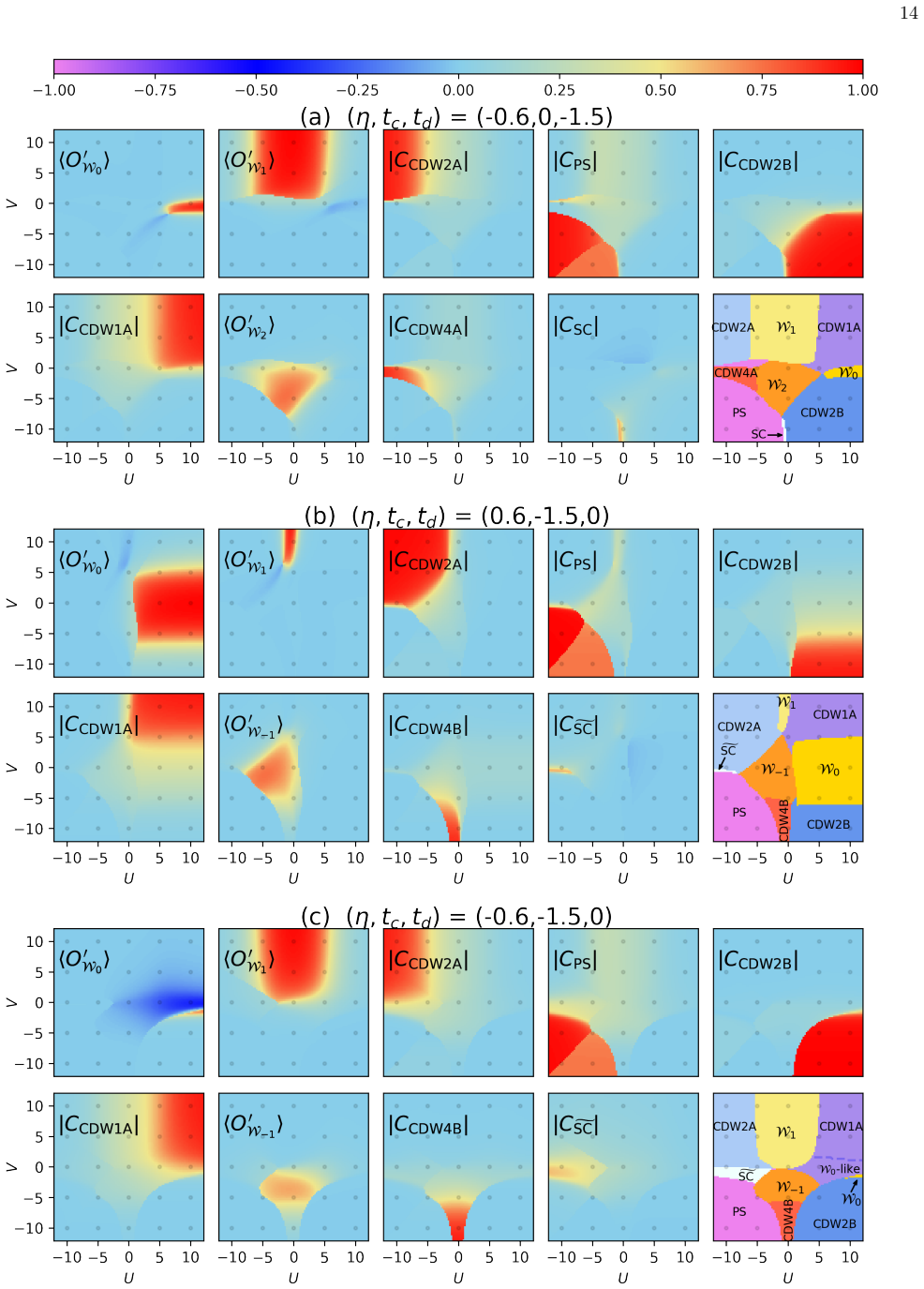
The interacting Su-Schrieffer-Heeger model with extended-range hoppings hosts topological phases plus two novel superconducting-like phases and five distinct charge-density-wave phases.
A machine-rendered reading of the paper's core claim, the machinery that carries it, and where it could break.
Core claim
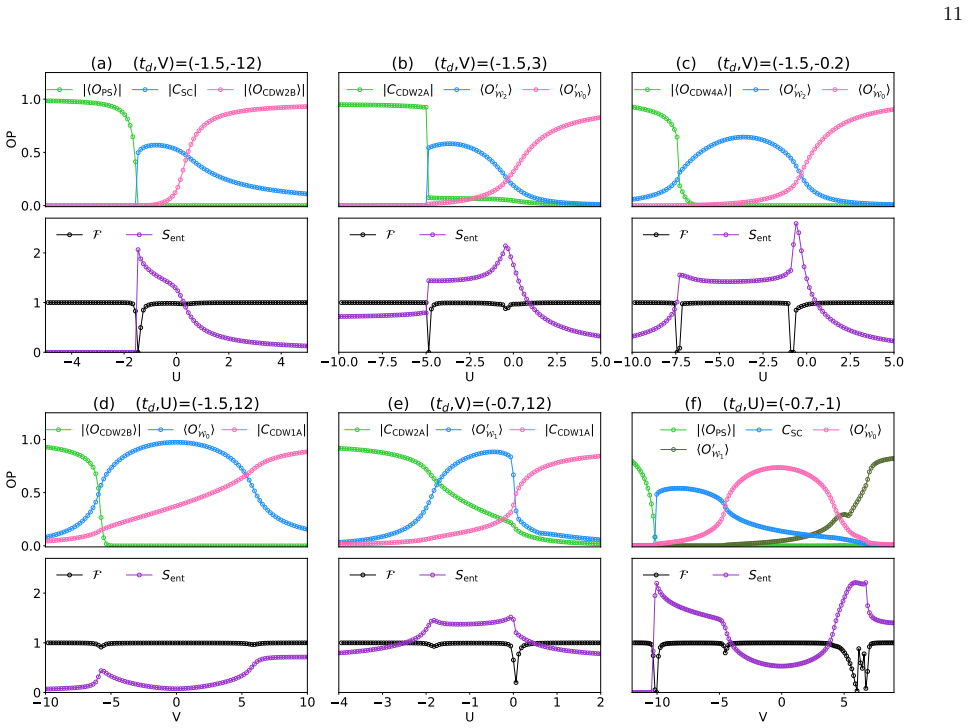
The central claim is that the interacting Su-Schrieffer-Heeger model with extended-range hoppings possesses a rich phase diagram that includes several topological phases, two novel superconducting-like phases, and five distinct charge-density-wave phases. The superconducting-like phases and two of the charge-density-wave phases are direct consequences of imbalanced interactions together with the extended hoppings. Order parameters are derived for each phase and are verified through large-system simulations, where they remain consistent with entanglement entropy and fidelity signatures of the transitions. Under interactions the derived order parameters permit non-unidirectional hoppings insid
What carries the argument
The order parameters derived separately for the topological, superconducting-like, and charge-density-wave phases, which serve as the diagnostic quantities that identify each phase in numerical simulations.
If this is right
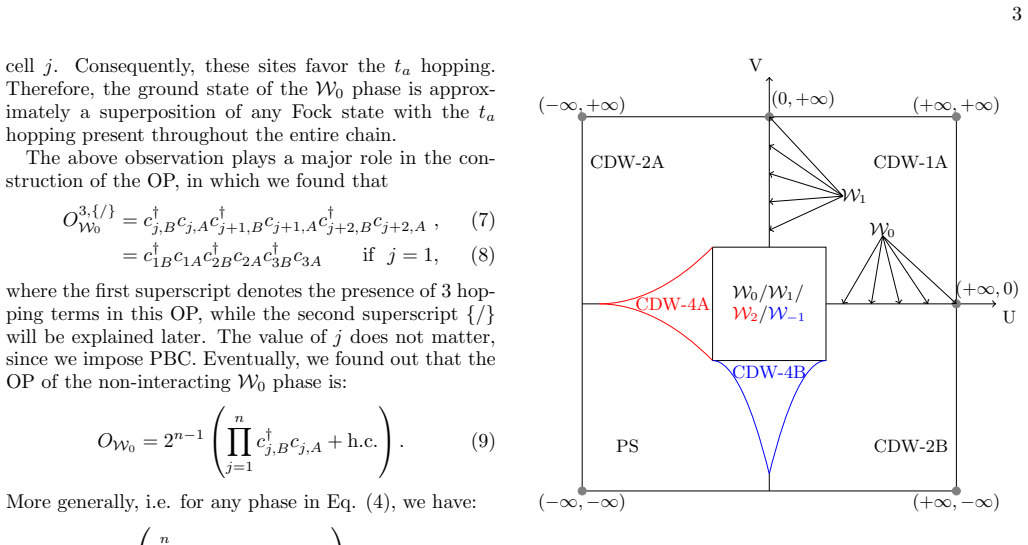
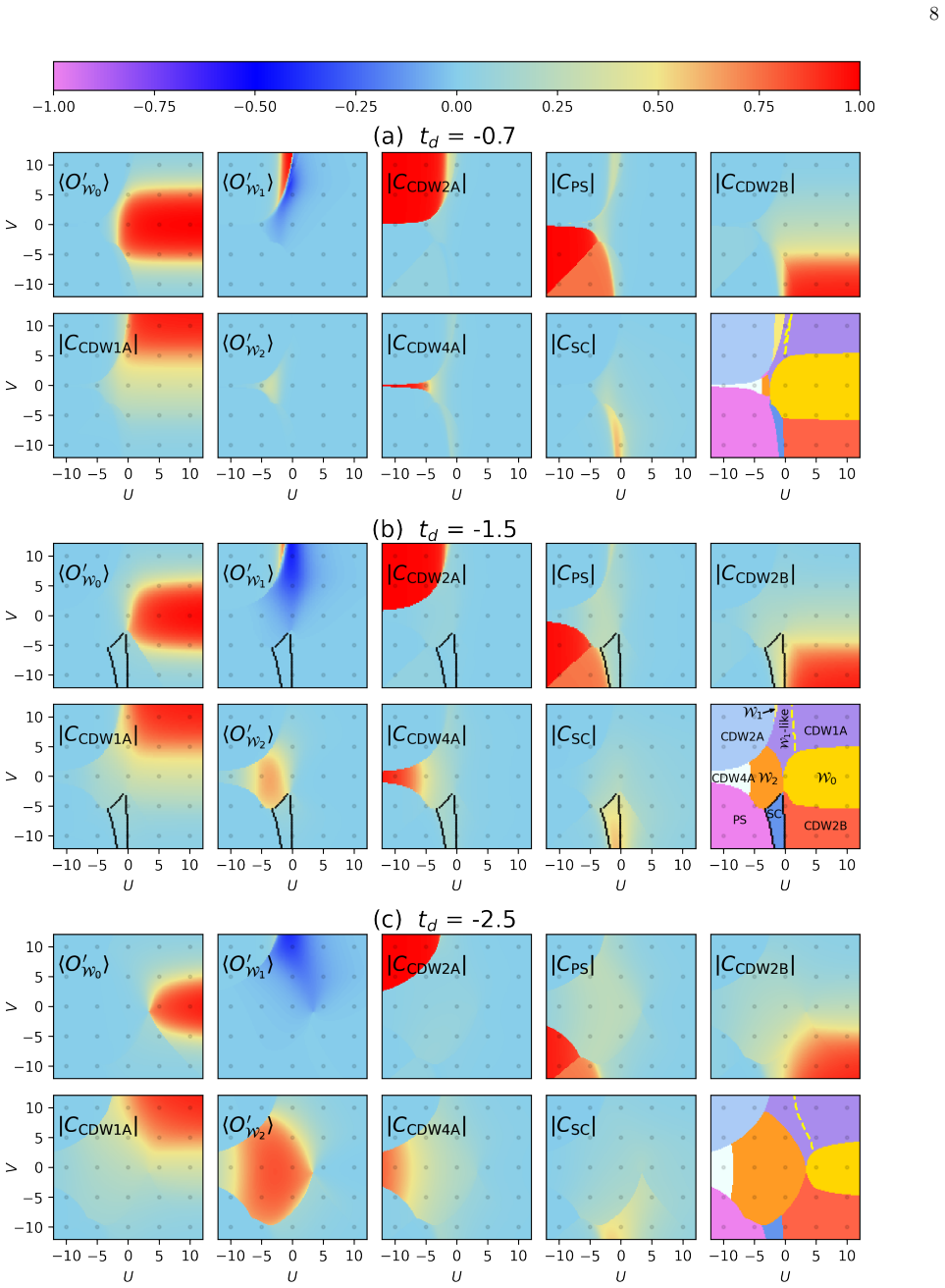
- The phase diagram contains topological phases coexisting with two novel superconducting-like phases and five distinct charge-density-wave phases.
- The superconducting-like phases and two charge-density-wave phases appear only when interactions are imbalanced and hoppings extend beyond nearest neighbors.
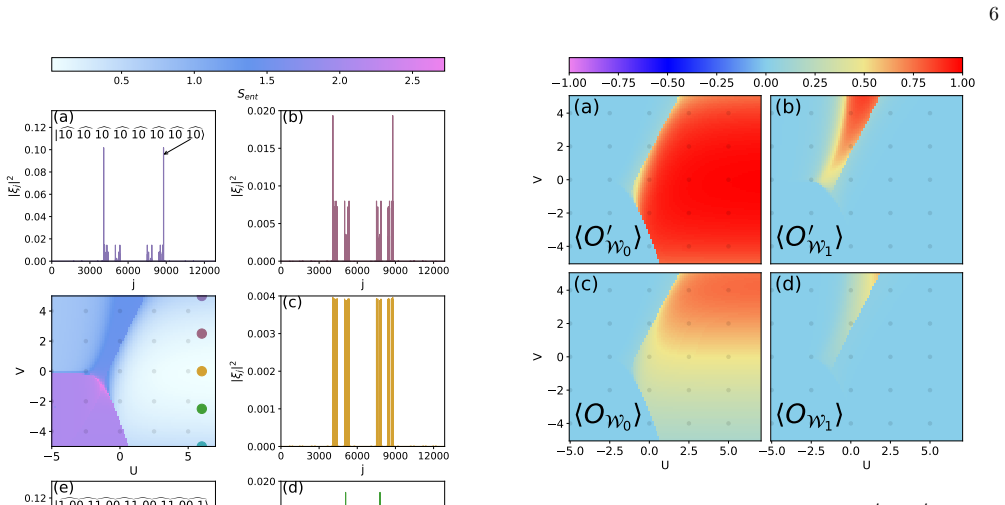
- Order parameters for all phases match the locations of phase transitions detected by entanglement entropy and fidelity.
- Interactions allow non-unidirectional hoppings inside topological phases, unlike the unidirectional restriction seen without interactions.
Where Pith is reading between the lines
- The same order-parameter construction could be applied to variants with different interaction strengths or additional longer-range terms to predict further phases.
- Experimental platforms such as optical lattices or quantum-dot arrays might realize the predicted phases by tuning interaction imbalance and hopping range.
- The distinction between unidirectional and bidirectional hoppings under interactions suggests a route to engineer protected edge states that survive moderate disorder.
Load-bearing premise
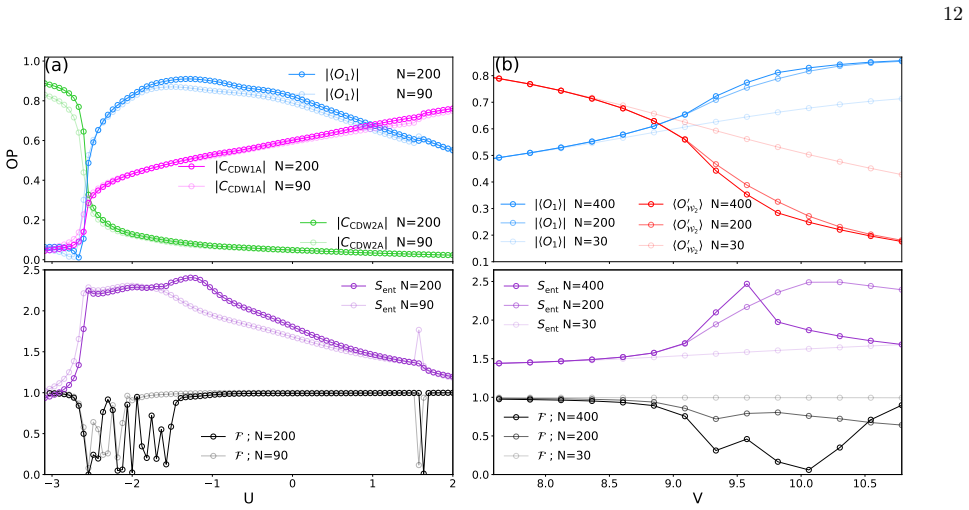
Large-system numerical simulations correctly capture the true ground states without being distorted by finite-size effects or truncation artifacts that could mislabel the phases.
What would settle it
Observation in sufficiently large systems of one of the two novel superconducting-like phases or of the two charge-density-wave phases that appear only when both imbalanced interactions and extended-range hoppings are present would support the claim; their absence would falsify it.
Figures

read the original abstract
Topological insulators have attracted numerous attentions recent years, where the Su-Schrieffer-Heeger (SSH) model is one of the most studied models. While the interacting version of it has been explored recently, the interplay between interactions and long-range hoppings merit further investigations. In this work, we uncover a rich phase diagram of the interacting SSH model with extended-range hoppings, in which it consists of several topological phases, two novel superconducting-like (SC-like) phases and five distinct charge-density-wave (CDW) phases. We substantiate that the SC-like and two CDW phases are direct consequences of imbalanced interactions and extended-range hoppings. We derive the order parameters (OPs) for each of the phases and verify them in large-system simulations, finding consistency with the entanglement entropy and the fidelity in capturing the phase transitions. In contrast to the non-interacting case where the favored hoppings are unidirectional in the topological phases, the derived OPs suggest non-unidirectional hoppings are possible under the influence of interactions.
Editorial analysis
A structured set of objections, weighed in public.
Referee Report
Summary. The paper examines the interacting Su-Schrieffer-Heeger (SSH) model augmented by extended-range hoppings. It derives order parameters for multiple topological phases, two novel superconducting-like (SC-like) phases, and five distinct charge-density-wave (CDW) phases. A phase diagram is constructed from large-system numerical simulations whose results are cross-checked for consistency against entanglement entropy and fidelity. The central claim is that the SC-like phases and two of the CDW phases are direct consequences of interaction imbalance together with the extended hoppings; the work also notes that interactions permit non-unidirectional hoppings in topological phases, in contrast to the non-interacting limit.
Significance. If the numerical identification of the phases holds, the result is significant because it maps an extended interacting SSH model onto a rich phase diagram containing previously unreported SC-like and CDW orders whose microscopic origin is traced to imbalance and long-range terms. The explicit construction of order parameters together with their consistency checks against independent observables (entanglement entropy, fidelity) provides a concrete, falsifiable framework that can be tested in future DMRG or tensor-network studies of related models.
major comments (1)
- [Abstract and numerical-results sections] Abstract and the sections describing the numerical results: the manuscript states that order parameters are 'verified in large-system simulations' and 'consistent with entanglement entropy and fidelity' but supplies no values for Hamiltonian parameters (hopping ratios, interaction strengths), system sizes L, bond dimensions, or truncation-error thresholds. Because the attribution of the two SC-like and two CDW phases to imbalanced interactions plus extended hoppings rests entirely on these simulations, the absence of convergence data leaves open the possibility that finite-size drift or truncation artifacts have misclassified the phases.
Simulated Author's Rebuttal
We thank the referee for their careful reading of the manuscript and for highlighting the importance of explicit numerical details. We address the single major comment below.
read point-by-point responses
-
Referee: [Abstract and numerical-results sections] Abstract and the sections describing the numerical results: the manuscript states that order parameters are 'verified in large-system simulations' and 'consistent with entanglement entropy and fidelity' but supplies no values for Hamiltonian parameters (hopping ratios, interaction strengths), system sizes L, bond dimensions, or truncation-error thresholds. Because the attribution of the two SC-like and two CDW phases to imbalanced interactions plus extended hoppings rests entirely on these simulations, the absence of convergence data leaves open the possibility that finite-size drift or truncation artifacts have misclassified the phases.
Authors: We agree that the manuscript as currently written does not supply the requested numerical parameters or convergence diagnostics in the abstract or main numerical-results sections, which is a legitimate concern for reproducibility and for confirming that the reported phases are free of finite-size or truncation artifacts. In the revised manuscript we will add explicit statements of the Hamiltonian parameters (hopping ratios and interaction strengths), the system sizes L used, the bond dimensions retained in the DMRG calculations, and the truncation-error thresholds. We will also include a brief discussion (or supplementary figures) demonstrating that the order parameters for the SC-like and relevant CDW phases remain stable upon increasing L and bond dimension, thereby supporting the attribution of these phases to interaction imbalance and extended hoppings. revision: yes
Circularity Check
No significant circularity in derivation chain
full rationale
The paper states that order parameters are derived for each phase and then verified via large-system simulations, with consistency checked against independent quantities (entanglement entropy and fidelity). No equations or steps are shown that reduce a claimed prediction or result to a fitted input, self-definition, or load-bearing self-citation by construction. The attribution of SC-like and CDW phases to imbalanced interactions plus extended hoppings is presented as a numerical finding rather than an algebraic identity, and the provided text contains no self-citation chains or ansatz smuggling that would force the central claims. The derivation chain is therefore self-contained against external numerical benchmarks.
Axiom & Free-Parameter Ledger
Reference graph
Works this paper leans on
-
[1]
Similar to the configuration in Eq
The ground state of the system in this limit is mainly contributed by the Fock state |c1 0c0 1c1 0c0 1c1 0c0 1c1 0c0 1⟩(17) and its global translation by one unit cell. Similar to the configuration in Eq. (12), these Fock states has a period of two unit cells, except that the wave “1100” now starts at site B while the one in Eq. (12) starts at site A. The...
-
[2]
1, labeled as the CDW-1A phase (or CDW-1B, which are equivalent under our notation)
and it takes the form OCDW2B(j) = 1 2 nj,B +n j+1,A −n j+1,B −n j+2,A .(18) 4.(U, V)→(∞,∞)for any finite(η, t c, td) This phase reside at the top-right corner in Fig. 1, labeled as the CDW-1A phase (or CDW-1B, which are equivalent under our notation). The dominant Fock state in the ground state of this phase is |c10c10c10c10c10c10c10c10⟩(19) and its parti...
-
[3]
CDW-4A” and ‘CDW-4B
In this non-interacting limit, the phase that would exist depends entirely on the values ofη,t c, andt d. For example, if (t c, td) = (0,0), the model reduces to the nearest-neighbor hopping interacting SSH model, the phase will beW 0 andW 1 forη >0 andη <0, respec- tively. An example of the phase diagram forη= 0.6 and η=−0.6 can be found in Ref. [71]. Ho...
-
[4]
01”, whereas the other sites are “10
Refinement of theW m phases’ OPs in the interacting regime To illustrate the main idea, we here focus on the OPs in Eqs. (9) and (25) whenN= 8. Figure 2 displays the Fock states’ probability distribution{|ξ i|2}of the ground states with differentValong theU= 6 path, where the x-axis is the integer corresponding to the binary repre- sentation of the Fock s...
-
[5]
nor- mally
Key features of the OPs in capturing the phase diagram In this subsection, we present the ground-state phase diagrams for small systems. Under PBC, the ground states of the CDW-1A/2A/2B/4A and the PS phases are symmetry-unbroken in finite systems. Therefore, instead of using the OP expectation values themselves, we con- sider their correlation functions: ...
-
[6]
The superconducting-like phase To find the OP of this phase, we consider (η, tc, td, U, V) = (0.6,0,−1.5,−1,−12) as an example. The dominant Fock states of the ground state which has |ξi|2 >0.005 are: |c1 0c0 1c1 0c0 1c1 0c0 1c1 0c0 1⟩ |ξ i|= 0.17720,(48) |c1 0c0 0c0 1c1 1c1 0c0 1c1 0c0 1⟩ |ξ i|= 0.13299,(49) |c1 0c0 0c0 1c1 0c0 1c1 1c1 0c0 1⟩ |ξ i|= 0.12...
-
[7]
A” and “B
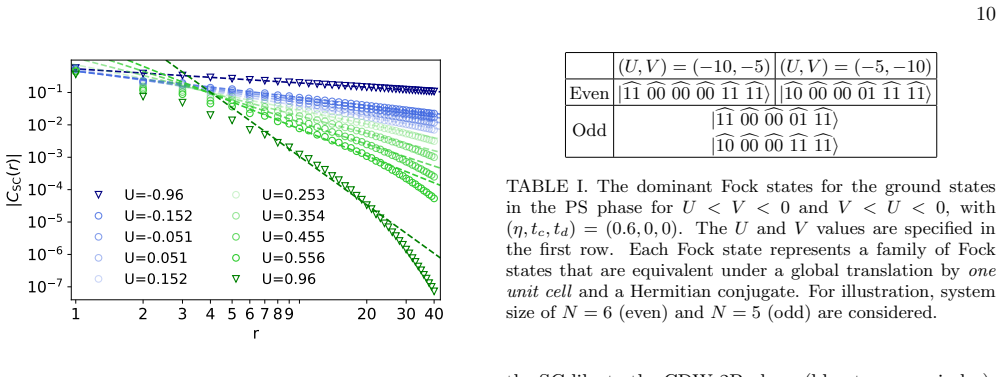
The finite-size effect in the PS phase As noted in Sec. III B 2, the PS phase exhibits a clear change in|C PS|within its own phase in Fig. 4, which we attribute to finite-size effect. The ground state’s domi- nant Fock states in each region are summarized in Ta- ble I. For systems containing even number of unit cells, the dominant Fock states at (U, V) = ...
2025
-
[8]
X. G. Wen, Topological orders in rigid states, Int. J. Mod. Phys. B4, 239 (1990)
1990
-
[9]
Lectures on the Quantum Hall Effect
D. Tong, Lectures on the quantum Hall effect, arXiv:1606.06687
work page internal anchor Pith review Pith/arXiv arXiv
-
[10]
Wen, Colloquium: Zoo of quantum-topological phases of matter, Rev
X.-G. Wen, Colloquium: Zoo of quantum-topological phases of matter, Rev. Mod. Phys.89, 041004 (2017)
2017
-
[11]
M. Z. Hasan and C. L. Kane, Colloquium: Topological insulators, Rev. Mod. Phys.82, 3045 (2010)
2010
-
[12]
Qi and S.-C
X.-L. Qi and S.-C. Zhang, Topological insulators and su- perconductors, Rev. Mod. Phys.83, 1057 (2011)
2011
-
[13]
W. P. Su, J. R. Schrieffer, and A. J. Heeger, Solitons in polyacetylene, Phys. Rev. Lett.42, 1698 (1979)
1979
-
[14]
Ja lochowski, M
M. Ja lochowski, M. Krawiec, and T. Kwapi´ nski, Imple- mentation of the Su–Schrieffer–Heeger model in the self- assembly Si–In atomic chains on the Si(553)–Au surface, ACS Nano18, 12861 (2024)
2024
-
[15]
H. Cai, J. Liu, J. Wu, Y. He, S.-Y. Zhu, J.-X. Zhang, and D.-W. Wang, Experimental observation of momentum- space chiral edge currents in room-temperature atoms, Phys. Rev. Lett.122, 023601 (2019)
2019
-
[16]
R. Mao, X. Xu, J. Wang, C. Xu, G. Qian, H. Cai, S.-Y. Zhu, and D.-W. Wang, Measuring Zak phase in room- temperature atoms, Light Sci. Appl.11, 291 (2022)
2022
-
[17]
C. Y. Wong, T. H. Hui, P. D. Sacramento, and W. C. Yu, Entanglement in quenched extended Su-Schrieffer- Heeger model with anomalous dynamical quantum phase transitions, Phys. Rev. B110, 054312 (2024)
2024
-
[18]
Vajna and B
S. Vajna and B. D´ ora, Topological classification of dy- namical phase transitions, Phys. Rev. B91, 155127 (2015)
2015
-
[19]
W. C. Yu, P. D. Sacramento, Y. C. Li, and H.-Q. Lin, Correlations and dynamical quantum phase transitions in an interacting topological insulator, Phys. Rev. B104, 085104 (2021)
2021
-
[20]
Sedlmayr, P
N. Sedlmayr, P. Jaeger, M. Maiti, and J. Sirker, Bulk- boundary correspondence for dynamical phase transi- tions in one-dimensional topological insulators and su- perconductors, Phys. Rev. B97, 064304 (2018)
2018
-
[21]
Zhang, Y.-P
W.-J. Zhang, Y.-P. Wu, L.-Z. Tang, and G.-Q. Zhang, Topological and dynamical phase transitions in the Su–Schrieffer–Heeger model with quasiperiodic and long- range hoppings, Commun. Theor. Phys.74, 075702 (2022)
2022
-
[22]
Hou, Q.-C
X.-Y. Hou, Q.-C. Gao, H. Guo, and C.-C. Chien, Meta- morphic dynamical quantum phase transition in double- quench processes at finite temperatures, Phys. Rev. B 106, 014301 (2022)
2022
-
[23]
X. Li, Y. Ma, D. Wang, Y. Wang, and S. Zhao, Re- constructing the dynamical quantum phase transitions via dimensional expansion in a generalized Su-Schrieffer- Heeger model, Phys. Rev. E106, 014124 (2022)
2022
-
[24]
Rossi and F
L. Rossi and F. Dolcini, Nonlinear current and dy- namical quantum phase transitions in the flux-quenched Su-Schrieffer-Heeger model, Phys. Rev. B106, 045410 (2022)
2022
-
[25]
Zhou, Y.-W
A.-L. Zhou, Y.-W. Xiao, N. Xu, L.-L. Gao, L.-J. Li, H. Zhou, Z.-M. Li, and C.-C. Shu, Topological enhance- ment of aPT-symmetric Su-Schrieffer-Heeger quantum battery, Phys. Rev. A113, 042213 (2026)
2026
-
[26]
Zhao, F.-Q
F. Zhao, F.-Q. Dou, and Q. Zhao, Charging performance of the Su-Schrieffer-Heeger quantum battery, Phys. Rev. Res.4, 013172 (2022)
2022
-
[27]
Hsu and T.-W
H.-C. Hsu and T.-W. Chen, Topological Anderson in- sulating phases in the long-range Su-Schrieffer-Heeger model, Phys. Rev. B102, 205425 (2020)
2020
-
[28]
Song and E
J. Song and E. Prodan, AIII and BDI topological systems at strong disorder, Phys. Rev. B89, 224203 (2014)
2014
-
[29]
L. Lin, Y. Ke, and C. Lee, Real-space representation of the winding number for a one-dimensional chiral- symmetric topological insulator, Phys. Rev. B103, 224208 (2021)
2021
-
[30]
P´ erez-Gonz´ alez, M
B. P´ erez-Gonz´ alez, M. Bello, A. G´ omez-Le´ on, and G. Platero, Interplay between long-range hopping and disorder in topological systems, Phys. Rev. B99, 035146 (2019)
2019
-
[31]
E. G. Cinnirella, A. Nava, G. Campagnano, and D. Giu- liano, Fate of high winding number topological phases in the disordered extended Su-Schrieffer-Heeger model, Phys. Rev. B109, 035114 (2024)
2024
-
[32]
Medina-Guerra, I
E. Medina-Guerra, I. V. Gornyi, and Y. Gefen, Phase transitions in a non-Hermitian Su-Schrieffer-Heeger model via Krylov spread complexity, Phys. Rev. B112, 035427 (2025)
2025
-
[33]
Hajong, R
G. Hajong, R. Modak, and B. P. Mandal, Emergence of Hermitian topology from non-Hermitian knots, Phys. Rev. B113, 115406 (2026)
2026
-
[34]
Y. L. Gal, X. Turkeshi, and M. Schir` o, Volume-to-area law entanglement transition in a non-Hermitian free fermionic chain, SciPost Phys.14, 138 (2023)
2023
-
[35]
Tzeng, C.-Y
Y.-C. Tzeng, C.-Y. Ju, G.-Y. Chen, and W.-M. Huang, Hunting for the non-Hermitian exceptional points with fidelity susceptibility, Phys. Rev. Res.3, 013015 (2021)
2021
-
[36]
B´ acsi and B
A. B´ acsi and B. D´ ora, Dynamics of entanglement after exceptional quantum quench, Phys. Rev. B103, 085137 16 (2021)
2021
-
[37]
Chang, J.-S
P.-Y. Chang, J.-S. You, X. Wen, and S. Ryu, Entangle- ment spectrum and entropy in topological non-Hermitian systems and nonunitary conformal field theory, Phys. Rev. Res.2, 033069 (2020)
2020
-
[38]
R. D. Soares, Y. L. Gal, C. Y. Leung, D. Meidan, A. Romito, and M. Schir` o, Symmetries, conservation laws and entanglement in non-Hermitian fermionic lattices, SciPost Phys.19, 094 (2025)
2025
-
[39]
Chen Ye, W
C. Chen Ye, W. L. Vleeshouwers, S. Heatley, V. Gritsev, and C. Morais Smith, Quantum metric of non-Hermitian Su-Schrieffer-Heeger systems, Phys. Rev. Res.6, 023202 (2024)
2024
-
[40]
A. Nava, G. Campagnano, P. Sodano, and D. Giuliano, Lindblad master equation approach to the topological phase transition in the disordered Su-Schrieffer-Heeger model, Phys. Rev. B107, 035113 (2023)
2023
-
[41]
Arandes and E
O. Arandes and E. J. Bergholtz, Quantum sensing with driven-dissipative Su-Schrieffer-Heeger lattices, Phys. Rev. Res.7, 013309 (2025)
2025
-
[42]
Bissonnette, N
A. Bissonnette, N. Delnour, A. Mckenna, H. Eleuch, M. Hilke, and R. MacKenzie, Boundary-induced topo- logical transition in an open Su-Schrieffer-Heeger model, Phys. Rev. B109, 075106 (2024)
2024
-
[43]
Dangel, M
F. Dangel, M. Wagner, H. Cartarius, J. Main, and G. Wunner, Topological invariants in dissipative exten- sions of the Su-Schrieffer-Heeger model, Phys. Rev. A98, 013628 (2018)
2018
-
[44]
Maffei, A
M. Maffei, A. Dauphin, F. Cardano, M. Lewenstein, and P. Massignan, Topological characterization of chiral mod- els through their long time dynamics, New J. Phys.20, 013023 (2018)
2018
-
[45]
Mas lowski and N
T. Mas lowski and N. Sedlmayr, Quasiperiodic dynamical quantum phase transitions in multiband topological in- sulators and connections with entanglement entropy and fidelity susceptibility, Phys. Rev. B101, 014301 (2020)
2020
-
[46]
Joshi and T
D. Joshi and T. Nag, Adiabatic charge transport in ex- tended Su-Schrieffer-Heeger models, Phys. Rev. B112, 075411 (2025)
2025
-
[47]
Sadrzadeh, R
M. Sadrzadeh, R. Jafari, and A. Langari, Dynami- cal topological quantum phase transitions at criticality, Phys. Rev. B103, 144305 (2021)
2021
-
[48]
Liu and K
F. Liu and K. Wakabayashi, Novel topological phase with a zero Berry curvature, Phys. Rev. Lett.118, 076803 (2017)
2017
-
[49]
Obana, F
D. Obana, F. Liu, and K. Wakabayashi, Topological edge states in the Su-Schrieffer-Heeger model, Phys. Rev. B 100, 075437 (2019)
2019
-
[50]
Liu, Analytic solution of then-dimensional Su- Schrieffer-Heeger model, Phys
F. Liu, Analytic solution of then-dimensional Su- Schrieffer-Heeger model, Phys. Rev. B108, 245140 (2023)
2023
-
[51]
Xu, Y.-Z
X.-W. Xu, Y.-Z. Li, Z.-F. Liu, and A.-X. Chen, Gen- eral bounded corner states in the two-dimensional Su- Schrieffer-Heeger model with intracellular next-nearest- neighbor hopping, Phys. Rev. A101, 063839 (2020)
2020
-
[52]
Zheng, V
L.-Y. Zheng, V. Achilleos, O. Richoux, G. Theocharis, and V. Pagneux, Observation of edge waves in a two- dimensional Su-Schrieffer-Heeger acoustic network, Phys. Rev. Appl.12, 034014 (2019)
2019
-
[53]
S. Rufo, N. Lopes, M. A. Continentino, and M. A. R. Griffith, Multicritical behavior in topological phase tran- sitions, Phys. Rev. B100, 195432 (2019)
2019
-
[54]
Li and A
C. Li and A. E. Miroshnichenko, Extended SSH model: Non-local couplings and non-monotonous edge states, Physics1, 2 (2019)
2019
-
[55]
L. Li, Z. Xu, and S. Chen, Topological phases of gen- eralized Su-Schrieffer-Heeger models, Phys. Rev. B89, 085111 (2014)
2014
-
[56]
Chang, J
P.-J. Chang, J. Pi, M. Zheng, Y.-T. Lei, X. Pan, D. Ruan, and G.-L. Long, Topological phases of extended Su- Schrieffer-Heeger-Hubbard model, Sci. Rep.15, 18023 (2025)
2025
-
[57]
Ghosh, A
A. Ghosh, A. M. Martin, and S. Majumder, Quench dy- namics of edge states in a finite extended Su-Schrieffer- Heeger system, Phys. Rev. E108, 034102 (2023)
2023
-
[58]
J. E. C. Carmelo, W. C. Yu, and P. D. Sacramento, Anomalous behaviors in dynamical quantum phase tran- sitions of long-range topological chains, J. Phys.: Con- dens. Matter37, 225401 (2025)
2025
-
[59]
T. H. Hui, X. Xia, P. D. Sacramento, and W. C. Yu, Beyond topological invariants: Order parameters from dominant fock-state patterns, arXiv:2605.10320
work page internal anchor Pith review Pith/arXiv arXiv
-
[60]
C. Li, R. Wang, Q. Gong, and Y. Li, Manipulating wind- ing numbers and multiple topological bound states via long-range coupling in chiral photonic lattices, Phys. Rev. Res.6, 043087 (2024)
2024
-
[61]
H. Liu, X. Huang, M. Yan, J. Lu, W. Deng, and Z. Liu, Acoustic topological metamaterials of large wind- ing number, Phys. Rev. Appl.19, 054028 (2023)
2023
-
[62]
D. Wang, Y. Deng, J. Ji, M. Oudich, W. A. Benal- cazar, G. Ma, and Y. Jing, Realization of aZ-classified chiral-symmetric higher-order topological insulator in a coupling-inverted acoustic crystal, Phys. Rev. Lett.131, 157201 (2023)
2023
-
[63]
Leefmans, A
C. Leefmans, A. Dutt, J. Williams, L. Yuan, M. Parto, F. Nori, S. Fan, and A. Marandi, Topological dissipation in a time-multiplexed photonic resonator network, Nat. Phys.18, 442 (2022)
2022
-
[64]
He, Z.-X
G.-C. He, Z.-X. Chen, X.-M. Zhang, Z.-G. Chen, and M.-H. Lu, Direct measurement of Zak phase and higher winding numbers in an electroacoustic cavity system, npj Acoust.2, 5 (2026)
2026
-
[65]
P. B. Melo, S. a. A. S. J´ unior, W. Chen, R. Mondaini, and T. Paiva, Topological marker approach to an interacting Su-Schrieffer-Heeger model, Phys. Rev. B108, 195151 (2023)
2023
-
[66]
Di Salvo, A
E. Di Salvo, A. Moustaj, C. Xu, L. Fritz, A. K. Mitchell, C. M. Smith, and D. Schuricht, Topological phases of the interacting Su-Schrieffer-Heeger model: An analyti- cal study, Phys. Rev. B110, 165145 (2024)
2024
-
[67]
Chen, Weakly interacting topological insulators: Quantum criticality and the renormalization group ap- proach, Phys
W. Chen, Weakly interacting topological insulators: Quantum criticality and the renormalization group ap- proach, Phys. Rev. B97, 115130 (2018)
2018
-
[68]
Sirker, M
J. Sirker, M. Maiti, N. P. Konstantinidis, and N. Sedl- mayr, Boundary fidelity and entanglement in the sym- metry protected topological phase of the SSH model, J. Stat. Mech. (2014) P10032
2014
-
[69]
A. M. Marques and R. G. Dias, Multihole edge states in Su-Schrieffer-Heeger chains with interactions, Phys. Rev. B95, 115443 (2017)
2017
-
[70]
Yahyavi, L
M. Yahyavi, L. Saleem, and B. Het´ enyi, Variational study of the interacting, spinless Su–Schrieffer–Heeger model, J. Phys.: Condens. Matter30, 445602 (2018)
2018
-
[71]
T. Jin, P. Ruggiero, and T. Giamarchi, Bosonization of the interacting Su-Schrieffer-Heeger model, Phys. Rev. B 107, L201111 (2023)
2023
-
[72]
Matveeva, D
P. Matveeva, D. Gutman, and S. T. Carr, Weakly interacting one-dimensional topological insulators: A 17 bosonization approach, Phys. Rev. B109, 165436 (2024)
2024
-
[73]
Wagner, L
N. Wagner, L. Crippa, A. Amaricci, P. Hansmann, M. Klett, E. J. K¨ onig, T. Sch¨ afer, D. D. Sante, J. Cano, A. J. Millis, A. Georges, and G. Sangiovanni, Mott in- sulators with boundary zeros, Nat. Commun.14, 7531 (2023)
2023
-
[74]
Mondal, S
S. Mondal, S. Greschner, L. Santos, and T. Mishra, Topological inheritance in two-component Hubbard mod- els with single-component Su-Schrieffer-Heeger dimeriza- tion, Phys. Rev. A104, 013315 (2021)
2021
-
[75]
Barbiero, L
L. Barbiero, L. Santos, and N. Goldman, Quenched dy- namics and spin-charge separation in an interacting topo- logical lattice, Phys. Rev. B97, 201115 (2018)
2018
-
[76]
S. R. Manmana, A. M. Essin, R. M. Noack, and V. Gurarie, Topological invariants and interacting one- dimensional fermionic systems, Phys. Rev. B86, 205119 (2012)
2012
-
[77]
Lessnich, S
D. Lessnich, S. M. Winter, M. Iraola, M. G. Vergniory, and R. Valent´ ı, Elementary band representations for the single-particle Green’s function of interacting topological insulators, Phys. Rev. B104, 085116 (2021)
2021
-
[78]
W. C. Yu, Y. C. Li, P. D. Sacramento, and H.-Q. Lin, Reduced density matrix and order parameters of a topo- logical insulator, Phys. Rev. B94, 245123 (2016)
2016
-
[79]
Zhou, J.-S
X. Zhou, J.-S. Pan, and S. Jia, Exploring interact- ing topological insulator in the extended Su-Schrieffer- Heeger model, Phys. Rev. B107, 054105 (2023)
2023
-
[80]
M. A. Marashli, H. L. H. Lam, H. Mokayed, F. Sandin, M. Liwicki, H.-K. Tang, and W. C. Yu, Identifying quan- tum phase transitions with minimal prior knowledge by unsupervised learning, SciPost Phys. Core8, 029 (2025)
2025
discussion (0)
Sign in with ORCID, Apple, or X to comment. Anyone can read and Pith papers without signing in.