Shape Formation for the Cooperative Transportation of Arbitrary Objects Using Multi-Agent Reinforcement Learning
Pith reviewed 2026-06-27 16:48 UTC · model grok-4.3
The pith
Multi-agent reinforcement learning lets robot teams autonomously form balanced supports under objects of arbitrary shape and mass.
A machine-rendered reading of the paper's core claim, the machinery that carries it, and where it could break.
Core claim
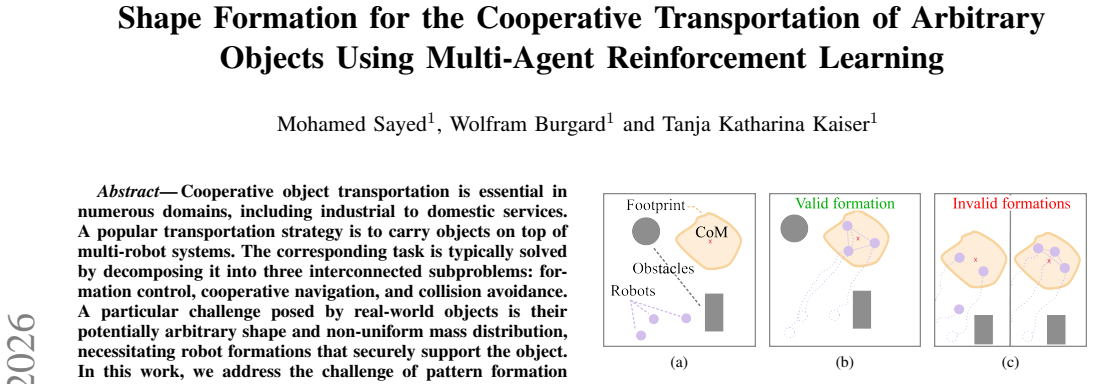
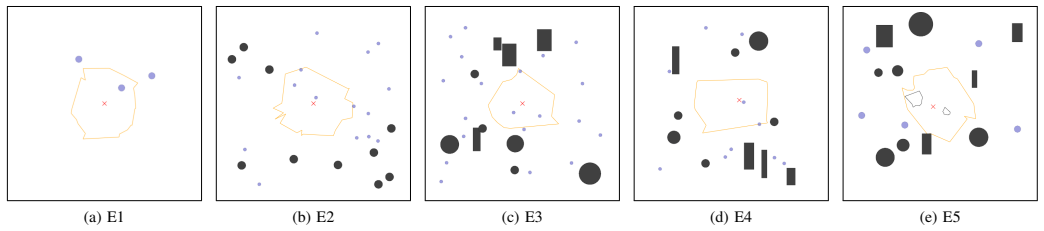
A novel multi-agent reinforcement learning approach enables a multi-robot system to autonomously position itself underneath an object to support its weight while avoiding obstacles during the formation process. Evaluations with diverse environments and varying numbers of robots show that the approach leads to policies that reliably produce balanced formations and generalize to cluttered scenes and objects with complex geometry and non-uniform mass distribution.
What carries the argument
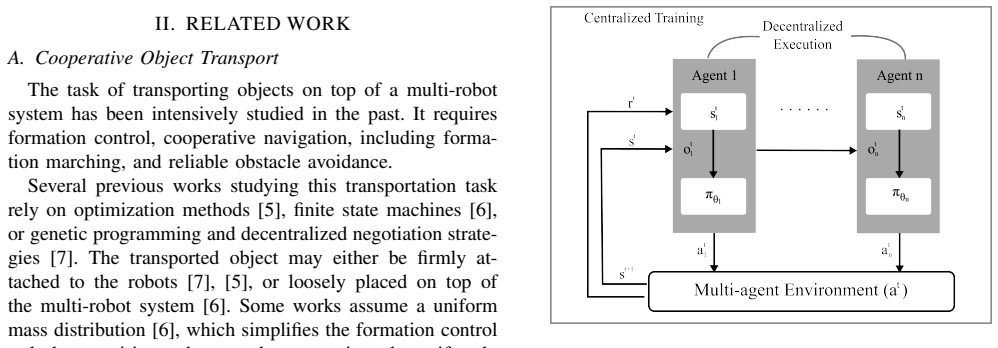
Multi-agent reinforcement learning policy trained end-to-end for simultaneous formation, navigation, and collision avoidance in object transport.
If this is right
- Robot teams can carry objects without requiring a pre-engineered formation for each new shape or mass distribution.
- The same learned policies operate across different numbers of robots and in scenes containing obstacles.
- Generalization holds for objects whose geometry and mass vary from those seen in training.
- Formation control, cooperative navigation, and avoidance are handled by one policy rather than three separate modules.
Where Pith is reading between the lines
- The method could lower the engineering cost of deploying robot teams for moving furniture or packages in homes and warehouses.
- Closing the simulation-to-reality gap in contact modeling would be required before reliable use on physical hardware.
- Similar end-to-end learning might extend to other multi-robot tasks that currently rely on manually designed geometric patterns.
Load-bearing premise
The physics simulator used during training correctly reproduces contact forces, support points, and non-uniform mass effects so that policies transfer to real objects.
What would settle it
Running the trained policies on physical robots carrying a real object of irregular shape and uneven mass distribution through a cluttered area, then checking whether the robots maintain stable contact without the object tilting or falling.
Figures
read the original abstract
Cooperative object transportation is essential in numerous domains, including industrial to domestic services. A popular transportation strategy is to carry objects on top of multi-robot systems. The corresponding task is typically solved by decomposing it into three interconnected subproblems: formation control, cooperative navigation, and collision avoidance. A particular challenge posed by real-world objects is their potentially arbitrary shape and non-uniform mass distribution, necessitating robot formations that securely support the object. In this work, we address the challenge of pattern formation control for transporting such real-world objects by proposing a novel multi-agent reinforcement learning approach. Our approach enables a multi-robot system to autonomously position itself underneath an object to support its weight while avoiding obstacles during the formation process. Our evaluations with diverse environments and varying numbers of robots show that our approach leads to policies that reliably produce balanced formations and generalize to cluttered scenes and objects with complex geometry and non-uniform mass distribution.
Editorial analysis
A structured set of objections, weighed in public.
Referee Report
Summary. The manuscript proposes a multi-agent reinforcement learning approach to solve the shape formation control subproblem in cooperative object transportation. The method trains robot teams to autonomously position themselves under arbitrary objects (with complex geometry and non-uniform mass) to provide balanced support while avoiding obstacles, with claimed generalization across cluttered scenes, varying robot counts, and object properties.
Significance. If the empirical results hold with proper validation, the work would demonstrate a practical MARL solution for a robotics task that is difficult to solve with hand-designed controllers, particularly for non-rigid or irregular objects. The generalization claims, if substantiated, would be a useful data point for sim-trained policies in contact-rich multi-robot scenarios.
major comments (1)
- [Abstract] Abstract: the central claim that 'evaluations with diverse environments and varying numbers of robots show that our approach leads to policies that reliably produce balanced formations and generalize' is unsupported because the manuscript provides no details on reward design, baselines, quantitative metrics, or statistical significance testing. This information is load-bearing for assessing whether the reported generalization actually occurred.
Simulated Author's Rebuttal
We thank the referee for their comments. We provide point-by-point responses below and will revise the manuscript accordingly where appropriate.
read point-by-point responses
-
Referee: [Abstract] Abstract: the central claim that 'evaluations with diverse environments and varying numbers of robots show that our approach leads to policies that reliably produce balanced formations and generalize' is unsupported because the manuscript provides no details on reward design, baselines, quantitative metrics, or statistical significance testing. This information is load-bearing for assessing whether the reported generalization actually occurred.
Authors: The full manuscript does include these details: reward design is detailed in Section 3.2 with the shaped reward function for balance and support; baselines are compared in Section 4.1 including rule-based and single-agent RL approaches; quantitative metrics such as formation success rate, center of mass deviation, and obstacle avoidance rate are reported in Section 4.3 with means and standard deviations over 50 random seeds; statistical significance is assessed via paired t-tests. However, we acknowledge that these may not be sufficiently highlighted to support the abstract claim. We will revise the abstract to include a brief mention of the evaluation metrics and add a table summarizing the generalization results. This constitutes a partial revision as the core content exists but will be made more accessible. revision: partial
Circularity Check
No circularity; empirical MARL training with no derivation chain
full rationale
The paper describes a standard multi-agent reinforcement learning setup for learning formation policies in simulation to support arbitrary objects. No equations, fitted parameters, uniqueness theorems, or self-citations are presented that would reduce any claimed result to its own inputs by construction. The central claims rest on trained policies evaluated in simulation, which is an independent empirical process rather than a self-referential derivation.
Axiom & Free-Parameter Ledger
Reference graph
Works this paper leans on
-
[1]
Cooperative object transport in multi-robot systems: A review of the state-of-the-art,
E. Tuci, M. H. M. Alkilabi, and O. Akanyeti, “Cooperative object transport in multi-robot systems: A review of the state-of-the-art,” Front. Robot. AI, vol. 5, 2018
2018
-
[2]
Coordinating hundreds of cooperative, autonomous vehicles in warehouses,
P. R. Wurman, R. D’Andrea, and M. Mountz, “Coordinating hundreds of cooperative, autonomous vehicles in warehouses,”AI Magazine, vol. 29, no. 1, 2008
2008
-
[3]
Distributed cooperative manipulation of an elastic object by a team of mobile robots,
T. Hardy, A. Q.-C. Nguyen, and M. J. Powell, “Distributed cooperative manipulation of an elastic object by a team of mobile robots,”arXiv preprint arXiv:2111.09046, 2021
-
[4]
Vmas: A vectorized multi-agent simulator for collective robot learning,
M. Bettini, R. Kortvelesy, J. Blumenkamp, and A. Prorok, “Vmas: A vectorized multi-agent simulator for collective robot learning,” inDistributed Autonomous Robotic Systems, ser. Springer Proc. in Advanced Robotics. Springer, Cham, 2024, vol. 28
2024
-
[5]
Coopera- tive multi-robot object transportation system based on hierarchical quadratic programming,
D. Koung, O. Kermorgant, I. Fantoni, and L. Belouaer, “Coopera- tive multi-robot object transportation system based on hierarchical quadratic programming,”IEEE Robotics and Automation Letters, vol. 6, no. 4, 2021
2021
-
[6]
Collective transport of arbitrarily shaped objects using robot swarms,
M. Jurt, E. Milner, M. Sooriyabandara, and S. Hauert, “Collective transport of arbitrarily shaped objects using robot swarms,”Artificial Life and Robotics, vol. 27, 2022
2022
-
[7]
Decentralised negotiation for multi-object collective transport with robot swarms,
G. L. Herranz, S. Hauert, and S. Jones, “Decentralised negotiation for multi-object collective transport with robot swarms,” inIEEE Int. Conf. on Autonomous Robot Systems and Competitions (ICARSC), 2022
2022
-
[8]
Pattern-RL: Multi-robot cooperative pattern formation via deep re- inforcement learning,
J. Wang, J. Cao, M. Stojmenovic, M. Zhao, J. Chen, and S. Jiang, “Pattern-RL: Multi-robot cooperative pattern formation via deep re- inforcement learning,” in2019 18th IEEE Int. Conf. On Machine Learning And Applications (ICMLA), 2019
2019
-
[9]
Programmable self- assembly in a thousand-robot swarm,
M. Rubenstein, A. Cornejo, and R. Nagpal, “Programmable self- assembly in a thousand-robot swarm,”Science, vol. 345, no. 6198, 2014
2014
-
[10]
Self-healing distributed swarm formation control using image moments,
C. L. Liu, I. L. D. Ridgley, M. L. Elwin, M. Rubenstein, R. A. Freeman, and K. M. Lynch, “Self-healing distributed swarm formation control using image moments,”IEEE Robotics and Automation Letters, vol. 9, no. 7, 2024
2024
-
[11]
A self-organized shape formation method for swarm controlling,
Q. Bi and Y . Huang, “A self-organized shape formation method for swarm controlling,” in2018 37th Chinese Control Conf. (CCC), 2018
2018
-
[12]
Shape formation in homogeneous swarms using local task swapping,
H. Wang and M. Rubenstein, “Shape formation in homogeneous swarms using local task swapping,”IEEE Trans. on Robotics, vol. 36, no. 3, 2020
2020
-
[13]
Zerocap: Zero-shot multi-robot context aware pattern formation via large language models,
V . L. N. Venkatesh and B.-C. Min, “Zerocap: Zero-shot multi-robot context aware pattern formation via large language models,” 2024
2024
-
[14]
S. V . Albrecht, F. Christianos, and L. Sch ¨afer,Multi-Agent Reinforce- ment Learning: Foundations and Modern Approaches. MIT Press, 2024
2024
-
[15]
A survey on multi-agent deep reinforcement learning: from the perspective of challenges and applications,
W. Du and S. Ding, “A survey on multi-agent deep reinforcement learning: from the perspective of challenges and applications,”Artifi- cial Intelligence Review, vol. 54, no. 5, pp. 3215–3238, 2021
2021
-
[16]
Scalable multi-agent reinforcement learning for warehouse logistics with robotic and human co-workers,
A. Krnjaic, R. D. Steleac, J. D. Thomas, G. Papoudakis, L. Sch ¨afer, et al., “Scalable multi-agent reinforcement learning for warehouse logistics with robotic and human co-workers,”arXiv preprint, 2023
2023
-
[17]
Smarts: Scalable multi-agent reinforcement learning training school for autonomous driving,
M. Zhou, J. Luo, J. Villella, Y . Yang, and et al., “Smarts: Scalable multi-agent reinforcement learning training school for autonomous driving,” inProc. of the Conf. on Robot Learning (CoRL), Cambridge, MA, USA, 2020
2020
-
[18]
End-to-end decentralized multi-robot navigation in unknown complex environments via deep reinforcement learning,
J. Lin, X. Yang, P. Zheng, and H. Cheng, “End-to-end decentralized multi-robot navigation in unknown complex environments via deep reinforcement learning,” inIEEE Int. Conf. on Mechatronics and Automation (ICMA), 2019, pp. 2493–2500
2019
-
[19]
Swarm reinforcement learning methods improving certainty of learning for a multi-robot formation problem,
H. Iima and Y . Kuroe, “Swarm reinforcement learning methods improving certainty of learning for a multi-robot formation problem,” in2015 IEEE Congress on Evolutionary Computation (CEC), 2015
2015
-
[20]
ASALT: Transfer Learning in MARL Kaiqing Zhang, Zhuoran Yang, Han Liu, Tong Zhang, and Tamer Basar
C. Yu, A. Velu, E. Vinitsky, J. Gao, Y . Wang, A. Bayen, and Y . Wu, “The surprising effectiveness of ppo in cooperative, multi- agent games,” inAdvances in Neural Information Processing Systems (NeurIPS) Datasets and Benchmarks Track, 2022, arXiv:2103.01955
-
[21]
Proximal Policy Optimization Algorithms
J. Schulman, F. Wolski, P. Dhariwal, A. Radford, and O. Klimov, “Proximal policy optimization algorithms,” 2017. [Online]. Available: https://arxiv.org/abs/1707.06347
work page internal anchor Pith review Pith/arXiv arXiv 2017
-
[22]
Tune: A Research Platform for Distributed Model Selection and Training
R. Liaw, E. Liang, R. Nishihara, P. Moritz, J. E. Gonzalez, and I. Stoica, “Tune: A research platform for distributed model selection and training,”arXiv preprint arXiv:1807.05118, 2018
work page internal anchor Pith review Pith/arXiv arXiv 2018
discussion (0)
Sign in with ORCID, Apple, or X to comment. Anyone can read and Pith papers without signing in.