REVIEW 2 major objections 75 references
If low-density nuclear physics is constrained, the frequency of a neutron star's crust-core interface mode reveals its radius to 5-10 percent independent of inner-core details.
Reviewed by Pith at T0; open to challenge. T0 means a machine referee read the full paper against a public rubric. the ladder, T0–T4 →
T0 review · grok-4.3
2026-06-27 15:35 UTC pith:SAUPEK77
load-bearing objection The paper floats the crust-core interface mode frequency as a radius proxy for merging neutron stars that stays mostly blind to inner-core details once low-density physics is fixed, but the abstract gives no calculations to back the insensitivity. the 2 major comments →
Measuring the radii of merging neutron stars with asteroseismology
The pith
A machine-rendered reading of the paper's core claim, the machinery that carries it, and where it could break.
Core claim
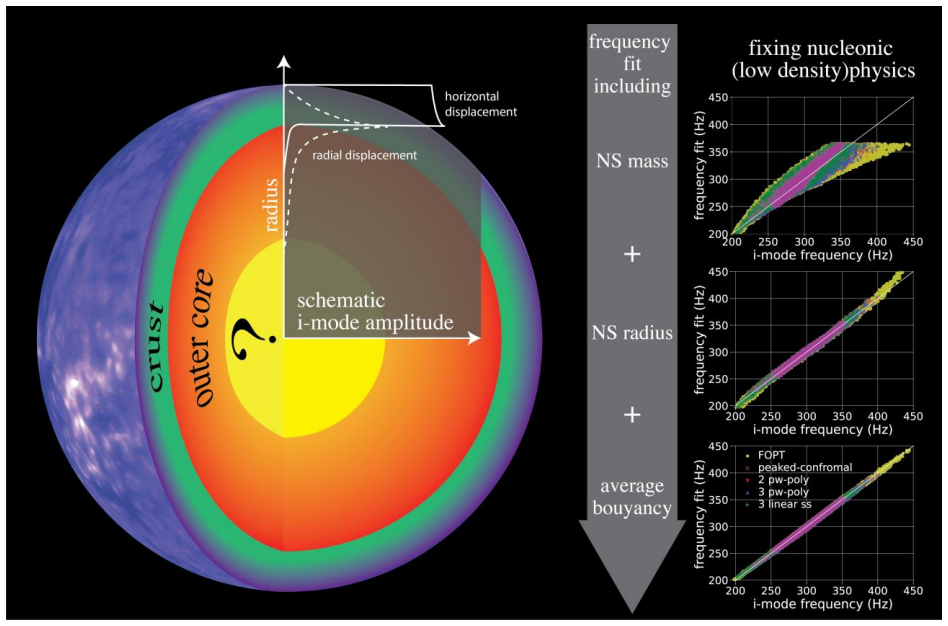
If nucleonic physics is well constrained at low densities, the frequency of the asteroseismic crust-core interface mode in a neutron star can be used to infer its radius to within 5-10%, in a way which is notably insensitive to the details of the inner core. This frequency can be measured through multimessenger coincident timing of resonant shattering flares, or direct observation of dynamical tidal resonance with next-generation gravitational-wave detectors.
What carries the argument
The frequency of the asteroseismic crust-core interface mode, which encodes the stellar radius once low-density nucleonic physics is known.
Load-bearing premise
The frequency of the crust-core interface mode depends primarily on the stellar radius and low-density nucleonic physics with negligible sensitivity to inner-core composition or phase.
What would settle it
A calculation or simulation showing that the mode frequency changes substantially when different inner-core equations of state are used while keeping radius and low-density physics fixed.
If this is right
- Radius inferred from the mode frequency constrains the equation of state at high densities.
- Improved low-density nucleonic constraints from nuclear physics directly enhance the precision of the radius measurement.
- Multimessenger observations of resonant shattering flares provide a way to measure the mode frequency.
- Next-generation gravitational-wave detectors enable direct observation of the dynamical tidal resonance to extract the frequency.
Where Pith is reading between the lines
- Combining this radius with other observables could test whether the inner core contains non-nucleonic matter.
- If the mode frequency is measured in multiple events, it could map how radius correlates with mass across the population.
- The method separates constraints on low-density and high-density physics, allowing nuclear experiment results to inform astrophysical inferences at higher densities.
Editorial analysis
A structured set of objections, weighed in public.
Referee Report
Summary. The manuscript proposes that, assuming nucleonic physics is well constrained at low densities, the frequency of the asteroseismic crust-core interface mode can be used to infer neutron star radii to within 5-10% accuracy in a manner insensitive to inner-core composition or phase. This frequency is argued to be measurable via multimessenger coincident timing of resonant shattering flares or direct observation of dynamical tidal resonance with next-generation gravitational-wave detectors, with improved low-density constraints enhancing the radius inference and thereby probing higher-density physics.
Significance. If the claimed insensitivity of the interface mode frequency to inner-core EOS details holds and can be robustly demonstrated, the work would provide a new asteroseismic route to radius measurements that complements existing methods and leverages ongoing nuclear physics efforts at low densities to constrain high-density matter. This could strengthen multimessenger constraints on the neutron star equation of state from mergers.
major comments (2)
- [Abstract] The central claim that the crust-core interface mode frequency is 'notably insensitive to the details of the inner core' is asserted in the abstract but is not supported by explicit calculations or model variations. No section demonstrates the frequency's dependence (or lack thereof) on high-density EOS parameters while holding the low-density nucleonic EOS fixed, nor are the hydrodynamic or elastic perturbation equations used to compute the mode frequency provided.
- [Abstract] The stated 5-10% radius accuracy is presented without an error budget, sensitivity analysis, or comparison against known stellar models that would show how the frequency-to-radius mapping achieves this precision under the assumed low-density constraints.
Simulated Author's Rebuttal
We thank the referee for their constructive feedback, which highlights areas where the abstract claims require stronger explicit support from the manuscript. We agree that revisions are warranted to address both major comments and will incorporate the requested demonstrations and analyses.
read point-by-point responses
-
Referee: [Abstract] The central claim that the crust-core interface mode frequency is 'notably insensitive to the details of the inner core' is asserted in the abstract but is not supported by explicit calculations or model variations. No section demonstrates the frequency's dependence (or lack thereof) on high-density EOS parameters while holding the low-density nucleonic EOS fixed, nor are the hydrodynamic or elastic perturbation equations used to compute the mode frequency provided.
Authors: We acknowledge that while the manuscript presents numerical results across multiple EOS models illustrating the mode frequency behavior, these do not include a dedicated, explicit demonstration of insensitivity via controlled variations with fixed low-density physics, nor are the underlying perturbation equations provided. We will revise by adding the hydrodynamic and elastic perturbation equations (in a new appendix) and include explicit model comparisons (e.g., additional figures or tables) showing frequency dependence on high-density parameters at fixed low-density EOS and radius to support the abstract claim. revision: yes
-
Referee: [Abstract] The stated 5-10% radius accuracy is presented without an error budget, sensitivity analysis, or comparison against known stellar models that would show how the frequency-to-radius mapping achieves this precision under the assumed low-density constraints.
Authors: The quoted 5-10% precision is based on the observed spread in our frequency-radius relations under low-density parameter variations consistent with existing constraints. However, we agree that a formal error budget, sensitivity analysis, and direct comparisons to known stellar models are not included. We will add a dedicated subsection performing this sensitivity analysis on low-density parameters and comparing the mapping against a set of benchmark stellar models to rigorously substantiate the accuracy. revision: yes
Circularity Check
No circularity; forward proposal with no self-referential equations or fits
full rationale
The provided abstract frames a conditional proposal: if low-density nucleonic physics is constrained, the crust-core interface mode frequency infers radius to 5-10% and is insensitive to inner-core details. No equations, no parameter fitting, no self-citations to load-bearing results, and no derivation chain appear. The claim does not reduce any output to its own inputs by construction and remains a hypothesis dependent on external nuclear constraints and future observations. This is the normal case of a self-contained conceptual paper.
Axiom & Free-Parameter Ledger
axioms (1)
- domain assumption Nucleonic physics is well constrained at low densities (up to ~2-3 times nuclear saturation density)
read the original abstract
The structure and dynamics of neutron stars can be used to probe the physics of extreme matter at nuclear densities and beyond. Nucleonic matter up to ~2-3 times nuclear saturation density is well-studied by nuclear experiments and theoretical modelling. Matter beyond these densities may contain non-nucleonic degrees of freedom that determine the structure of the neutron star inner core and influence bulk observables like stellar radius. Neutron star radius is a key parameter for constraining the core equation of state, but is not a direct gravitational-wave observable during neutron star mergers. Here we show that, if nucleonic physics is well constrained at low densities, the frequency of the asteroseismic crust-core interface mode in a neutron star can be used to infer its radius to within 5-10%, in a way which is notably insensitive to the details of the inner core. This frequency can be measured through multimessenger coincident timing of resonant shattering flares, or direct observation of dynamical tidal resonance with next-generation gravitational-wave detectors. We show that improved constraints on low-density nucleonic physics by nuclear experimental and theoretical efforts will substantially improve such a radius measurement, leveraging low-density efforts for an improved understanding of physics at higher densities.
Figures

Reference graph
Works this paper leans on
-
[1]
Lattimer, J. M. Neutron Stars and the Nuclear Matter Equation of State. Annu. Rev. Nucl. Part. Sci. 71, 433–464 (2021)
2021
-
[2]
Chatziioannou, K. et al. Neutron stars and the dense matter equation of state. Rev. Mod. Phys. 97, 045007 (2025)
2025
-
[3]
Kumar, R. et al. Theoretical and experimental constraints for the equation of state of dense and hot matter. Living Rev Relativity 27, 3 (2024)
2024
-
[4]
in Neutron Stars 1 (eds Haensel, P., Potekhin, A
Neutron Stars with Exotic Cores. in Neutron Stars 1 (eds Haensel, P., Potekhin, A. Y. & Yakovlev, D. G.) vol. 326 351 –405 (Springer New York, New York, NY, 2007)
2007
-
[5]
& Steiner, A
Han, S. & Steiner, A. W. Tidal deformability with sharp phase transitions in binary neutron stars. Phys. Rev. D 99, 083014 (2019)
2019
-
[6]
& Landry, P
Legred, I., Chatziioannou, K., Essick, R., Han, S. & Landry, P. Impact of the PSR J 0740 + 6620 radius constraint on the properties of high-density matter. Phys. Rev. D 104, 063003 (2021)
2021
-
[7]
& Watts, A
Huang, C., Tolos, L., Providência, C. & Watts, A. Constraining a relativistic mean field model using neutron star mass –radius measurements II: hyperonic models. Monthly Notices of the Royal Astronomical Society 536, 3262–3275 (2025)
2025
-
[8]
De, S. et al. Tidal Deformabilities and Radii of Neutron Stars from the Observation of GW170817. Phys. Rev. Lett. 121, 091102 (2018)
2018
-
[9]
S., Hinderer, T., Piro, A
Tsang, D., Read, J. S., Hinderer, T., Piro, A. L. & Bondarescu, R. Resonant Shattering of Neutron Star Crusts. Phys. Rev. Lett. 108, 011102 (2012)
2012
-
[10]
Neill, D., Newton, W. G. & Tsang, D. Resonant shattering flares as multimessenger probes of the nuclear symmetry energy. Monthly Notices of the Royal Astronomical Society 504, 1129–1143 (2021)
2021
-
[11]
Andersson, N. & Ho, W. C. G. Using gravitational-wave data to constrain dynamical tides in neutron star binaries. Phys. Rev. D 97, 023016 (2018)
2018
-
[12]
Waveform uncertainty quantification and interpretation for gravitational -wave astronomy
Read, J. Waveform uncertainty quantification and interpretation for gravitational -wave astronomy. Class. Quantum Grav. 40, 135002 (2023)
2023
-
[13]
Becker, D. et al. The P2 experiment: A future high-precision measurement of the weak mixing angle at low momentum transfer. Eur. Phys. J. A 54, 208 (2018)
2018
-
[14]
Balantekin, A. B. et al. Nuclear theory and science of the facility for rare isotope beams. Mod. Phys. Lett. A 29, 1430010 (2014)
2014
-
[15]
Durante, M. et al. All the fun of the FAIR: fundamental physics at the facility for antiproton and ion research. Phys. Scr. 94, 033001 (2019)
2019
-
[16]
Determining the nuclear equation of state from neutron-star masses and radii
Lindblom, L. Determining the nuclear equation of state from neutron-star masses and radii. ApJ 398, 569 (1992)
1992
-
[17]
Riley, T. E. et al. A NICER View of PSR J0030+0451: Millisecond Pulsar Parameter Estimation. ApJL 887, L21 (2019)
2019
-
[18]
Riley, T. E. et al. A NICER View of the Massive Pulsar PSR J0740+6620 Informed by Radio Timing and XMM -Newton Spectroscopy. ApJL 918, L27 (2021)
2021
-
[19]
Choudhury, D. et al. A NICER View of the Nearest and Brightest Millisecond Pulsar: PSR J0437–4715. ApJL 971, L20 (2024)
2024
-
[20]
Salmi, T. et al. A NICER View of PSR J1231−1411: A Complex Case. ApJ 976, 58 (2024)
2024
-
[21]
Mauviard, L. et al. A NICER View of the 1.4 M⊙ Edge-on Pulsar PSR J0614-3329. ApJ 995, 60 (2025)
2025
-
[22]
Raithel, C. A. & Most, E. R. Degeneracy in the Inference of Phase Transitions in the Neutron Star Equation of State from Gravitational Wave Data. Phys. Rev. Lett. 130, 201403 (2023)
2023
-
[23]
Raithel, C. A. & Most, E. R. Tidal deformability doppelgänger: Implications of a low -density phase transition in the neutron star equation of state. Phys. Rev. D 108, 023010 (2023)
2023
-
[24]
O., Chatziioannou, K
Legred, I., Sy-Garcia, B. O., Chatziioannou, K. & Essick, R. Assessing equation of state-independent relations for neutron stars with nonparametric models. Phys. Rev. D 109, 023020 (2024)
2024
-
[25]
Suleiman, L., Fortin, M., Zdunik, J. L. & Haensel, P. Influence of the crust on the neutron star macrophysical quantities a nd universal relations. Phys. Rev. C 104, 015801 (2021)
2021
-
[26]
Resonant oscillations and tidal heating in coalescing binary neutron stars
Lai, D. Resonant oscillations and tidal heating in coalescing binary neutron stars. Monthly Notices of the Royal Astronomical Society 270, 611–629 (1994)
1994
-
[27]
& Hinderer, T
Pratten, G., Schmidt, P. & Hinderer, T. Gravitational -wave asteroseismology with fundamental modes from compact binary inspirals. Nat Commun 11, 2553 (2020)
2020
-
[28]
R., Kim, Y., Chatziioannou, K
Most, E. R., Kim, Y., Chatziioannou, K. & Legred, I. Nonlinear Alfvén-wave Dynamics and Premerger Emission from Crustal Oscillations in Neutron Star Mergers. ApJL 973, L37 (2024)
2024
-
[29]
R., Gittins, F., Andersson, N
Counsell, A. R., Gittins, F., Andersson, N. & Tews, I. Interface Modes in Inspiralling Neutron Stars: A Gravitational -Wave Probe of First-Order Phase Transitions. Phys. Rev. Lett. 135, 081402 (2025)
2025
-
[30]
Hinderer, T. et al. Effects of Neutron -Star Dynamic Tides on Gravitational Waveforms within the Effective -One-Body Approach. Phys. Rev. Lett. 116, 181101 (2016)
2016
-
[31]
& Taracchini, A
Steinhoff, J., Hinderer, T., Buonanno, A. & Taracchini, A. Dynamical tides in general relativity: Effective action and effective- one-body Hamiltonian. Phys. Rev. D 94, 104028 (2016)
2016
-
[32]
& Hinderer, T
Schmidt, P. & Hinderer, T. Frequency domain model of f -mode dynamic tides in gravitational waveforms from compact binary inspirals. Phys. Rev. D 100, 021501 (2019)
2019
-
[33]
& Pnigouras, P
Passamonti, A., Andersson, N. & Pnigouras, P. Dynamical tides in neutron stars: the impact of the crust. Monthly Notices of the Royal Astronomical Society 504, 1273–1293 (2021)
2021
-
[34]
N., Van Horn, H
McDermott, P. N., Van Horn, H. M. & Hansen, C. J. Nonradial oscillations of neutron stars. ApJ 325, 725 (1988)
1988
-
[35]
& Andersson, N
Gittins, F. & Andersson, N. Neutron-star seismology with realistic, finite-temperature nuclear matter. Phys. Rev. D 111, 083024 (2025)
2025
-
[36]
& Gulminelli, F
Margueron, J., Hoffmann Casali, R. & Gulminelli, F. Equation of state for dense nucleonic matter from metamodeling. I. Foundational aspects. Phys. Rev. C 97, 025805 (2018)
2018
-
[37]
& Reddy, S
Grams, G., Somasundaram, R., Margueron, J. & Reddy, S. Properties of the neutron star crust: Quantifying and correlating uncertainties with improved nuclear physics. Phys. Rev. C 105, 035806 (2022)
2022
-
[38]
& Lee, U
Yoshida, S. & Lee, U. Nonradial oscillations of neutron stars with a solid crust: Analysis in the relativistic Cowling approximation. A&A 395, 201–208 (2002)
2002
-
[39]
& Newton, W
Neill, D., Tsang, D., van Eerten, H., Ryan, G. & Newton, W. G. Resonant shattering flares in black hole-neutron star and binary neutron star mergers. Monthly Notices of the Royal Astronomical Society 514, 5385–5402 (2022)
2022
-
[40]
Abbott, B. P. et al. GW170817: Observation of Gravitational Waves from a Binary Neutron Star Inspiral. Phys. Rev. Lett. 119, 161101 (2017)
2017
-
[41]
The LIGO Scientific Collaboration et al. GWTC-4.0: Updating the Gravitational-Wave Transient Catalog with Observations from the First Part of the Fourth LIGO -Virgo-KAGRA Observing Run. Preprint at https://doi.org/10.48550/ARXIV.2508.18082 (2025)
work page internal anchor Pith review Pith/arXiv arXiv doi:10.48550/arxiv.2508.18082 2025
-
[42]
& Dietrich, T
Puecher, A., Samajdar , A. & Dietrich, T. Measuring tidal effects with the Einstein Telescope: A design study. Phys. Rev. D 108, 023018 (2023)
2023
-
[43]
Drischler, C., Holt, J. W. & Wellenhofer, C. Chiral Effective Field Theory and the High -Density Nuclear Equation of State. Annu. Rev. Nucl. Part. Sci. 71, 403–432 (2021)
2021
-
[44]
& Reinert, P
Epelbaum, E., Krebs, H. & Reinert, P. High -Precision Nuclear Forces From Chiral EFT: State -of-the-Art, Challenges, and Outlook. Front. Phys. 8, 98 (2020)
2020
-
[45]
& Entem, D
Machleidt, R. & Entem, D. R. Chiral effective field theory and nuclear forces. Physics Reports 503, 1–75 (2011)
2011
-
[46]
& Holt, J
Lim, Y. & Holt, J. W. Neutron Star Tidal Deformabilities Constrained by Nuclear Theory and Experiment. Phys. Rev. Lett. 121, 062701 (2018)
2018
-
[47]
A., Furnstahl, R
Drischler, C., Melendez, J. A., Furnstahl, R. J. & Phillips, D. R. Quantifying uncertainties and correlations in the nuclear-matter equation of state. Phys. Rev. C 102, 054315 (2020)
2020
-
[48]
Y., Tsang, M
Tsang, C. Y., Tsang, M. B., Lynch, W. G., Kumar, R. & Horowitz, C. J. Determination of the equation of state from nuclear experiments and neutron star observations. Nat Astron 8, 328–336 (2024)
2024
-
[49]
& McLerran, L
Oliinychenko, D., Sorensen, A., Koch, V. & McLerran, L. Sensitivity of Au + Au collisions to the symmetric nuclear matter equation of state at 2–5 nuclear saturation densities. Phys. Rev. C 108, 034908 (2023)
2023
-
[50]
& Pethick, C
Schwenk, A. & Pethick, C. J. Resonant Fermi Gases with a Large Effective Range. Phys. Rev. Lett. 95, 160401 (2005)
2005
-
[51]
& Sherrill, B
Gade, A. & Sherrill, B. M. (eds) FRIB400: The Scientific Case for the 400 MeV/u Energy Upgrade of FRIB (Facility for Rare Isotope Beams, Michigan State Univ., 2019); available at FRIB PDF archive. Methods (online versions only, limited to ~3000 words): NS model construction We construct spherically symmetric equilibrium NS models following the NS metamode...
2019
-
[52]
48 being 1σ values
We treat each constraint as a n independent normal distribution, with the uncertainties given by ref. 48 being 1σ values. In addition to these, we include a constraint based on the calculations of ref. 50 for a unitary neutron gas, E PNM(0.0085 fm-3)=2.912±0.522 MeV, which helps to avoid extremely soft PNM EOSs that result in low crust-core transition den...
-
[53]
& Gulminelli, F
Margueron, J., Hoffmann Casali, R. & Gulminelli, F. Equation of state for dense nucleonic matter from metamodeling. II. Predictions for neutron star properties. Phys. Rev. C 97, 025806 (2018)
2018
-
[54]
G., Pethick, C
Ravenhall, D. G., Pethick, C. J. & Wilson, J. R. Structure of Matter below Nuclear Saturation Density. Phys. Rev. Lett. 50, 2066–2069 (1983)
2066
-
[55]
P., Ravenhall, D
Lorenz, C. P., Ravenhall, D. G. & Pethick, C. J. Neutron star crusts. Phys. Rev. Lett. 70, 379–382 (1993)
1993
-
[56]
Pethick, C. J. & Ravenhall, D. G. Matter at Large Neutron Excess and the Physics of Neutron -Star Crusts. Annu. Rev. Nucl. Part. Sci. 45, 429–484 (1995)
1995
-
[57]
Pethick, C. J. & Potekhin, A. Y. Liquid crystals in the mantles of neutron stars. Physics Letters B 427, 7–12 (1998)
1998
-
[58]
Constraints on pasta structure of neutron stars from oscillations in giant flares
Sotani, H. Constraints on pasta structure of neutron stars from oscillations in giant flares. Monthly Notices of the Royal Astronomical Society: Letters 417, L70–L73 (2011)
2011
-
[59]
& Haensel, P
Chamel, N. & Haensel, P. Physics of Neutron Star Crusts. Living Rev. Relativ. 11, 10 (2008)
2008
-
[60]
Carreau, T., Gulminelli, F., Chamel, N., Fantina, A. F. & Pearson, J. M. Crystallization of the inner crust of a neutron star and the influence of shell effects. A&A 635, A84 (2020)
2020
-
[61]
Grams, G. et al. Neutron Star Inner Crust at Finite Temperatures: A Comparison Between Compressible Liquid Drop and Extended Thomas–Fermi Approaches. Universe 11, 172 (2025)
2025
-
[62]
Vuille, C. & Ipser, J. On the maximum mass of neutron stars. in Eighth Canadian conference on general relativity and relativistic astrophysics 60–62 (ASCE, Montreal (Quebec), 1999). doi:10.1063/1.1301564
-
[63]
S., Lackey, B
Read, J. S., Lackey, B. D., Owen, B. J. & Friedman, J. L. Constraints on a phenomenologically parametrized neutron -star equation of state. Phys. Rev. D 79, 124032 (2009)
2009
-
[64]
& Margueron, J
Somasundaram, R., Tews, I. & Margueron, J. Investigating signatures of phase transitions in neutron -star cores. Phys. Rev. C 107, 025801 (2023)
2023
-
[65]
& Reddy, S
Tews, I., Carlson, J., Gandolfi, S. & Reddy, S. Constraining the Speed of Sound inside Neutron Stars with Chiral Effective Field Theory Interactions and Observations. ApJ 860, 149 (2018)
2018
-
[66]
Fonseca, E. et al. Refined Mass and Geometric Measurements of the High-mass PSR J0740+6620. ApJL 915, L12 (2021)
2021
-
[67]
& Goldreich, P
Reisenegger, A. & Goldreich, P. A new class of g-modes in neutron stars. ApJ 395, 240 (1992)
1992
-
[68]
Neutron stars: Observing the properties of high-density nuclear matter
Baym, G. Neutron stars: Observing the properties of high-density nuclear matter. Nuclear Physics A 590, 233–248 (1995)
1995
-
[69]
Pandharipande, V. R. & Smith, R. A. A model neutron solid with π0 condensate. Nuclear Physics A 237, 507–532 (1975)
1975
-
[70]
Owen, B. J. Maximum Elastic Deformations of Compact Stars with Exotic Equations of State. Phys. Rev. Lett. 95, 211101 (2005)
2005
-
[71]
J., Melendez, J
Drischler, C., Furnstahl, R. J., Melendez, J. A. & Phillips, D. R. How Well Do We Know the Neutron-Matter Equation of State at the Densities Inside Neutron Stars? A Bayesian Approach with Correlated Uncertainties. Phys. Rev. Lett. 125, 202702 (2020)
2020
-
[72]
A., Furnstahl, R
Melendez, J. A., Furnstahl, R. J., Phillips, D. R., Pratola, M. T. & Wesolowski, S. Quantifying correlated truncation error s in effective field theory. Phys. Rev. C 100, 044001 (2019)
2019
-
[73]
& Schwenk, A
Drischler, C., Hebeler, K. & Schwenk, A. Chiral Interactions up to Next -to-Next-to-Next-to-Leading Order and Nuclear Saturation. Phys. Rev. Lett. 122, 042501 (2019)
2019
-
[74]
& Somà, V
Duguet, T., Ebran, J.-P., Frosini, M., Hergert, H. & Somà, V. Rooting the EDF method into the ab initio framework: PGCM- PT formalism based on MR-IMSRG pre-processed Hamiltonians. Eur. Phys. J. A 59, 13 (2023)
2023
-
[75]
Armstrong, C. L. et al. Constraining Hamiltonians from chiral effective field theory with neutron -star data. Preprint at https://doi.org/10.48550/ARXIV.2601.05999 (2026). Acknowledgements: This work as initially arose from discussions during the 'eXtreme Matter in eXtreme Stars (XMXS)’ worksh op at the Lorentz Center (Leiden, The Netherlands), whom we gr...
work page internal anchor Pith review doi:10.48550/arxiv.2601.05999 2026
discussion (0)
Sign in with ORCID, Apple, or X to comment. Anyone can read and Pith papers without signing in.