Universal Suppression of Gravitational Waves from Black Hole Evaporation Dynamics
Pith reviewed 2026-06-27 15:37 UTC · model grok-4.3
The pith
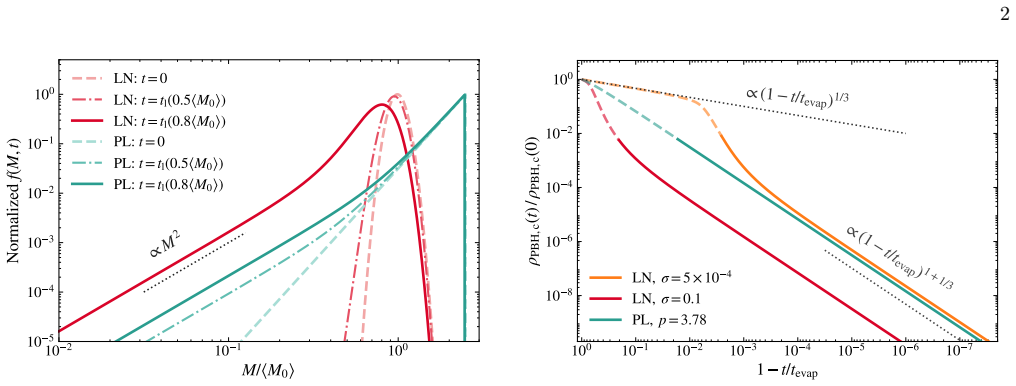
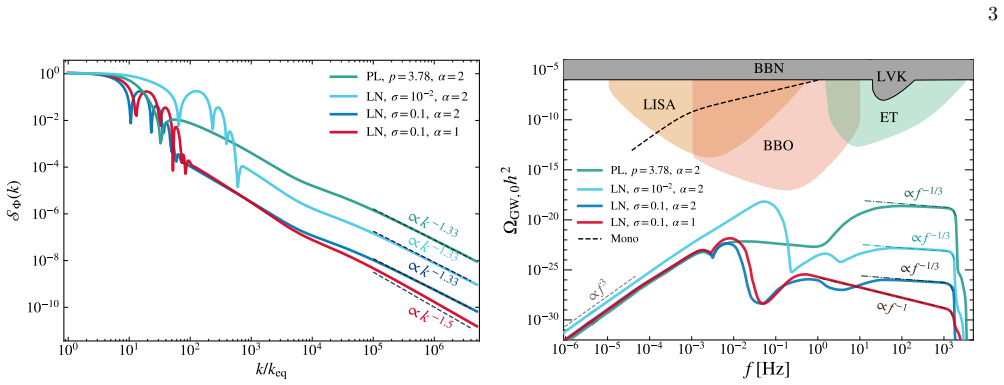
Black hole populations with finite-width mass distributions show universal late-time evaporation that suppresses induced gravitational waves via a characteristic power law, independent of initial details.
A machine-rendered reading of the paper's core claim, the machinery that carries it, and where it could break.
Core claim
Black hole populations with finite width mass distributions exhibit a universal late time evolution governed by the evaporation dynamics rather than the details of the initial mass distribution, leading to a characteristic power law suppression of the induced GWs. This establishes a direct connection between the asymptotic GW spectrum and the underlying law of black hole evaporation, shown for a broad class of mass functions in primordial black hole scenarios that include an early Universe matter-dominated era, with the critical-collapse case appearing as a special instance of the same phenomenon.
What carries the argument
The universal late-time evolution of finite-width black hole mass distributions under evaporation dynamics, which dictates the asymptotic form of the induced gravitational-wave spectrum.
If this is right
- The suppression previously found for critical-collapse distributions is a special case of the general phenomenon.
- The asymptotic gravitational-wave spectrum encodes the black-hole evaporation law itself.
- The late-time behavior holds across a broad class of initial mass functions provided the finite-width and early matter-era conditions are met.
- Induced gravitational waves become insensitive to the precise initial mass distribution once evaporation dominates the late evolution.
Where Pith is reading between the lines
- Future gravitational-wave observations could extract the evaporation law without needing detailed knowledge of the initial mass function.
- Similar universal late-time signatures might appear in other cosmological observables sourced by the same black-hole populations.
- The result suggests testing whether the same suppression pattern persists when the early matter era is replaced by other expansion histories.
Load-bearing premise
Black hole populations must possess finite-width mass distributions and occur in primordial black hole scenarios that include an early matter-dominated era.
What would settle it
Detection of a primordial-black-hole-induced gravitational-wave spectrum whose late-time tail deviates from the predicted power-law suppression would falsify the universal-evolution claim.
Figures
read the original abstract
Evaporating black holes can leave distinct imprints on gravitational wave (GW) backgrounds. We show that black hole populations with finite width mass distributions exhibit a universal late time evolution governed by the evaporation dynamics rather than the details of the initial mass distribution, leading to a characteristic power law suppression of the induced GWs. We demonstrate this for a broad class of mass functions in primordial black hole (PBH) scenarios featuring an early Universe matter-dominated era, and identify the suppression of PBH-induced GWs found for critical collapse distributions as a manifestation of this general phenomenon. Our results establish a direct connection between the asymptotic GW spectrum and the underlying law of black hole evaporation.
Editorial analysis
A structured set of objections, weighed in public.
Referee Report
Summary. The manuscript claims that black hole populations with finite-width mass distributions in primordial black hole scenarios featuring an early matter-dominated era exhibit a universal late-time evolution governed by the evaporation dynamics rather than the details of the initial mass distribution. This leads to a characteristic power-law suppression of the induced gravitational waves. The result is demonstrated for a broad class of mass functions, with the suppression previously found for critical collapse distributions identified as a special case; the work establishes a direct connection between the asymptotic GW spectrum and the underlying evaporation law.
Significance. If the central result holds, it supplies a robust, initial-condition-independent link between observable GW backgrounds and the physics of black hole evaporation in PBH scenarios. This unifies disparate earlier findings under a single framework and could allow future GW data to constrain evaporation models without detailed knowledge of the primordial mass function.
minor comments (3)
- [§2.1] §2.1: The definition of 'finite width' for the mass function is introduced qualitatively; a precise quantitative criterion (e.g., a bound on the variance relative to the mean mass) would clarify the domain of validity of the universality claim.
- [Figure 3] Figure 3: The plotted GW spectra for different mass functions would benefit from an inset or additional panel showing the ratio to the universal power-law form to make the convergence visually quantitative.
- The reference list omits several recent works on GWs from evaporating PBHs in matter-dominated eras (e.g., papers from 2022–2023 on induced GWs during early MD); adding these would strengthen the contextual placement.
Simulated Author's Rebuttal
We thank the referee for the positive assessment of our manuscript, including the summary of the central result on universal late-time evolution and the significance evaluation linking GW spectra to evaporation laws. The recommendation for minor revision is noted. However, the major comments section contains no specific points requiring response.
Circularity Check
No significant circularity detected
full rationale
The abstract claims a universal late-time evolution for finite-width mass distributions in PBH scenarios with an early matter-dominated era, with GW suppression governed by evaporation dynamics rather than initial conditions. No equations, derivations, or self-citations are provided in the given text that would allow identification of any reduction by construction (e.g., fitted parameters renamed as predictions or ansatzes smuggled via citation). The result is framed as a demonstration across a broad class of mass functions, indicating an independent derivation from the evaporation law. This is the most common honest finding when no load-bearing circular steps can be quoted.
Axiom & Free-Parameter Ledger
Reference graph
Works this paper leans on
-
[1]
S. W. Hawking, Nature248, 30 (1974)
1974
-
[2]
S. W. Hawking, Commun. Math. Phys.43, 199 (1975), [Erratum: Commun.Math.Phys. 46, 206 (1976)]
1975
-
[3]
Y. B. Zel’dovich and I. D. Novikov, Sov. Astron.10, 602 (1967)
1967
-
[4]
Hawking, Mon
S. Hawking, Mon. Not. Roy. Astron. Soc.152, 75 (1971)
1971
-
[5]
B. J. Carr and S. W. Hawking, Mon. Not. Roy. Astron. Soc.168, 399 (1974)
1974
-
[6]
B. J. Carr, Astrophys. J.201, 1 (1975)
1975
-
[7]
M. Y. Khlopov and A. G. Polnarev, Phys. Lett. B97, 383 (1980)
1980
-
[8]
B. Carr, K. Kohri, Y. Sendouda, and J. Yokoyama, Rept. Prog. Phys.84, 116902 (2021), arXiv:2002.12778 [astro- ph.CO]
Pith/arXiv arXiv 2021
-
[9]
K. N. Ananda, C. Clarkson, and D. Wands, Phys. Rev. D75, 123518 (2007), arXiv:gr-qc/0612013
Pith/arXiv arXiv 2007
-
[10]
D. Baumann, P. J. Steinhardt, K. Takahashi, and K. Ichiki, Phys. Rev. D76, 084019 (2007), arXiv:hep- th/0703290
arXiv 2007
-
[11]
K. Kohri and T. Terada, Phys. Rev. D97, 123532 (2018), arXiv:1804.08577 [gr-qc]
Pith/arXiv arXiv 2018
-
[12]
Domènech, Universe7, 398 (2021), arXiv:2109.01398 [gr-qc]
G. Domènech, Universe7, 398 (2021), arXiv:2109.01398 [gr-qc]
Pith/arXiv arXiv 2021
-
[13]
K. Inomata, K. Kohri, T. Nakama, and T. Terada, Phys. Rev. D100, 043532 (2019), [Erratum: Phys.Rev.D 108, 049901 (2023)], arXiv:1904.12879 [astro-ph.CO]
arXiv 2019
-
[14]
G. Domènech, C. Lin, and M. Sasaki, JCAP 04, 062 (2021), [Erratum: JCAP 11, E01 (2021)], arXiv:2012.08151 [gr-qc]
arXiv 2021
-
[15]
T. Papanikolaou, V. Vennin, and D. Langlois, JCAP03, 053 (2021), arXiv:2010.11573 [astro-ph.CO]
arXiv 2021
-
[16]
T. Papanikolaou, X.-C. He, X.-H. Ma, Y.-F. Cai, E. N. Saridakis, and M. Sasaki, Phys. Lett. B857, 138997 (2024), arXiv:2403.00660 [astro-ph.CO]
arXiv 2024
- [17]
-
[18]
G. Domènech, V. Takhistov, and M. Sasaki, Phys. Lett. B823, 136722 (2021), arXiv:2105.06816 [astro-ph.CO]
arXiv 2021
-
[19]
Papanikolaou, JCAP10, 089 (2022), arXiv:2207.11041 [astro-ph.CO]
T. Papanikolaou, JCAP10, 089 (2022), arXiv:2207.11041 [astro-ph.CO]
arXiv 2022
-
[20]
K. Inomata, M. Kawasaki, K. Mukaida, T. Terada, and T. T. Yanagida, Phys. Rev. D101, 123533 (2020), arXiv:2003.10455 [astro-ph.CO]
arXiv 2020
- [21]
- [22]
-
[23]
Y. Gouttenoire, N. Leister, and P. Schwaller, (2026), arXiv:2605.21474 [hep-ph]
Pith/arXiv arXiv 2026
-
[24]
Y. Gouttenoire, N. Leister, and P. Schwaller, (2026), arXiv:2605.21477 [hep-ph]
Pith/arXiv arXiv 2026
-
[25]
A. Kusenko and M. E. Shaposhnikov, Phys. Lett. B418, 46 (1998), arXiv:hep-ph/9709492
Pith/arXiv arXiv 1998
-
[26]
A. G. Abacet al. (LIGO Scientific, VIRGO, KAGRA), (2025), arXiv:2508.20721 [gr-qc]
arXiv 2025
-
[27]
P.Amaro-Seoane etal.(LISA), (2017),arXiv:1702.00786 [astro-ph.IM]
Pith/arXiv arXiv 2017
-
[28]
Karnesiset al., (2022), arXiv:2209.04358 [gr-qc]
N. Karnesiset al., (2022), arXiv:2209.04358 [gr-qc]
arXiv 2022
-
[29]
G. M. Harry, P. Fritschel, D. A. Shaddock, W. Folkner, and E. S. Phinney, Class. Quant. Grav.23, 4887 (2006), [Erratum: Class.Quant.Grav. 23, 7361 (2006)]
2006
-
[30]
Maggiore et al., JCAP03, 050 (2020), arXiv:1912.02622 [astro-ph.CO]
M. Maggiore et al., JCAP03, 050 (2020), arXiv:1912.02622 [astro-ph.CO]
Pith/arXiv arXiv 2020
-
[31]
B. J. Carr, K. Kohri, Y. Sendouda, and J. Yokoyama, Phys. Rev. D94, 044029 (2016), arXiv:1604.05349 [astro- ph.CO]
Pith/arXiv arXiv 2016
-
[32]
Y.-F. Cai, C. Chen, Q. Ding, and Y. Wang, Eur. Phys. J. C83, 913 (2023), arXiv:2112.10422 [astro-ph.CO]
arXiv 2023
-
[33]
Dolgov and J
A. Dolgov and J. Silk, Phys. Rev. D47, 4244 (1993)
1993
-
[34]
K. Kannike, L. Marzola, M. Raidal, and H. Veermäe, JCAP09, 020 (2017), arXiv:1705.06225 [astro-ph.CO]
Pith/arXiv arXiv 2017
-
[35]
M. W. Choptuik, Phys. Rev. Lett.70, 9 (1993)
1993
-
[36]
C. R. Evans and J. S. Coleman, Phys. Rev. Lett.72, 1782 (1994), arXiv:gr-qc/9402041
Pith/arXiv arXiv 1994
-
[37]
J. C. Niemeyer and K. Jedamzik, Phys. Rev. D59, 124013 (1999), arXiv:astro-ph/9901292
Pith/arXiv arXiv 1999
-
[38]
T. Chiba, K. Kamada, and M. Yamaguchi, Phys. Rev. D81, 083503 (2010), arXiv:0912.3585 [astro-ph.CO]
Pith/arXiv arXiv 2010
-
[39]
K. D. Lozanov and V. Takhistov, Phys. Rev. Lett.130, 181002 (2023), arXiv:2204.07152 [astro-ph.CO]
arXiv 2023
-
[40]
K. D. Lozanov, M. Sasaki, and V. Takhistov, JCAP01, 094 (2025), arXiv:2304.06709 [astro-ph.CO]
arXiv 2025
-
[41]
K. D. Lozanov, M. Sasaki, and V. Takhistov, Phys. Lett. B848, 138392 (2024), arXiv:2309.14193 [astro-ph.CO]
arXiv 2024
-
[42]
K. D. Lozanov, S. Pi, M. Sasaki, V. Takhistov, and A. Wang, Class. Quant. Grav.42, 035007 (2025), arXiv:2310.03594 [astro-ph.CO]
arXiv 2025
-
[43]
G. Domènech and J. Tränkle, (2024), arXiv:2409.12125 [gr-qc]. 6 Supplemental Material for Universal Suppression of Gravitational Waves from Black Hole Evaporation Dynamics Xin-Chen He, Xiao-Han Ma, Misao Sasaki, Volodymyr Takhistov In this Supplemental Material we provide additional details on calculation of the PBH mass function evolution, universal scal...
arXiv 2024
discussion (0)
Sign in with ORCID, Apple, or X to comment. Anyone can read and Pith papers without signing in.