Satellite compaction pathways: environmental drivers shaping dwarf galaxy corpulence in the TNG50 simulation
Pith reviewed 2026-06-27 16:07 UTC · model grok-4.3
The pith
Compact dwarf satellites in TNG50 arise via three distinct pathways tied to dark matter content and environment.
A machine-rendered reading of the paper's core claim, the machinery that carries it, and where it could break.
Core claim
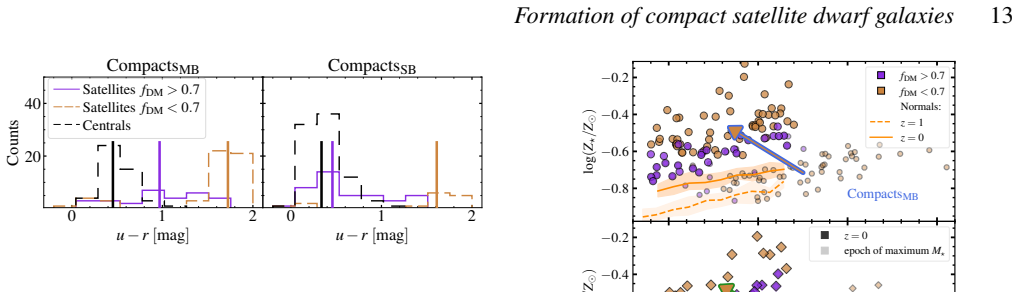
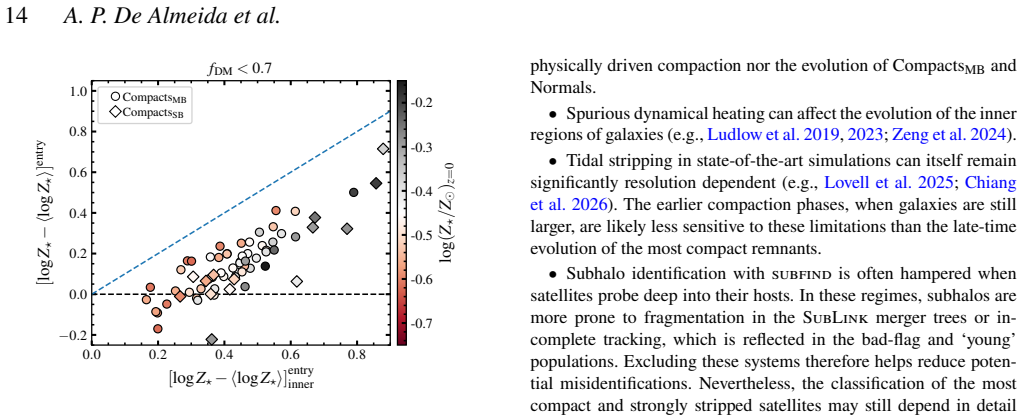
Compact dwarf satellites in TNG50 form through distinct pathways: dark-matter-rich ones via gas inflows in poorer environments with fewer mergers; most dark-matter-poor ones via tidal stripping of outer stars, faster when gas is present; and some very metal-rich dark-matter-poor ones via ram-pressure-driven starbursts near first pericenter followed by stripping.
What carries the argument
The z=0 size-mass relation used to classify compact versus normal dwarfs, combined with tracking of merger history, gas flows, tidal forces, and ram pressure along satellite orbits.
If this is right
- Dark-matter-rich compact satellites should occupy lower-density regions and show fewer merger remnants.
- Dark-matter-poor compact satellites should display faster size reduction when gas is retained during stripping.
- Very metal-rich dark-matter-poor compact satellites should show a starburst signature timed near first pericenter passage.
- The overall population of compact satellites should split into these groups with measurable differences in metallicity and color at fixed stellar mass.
Where Pith is reading between the lines
- If the pathways hold, surveys that measure both size and dark-matter content of dwarf satellites could map which environmental process dominated their compaction.
- The faster compaction with gas present suggests that quenching timing affects final size even for stripped systems.
- The tentative ram-pressure channel may become more common in denser clusters where pericenter passages are stronger.
Load-bearing premise
The simulation's subgrid physics and resolution capture gas dynamics, star formation, and tidal or ram-pressure effects accurately enough that the identified pathways are not dominated by numerical artifacts.
What would settle it
Re-running the same selection in a higher-resolution simulation or a different hydrodynamical code yields a different dominant pathway or erases the separation by dark-matter content.
Figures
read the original abstract
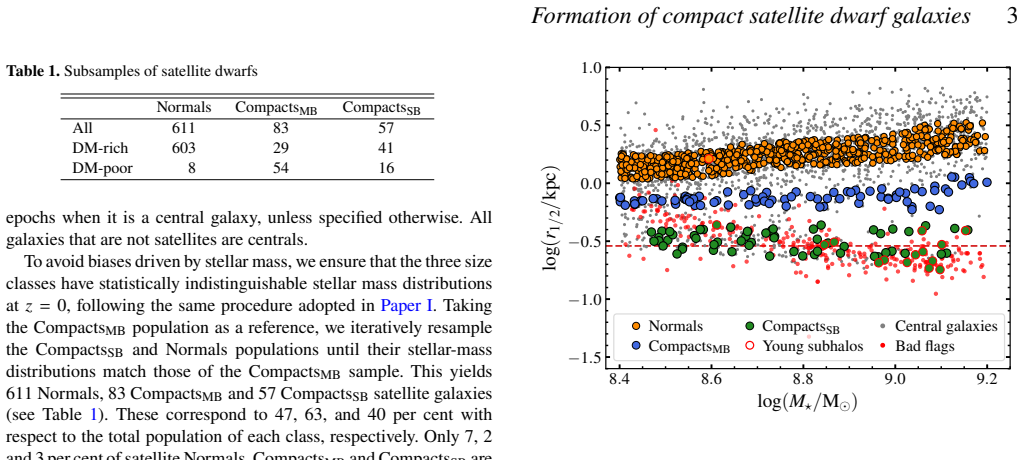
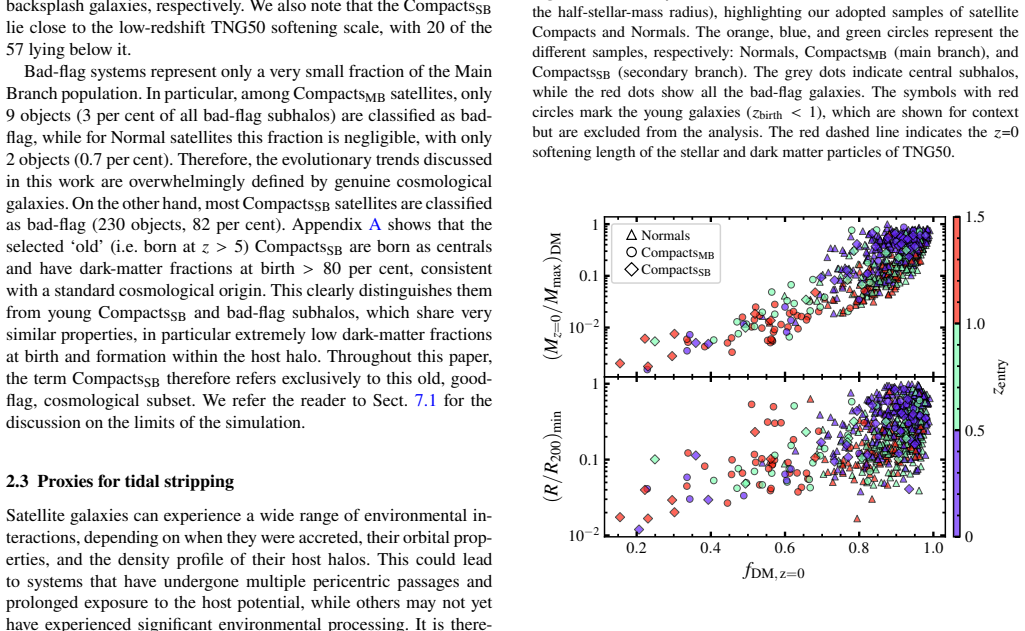
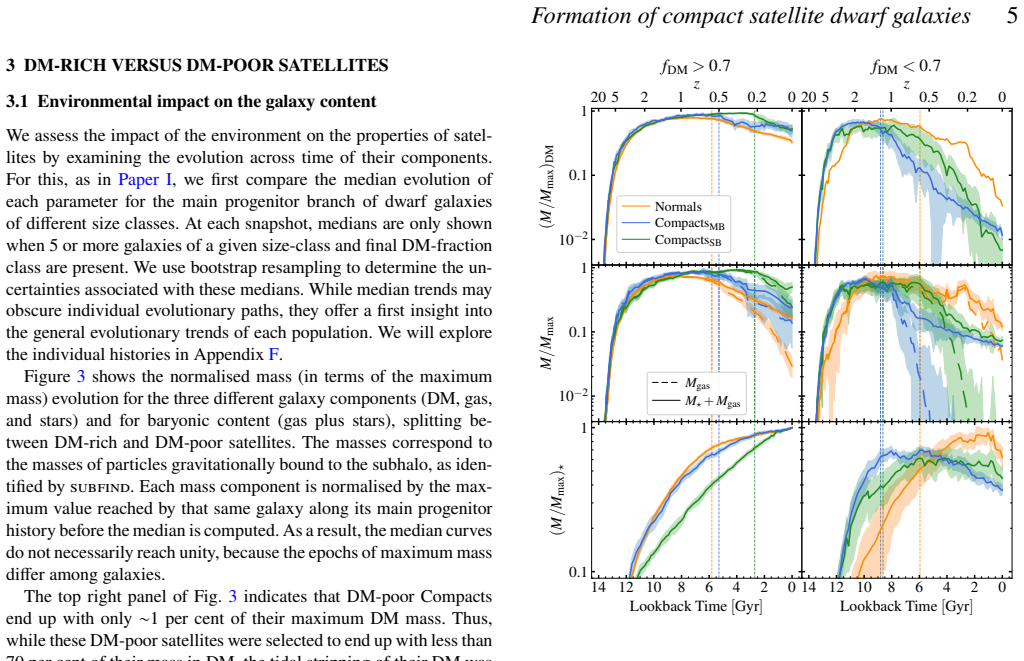
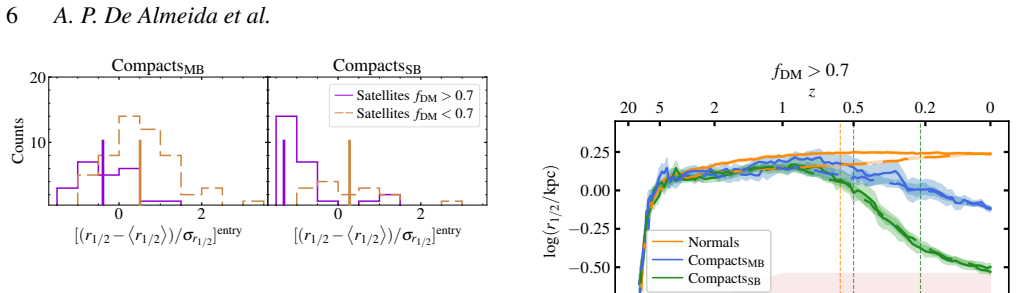
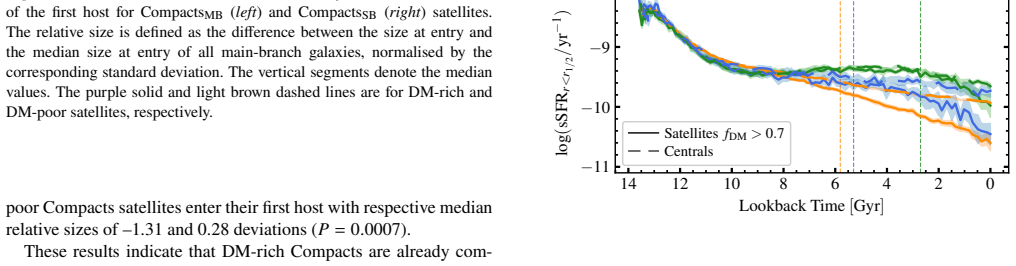
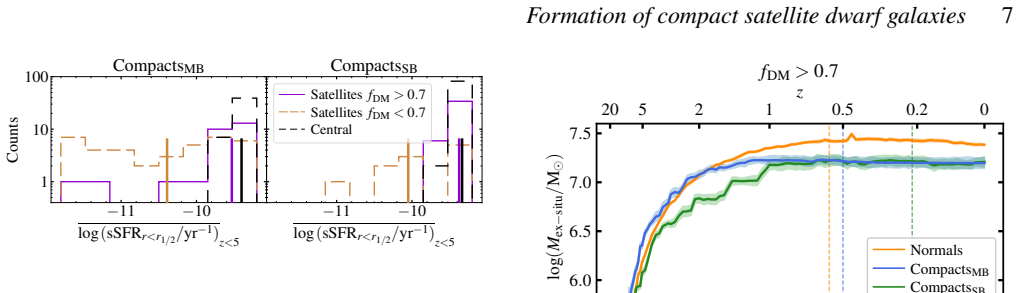
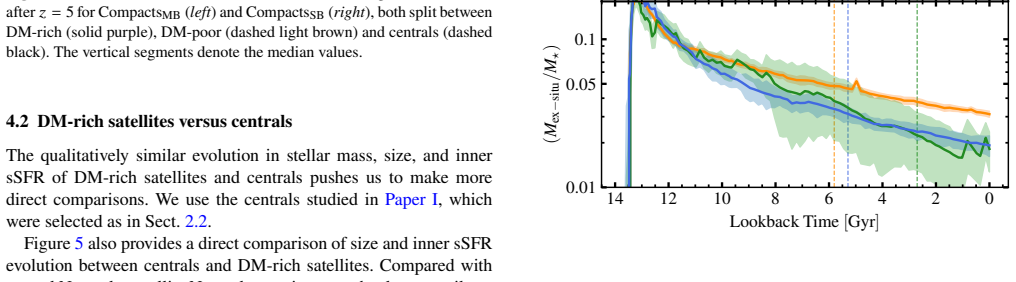
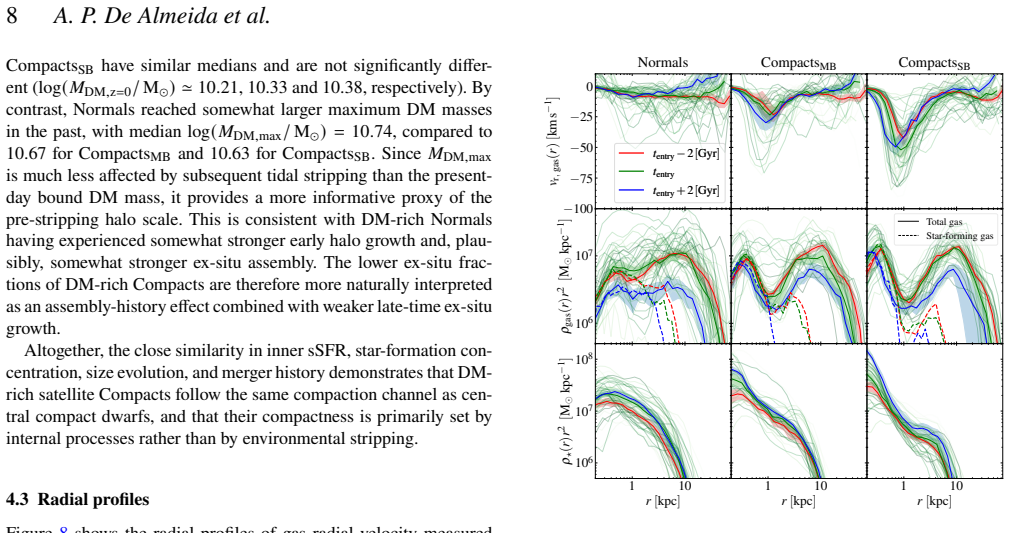
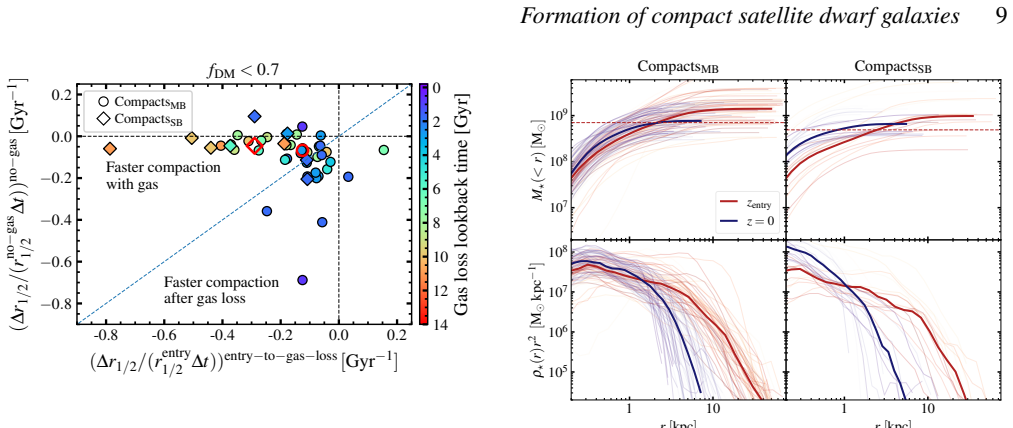
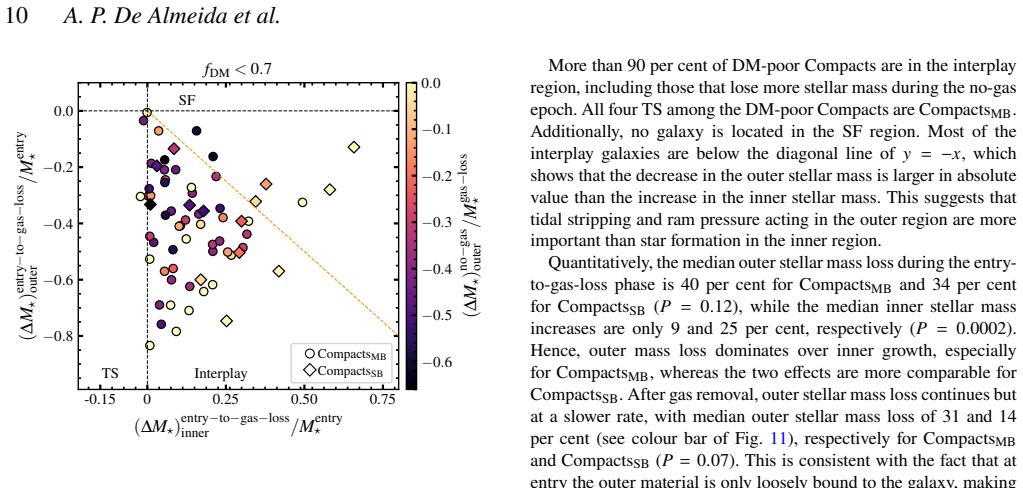
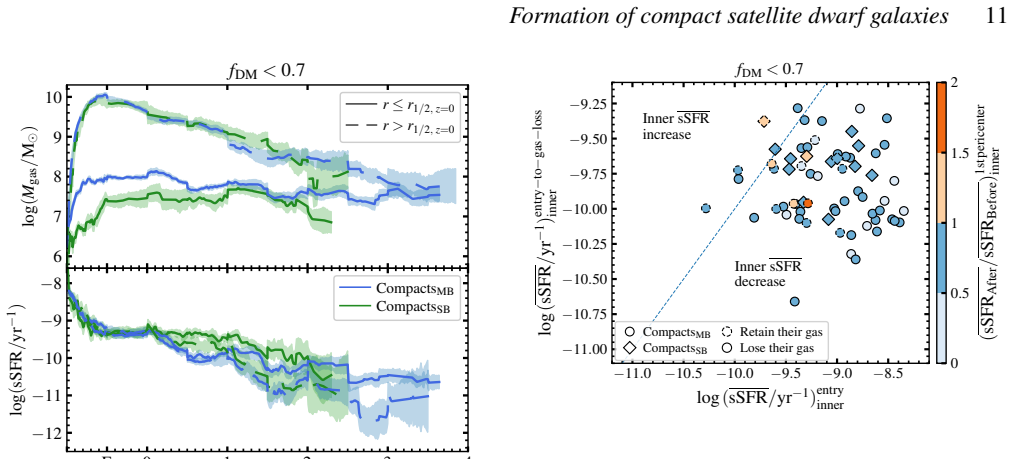
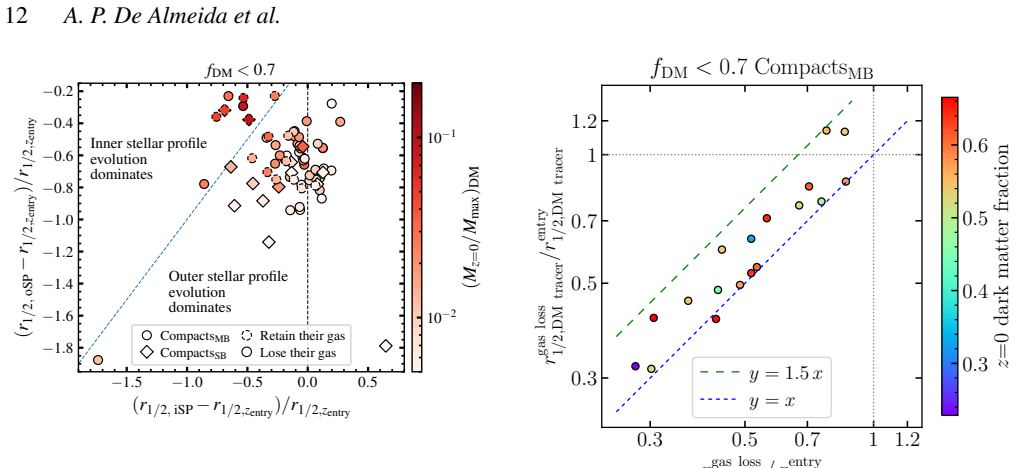
We explore the physical mechanisms driving dwarf galaxy corpulence, focusing on those that end up as compact satellites. We select dwarf galaxies at $z=0$ with $\log(M_\star/{\rm M}_\odot)$ between 8.4 and 9.2 from the TNG50 hydrodynamical simulation after excluding systems flagged as potentially spurious. Compact dwarfs are defined according to the $z=0$ size-mass relation as those on the lower envelope of its main branch or on its lower-size secondary branch, while "Normal" lie on the main branch spine. We identify two robust compaction pathways and a third, more tentative, channel: 1) Compact satellites that remain rich in dark matter (DM) inhabit poorer environments having fewer mergers, favouring the accretion of lower-angular-momentum gas. This allows gas inflows that drive concentrated inner star formation and compaction, as previously found for centrals. 2) Most DM-poor satellites (which typically end up red and metal-rich for their stellar mass) undergo compaction mainly caused by tidal stripping of outer stars. Their compaction is faster when gas is present, by at least 15 per cent after correcting for the stronger tidal field. 3) For most of our few very metal-rich DM-poor Compact satellites, the major compaction phase begins with a starburst driven by ram pressure compression near first pericentre, even if much of the compaction often occurs during subsequent tidal stripping. As a result, compact dwarf satellites in TNG50 arise through distinct pathways. We discuss how numerical effects can affect this conclusion.
Editorial analysis
A structured set of objections, weighed in public.
Referee Report
Summary. The manuscript examines compaction pathways for dwarf satellite galaxies in the TNG50 simulation. It selects systems at z=0 with 8.4 < log(M*/M⊙) < 9.2 (after spurious-object removal), defines compact objects via their position on the z=0 size-mass relation (lower envelope or secondary branch), and reports three channels: (1) DM-rich compacts form via low-angular-momentum gas inflows enabled by fewer mergers in poorer environments; (2) most DM-poor compacts form via tidal stripping of outer stars (accelerated when gas is present); (3) a subset of very metal-rich DM-poor objects experience an initial ram-pressure-driven starburst near first pericentre followed by stripping. The work notes that numerical effects may influence the result.
Significance. If the channel distinctions prove robust, the study would usefully extend earlier central-galaxy results to satellites by linking compactness to independent environmental and merger diagnostics. The explicit mass window, spurious exclusion, and separation by DM content and metallicity provide a concrete classification that could guide future observational tests, though the absence of convergence checks limits immediate impact.
major comments (2)
- [Abstract] Abstract: the statement that 'numerical effects can affect this conclusion' is acknowledged but not followed by resolution-convergence tests or subgrid-parameter variations; without these, it remains unclear whether the reported fractions and timings of the three pathways are stable when the subgrid scale for star formation, feedback, or hydrodynamics is altered at M* ~ 10^8.5–10^9.2 M⊙.
- [Methods / selection criteria] Selection and pathway identification (implicit in abstract and methods): the compactness label is defined from the z=0 size-mass relation while the pathways are diagnosed from DM content, merger history, gas angular momentum, tidal field, and ram pressure; it is not demonstrated that post-hoc choices in branch identification or environment metrics are independent of the compactness threshold, which is load-bearing for the claim of distinct physical channels.
minor comments (2)
- [Results (DM-poor channel)] The abstract and text should clarify whether the 'at least 15 per cent' faster compaction with gas is measured after explicit matching on tidal-field strength or after a statistical correction.
- [Abstract] Minor notation: the mass range is given as log(M⋆/M⊙) between 8.4 and 9.2; consistent use of the same symbol set (M⋆ vs M*) would aid readability.
Simulated Author's Rebuttal
We thank the referee for their constructive comments on our manuscript. We address each major point below, indicating where revisions have been made.
read point-by-point responses
-
Referee: [Abstract] Abstract: the statement that 'numerical effects can affect this conclusion' is acknowledged but not followed by resolution-convergence tests or subgrid-parameter variations; without these, it remains unclear whether the reported fractions and timings of the three pathways are stable when the subgrid scale for star formation, feedback, or hydrodynamics is altered at M* ~ 10^8.5–10^9.2 M⊙.
Authors: We agree that dedicated convergence tests would strengthen the robustness claims. TNG50 is the highest-resolution run available in the suite, and performing equivalent simulations with varied subgrid parameters at this mass scale exceeds the computational resources of the present study. In the revised manuscript we have expanded the discussion of numerical caveats (new subsection in Methods and extended text in Conclusions), adding quantitative estimates of resolution effects on dwarf sizes drawn from prior TNG convergence papers and reiterating the existing caveat in the abstract. revision: partial
-
Referee: [Methods / selection criteria] Selection and pathway identification (implicit in abstract and methods): the compactness label is defined from the z=0 size-mass relation while the pathways are diagnosed from DM content, merger history, gas angular momentum, tidal field, and ram pressure; it is not demonstrated that post-hoc choices in branch identification or environment metrics are independent of the compactness threshold, which is load-bearing for the claim of distinct physical channels.
Authors: We have performed additional post-processing checks (now included in the revised Methods and a new supplementary figure) showing that the three pathways and their key correlations remain distinct when the compactness threshold is shifted by ±0.2 dex. The diagnostics themselves (merger trees, gas angular momentum, tidal field strength, ram-pressure estimates) are extracted independently of the stellar size measurement, and the environmental/merger trends persist across threshold variations, supporting that the channel distinctions are not driven by the precise compactness cut. revision: yes
- Full resolution-convergence tests and subgrid-parameter variations to verify the reported pathway fractions and timings at M* ~ 10^8.5–10^9.2 M⊙.
Circularity Check
No significant circularity; analysis is diagnostic on independent simulation outputs
full rationale
The paper selects dwarfs from TNG50 at z=0 using a size-mass relation to label compact vs normal, then diagnoses pathways from separate simulation quantities (DM fraction, merger counts, gas angular momentum, tidal strength, ram pressure). These inputs are not defined from or fitted to the compactness label, and no equations or self-citations reduce the channel identification to the selection criterion by construction. The work is a post-processing classification of hydrodynamical outputs rather than a closed derivation loop.
Axiom & Free-Parameter Ledger
free parameters (2)
- stellar mass selection window =
8.4-9.2
- compactness threshold on size-mass relation
axioms (2)
- domain assumption TNG50 subgrid physics and resolution faithfully reproduce the relevant baryonic processes (gas inflows, tidal stripping, ram pressure) at dwarf scales
- domain assumption The z=0 size-mass relation provides an objective, simulation-internal definition of compactness that does not presuppose the environmental drivers
Reference graph
Works this paper leans on
-
[1]
What drives the corpulence of galaxies?. I. The formation of central compact dwarf galaxies in TNG50. , keywords =. doi:10.1051/0004-6361/202449939 , archivePrefix =. 2404.15482 , primaryClass =
-
[2]
A 3.5-million Solar Masses Black Hole in the Centre of the Ultracompact Dwarf Galaxy Fornax UCD3
A 3.5 million Solar masses black hole in the centre of the ultracompact dwarf galaxy fornax UCD3 , journal =. doi:10.1093/mnras/sty913 , archivePrefix =. 1804.02938 , primaryClass =
work page internal anchor Pith review Pith/arXiv arXiv doi:10.1093/mnras/sty913
-
[3]
The Chemical Composition of the Sun , journal =. doi:10.1146/annurev.astro.46.060407.145222 , archivePrefix =. 0909.0948 , primaryClass =
-
[4]
Simulating galaxy formation with black hole driven thermal and kinetic feedback. , keywords =. doi:10.1093/mnras/stw2944 , archivePrefix =. 1607.03486 , primaryClass =
work page internal anchor Pith review Pith/arXiv arXiv doi:10.1093/mnras/stw2944
-
[5]
2013, MNRAS, 436, 3031, doi: 10.1093/mnras/stt1789
A model for cosmological simulations of galaxy formation physics. , keywords =. doi:10.1093/mnras/stt1789 , archivePrefix =. 1305.2913 , primaryClass =
work page internal anchor Pith review Pith/arXiv arXiv doi:10.1093/mnras/stt1789
-
[6]
A Population of Compact Elliptical Galaxies Detected with the Virtual Observatory
A Population of Compact Elliptical Galaxies Detected with the Virtual Observatory , journal =. doi:10.1126/science.1175930 , archivePrefix =. 0910.0293 , primaryClass =
work page internal anchor Pith review Pith/arXiv arXiv doi:10.1126/science.1175930
-
[7]
Star Formation in Cluster Galaxies at 0.2<z<0.55
Star Formation in Cluster Galaxies at 0.2 < Z < 0.55 , journal =. doi:10.1086/310927 , archivePrefix =. astro-ph/9707339 , primaryClass =
work page internal anchor Pith review Pith/arXiv arXiv doi:10.1086/310927
-
[8]
The effect of ram-pressure stripping on dwarf galaxies. , keywords =. doi:10.1093/mnras/staa775 , archivePrefix =. 2003.09591 , primaryClass =
-
[9]
Array programming with NumPy. , keywords =. doi:10.1038/s41586-020-2649-2 , archivePrefix =. 2006.10256 , primaryClass =
work page internal anchor Pith review Pith/arXiv arXiv doi:10.1038/s41586-020-2649-2 2006
-
[10]
SciPy 1.0--Fundamental Algorithms for Scientific Computing in Python
SciPy 1.0: fundamental algorithms for scientific computing in Python. Nature Methods , keywords =. doi:10.1038/s41592-019-0686-2 , archivePrefix =. 1907.10121 , primaryClass =
work page internal anchor Pith review Pith/arXiv arXiv doi:10.1038/s41592-019-0686-2 1907
-
[11]
The IllustrisTNG simulations: public data release. Computational Astrophysics and Cosmology , keywords =. doi:10.1186/s40668-019-0028-x , archivePrefix =. 1812.05609 , primaryClass =
-
[12]
Computing in Science and Engineering , keywords =
Matplotlib: A 2D Graphics Environment. Computing in Science and Engineering , keywords =. doi:10.1109/MCSE.2007.55 , adsurl =
-
[13]
On the Interpretation of the Morphology-Density Relation for Galaxies in Clusters , journal =. doi:10.1086/169602 , adsurl =
-
[14]
doi:10.1111/j.1365-2966.2009.15868.x , eprint =
Chemical enrichment in cosmological, smoothed particle hydrodynamics simulations. , keywords =. doi:10.1111/j.1365-2966.2009.15331.x , archivePrefix =. 0902.1535 , primaryClass =
-
[15]
doi:10.3847/1538-4357/ad4d8a , archivePrefix =
Formation Pathways of the Compact Stellar Systems , journal =. doi:10.3847/1538-4357/ad4d8a , archivePrefix =. 2405.10195 , primaryClass =
-
[16]
On stellar mass loss from galaxies in groups and clusters
On stellar mass loss from galaxies in groups and clusters , journal =. doi:10.1093/mnras/stx1840 , archivePrefix =. 1707.06264 , primaryClass =
work page internal anchor Pith review Pith/arXiv arXiv doi:10.1093/mnras/stx1840
-
[17]
The Universal Rotation Curve of Spiral Galaxies: I. the Dark Matter Connection
The universal rotation curve of spiral galaxies. , year = 1996, month = jul, volume =. doi:10.1093/mnras/278.1.27 , archivePrefix =. astro-ph/9506004 , primaryClass =
work page internal anchor Pith review Pith/arXiv arXiv doi:10.1093/mnras/278.1.27 1996
-
[18]
Disruption of Galactic Clusters. , journal =. doi:10.1086/146435 , adsurl =
-
[19]
Environmental Influences on Galaxy Structure , journal =
-
[20]
The Sloan Lens ACS Survey. III. The Structure and Formation of Early-Type Galaxies and Their Evolution since z. , year = 2006, month = oct, volume =. doi:10.1086/505696 , archivePrefix =. astro-ph/0601628 , primaryClass =
work page internal anchor Pith review Pith/arXiv arXiv doi:10.1086/505696 2006
-
[21]
Dark matter in elliptical galaxies - II. Estimating the mass within the virial radius , journal =. doi:10.1111/j.1365-2966.2005.09400.x , archivePrefix =. astro-ph/0405491 , primaryClass =
-
[22]
Revisiting the Bulge-Halo Conspiracy. I. Dependence on Galaxy Properties and Halo Mass , journal =. doi:10.3847/1538-4357/aa66ce , archivePrefix =. 1703.06145 , primaryClass =
work page internal anchor Pith review Pith/arXiv arXiv doi:10.3847/1538-4357/aa66ce
-
[23]
Theory of galaxy dynamics in clusters and groups
Theory of Galaxy Dynamics in Clusters and Groups , booktitle =. doi:10.48550/arXiv.astro-ph/9911333 , archivePrefix =. astro-ph/9911333 , primaryClass =
work page internal anchor Pith review Pith/arXiv arXiv doi:10.48550/arxiv.astro-ph/9911333
-
[24]
Formation of Transitional cE/UCD Galaxies through Massive/Dwarf Disc Galaxy Mergers. Galaxies , keywords =. doi:10.3390/galaxies12010001 , archivePrefix =. 2412.03100 , primaryClass =
-
[25]
doi:10.1051/0004-6361/202039429 , archivePrefix =
Introducing the NEWHORIZON simulation: Galaxy properties with resolved internal dynamics across cosmic time , journal =. doi:10.1051/0004-6361/202039429 , archivePrefix =. 2009.10578 , primaryClass =
-
[26]
Galaxy morphology in rich clusters: implications for the formation and evolution of galaxies. , keywords =. doi:10.1086/157753 , adsurl =
-
[27]
The radial distribution of morphological types of galaxies in X-ray clusters. , keywords =. doi:10.1086/155369 , adsurl =
-
[28]
A Spectroscopic Catalog of 10 Distant Rich Clusters of Galaxies
A Spectroscopic Catalog of 10 Distant Rich Clusters of Galaxies. , keywords =. doi:10.1086/313213 , archivePrefix =. astro-ph/9901263 , primaryClass =
work page internal anchor Pith review Pith/arXiv arXiv doi:10.1086/313213
-
[29]
2004, MNRAS, 347, 508, doi: 10.1111/j.1365-2966.2004.07225.x
Chemical enrichment of the intracluster and intergalactic medium in a hierarchical galaxy formation model. , keywords =. doi:10.1111/j.1365-2966.2004.07584.x , archivePrefix =. astro-ph/0310268 , primaryClass =
-
[30]
doi:10.3847/1538-4365/acb99a , archivePrefix =
Public Data Release of the FIRE-2 Cosmological Zoom-in Simulations of Galaxy Formation , journal =. doi:10.3847/1538-4365/acb99a , archivePrefix =. 2202.06969 , primaryClass =
-
[31]
Ram pressure stripping of spiral galaxies in clusters. , keywords =. doi:10.1046/j.1365-8711.1999.02715.x , archivePrefix =. astro-ph/9903436 , primaryClass =
-
[32]
Detection of Supermassive Black Holes in Two Virgo Ultracompact Dwarf Galaxies
Detection of Supermassive Black Holes in Two Virgo Ultracompact Dwarf Galaxies , journal =. doi:10.3847/1538-4357/aa6972 , archivePrefix =. 1703.09221 , primaryClass =
work page internal anchor Pith review Pith/arXiv arXiv doi:10.3847/1538-4357/aa6972
-
[33]
Differences in the Structural Properties and Star-formation Rates of Field and Cluster Galaxies at z -0.5ex 1. , keywords =. doi:10.3847/0004-637X/826/1/60 , archivePrefix =. 1605.05314 , primaryClass =
work page internal anchor Pith review Pith/arXiv arXiv doi:10.3847/0004-637x/826/1/60
-
[34]
Star formation quenching in simulated group and cluster galaxies: When, how, and why?
Star formation quenching in simulated group and cluster galaxies: when, how, and why?. , keywords =. doi:10.1093/mnras/stu2293 , archivePrefix =. 1410.8161 , primaryClass =
work page internal anchor Pith review Pith/arXiv arXiv doi:10.1093/mnras/stu2293
-
[35]
Differential Galaxy Evolution in Cluster and Field Galaxies at z=0.3
Differential Galaxy Evolution in Cluster and Field Galaxies at z -0.5ex 0.3. , keywords =. doi:10.1086/308056 , archivePrefix =. astro-ph/9906470 , primaryClass =
work page internal anchor Pith review Pith/arXiv arXiv doi:10.1086/308056
-
[36]
Orbits in Spiral Galaxies and the Velocity Dispersion of Population i Stars , journal =. doi:10.1086/149349 , adsurl =
-
[37]
Angular Momentum from Tidal Torques. , keywords =. doi:10.1086/165480 , adsurl =
-
[38]
Fueling Starburst Galaxies with Gas-rich Mergers. , keywords =. doi:10.1086/185978 , adsurl =
-
[39]
Dynamics of interacting galaxies. , keywords =. doi:10.1146/annurev.aa.30.090192.003421 , adsurl =
-
[40]
The Origin of Star Formation Gradients in Rich Galaxy Clusters
The Origin of Star Formation Gradients in Rich Galaxy Clusters. , keywords =. doi:10.1086/309323 , archivePrefix =. astro-ph/0004078 , primaryClass =
work page internal anchor Pith review Pith/arXiv arXiv doi:10.1086/309323
-
[41]
An observational test for star formation prescriptions in cosmological hydrodynamical simulations
An observational test for star formation prescriptions in cosmological hydrodynamical simulations , journal =. doi:10.1093/mnras/stz969 , archivePrefix =. 1812.05613 , primaryClass =
work page internal anchor Pith review Pith/arXiv arXiv doi:10.1093/mnras/stz969
-
[42]
The evolution of disk galaxies and the origin of S0 galaxies. , keywords =. doi:10.1086/157917 , adsurl =
-
[43]
MNRAS , year = 2014, volume =
2014
-
[44]
On the formation and physical properties of the intracluster light in hierarchical galaxy formation models. , keywords =. doi:10.1093/mnras/stt2174 , archivePrefix =. 1311.2076 , primaryClass =
work page internal anchor Pith review Pith/arXiv arXiv doi:10.1093/mnras/stt2174 2076
-
[45]
A Stellar Mass Threshold for Quenching of Field Galaxies
A Stellar Mass Threshold for Quenching of Field Galaxies. , keywords =. doi:10.1088/0004-637X/757/1/85 , archivePrefix =. 1206.3573 , primaryClass =
work page internal anchor Pith review Pith/arXiv arXiv doi:10.1088/0004-637x/757/1/85
-
[46]
Tidal stripping and the structure of dwarf galaxies in the Local Group
Tidal stripping and the structure of dwarf galaxies in the Local Group. , keywords =. doi:10.1093/mnras/sty408 , archivePrefix =. 1707.03898 , primaryClass =
work page internal anchor Pith review Pith/arXiv arXiv doi:10.1093/mnras/sty408
-
[47]
The Harlow-Shapley Symposium on Globular Cluster Systems in Galaxies , year = 1988, editor =
The Nuclei of Nucleated Dwarf Elliptical Galaxies - are they Globular Clusters?. The Harlow-Shapley Symposium on Globular Cluster Systems in Galaxies , year = 1988, editor =
1988
-
[48]
ARA&A , year = 2016, volume =
2016
-
[49]
Identification of the long stellar stream of the prototypical massive globular cluster Centauri. Nature Astronomy , keywords =. doi:10.1038/s41550-019-0751-x , archivePrefix =. 1902.09544 , primaryClass =
work page internal anchor Pith review Pith/arXiv arXiv doi:10.1038/s41550-019-0751-x 1902
-
[50]
ApJL , year = 2001, volume =
2001
-
[51]
Galaxy threshing and the origin of ultra-compact dwarf galaxies in the Fornax cluster. , keywords =. doi:10.1046/j.1365-8711.2003.06916.x , archivePrefix =. astro-ph/0308243 , primaryClass =
-
[52]
Are Globular Clusters the Nuclei of Cannibalized Dwarf Galaxies?. , keywords =. doi:10.1086/174514 , adsurl =
-
[53]
doi:10.1111/j.1365-2966.2009.15868.x , eprint =
Tidal evolution of discy dwarf galaxies in the Milky Way potential: the formation of dwarf spheroidals , journal =. doi:10.1111/j.1365-2966.2009.15046.x , archivePrefix =. 0803.2464 , primaryClass =
-
[54]
Bondi or not Bondi: the impact of resolution on accretion and drag force modelling for supermassive black holes. , keywords =. doi:10.1093/mnras/sty931 , archivePrefix =. 1803.03014 , primaryClass =
work page internal anchor Pith review Pith/arXiv arXiv doi:10.1093/mnras/sty931
-
[55]
Zooming in on supermassive black holes: how resolving their gas cloud host renders their accretion episodic. , keywords =. doi:10.1093/mnras/sty2890 , archivePrefix =. 1810.01649 , primaryClass =
work page internal anchor Pith review Pith/arXiv arXiv doi:10.1093/mnras/sty2890
-
[56]
2008, MNRAS, 385, L108, doi: 10.1111/j.1745-3933.2008.00443.x Rodr´ ıguez Castillo, G
Formation of blue compact dwarf galaxies from merging and interacting gas-rich dwarfs. , keywords =. doi:10.1111/j.1745-3933.2008.00489.x , archivePrefix =. 0805.0662 , primaryClass =
-
[57]
What Shapes the Luminosity Function of Galaxies?
What Shapes the Luminosity Function of Galaxies?. , keywords =. doi:10.1086/379160 , archivePrefix =. astro-ph/0302450 , primaryClass =
work page internal anchor Pith review Pith/arXiv arXiv doi:10.1086/379160
-
[58]
M., 2011, @doi [ ] 10.1111/j.1365-2966.2010.17821.x , 411, 1917
Curvature in the colour-magnitude relation but not in colour-. , year = 2011, month = mar, volume =. doi:10.1111/j.1365-2966.2010.17984.x , archivePrefix =. 1005.3770 , primaryClass =
-
[59]
The physics of dissipational galaxy formation. , keywords =. doi:10.1086/155378 , adsurl =
-
[60]
2004, MNRAS, 347, 508, doi: 10.1111/j.1365-2966.2004.07225.x
On the origin of the galaxy luminosity function. , keywords =. doi:10.1111/j.1365-2966.2004.07277.x , archivePrefix =. astro-ph/0308172 , primaryClass =
-
[61]
X-ray detected AGN in SDSS dwarf galaxies. , keywords =. doi:10.1093/mnras/staa040 , archivePrefix =. 2001.03135 , primaryClass =
-
[62]
Environmental Effects on Late-Type Galaxies in Nearby Clusters
Environmental Effects on Late-Type Galaxies in Nearby Clusters. , keywords =. doi:10.1086/500691 , archivePrefix =. astro-ph/0601108 , primaryClass =
work page internal anchor Pith review Pith/arXiv arXiv doi:10.1086/500691
-
[63]
Breaking the hierarchy of galaxy formation. , keywords =. doi:10.1111/j.1365-2966.2006.10519.x , archivePrefix =. astro-ph/0511338 , primaryClass =
-
[64]
Too big to fail? The puzzling darkness of massive Milky Way subhaloes. , keywords =. doi:10.1111/j.1745-3933.2011.01074.x , archivePrefix =. 1103.0007 , primaryClass =
-
[65]
The Milky Way's bright satellites as an apparent failure of CDM. , keywords =. doi:10.1111/j.1365-2966.2012.20695.x , archivePrefix =. 1111.2048 , primaryClass =
-
[66]
The Relationships Among Compact Stellar Systems: A Fresh View of Ultra Compact Dwarfs
The Relationships among Compact Stellar Systems: A Fresh View of Ultracompact Dwarfs. , keywords =. doi:10.1088/0004-6256/142/6/199 , archivePrefix =. 1109.5696 , primaryClass =
work page internal anchor Pith review Pith/arXiv arXiv doi:10.1088/0004-6256/142/6/199
-
[67]
Expanded haloes, abundance matching and too-big-to-fail in the Local Group
Expanded haloes, abundance matching and too-big-to-fail in the Local Group. , keywords =. doi:10.1093/mnras/stv864 , archivePrefix =. 1410.3825 , primaryClass =
work page internal anchor Pith review Pith/arXiv arXiv doi:10.1093/mnras/stv864
-
[68]
Cold gas stripping in satellite galaxies: from pairs to clusters
Cold gas stripping in satellite galaxies: from pairs to clusters. , keywords =. doi:10.1093/mnras/stw2991 , archivePrefix =. 1611.00896 , primaryClass =
work page internal anchor Pith review Pith/arXiv arXiv doi:10.1093/mnras/stw2991
-
[69]
The evolution of galaxies in clusters. V. A study of populations since Z 0.5. , keywords =. doi:10.1086/162519 , adsurl =
-
[70]
Tidal Generation of Active Spirals and S0 Galaxies by Rich Clusters. , keywords =. doi:10.1086/168362 , adsurl =
-
[71]
The Formation of Compact Elliptical Galaxies in the Vicinity of a Massive Galaxy: The Role of Ram-pressure Confinement , journal =. doi:10.3847/1538-4357/ab0e0c , archivePrefix =. 1811.06778 , primaryClass =
work page internal anchor Pith review Pith/arXiv arXiv doi:10.3847/1538-4357/ab0e0c
-
[72]
Two Channels of Metal-rich Compact Stellar System Formation: Starbursts under High Ram Pressure versus Tidal Stripping. , keywords =. doi:10.3847/2041-8213/ada912 , archivePrefix =. 2409.05229 , primaryClass =
-
[73]
How do galaxies acquire their mass?
How do galaxies acquire their mass? , journal =. doi:10.1051/0004-6361/201015780 , archivePrefix =. 1002.3257 , primaryClass =
work page internal anchor Pith review Pith/arXiv arXiv doi:10.1051/0004-6361/201015780
-
[74]
2008, MNRAS, 385, L108, doi: 10.1111/j.1745-3933.2008.00443.x Rodr´ ıguez Castillo, G
SDSSJ124155.33+114003.7 - a missing link between compact elliptical and ultracompact dwarf galaxies , journal =. doi:10.1111/j.1745-3933.2008.00438.x , archivePrefix =. 0712.2724 , primaryClass =
-
[75]
Hierarchical galaxy formation. , keywords =. doi:10.1046/j.1365-8711.2000.03879.x , archivePrefix =. astro-ph/0007281 , primaryClass =
-
[76]
The many lives of active galactic nuclei: cooling flows, black holes and the luminosities and colours of galaxies. , keywords =. doi:10.1111/j.1365-2966.2005.09675.x , archivePrefix =. astro-ph/0508046 , primaryClass =
-
[77]
Do mergers spin-up dark matter haloes?. , keywords =. doi:10.1111/j.1745-3933.2007.00348.x , archivePrefix =. astro-ph/0703195 , primaryClass =
-
[78]
AGN-driven quenching of satellite galaxies
AGN-driven quenching of satellite galaxies. , keywords =. doi:10.1093/mnras/stz1697 , archivePrefix =. 1906.07431 , primaryClass =
work page internal anchor Pith review Pith/arXiv arXiv doi:10.1093/mnras/stz1697 1906
-
[79]
The evolution of large-scale structure in a universe dominated by cold dark matter. , keywords =. doi:10.1086/163168 , adsurl =
-
[80]
Radio AGN in nearby dwarf galaxies: the important role of AGN in dwarf galaxy evolution. , keywords =. doi:10.1093/mnras/stac068 , archivePrefix =. 2201.09903 , primaryClass =
discussion (0)
Sign in with ORCID, Apple, or X to comment. Anyone can read and Pith papers without signing in.