Integrating Local and Global Entropy for Uncertainty Quantification in LLMs
Pith reviewed 2026-06-28 10:28 UTC · model grok-4.3
The pith
Geometric complexity of hidden states measures global uncertainty distinct from token entropy in LLMs
A machine-rendered reading of the paper's core claim, the machinery that carries it, and where it could break.
Core claim
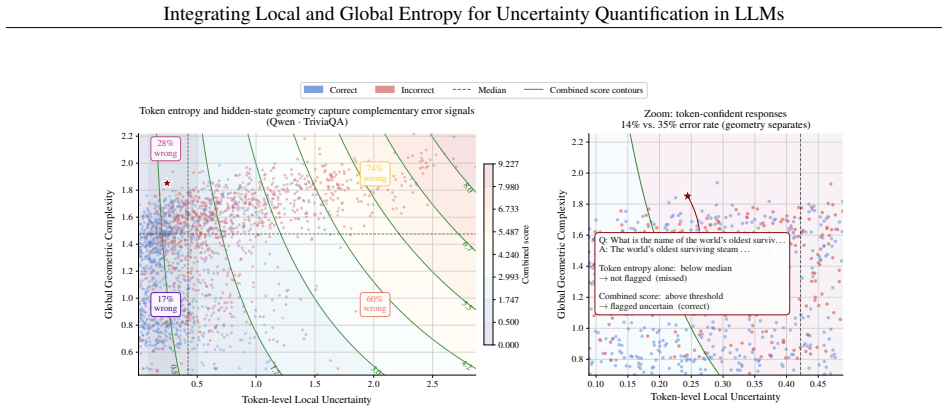
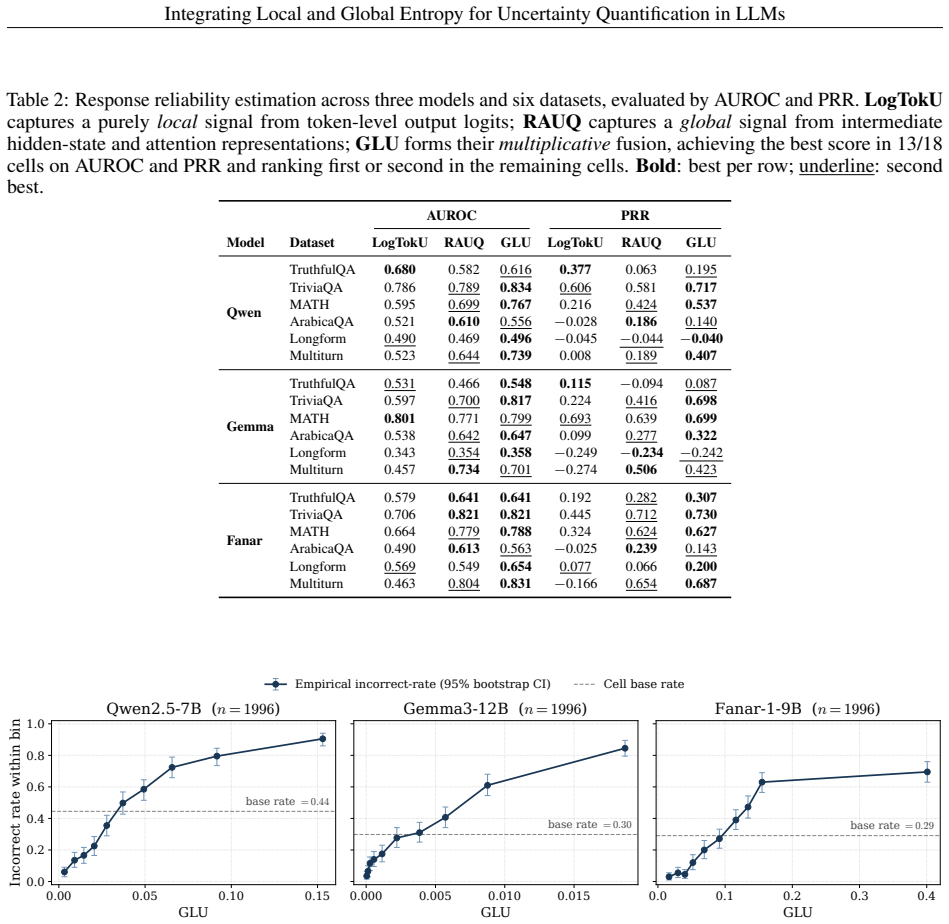
Hidden-state geometric entropy (global uncertainty) and token-level entropy (local uncertainty) are statistically near-orthogonal, capturing distinct failure regimes for reliability prediction. In particular, global geometry recovers the confident-but-wrong failure mode that local signals systematically miss. Building on this, we propose Global-Local Uncertainty (GLU), an unsupervised, single-pass score that fuses the two signals via a multiplicative gate. Across three model families and six benchmarks, GLU matches or outperforms all unsupervised baselines.
What carries the argument
The multiplicative fusion of hidden-state geometric entropy and token-level entropy into the GLU score
If this is right
- GLU matches or outperforms unsupervised baselines across models and benchmarks
- GLU requires only one forward pass
- GLU remains length-normalized and architecture-agnostic
- Global geometry identifies failure modes missed by local entropy
Where Pith is reading between the lines
- This fusion approach could be applied to other uncertainty signals in neural networks
- Single-pass methods like this may enable faster reliability checks in production systems
- Analyzing hidden state geometry might reveal new ways to detect model overconfidence
Load-bearing premise
The geometric complexity of hidden-state matrices constitutes a valid and independent measure of global uncertainty.
What would settle it
A dataset or benchmark where adding the global geometric entropy term to token entropy produces no improvement in identifying unreliable outputs.
Figures
read the original abstract
Large language models hallucinate confidently, making uncertainty quantification (UQ) essential for reliable deployment. Existing methods rely predominantly on token-level signals, leaving the geometric structure of intermediate hidden states underused. In this paper, we take the geometric complexity of hidden-state matrices as a measure of the global uncertainty of LLMs, while treating token-level uncertainty estimation as a local metric. We show that hidden-state geometric entropy (global uncertainty) and token-level entropy (local uncertainty) are statistically near-orthogonal, capturing distinct failure regimes for reliability prediction. In particular, global geometry recovers the confident-but-wrong failure mode that local signals systematically miss. Building on this, we propose Global-Local Uncertainty (GLU), an unsupervised, single-pass score that fuses the two signals via a multiplicative gate. Across three model families and six benchmarks, GLU matches or outperforms all unsupervised baselines while requiring only a single forward pass and remaining length-normalized and architecture-agnostic.
Editorial analysis
A structured set of objections, weighed in public.
Referee Report
Summary. The paper proposes Global-Local Uncertainty (GLU), an unsupervised single-pass score for LLM uncertainty quantification. It treats geometric entropy of hidden-state matrices as a global uncertainty signal and token-level entropy as a local signal, claims these are statistically near-orthogonal and capture distinct failure regimes (with global recovering confident-but-wrong cases missed by local), and shows that their multiplicative fusion yields a reliability predictor that matches or exceeds unsupervised baselines across three model families and six benchmarks while remaining length-normalized and architecture-agnostic.
Significance. If the orthogonality, regime-recovery, and performance results hold, the work supplies a practical, training-free UQ method that exploits underused geometric structure in intermediate activations. The single-forward-pass requirement and explicit handling of a known limitation of token-only methods constitute a concrete advance for reliable deployment. The empirical scope across multiple families and benchmarks strengthens the case for the approach's generality.
major comments (2)
- [§3.1] §3.1 (definition of geometric entropy): the precise matrix-complexity measure (e.g., whether it uses nuclear norm, effective rank via singular values, or another functional) must be stated with an explicit equation; without it the global-uncertainty claim cannot be reproduced or compared to prior geometric analyses of hidden states.
- [§4.3, §5.2] §4.3 and §5.2 (orthogonality and regime analysis): the exact correlation statistic, significance threshold, and any per-benchmark data-exclusion rules used to establish near-orthogonality and the recovery of the confident-but-wrong regime need to be reported; these quantities are load-bearing for the central claim that the two signals are independent and complementary.
minor comments (3)
- Figure 2 (correlation heatmaps): axis labels and color-bar scale should be enlarged for readability; the current size makes it difficult to verify the reported near-zero correlations.
- Notation: the multiplicative gate in the GLU definition should be given a numbered equation rather than inline text to facilitate reference in the experimental section.
- Related-work section: a brief citation to prior uses of matrix geometric measures (e.g., effective dimension or nuclear-norm analyses) in neural-network uncertainty literature would help situate the geometric-entropy contribution.
Simulated Author's Rebuttal
We thank the referee for the constructive comments and the positive recommendation for minor revision. We address each major comment below.
read point-by-point responses
-
Referee: [§3.1] §3.1 (definition of geometric entropy): the precise matrix-complexity measure (e.g., whether it uses nuclear norm, effective rank via singular values, or another functional) must be stated with an explicit equation; without it the global-uncertainty claim cannot be reproduced or compared to prior geometric analyses of hidden states.
Authors: We agree that an explicit equation is necessary for reproducibility. In the revised manuscript we will insert a precise mathematical definition of geometric entropy in §3.1, specifying the exact functional applied to the hidden-state matrix. revision: yes
-
Referee: [§4.3, §5.2] §4.3 and §5.2 (orthogonality and regime analysis): the exact correlation statistic, significance threshold, and any per-benchmark data-exclusion rules used to establish near-orthogonality and the recovery of the confident-but-wrong regime need to be reported; these quantities are load-bearing for the central claim that the two signals are independent and complementary.
Authors: We agree that these statistical details should be reported explicitly. The revised manuscript will add the exact correlation statistic, significance threshold, and any per-benchmark data-exclusion rules in §§4.3 and 5.2. revision: yes
Circularity Check
No significant circularity detected
full rationale
The paper presents GLU as an unsupervised multiplicative fusion of two independently defined entropy measures: geometric complexity of hidden-state matrices (global) and token-level entropy (local). No equations or derivations reduce the proposed score to a fitted parameter, self-referential definition, or self-citation chain. Orthogonality and regime-specific recovery are supported by explicit definitions, correlation statistics, and empirical breakdowns across external benchmarks and model families, making the central claims self-contained against independent validation rather than tautological.
Axiom & Free-Parameter Ledger
invented entities (1)
-
GLU score
no independent evidence
Reference graph
Works this paper leans on
-
[1]
Declan Jackson, William Keating, George Cameron, and Micah Hill-Smith. AA-Omniscience: Evaluating cross-domain knowledge reliability in large language models.arXiv preprint arXiv:2511.13029,
-
[2]
Mitigat- ing llm hallucinations via conformal abstention.arXiv preprint arXiv:2405.01563, 2024
Yasin Abbasi Yadkori, Ilja Kuzborskij, David Stutz, András György, Adam Fisch, Arnaud Doucet, Iuliya Beloshapka, Wei-Hung Weng, Yao-Yuan Yang, Csaba Szepesvári, Ali Taylan Cemgil, and Nenad Tomasev. Mitigating llm hallucinations via conformal abstention. (arXiv:2405.01563), April 2024a. doi: 10.48550/arXiv.2405.01563. URL http://arxiv.org/abs/2405.01563. ...
-
[3]
Huan Ma, Jingdong Chen, Joey Tianyi Zhou, Guangyu Wang, and Changqing Zhang
Curran Associates Inc. Huan Ma, Jingdong Chen, Joey Tianyi Zhou, Guangyu Wang, and Changqing Zhang. Estimating llm uncertainty with evidence.arXiv preprint arXiv:2502.00290,
-
[4]
Language Models (Mostly) Know What They Know
Saurav Kadavath, Tom Conerly, Amanda Askell, Tom Henighan, Dawn Drain, Ethan Perez, Nicholas Schiefer, Zac Hatfield-Dodds, Nova DasSarma, Eli Tran-Johnson, et al. Language models (mostly) know what they know.arXiv preprint arXiv:2207.05221,
work page internal anchor Pith review Pith/arXiv arXiv
-
[5]
Siddhartha Dalal and Vishal Misra. Beyond the black box: A statistical model for llm reasoning and inference.arXiv preprint arXiv:2402.03175,
-
[6]
Potsawee Manakul, Adian Liusie, and Mark J. F. Gales. Selfcheckgpt: Zero-resource black-box hallucination detection for generative large language models. In Houda Bouamor, Juan Pino, and Kalika Bali, editors,Proceedings of the 2023 Conference on Empirical Methods in Natural Language Processing, EMNLP 2023, Singapore, December 6-10, 2023, pages 9004–9017. ...
2023
-
[7]
doi: 10.18653/V1/2023.EMNLP-MAIN.557. URLhttps://doi.org/10.18653/v1/2023.emnlp-main.557. Alexander Nikitin, Jannik Kossen, Yarin Gal, and Pekka Marttinen. Kernel language entropy: Fine-grained uncertainty quantification for llms from semantic similarities.arXiv preprint arXiv:2405.20003,
-
[8]
URL https://arxiv.org/abs/ 2402.12563. 10 Integrating Local and Global Entropy for Uncertainty Quantification in LLMs Hadas Orgad, Michael Toker, Zorik Gekhman, Roi Reichart, Idan Szpektor, Hadas Kotek, and Yonatan Belinkov. Llms know more than they show: On the intrinsic representation of llm hallucinations. International Conference on Learning Represent...
-
[9]
LLMs Get Lost In Multi-Turn Conversation
Philippe Laban, Hiroaki Hayashi, Yingbo Zhou, and Jennifer Neville. Llms get lost in multi-turn conversation.arXiv preprint arXiv:2505.06120,
work page internal anchor Pith review Pith/arXiv arXiv
-
[10]
Qwen Team, An Yang, Baosong Yang, Beichen Zhang, Binyuan Hui, Bo Zheng, Bowen Yu, Chengyuan Li, Dayiheng Liu, Fei Huang, Haoran Wei, Huan Lin, Jian Yang, Jianhong Tu, Jianwei Zhang, Jianxin Yang, Jiaxi Yang, Jingren Zhou, Junyang Lin, Kai Dang, Keming Lu, Keqin Bao, Kexin Yang, Le Yu, Mei Li, Mingfeng Xue, Pei Zhang, Qin Zhu, Rui Men, Runji Lin, Tianhao L...
work page internal anchor Pith review Pith/arXiv arXiv
-
[11]
Gemma Team, Aishwarya Kamath, Johan Ferret, Shreya Pathak, Nino Vieillard, Ramona Merhej, Sarah Perrin, Tatiana Matejovicova, Alexandre Ramé, Morgane Rivière, Louis Rouillard, Thomas Mesnard, Geoffrey Cideron, Jean- Bastien Grill, Sabela Ramos, Edouard Yvinec, Michelle Casbon, Etienne Pot, Ivo Penchev, Gaël Liu, Francesco Visin, Kathleen Kenealy, Lucas Be...
work page internal anchor Pith review Pith/arXiv arXiv
-
[12]
Fanar: An arabic-centric multimodal generative ai platform.arXiv preprint arXiv:2501.13944,
Fanar Team, Ummar Abbas, Mohammad Shahmeer Ahmad, Firoj Alam, Enes Altinisik, Ehsannedin Asgari, Yazan Boshmaf, Sabri Boughorbel, Sanjay Chawla, Shammur Chowdhury, Fahim Dalvi, Kareem Darwish, Nadir Durrani, Mohamed Elfeky, Ahmed Elmagarmid, Mohamed Eltabakh, Masoomali Fatehkia, Anastasios Fragkopoulos, Maram Hasanain, Majd Hawasly, Mus’ab Husaini, Soon-G...
-
[13]
Yasin Abbasi Yadkori, Ilja Kuzborskij, András György, and Csaba Szepesvári
URLhttps://openreview.net/forum?id=jN5y-zb5Q7m. Yasin Abbasi Yadkori, Ilja Kuzborskij, András György, and Csaba Szepesvári. To believe or not to believe your llm: Iterative prompting for estimating epistemic uncertainty. InProceedings of the 38th International Conference on Neural Information Processing Systems, NIPS ’24, Red Hook, NY , USA, 2024b. Curran...
-
[14]
adapts grade-school math word problems into a sharded, multi-turn conversational setting in which the problem is revealed incrementally across turns. We use the math subset of the releasedlost_in_conversationdata, comprising103problems decomposed into multiple turns each. D Methods and Ablations This appendix provides the complete picture behind the main-...
discussion (0)
Sign in with ORCID, Apple, or X to comment. Anyone can read and Pith papers without signing in.