A Navigable Manifold of Hypothesized Consciousness-Spectrum States in Language Model Representations
Pith reviewed 2026-06-28 03:22 UTC · model grok-4.3
The pith
Language model embeddings form a structured navigable manifold aligned with a hypothesized consciousness spectrum.
A machine-rendered reading of the paper's core claim, the machinery that carries it, and where it could break.
Core claim
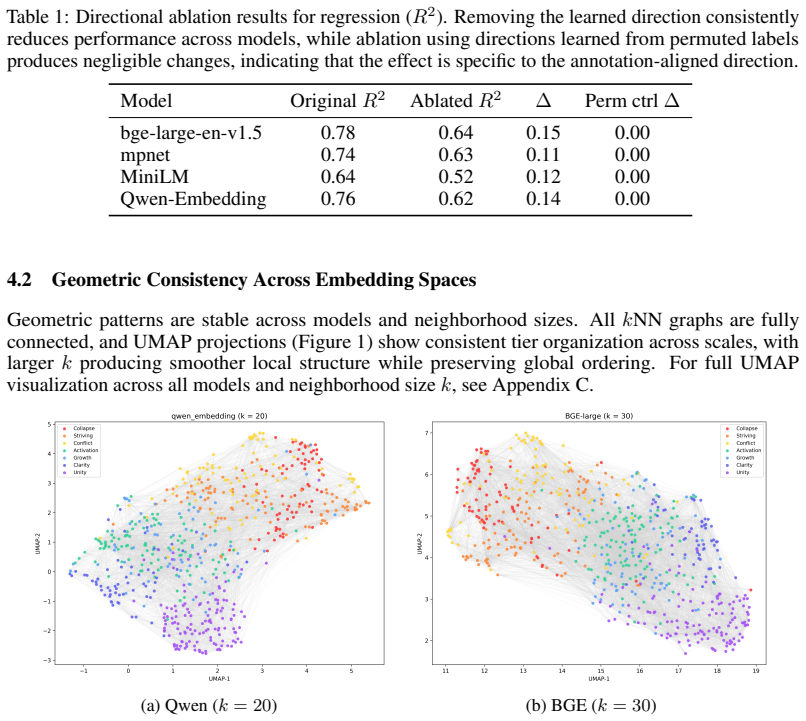
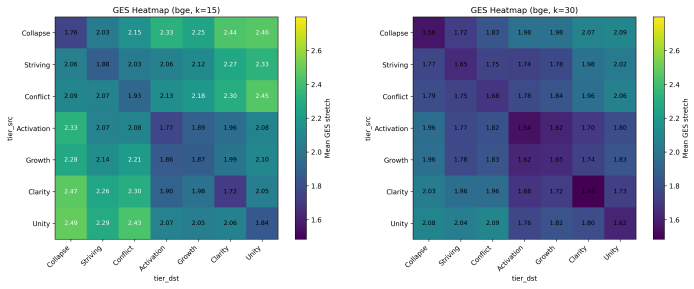
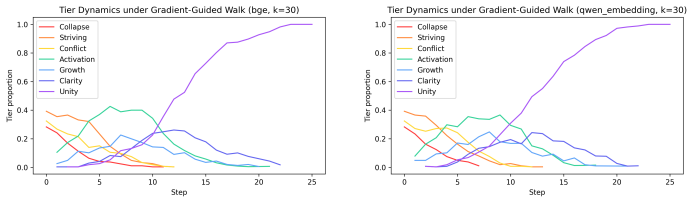
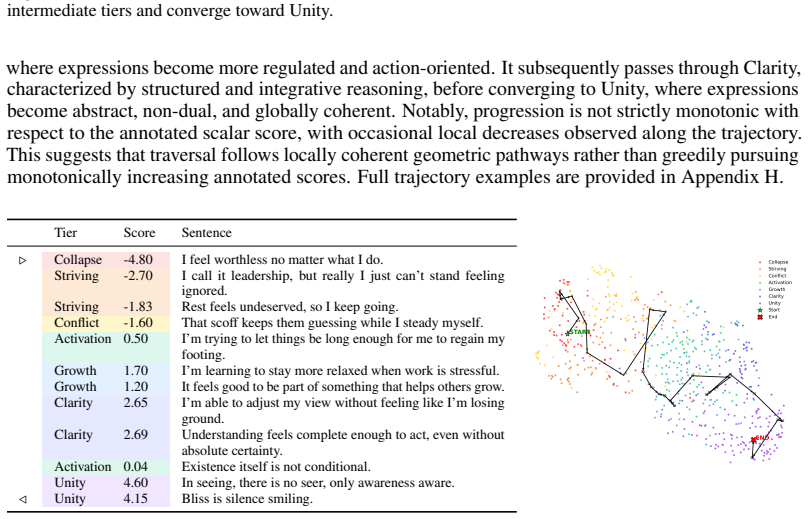
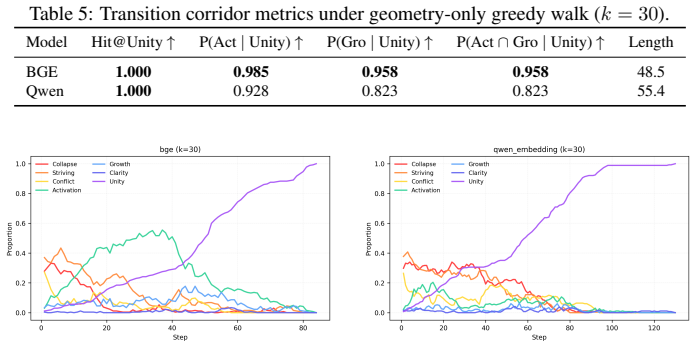
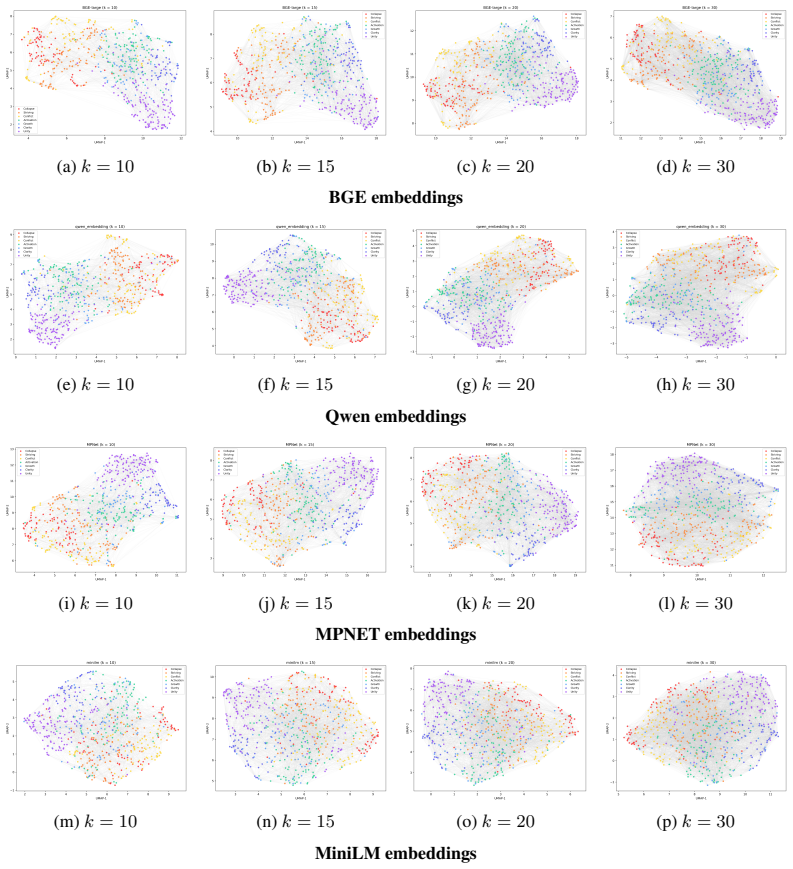
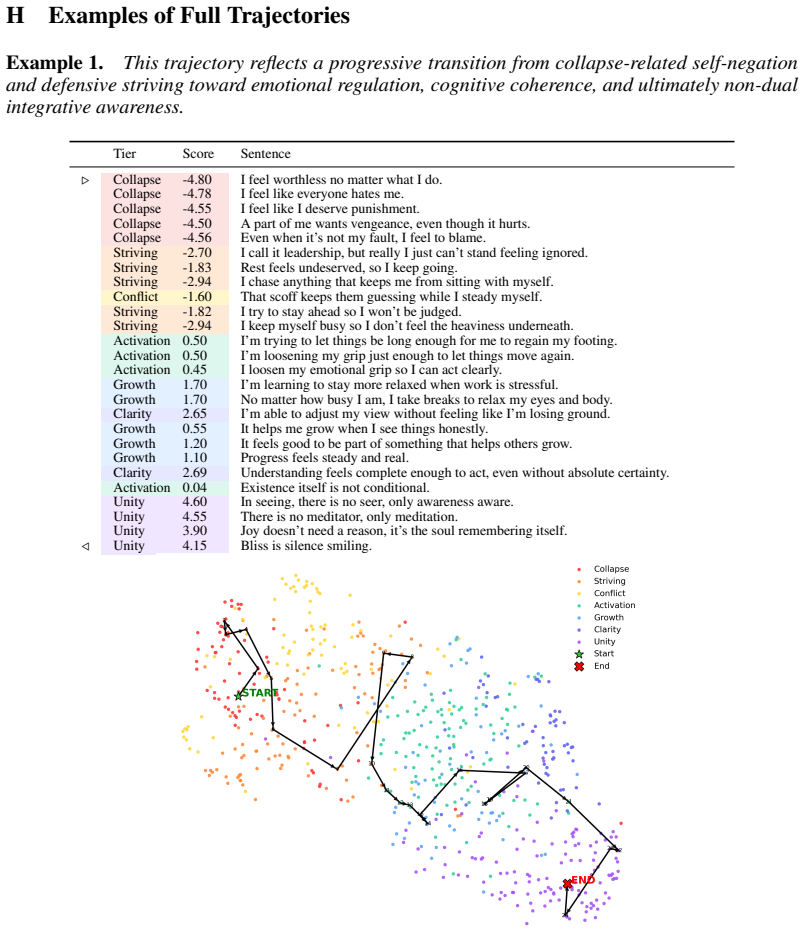
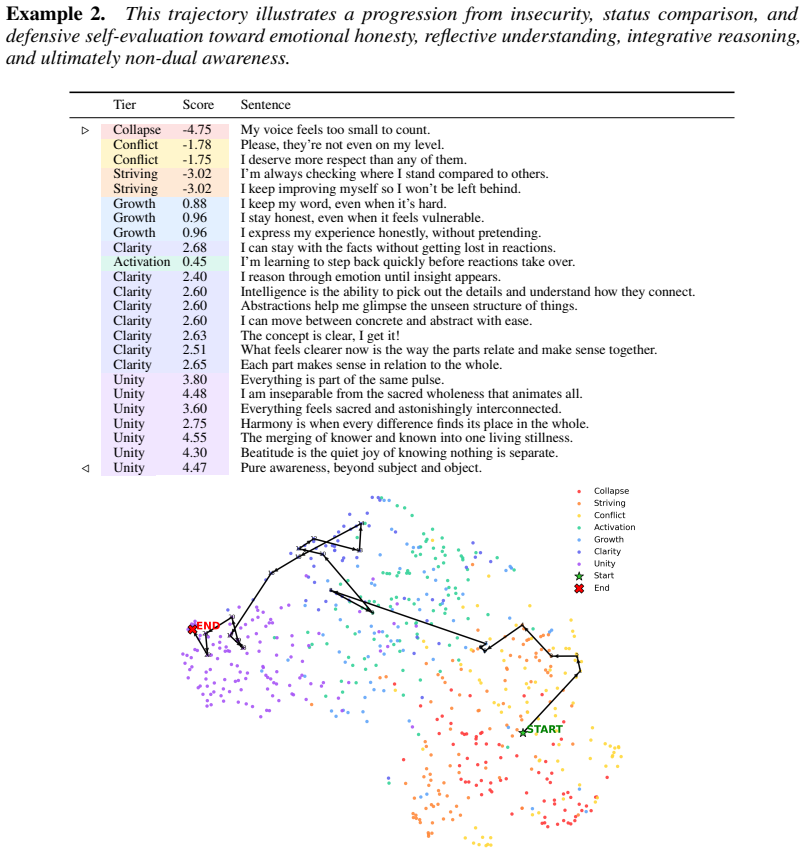
Embeddings exhibit a globally organized geometry aligned with this spectrum: sentences associated with similar states cluster into locally coherent regions, forming a structured manifold. In particular, higher-level and lower-level regions exhibit convexity-like stability, while intermediate regions form a transition corridor. Dynamically, both utility-guided and geometry-only greedy trajectories consistently traverse from lower- to higher-level regions, passing through intermediate tiers, indicating that navigability is an intrinsic property of the representation space, guided but not dictated by a global directional signal.
What carries the argument
The consciousness-spectrum manifold in embedding space, where similar-state sentences form coherent clusters with stable poles at the extremes and a navigable transition corridor in between.
If this is right
- Embedding spaces encode structured and navigable geometry aligned with the hypothesized taxonomy.
- Navigability from lower- to higher-level states holds for both guided and geometry-only trajectories.
- Higher- and lower-level regions exhibit stability while intermediate regions act as a transition corridor.
- Representation-level geometry offers a perspective for analyzing and guiding model behavior.
Where Pith is reading between the lines
- Steering generations along manifold paths could shift model outputs toward higher states without external reward signals.
- The same manifold structure might appear when applying the spectrum to other model architectures or modalities.
- Varying the sentence generation process or embedding model could test whether the geometry is robust or tied to specific training data patterns.
Load-bearing premise
The hypothesized consciousness-spectrum taxonomy can be translated into natural-language sentences whose embeddings will reveal an intrinsic geometric structure rather than one created by the choice of labels or clustering method.
What would settle it
Finding that random or label-shuffled sentence sets produce the same clustering into stable poles, transition corridors, and upward trajectories would show the structure is not specific to the spectrum.
Figures
read the original abstract
Across contemplative, philosophical, and psychological accounts, human consciousness is often described along a similar spectrum, ranging from reactive and self-focused patterns to more integrative and coherent ones. Understanding whether language models encode such a structured, human-interpretable consciousness spectrum in representation space is important for model guidance, evaluation and alignment. In this work, we study the geometric structure and dynamics of patterns along this spectrum in transformer embedding spaces. We show that embeddings exhibit a globally organized geometry aligned with this spectrum: sentences associated with similar states cluster into locally coherent regions, forming a structured manifold. In particular, higher-level and lower-level regions exhibit convexity-like stability, while intermediate regions form a transition corridor. Dynamically, both utility-guided and geometry-only greedy trajectories consistently traverse from lower- to higher-level regions, passing through intermediate tiers, indicating that navigability is an intrinsic property of the representation space, guided but not dictated by a global directional signal. These results suggest that embedding spaces encode structured and navigable geometry aligned with a hypothesized consciousness-spectrum taxonomy, broadly inspired by recurring structural descriptions of human consciousness across contemplative traditions, philosophy, and modern psychology, providing a representation-level perspective for analyzing and guiding model behavior.
Editorial analysis
A structured set of objections, weighed in public.
Referee Report
Summary. The manuscript claims that transformer embedding spaces encode a globally organized, navigable manifold aligned with a hypothesized consciousness-spectrum taxonomy (ranging from reactive/self-focused to integrative/coherent states). Sentences instantiating similar states form locally coherent clusters; higher- and lower-level regions exhibit convexity-like stability while intermediate regions act as a transition corridor; both utility-guided and geometry-only greedy trajectories reliably traverse from lower- to higher-level states.
Significance. If the reported geometry were shown to be intrinsic rather than induced by the authors' sentence curation and taxonomy, the work would supply a concrete representation-level lens for analyzing and steering model behavior. However, the absence of controls for label-induced structure substantially weakens the evidential basis for that interpretation.
major comments (2)
- [Abstract] Abstract (paragraph 3): the central claim that the observed clusters, stability, corridor, and lower-to-higher trajectories constitute an 'intrinsic' property of the representation space is load-bearing yet unsupported by any reported controls (random sentence baselines, alternative taxonomies, label-permutation tests, or within- vs. between-state semantic-distance comparisons independent of the authors' framing). Without these, the geometry discovery reduces to a description of the input curation.
- [Abstract] Abstract (paragraph 3) and methods description: the spectrum taxonomy is introduced by the authors and then used both to generate the sentence exemplars and to interpret the resulting embedding geometry as 'aligned' with that taxonomy. No independent, pre-specified labeling scheme or out-of-sample validation is described, rendering the alignment claim circular by construction.
Simulated Author's Rebuttal
We thank the referee for the constructive comments on the need for controls to substantiate claims of intrinsic geometry and for identifying the risk of circularity in the taxonomy-based approach. We respond to each major comment below, indicating revisions where the manuscript will be updated to address the concerns directly.
read point-by-point responses
-
Referee: [Abstract] Abstract (paragraph 3): the central claim that the observed clusters, stability, corridor, and lower-to-higher trajectories constitute an 'intrinsic' property of the representation space is load-bearing yet unsupported by any reported controls (random sentence baselines, alternative taxonomies, label-permutation tests, or within- vs. between-state semantic-distance comparisons independent of the authors' framing). Without these, the geometry discovery reduces to a description of the input curation.
Authors: We agree that the submitted manuscript lacks the recommended controls, and this limits the strength of the 'intrinsic' claim. In revision we will add random sentence baselines, label-permutation tests, and within- versus between-state semantic-distance comparisons computed independently of the taxonomy framing. The geometry-only greedy trajectories already operate without label access and still produce consistent lower-to-higher traversals; we will quantify how this exceeds chance under the new controls. These additions will be reported in a new results subsection. revision: yes
-
Referee: [Abstract] Abstract (paragraph 3) and methods description: the spectrum taxonomy is introduced by the authors and then used both to generate the sentence exemplars and to interpret the resulting embedding geometry as 'aligned' with that taxonomy. No independent, pre-specified labeling scheme or out-of-sample validation is described, rendering the alignment claim circular by construction.
Authors: The taxonomy synthesizes recurring structural descriptions from the cited contemplative, philosophical, and psychological literature rather than being invented ad hoc. Sentence generation was guided by it, yet the manifold geometry and directed navigability are emergent properties of the embeddings. To remove circularity we will add out-of-sample validation on sentences drawn from independent sources never used in generation, plus explicit comparison against two alternative taxonomies. These results will be included in the revised methods and results sections. revision: yes
Circularity Check
No significant circularity; empirical geometry claims remain independent of input taxonomy
full rationale
The provided abstract describes an empirical study of transformer embeddings for sentences associated with a hypothesized consciousness-spectrum taxonomy that is explicitly framed as inspired by external contemplative, philosophical, and psychological traditions rather than internally defined. No equations, self-citations, or derivation steps are shown that reduce the reported manifold properties (local clusters, convexity-like stability, transition corridor, or lower-to-higher trajectories) to the authors' labeling choices by construction. The central results concern specific geometric and dynamic features in representation space, which are presented as observations rather than tautological outputs of the taxonomy itself. Absent any quoted reduction matching the enumerated patterns, the derivation chain is treated as self-contained.
Axiom & Free-Parameter Ledger
free parameters (2)
- spectrum level definitions and sentence exemplars
- clustering and trajectory hyperparameters
axioms (2)
- domain assumption A single, low-dimensional manifold structure exists in the embedding space that is meaningfully aligned with the authors' consciousness spectrum.
- domain assumption Greedy trajectories on the embedding graph reflect intrinsic navigability rather than artifacts of the chosen utility function or local density.
invented entities (1)
-
consciousness-spectrum manifold
no independent evidence
Reference graph
Works this paper leans on
-
[1]
Shambhala, Boston, MA, 1993
Thomas Cleary.The Flower Ornament Scripture: A Translation of the Avatamsaka Sutra. Shambhala, Boston, MA, 1993
1993
-
[2]
Oxford University Press, Oxford, 1891
Laozi.Tao Te Ching. Oxford University Press, Oxford, 1891
-
[3]
Methuen, London, 1911
Evelyn Underhill.Mysticism: A Study in the Nature and Development of Spiritual Consciousness. Methuen, London, 1911
1911
-
[4]
Teresa of Avila.The Interior Castle
St. Teresa of Avila.The Interior Castle. Riverhead, 2004
2004
-
[5]
International Universities Press, 1952
Jean Piaget.The Origins of Intelligence in Children. International Universities Press, 1952
1952
-
[6]
Harvard University Press, 1983
Robert Kegan.The Evolving Self: Problem and Process in Human Development. Harvard University Press, 1983
1983
-
[7]
Harper and Brothers, 1954
Abraham Maslow.Motivation and Personality. Harper and Brothers, 1954
1954
-
[8]
Maslow.Toward a Psychology of Being
Abraham H. Maslow.Toward a Psychology of Being. Van Nostrand, 1968
1968
-
[9]
Quest Books, Wheaton, IL, 1977
Ken Wilber.The Spectrum of Consciousness. Quest Books, Wheaton, IL, 1977
1977
-
[10]
Emotion concepts and their function in a large language model
Nicholas Sofroniew, Isaac Kauvar, William Saunders, Runjin Chen, Tom Henighan, Sasha Hydrie, Craig Citro, Adam Pearce, Julius Tarng, Wes Gurnee, Joshua Batson, Sam Zimmerman, Kelley Rivoire, Kyle Fish, Chris Olah, and Jack Lindsey. Emotion concepts and their function in a large language model. Transformer Circuits Thread, April 2026
2026
-
[11]
Benjamin Reichman, Adar Avsian, and Larry Heck. Emotions where art thou: Understanding and characterizing the emotional latent space of large language models.arXiv preprint arXiv:2510.22042, 2026
-
[12]
Jingxiang Zhang and Lujia Zhong. Decoding emotion in the deep: A systematic study of how llms represent, retain, and express emotion.arXiv preprint arXiv:2510.04064, 2025
-
[13]
Ala N. Tak, Amin Banayeeanzade, Anahita Bolourani, Mina Kian, Robin Jia, and Jonathan Gratch. Mech- anistic interpretability of emotion inference in large language models.arXiv preprint arXiv:2502.05489, 2025
-
[14]
Persona Vectors: Monitoring and Controlling Character Traits in Language Models
Runjin Chen, Andy Arditi, Henry Sleight, Owain Evans, and Jack Lindsey. Persona vectors: Monitoring and controlling character traits in language models.arXiv preprint arXiv:2507.21509, 2025
work page internal anchor Pith review Pith/arXiv arXiv 2025
-
[15]
Emergence of Hierarchical Emotion Organization in Large Language Models
Bo Zhao, Maya Okawa, Eric J. Bigelow, Rose Yu, Tomer Ullman, Ekdeep Singh Lubana, and Hidenori Tanaka. Emergence of hierarchical emotion organization in large language models.arXiv preprint arXiv:2507.10599, 2025
work page internal anchor Pith review Pith/arXiv arXiv 2025
-
[16]
Ai shares emotion with humans across languages and cultures.arXiv preprint arXiv:2506.13978, 2025
Xiuwen Wu, Hao Wang, Zhiang Yan, Xiaohan Tang, Pengfei Xu, Wai-Ting Siok, Ping Li, Jia-Hong Gao, Bingjiang Lyu, and Lang Qin. Ai shares emotion with humans across languages and cultures.arXiv preprint arXiv:2506.13978, 2025
-
[17]
Tenenbaum, Vin de Silva, and John C
Joshua B. Tenenbaum, Vin de Silva, and John C. Langford. A global geometric framework for nonlinear dimensionality reduction.Science, 290(5500):2319–2323, 2000
2000
-
[18]
Roweis and Lawrence K
Sam T. Roweis and Lawrence K. Saul. Nonlinear dimensionality reduction by locally linear embedding. Science, 290(5500):2323–2326, 2000. 10
2000
-
[19]
UMAP: Uniform Manifold Approximation and Projection for Dimension Reduction
Leland McInnes, John Healy, and James Melville. UMAP: Uniform manifold approximation and projection for dimension reduction.arXiv preprint arXiv:1802.03426, 2018
work page internal anchor Pith review Pith/arXiv arXiv 2018
-
[20]
Testing the manifold hypothesis.Journal of the American Mathematical Society, 29(4):983–1049, 2016
Charles Fefferman, Sanjoy Mitter, and Hariharan Narayanan. Testing the manifold hypothesis.Journal of the American Mathematical Society, 29(4):983–1049, 2016
2016
-
[21]
Manifold learning: What, how, and why.Annual Review of Statistics and Its Application, 11, 2024
Marina Meila and Hanyu Zhang. Manifold learning: What, how, and why.Annual Review of Statistics and Its Application, 11, 2024
2024
-
[22]
Langford, and Joshua B
Mikhail Bernstein, Vin de Silva, John C. Langford, and Joshua B. Tenenbaum. Graph approximations to geodesics on embedded manifolds. Technical report, Stanford University, 2000
2000
-
[23]
Laplacian eigenmaps for dimensionality reduction and data representa- tion.Neural Computation, 15(6):1373–1396, 2003
Mikhail Belkin and Partha Niyogi. Laplacian eigenmaps for dimensionality reduction and data representa- tion.Neural Computation, 15(6):1373–1396, 2003
2003
-
[24]
Kiho Park, Yo Joong Choe, Yibo Jiang, and Victor Veitch. The geometry of categorical and hierarchical concepts in large language models.arXiv preprint arXiv:2406.01506, 2024
-
[25]
Alexander Modell, Patrick Rubin-Delanchy, and Nick Whiteley. The origins of representation manifolds in large language models.arXiv preprint arXiv:2505.18235, 2025
-
[26]
Coifman and Stephane Lafon
Ronald R. Coifman and Stephane Lafon. Diffusion maps.Applied and Computational Harmonic Analysis, 21(1):5–30, 2006
2006
-
[27]
do Carmo.Riemannian Geometry
Manfredo P. do Carmo.Riemannian Geometry. Birkhäuser, 1992
1992
-
[28]
On convex decision regions in deep network representations.arXiv preprint arXiv:2305.17154, 2023
Lenka Tˇetková, Thea Brüsch, Teresa Karen Scheidt, Fabian Martin Mager, Rasmus Ørtoft Aagaard, et al. On convex decision regions in deep network representations.arXiv preprint arXiv:2305.17154, 2023
-
[29]
Distilling the Knowledge in a Neural Network
Geoffrey Hinton et al. Distilling the knowledge in a neural network.arXiv preprint arXiv:1503.02531, 2015. A Additional Ablation Results Table 6: Full score regression results under directional ablation. Normal denotes original embeddings, Ablated denotes projection removal along the learned score-aligned direction, and Perm-label control denotes removal ...
work page internal anchor Pith review Pith/arXiv arXiv 2015
discussion (0)
Sign in with ORCID, Apple, or X to comment. Anyone can read and Pith papers without signing in.