Radio Emission from High-Frequency Gravitational Wave Point Sources
Pith reviewed 2026-06-27 15:41 UTC · model grok-4.3
The pith
Existing radio telescopes detect high-frequency gravitational waves from primordial black hole mergers more effectively than many dedicated experiments through conversion to radio photons.
A machine-rendered reading of the paper's core claim, the machinery that carries it, and where it could break.
Core claim
High-frequency gravitational waves convert to radio photons in the presence of astrophysical magnetic fields through the inverse Gertsenshtein effect, enabling existing radio telescopes like CHIME and FAST to detect point sources of these waves, including primordial black hole mergers and ultralight boson clouds, at sensitivities that exceed those of many other current experiments.
What carries the argument
The inverse Gertsenshtein effect, which converts high-frequency gravitational waves into electromagnetic radio photons in magnetic fields, carrying the argument by linking gravitational wave sources directly to observable radio signals.
If this is right
- CHIME and FAST significantly outperform many existing experiments for detecting transient high-frequency gravitational waves from primordial black hole mergers.
- Radio telescopes provide unique sensitivity to monochromatic high-frequency gravitational wave emission from ultralight boson clouds around primordial black holes.
- Generic sources of detectable high-frequency gravitational waves can be probed effectively with current radio instruments.
- The method applies to both transient and continuous sources in the MHz-GHz regime.
Where Pith is reading between the lines
- This detection channel could constrain the abundance of primordial black holes in mass ranges where mergers produce high-frequency waves.
- Combining radio data with other messengers might help distinguish gravitational wave signals from ordinary astrophysical radio sources.
- Improved modeling of magnetic field distributions in galaxies could refine the expected event rates for future searches.
Load-bearing premise
The inverse Gertsenshtein conversion produces detectable radio signals from high-frequency gravitational waves in typical astrophysical magnetic fields, with realistic rates and properties assumed for primordial black hole mergers and boson clouds.
What would settle it
A direct calculation or observation showing that the radio flux expected from a primordial black hole merger at a given distance falls below the sensitivity threshold of CHIME or FAST would falsify the performance claim.
Figures
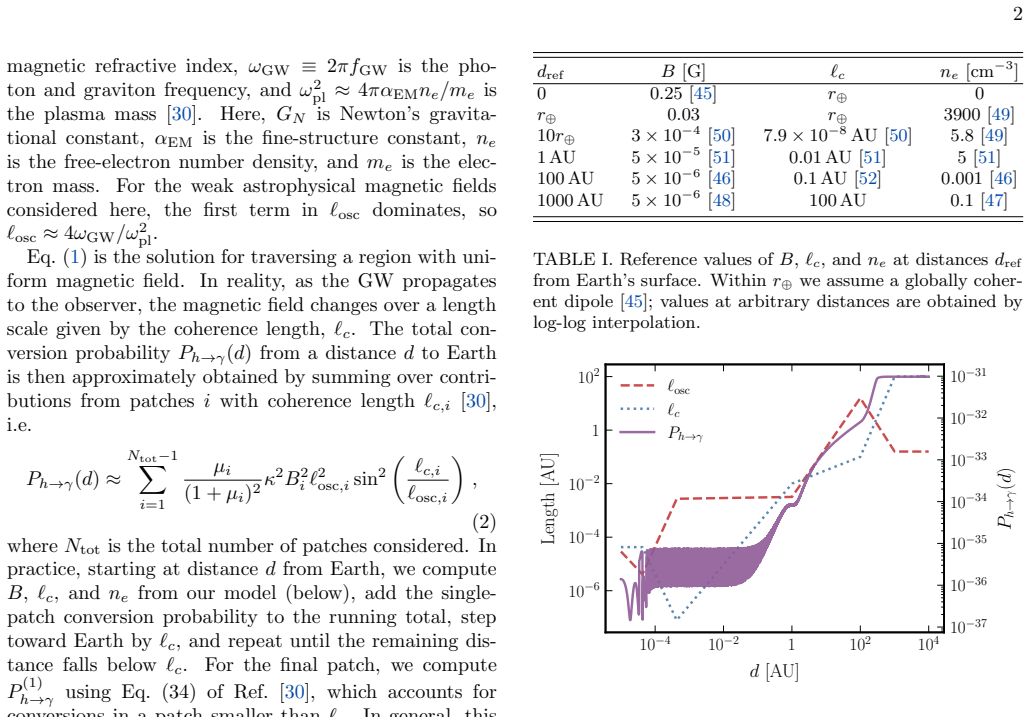
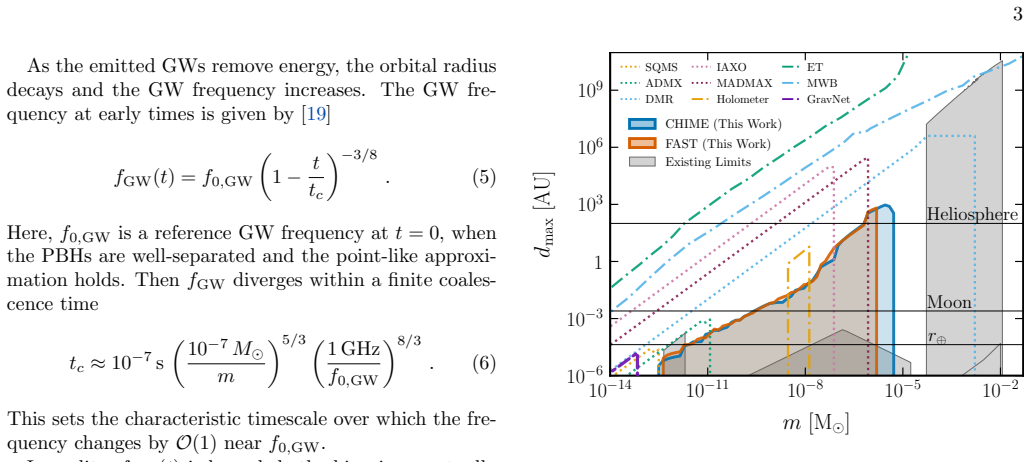
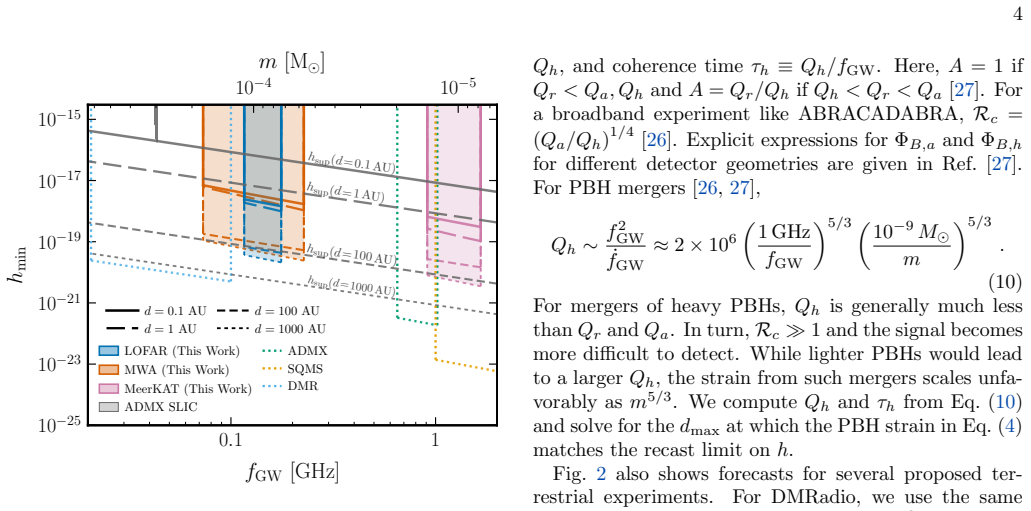
read the original abstract
High-frequency gravitational waves (HFGWs) in the MHz to GHz regime can convert into radio photons in the presence of astrophysical magnetic fields through the inverse Gertsenshtein effect. We show that existing radio telescopes like CHIME and FAST are excellent tools for detecting HFGW sources, significantly outperforming many existing experiments at detecting primordial black hole (PBH) mergers, the most realistic sources of transient HFGWs. Radio telescopes are also uniquely sensitive to sources of monochromatic HFGW emission, such as ultralight boson clouds formed through superradiance around PBHs, and are likely to have excellent sensitivity to generic sources of detectable HFGWs.
Editorial analysis
A structured set of objections, weighed in public.
Referee Report
Summary. The manuscript argues that high-frequency gravitational waves (MHz–GHz) from transient sources such as primordial black hole (PBH) mergers and from monochromatic sources such as superradiant ultralight boson clouds around PBHs can convert to detectable radio photons via the inverse Gertsenshtein effect in astrophysical magnetic fields. It claims that existing radio telescopes (CHIME, FAST) therefore provide superior sensitivity to these signals compared with many dedicated HFGW experiments.
Significance. If the conversion modeling and source-rate assumptions hold, the work would demonstrate that routine radio-astronomy facilities can access a previously under-explored HFGW window, offering a low-cost route to constraints on PBH dark-matter scenarios and ultralight bosons. The emphasis on existing instruments rather than new hardware is a practical strength.
major comments (3)
- [Results on PBH mergers] The central sensitivity comparison for PBH mergers (abstract and main results) is load-bearing on the adopted merger-rate density and mass function; these quantities are free parameters whose plausible range spans orders of magnitude. The manuscript must show explicitly (e.g., via a rate scan or shaded uncertainty band) over what fraction of current observational bounds the claimed outperformance versus other experiments survives.
- [Conversion modeling] The inverse-Gertsenshtein conversion probability that underpins all flux estimates depends on magnetic-field strength, coherence length, and plasma effects. No derivation or numerical evaluation of this probability for the relevant astrophysical environments is supplied in the abstract, and the main text must provide the explicit expression (including any suppression factors) together with the fiducial B-field values used for CHIME/FAST forecasts.
- [Boson-cloud sensitivity section] The monochromatic boson-cloud channel is stated to be less rate-sensitive, yet it inherits the same conversion modeling. The paper should quantify how the claimed radio-telescope advantage changes when the effective conversion efficiency is varied by a factor of ten (a plausible uncertainty given field inhomogeneity).
minor comments (2)
- Notation for the conversion probability and the radio flux should be defined once and used consistently; several symbols appear without prior definition in the abstract.
- The manuscript should cite the most recent PBH merger-rate constraints (e.g., from LIGO/Virgo and microlensing) when stating the adopted rate range.
Simulated Author's Rebuttal
We thank the referee for the constructive and detailed comments. We address each major point below and will revise the manuscript accordingly to strengthen the presentation of uncertainties and modeling details.
read point-by-point responses
-
Referee: [Results on PBH mergers] The central sensitivity comparison for PBH mergers (abstract and main results) is load-bearing on the adopted merger-rate density and mass function; these quantities are free parameters whose plausible range spans orders of magnitude. The manuscript must show explicitly (e.g., via a rate scan or shaded uncertainty band) over what fraction of current observational bounds the claimed outperformance versus other experiments survives.
Authors: We agree that the merger-rate density and mass function are key uncertainties. In the revised manuscript we will add a parameter scan over the range of rates consistent with existing observational bounds on PBH mergers and include shaded bands on the sensitivity plots. This will explicitly indicate the fraction of the allowed parameter space in which the radio-telescope forecasts remain superior to dedicated HFGW experiments. revision: yes
-
Referee: [Conversion modeling] The inverse-Gertsenshtein conversion probability that underpins all flux estimates depends on magnetic-field strength, coherence length, and plasma effects. No derivation or numerical evaluation of this probability for the relevant astrophysical environments is supplied in the abstract, and the main text must provide the explicit expression (including any suppression factors) together with the fiducial B-field values used for CHIME/FAST forecasts.
Authors: The explicit conversion probability, including the plasma-frequency suppression factor, appears in Section 3 of the main text. To make this more accessible we will add the full expression (P_{G o \gamma} imes suppression) together with the fiducial values B = 5 imes 10^{-6} G (CHIME) and B = 10^{-5} G (FAST) and coherence length \sim 1 pc directly into the abstract and a dedicated methods paragraph. revision: yes
-
Referee: [Boson-cloud sensitivity section] The monochromatic boson-cloud channel is stated to be less rate-sensitive, yet it inherits the same conversion modeling. The paper should quantify how the claimed radio-telescope advantage changes when the effective conversion efficiency is varied by a factor of ten (a plausible uncertainty given field inhomogeneity).
Authors: We will include a new sensitivity curve in the boson-cloud section that varies the conversion efficiency by a factor of ten around the fiducial value. The revised figure will show that the radio-telescope advantage persists across most of this range, with only marginal degradation at the lowest efficiency. revision: yes
Circularity Check
No circularity: sensitivity claims rest on explicit conversion calculations and external comparisons
full rationale
The paper derives radio fluxes from HFGWs via the inverse Gertsenshtein effect in astrophysical B-fields, then compares CHIME/FAST reach to other experiments for PBH mergers and boson clouds. No load-bearing step reduces by construction to a fitted parameter renamed as prediction, a self-defined quantity, or a self-citation chain; the conversion probability follows from standard QED in external fields, and the outperformance statement is a direct numerical comparison against published sensitivities of other instruments. The derivation is therefore self-contained against external benchmarks.
Axiom & Free-Parameter Ledger
free parameters (2)
- astrophysical magnetic field strength
- PBH merger rate and mass distribution
axioms (1)
- domain assumption The inverse Gertsenshtein effect converts HFGWs to radio photons at usable efficiency in astrophysical magnetic fields.
Forward citations
Cited by 1 Pith paper
-
Graviton Floor
Photon-to-graviton conversion in blazar jets dominates a new graviton background that sets a floor for high-frequency GW detectors, analogous to the neutrino floor.
Reference graph
Works this paper leans on
-
[1]
B. P. Abbottet al.(LIGO Scientific Collabora- tion), LIGO: The Laser interferometer gravitational- wave observatory, Rept. Prog. Phys.72, 076901 (2009), arXiv:0711.3041 [gr-qc]
Pith/arXiv arXiv 2009
-
[2]
J. Aasiet al.(LIGO Scientific Collaboration), Advanced LIGO, Classical and Quantum Gravity32, 074001 (2015), arXiv:1411.4547 [gr-qc]. 6
Pith/arXiv arXiv 2015
-
[3]
R. Abbottet al.(LIGO Scientific and VIRGO Collab- orations), GWTC-2: Compact Binary Coalescences Ob- served by LIGO and Virgo During the First Half of the Third Observing Run, Phys. Rev. X11, 021053 (2021), arXiv:2010.14527 [gr-qc]
Pith/arXiv arXiv 2021
-
[4]
Accadiaet al.(VIRGO Collaboration), Virgo: A laser interferometer to detect gravitational waves, Journal of Instrumentation7, 3012
T. Accadiaet al.(VIRGO Collaboration), Virgo: A laser interferometer to detect gravitational waves, Journal of Instrumentation7, 3012
-
[5]
T. Akutsuet al.(KAGRA Collaboration), Overview of KAGRA : KAGRA science, PTEP2021, 05A103 (2021), arXiv:2008.02921 [gr-qc]
arXiv 2021
-
[6]
H. Xuet al.(CPTA Collaboration), Searching for the nano-Hertz stochastic gravitational wave background with the Chinese Pulsar Timing Array Data Release I, Research in Astronomy and Astrophysics23, 075024 (2023), arXiv:2306.16216 [astro-ph.HE]
Pith/arXiv arXiv 2023
-
[7]
G. Desvigneset al.(EPTA Collaboration), High- precision timing of 42 millisecond pulsars with the Euro- pean Pulsar Timing Array, Monthly Notices of the Royal Astronomical Society458, 3341 (2016)
2016
-
[8]
P. Tarafdaret al.(InPTA Collaboration), The Indian Pulsar Timing Array: First data release, Publications of the Astronomical Society of Australia39, e053 (2022), arXiv:2206.09289 [astro-ph.IM]
arXiv 2022
-
[9]
M. Baileset al.(MeerTime Collaboration), MeerTime - the MeerKAT Key Science Program on Pulsar Timing (2018), arXiv:1803.07424 [astro-ph.IM]
Pith/arXiv arXiv 2018
-
[10]
A. Brazieret al.(NANOGrav Collaboration), The NANOGrav Program for Gravitational Waves and Fun- damental Physics (2019), arXiv:1908.05356 [astro-ph]
arXiv 2019
-
[11]
Hobbs, The Parkes Pulsar Timing Array, Class
G. Hobbs, The Parkes Pulsar Timing Array, Class. Quant. Grav.30, 224007 (2013), arXiv:1307.2629
Pith/arXiv arXiv 2013
-
[12]
B. P. Abbottet al., A gravitational-wave standard siren measurement of the Hubble constant, Nature551, 85 (2017), arXiv:1710.05835 [astro-ph.CO]
Pith/arXiv arXiv 2017
-
[13]
G. Agazieet al.(NANOGrav Collaboration), The NANOGrav 15-year Data Set: Evidence for a Gravitational-Wave Background, The Astrophysical Journal Letters951, L8 (2023), arXiv:2306.16213 [astro- ph.HE]
Pith/arXiv arXiv 2023
-
[14]
A. Afzalet al.(NANOGrav Collaboration), The NANOGrav 15-year Data Set: Search for Signals from New Physics, The Astrophysical Journal Letters951, L11 (2023), arXiv:2306.16219 [astro-ph.HE]
Pith/arXiv arXiv 2023
-
[15]
A. G. Abacet al.(LIGO Scientific, VIRGO, KA- GRA Collaborations), Cosmological and High Energy Physics implications from gravitational-wave background searches in LIGO-Virgo-KAGRA’s O1-O4a runs (2025), arXiv:2510.26848 [gr-qc]
arXiv 2025
-
[16]
A. G. Abacet al.(LIGO Scientific, VIRGO, KAGRA Collaborations), GW241011 and GW241110: Exploring Binary Formation and Fundamental Physics with Asym- metric, High-spin Black Hole Coalescences, Astrophys. J. Lett.993, L21 (2025), arXiv:2510.26931 [astro-ph]
arXiv 2025
-
[17]
A. G. Abacet al.(LIGO Scientific, VIRGO, KA- GRA Collaborations), Black Hole Spectroscopy and Tests of General Relativity with GW250114 (2025), arXiv:2509.08099 [gr-qc]
Pith/arXiv arXiv 2025
-
[18]
N. Aggarwalet al., Challenges and Opportunities of Gravitational Wave Searches at MHz to GHz Fre- quencies, Living Reviews in Relativity24, 4 (2021), arXiv:2011.12414 [gr-qc]
arXiv 2021
-
[19]
G. Franciolini, A. Maharana, and F. Muia, Hunt for Light Primordial Black Hole Dark Matter with Ultra- High-Frequency Gravitational Waves, Physical Review D 106, 103520 (2022), arXiv:2205.02153 [astro-ph]
arXiv 2022
-
[20]
Gertsenshtein, Wave Resonance of Light and Gravita- tional Waves., Journal of Experimental and Theoretical Physics41, 113 (1961)
M. Gertsenshtein, Wave Resonance of Light and Gravita- tional Waves., Journal of Experimental and Theoretical Physics41, 113 (1961)
1961
-
[21]
Boccaletti, V
D. Boccaletti, V. De Sabbata, P. Fortini, and C. Gualdi, Conversion of photons into gravitons and vice versa in a static electromagnetic field, Il Nuovo Cimento B (1965- 1970)70, 129 (1970)
1965
-
[22]
Ya. B. Zel’dovich, Electromagnetic and gravitational waves in a stationary magnetic field, Soviet Journal of Experimental and Theoretical Physics38, 652 (1974)
1974
-
[23]
Sikivie, Experimental Tests of the Invisible Axion, Phys
P. Sikivie, Experimental Tests of the Invisible Axion, Phys. Rev. Lett.51, 1415 (1983)
1983
-
[24]
A. Ringwald, J. Sch¨ utte-Engel, and C. Tamarit, Grav- itational Waves as a Big Bang Thermometer, Journal of Cosmology and Astroparticle Physics2021(03), 054, arXiv:2011.04731 [hep-ph]
arXiv 2011
- [25]
- [26]
- [27]
-
[28]
R. Capdevilla, R. Harnik, T. Kim, and T. Krokotsch, High-frequency gravitational wave detection by the BREAD experiment, Phys. Rev. D112, 035031 (2025), arXiv:2505.21628 [hep-ph]
arXiv 2025
-
[29]
K. Schmieden and M. Schott, The Global Network of Cavities to Search for Gravitational Waves (GravNet): A novel scheme to hunt gravitational waves signatures from the early universe (2023), arXiv:2308.11497 [gr-qc]
arXiv 2023
-
[30]
V. Domcke and C. Garcia-Cely, Potential of radio telescopes as high-frequency gravitational wave detec- tors, Physical Review Letters126, 021104 (2021), arXiv:2006.01161 [astro-ph]
arXiv 2021
- [31]
- [32]
- [33]
-
[34]
M. Amiriet al.(CHIME Collaboration), An Overview of CHIME, the Canadian Hydrogen Intensity Mapping Ex- periment, The Astrophysical Journal Supplement Series 261, 29 (2022), arXiv:2201.07869 [astro-ph]
arXiv 2022
-
[35]
Jianget al.(FAST Project), Commissioning Progress of the FAST (2019), arXiv:1903.06324 [astro-ph]
P. Jianget al.(FAST Project), Commissioning Progress of the FAST (2019), arXiv:1903.06324 [astro-ph]
Pith/arXiv arXiv 2019
-
[36]
P. Jianget al.(FAST Project), The Fundamental Perfor- mance of FAST with 19-beam Receiver at L Band, Re- search in Astronomy and Astrophysics20, 064 (2020), arXiv:2002.01786 [astro-ph]. 7
arXiv 2020
-
[37]
L. Qian, R. Yao, J. Sun, J. Xu, Z. Pan, and P. Jiang (FAST Collaboration), FAST: Its Scientific Achieve- ments and Prospects, The Innovation1, 100053 (2020), arXiv:2011.13542 [astro-ph]
arXiv 2020
-
[38]
D. I. Dunsky, G. Krnjaic, and E. Pinetti, Observing Dark Matter Decays to Gravitons via Graviton-Photon Con- version (2025), arXiv:2503.19019 [hep-ph]
arXiv 2025
-
[39]
J. L. Burch, T. E. Moore, R. B. Torbert, and B. L. Giles, Magnetospheric Multiscale Overview and Science Objec- tives, Space Science Reviews199, 5 (2016)
2016
-
[40]
W. Xu, R. A. Marshall, J. Bortnik, and J. W. Bon- nell, An Electron Density Model of the D- and E- Region Ionosphere for Transionospheric VLF Propaga- tion, Journal of Geophysical Research: Space Physics 126, e2021JA029288 (2021)
2021
-
[41]
Angelopoulos, The ARTEMIS Mission, Space Science Reviews165, 3 (2011)
V. Angelopoulos, The ARTEMIS Mission, Space Science Reviews165, 3 (2011)
2011
-
[42]
D. G. Sibecket al., ARTEMIS Science Objectives, Space Science Reviews165, 59 (2011)
2011
-
[43]
Runov, V
A. Runov, V. Angelopoulos, K. Khurana, J. Liu, M. Ba- likhin, and A. V. Artemyev, Properties of Quiet Magne- totail Plasma Sheet at Lunar Distances, Journal of Geo- physical Research: Space Physics128, e2023JA031908 (2023)
2023
-
[44]
Meng and K
C.-I. Meng and K. A. Anderson, Magnetic field config- uration in the magnetotail near 60 RE, Journal of Geo- physical Research (1896-1977)79, 5143 (1974)
1977
-
[45]
C. C. Finlayet al., International Geomagnetic Reference Field: The eleventh generation, Geophysical Journal In- ternational183, 1216 (2010)
2010
-
[46]
D. A. Gurnett and W. S. Kurth, Plasma densities near and beyond the heliopause from the Voyager 1 and 2 plasma wave instruments, Nature Astronomy3, 1024 (2019)
2019
-
[47]
Redfield and R
S. Redfield and R. E. Falcon, The Structure of the Local Interstellar Medium. V. Electron Densities, The Astro- physical Journal683, 207 (2008)
2008
-
[48]
L. F. Burlaga and N. F. Ness, Observations of the Inter- stellar Magnetic Field in the Outer Heliosheath: Voyager 1, The Astrophysical Journal829, 134 (2016)
2016
-
[49]
D. L. Carpenter and R. R. Anderson, An ISEE/whistler model of equatorial electron density in the magneto- sphere, Journal of Geophysical Research: Space Physics 97, 1097 (1992)
1992
-
[50]
J. E. Stawarz, J. P. Eastwood, T. D. Phan, I. L. Gin- gell, P. S. Pyakurel, M. A. Shay, S. L. Robertson, C. T. Russell, and O. Le Contel, Turbulence-driven magnetic reconnection and the magnetic correlation length: Obser- vations from Magnetospheric Multiscale in Earth’s mag- netosheath, Physics of Plasmas29, 012302 (2022)
2022
-
[51]
M. L. Goldstein, J. P. Eastwood, R. A. Treumann, E. A. Lucek, J. Pickett, and P. D´ ecr´ eau, The Near-Earth Solar Wind, Space Science Reviews118, 7 (2005)
2005
-
[52]
F. Fraternaleet al., Turbulence in the outer heliosphere, Space Science Reviews218, 50 (2022), arXiv:2207.14115
arXiv 2022
-
[53]
Maggiore,Gravitational Waves
M. Maggiore,Gravitational Waves. Volume 1, Theory and Experiments(University Press, Oxford, 2007)
2007
-
[54]
M. Amiriet al.(CHIME/FRB Collaboration), The First CHIME/FRB Fast Radio Burst Catalog, The Astro- physical Journal Supplement Series257, 59 (2021), arXiv:2106.04352 [astro-ph]
arXiv 2021
-
[55]
A. L. Miller, N. Aggarwal, S. Clesse, and F. D. Lillo, Constraints on planetary and asteroid-mass primordial black holes from continuous gravitational-wave searches, Physical Review D105, 062008 (2022), arXiv:2110.06188 [gr-qc]
arXiv 2022
-
[56]
A. L. Miller, N. Aggarwal, S. Clesse, F. D. Lillo, S. Sachdev, P. Astone, C. Palomba, O. J. Piccinni, and L. Pierini, Gravitational wave constraints on planetary- mass primordial black holes using LIGO O3a data, Physi- cal Review Letters133, 111401 (2024), arXiv:2402.19468 [gr-qc]
arXiv 2024
-
[57]
N. Crisosto, G. Rybka, P. Sikivie, N. S. Sullivan, D. B. Tanner, and J. Yang, ADMX SLIC: Results from a Super- conducting LC Circuit Investigating Cold Axions, Physi- cal Review Letters124, 241101 (2020), arXiv:1911.05772 [astro-ph]
arXiv 2020
-
[58]
C. P. Salemiet al., Search for Low-Mass Axion Dark Matter with ABRACADABRA-10 cm, Physical Review Letters127, 081801 (2021), arXiv:2102.06722 [hep-ex]
arXiv 2021
-
[59]
A. S. Chouet al.(Holometer Collaboration), MHz grav- itational wave constraints with decameter Michelson in- terferometers, Physical Review D95, 063002 (2017), arXiv:1611.05560 [astro-ph]
Pith/arXiv arXiv 2017
- [60]
-
[61]
S. Hild, S. Chelkowski, and A. Freise, Pushing towards the ET sensitivity using ’conventional’ technology (2008), arXiv:0810.0604 [gr-qc]
Pith/arXiv arXiv 2008
-
[62]
Punturoet al., The Einstein Telescope: A third- generation gravitational wave observatory, Class
M. Punturoet al., The Einstein Telescope: A third- generation gravitational wave observatory, Class. Quant. Grav.27, 194002 (2010)
2010
-
[63]
Hildet al., Sensitivity Studies for Third-Generation Gravitational Wave Observatories, Class
S. Hildet al., Sensitivity Studies for Third-Generation Gravitational Wave Observatories, Class. Quant. Grav. 28, 094013 (2011), arXiv:1012.0908 [gr-qc]
Pith/arXiv arXiv 2011
- [64]
-
[65]
S. Gasparotto, G. Franciolini, and V. Domcke, Gravita- tional Wave Memory of Primordial Black Hole Mergers (2025), arXiv:2505.01356 [astro-ph.CO]
arXiv 2025
-
[66]
A. Arvanitaki and S. Dubovsky, Exploring the string ax- iverse with precision black hole physics, Physical Review D83, 044026 (2011), arXiv:1004.3558 [hep-th]
Pith/arXiv arXiv 2011
-
[67]
A. Arvanitaki, M. Baryakhtar, and X. Huang, Discov- ering the QCD Axion with Black Holes and Gravita- tional Waves, Physical Review D91, 084011 (2015), arXiv:1411.2263 [hep-ph]
Pith/arXiv arXiv 2015
-
[68]
A. Arvanitaki, M. Baryakhtar, S. Dimopoulos, S. Dubovsky, and R. Lasenby, Black Hole Mergers and the QCD Axion at Advanced LIGO, Physical Review D95, 043001 (2017), arXiv:1604.03958 [hep-ph]
Pith/arXiv arXiv 2017
-
[69]
R. Brito, V. Cardoso, and P. Pani,Superradiance – the 2020 Edition, Vol. 971 (2020) arXiv:1501.06570 [gr-qc]
Pith/arXiv arXiv 2020
-
[70]
N. Aggarwal, G. P. Winstone, M. Teo, M. Baryakhtar, S. L. Larson, V. Kalogera, and A. A. Geraci, Searching for new physics with a levitated-sensor-based gravitational- wave detector (2020), arXiv:2010.13157 [gr-qc]
arXiv 2020
-
[71]
V. D. Luca, V. Desjacques, G. Franciolini, A. Malhotra, and A. Riotto, The Initial Spin Probability Distribution of Primordial Black Holes, Journal of Cosmology and Astroparticle Physics2019(05), 018, arXiv:1903.01179 [astro-ph.CO]
arXiv 1903
-
[72]
S. Mandalet al., Extremely deep 150 MHz source counts from the LoTSS Deep Fields, Astronomy & Astrophysics 8 648, A5 (2021), arXiv:2011.08829 [astro-ph]
arXiv 2021
-
[73]
T. W. Shimwellet al., The LOFAR Two-metre Sky Sur- vey: Deep Fields Data Release 2: I. The ELAIS-N1 field, Astronomy & Astrophysics695, A80 (2025)
2025
-
[74]
M. Mutaleet al.(MeerKAT Collaboration), The SARAO MeerKAT Galactic Plane survey compact source cat- alogue, Monthly Notices of the Royal Astronomical Society546, staf1849 (2026), arXiv:2510.23707 [astro- ph.GA]
arXiv 2026
-
[75]
N. Hurley-Walkeret al., GaLactic and Extragalactic All- sky Murchison Widefield Array (GLEAM) survey I: A low-frequency extragalactic catalogue, Monthly Notices of the Royal Astronomical Society464, 1146 (2017), arXiv:1610.08318 [astro-ph]
Pith/arXiv arXiv 2017
-
[76]
K. Vanderlindeet al., The Canadian Hydrogen Observa- tory and Radio-transient Detector (CHORD), Canadian Long Range Plan for Astronomy and Astrophysics White Papers2020, 28 (2019), arXiv:1911.01777 [astro-ph.IM]
arXiv 2019
- [77]
-
[78]
A. Weltmanet al., Fundamental Physics with the Square Kilometre Array, Publications of the Astronomical Soci- ety of Australia37, e002 (2020), arXiv:1810.02680 [astro- ph]
arXiv 2020
-
[79]
C. R. Harriset al., Array programming with NumPy, Nature585, 357 (2020)
2020
-
[80]
Virtanenet al., SciPy 1.0: Fundamental algorithms for scientific computing in Python, Nature Methods17, 261 (2020)
P. Virtanenet al., SciPy 1.0: Fundamental algorithms for scientific computing in Python, Nature Methods17, 261 (2020)
2020
discussion (0)
Sign in with ORCID, Apple, or X to comment. Anyone can read and Pith papers without signing in.