Tame the Umklapp Processes in Real-Time Lattice Simulation for Hydrodynamics: An Ising Field Theory Study
Pith reviewed 2026-06-27 13:57 UTC · model grok-4.3
The pith
In the scaling region of a lattice Ising field theory, Umklapp processes are suppressed so relativistic hydrodynamic sound modes emerge at long wavelengths and late times.
A machine-rendered reading of the paper's core claim, the machinery that carries it, and where it could break.
Core claim
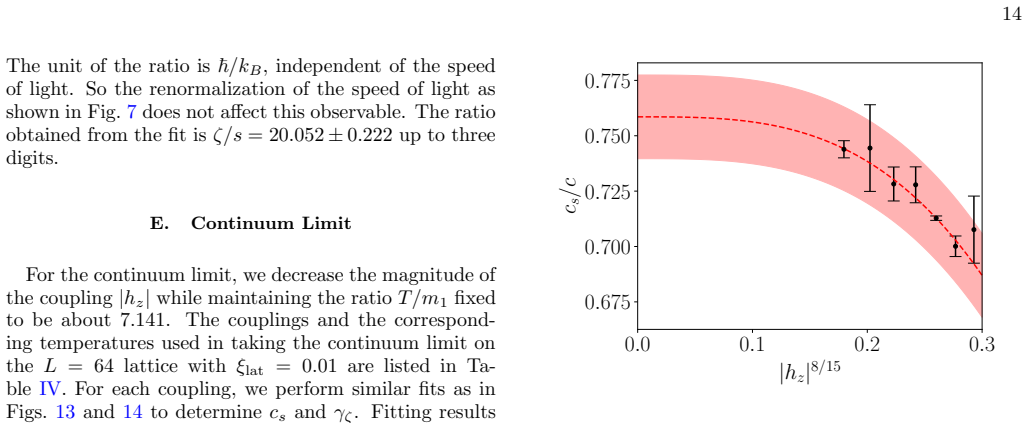
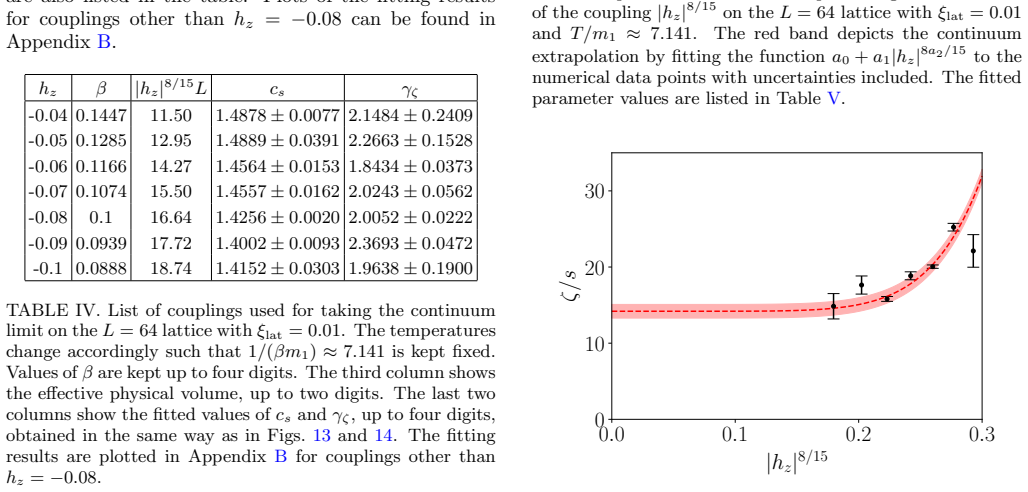
In the scaling region of the lattice theory, Umklapp processes are suppressed and the sound modes of relativistic hydrodynamics emerge at long wavelength and late time. The extracted ratio of bulk viscosity to entropy density is ζ/s=14.19±0.90 and the speed of sound is c_s/c=0.76 ± 0.02 at the temperature T≈7.14 in units of the lowest stable particle's mass.
What carries the argument
Real-time symmetric correlation function of the stress-energy tensor, computed via lattice Hamiltonian simulation with exact diagonalization and matrix product states.
If this is right
- Sound modes of relativistic hydrodynamics appear at long wavelength and late time once Umklapp processes are suppressed.
- The ratio of bulk viscosity to entropy density equals 14.19 plus or minus 0.90 at the stated temperature.
- The speed of sound equals 0.76 times the speed of light at the same temperature.
- Real-time lattice Hamiltonian simulation can describe hydrodynamization and yield transport coefficients nonperturbatively in this theory.
Where Pith is reading between the lines
- The same lattice approach could be used to extract shear viscosity if the full stress-tensor correlator is accessible.
- If the scaling region remains accessible in other non-integrable models, lattice methods might systematically connect microscopic field theories to macroscopic hydrodynamics.
- The reported suppression of Umklapp processes suggests that similar real-time simulations could test hydrodynamic predictions in systems where analytic control is limited.
Load-bearing premise
The chosen lattice discretization and parameters place the simulation inside a scaling region where continuum hydrodynamics is recovered without dominant lattice artifacts or finite-volume effects altering the transport coefficients.
What would settle it
Repeating the simulation on a significantly finer lattice spacing or larger volume and obtaining a ζ/s value outside the reported uncertainty range would falsify the claim that the extracted coefficients represent the continuum hydrodynamic limit.
Figures
read the original abstract
We calculate the real-time symmetric correlation function of the stress-energy tensor for a non-integrable Ising field theory consisting of three stable scalar particles via lattice Hamiltonian simulation. Using classical exact diagonalization and the matrix product state tensor network methods, we find that in the scaling region of the lattice theory, Umklapp processes are suppressed and the sound modes of relativistic hydrodynamics emerge at long wavelength and late time. The extracted ratio of bulk viscosity to entropy density is $\zeta/s=14.19\pm 0.90$ and the speed of sound is $c_s/c=0.76 \pm 0.02$ at the temperature $T\approx 7.14$ in units of the lowest stable particle's mass. Our study demonstrates the utility of real-time lattice Hamiltonian simulation for describing hydrodynamization and calculating transport coefficients nonperturbatively.
Editorial analysis
A structured set of objections, weighed in public.
Referee Report
Summary. The manuscript presents a study of real-time symmetric correlation functions of the stress-energy tensor in a non-integrable Ising field theory with three stable particles, simulated on the lattice using exact diagonalization and matrix product state methods. The authors claim that in the scaling region, Umklapp processes are suppressed, leading to the emergence of sound modes from relativistic hydrodynamics at long wavelengths and late times. They extract the ratio of bulk viscosity to entropy density as ζ/s = 14.19 ± 0.90 and the speed of sound as c_s/c = 0.76 ± 0.02 at a temperature T ≈ 7.14 (in units of the lowest stable particle mass), demonstrating the potential of such simulations for calculating transport coefficients nonperturbatively.
Significance. Should the central claim be validated, this work would be significant as it offers a non-perturbative, real-time approach to studying hydrodynamization and transport in quantum field theories using lattice methods, which could have implications for understanding hydrodynamic behavior in strongly coupled systems. The combination of classical exact diagonalization and tensor network techniques for real-time evolution is a notable technical aspect.
major comments (2)
- Abstract: the claim that 'in the scaling region of the lattice theory, Umklapp processes are suppressed' (allowing sound modes of relativistic hydrodynamics to emerge) is load-bearing for the central hydrodynamic interpretation and the reported values of ζ/s and c_s, but the manuscript provides no explicit scaling tests such as results at multiple lattice spacings or volumes demonstrating convergence of the extracted coefficients.
- Abstract and methods description: the temperature T≈7.14 (in units of the lowest stable particle mass) and the assertion that the chosen parameters place the simulation inside the scaling regime without dominant lattice artifacts or finite-volume effects are not supported by quantitative checks (e.g., finite-size scaling of the late-time stress-tensor correlator), leaving the transport-coefficient extraction vulnerable to discretization contamination.
minor comments (1)
- The abstract reports numerical results with error bars, but additional details on the fitting procedures, data cuts, and convergence checks used to extract ζ/s and c_s from the correlation functions would improve reproducibility and clarity.
Simulated Author's Rebuttal
We thank the referee for their thorough review and constructive comments. The concerns about explicit demonstrations of the scaling regime are well taken and directly relevant to the robustness of the hydrodynamic interpretation. We address each major comment below and will revise the manuscript to incorporate additional supporting analyses.
read point-by-point responses
-
Referee: Abstract: the claim that 'in the scaling region of the lattice theory, Umklapp processes are suppressed' (allowing sound modes of relativistic hydrodynamics to emerge) is load-bearing for the central hydrodynamic interpretation and the reported values of ζ/s and c_s, but the manuscript provides no explicit scaling tests such as results at multiple lattice spacings or volumes demonstrating convergence of the extracted coefficients.
Authors: We agree that the manuscript does not present explicit scaling tests across multiple lattice spacings or volumes in the results shown. Parameter choices were guided by the known continuum scaling of the Ising field theory, and the emergence of hydrodynamic sound modes is taken as evidence of Umklapp suppression, but direct convergence checks for the extracted coefficients are absent. In the revised manuscript we will add comparisons at different lattice spacings (where computationally feasible) and volumes to demonstrate convergence of ζ/s and c_s. revision: yes
-
Referee: Abstract and methods description: the temperature T≈7.14 (in units of the lowest stable particle mass) and the assertion that the chosen parameters place the simulation inside the scaling regime without dominant lattice artifacts or finite-volume effects are not supported by quantitative checks (e.g., finite-size scaling of the late-time stress-tensor correlator), leaving the transport-coefficient extraction vulnerable to discretization contamination.
Authors: The reported temperature is extracted from the energy density of the thermal ensemble at the chosen parameters. The scaling regime is inferred from the observed suppression of Umklapp scattering and the appearance of relativistic sound modes. We acknowledge that quantitative finite-size scaling of the late-time correlator and explicit checks against lattice artifacts are not provided. We will include such analyses (e.g., system-size dependence of the correlator) in the revised manuscript to substantiate that finite-volume and discretization effects are under control. revision: yes
Circularity Check
No significant circularity; transport coefficients extracted from simulated correlators.
full rationale
The paper computes the real-time symmetric stress-energy tensor correlation function via lattice Hamiltonian simulation (exact diagonalization and MPS) for a non-integrable Ising field theory. The values ζ/s = 14.19 ± 0.90 and c_s/c = 0.76 ± 0.02 are obtained by analyzing the late-time, long-wavelength behavior of these simulated correlators in the scaling region. These quantities are outputs of the numerical computation rather than input parameters, fitted targets, or quantities defined in terms of the hydrodynamic modes themselves. The observation that Umklapp processes are suppressed follows from the simulation results in the chosen parameter regime and is not imposed by construction. No load-bearing step reduces to a self-citation chain or to a renaming of the input data.
Axiom & Free-Parameter Ledger
axioms (1)
- domain assumption The lattice Hamiltonian in the scaling region faithfully reproduces the continuum non-integrable Ising field theory hydrodynamics
Reference graph
Works this paper leans on
-
[1]
A previous work using MPS to study real-time correla- tors in this field theory can be found in Ref
We also discuss the renormalization flows of several quantities against the bare couplings and extract the bulk viscosity and the speed of sound in the continuum limit. A previous work using MPS to study real-time correla- tors in this field theory can be found in Ref. [44], which didn’t study correlators of the stress-energy tensors, nei- ther showed the...
Pith/arXiv arXiv 2026
-
[2]
H. Song, S. A. Bass, U. Heinz, T. Hirano, and C. Shen, 200 A GeV Au+Au collisions serve a nearly per- fect quark-gluon liquid, Phys. Rev. Lett.106, 192301 (2011), [Erratum: Phys.Rev.Lett. 109, 139904 (2012)], arXiv:1011.2783 [nucl-th]
Pith/arXiv arXiv 2011
-
[3]
B. Schenke, S. Jeon, and C. Gale, Elliptic and triangular flow in event-by-event (3+1)D viscous hydrodynamics, Phys. Rev. Lett.106, 042301 (2011), arXiv:1009.3244 [hep-ph]
Pith/arXiv arXiv 2011
-
[4]
J. E. Bernhard, J. S. Moreland, and S. A. Bass, Bayesian estimation of the specific shear and bulk viscosity of quark–gluon plasma, Nature Phys.15, 1113 (2019)
2019
-
[5]
G. Nijs, W. van der Schee, U. G¨ ursoy, and R. Snellings, Transverse Momentum Differential Global Analysis of Heavy-Ion Collisions, Phys. Rev. Lett.126, 202301 (2021), arXiv:2010.15130 [nucl-th]
arXiv 2021
-
[6]
G. Policastro, D. T. Son, and A. O. Starinets, The Shear viscosity of strongly coupled N=4 supersymmetric Yang-Mills plasma, Phys. Rev. Lett.87, 081601 (2001), arXiv:hep-th/0104066
Pith/arXiv arXiv 2001
-
[7]
G. D. Moore, Shear viscosity in QCD and why it’s hard to calculate, inCriticality in QCD and the Hadron Res- onance Gas(2020) arXiv:2010.15704 [hep-ph]
arXiv 2020
-
[8]
Jeon, Hydrodynamic transport coefficients in rela- tivistic scalar field theory, Phys
S. Jeon, Hydrodynamic transport coefficients in rela- tivistic scalar field theory, Phys. Rev. D52, 3591 (1995), arXiv:hep-ph/9409250
Pith/arXiv arXiv 1995
-
[9]
S. Jeon and L. G. Yaffe, From quantum field theory to hydrodynamics: Transport coefficients and effective kinetic theory, Phys. Rev. D53, 5799 (1996), arXiv:hep- ph/9512263
arXiv 1996
- [10]
- [11]
-
[12]
J. Ghiglieri, G. D. Moore, and D. Teaney, QCD Shear Viscosity at (almost) NLO, JHEP (03), 1, arXiv:1802.09535 [hep-ph]
-
[13]
H. B. Meyer, A Calculation of the shear viscosity in SU(3) gluodynamics, Phys. Rev. D76, 101701 (2007), arXiv:0704.1801 [hep-lat]
Pith/arXiv arXiv 2007
-
[14]
S. W. Mages, S. Bors´ anyi, Z. Fodor, A. Sch¨ afer, and K. Szab´ o, Shear Viscosity from Lattice QCD, PoSLAT- TICE2014, 232 (2015)
2015
-
[15]
E. Itou and Y. Nagai, Sparse modeling approach to obtaining the shear viscosity from smeared correlation functions, JHEP07, 007, arXiv:2004.02426 [hep-lat]
arXiv 2004
-
[16]
E. Itou and Y. Nagai, QCD viscosity by combining the gradient flow and sparse modeling methods, PoSLAT- TICE2021, 214 (2022), arXiv:2110.13417 [hep-lat]
arXiv 2022
-
[17]
Altenkort, A
L. Altenkort, A. M. Eller, A. Francis, O. Kaczmarek, L. Mazur, G. D. Moore, and H.-T. Shu, Viscosity of pure-glue qcd from the lattice, Phys. Rev. D108, 014503 (2023)
2023
-
[18]
T. D. Cohen, H. Lamm, S. Lawrence, and Y. Yamauchi (NuQS), Quantum algorithms for transport coefficients in gauge theories, Phys. Rev. D104, 094514 (2021), arXiv:2104.02024 [hep-lat]
arXiv 2021
- [19]
-
[20]
N. Mueller, T. V. Zache, and R. Ott, Thermalization of Gauge Theories from their Entanglement Spectrum, Phys. Rev. Lett.129, 011601 (2022), arXiv:2107.11416 [quant-ph]
arXiv 2022
-
[21]
X. Yao, SU(2) gauge theory in 2+1 dimensions on a plaquette chain obeys the eigenstate thermaliza- tion hypothesis, Phys. Rev. D108, L031504 (2023), arXiv:2303.14264 [hep-lat]
arXiv 2023
- [22]
-
[23]
K. Lee, J. Mulligan, F. Ringer, and X. Yao, Liouvillian dynamics of the open Schwinger model: String breaking and kinetic dissipation in a thermal medium, Phys. Rev. D108, 094518 (2023), arXiv:2308.03878 [quant-ph]
arXiv 2023
- [24]
-
[25]
J. Lin, D. Luo, X. Yao, and P. E. Shanahan, Real-time dynamics of the Schwinger model as an open quantum system with Neural Density Operators, JHEP06, 211, arXiv:2402.06607 [hep-ph]
- [26]
-
[27]
N. Mueller, T. Wang, O. Katz, Z. Davoudi, and M. Cetina, Quantum Computing Universal Thermal- ization Dynamics in a (2+1)D Lattice Gauge Theory, (2024), arXiv:2408.00069 [quant-ph]
arXiv 2024
- [28]
- [29]
-
[30]
J. C. Halimeh, N. Mueller, J. Knolle, Z. Papi´ c, and Z. Davoudi, Quantum simulation of out-of-equilibrium dynamics in gauge theories, (2025), arXiv:2509.03586 [quant-ph]
Pith/arXiv arXiv 2025
-
[31]
D. Das, L. Ebner, S. V. Kadam, I. Raychowdhury, A. Sch¨ afer, and X. Yao, Eigenstate thermalization in (1+1)-dimensional SU(2) lattice gauge theory coupled with dynamical fermions, Phys. Rev. D113, 074514 (2026), arXiv:2509.18269 [hep-th]
Pith/arXiv arXiv 2026
-
[32]
Z. Li, M. Illa, and M. J. Savage, A Framework for Quan- tum Simulations of Energy-Loss and Hadronization in Non-Abelian Gauge Theories: SU(2) Lattice Gauge Theory in 1+1D, (2025), arXiv:2512.05210 [quant-ph]
Pith/arXiv arXiv 2025
- [33]
-
[34]
A. T. Than, S. V. Kadam, V. Vikramaditya, N. H. Nguyen, X. Liu, Z. Davoudi, A. M. Green, and N. M. Linke, Observation of quantum-field-theory dy- namics on a spin-phonon quantum computer, (2025), arXiv:2509.11477 [quant-ph]
arXiv 2025
- [35]
- [36]
-
[37]
J.-W. Chen, Y.-T. Chen, G. Meher, B. M¨ uller, A. Sch¨ afer, and X. Yao, Thermalization of SU(2) Lat- tice Gauge Fields on Quantum Computers, (2026), arXiv:2603.23948 [hep-lat]
Pith/arXiv arXiv 2026
-
[38]
F. Turro and X. Yao, Emergent hydrodynamic mode on SU(2) plaquette chains and quantum simulation, Phys. Rev. D111, 094502 (2025), arXiv:2502.17551 [hep-ph]
arXiv 2025
-
[39]
B. Ye, F. Machado, C. D. White, R. S. K. Mong, and N. Y. Yao, Emergent hydrodynamics in nonequilibrium quantum systems, Phys. Rev. Lett.125, 030601 (2020)
2020
-
[40]
C. Zuet al., Emergent hydrodynamics in a strongly in- teracting dipolar spin ensemble, Nature597, 45 (2021), arXiv:2104.07678 [quant-ph]
arXiv 2021
-
[41]
L. D. Landau, E. M. Lifshitz, and L. P. Pitaevskii, Statistical Physics, Part 2: Theory of the Condensed State, 1st ed., Course of Theoretical Physics, Vol. 9 (Butterworth-Heinemann, Oxford, 1980)
1980
-
[42]
P. B. Arnold and L. G. Yaffe, Effective theories for real time correlations in hot plasmas, Phys. Rev. D57, 1178 (1998), arXiv:hep-ph/9709449
Pith/arXiv arXiv 1998
-
[43]
Vidal, Efficient classical simulation of slightly entan- gled quantum computations, Physical Review Letters 91, 147902 (2003)
G. Vidal, Efficient classical simulation of slightly entan- gled quantum computations, Physical Review Letters 91, 147902 (2003)
2003
-
[44]
D. P´ erez-Garc´ ıa, F. Verstraete, M. M. Wolf, and J. I. Cirac, Matrix product state representations, Quantum Information & Computation7, 401 (2007), arXiv:quant- ph/0608197
arXiv 2007
-
[45]
M. C. Banuls, M. P. Heller, K. Jansen, J. Knaute, and V. Svensson, From spin chains to real-time thermal field theory using tensor networks, Phys. Rev. Res.2, 033301 (2020), arXiv:1912.08836 [hep-th]
arXiv 2020
-
[46]
G. Delfino, P. Grinza, and G. Mussardo, Decay of parti- cles above threshold in the Ising field theory with mag- netic field, Nucl. Phys. B737, 291 (2006), arXiv:hep- th/0507133
arXiv 2006
-
[47]
R. G. Jha, A. Milsted, D. Neuenfeld, J. Preskill, and P. Vieira, Real-time scattering in Ising field theory using matrix product states, Phys. Rev. Res.7, 023266 (2025), arXiv:2411.13645 [hep-th]
arXiv 2025
-
[48]
A. B. Zamolodchikov, Integrable field theory from con- formal field theory, Adv. Stud. Pure Math.19, 641 (1989)
1989
-
[49]
A. B. Zamolodchikov, Integrals of Motion and S Ma- trix of the (Scaled) T=T(c) Ising Model with Magnetic Field, Int. J. Mod. Phys. A4, 4235 (1989)
1989
-
[50]
Coldea, D
R. Coldea, D. A. Tennant, E. M. Wheeler, E. Wawrzyn- ska, D. Prabhakaran, M. Telling, K. Habicht, P. Smeibidl, and K. Kiefer, Quantum criticality in an ising chain: Experimental evidence for emergentE 8 symmetry, Science327, 177 (2010)
2010
-
[51]
B. M. McCoy and T. T. Wu, Two-dimensional ising field theory in a magnetic field: Breakup of the cut in the two-point function, Phys. Rev. D18, 1259 (1978)
1978
-
[52]
G. Delfino and G. Mussardo, The spin-spin correlation function in the two-dimensional ising model in a mag- netic field att=t c, Nucl. Phys. B455, 724 (1995), arXiv:hep-th/9507010
Pith/arXiv arXiv 1995
-
[53]
P. Fonseca and A. Zamolodchikov, Ising field theory in a magnetic field: analytic properties of the free energy (2001), arXiv:hep-th/0112167 [hep-th]
Pith/arXiv arXiv 2001
-
[54]
G. Delfino, Particle decay in ising field theory with mag- netic field, in15th International Congress on Mathemat- ical Physics(2007) arXiv:hep-th/0703288 [hep-th]
Pith/arXiv arXiv 2007
-
[55]
B. Gabai and X. Yin, On the s-matrix of ising field theory in two dimensions, J. High Energ. Phys.2022 (10), 168, arXiv:1905.00710 [hep-th]
arXiv 2022
-
[56]
A. L. Fitzpatrick, E. Katz, and Y. Xin, Lightcone hamiltonian for ising field theory i:t < t c (2023), arXiv:2311.16290 [hep-th]
arXiv 2023
-
[57]
R. C. Farrell, N. A. Zemlevskiy, M. Illa, and J. Preskill, Digital quantum simulations of scattering in quantum field theories using W states, (2025), arXiv:2505.03111 [quant-ph]
arXiv 2025
-
[58]
R. X. Siew, S. Chandrasekharan, and T. Bhat- tacharya, Asymptotic-freedom and massive glueballs in a qubit-regularized SU(2) gauge theory, (2025), arXiv:2512.11068 [hep-lat]
arXiv 2025
-
[59]
R. A. Davison and L. V. Delacretaz, Universal thermal- ization dynamics in (1+1)d QFTs, SciPost Phys.18, 177 (2025), arXiv:2409.09112 [hep-th]
arXiv 2025
-
[60]
K. Lee, F. Turro, and X. Yao, Quantum computing for energy correlators, Phys. Rev. D111, 054514 (2025), arXiv:2409.13830 [hep-ph]
arXiv 2025
-
[61]
Verstraete and J
F. Verstraete and J. I. Cirac, Matrix product states rep- resent ground states faithfully, Phys. Rev. B73, 094423 (2006)
2006
-
[62]
M. B. Hastings, An area law for one dimensional quan- tum systems, Journal of Statistical Mechanics: Theory and Experiment2007, P08024 (2007), arXiv:0705.2024 [quant-ph]
Pith/arXiv arXiv 2007
-
[63]
Eisert, M
J. Eisert, M. Cramer, and M. B. Plenio, Colloquium: Area laws for the entanglement entropy, Rev. Mod. Phys.82, 277 (2010)
2010
-
[64]
Verstraete, J
F. Verstraete, J. J. Garc´ ıa-Ripoll, and J. I. Cirac, Ma- trix product density operators: Simulation of finite- temperature and dissipative systems, Phys. Rev. Lett. 93, 207204 (2004)
2004
-
[65]
M. M. Wolf, F. Verstraete, M. B. Hastings, and J. I. Cirac, Area laws in quantum systems: Mutual infor- mation and correlations, Phys. Rev. Lett.100, 070502 (2008)
2008
-
[66]
Berta, F
M. Berta, F. G. S. L. Brand˜ ao, J. Haegeman, V. B. Scholz, and F. Verstraete, Thermal states as convex combinations of matrix product states, Phys. Rev. B 98, 235154 (2018)
2018
-
[67]
Fishman, S
M. Fishman, S. R. White, and E. M. Stoudenmire, The ITensor Software Library for Tensor Network Calcula- tions, SciPost Phys. Codebases , 4 (2022)
2022
-
[68]
Fishman, S
M. Fishman, S. R. White, and E. M. Stoudenmire, Codebase release 0.3 for ITensor, SciPost Phys. Code- bases , 4 (2022)
2022
-
[69]
A. E. Feiguin and S. R. White, Finite-temperature den- sity matrix renormalization using an enlarged hilbert 21 space, Phys. Rev. B72, 220401 (2005), arXiv:cond- mat/0510124 [cond-mat.str-el]
arXiv 2005
-
[70]
J. Houdayer and G. Misguich, Tensormixedstates: A ju- lia library for simulating pure and mixed quantum states using matrix product states (2025), arXiv:2505.11377 [quant-ph]
Pith/arXiv arXiv 2025
-
[71]
M¨ uller, Zum paradox der W¨ armeleitungstheorie, Zeitschrift f¨ ur Physik198, 329 (1967)
I. M¨ uller, Zum paradox der W¨ armeleitungstheorie, Zeitschrift f¨ ur Physik198, 329 (1967)
1967
-
[72]
Israel, Nonstationary irreversible thermodynamics: A Causal relativistic theory, Annals Phys.100, 310 (1976)
W. Israel, Nonstationary irreversible thermodynamics: A Causal relativistic theory, Annals Phys.100, 310 (1976)
1976
-
[73]
Israel and J
W. Israel and J. M. Stewart, Thermodynamics of non- stationary and transient effects in a relativistic gas, Phys. Lett. A58, 213 (1976)
1976
-
[74]
Israel and J
W. Israel and J. M. Stewart, Transient relativistic ther- modynamics and kinetic theory, Annals Phys.118, 341 (1979)
1979
-
[75]
R. Baier, P. Romatschke, D. T. Son, A. O. Starinets, and M. A. Stephanov, Relativistic viscous hydrodynam- ics, conformal invariance, and holography, JHEP04, 100, arXiv:0712.2451 [hep-th]
-
[76]
G. S. Denicol, H. Niemi, E. Molnar, and D. H. Rischke, Derivation of transient relativistic fluid dynamics from the Boltzmann equation, Phys. Rev. D85, 114047 (2012), [Erratum: Phys.Rev.D 91, 039902 (2015)], arXiv:1202.4551 [nucl-th]
Pith/arXiv arXiv 2012
-
[77]
F. S. Bemfica, F. S. Bemfica, M. M. Disconzi, M. M. Dis- conzi, J. Noronha, and J. Noronha, Nonlinear Causality of General First-Order Relativistic Viscous Hydrody- namics, Phys. Rev. D100, 104020 (2019), [Erratum: Phys.Rev.D 105, 069902 (2022)], arXiv:1907.12695 [gr- qc]
arXiv 2019
-
[78]
Kovtun, First-order relativistic hydrodynamics is sta- ble, JHEP10, 034, arXiv:1907.08191 [hep-th]
P. Kovtun, First-order relativistic hydrodynamics is sta- ble, JHEP10, 034, arXiv:1907.08191 [hep-th]
arXiv 1907
-
[79]
J. Armas and A. Jain, Effective field theory for hydro- dynamics without boosts, SciPost Phys.11, 054 (2021), arXiv:2010.15782 [hep-th]
arXiv 2021
-
[80]
J. Bhambure, A. Mazeliauskas, J.-F. Paquet, R. Singh, M. Singh, D. Teaney, and F. Zhou, Relativistic viscous hydrodynamics in the density frame: Numerical tests and comparisons, Phys. Rev. C111, 064910 (2025), arXiv:2412.10303 [nucl-th]
arXiv 2025
discussion (0)
Sign in with ORCID, Apple, or X to comment. Anyone can read and Pith papers without signing in.