Learning the Universe with cosmological rescaling of merger trees and semi-analytic galaxy formation models
Pith reviewed 2026-06-27 15:18 UTC · model grok-4.3
The pith
Rescaling merger trees from 64 base N-body simulations produces galaxy statistics across cosmological parameters at the accuracy of 750 full simulations.
A machine-rendered reading of the paper's core claim, the machinery that carries it, and where it could break.
Core claim
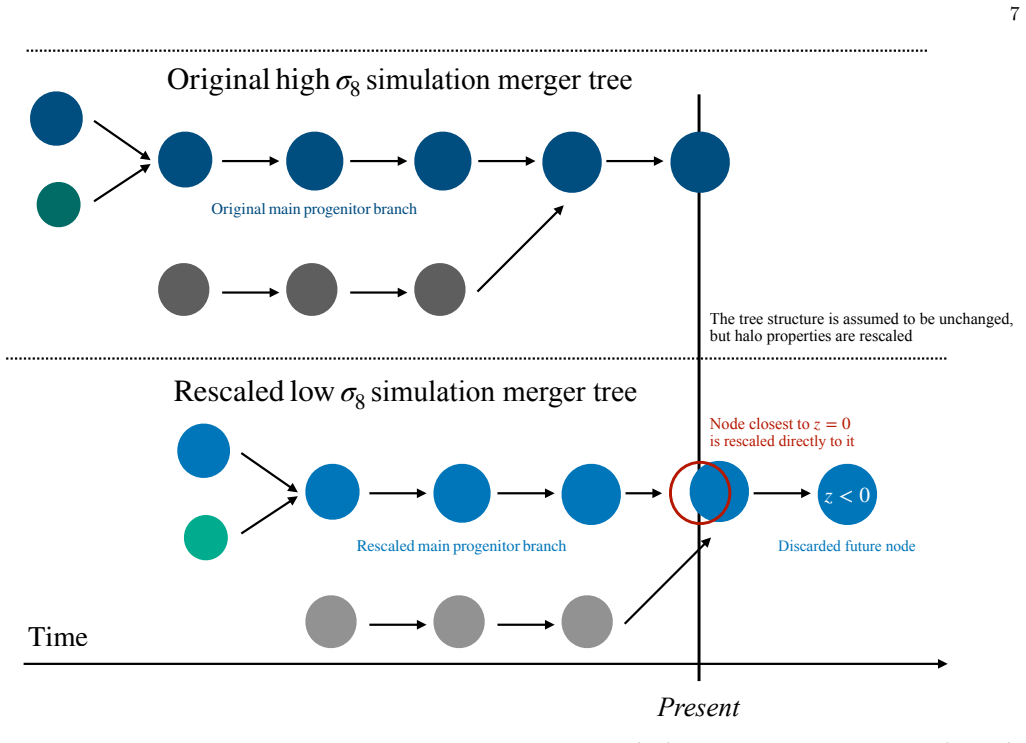
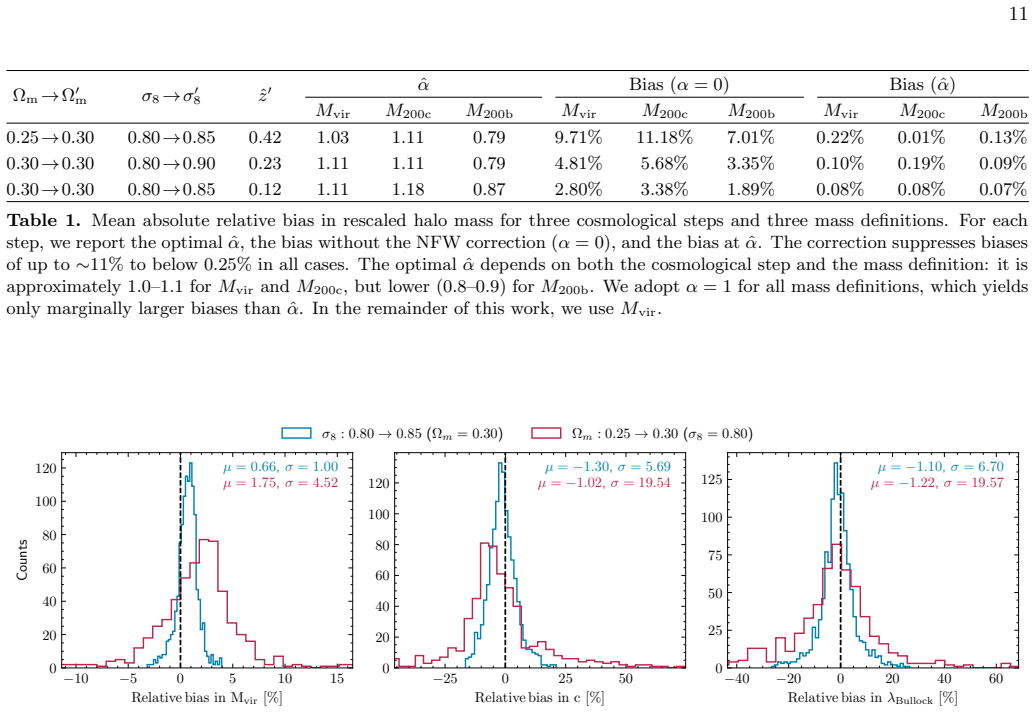
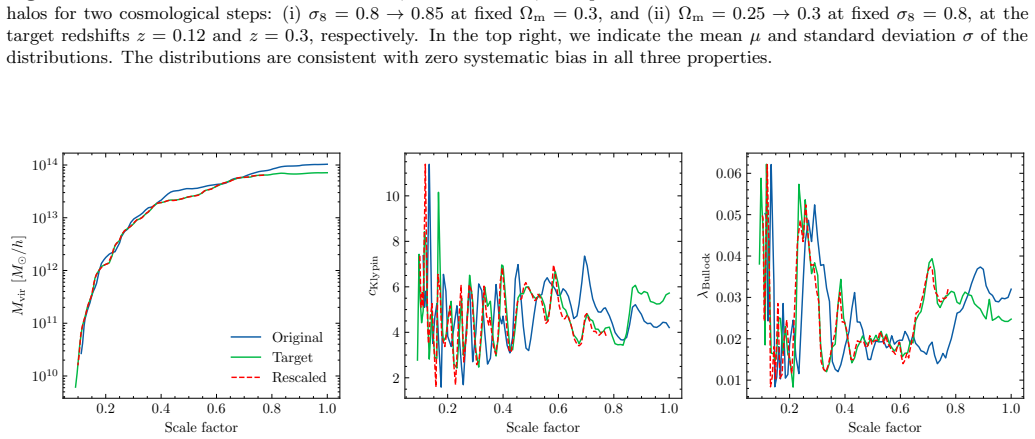
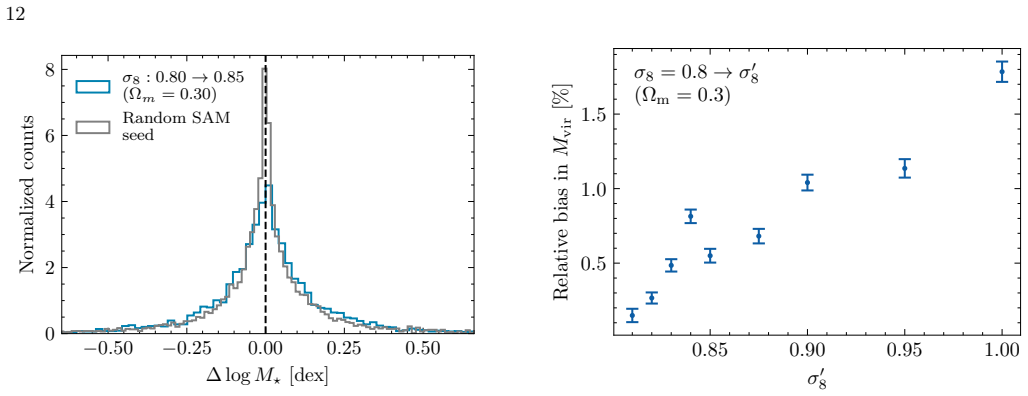
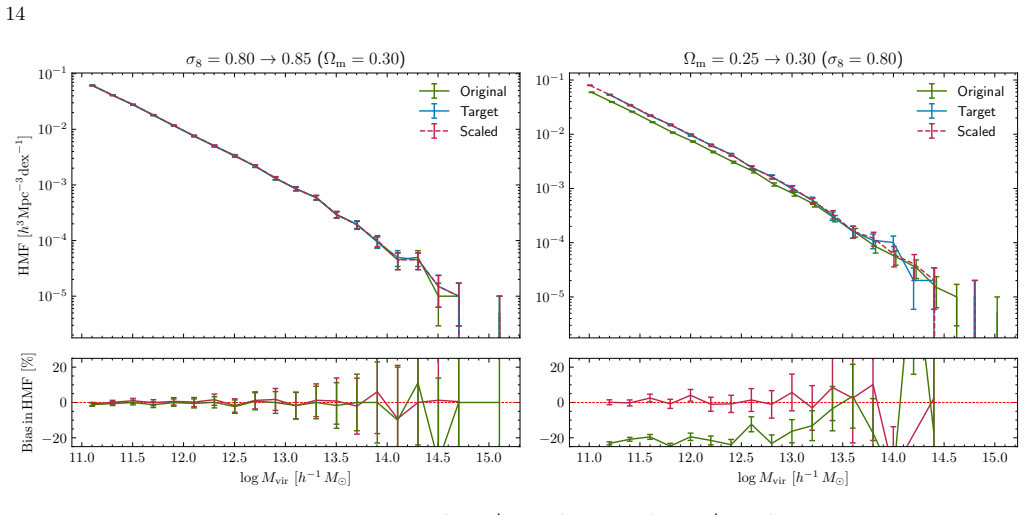
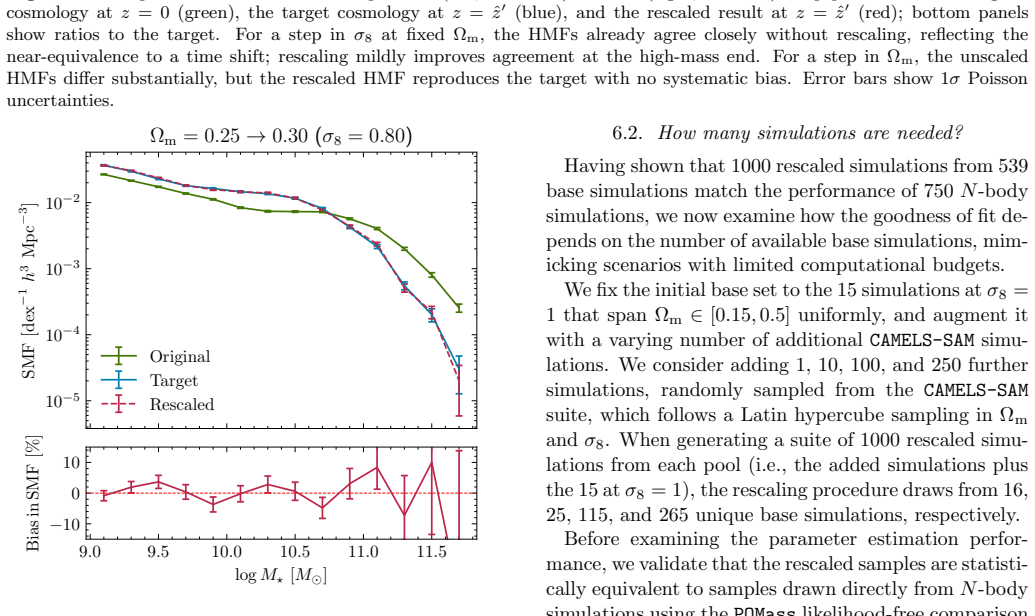
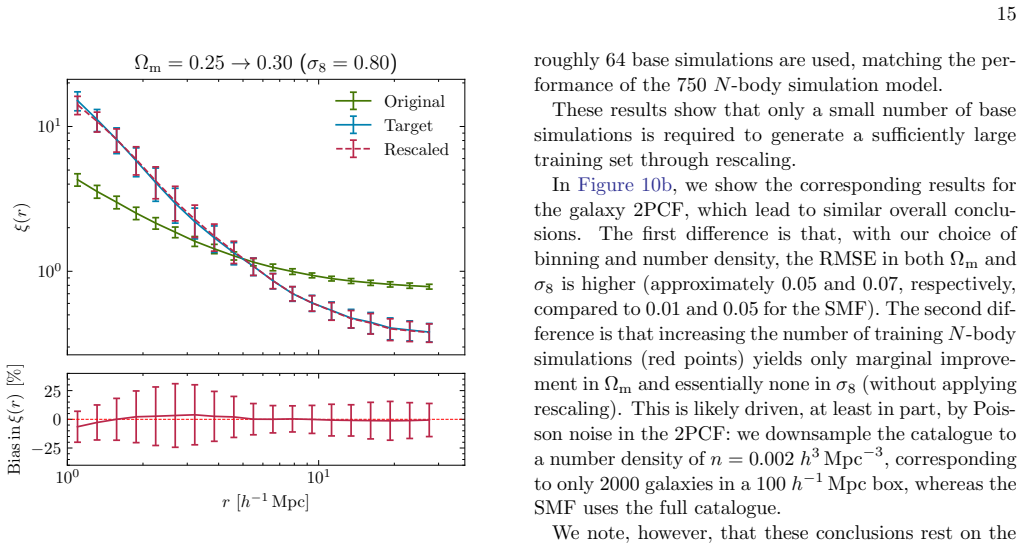
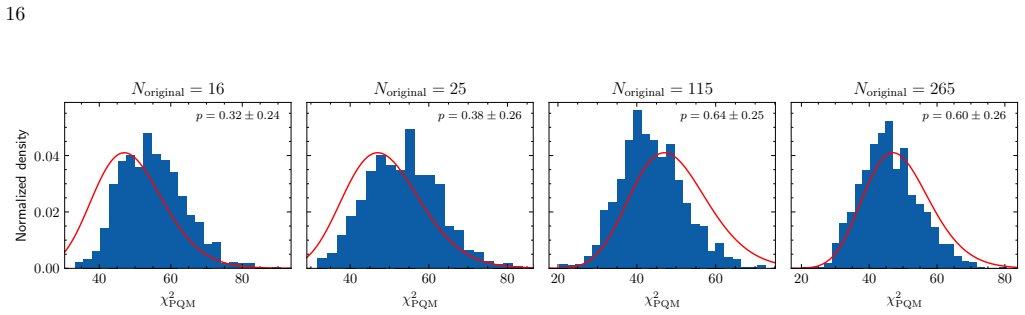
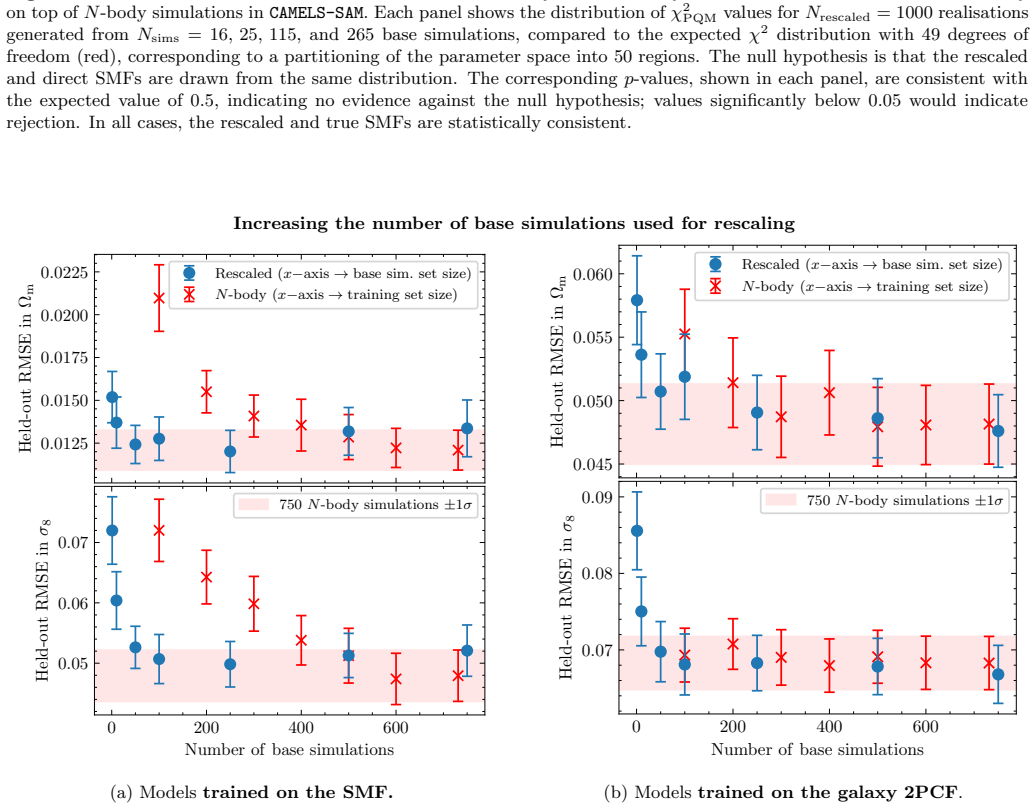
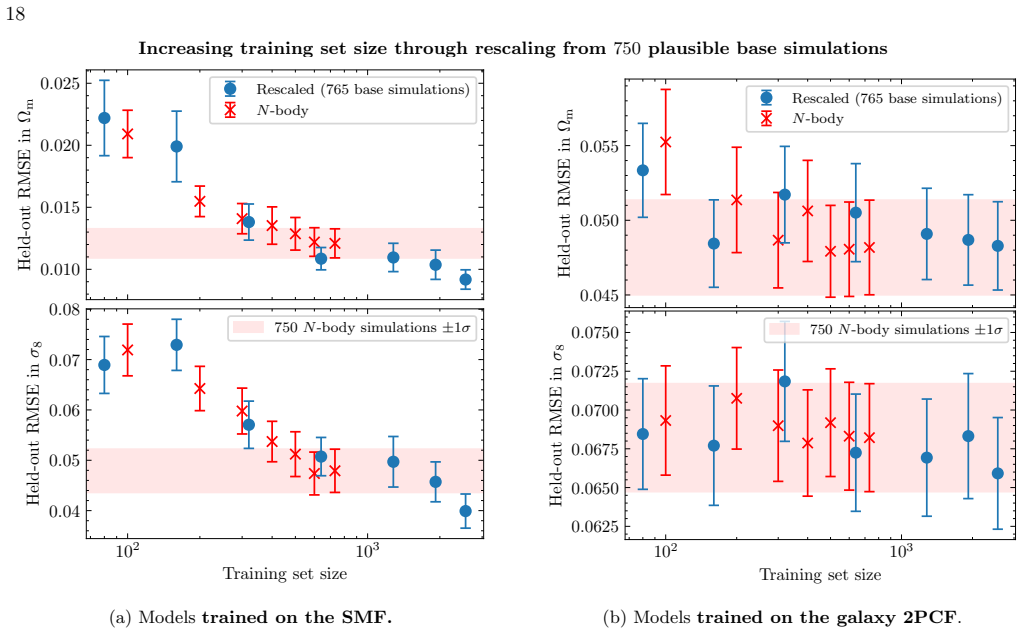
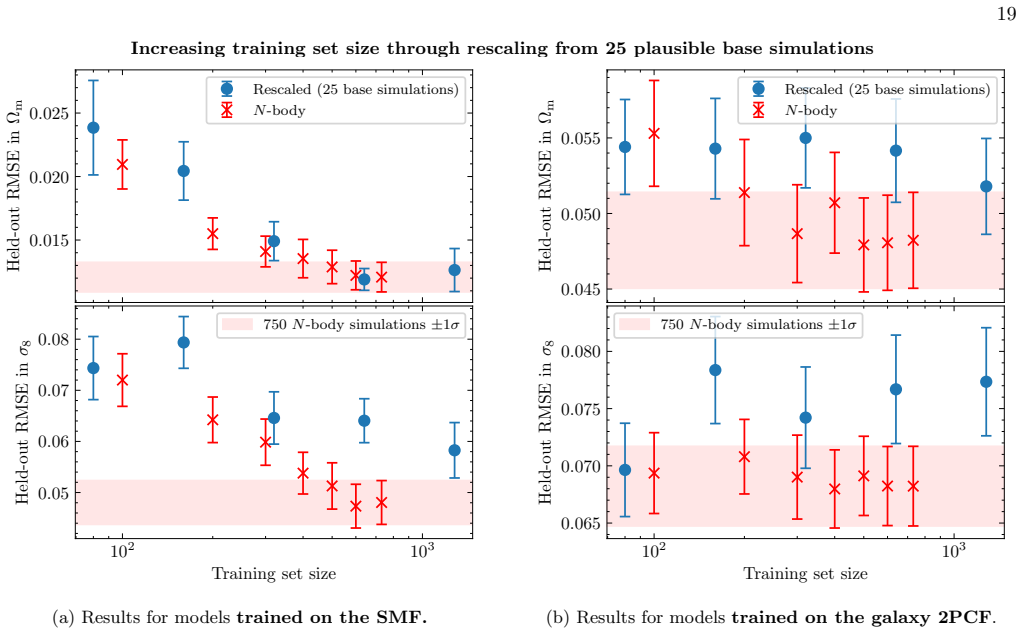
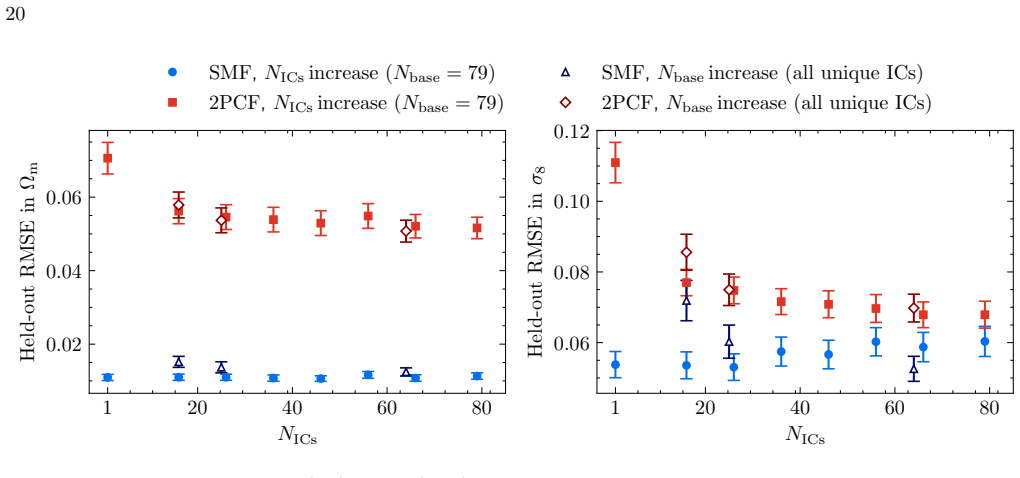
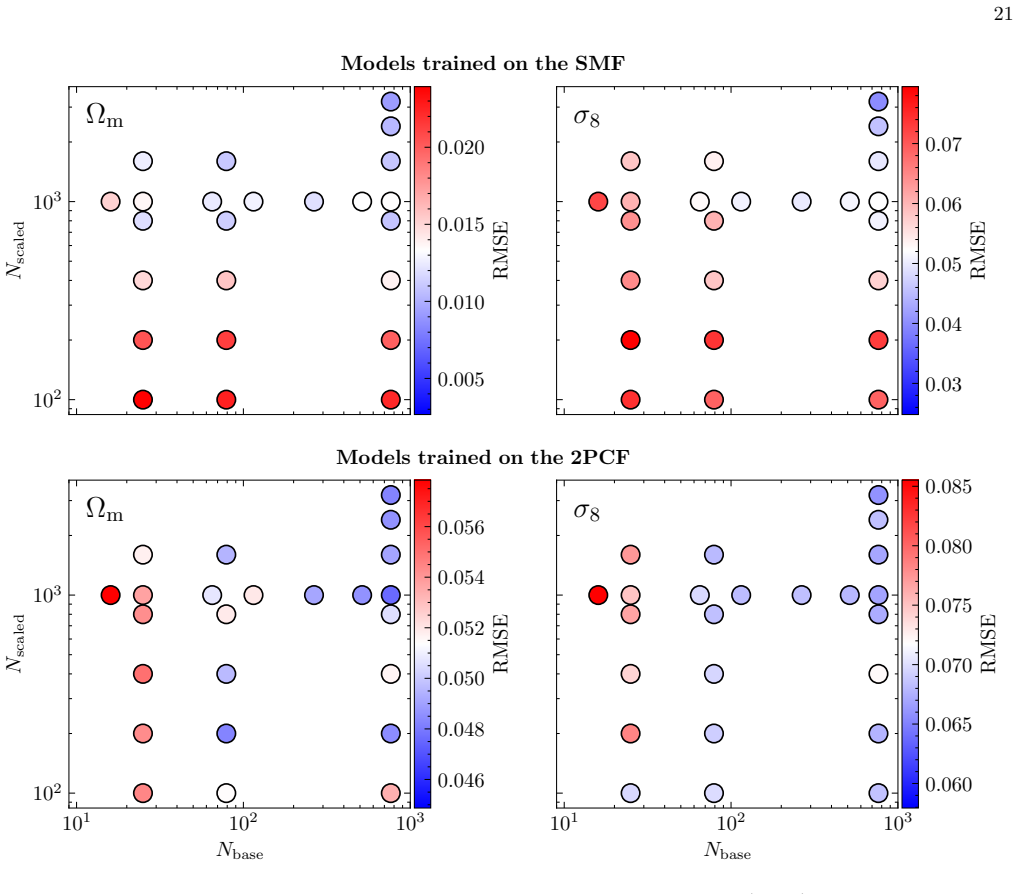
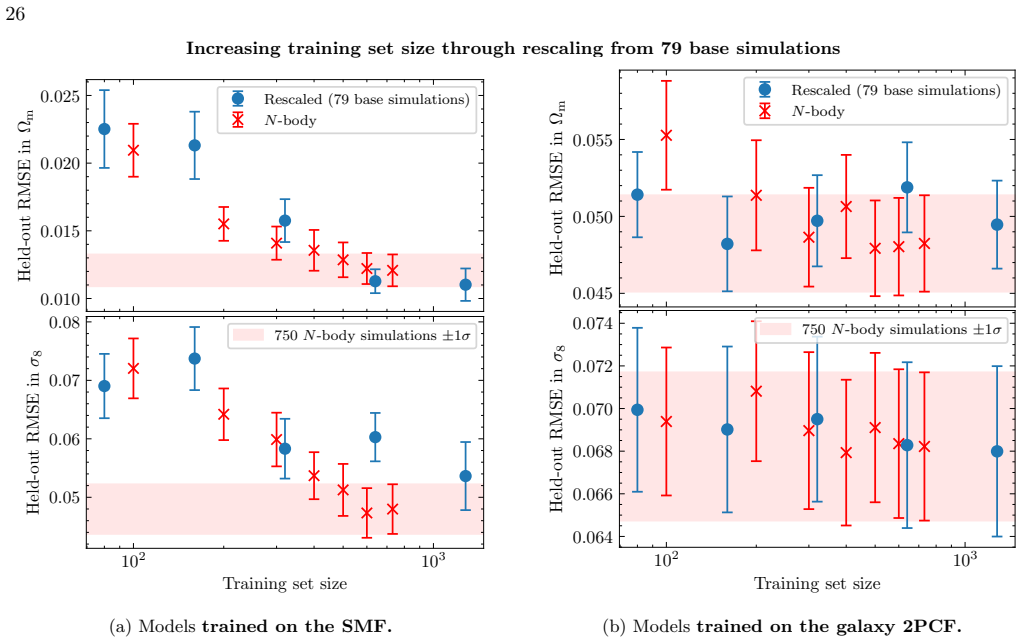
Extending cosmological rescaling to merger trees with a halo-profile-based correction controlled by one free parameter suppresses systematic bias in rescaled halo masses to below the percent level across the Omega_m-sigma_8 plane, enabling the Santa Cruz semi-analytic model to produce accurate galaxy summary statistics for new cosmologies at negligible added cost; as few as 64 base N-body simulations rescaled to about 1000 training samples match the accuracy of 750 dedicated N-body simulations for estimating Omega_m and sigma_8, with further improvement at 3200 realisations.
What carries the argument
Cosmological rescaling applied directly to merger trees together with a single-parameter halo-profile correction that adjusts masses to the target cosmology while feeding the Santa Cruz semi-analytic model.
If this is right
- Galaxy summary statistics become available across a dense grid of Omega_m and sigma_8 without the cost of new N-body simulations for each point.
- The computational overhead of rescaling all trees from one CAMELS-SAM simulation remains around 0.1 CPU hours.
- Prediction accuracy for Omega_m increases by roughly 25 percent when the number of rescaled realisations rises from 1000 to 3200.
- The same rescaled trees can be fed to other semi-analytic models at essentially zero extra cost.
Where Pith is reading between the lines
- The method could be combined with existing suites that already vary astrophysical parameters to produce joint cosmological and astrophysical training sets.
- If the single-parameter correction proves stable, the approach might be tested on other N-body codes or initial condition generators beyond those used here.
Load-bearing premise
The single free parameter in the halo-profile correction removes bias in rescaled halo masses to below one percent without degrading the accuracy of the semi-analytic galaxy formation outputs.
What would settle it
Compare the stellar mass function and two-point correlation function obtained from the rescaled trees against those from a set of fully independent N-body simulations run at the same target Omega_m and sigma_8 values and check whether the differences stay below the accuracy levels reported for the 64-to-750 equivalence.
Figures
read the original abstract
Learning cosmology from galaxy surveys requires large suites of simulations spanning the cosmological and astrophysical parameter space, yet hydrodynamical simulations of galaxy formation remain prohibitively expensive. Semi-analytic models offer an inexpensive, physically grounded alternative, but still require halo merger trees from $N$-body simulations, and densely sampling cosmological parameters in sufficient volume remains expensive. We address this by extending cosmological rescaling to operate directly on merger trees and applying it in the $\Omega_{\rm m}$-$\sigma_8$ plane, running the Santa Cruz semi-analytic model for galaxy formation on the rescaled trees to produce galaxy populations across new cosmological and astrophysical parameters at negligible additional cost. A novel halo-profile-based correction, controlled by a single free parameter, suppresses systematic bias in rescaled halo masses to below the per cent level. We apply the method to parameter estimation of $\Omega_{\rm m}$ and $\sigma_8$ given either the stellar mass function or the two-point correlation function, finding that as few as 64, and potentially fewer, base $N$-body simulations, rescaled to $\sim1000$ training samples, match the accuracy of 750 dedicated $N$-body simulations; rescaling to 3200 realisations improves the prediction of $\Omega_{\rm m}$ by $\sim25\%$. Rescaling all merger trees from a single CAMELS-SAM $N$-body simulation costs $\sim0.1$ CPUh, compared to several thousand CPUh to run the simulation itself. We demonstrate a practical route to obtaining predictions of galaxy summary statistics across cosmological and astrophysical parameters, even with a relatively small number of base $N$-body simulations.
Editorial analysis
A structured set of objections, weighed in public.
Referee Report
Summary. The paper extends cosmological rescaling techniques to operate directly on halo merger trees in the Ω_m-σ_8 plane. It applies a halo-profile-based correction controlled by a single free parameter to reduce systematic mass bias in the rescaled halos, then runs the Santa Cruz semi-analytic model on the corrected trees to generate galaxy populations. The central result is that rescaling from as few as 64 base N-body simulations to produce ~1000 training samples yields Ω_m and σ_8 inference accuracy comparable to that obtained from 750 dedicated N-body simulations when using either the stellar mass function or the two-point correlation function; further rescaling to 3200 realizations improves Ω_m prediction by ~25%. The computational cost of rescaling is stated to be negligible (~0.1 CPUh per CAMELS-SAM tree set).
Significance. If the rescaling plus single-parameter correction preserves merger-tree structure and SAM outputs to the claimed precision, the method offers a practical route to densely sampling cosmological and astrophysical parameter space for galaxy-survey inference at far lower cost than running equivalent suites of dedicated N-body simulations. This would be a useful efficiency gain for training sets used in cosmological parameter estimation from galaxy statistics.
major comments (2)
- [Section describing the halo-profile correction and its validation] The central accuracy claim (64 base simulations matching 750 dedicated ones) rests on the halo-profile correction suppressing mass bias to <1% uniformly across the Ω_m-σ_8 plane while leaving SAM galaxy statistics intact. The manuscript does not provide a quantitative validation (e.g., bias maps or residual distributions versus Ω_m and σ_8) demonstrating that a single scalar parameter achieves this uniformly; any cosmology-dependent residual from concentration-mass relations or subhalo stripping would propagate directly into the stellar-mass function and correlation function used for the inference comparison.
- [Results on Ω_m/σ_8 inference] The reported equivalence in parameter-estimation accuracy is presented without an explicit error budget or cross-validation that isolates the contribution of the rescaling correction from other modeling choices (e.g., the specific SAM parameter settings or the choice of summary statistics). It is therefore unclear whether the ~25% improvement quoted for 3200 realizations is robust to variations in the correction parameter or to the precise definition of the training-set size.
minor comments (2)
- [Methods] Notation for the single free parameter of the halo-profile correction should be introduced with an explicit equation and its fitting procedure described in a dedicated subsection.
- [Figure captions] Figure captions for any bias or accuracy plots should state the exact range of Ω_m and σ_8 values tested and whether the correction parameter was held fixed or re-tuned per cosmology.
Simulated Author's Rebuttal
We thank the referee for the constructive and detailed report. We address each major comment below and have revised the manuscript accordingly to strengthen the presentation of the halo-profile correction validation and the inference error budget.
read point-by-point responses
-
Referee: [Section describing the halo-profile correction and its validation] The central accuracy claim (64 base simulations matching 750 dedicated ones) rests on the halo-profile correction suppressing mass bias to <1% uniformly across the Ω_m-σ_8 plane while leaving SAM galaxy statistics intact. The manuscript does not provide a quantitative validation (e.g., bias maps or residual distributions versus Ω_m and σ_8) demonstrating that a single scalar parameter achieves this uniformly; any cosmology-dependent residual from concentration-mass relations or subhalo stripping would propagate directly into the stellar-mass function and correlation function used for the inference comparison.
Authors: We agree that explicit quantitative validation maps would strengthen the manuscript. In the revised version we will add bias maps and residual distributions of the corrected halo masses versus Ω_m and σ_8, confirming uniformity to <1% across the plane. The single-parameter correction is applied at the halo-profile level precisely to absorb cosmology-dependent effects from concentration-mass relations; any residual subhalo-stripping mismatches would appear as systematic offsets in the SAM outputs, yet the reported SMF and 2PCF inference accuracies match those from dedicated runs to within the quoted precision. We will add a short discussion of this point. revision: yes
-
Referee: [Results on Ω_m/σ_8 inference] The reported equivalence in parameter-estimation accuracy is presented without an explicit error budget or cross-validation that isolates the contribution of the rescaling correction from other modeling choices (e.g., the specific SAM parameter settings or the choice of summary statistics). It is therefore unclear whether the ~25% improvement quoted for 3200 realizations is robust to variations in the correction parameter or to the precise definition of the training-set size.
Authors: The equivalence is demonstrated by direct side-by-side comparison of the recovered Ω_m–σ_8 posteriors. To isolate the rescaling contribution we will add, in revision, an explicit error-budget subsection together with cross-validation tests that vary the correction parameter by ±20% around its fiducial value and recompute the inference accuracy. The training-set size is defined as the number of rescaled merger-tree realizations supplied to the emulator; we will clarify this definition and show the scaling of accuracy with training-set size (including the 1000-to-3200 step) to confirm robustness of the ~25% Ω_m improvement. revision: yes
Circularity Check
No significant circularity detected
full rationale
The paper's derivation introduces a novel halo-profile correction with one explicit free parameter to suppress rescaled halo mass bias, then validates the resulting SAM galaxy statistics against dedicated N-body runs. No step reduces by construction to its own inputs: the parameter is fitted to halo masses but the target claims (matching accuracy for Ω_m/σ_8 inference) rest on external comparisons, not self-definition or renaming. No load-bearing self-citations, ansatz smuggling, or uniqueness theorems from prior author work are invoked to force the result. The chain is self-contained against external benchmarks.
Axiom & Free-Parameter Ledger
free parameters (1)
- halo-profile correction parameter
axioms (1)
- domain assumption Cosmological rescaling applied directly to merger trees preserves the statistical properties required for accurate semi-analytic galaxy formation modeling in the Ω_m-σ_8 plane
Reference graph
Works this paper leans on
-
[1]
Cosmological constraints from the small scale clustering of Emission Line Galaxies
Cosmological constraints from the small scale clustering of Emission Line Galaxies. arXiv e-prints , keywords =. doi:10.48550/arXiv.2604.19449 , archivePrefix =. 2604.19449 , primaryClass =
work page internal anchor Pith review Pith/arXiv arXiv doi:10.48550/arxiv.2604.19449
-
[2]
Cosmological constraints from galaxy clustering and galaxy─galaxy lensing with extended SubHalo Abundance Matching. , keywords =. doi:10.1093/mnras/staf2143 , archivePrefix =. 2507.01601 , primaryClass =
-
[3]
Non-universality of the mass function: dependence on the growth rate and power spectrum shape. , keywords =. doi:10.1093/mnras/stab3337 , archivePrefix =. 2102.08958 , primaryClass =
-
[4]
The CAMELS Project: Cosmology and Astrophysics with Machine-learning Simulations. , keywords =. doi:10.3847/1538-4357/abf7ba , archivePrefix =. 2010.00619 , primaryClass =
-
[5]
Constraining Cosmology with Machine Learning and Galaxy Clustering: The CAMELS-SAM Suite. , keywords =. doi:10.3847/1538-4357/accd52 , archivePrefix =. 2204.02408 , primaryClass =
-
[6]
The AREPO Public Code Release. , keywords =. doi:10.3847/1538-4365/ab908c , archivePrefix =. 1909.04667 , primaryClass =
-
[7]
CAMB: Code for Anisotropies in the Microwave Background
-
[8]
The Rockstar Phase-Space Temporal Halo Finder and the Velocity Offsets of Cluster Cores
The ROCKSTAR Phase-space Temporal Halo Finder and the Velocity Offsets of Cluster Cores. , keywords =. doi:10.1088/0004-637X/762/2/109 , archivePrefix =. 1110.4372 , primaryClass =
work page internal anchor Pith review Pith/arXiv arXiv doi:10.1088/0004-637x/762/2/109
-
[9]
Gravitationally Consistent Halo Catalogs and Merger Trees for Precision Cosmology
Gravitationally Consistent Halo Catalogs and Merger Trees for Precision Cosmology. , keywords =. doi:10.1088/0004-637X/763/1/18 , archivePrefix =. 1110.4370 , primaryClass =
work page internal anchor Pith review Pith/arXiv arXiv doi:10.1088/0004-637x/763/1/18
-
[10]
Semi-analytic modelling of galaxy formation: the local Universe. , keywords =. doi:10.1046/j.1365-8711.1999.03032.x , archivePrefix =. astro-ph/9802268 , primaryClass =
-
[11]
2009, MNRAS, 394, 191, doi: 10.1111/j.1365-2966.2008.14359.x
A semi-analytic model for the co-evolution of galaxies, black holes and active galactic nuclei. , keywords =. doi:10.1111/j.1365-2966.2008.13805.x , archivePrefix =. 0808.1227 , primaryClass =
-
[12]
Star Formation in Semi-Analytic Galaxy Formation Models with Multiphase Gas
Star formation in semi-analytic galaxy formation models with multiphase gas. , keywords =. doi:10.1093/mnras/stv1877 , archivePrefix =. 1503.00755 , primaryClass =
work page internal anchor Pith review Pith/arXiv arXiv doi:10.1093/mnras/stv1877
-
[13]
Mock light-cones and theory friendly catalogues for the CANDELS survey. , keywords =. doi:10.1093/mnras/stab231 , archivePrefix =. 2102.00108 , primaryClass =
-
[14]
Galaxy scaling relations, dispersions, and residuals at z = 0
Galaxy formation in the Santa Cruz semi-analytic model compared with IllustrisTNG - I. Galaxy scaling relations, dispersions, and residuals at z = 0. , keywords =. doi:10.1093/mnras/stac2297 , archivePrefix =. 2111.03077 , primaryClass =
-
[15]
One simulation to fit them all - changing the background parameters of a cosmological N-body simulation. , keywords =. doi:10.1111/j.1365-2966.2010.16459.x , archivePrefix =. 0912.4277 , primaryClass =
-
[16]
How accurate is it to update the cosmology of your halo catalogues?. , keywords =. doi:10.1111/j.1365-2966.2011.19635.x , archivePrefix =. 1103.5074 , primaryClass =
-
[17]
Galaxy formation in WMAP1 and WMAP7 cosmologies
Galaxy formation in WMAP1 and WMAP7 cosmologies. , keywords =. doi:10.1093/mnras/sts115 , archivePrefix =. 1206.0052 , primaryClass =
work page internal anchor Pith review Pith/arXiv arXiv doi:10.1093/mnras/sts115
-
[18]
Remapping dark matter halo catalogues between cosmological simulations
Remapping dark matter halo catalogues between cosmological simulations. , keywords =. doi:10.1093/mnras/stu345 , archivePrefix =. 1308.5183 , primaryClass =
work page internal anchor Pith review Pith/arXiv arXiv doi:10.1093/mnras/stu345
-
[19]
A Universal Density Profile from Hierarchical Clustering
A Universal Density Profile from Hierarchical Clustering. , keywords =. doi:10.1086/304888 , archivePrefix =. astro-ph/9611107 , primaryClass =
work page internal anchor Pith review Pith/arXiv arXiv doi:10.1086/304888
-
[20]
Statistical Properties of X-ray Clusters: Analytic and Numerical Comparisons
Statistical Properties of X-Ray Clusters: Analytic and Numerical Comparisons. , keywords =. doi:10.1086/305262 , archivePrefix =. astro-ph/9710107 , primaryClass =
work page internal anchor Pith review Pith/arXiv arXiv doi:10.1086/305262
-
[21]
NIHAO project II: halo shape, phase-space density and velocity distribution of dark matter in galaxy formation simulations. , keywords =. doi:10.1093/mnras/stw1688 , archivePrefix =. 1503.04814 , primaryClass =
work page internal anchor Pith review Pith/arXiv arXiv doi:10.1093/mnras/stw1688
-
[22]
On the galaxy-halo connection in the EAGLE simulation
On the galaxy-halo connection in the EAGLE simulation. , keywords =. doi:10.1093/mnrasl/slx093 , archivePrefix =. 1612.01029 , primaryClass =
work page internal anchor Pith review Pith/arXiv arXiv doi:10.1093/mnrasl/slx093
-
[23]
Comparing galaxy formation in semi-analytic models and hydrodynamical simulations
Comparing galaxy formation in semi-analytic models and hydrodynamical simulations. , keywords =. doi:10.1093/mnras/stx2770 , archivePrefix =. 1709.08647 , primaryClass =
work page internal anchor Pith review Pith/arXiv arXiv doi:10.1093/mnras/stx2770
-
[24]
Baryons shaping dark matter haloes. , keywords =. doi:10.1093/mnras/staa3988 , archivePrefix =. 2008.02404 , primaryClass =
-
[25]
Evaluating the variance of individual halo properties in constrained cosmological simulations. , keywords =. doi:10.1093/mnras/stae2292 , archivePrefix =. 2310.20672 , primaryClass =
-
[26]
The Mass-Concentration-Redshift Relation of Cold and Warm Dark Matter Halos
The mass-concentration-redshift relation of cold and warm dark matter haloes. , keywords =. doi:10.1093/mnras/stw1046 , archivePrefix =. 1601.02624 , primaryClass =
work page internal anchor Pith review Pith/arXiv arXiv doi:10.1093/mnras/stw1046
-
[27]
CORRFUNC - a suite of blazing fast correlation functions on the CPU. , keywords =. doi:10.1093/mnras/stz3157 , archivePrefix =. 1911.03545 , primaryClass =
-
[28]
Bias and Variance of Angular Correlation Functions. , keywords =. doi:10.1086/172900 , adsurl =
-
[29]
Fast $\epsilon$-free Inference of Simulation Models with Bayesian Conditional Density Estimation
Fast -free Inference of Simulation Models with Bayesian Conditional Density Estimation. arXiv e-prints , keywords =. doi:10.48550/arXiv.1605.06376 , archivePrefix =. 1605.06376 , primaryClass =
work page internal anchor Pith review Pith/arXiv arXiv doi:10.48550/arxiv.1605.06376
-
[30]
Approximate Bayesian Computational methods
Approximate Bayesian Computational methods. arXiv e-prints , keywords =. doi:10.48550/arXiv.1101.0955 , archivePrefix =. 1101.0955 , primaryClass =
work page internal anchor Pith review Pith/arXiv arXiv doi:10.48550/arxiv.1101.0955
-
[31]
Proceedings of the National Academy of Science , keywords =
The frontier of simulation-based inference. Proceedings of the National Academy of Science , keywords =. doi:10.1073/pnas.1912789117 , archivePrefix =. 1911.01429 , primaryClass =
-
[32]
Automatic Posterior Transformation for Likelihood-Free Inference
Automatic Posterior Transformation for Likelihood-Free Inference. arXiv e-prints , keywords =. doi:10.48550/arXiv.1905.07488 , archivePrefix =. 1905.07488 , primaryClass =
work page internal anchor Pith review Pith/arXiv arXiv doi:10.48550/arxiv.1905.07488 1905
-
[33]
Massive optimal data compression and density estimation for scalable, likelihood-free inference in cosmology. , keywords =. doi:10.1093/mnras/sty819 , archivePrefix =. 1801.01497 , primaryClass =
work page internal anchor Pith review Pith/arXiv arXiv doi:10.1093/mnras/sty819
-
[34]
Sequential Neural Likelihood: Fast Likelihood-free Inference with Autoregressive Flows
Sequential Neural Likelihood: Fast Likelihood-free Inference with Autoregressive Flows. arXiv e-prints , keywords =. doi:10.48550/arXiv.1805.07226 , archivePrefix =. 1805.07226 , primaryClass =
work page internal anchor Pith review Pith/arXiv arXiv doi:10.48550/arxiv.1805.07226
-
[35]
Likelihood-free MCMC with Amortized Approximate Ratio Estimators. arXiv e-prints , keywords =. doi:10.48550/arXiv.1903.04057 , archivePrefix =. 1903.04057 , primaryClass =
-
[36]
Normalizing Flows for Probabilistic Modeling and Inference. arXiv e-prints , keywords =. doi:10.48550/arXiv.1912.02762 , archivePrefix =. 1912.02762 , primaryClass =
-
[37]
Mixture density networks
Bishop, Christopher M. Mixture density networks. 1994
1994
-
[38]
Optuna: A Next-generation Hyperparameter Optimization Framework
Optuna: A Next-generation Hyperparameter Optimization Framework. arXiv e-prints , keywords =. doi:10.48550/arXiv.1907.10902 , archivePrefix =. 1907.10902 , primaryClass =
work page internal anchor Pith review Pith/arXiv arXiv doi:10.48550/arxiv.1907.10902 1907
-
[39]
The Open Journal of Astrophysics , keywords =
LtU-ILI: An All-in-One Framework for Implicit Inference in Astrophysics and Cosmology. The Open Journal of Astrophysics , keywords =. doi:10.33232/001c.120559 , archivePrefix =. 2402.05137 , primaryClass =
-
[40]
Cook and Andrew Gelman and Donald B
Samantha R. Cook and Andrew Gelman and Donald B. Rubin , journal =. Validation of Software for Bayesian Models Using Posterior Quantiles , urldate =
-
[41]
Diagnostics for Conditional Density Models and Bayesian Inference Algorithms. arXiv e-prints , keywords =. doi:10.48550/arXiv.2102.10473 , archivePrefix =. 2102.10473 , primaryClass =
-
[42]
40th International Conference on Machine Learning , keywords =
Sampling-Based Accuracy Testing of Posterior Estimators for General Inference. 40th International Conference on Machine Learning , keywords =. doi:10.48550/arXiv.2302.03026 , archivePrefix =. 2302.03026 , primaryClass =
-
[43]
Gaussian Error Linear Units (GELUs)
Gaussian Error Linear Units (GELUs). arXiv e-prints , keywords =. doi:10.48550/arXiv.1606.08415 , archivePrefix =. 1606.08415 , primaryClass =
work page internal anchor Pith review Pith/arXiv arXiv doi:10.48550/arxiv.1606.08415
-
[44]
The BACCO simulation project: exploiting the full power of large-scale structure for cosmology. , keywords =. doi:10.1093/mnras/stab2018 , archivePrefix =. 2004.06245 , primaryClass =
-
[45]
A Quantification of the Butterfly Effect in Cosmological Simulations and Implications for Galaxy Scaling Relations. , keywords =. doi:10.3847/1538-4357/aaf4bb , archivePrefix =. 1807.07084 , primaryClass =
work page internal anchor Pith review Pith/arXiv arXiv doi:10.3847/1538-4357/aaf4bb
-
[46]
3 per cent-accurate predictions for the clustering of dark matter, haloes, and subhaloes, over a wide range of cosmologies and scales. , keywords =. doi:10.1093/mnras/staa3117 , archivePrefix =. 2001.03176 , primaryClass =
-
[47]
A universal angular momentum profile for galactic halos
A Universal Angular Momentum Profile for Galactic Halos. , keywords =. doi:10.1086/321477 , archivePrefix =. astro-ph/0011001 , primaryClass =
work page internal anchor Pith review Pith/arXiv arXiv doi:10.1086/321477
-
[48]
Halo and subhalo demographics with Planck cosmological parameters: Bolshoi-Planck and MultiDark-Planck simulations. , keywords =. doi:10.1093/mnras/stw1705 , archivePrefix =. 1602.04813 , primaryClass =
work page internal anchor Pith review Pith/arXiv arXiv doi:10.1093/mnras/stw1705
-
[49]
The Effects of Non-Gaussian Initial Conditions on the Structure and Substructure of Cold Dark Matter Halos. , keywords =. doi:10.1086/378773 , archivePrefix =. astro-ph/0306293 , primaryClass =
work page internal anchor Pith review Pith/arXiv arXiv doi:10.1086/378773
-
[50]
The large-scale structure of the universe
-
[51]
Cosmological remapping for efficient generation of 21 cm intensity mapping mocks. , keywords =. doi:10.1088/1475-7516/2026/01/019 , archivePrefix =. 2506.14588 , primaryClass =
-
[52]
Masked Autoregressive Flow for Density Estimation
Masked Autoregressive Flow for Density Estimation. arXiv e-prints , keywords =. doi:10.48550/arXiv.1705.07057 , archivePrefix =. 1705.07057 , primaryClass =
work page internal anchor Pith review Pith/arXiv arXiv doi:10.48550/arxiv.1705.07057
-
[53]
Dropout as a Bayesian Approximation: Representing Model Uncertainty in Deep Learning
Dropout as a Bayesian Approximation: Representing Model Uncertainty in Deep Learning. arXiv e-prints , keywords =. doi:10.48550/arXiv.1506.02142 , archivePrefix =. 1506.02142 , primaryClass =
work page internal anchor Pith review Pith/arXiv arXiv doi:10.48550/arxiv.1506.02142
-
[54]
SGDR: Stochastic Gradient Descent with Warm Restarts
SGDR: Stochastic Gradient Descent with Warm Restarts. arXiv e-prints , keywords =. doi:10.48550/arXiv.1608.03983 , archivePrefix =. 1608.03983 , primaryClass =
work page internal anchor Pith review Pith/arXiv arXiv doi:10.48550/arxiv.1608.03983
-
[55]
The BACCO simulation project: a baryonification emulator with neural networks. , keywords =. doi:10.1093/mnras/stab1911 , archivePrefix =. 2011.15018 , primaryClass =
-
[56]
The BACCO simulation project: biased tracers in real space. , keywords =. doi:10.1093/mnras/stad2008 , archivePrefix =. 2101.12187 , primaryClass =
-
[57]
The bacco simulation project: bacco hybrid Lagrangian bias expansion model in redshift space. , keywords =. doi:10.1093/mnras/stad368 , archivePrefix =. 2207.06437 , primaryClass =
-
[58]
PQMass: Probabilistic Assessment of the Quality of Generative Models using Probability Mass Estimation. The Thirteenth International Conference on Learning Representations , year = 2025, month = jan, eid =. doi:10.48550/arXiv.2402.04355 , archivePrefix =. 2402.04355 , primaryClass =
-
[59]
The BIG SOBOL SEQUENCE: How many simulations do we need for simulation-based inference in cosmology?. , keywords =. doi:10.1051/0004-6361/202554602 , archivePrefix =. 2503.13755 , primaryClass =
-
[60]
Spectroscopic Target Selection in the Sloan Digital Sky Survey: The Main Galaxy Sample
Spectroscopic Target Selection in the Sloan Digital Sky Survey: The Main Galaxy Sample. , keywords =. doi:10.1086/342343 , archivePrefix =. astro-ph/0206225 , primaryClass =
work page internal anchor Pith review Pith/arXiv arXiv doi:10.1086/342343
-
[61]
The Dark Energy Spectroscopic Instrument (DESI)
The Dark Energy Spectroscopic Instrument (DESI). Bulletin of the American Astronomical Society , year = 2019, volume =. doi:10.48550/arXiv.1907.10688 , archivePrefix =. 1907.10688 , primaryClass =
work page internal anchor Pith review Pith/arXiv arXiv doi:10.48550/arxiv.1907.10688 2019
-
[62]
Overview of the Euclid mission
Euclid: I. Overview of the Euclid mission. , keywords =. doi:10.1051/0004-6361/202450810 , archivePrefix =. 2405.13491 , primaryClass =
-
[63]
LSST: from Science Drivers to Reference Design and Anticipated Data Products
LSST: From Science Drivers to Reference Design and Anticipated Data Products. , keywords =. doi:10.3847/1538-4357/ab042c , archivePrefix =. 0805.2366 , primaryClass =
work page internal anchor Pith review Pith/arXiv arXiv doi:10.3847/1538-4357/ab042c
-
[64]
Planck 2018 results. VI. Cosmological parameters. , keywords =. doi:10.1051/0004-6361/201833910 , archivePrefix =. 1807.06209 , primaryClass =
work page internal anchor Pith review Pith/arXiv arXiv doi:10.1051/0004-6361/201833910 2018
-
[65]
2014 , volume =
The No-U-Turn Sampler: Adaptively Setting Path Lengths in Hamiltonian Monte Carlo , journal =. 2014 , volume =
2014
-
[66]
Learning the Universe: cosmological and astrophysical parameter inference with galaxy luminosity functions and colours. , keywords =. doi:10.1093/mnras/staf1888 , archivePrefix =. 2411.13960 , primaryClass =
-
[67]
First results from the IllustrisTNG simulations: matter and galaxy clustering
First results from the IllustrisTNG simulations: matter and galaxy clustering. , keywords =. doi:10.1093/mnras/stx3304 , archivePrefix =. 1707.03397 , primaryClass =
work page internal anchor Pith review Pith/arXiv arXiv doi:10.1093/mnras/stx3304
-
[68]
Simulating Galaxy Formation with the IllustrisTNG Model
Simulating galaxy formation with the IllustrisTNG model. , keywords =. doi:10.1093/mnras/stx2656 , archivePrefix =. 1703.02970 , primaryClass =
work page internal anchor Pith review Pith/arXiv arXiv doi:10.1093/mnras/stx2656
-
[69]
The EAGLE project: Simulating the evolution and assembly of galaxies and their environments
The EAGLE project: simulating the evolution and assembly of galaxies and their environments. , keywords =. doi:10.1093/mnras/stu2058 , archivePrefix =. 1407.7040 , primaryClass =
work page internal anchor Pith review Pith/arXiv arXiv doi:10.1093/mnras/stu2058
-
[70]
Simba: Cosmological Simulations with Black Hole Growth and Feedback
SIMBA: Cosmological simulations with black hole growth and feedback. , keywords =. doi:10.1093/mnras/stz937 , archivePrefix =. 1901.10203 , primaryClass =
work page internal anchor Pith review Pith/arXiv arXiv doi:10.1093/mnras/stz937 1901
-
[71]
The Quijote Simulations. , keywords =. doi:10.3847/1538-4365/ab9d82 , archivePrefix =. 1909.05273 , primaryClass =
-
[72]
Dancing in the dark: galactic properties trace spin swings along the cosmic web
Dancing in the dark: galactic properties trace spin swings along the cosmic web. , keywords =. doi:10.1093/mnras/stu1227 , archivePrefix =. 1402.1165 , primaryClass =
work page internal anchor Pith review Pith/arXiv arXiv doi:10.1093/mnras/stu1227
-
[73]
Fast likelihood-free cosmology with neural density estimators and active learning
Fast likelihood-free cosmology with neural density estimators and active learning. , keywords =. doi:10.1093/mnras/stz1960 , archivePrefix =. 1903.00007 , primaryClass =
work page internal anchor Pith review Pith/arXiv arXiv doi:10.1093/mnras/stz1960 1903
-
[74]
On the accuracy of dark matter halo merger trees and the consequences for semi-analytic models of galaxy formation. , keywords =. doi:10.1093/mnras/staf519 , archivePrefix =. 2501.07677 , primaryClass =
-
[75]
Achieving Convergence in Galaxy Formation Models by Augmenting N-body Merger Trees
Achieving convergence in galaxy formation models by augmenting N-body merger trees. Computational Astrophysics and Cosmology , keywords =. doi:10.1186/s40668-016-0016-3 , archivePrefix =. 1604.02147 , primaryClass =
work page internal anchor Pith review Pith/arXiv arXiv doi:10.1186/s40668-016-0016-3
-
[76]
Transfer learning for multifidelity simulation-based inference in cosmology. , keywords =. doi:10.1093/mnras/staf1436 , archivePrefix =. 2505.21215 , primaryClass =
-
[77]
Cosmological constraints using simulation-based inference of galaxy clustering with marked power spectra. , keywords =. doi:10.1103/9l4n-3pcx , archivePrefix =. 2404.04228 , primaryClass =
-
[78]
Galaxy Formation through Hierarchical Clustering. , year = 1991, month = sep, volume =. doi:10.1086/170483 , adsurl =
-
[79]
, year = 1993, month = sep, volume =
The formation and evolution of galaxies within merging dark matter haloes. , year = 1993, month = sep, volume =. doi:10.1093/mnras/264.1.201 , adsurl =
-
[80]
Hierarchical galaxy formation. , keywords =. doi:10.1046/j.1365-8711.2000.03879.x , archivePrefix =. astro-ph/0007281 , primaryClass =
discussion (0)
Sign in with ORCID, Apple, or X to comment. Anyone can read and Pith papers without signing in.