POPSICLE: Benchmark Datasets for Segmentation and Localization in CryoET
Pith reviewed 2026-06-27 14:22 UTC · model grok-4.3
The pith
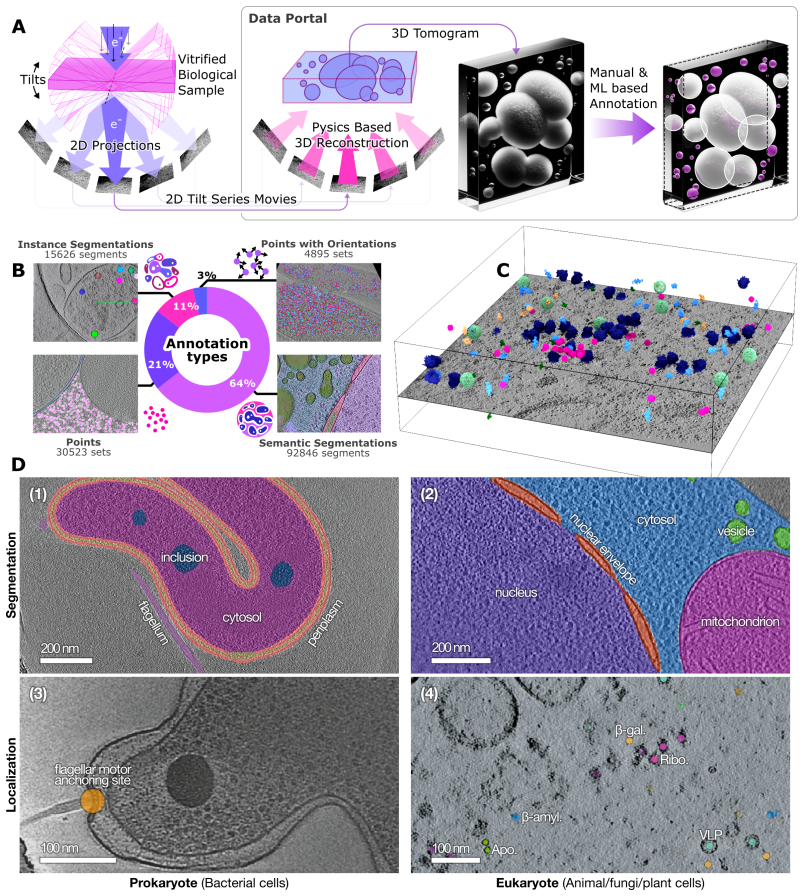
POPSICLE assembles benchmark datasets from the CryoET Data Portal for segmentation and localization tasks in cryo-electron tomography.
A machine-rendered reading of the paper's core claim, the machinery that carries it, and where it could break.
Core claim
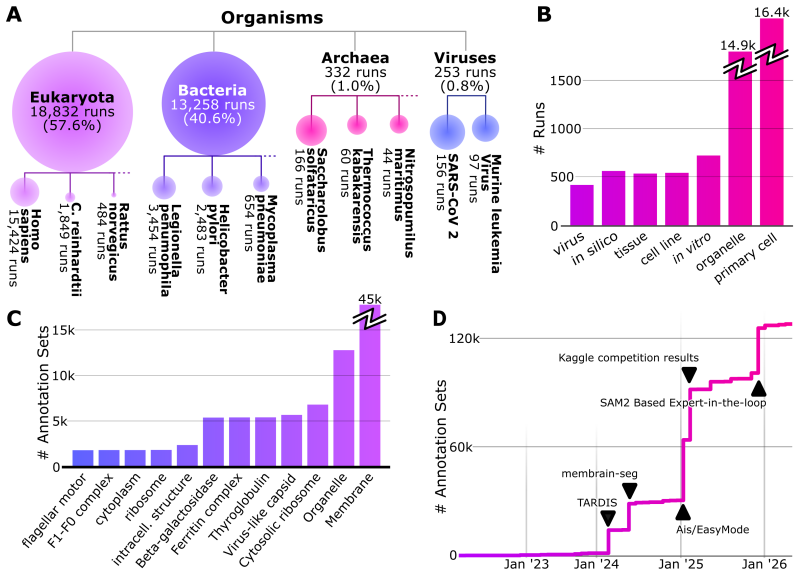
POPSICLE is a benchmark suite for cryoET segmentation and macromolecular localization built from the CryoET Data Portal. It spans eukaryotic and prokaryotic systems, purified and in situ samples, and voxel-wise segmentation as well as localization tasks. Baseline experiments reveal substantial variation in model rankings across tasks, underscoring the need for benchmarks tailored to cryoET.
What carries the argument
POPSICLE benchmark suite, which converts portal data into standardized segmentation and localization tasks with fixed train-test splits and evaluation metrics.
If this is right
- Model rankings obtained on one cryoET task cannot be assumed to hold on another task.
- Evaluation practices imported from other imaging domains must be checked against cryoET-specific data characteristics.
- Newly deposited volumes and annotations in the portal can be incorporated into the benchmark without rebuilding the entire suite.
- Reproducible comparisons across research groups become possible once all methods are tested on the same splits and metrics.
Where Pith is reading between the lines
- A researcher could test whether models that excel at localization in purified samples also excel at the same task inside crowded cellular volumes.
- The observed ranking variation might be traced to differences in particle density or tomogram thickness across the included datasets.
- If the benchmark is widely adopted, journals could require that new cryoET methods report results on at least one POPSICLE task.
- Extending the suite to include time-resolved or multi-tilt series could expose whether current models capture dynamic structural changes.
Load-bearing premise
The annotations and metadata already present in the CryoET Data Portal are accurate, complete, and representative enough to serve as ground truth.
What would settle it
Re-annotating a subset of the tomograms by independent experts and re-running the baseline models produces a different ordering of method performance.
Figures
read the original abstract
Cryo-electron tomography (cryoET) has emerged as a powerful tool in structural and cellular biology by enabling direct visualization of macromolecular structures within intact cells, thereby linking molecular architecture to cellular organization in a native context. Realizing the full potential of cryoET, however, increasingly depends on advances in computational analysis, particularly machine learning (ML), to interpret its complex and information-rich data. Despite rapid progress, ML development for cryoET remains bottlenecked by the lack of standardized, well-annotated benchmarks. Existing evaluations are typically small, task-specific, and are assembled in isolation, limiting robust comparisons across methods. Here, we present POPSICLE, a benchmark suite for cryoET segmentation and macromolecular localization built from the CryoET Data Portal - an open, ML-ready repository of tomographic data, metadata, and annotations. POPSICLE spans eukaryotic and prokaryotic systems, both purified and fully in situ samples, and dense voxel-wise segmentation as well as sparse localization tasks. Built on a living data resource, it can expand as new datasets and annotations become available. Baseline experiments reveal substantial variation in model rankings across tasks, underscoring the need for benchmarks tailored to the unique characteristics of cryoET rather than evaluation practices adapted from adjacent biomedical imaging domains. POPSICLE thus provides an open and extensible foundation for reproducible ML evaluation in cryoET.
Editorial analysis
A structured set of objections, weighed in public.
Referee Report
Summary. The manuscript presents POPSICLE, a benchmark suite for cryoET segmentation and macromolecular localization tasks, constructed from the existing CryoET Data Portal. It spans eukaryotic and prokaryotic systems, purified and in situ samples, and both dense voxel-wise segmentation and sparse localization. Baseline ML experiments are reported to reveal substantial variation in model rankings across tasks, and the resource is positioned as open and extensible.
Significance. If the portal annotations can be shown to serve as reliable ground truth, POPSICLE would address a genuine gap by supplying a standardized, living benchmark resource for ML method development in cryoET, enabling more robust cross-method comparisons than the current small, ad-hoc evaluations.
major comments (1)
- [Abstract and Data/Methods] Abstract and Data/Methods sections: The central claim that POPSICLE supplies a reproducible benchmark foundation requires that the CryoET Data Portal annotations function as accurate ground truth for both segmentation and localization. No description is provided of independent validation (inter-annotator agreement, expert re-labeling, or comparison against subtomogram averaging), which is load-bearing because systematic label omissions or errors common in cellular tomograms would render the reported baseline model rankings and the claim of 'substantial variation' unreliable.
minor comments (1)
- [Results/Baselines] The manuscript should report data-split criteria, exclusion rules, and any error bars or statistical tests on the baseline results to allow readers to assess robustness.
Simulated Author's Rebuttal
We thank the referee for highlighting the critical importance of annotation quality for establishing POPSICLE as a reliable benchmark. We agree that this aspect requires explicit discussion and will revise the manuscript accordingly.
read point-by-point responses
-
Referee: [Abstract and Data/Methods] Abstract and Data/Methods sections: The central claim that POPSICLE supplies a reproducible benchmark foundation requires that the CryoET Data Portal annotations function as accurate ground truth for both segmentation and localization. No description is provided of independent validation (inter-annotator agreement, expert re-labeling, or comparison against subtomogram averaging), which is load-bearing because systematic label omissions or errors common in cellular tomograms would render the reported baseline model rankings and the claim of 'substantial variation' unreliable.
Authors: We acknowledge that the manuscript does not include independent validation of the portal annotations. The annotations originate from the contributing research groups via the CryoET Data Portal and reflect expert curation, but inter-annotator agreement statistics or direct comparisons to subtomogram averaging are not uniformly available across the selected datasets. In the revised version we will expand the Data/Methods section with a new subsection on annotation provenance, citing the portal documentation and any reported quality controls for each included tomogram. We will also add an explicit limitations paragraph noting that cellular tomograms can contain label omissions or ambiguities and that the reported model rankings therefore reflect performance relative to the provided annotations rather than absolute ground truth. The claim of substantial variation across tasks will be reframed to emphasize that this variation is observed under the current annotation regime, underscoring the need for community-wide annotation standards. These changes will be made without altering the core contribution of a standardized, extensible benchmark resource. revision: yes
Circularity Check
No circularity: benchmark dataset paper with no derivations
full rationale
This paper presents a data resource and benchmark suite assembled from the existing CryoET Data Portal. It contains no mathematical derivations, equations, fitted parameters, predictions, or uniqueness theorems. The contribution is descriptive curation of datasets for segmentation and localization tasks, with baseline experiments that do not reduce to self-referential fits or self-citations. No load-bearing steps exist that could be circular by construction.
Axiom & Free-Parameter Ledger
Reference graph
Works this paper leans on
-
[1]
M. Beck and W. Baumeister. Cryo-electron tomography: Can it reveal the molecular sociology of cells in atomic detail?Trends in Cell Biology, 26(11):817–824, 2016. doi: 10.1016/j.tcb. 2016.06.004. URLhttps://pubmed.ncbi.nlm.nih.gov/27671779/
-
[2]
Fine details in complex environments: the power of cryo-electron tomography.Biochemical Society Transactions, 46(4):807–816, 2018
Joshua Hutchings and Giulia Zanetti. Fine details in complex environments: the power of cryo-electron tomography.Biochemical Society Transactions, 46(4):807–816, 2018
2018
-
[3]
Bringing structure to cell biology with cryo-electron tomography.Annual review of biophysics, 52(1):573–595, 2023
Lindsey N Young and Elizabeth Villa. Bringing structure to cell biology with cryo-electron tomography.Annual review of biophysics, 52(1):573–595, 2023
2023
-
[4]
Mbir: A cryo-et 3d reconstruction method that effectively minimizes missing wedge artifacts and restores missing information.Journal of structural biology, 206(2):183–192, 2019
Rui Yan, Singanallur V Venkatakrishnan, Jun Liu, Charles A Bouman, and Wen Jiang. Mbir: A cryo-et 3d reconstruction method that effectively minimizes missing wedge artifacts and restores missing information.Journal of structural biology, 206(2):183–192, 2019
2019
-
[5]
Ermel, Joshua Hutchings, Daniel Serwas, Hannah Siems, Norbert S
Ariana Peck, Yue Yu, Mohammadreza Paraan, Dari Kimanius, Utz H. Ermel, Joshua Hutchings, Daniel Serwas, Hannah Siems, Norbert S. Hill, Mallak Ali, Julia Peukes, Garrett A. Greenan, 9 Shu-Hsien Sheu, Elizabeth A. Montabana, Bridget Carragher, Clinton S. Potter, David A. Agard, and Shawn Zheng. Aretomolive: Automated reconstruction of comprehensively-correc...
-
[6]
Streamlining segmentation of cryo-electron tomography datasets with ais.Elife, 13:RP98552, 2024
Mart GF Last, Leoni Abendstein, Lenard M V oortman, and Thomas H Sharp. Streamlining segmentation of cryo-electron tomography datasets with ais.Elife, 13:RP98552, 2024
2024
-
[7]
Emmanuel Moebel, Antonio Martinez-Sanchez, Lorenz Lamm, Ricardo D. Righetto, Wojciech Wietrzynski, Sahradha Albert, Damien Larivière, Eric Fourmentin, Stefan Pfeffer, Julio Ortiz, Wolfgang Baumeister, Tingying Peng, Benjamin D. Engel, and Charles Kervrann. Deep learning improves macromolecule identification in 3d cellular cryo-electron tomograms.Nature Me...
-
[8]
Montabana, Daniel Serwas, Hannah Siems, Feng Wang, Zhuowen Zhao, Shawn Zheng, Matthias Haury, David A
Ariana Peck, Yue Yu, Jonathan Schwartz, Anchi Cheng, Utz Heinrich Ermel, Joshua Hutchings, Saugat Kandel, Dari Kimanius, Elizabeth A. Montabana, Daniel Serwas, Hannah Siems, Feng Wang, Zhuowen Zhao, Shawn Zheng, Matthias Haury, David A. Agard, Clinton S. Potter, Bridget Carragher, Kyle Harrington, and Mohammadreza Paraan. A realistic phantom dataset for b...
2025
-
[9]
C. Braxton Owens, Rachel Webb, T. J. Hart, Matthew M. Ward, Andrew J. Darley, Stefano Maggi, Bryan S. Morse, Grant J. Jensen, Walter C. Reade, Mohammed Kaplan, and Gus L.W. Hart. Motorbench: A cryo-electron tomography dataset of bacterial flagellar motors for testing detection algorithms.bioRxiv, 2025. doi: 10.1101/2025.04.23.650258
-
[10]
Pedro R. A. S. Bassi, Wenxuan Li, Yucheng Tang, Fabian Isensee, Zifu Wang, Jieneng Chen, Yu-Cheng Chou, Saikat Roy, Yannick Kirchhoff, Maximilian Rokuss, Ziyan Huang, Jin Ye, Junjun He, Tassilo Wald, Constantin Ulrich, Michael Baumgartner, Klaus H. Maier-Hein, Paul Jaeger, Yiwen Ye, Yutong Xie, Jianpeng Zhang, Ziyang Chen, Yong Xia, Zhaohu Xing, Lei Zhu, ...
-
[11]
Serial lift-out: sampling the molecular anatomy of whole organisms.Nature Methods, 21(9): 1684–1692, 2024
Oda Helene Schiøtz, Christoph JO Kaiser, Sven Klumpe, Dustin R Morado, Matthias Poege, Jonathan Schneider, Florian Beck, David P Klebl, Christopher Thompson, and Jürgen M Plitzko. Serial lift-out: sampling the molecular anatomy of whole organisms.Nature Methods, 21(9): 1684–1692, 2024
2024
-
[12]
A data portal for providing standardized annotations for cryo-electron tomography.Nature Methods, 21(12): 2200–2202, 2024
Utz Ermel, Anchi Cheng, Jun Xi Ni, Jessica Gadling, Manasa Venkatakrishnan, Kira Evans, Jeremy Asuncion, Andrew Sweet, Janeece Pourroy, Zun Shi Wang, et al. A data portal for providing standardized annotations for cryo-electron tomography.Nature Methods, 21(12): 2200–2202, 2024
2024
-
[13]
Goetz, Alexander Mattausch, Frosina Stojanovska, Christian E
Irene de Teresa-Trueba, Sara K. Goetz, Alexander Mattausch, Frosina Stojanovska, Christian E. Zimmerli, Mauricio Toro-Nahuelpan, Dorothy W. C. Cheng, Fergus Tollervey, Constantin Pape, Martin Beck, Alba Diz-Muñoz, Anna Kreshuk, Julia Mahamid, and Judith B. Zaugg. Convolutional networks for supervised mining of molecular patterns within cellular context. N...
2023
-
[14]
Frangakis, and Kyle I
Utz Heinrich Ermel, Jonathan Schwartz, Zhuowen Zhao, Daniel Ji, Ariana Peck, Yue Yu, Mohammadreza Paraan, Bridget Carragher, Achilleas S. Frangakis, and Kyle I. S. Harrington. copick: An open dataset interface and toolkit for collaborative annotation and analysis of cryo-electron tomography data.Protein Science, 35(5):e70578, 2026. doi: https://doi.org/10...
2026
-
[15]
Thomas D. Goddard, Conrad C. Huang, Elaine C. Meng, Eric F. Pettersen, Gregory S. Couch, John H. Morris, and Thomas E. Ferrin. Ucsf chimerax: Meeting modern challenges in visualiza- tion and analysis.Protein Science, 27(1):14–25, 2018. doi: https://doi.org/10.1002/pro.3235. 10
-
[16]
Nicholas Sofroniew, Talley Lambert, Grzegorz Bokota, Juan Nunez-Iglesias, Peter Sobolewski, Andrew Sweet, Lorenzo Gaifas, Kira Evans, Alister Burt, Draga Doncila Pop, Kevin Ya- mauchi, Melissa Weber Mendonça, Jaime Rodríguez-Guerra, Lucy Liu, Genevieve Buckley, Wouter-Michiel Vierdag, Ashley Anderson, Timothy Monko, Carol Willing, Loic Royer, Ah- met Can ...
2026
-
[17]
Membrain: A deep learning-aided pipeline for detection of membrane proteins in cryo-electron tomograms.Computer methods and programs in biomedicine, 224:106990, 2022
Lorenz Lamm, Ricardo D Righetto, Wojciech Wietrzynski, Matthias Pöge, Antonio Martinez- Sanchez, Tingying Peng, and Benjamin D Engel. Membrain: A deep learning-aided pipeline for detection of membrane proteins in cryo-electron tomograms.Computer methods and programs in biomedicine, 224:106990, 2022
2022
-
[18]
Shrec 2020: Classifi- cation in cryo-electron tomograms.Computers & Graphics, 91:279–289, 2020
Ilja Gubins, Marten L Chaillet, Gijs van Der Schot, Remco C Veltkamp, Friedrich Förster, Yu Hao, Xiaohua Wan, Xuefeng Cui, Fa Zhang, Emmanuel Moebel, et al. Shrec 2020: Classifi- cation in cryo-electron tomograms.Computers & Graphics, 91:279–289, 2020
2020
-
[19]
Tomotwin: generalized 3d localization of macromolecules in cryo-electron tomograms with structural data mining.Nature methods, 20(6):871–880, 2023
Gavin Rice, Thorsten Wagner, Markus Stabrin, Oleg Sitsel, Daniel Prumbaum, and Stefan Raunser. Tomotwin: generalized 3d localization of macromolecules in cryo-electron tomograms with structural data mining.Nature methods, 20(6):871–880, 2023
2023
-
[20]
Guole Liu, Tongxin Niu, Mengxuan Qiu, Yun Zhu, Fei Sun, and Ge Yang. Deepetpicker: Fast and accurate 3d particle picking for cryo-electron tomography using weakly supervised deep learning.Nature Communications, 15:2090, 2024. doi: 10.1038/s41467-024-46041-0
-
[21]
An image processing pipeline for electron cryo-tomography in relion-5.FEBS open bio, 14(11):1788– 1804, 2024
Alister Burt, Bogdan Toader, Rangana Warshamanage, Andriko von Kügelgen, Euan Pyle, Jasenko Zivanov, Dari Kimanius, Tanmay AM Bharat, and Sjors HW Scheres. An image processing pipeline for electron cryo-tomography in relion-5.FEBS open bio, 14(11):1788– 1804, 2024
2024
-
[22]
Real-time cryo-electron microscopy data preprocessing with warp.Nature methods, 16(11):1146–1152, 2019
Dimitry Tegunov and Patrick Cramer. Real-time cryo-electron microscopy data preprocessing with warp.Nature methods, 16(11):1146–1152, 2019
2019
-
[23]
Membrane and microtubule rapid instance seg- mentation with dimensionless instance segmentation by learning graph representations of point clouds
Robert Kiewisz and Tristan Bepler. Membrane and microtubule rapid instance seg- mentation with dimensionless instance segmentation by learning graph representations of point clouds. Machine Learning in Structural Biology Workshop, NeurIPS 2022,
2022
-
[24]
URL https://www.mlsb.io/papers_2022/Membrane_and_microtubule_ rapid_instance_segmentation_with_dimensionless_instance_segmentation_ by_learning_graph_representations_of_point_clouds.pdf
-
[25]
Mem- brain v2: an end-to-end tool for the analysis of membranes in cryo-electron tomography.biorxiv, pages 2024–01, 2024
Lorenz Lamm, Simon Zufferey, Ricardo D Righetto, Wojciech Wietrzynski, Kevin A Yamauchi, Alister Burt, Ye Liu, Hanyi Zhang, Antonio Martinez-Sanchez, Sebastian Ziegler, et al. Mem- brain v2: an end-to-end tool for the analysis of membranes in cryo-electron tomography.biorxiv, pages 2024–01, 2024
2024
-
[26]
SABER: Segment Anything Based Expert Recognition,
Jonathan Schwartz, Dari Kimanius. SABER: Segment Anything Based Expert Recognition,
-
[27]
Platform designed for au- tonomous segmentation of organelles from cryo-electron tomography (cryo-ET) or electron microscopy (EM) datasets
URL https://github.com/chanzuckerberg/saber. Platform designed for au- tonomous segmentation of organelles from cryo-electron tomography (cryo-ET) or electron microscopy (EM) datasets. 11
-
[28]
nnu-net: a self-configuring method for deep learning-based biomedical image segmentation.Nature methods, 18(2):203–211, 2021
Fabian Isensee, Paul F Jaeger, Simon AA Kohl, Jens Petersen, and Klaus H Maier-Hein. nnu-net: a self-configuring method for deep learning-based biomedical image segmentation.Nature methods, 18(2):203–211, 2021
2021
-
[29]
nnu-net revisited: A call for rigorous validation in 3d medical image segmentation
Fabian Isensee, Tassilo Wald, Constantin Ulrich, Michael Baumgartner, Saikat Roy, Klaus H Maier-Hein, and Paul F Jäger. nnu-net revisited: A call for rigorous validation in 3d medical image segmentation. InInternational Conference on Medical Image Computing and Computer- Assisted Intervention, pages 497–507. Springer, 2024
2024
-
[30]
Mednext: Transformer-driven scaling of convnets for medical image segmentation
Saikat Roy, Gregor Koehler, Constantin Ulrich, Michael Baumgartner, Jens Petersen, Fabian Isensee, Paul F Jaeger, and Klaus Maier-Hein. Mednext: Transformer-driven scaling of convnets for medical image segmentation. InInternational Conference on Medical Image Computing and Computer-Assisted Intervention, pages 405–415. Springer, 2023
2023
-
[31]
Roth, and Daguang Xu
Ali Hatamizadeh, Vishwesh Nath, Yucheng Tang, Dong Yang, Holger R. Roth, and Daguang Xu. Swin unetr: Swin transformers for semantic segmentation of brain tumors in mri images. In Brainlesion: Glioma, Multiple Sclerosis, Stroke and Traumatic Brain Injuries, pages 272–284. Springer International Publishing, 2022
2022
-
[32]
Towards a guideline for evaluation metrics in medical image segmentation.BMC research notes, 15(1):210, 2022
Dominik Müller, Iñaki Soto-Rey, and Frank Kramer. Towards a guideline for evaluation metrics in medical image segmentation.BMC research notes, 15(1):210, 2022
2022
-
[33]
V oxtell: Free-text promptable universal 3d medical image segmentation, 2025
Maximilian Rokuss, Moritz Langenberg, Yannick Kirchhoff, Fabian Isensee, Benjamin Hamm, Constantin Ulrich, Sebastian Regnery, Lukas Bauer, Efthimios Katsigiannopulos, Tobias No- rajitra, and Klaus Maier-Hein. V oxtell: Free-text promptable universal 3d medical image segmentation, 2025
2025
-
[34]
nnInteractive: Redefining 3D promptable segmen- tation.arXiv [cs.CV], March 2025
Fabian Isensee, Maximilian Rokuss, Lars Krämer, Stefan Dinkelacker, Ashis Ravindran, Florian Stritzke, Benjamin Hamm, Tassilo Wald, Moritz Langenberg, Constantin Ulrich, Jonathan Deissler, Ralf Floca, and Klaus Maier-Hein. nnInteractive: Redefining 3D promptable segmen- tation.arXiv [cs.CV], March 2025
2025
-
[35]
Motorbench flagellar motor localization test set
CryoET Data Portal. Motorbench flagellar motor localization test set. https:// cryoetdataportal.czscience.com/depositions/10347, 2025. Deposition CZCDP- 10347
2025
-
[36]
Motorbench flagellar motor localization training set
CryoET Data Portal. Motorbench flagellar motor localization training set. https:// cryoetdataportal.czscience.com/depositions/10332, 2025. Deposition CZCDP- 10332
2025
-
[37]
BYU - Locating Bacterial Flagellar Motors 2025
Brigham Young University. BYU - Locating Bacterial Flagellar Motors 2025. https://www. kaggle.com/competitions/byu-locating-bacterial-flagellar-motors-2025 ,
2025
-
[38]
Kaggle competition dataset
-
[39]
Flagellar Motors Dataset Code
Brenden Artley. Flagellar Motors Dataset Code. https://www.kaggle.com/code/ brendanartley/flagellar-motors-dataset-code , 2025. Kaggle notebook describing the external CryoET flagellar motors training dataset
2025
-
[40]
1st Place Solution for the BYU Locating Bacterial Flagellar Motors Competi- tion
Brenden Artley. 1st Place Solution for the BYU Locating Bacterial Flagellar Motors Competi- tion. https://github.com/brendanartley/BYU-competition, 2025. Repository for the first-place Kaggle solution
2025
-
[41]
Solution to the BYU - Locating Bacterial Flagellar Motors 2025 Kaggle Challenge
MIC-DKFZ Team. Solution to the BYU - Locating Bacterial Flagellar Motors 2025 Kaggle Challenge. https://github.com/MIC-DKFZ/kaggle_BYU_Locating_ Bacterial-Flagellar_Motors_2025_solution, 2025. Repository for the second-place Kaggle solution and expanded/corrected dataset workflow
2025
-
[42]
Octopi: v1.4, 2026
Jonathan Schwartz, Utz Heinrich Ermel, Daniel Ji, and Zhuowen Zhao. Octopi: v1.4, 2026
2026
-
[43]
Aretomolive: Automated reconstruction of comprehensively-corrected and denoised cryo-electron tomograms in real-time and at high throughput.bioRxiv, pages 2025–03, 2025
Ariana Peck, Yue Yu, Mohammadreza Paraan, Dari Kimanius, Utz H Ermel, Joshua Hutchings, Daniel Serwas, Hannah Siems, Norbert S Hill, Mallak Ali, et al. Aretomolive: Automated reconstruction of comprehensively-corrected and denoised cryo-electron tomograms in real-time and at high throughput.bioRxiv, pages 2025–03, 2025. 12
2025
-
[44]
Mrc2014: Extensions to the mrc format header for electron cryo-microscopy and tomography
Anchi Cheng, Richard Henderson, David Mastronarde, Steven J Ludtke, Remco HM Schoen- makers, Judith Short, Roberto Marabini, Sargis Dallakyan, David Agard, and Martyn Winn. Mrc2014: Extensions to the mrc format header for electron cryo-microscopy and tomography. Journal of structural biology, 192(2):146–150, 2015
2015
-
[45]
Brown, Jean-Marie Burel, Xavier Casas Moreno, Gustavo de Medeiros, Erin E
Josh Moore, Daniela Basurto-Lozada, Sébastien Besson, John Bogovic, Jordão Bragantini, Eva M. Brown, Jean-Marie Burel, Xavier Casas Moreno, Gustavo de Medeiros, Erin E. Diel, David Gault, Satrajit S. Ghosh, Ilan Gold, Yaroslav O. Halchenko, Matthew Hartley, Dave Horsfall, Mark S. Keller, Mark Kittisopikul, Gabor Kovacs, Aybüke KüpcüYolda¸ s, Koji Kyoda, A...
-
[46]
Jeremy Maitin-Shepard, Alex Baden, William Silversmith, Eric Perlman, Forrest Collman, Tim Blakely, Jan Funke, Chris Jordan, Ben Falk, Nico Kemnitz, et al. google/neuroglancer: Webgl-based viewer for volumetric data, 2021. URL https://doi.org/10.5281/zenodo. 5573294. 13 Appendix This appendix provides detailed insights into the POPSICLE benchmark and is o...
discussion (0)
Sign in with ORCID, Apple, or X to comment. Anyone can read and Pith papers without signing in.