REVIEW 3 major objections 2 minor 20 references
Detecting Knowledge Gaps from Conversational AI Interactions Using Curriculum Prerequisite Graphs
T0 review · 3 major / 2 minor · reviewed 2026-06-27 · grok-4.3
Pith's one-line read Student questions to conversational AI teaching assistants can be mapped to curriculum topics to detect knowledge gaps.
desk verdict Pipeline uses GPT-4 to build course graphs and few-shot classify AI chat logs to topics, hitting 80% accuracy and rho=0.49 with survey difficulty, but lacks reported checks on graph or labels. read the letter →
The pith
A machine-rendered reading of the paper's core claim, the machinery that carries it, and where it could break.
The reading
What carries the argument
The few-shot text classifier grounded in the GPT-4-extracted prerequisite knowledge graph, which assigns each question to one of 42 curriculum topics or an unknown abstention class.
What would settle it
A replication in a new course that finds no significant correlation between the classified question volumes and an independent difficulty measure would falsify the central claim.
Extended reading notes
Core claim
Conversational AI interaction logs, when classified against a prerequisite knowledge graph of the curriculum, carry actionable signals about topic-level knowledge gaps; the mapping achieves 80 percent accuracy and the resulting topic volumes correlate significantly with student self-reported difficulty.
Load-bearing premise
The classifier's topic assignments are accurate enough that their aggregate volumes can be treated as a reliable proxy for topic difficulty.
Editorial extensions
If this is right
- Instructors obtain a running, curriculum-grounded view of which topics warrant extra attention without running additional surveys.
- Question volume becomes a convergent indicator that the classified stream reflects genuine student difficulty.
- The pipeline turns untapped AI assistant logs into diagnostic data for large online courses.
- The abstention class filters out questions outside the curriculum, reducing noise in the difficulty signal.
Reading between the lines
- The same graph-plus-classifier approach could be tested in undergraduate courses where prerequisite structure is less uniform.
- Real-time aggregation of classified questions might let instructors adjust lecture emphasis within a single term.
- Pairing the question-volume signal with quiz or homework performance data could produce a stronger combined indicator of gaps.
Editorial analysis
A structured set of objections, weighed in public.
Referee Report
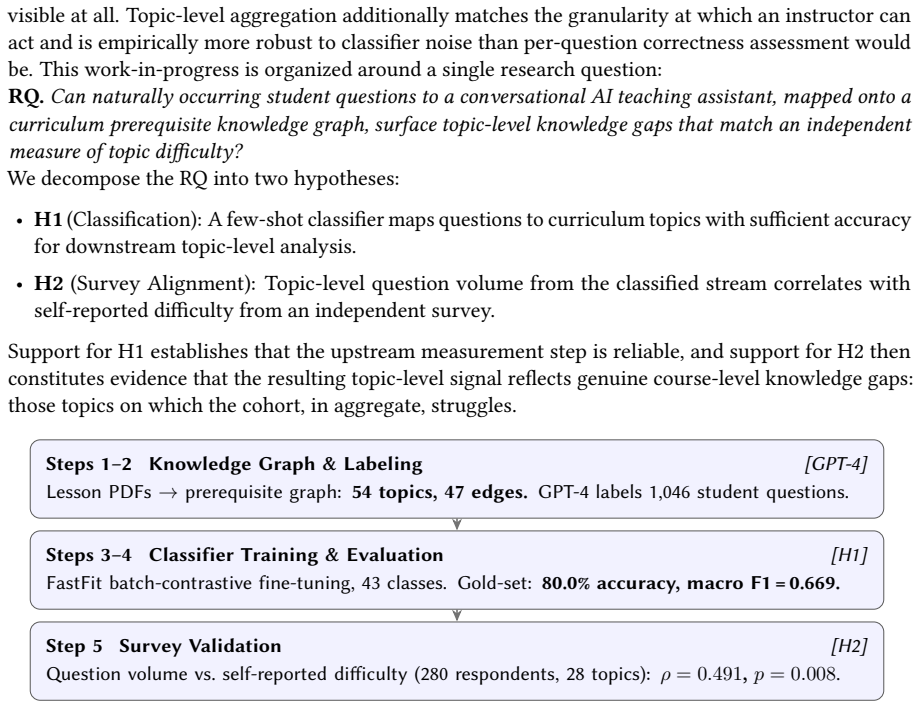
Summary. The paper presents a pipeline that extracts a prerequisite knowledge graph of course concepts using GPT-4 and grounds a few-shot text classifier to map student questions from a conversational AI teaching assistant to 42 curriculum topics (plus an 'unknown' class). On 1,340 question events from 164 students in a graduate AI course, the classifier achieves 80.0% accuracy; topic-level question volumes then correlate with an independent mid-semester student survey on topic difficulty (Spearman's rho = 0.491, p = 0.008, n = 28 topics). The central claim is that these logs, once mapped to the graph, yield actionable signals of knowledge gaps.
Significance. If the accuracy and correlation hold under proper validation, the work supplies a scalable, curriculum-grounded method for turning AI interaction logs into diagnostic signals for instructors. The use of real course data (164 students) and convergent validation against an external survey are strengths; the approach could generalize to other large courses where direct assessment is costly.
major comments (3)
- [Abstract / Evaluation] Abstract and Evaluation section: The reported 80.0% accuracy on the 1,340-question test set is presented without any description of the ground-truth labeling protocol, inter-rater reliability statistics, or controls for question-phrasing biases. Because the downstream correlation (rho = 0.491) is offered as evidence that the topic volumes reflect genuine difficulty, the absence of these details makes the accuracy figure non-interpretable and the correlation claim unsupported.
- [Methods] Methods (graph extraction): No validation, manual review, or external check is reported for the GPT-4-extracted prerequisite graph itself (e.g., edge accuracy against expert annotation or comparison to a hand-curated baseline). The graph is load-bearing for both the few-shot prompting and the interpretation of detected gaps; without such checks the pipeline's grounding remains unverified.
- [Results] Results (correlation): The reported correlation uses n = 28 topics, yet the handling of low-volume topics, the 'unknown' abstention class, and potential systematic classifier errors is not addressed. If misclassifications disproportionately affect difficult topics, the observed rho could be an artifact rather than convergent evidence.
minor comments (2)
- [Abstract] The abstract states the number of students (164) and events (1,340) but does not indicate the total number of distinct topics in the course or the fraction of questions falling into the 'unknown' class; adding these figures would improve context.
- [Methods] Notation for the 43-class label set (42 topics + unknown) is introduced without an explicit table or diagram showing the prerequisite edges; a small illustrative subgraph would clarify the grounding step.
Simulated Author's Rebuttal
Thank you for the opportunity to respond to the referee's comments. We address each major comment below, indicating the revisions we will make to the manuscript.
read point-by-point responses
-
Referee: [Abstract / Evaluation] Abstract and Evaluation section: The reported 80.0% accuracy on the 1,340-question test set is presented without any description of the ground-truth labeling protocol, inter-rater reliability statistics, or controls for question-phrasing biases. Because the downstream correlation (rho = 0.491) is offered as evidence that the topic volumes reflect genuine difficulty, the absence of these details makes the accuracy figure non-interpretable and the correlation claim unsupported.
Authors: We agree that the labeling protocol requires more detail for the accuracy to be interpretable. The 1,340 questions were labeled by course staff mapping each to the 42 topics or 'unknown' based on the curriculum. We will revise the Evaluation section to fully describe the labeling process, how consistency was maintained, and steps taken in few-shot example selection to cover phrasing variation. This addition will support the downstream correlation claim. revision: yes
-
Referee: [Methods] Methods (graph extraction): No validation, manual review, or external check is reported for the GPT-4-extracted prerequisite graph itself (e.g., edge accuracy against expert annotation or comparison to a hand-curated baseline). The graph is load-bearing for both the few-shot prompting and the interpretation of detected gaps; without such checks the pipeline's grounding remains unverified.
Authors: We acknowledge the absence of reported validation for the extracted graph. We will add to the Methods section a description of the instructor's manual review of a sample of extracted edges for accuracy, along with the rationale for using GPT-4 extraction as a scalable method grounded in the course syllabus. revision: yes
-
Referee: [Results] Results (correlation): The reported correlation uses n = 28 topics, yet the handling of low-volume topics, the 'unknown' abstention class, and potential systematic classifier errors is not addressed. If misclassifications disproportionately affect difficult topics, the observed rho could be an artifact rather than convergent evidence.
Authors: We will revise the Results section to explicitly state the topic inclusion criteria for the n=28 (minimum volume threshold to reduce noise), confirm that the 'unknown' class was excluded from volume calculations, and add a sensitivity discussion or check on how classifier errors might affect the correlation with difficulty ratings. revision: yes
Circularity Check
No circularity: empirical evaluation on external data and independent survey
full rationale
The paper reports an empirical pipeline: GPT-4 graph extraction, few-shot classification on 1,340 questions, measured 80% accuracy, and Spearman correlation (rho=0.491) against a separate mid-semester student survey. No equations, fitted parameters renamed as predictions, self-definitional loops, or load-bearing self-citations appear in the derivation. The accuracy figure and correlation are presented as measured outcomes on held-out data and external validation, not as quantities forced by construction from the inputs themselves. This is a standard empirical result with no reduction to tautology.
Assumptions & free parameters
assumptions (1)
- domain assumption A few-shot text classifier grounded in a GPT-4-extracted prerequisite graph can map natural language student questions to curriculum topics with sufficient accuracy to reflect genuine topic difficulty.
Cite this review
Pith. "Pith review of Detecting Knowledge Gaps from Conversational AI Interactions Using Curriculum Prerequisite Graphs." pith.science (2026). https://pith.science/paper/MKB5RSVT
@misc{pith2026260610736,
  author       = {Pith},
  title        = {Pith review of: Detecting Knowledge Gaps from Conversational AI Interactions Using Curriculum Prerequisite Graphs},
  year         = {2026},
  howpublished = {\url{https://pith.science/paper/MKB5RSVT}},
  note         = {Machine review of arXiv:2606.10736}
}
read the original abstract
Large online courses generate thousands of student questions directed at conversational AI teaching assistants, yet these interaction logs remain largely untapped as diagnostic signals. We present a pipeline that maps student questions from a conversational AI teaching assistant to curriculum topics using a few-shot text classifier, grounded in a GPT-4-extracted prerequisite knowledge graph of course concepts. Evaluated on 1,340 question events from 164 students in a graduate-level AI course, our classifier achieves 80.0% accuracy across 43 labels (42 curriculum topics plus an "unknown" abstention class). Topic-level question volume correlates significantly with student self-reported difficulty from an independent mid-semester survey (rho = 0.491, p = 0.008, n = 28 topics), providing convergent evidence that the classified question stream reflects genuine topic difficulty. These results demonstrate that conversational AI interaction logs, mapped onto curriculum structure, carry actionable signals about topic-level knowledge gaps and provide instructors with a curriculum-grounded view of which topics warrant attention.
Figures

Reference graph
Works this paper leans on
-
[1]
A. K. Goel and L. Polepeddi, Jill Watson: A virtual teaching assistant for online education, in: Learning Engineering for Online Education, Routledge, 2018, pp. 120–143
2018
-
[2]
Maiti, A
P. Maiti, A. K. Goel, Can an AI partner empower learners to ask critical questions?, in:Proceedings of the 30th International Conference on Intelligent User Interfaces (IUI ’25), 2025, pp. 314–324
2025
- [3]
-
[4]
Cabral, R
L. Cabral, R. Pinto, G. Gonçalves, AI-powered learning analytics dashboards: A systematic review of applications, techniques, and research gaps, Discover Education, 2025
2025
-
[5]
A. T. Corbett, J. R. Anderson, Knowledge tracing: Modeling the acquisition of procedural knowl- edge, User Modeling and User-Adapted Interaction 4(4) (1994) 253–278
1994
-
[6]
Piech, et al., Deep knowledge tracing, in:Advances in Neural Information Processing Systems, 2015
C. Piech, et al., Deep knowledge tracing, in:Advances in Neural Information Processing Systems, 2015
2015
-
[7]
Yehudai, E
A. Yehudai, E. Bandel, et al., FastFit: Fast and effective few-shot text classification with a multitude of classes, in:Proceedings of NAACL 2024 (System Demonstrations), 2024
2024
-
[8]
P. Chen, Y. Lu, V. W. Zheng, Y. Pian, Prerequisite-driven deep knowledge tracing, in:IEEE International Conference on Data Mining (ICDM), 2018, pp. 39–48
2018
Show all 20 references
-
[9]
L. Pan, C. Li, J. Li, J. Tang, Prerequisite relation learning for concepts in MOOCs, in:Proceedings of ACL, 2017
2017
-
[10]
Liang, J
C. Liang, J. Ye, S. Wang, B. Pursel, C. L. Giles, Investigating active learning for concept prerequisite learning, in:Proceedings of the AAAI Conference on Artificial Intelligence, volume 32, 2018
2018
-
[11]
I. Roll, V. Aleven, B. M. McLaren, K. R. Koedinger, Improving students’ help-seeking skills using metacognitive feedback in an intelligent tutoring system, Learning and Instruction 21(2) (2011) 267–280
2011
-
[12]
J. Park, Y. Medhat, H. P. Wai, P. Thajchayapong, A. K. Goel, Evaluating learner representations for differentiation prior to instructional outcomes, arXiv preprint arXiv:2604.05848, 2026
2026 arXiv
-
[13]
J. Park, Y. Medhat, H. P. Wai, P. Thajchayapong, A. K. Goel, Memory-based vs. context-only conditioning produces distinct behavioral patterns in stateful personalization, arXiv preprint arXiv:2605.27389, 2026
2026 arXiv
-
[14]
S. Basu, J. Brown, C. Lum, J. Park, A. K. Goel, Bidirectional feedback-based personalization of learning using multi-tier AI: A real-world assessment of its efficacy in classrooms, in:Proceedings of the AAAI Symposium Series, volume 5, 2025, pp. 50–51
2025
-
[15]
Reimers, I
N. Reimers, I. Gurevych, Sentence-BERT: Sentence embeddings using Siamese BERT-networks, in:Proceedings of EMNLP, 2019
2019
-
[16]
Tunstall, N
L. Tunstall, N. Reimers, U. E. S. Jo, L. Bates, D. Korat, M. Wasserblat, O. Pereg, Efficient few-shot learning without prompts, arXiv preprint arXiv:2209.11055, 2022
2022
-
[17]
A. K. Goel, P. Thajchayapong, V. Nandan, H. Sikka, S. Rugaber, A4L: An architecture for AI- augmented learning, in:AI Applications in Online Higher Education Administration, Routledge, 2025, pp. 151–164
2025
-
[18]
Thajchayapong, S
P. Thajchayapong, S. Carbonaro, T. Couper, B. Helmick, S. Rugaber, A. K. Goel, Evolution of A4L: A data architecture for AI-augmented learning, arXiv preprint arXiv:2511.11877, 2025
2025
-
[19]
J. A. Santana, P. Thajchayapong, S. Rugaber, A. K. Goel, A highly configurable data analytics pipeline for learning, in:Proceedings of EDULEARN25, 2025, p. 8737
2025
-
[20]
J. Park, Y. Medhat, H. P. Wai, P. Thajchayapong, A. K. Goel, Surfacing isolated learners with outcome-independent mediation of feedback between teachers and students using AI, arXiv preprint arXiv:2605.29240, 2026
2026 arXiv
Reviewed June 27, 2026 · model on record in the stance chip above.
Discussion (0). Sign in to comment.