First detection of HDO ice in a protoplanetary disk
Pith reviewed 2026-06-27 11:45 UTC · model grok-4.3
The pith
JWST observations detect HDO ice in an edge-on protoplanetary disk for the first time.
A machine-rendered reading of the paper's core claim, the machinery that carries it, and where it could break.
Core claim
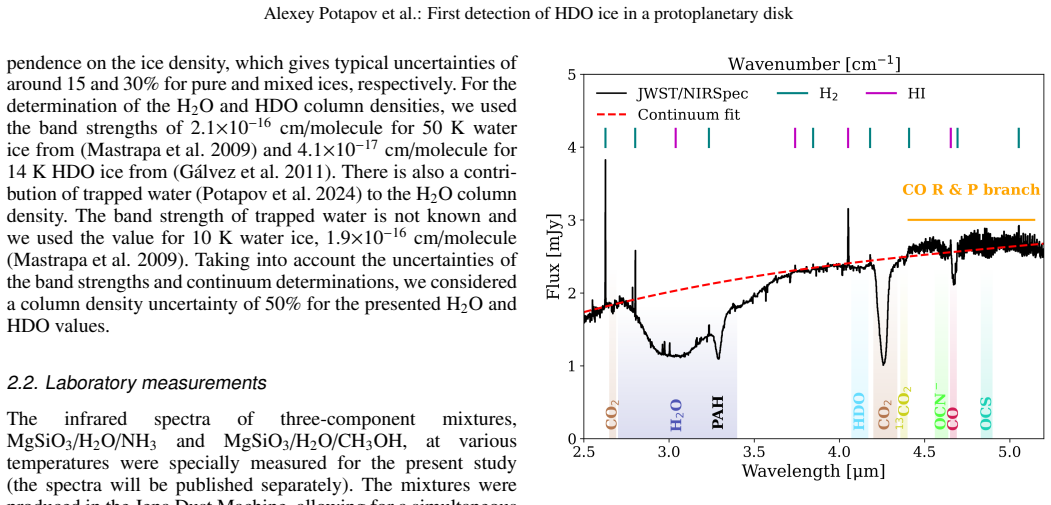
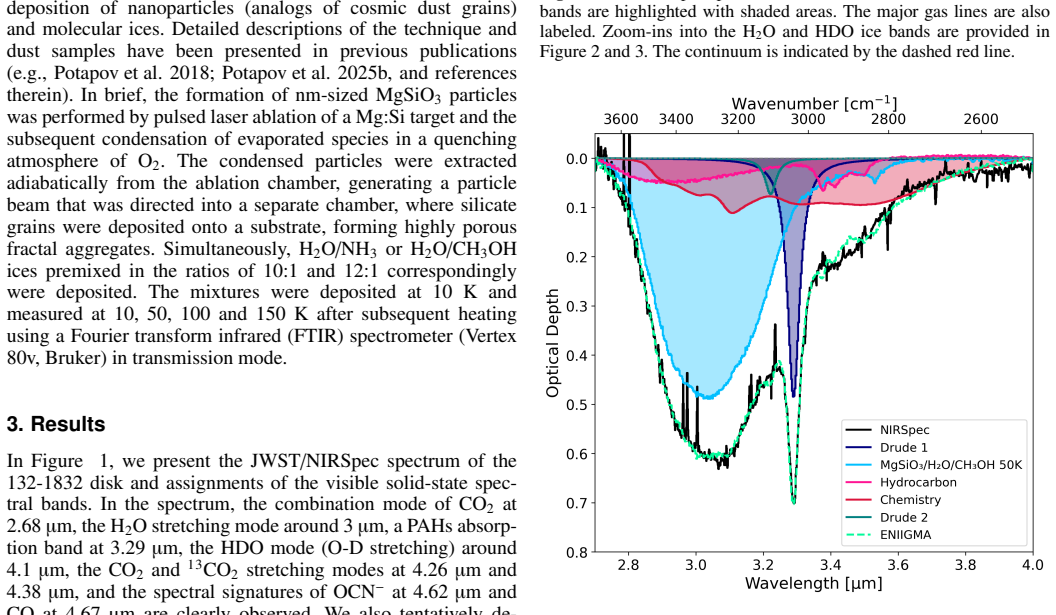
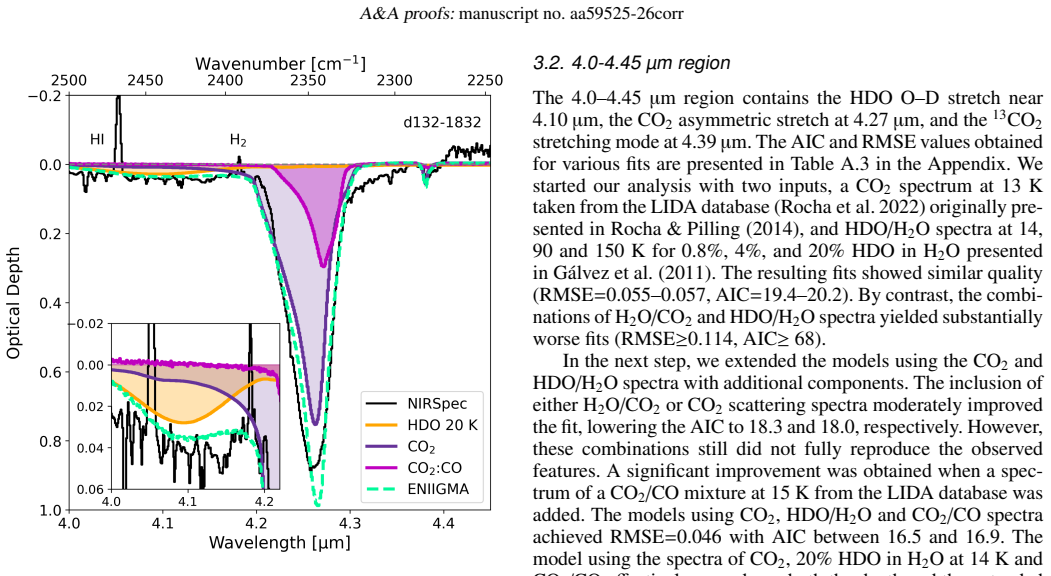
Using JWST/NIRSpec observations of the 132-1832 edge-on disk and the ENIIGMA fitting tool with laboratory ice spectra, we report the first detections of HDO ice in a protoplanetary disk. The estimated upper limit for the HDO/H2O ratio is much higher than ratios obtained for chondrites, comets, and embedded young stellar objects. Beyond HDO we detect H2O, CO2, 13CO2, CO, OCN-, and OCS ices. The HDO ice detection may point to efficient ice processing in the disk and confirm findings of laboratory experiments on deuterated ices.
What carries the argument
The ENIIGMA fitting tool matched to unique laboratory ice spectra that isolate HDO absorption features in the JWST data.
If this is right
- The elevated HDO/H2O ratio indicates that deuterium enrichment proceeds differently once material reaches the disk stage.
- Ice processing must be efficient enough in disks to alter the deuterium budget relative to earlier embedded stages.
- Laboratory results on deuterated ice chemistry receive direct observational support from disk environments.
- The same set of other molecular ices appears across multiple disks, suggesting shared chemical pathways.
Where Pith is reading between the lines
- Models of water delivery to forming planets will need to incorporate disk-stage processing to match observed D/H ratios in solar system bodies.
- Targeted follow-up observations of additional edge-on disks could test whether the high HDO ratio is typical or specific to this system.
- The detection provides a new anchor point for tracing the full inheritance chain of water from clouds to planets.
Load-bearing premise
The laboratory ice spectra used in the fit uniquely identify the observed absorption features as HDO without significant contamination from other species or instrumental effects.
What would settle it
An independent spectrum at higher resolution or different wavelength coverage that shows the attributed HDO bands are absent or match another carrier would falsify the identification.
Figures
read the original abstract
Protoplanetary disks are the birthplace of planets and planetary systems. Investigating the molecular inventory of disks is key to linking the chemical evolution of the interstellar medium and the makeup of planets and their atmospheres. In particular, tracing the history of the deuterium enrichment of water along the journey from interstellar clouds through protoplanetary disks to planetary systems provides critical insights into the chemical inheritance. We aim to investigate the chemical composition of ices in protoplanetary disks; specifically, the presence of HDO ice that ought to be present, but has not been detected in disks thus far. We analyzed JWST/NIRSpec observations of the 132-1832 edge-on disk located in the Orion Nebula Cluster using the ENIIGMA fitting tool and unique laboratory data. We report on the first detections of HDO ice in a protoplanetary disk. The estimated upper limit for the HDO/H$_2$O ratio for 132-1832 is much higher, compared to HDO/H$_2$O ratios obtained for chondrites, comets, and embedded young stellar objects. In the disk ices, beyond HDO, we detected H$_2$O, CO$_2$, $^{13}$CO$_2$, CO, OCN$^-$, and OCS, species, whose presence has also been detected in other disks. The HDO ice detection may point to the efficient ice processing in the disk and confirm the findings of laboratory experiments on deuterated ices.
Editorial analysis
A structured set of objections, weighed in public.
Referee Report
Summary. The manuscript reports JWST/NIRSpec observations of the edge-on protoplanetary disk 132-1832, using the ENIIGMA fitting tool together with laboratory ice spectra to claim the first detection of HDO ice in any protoplanetary disk. Additional ices (H2O, CO2, 13CO2, CO, OCN-, OCS) are identified, and an upper limit on the HDO/H2O ratio is stated to be substantially higher than values reported for chondrites, comets, and embedded YSOs, interpreted as evidence for efficient ice processing.
Significance. If the HDO identification is robust, the result would provide the first direct link between deuterium fractionation in disk ices and the chemical inheritance pathway from the ISM to planets. The anchoring of the fit to independent laboratory spectra and public JWST data is a methodological strength that supports reproducibility.
major comments (3)
- [Abstract] Abstract and results section: the central claim of a 'first detection' of HDO rests on the ENIIGMA fit, yet no quantitative fit statistics (e.g., reduced chi-squared, residual maps), error bars on the upper limit, or explicit model-comparison tests against alternative carriers (other deuterated ices, OCS overtones, CO2 combination bands) are supplied, leaving the uniqueness of the assignment unverified.
- [Analysis section] Analysis section: the derivation of the HDO/H2O upper limit is presented as a free parameter, but the manuscript provides no details on the temperature range, optical-depth assumptions, or continuum-subtraction procedure used to convert the fitted optical depth into the reported ratio, which is load-bearing for the claim that the limit is 'much higher' than literature values.
- [Results section] Results section: while laboratory spectra are cited as 'unique,' no table or figure shows the laboratory HDO template overlaid on the observed spectrum with residuals, nor are alternative laboratory templates (e.g., other deuterated species) tested to quantify contamination risk under the disk's physical conditions.
minor comments (2)
- [Abstract] The abstract statement that the upper limit 'is much higher' is imprecise; numerical values with uncertainties should be stated explicitly.
- A comparison table of the derived HDO/H2O upper limit against the cited chondrite, comet, and YSO values would improve clarity and context.
Simulated Author's Rebuttal
We thank the referee for the constructive and detailed comments on our manuscript. We address each major comment below and will revise the paper to incorporate the requested information and figures, thereby strengthening the presentation of the HDO detection and the derived upper limit.
read point-by-point responses
-
Referee: [Abstract] Abstract and results section: the central claim of a 'first detection' of HDO rests on the ENIIGMA fit, yet no quantitative fit statistics (e.g., reduced chi-squared, residual maps), error bars on the upper limit, or explicit model-comparison tests against alternative carriers (other deuterated ices, OCS overtones, CO2 combination bands) are supplied, leaving the uniqueness of the assignment unverified.
Authors: We agree that quantitative metrics and explicit model comparisons are important for verifying the uniqueness of the HDO assignment. In the revised manuscript we will report reduced chi-squared values and residual maps for the ENIIGMA fits, include error bars on the HDO/H2O upper limit, and add explicit model-comparison tests against alternative carriers including other deuterated ices, OCS overtones, and CO2 combination bands. revision: yes
-
Referee: [Analysis section] Analysis section: the derivation of the HDO/H2O upper limit is presented as a free parameter, but the manuscript provides no details on the temperature range, optical-depth assumptions, or continuum-subtraction procedure used to convert the fitted optical depth into the reported ratio, which is load-bearing for the claim that the limit is 'much higher' than literature values.
Authors: We acknowledge that these methodological details are essential for reproducibility and for supporting the comparison to literature values. The revised analysis section will include the temperature range adopted for the laboratory templates, the optical-depth assumptions, and the continuum-subtraction procedure used to derive the HDO/H2O upper limit from the fitted optical depth. revision: yes
-
Referee: [Results section] Results section: while laboratory spectra are cited as 'unique,' no table or figure shows the laboratory HDO template overlaid on the observed spectrum with residuals, nor are alternative laboratory templates (e.g., other deuterated species) tested to quantify contamination risk under the disk's physical conditions.
Authors: We will add a dedicated figure in the results section that overlays the laboratory HDO template on the observed spectrum together with the residuals. We will also test alternative laboratory templates for other deuterated species and quantify the potential contamination risk under the physical conditions of the 132-1832 disk. revision: yes
Circularity Check
No significant circularity in observational detection
full rationale
The paper reports a first detection of HDO ice via JWST/NIRSpec absorption features fitted by the ENIIGMA tool against independent laboratory ice spectra. No equations, derivations, or predictions are present that reduce the reported detection or HDO/H2O upper limit to a fitted parameter defined by the same observations. The central claim rests on external lab data and public telescope data rather than any self-referential loop, self-citation chain, or ansatz smuggled via prior work. The uniqueness of the carrier identification is an untested assumption but does not constitute a circular reduction of the result to its inputs.
Axiom & Free-Parameter Ledger
free parameters (1)
- HDO/H2O upper limit
axioms (1)
- domain assumption Laboratory transmission spectra of HDO-containing ices accurately reproduce the absorption profile under disk conditions
Reference graph
Works this paper leans on
-
[1]
2025, JWST Calibration Pipeline, 1.18.1, Zenodo, doi: 10.5281/zenodo.6984365
Aikawa, Y ., Kamuro, D., Sakon, I., et al. 2012, A&A, 538, A57 Alexander, C. M. O., Bowden, R., Fogel, M. L., et al. 2012, Sci, 337, 721 Altwegg, K., Balsiger, H., Bar-Nun, A., et al. 2015, Sci, 347, 1261952 Andreu, A., Coutens, A., Cruz-Sáenz de Miera, F., et al. 2023, A&A, 677, L17 Article number, page 5 A&A proofs:manuscript no. aa59525-26corr Fig. 4.C...
-
[2]
PAH continuum
and 3.7×10 16 cm−2 (for Background 3). The variance in the derived column densities depending on the chosen background may be attributed to the apparent10 gradient of the PAH and CO emission across the field of view and how it, after subtraction, influences the continuum determination. Notably, the continuum determination is susceptible to changes in the ...
2022
-
[3]
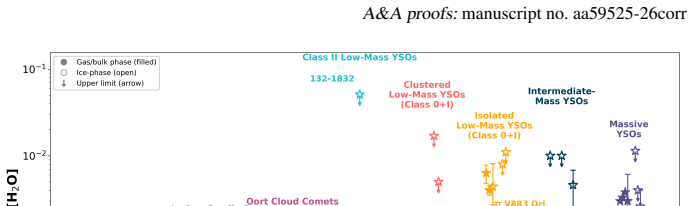
Object Phase HDO/H 2O (10−3) Ref Carbonaceous chondrites CI chondrites — 0.129–0.195 1 CM chondrites — 0.173±0.007 1 CR chondrites — 0.342 1 CO chondrites — 0.170–0.264 1 Halley-type comets 12P/Pons-Brooks gas 0.17±0.04 2 1P/Halley gas 0.42±0.06 3 8P/Tuttle gas 0.82±0.29 4 153P/Ikeya-Zhang gas<0.56±0.06 5 Jupiter-family comets 46P/Wirtanen gas 0.32±0.13 6...
2009
-
[4]
Alexander et al. (2012)
2012
-
[5]
Cordiner et al. (2025)
2025
-
[6]
Villanueva et al. (2009)
2009
-
[7]
Hartogh et al. (2011)
2011
-
[8]
Altwegg et al. (2015)
2015
-
[9]
Bockelée-Morvan et al. (2012)
2012
-
[10]
Hutsemékers et al. (2008)
2008
-
[11]
Bockelée-Morvan et al. (1998)
1998
-
[12]
(2012) Article number, page 11 A&A proofs:manuscript no
Gibb et al. (2012) Article number, page 11 A&A proofs:manuscript no. aa59525-26corr Table A.6.Ice and gas HDO/H 2O values of protostars. The values are graphically shown in Figure 4 Object Phase HDO/H 2O (10−3) Ref Clustered class 0 LYSOs NGC 1333 IRAS 4A-NW gas 0.54±0.15 1, 2 NGC 1333 IRAS 2A gas 0.74±0.21 1 NGC 1333 IRAS 4B gas 0.59±0.26 1 IRAS 16293-24...
2012
-
[13]
Persson et al. (2014)
2014
-
[14]
Jensen et al. (2019)
2019
-
[15]
Parise et al. (2003)
2003
-
[16]
Jensen et al. (2021)
2021
-
[17]
Slavicinska et al. (2025)
2025
-
[18]
Andreu et al. (2023)
2023
-
[19]
Dartois et al. (2003)
2003
-
[20]
Slavicinska et al. (2024)
2024
-
[21]
van der Tak et al. (2006)
2006
-
[22]
Emprechtinger et al. (2013)
2013
-
[23]
(2014) Article number, page 12
Coutens et al. (2014) Article number, page 12
2014
discussion (0)
Sign in with ORCID, Apple, or X to comment. Anyone can read and Pith papers without signing in.