Exact Dynamics of Topological Order Across a CDW--SPT Transition
Pith reviewed 2026-06-27 11:13 UTC · model grok-4.3
The pith
Sudden quenches from a CDW state leave finite excitations that block long-range SPT order, while slow ramps permit its buildup.
A machine-rendered reading of the paper's core claim, the machinery that carries it, and where it could break.
Core claim
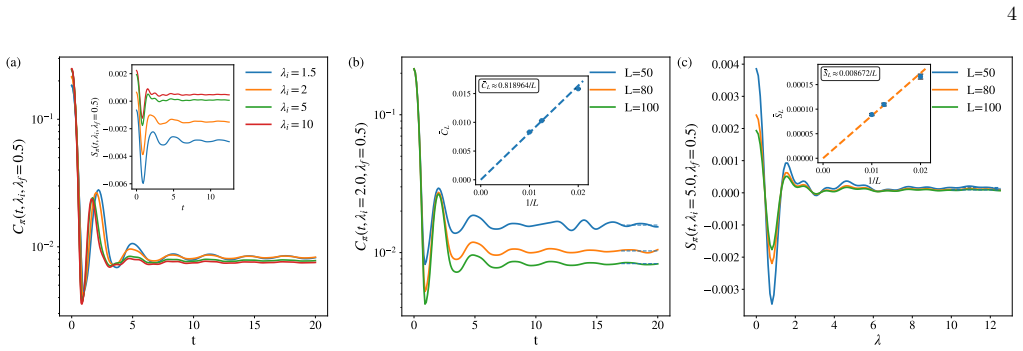
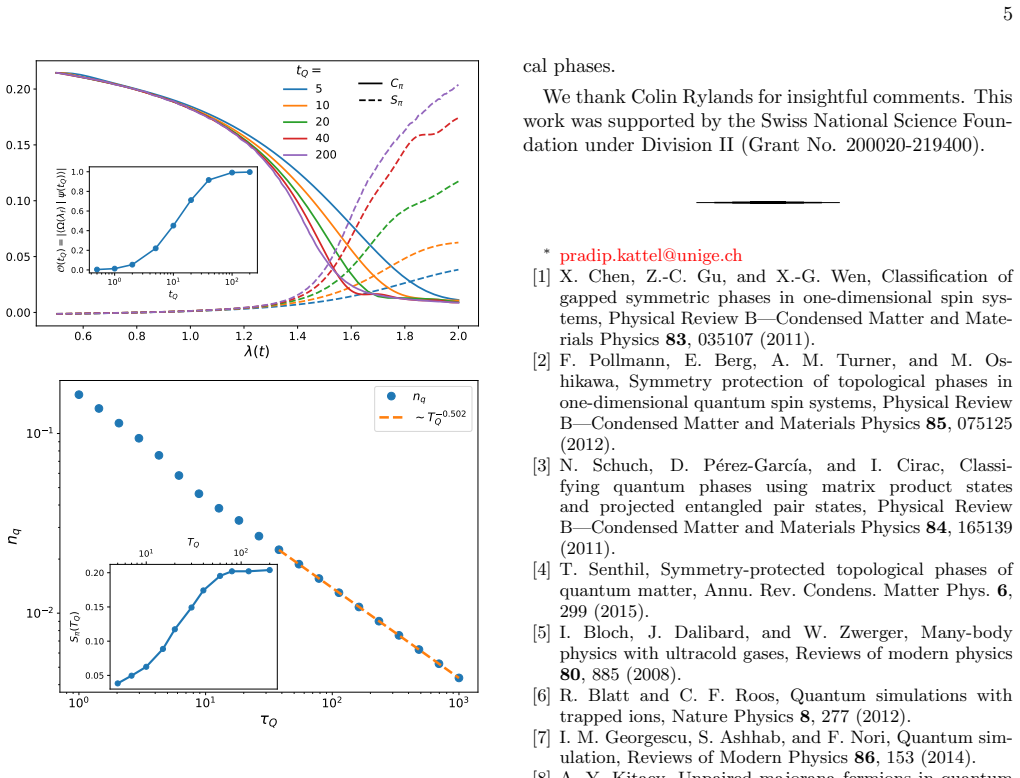
Starting from a CDW initial state, sudden quenches into the SPT regime produce a post-quench state with finite excitation density above the topological ground state, so long-range SPT order does not emerge. Slow ramps allow the system to follow the instantaneous ground state away from the critical region, enabling buildup of SPT order whose deviations are governed by Kibble-Zurek defect production. The dynamics is solvable via a unitary mapping to a quadratic fermionic Hamiltonian, which yields the Loschmidt echo with cusps at dynamical quantum phase transitions and the correlation functions that expose the two mechanisms.
What carries the argument
Unitary mapping of the interacting Hamiltonian to a quadratic fermionic model, which renders the time evolution exactly solvable and permits direct computation of the Loschmidt echo, two-point correlations, and string correlator.
If this is right
- CDW order melts under both quench and ramp protocols.
- The Loschmidt rate function develops cusps that mark dynamical quantum phase transitions.
- Correlation dynamics display the distinct mechanisms operating in quenches versus ramps.
- Reaching the topological regime is insufficient for topological order; suppression of excitation production during the drive is required.
Where Pith is reading between the lines
- The same protocol contrast could appear in other SPT models that lack an exact mapping, motivating numerical studies of post-quench excitation densities.
- Kibble-Zurek scaling extracted from the ramp data supplies a quantitative benchmark for defect suppression in engineered topological systems.
- Fast quenches might be deliberately used to suppress unwanted topological order in systems where its presence is undesirable.
Load-bearing premise
The interacting dynamics admits an exact unitary mapping to a quadratic fermionic Hamiltonian starting from the chosen CDW state.
What would settle it
Direct measurement after a sudden quench of a nonzero excitation density above the SPT ground state that remains correlated with the absence of long-range string order, contrasted with growth of the same string order under a sufficiently slow ramp.
Figures
read the original abstract
We investigate the nonequilibrium dynamics of a one-dimensional interacting system across a transition from a charge-density-wave (CDW) phase to a symmetry-protected topological (SPT) phase. Starting from a CDW initial state, we study both sudden quenches and slow ramps into the SPT regime. While the CDW order melts under both protocols, the fate of topological order is sharply different. Following a sudden quench, long-range SPT order does not emerge because the post-quench state contains a finite density of excitations above the topological ground state. In contrast, slow ramps allow the system to follow the instantaneous ground state away from the critical region, enabling the buildup of SPT order with deviations governed by Kibble-Zurek defect production. The dynamics is solvable via a unitary mapping to a quadratic fermionic Hamiltonian, allowing us to compute the Loschmidt echo, correlation functions, and string correlator. The Loschmidt rate function exhibits cusps signaling dynamical quantum phase transitions, while the correlation dynamics reveal the contrasting mechanisms governing quenches and ramps across the transition. These results demonstrate that entering the topological regime is not sufficient for the emergence of topological order; the decisive factor is the suppression of excitation production during the evolution.
Editorial analysis
A structured set of objections, weighed in public.
Referee Report
Summary. The manuscript investigates nonequilibrium dynamics of a 1D interacting system across a CDW-to-SPT transition. Starting from a CDW initial state, it contrasts sudden quenches (where long-range SPT order fails to emerge due to finite excitation density above the topological ground state) with slow ramps (where the system follows the instantaneous ground state and SPT order builds up, with deviations set by Kibble-Zurek defect production). The central technical claim is that the dynamics is exactly solvable via a unitary mapping of the interacting Hamiltonian to a quadratic fermionic model, which permits explicit computation of the Loschmidt echo (showing cusps at dynamical quantum phase transitions), correlation functions, and the string correlator.
Significance. If the unitary mapping is rigorously established and preserves the relevant symmetries, string-order operator, and phase structure, the work would supply one of the few exact, non-perturbative results on the dynamical emergence (or suppression) of SPT order in an interacting system. The explicit contrast between quench and ramp protocols, together with the Kibble-Zurek scaling under ramps, would provide a valuable benchmark for numerical and experimental studies of dynamical topological phases and dynamical quantum phase transitions.
major comments (2)
- [Model and mapping (likely §2 or §3)] The entire set of exact results (Loschmidt rate function, correlation dynamics, string-order evolution) rests on the unitary mapping to a quadratic fermionic Hamiltonian. The manuscript asserts the existence of this mapping but supplies neither its explicit construction nor a verification that (i) the mapped quadratic model retains the SPT phase of the original interacting system, (ii) the initial CDW state maps to a state whose time evolution under the quadratic Hamiltonian produces the claimed finite excitation density relative to the topological ground state, and (iii) the string correlator can be evaluated without further approximations. This mapping is load-bearing for the central claim that quenches produce no long-range SPT order while ramps do; without it the contrast between protocols cannot be demonstrated exactly.
- [Results on quenches (§4 or §5)] The abstract and introduction state that the post-quench state contains a finite density of excitations above the topological ground state, yet no explicit calculation or bound on this density is referenced. If the mapping is only approximate or symmetry-breaking, the claimed absence of SPT order after a quench would require additional justification beyond the Kibble-Zurek argument given for ramps.
minor comments (2)
- [Throughout] Notation for the string-order parameter and the Loschmidt rate function should be introduced with explicit definitions and reference to the mapped fermionic operators.
- [Figures] Figure captions for the Loschmidt echo and string-correlator plots should state the precise ramp protocol (linear, power-law, etc.) and the value of the ramp time au used in each panel.
Simulated Author's Rebuttal
We thank the referee for their careful reading of the manuscript and for identifying the points that require additional clarification. We address each major comment below and have revised the manuscript to strengthen the presentation of the unitary mapping and the supporting calculations.
read point-by-point responses
-
Referee: [Model and mapping (likely §2 or §3)] The entire set of exact results (Loschmidt rate function, correlation dynamics, string-order evolution) rests on the unitary mapping to a quadratic fermionic Hamiltonian. The manuscript asserts the existence of this mapping but supplies neither its explicit construction nor a verification that (i) the mapped quadratic model retains the SPT phase of the original interacting system, (ii) the initial CDW state maps to a state whose time evolution under the quadratic Hamiltonian produces the claimed finite excitation density relative to the topological ground state, and (iii) the string correlator can be evaluated without further approximations. This mapping is load-bearing for the central claim that quenches produce no long-range SPT order while ramps do; without it the contrast between protocols cannot be demonstrated exactly.
Authors: We agree that a more explicit presentation of the mapping is warranted. Section 2 introduces the unitary transformation that maps the interacting model to a quadratic fermionic Hamiltonian while preserving the protecting symmetries. In the revised manuscript we have expanded this section with the explicit operator-level construction of the mapping, a direct verification that the SPT phase (including the string-order parameter) is retained, and an explicit computation showing that the CDW initial state evolves to a state with finite excitation density above the topological ground state. The string correlator is evaluated exactly via Wick's theorem in the free-fermion representation; no further approximations are introduced. These additions are now cross-referenced in the results sections. revision: yes
-
Referee: [Results on quenches (§4 or §5)] The abstract and introduction state that the post-quench state contains a finite density of excitations above the topological ground state, yet no explicit calculation or bound on this density is referenced. If the mapping is only approximate or symmetry-breaking, the claimed absence of SPT order after a quench would require additional justification beyond the Kibble-Zurek argument given for ramps.
Authors: We have added an explicit calculation of the post-quench excitation density in the revised Section 4. Using the mapped quadratic Hamiltonian we evaluate the occupation numbers of the Bogoliubov modes in the initial CDW state; the resulting density is finite and system-size independent in the thermodynamic limit. This calculation is now cited from the abstract and introduction, providing direct support for the absence of long-range SPT order after a sudden quench. The argument for ramps remains based on Kibble-Zurek scaling, but the quench result stands on its own via the exact density computation. revision: yes
Circularity Check
No significant circularity detected
full rationale
The paper asserts solvability via a unitary mapping to a quadratic fermionic Hamiltonian and applies the Kibble-Zurek mechanism to contrast quench versus ramp protocols. No quoted equations, self-citations, or fitted parameters reduce any claimed prediction or string-order result to a tautological input by construction. The Loschmidt echo cusps and correlation dynamics are presented as direct consequences of the mapping and excitation density, without load-bearing self-referential steps or renaming of known results. The derivation chain remains self-contained against the stated assumptions.
Axiom & Free-Parameter Ledger
axioms (2)
- domain assumption The interacting Hamiltonian admits an exact unitary mapping to a quadratic fermionic model.
- domain assumption Kibble-Zurek defect production governs deviations from the instantaneous ground state during slow ramps.
Reference graph
Works this paper leans on
-
[1]
Chen, Z.-C
X. Chen, Z.-C. Gu, and X.-G. Wen, Classification of gapped symmetric phases in one-dimensional spin sys- tems, Physical Review B—Condensed Matter and Mate- rials Physics83, 035107 (2011)
2011
-
[2]
Pollmann, E
F. Pollmann, E. Berg, A. M. Turner, and M. Os- hikawa, Symmetry protection of topological phases in one-dimensional quantum spin systems, Physical Review B—Condensed Matter and Materials Physics85, 075125 (2012)
2012
-
[3]
Schuch, D
N. Schuch, D. P´ erez-Garc´ ıa, and I. Cirac, Classi- fying quantum phases using matrix product states and projected entangled pair states, Physical Review B—Condensed Matter and Materials Physics84, 165139 (2011)
2011
-
[4]
Senthil, Symmetry-protected topological phases of quantum matter, Annu
T. Senthil, Symmetry-protected topological phases of quantum matter, Annu. Rev. Condens. Matter Phys.6, 299 (2015)
2015
-
[5]
Bloch, J
I. Bloch, J. Dalibard, and W. Zwerger, Many-body physics with ultracold gases, Reviews of modern physics 80, 885 (2008)
2008
-
[6]
Blatt and C
R. Blatt and C. F. Roos, Quantum simulations with trapped ions, Nature Physics8, 277 (2012)
2012
-
[7]
I. M. Georgescu, S. Ashhab, and F. Nori, Quantum sim- ulation, Reviews of Modern Physics86, 153 (2014)
2014
-
[8]
A. Y. Kitaev, Unpaired majorana fermions in quantum wires, Physics-uspekhi44, 131 (2001)
2001
-
[9]
P. Kattel, Y. Tang, and N. Andrei, Isospectrality and operator complexity, (2026), arXiv:2606.05294 [quant- ph]
Pith/arXiv arXiv 2026
-
[10]
Calabrese and J
P. Calabrese and J. Cardy, Evolution of entanglement entropy in one-dimensional systems, Journal of Statisti- cal Mechanics: Theory and Experiment2005, P04010 (2005)
2005
-
[11]
D. Iyer, H. Guan, and N. Andrei, Exact formalism for the quench dynamics of integrable models, Physical Review A—Atomic, Molecular, and Optical Physics87, 053628 (2013)
2013
-
[12]
Bernier, R
J.-S. Bernier, R. Citro, C. Kollath, and E. Orignac, Cor- relation dynamics during a slow interaction quench in a one-dimensional bose gas, Physical Review Letters112, 065301 (2014)
2014
-
[13]
N. Andrei, Quench dynamics in integrable systems, arXiv preprint arXiv:1606.08911, Les Houches Lectures (2016)
Pith/arXiv arXiv 2016
-
[14]
Rylands and N
C. Rylands and N. Andrei, Non-equilibrium aspects of integrable models, Annual Review of Condensed Matter Physics11(2020)
2020
-
[15]
Pollmann, S
F. Pollmann, S. Mukerjee, A. G. Green, and J. E. Moore, Dynamics after a sweep through a quantum critical point, Physical Review E—Statistical, Nonlinear, and Soft Mat- ter Physics81, 020101 (2010)
2010
-
[16]
Vajna and B
S. Vajna and B. D´ ora, Topological classification of dy- namical phase transitions, Physical Review B91, 155127 (2015)
2015
-
[17]
Chung, Y.-H
M.-C. Chung, Y.-H. Jhu, P. Chen, and C.-Y. Mou, 6 Quench dynamics of topological maximally entangled states, Journal of Physics: Condensed Matter25, 285601 (2013)
2013
-
[18]
Y. Tang, P. Kattel, and N. Andrei, On the topologi- cal dual of the xxz spin chain, Physical Review B113, L041113 (2026)
2026
-
[19]
M. Heyl, A. Polkovnikov, and S. Kehrein, Dynamical quantum phase transitions in the transverse-field ising model, Physical review letters110, 135704 (2013)
2013
-
[20]
Heyl, Dynamical quantum phase transitions: a re- view, Reports on Progress in Physics81, 054001 (2018)
M. Heyl, Dynamical quantum phase transitions: a re- view, Reports on Progress in Physics81, 054001 (2018)
2018
-
[21]
Jurcevic, H
P. Jurcevic, H. Shen, P. Hauke, C. Maier, T. Brydges, C. Hempel, B. Lanyon, M. Heyl, R. Blatt, and C. Roos, Direct observation of dynamical quantum phase transi- tions in an interacting many-body system, Physical re- view letters119, 080501 (2017)
2017
-
[22]
D. V. Else, S. D. Bartlett, and A. C. Doherty, Symme- try protection of measurement-based quantum computa- tion in ground states, New Journal of Physics14, 113016 (2012)
2012
-
[23]
E. H. Lieb and D. W. Robinson, The finite group velocity of quantum spin systems, Communications in mathemat- ical physics28, 251 (1972)
1972
-
[24]
Nachtergaele and R
B. Nachtergaele and R. Sims, Lieb-robinson bounds and the exponential clustering theorem, Communications in mathematical physics265, 119 (2006)
2006
-
[25]
M. B. Hastings and T. Koma, Spectral gap and exponen- tial decay of correlations, Communications in mathemat- ical physics265, 781 (2006)
2006
-
[26]
Landau, On the theory of transfer of energy at colli- sions ii, Phys
L. Landau, On the theory of transfer of energy at colli- sions ii, Phys. Z. Sowjetunion2, 118 (1932)
1932
-
[27]
Zener, Non-adiabatic crossing of energy levels, Pro- ceedings of the Royal Society of London
C. Zener, Non-adiabatic crossing of energy levels, Pro- ceedings of the Royal Society of London. Series A, Con- taining Papers of a Mathematical and Physical Character 137, 696 (1932)
1932
-
[28]
T. W. Kibble, Topology of cosmic domains and strings, Journal of Physics A: Mathematical and General9, 1387 (1976)
1976
-
[29]
W. H. Zurek, Cosmological experiments in superfluid he- lium?, Nature317, 505 (1985)
1985
-
[30]
Polkovnikov, Universal adiabatic dynamics in the vicinity of a quantum critical point, Physical Review B—Condensed Matter and Materials Physics72, 161201 (2005)
A. Polkovnikov, Universal adiabatic dynamics in the vicinity of a quantum critical point, Physical Review B—Condensed Matter and Materials Physics72, 161201 (2005)
2005
-
[31]
Dziarmaga, Dynamics of a quantum phase transition and relaxation to a steady state, Advances in Physics59, 1063 (2010)
J. Dziarmaga, Dynamics of a quantum phase transition and relaxation to a steady state, Advances in Physics59, 1063 (2010)
2010
discussion (0)
Sign in with ORCID, Apple, or X to comment. Anyone can read and Pith papers without signing in.