Exact Entanglement Dynamics Beyond Nearest-Neighbor Dual-Unitary Floquet Systems
Pith reviewed 2026-06-27 13:15 UTC · model grok-4.3
The pith
Staggered finite-range kicked Ising models keep dual-unitarity intact under sublattice coupling, yielding exact closed-form Rényi entanglement entropies at all times.
A machine-rendered reading of the paper's core claim, the machinery that carries it, and where it could break.
Core claim
In these staggered models the inter-sublattice couplings do not obstruct dual-unitarity, so the full time-dependent n-Rényi entanglement entropies for r=2 are exactly the sum of the two coupled sublattice contributions and can be written in closed form for every n and every time.
What carries the argument
Staggered dual-unitary sublattices whose mutual couplings preserve the dual-unitarity property on each sublattice.
Load-bearing premise
The inter-sublattice couplings leave the dual-unitarity of each sublattice intact.
What would settle it
A direct computation of the operator entanglement or a two-point correlation function that deviates from the dual-unitary prediction once the inter-sublattice coupling is turned on.
Figures
read the original abstract
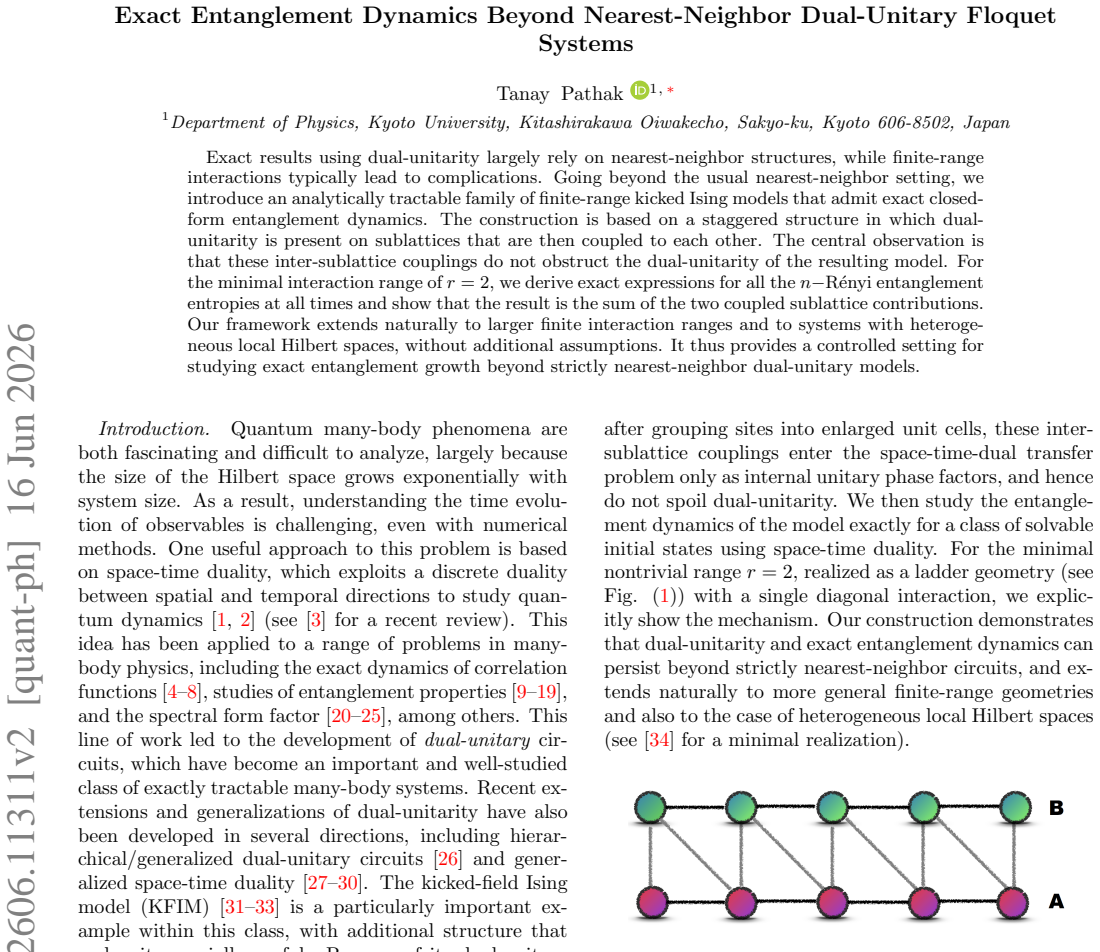
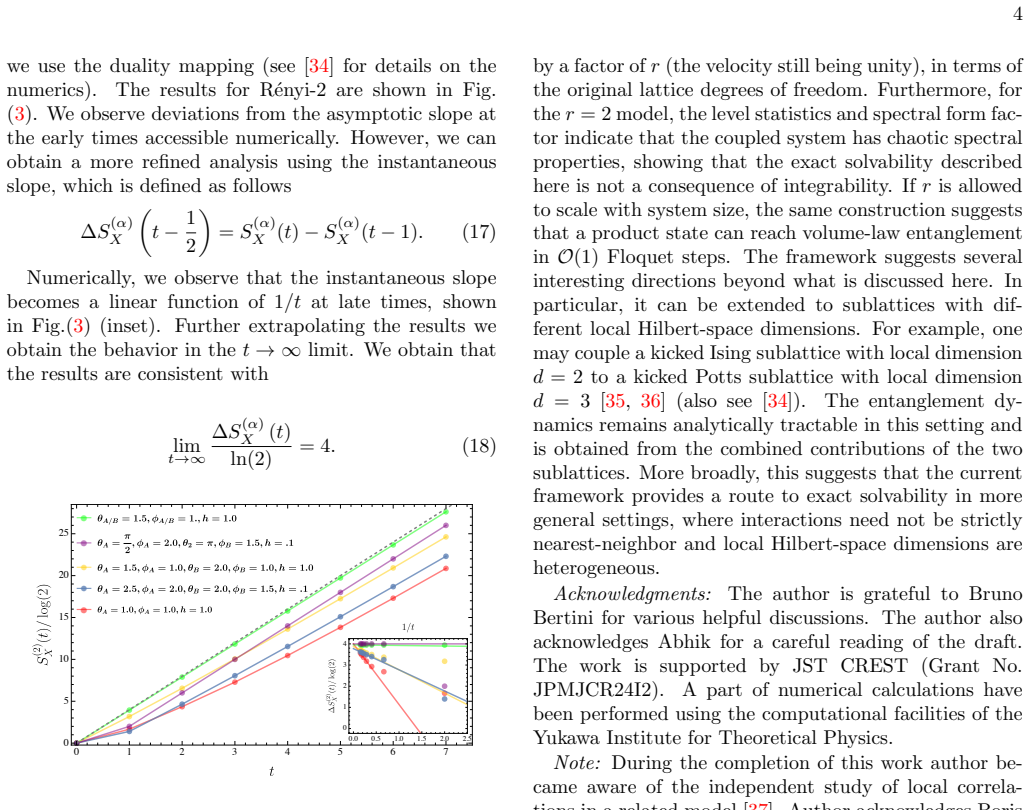
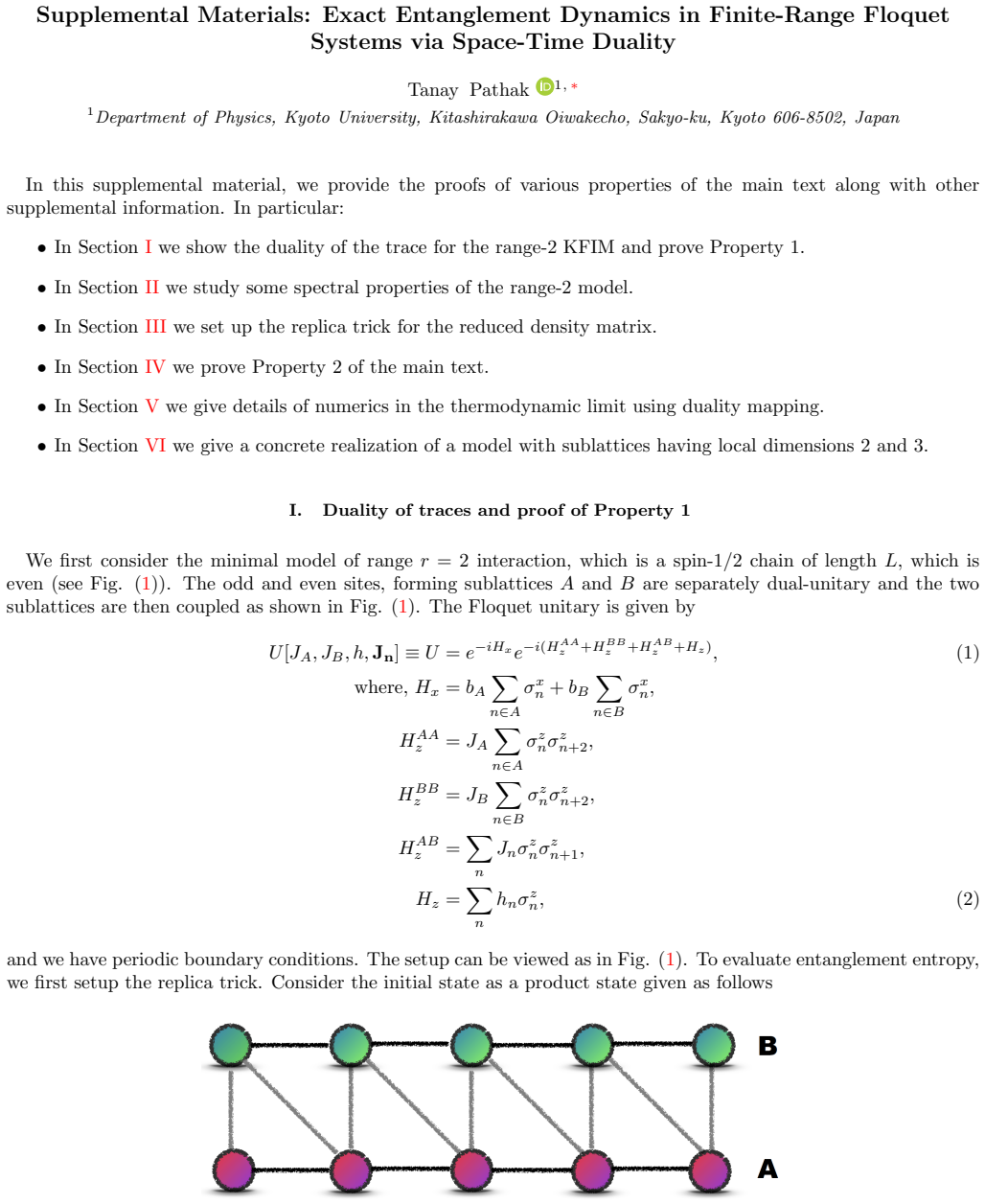
Exact results using dual-unitarity largely rely on nearest-neighbor structures, while finite-range interactions typically lead to complications. Going beyond the usual nearest-neighbor setting, we introduce an analytically tractable family of finite-range kicked Ising models that admit exact closed-form entanglement dynamics. The construction is based on a staggered structure in which dual-unitarity is present on sublattices that are then coupled to each other. The central observation is that these inter-sublattice couplings do not obstruct the dual-unitarity of the resulting model. For the minimal interaction range of $r= 2$, we derive exact expressions for all the $n-$R\'enyi entanglement entropies at all times and show that the result is the sum of the two coupled sublattice contributions. Our framework extends naturally to larger finite interaction ranges and to systems with heterogeneous local Hilbert spaces, without additional assumptions. It thus provides a controlled setting for studying exact entanglement growth beyond strictly nearest-neighbor dual-unitary models.
Editorial analysis
A structured set of objections, weighed in public.
Referee Report
Summary. The paper introduces a staggered finite-range dual-unitary Floquet model for kicked Ising systems in which dual-unitarity holds on coupled sublattices. For the minimal interaction range r=2, it derives exact closed-form expressions for all n-Rényi entanglement entropies at all times, showing that these factor as the sum of independent contributions from the two sublattices. The construction is claimed to extend without additional assumptions to larger finite ranges and to systems with heterogeneous local Hilbert-space dimensions.
Significance. If the algebraic verification of preserved dual-unitarity holds, the work supplies a controlled, analytically tractable family of models that extends exact entanglement dynamics beyond the nearest-neighbor limit that has dominated the dual-unitary literature. The explicit factorization into sublattice contributions and the provision of closed-form Rényi entropies at all times constitute a concrete advance for studying finite-range interacting Floquet systems.
minor comments (3)
- [Section 2] The abstract states that the inter-sublattice couplings 'do not obstruct the dual-unitarity of the resulting model,' but the main text should include an explicit statement of the dual-unitarity conditions (e.g., the two unitary conditions on the gate) both before and after the coupling is introduced.
- [Section 4] The claim that the framework 'extends naturally' to larger r should be illustrated with at least one explicit gate definition or entropy formula for r=3 to substantiate the generality.
- [Section 2] Notation for the staggered lattice and the two sublattices should be introduced with a figure or diagram in the first section where the model is defined.
Simulated Author's Rebuttal
We thank the referee for the positive evaluation and recommendation of minor revision. The summary accurately captures the main results on staggered finite-range dual-unitary models and the exact factorization of Rényi entropies. No major comments were provided in the report.
Circularity Check
No significant circularity
full rationale
The derivation begins with an explicit staggered construction of finite-range kicked Ising gates whose dual-unitarity on each sublattice is preserved after inter-sublattice coupling; the paper states this preservation as the central observation and then algebraically obtains the Rényi entropies as the sum of the two independent sublattice contributions. No parameter is fitted to data and then relabeled a prediction, no uniqueness theorem is imported from prior self-work, and no ansatz is smuggled via citation. The claimed exact expressions are presented as direct consequences of the gate definitions and the verified dual-unitarity conditions, rendering the chain self-contained against external benchmarks.
Axiom & Free-Parameter Ledger
axioms (1)
- domain assumption Inter-sublattice couplings preserve dual-unitarity of the staggered model.
invented entities (1)
-
Staggered finite-range dual-unitary Floquet model
no independent evidence
Reference graph
Works this paper leans on
-
[1]
it has trivial Jordan blocks
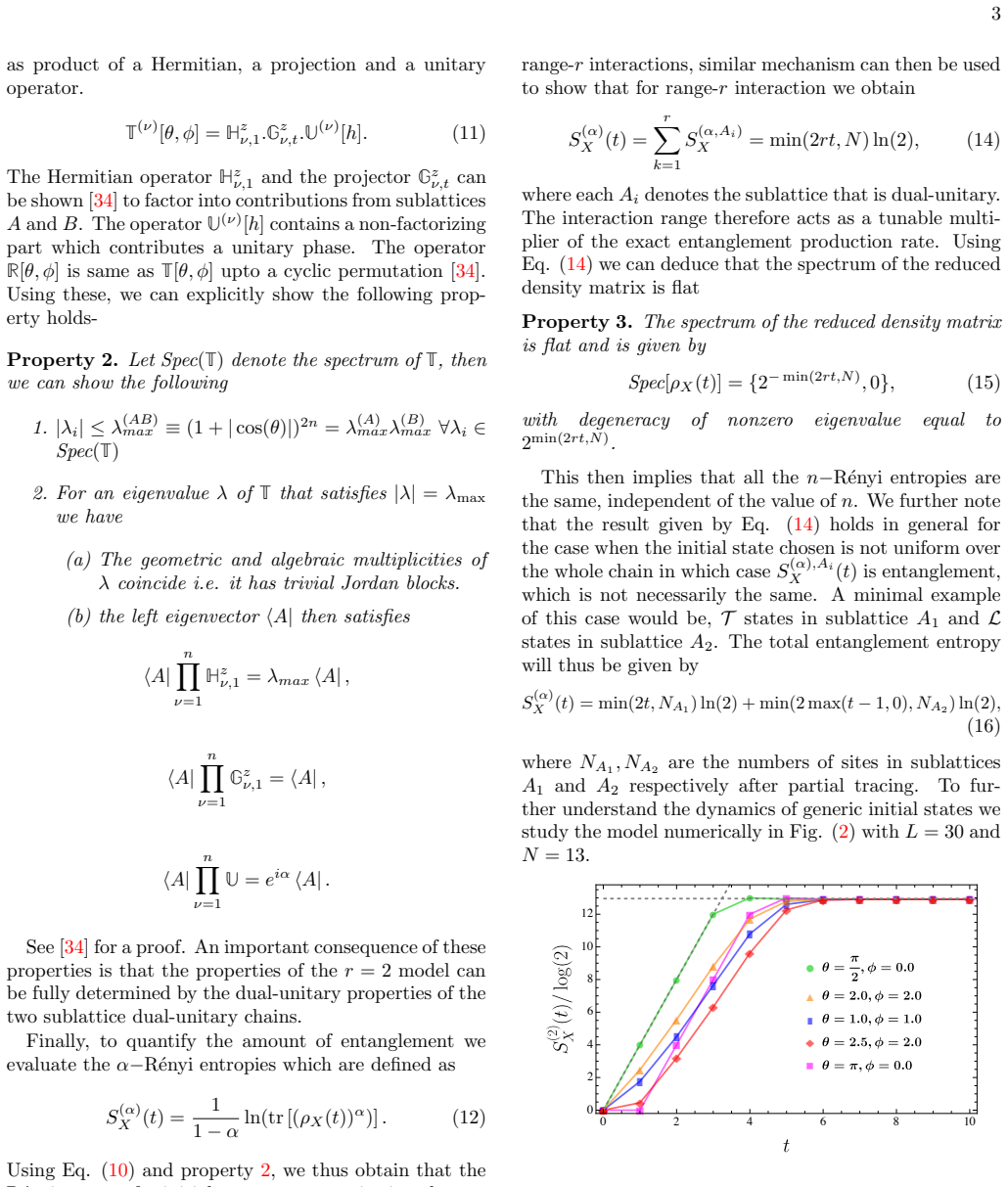
For an eigenvalueλofTthat satisfies|λ|=λ max we have (a) The geometric and algebraic multiplicities of λcoincide i.e. it has trivial Jordan blocks. (b) the left eigenvector⟨A|then satisfies ⟨A| nY ν=1 Hz ν,1 =λ max ⟨A|, ⟨A| nY ν=1 Gz ν,1 =⟨A|, ⟨A| nY ν=1 U=e iα ⟨A|. See [34] for a proof. An important consequence of these properties is that the properties ...
-
[2]
Matrix product states for dynamical simulation of infinite chains,
M. C. Ba˜ nuls, M. B. Hastings, F. Verstraete, and J. I. Cirac, “Matrix product states for dynamical simulation of infinite chains,” Phys. Rev. Lett.102, 240603 (2009)
2009
-
[3]
Particle- time duality in the kicked ising spin chain,
M Akila, D Waltner, B Gutkin, and T Guhr, “Particle- time duality in the kicked ising spin chain,” Journal of Physics A: Mathematical and Theoretical49, 375101 (2016)
2016
-
[4]
Exactly solvable many-body dynamics from space-time duality
Bruno Bertini, Pieter W. Claeys, and Tomaˇ z Prosen, “Exactly solvable many-body dynamics from space- time duality,” Rev. Mod. Phys.98, 025001 (2026), arXiv:2505.11489 [cond-mat.stat-mech]
work page internal anchor Pith review Pith/arXiv arXiv 2026
-
[5]
Exact correlation functions for dual-unitary lattice models in 1 + 1 dimensions,
Bruno Bertini, Pavel Kos, and Tomaˇ z Prosen, “Exact correlation functions for dual-unitary lattice models in 1 + 1 dimensions,” Phys. Rev. Lett.123, 210601 (2019)
2019
-
[6]
Exact local correlations in kicked chains,
Boris Gutkin, Petr Braun, Maram Akila, Daniel Waltner, and Thomas Guhr, “Exact local correlations in kicked chains,” Phys. Rev. B102, 174307 (2020)
2020
-
[7]
Ergodic and nonergodic dual-unitary quantum circuits with arbitrary local hilbert space dimension,
Pieter W. Claeys and Austen Lamacraft, “Ergodic and nonergodic dual-unitary quantum circuits with arbitrary local hilbert space dimension,” Phys. Rev. Lett.126, 100603 (2021). 5
2021
-
[8]
Exact dynamics in dual-unitary quan- tum circuits,
Lorenzo Piroli, Bruno Bertini, J. Ignacio Cirac, and Tomaˇ z Prosen, “Exact dynamics in dual-unitary quan- tum circuits,” Phys. Rev. B101, 094304 (2020)
2020
-
[9]
Solvable models of many-body chaos from dual-koopman circuits,
Arul Lakshminarayan, “Solvable models of many-body chaos from dual-koopman circuits,” Phys. Rev. Lett. 133, 170403 (2024)
2024
-
[11]
Exact quench dynamics of the floquet quantum east model at the deterministic point,
Bruno Bertini, Cecilia De Fazio, Juan P. Garrahan, and Katja Klobas, “Exact quench dynamics of the floquet quantum east model at the deterministic point,” Phys. Rev. Lett.132, 120402 (2024)
2024
-
[12]
Uni- tary circuits of finite depth and infinite width from quantum channels,
Sarang Gopalakrishnan and Austen Lamacraft, “Uni- tary circuits of finite depth and infinite width from quantum channels,” Phys. Rev. B100, 064309 (2019), arXiv:1903.11611 [quant-ph]
-
[13]
Opera- tor Entanglement in Local Quantum Circuits I: Chaotic Dual-Unitary Circuits,
Bruno Bertini, Pavel Kos, and Tomaˇ z Prosen, “Opera- tor Entanglement in Local Quantum Circuits I: Chaotic Dual-Unitary Circuits,” SciPost Phys.8, 067 (2020), arXiv:1909.07407 [cond-mat.stat-mech]
-
[14]
Oper- ator Entanglement in Local Quantum Circuits II: Soli- tons in Chains of Qubits,
Bruno Bertini, Pavel Kos, and Tomaˇ z Prosen, “Oper- ator Entanglement in Local Quantum Circuits II: Soli- tons in Chains of Qubits,” SciPost Phys.8, 068 (2020), arXiv:1909.07410 [cond-mat.stat-mech]
-
[15]
Creating ensembles of dual unitary and maxi- mally entangling quantum evolutions,
Suhail Ahmad Rather, S. Aravinda, and Arul Lakshmi- narayan, “Creating ensembles of dual unitary and maxi- mally entangling quantum evolutions,” Phys. Rev. Lett. 125, 070501 (2020)
2020
-
[16]
Entanglement barriers in dual-unitary circuits,
Isaac Reid and Bruno Bertini, “Entanglement barriers in dual-unitary circuits,” Phys. Rev. B104, 014301 (2021), arXiv:2103.12794 [cond-mat.stat-mech]
-
[17]
Maximal entangle- ment velocity implies dual unitarity,
Tianci Zhou and Aram W. Harrow, “Maximal entangle- ment velocity implies dual unitarity,” Phys. Rev. B106, L201104 (2022), arXiv:2204.10341 [quant-ph]
-
[18]
Growth of entan- glement of generic states under dual-unitary dynamics,
Alessandro Foligno and Bruno Bertini, “Growth of entan- glement of generic states under dual-unitary dynamics,” Phys. Rev. B107, 174311 (2023)
2023
-
[19]
Nonequilibrium dynamics of charged dual- unitary circuits,
Alessandro Foligno, Pasquale Calabrese, and Bruno Bertini, “Nonequilibrium dynamics of charged dual- unitary circuits,” PRX Quantum6, 010324 (2025)
2025
-
[20]
Mixed-State Entanglement in a Minimal Model of Quantum Chaos,
Tanay Pathak, “Mixed-State Entanglement in a Minimal Model of Quantum Chaos,” (2026), arXiv:2603.14292 [quant-ph]
-
[21]
Exact Spectral Form Factor in a Minimal Model of Many-Body Quantum Chaos
Bruno Bertini, Pavel Kos, and Tomaˇ z Prosen, “Exact Spectral Form Factor in a Minimal Model of Many-Body Quantum Chaos,” Phys. Rev. Lett.121, 264101 (2018), arXiv:1805.00931 [nlin.CD]
work page internal anchor Pith review Pith/arXiv arXiv 2018
-
[22]
Random Matrix Spectral Form Factor of Dual-Unitary Quantum Circuits,
Bruno Bertini, Pavel Kos, and Tomaˇ z Prosen, “Random Matrix Spectral Form Factor of Dual-Unitary Quantum Circuits,” Commun. Math. Phys.387, 597–620 (2021), arXiv:2012.12254 [math-ph]
-
[23]
Statistics of the spectral form factor in the self-dual kicked ising model,
Ana Flack, Bruno Bertini, and Tomaˇ z Prosen, “Statistics of the spectral form factor in the self-dual kicked ising model,” Phys. Rev. Res.2, 043403 (2020)
2020
-
[24]
Local pairing of feyn- man histories in many-body floquet models,
S. J. Garratt and J. T. Chalker, “Local pairing of feyn- man histories in many-body floquet models,” Phys. Rev. X11, 021051 (2021)
2021
-
[25]
Structural stability hypothesis of dual unitary quantum chaos,
Jonathon Riddell, Curt von Keyserlingk, Tomaˇ z Prosen, and Bruno Bertini, “Structural stability hypothesis of dual unitary quantum chaos,” Phys. Rev. Res.6, 033226 (2024)
2024
-
[26]
Operator dynamics in floquet many-body systems,
Takato Yoshimura, Samuel J. Garratt, and J. T. Chalker, “Operator dynamics in floquet many-body systems,” Phys. Rev. B111, 094316 (2025)
2025
-
[27]
Hierar- chical generalization of dual unitarity,
Xie-Hang Yu, Zhiyuan Wang, and Pavel Kos, “Hierar- chical generalization of dual unitarity,” Quantum8, 1260 (2024), arXiv:2307.03138 [quant-ph]
-
[28]
Cheryne Jonay, Vedika Khemani, and Matteo Ippoliti, “Triunitary quantum circuits,” Phys. Rev. Res.3, 043046 (2021), arXiv:2106.07686 [quant-ph]
-
[29]
Entanglement membrane in exactly solvable lat- tice models,
Michael A. Rampp, Suhail A. Rather, and Pieter W. Claeys, “Entanglement membrane in exactly solvable lat- tice models,” Phys. Rev. Res.6, 033271 (2024)
2024
-
[30]
Quantum information spreading in generalized dual- unitary circuits,
Alessandro Foligno, Pavel Kos, and Bruno Bertini, “Quantum information spreading in generalized dual- unitary circuits,” Phys. Rev. Lett.132, 250402 (2024)
2024
-
[31]
Solvable entanglement dy- namics in quantum circuits with generalized space-time duality,
Chuan Liu and Wen Wei Ho, “Solvable entanglement dy- namics in quantum circuits with generalized space-time duality,” Phys. Rev. Res.7, L012011 (2025)
2025
-
[32]
Exact time-correlation functions of quantum ising chain in a kicking transversal magnetic field: Spectral analysis of the adjoint propagator in heisenberg picture,
Tomaˇ z Prosen, “Exact time-correlation functions of quantum ising chain in a kicking transversal magnetic field: Spectral analysis of the adjoint propagator in heisenberg picture,” Progress of Theoretical Physics Sup- plement139, 191–203 (2000)
2000
-
[33]
General relation between quantum er- godicity and fidelity of quantum dynamics,
Tomaˇ z Prosen, “General relation between quantum er- godicity and fidelity of quantum dynamics,” Phys. Rev. E65, 036208 (2002)
2002
-
[34]
Chaos and Complexity of quantum motion
Tomaˇ z Prosen, “Chaos and complexity of quantum mo- tion,” J. Phys. A40, 7881 (2007), arXiv:0704.2247 [quant-ph]
work page internal anchor Pith review Pith/arXiv arXiv 2007
-
[35]
See Supplemental Material at URL-will-be-inserted-by- publisher, with additional references, for details on proofs, numerical methods and additional supporting re- sults
-
[36]
Floquet integrability and long-range entangle- ment generation in the one-dimensional quantum potts model,
A. I. Lotkov, V. Gritsev, A. K. Fedorov, and D. V. Kurlov, “Floquet integrability and long-range entangle- ment generation in the one-dimensional quantum potts model,” Phys. Rev. B105, 144306 (2022)
2022
-
[38]
Local cor- relations in long-range dual-unitary kicked Hamiltonian chains,
Vladimir Al. Osipov, Marc Cedric Spyra, Jana Carolina Schumann, Thomas Guhr, and Boris Gutkin, “Local cor- relations in long-range dual-unitary kicked Hamiltonian chains,” (2026), arXiv:2606.13857 [quant-ph]. Supplemental Materials: Exact Entanglement Dynamics in Finite-Range Floquet Systems via Space-Time Duality Tanay Pathak 1,∗ 1Department of Physics, ...
-
[39]
it has trivial Jordan blocks
For an eigenvalueλofTthat satisfies|λ|=λ max we have (a) The geometric and algebraic multiplicities ofλcoincide i.e. it has trivial Jordan blocks. (b) the left eigenvector⟨A|then satisfies ⟨A| nY ν=1 Hz ν,1 =λ max ⟨A|, ⟨A| nY ν=1 Gz ν,1 =⟨A|, ⟨A| nY ν=1 U=e iα ⟨A|. 8 Proof.–For a generic state⟨A|and using the fact thatG z ν,t is a projector and its expect...
-
[40]
Madan Lal Mehta,Random matrices(Elsevier, 2004)
2004
-
[41]
Distribution of the ratio of consecutive level spacings in random matrix ensembles,
Y. Y. Atas, E. Bogomolny, O. Giraud, and G. Roux, “Distribution of the ratio of consecutive level spacings in random matrix ensembles,” Phys. Rev. Lett.110, 084101 (2013)
2013
-
[42]
Entanglement spreading in a minimal model of maximal many-body quantum chaos
Bruno Bertini, Pavel Kos, and Tomaˇ z Prosen, “Entanglement spreading in a minimal model of maximal many-body quantum chaos,” Phys. Rev. X9, 021033 (2019), arXiv:1812.05090 [cond-mat.stat-mech]
work page internal anchor Pith review Pith/arXiv arXiv 2019
-
[43]
Floquet integrability and long-range entanglement generation in the one-dimensional quantum potts model,
A. I. Lotkov, V. Gritsev, A. K. Fedorov, and D. V. Kurlov, “Floquet integrability and long-range entanglement generation in the one-dimensional quantum potts model,” Phys. Rev. B105, 144306 (2022)
2022
-
[44]
Operator dynamics and entanglement in space-time dual Hadamard lattices,
Pieter W. Claeys and Austen Lamacraft, “Operator dynamics and entanglement in space-time dual Hadamard lattices,” J. Phys. A57, 405301 (2024), arXiv:2406.03781 [quant-ph]
discussion (0)
Sign in with ORCID, Apple, or X to comment. Anyone can read and Pith papers without signing in.