Quantized Stochastic Primal-Dual Methods for Distributed Optimization under Relaxed Global Geometry
Pith reviewed 2026-06-27 12:11 UTC · model grok-4.3
The pith
A quantized stochastic primal-dual method converges linearly to an explicit neighborhood under relaxed global geometry conditions.
A machine-rendered reading of the paper's core claim, the machinery that carries it, and where it could break.
Core claim
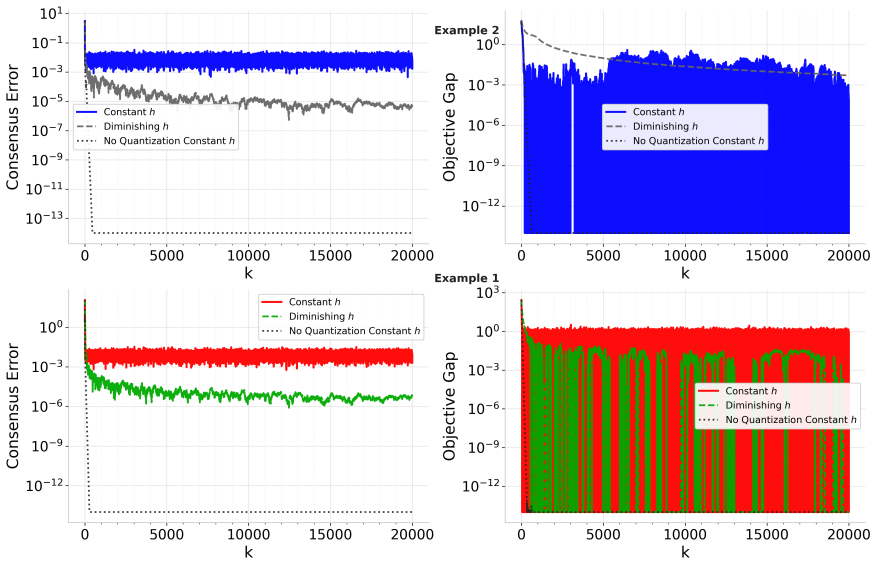
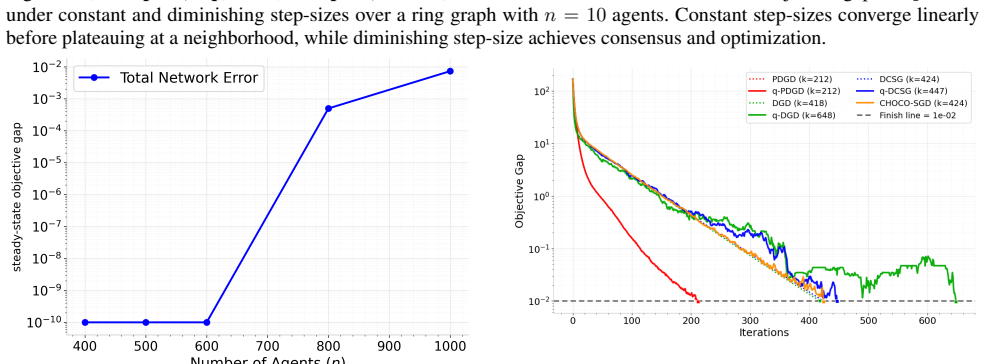
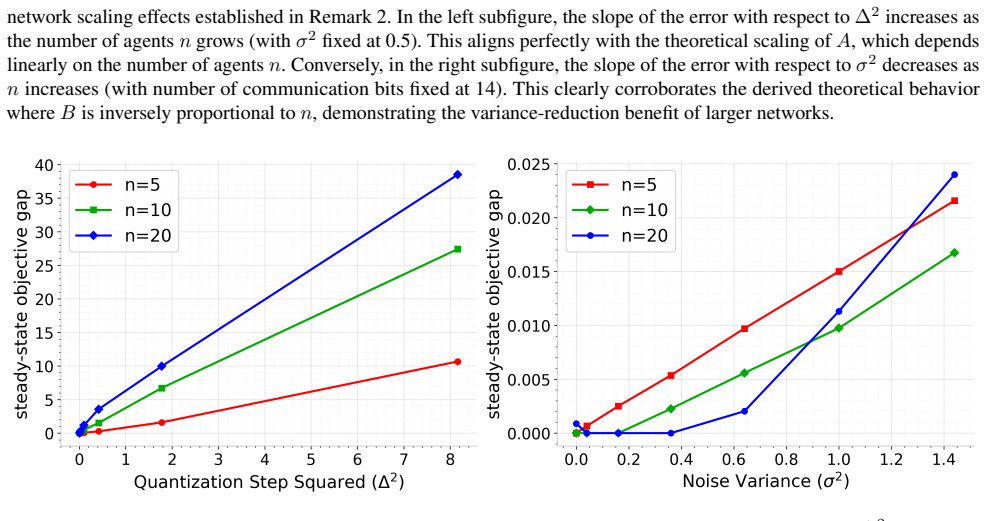
q-PDGD achieves linear contraction to an explicit neighborhood determined by gradient noise, quantization distortion, and network connectivity under RSI with constant step-size, O(1/k) convergence with diminishing step-size without shared-minimizer assumptions, and linear-to-neighborhood convergence under PL in the stochastic quantized distributed setting.
What carries the argument
The q-PDGD algorithm using primal-dual updates combined with random unbiased quantization, analyzed via RSI and PL inequalities as relaxed global geometry.
Load-bearing premise
The objective satisfies either the restricted secant inequality or the Polyak-Lojasiewicz inequality.
What would settle it
Observing that the convergence rate does not become linear when RSI or PL holds, or that the neighborhood radius does not scale with the quantization distortion as predicted.
Figures
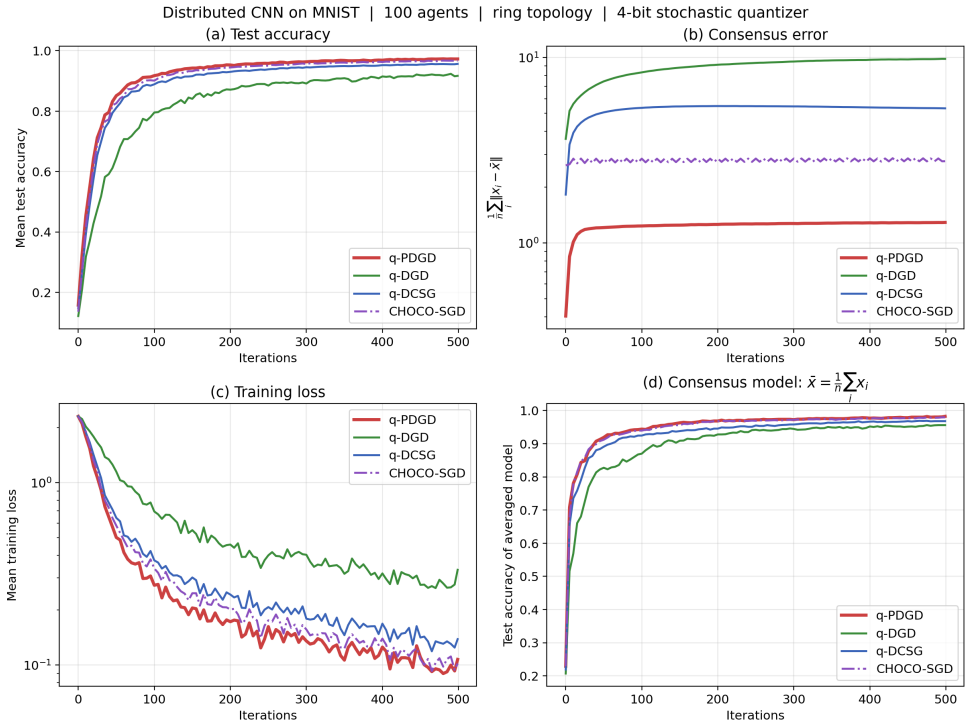
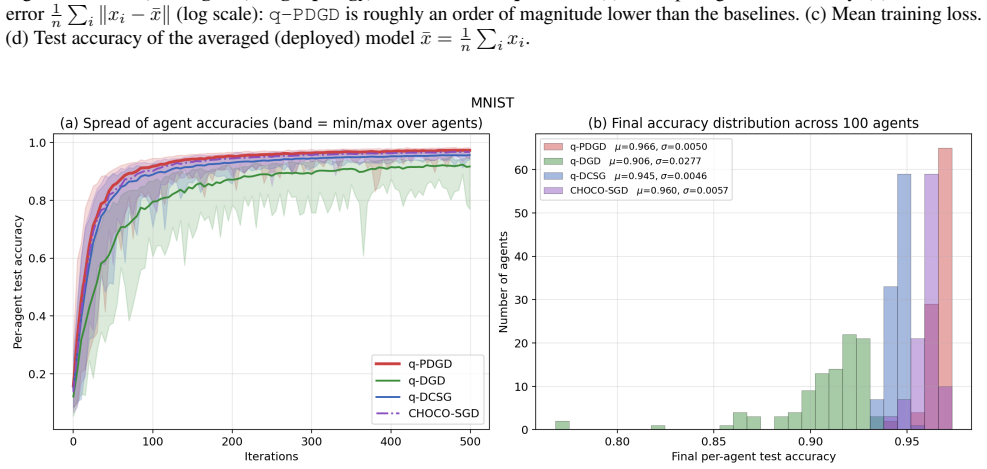
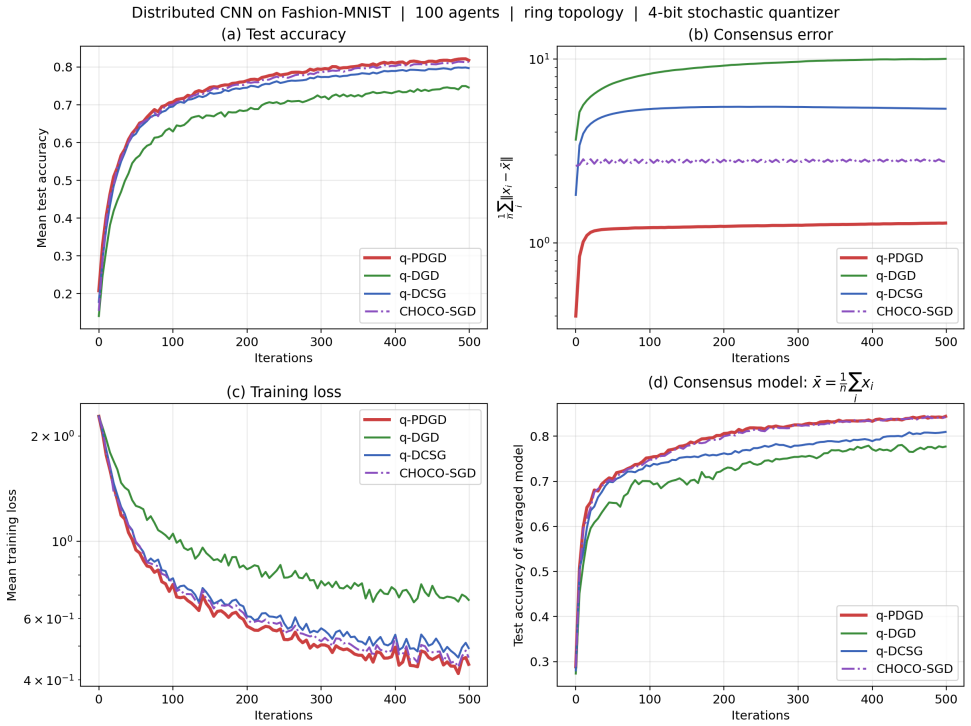
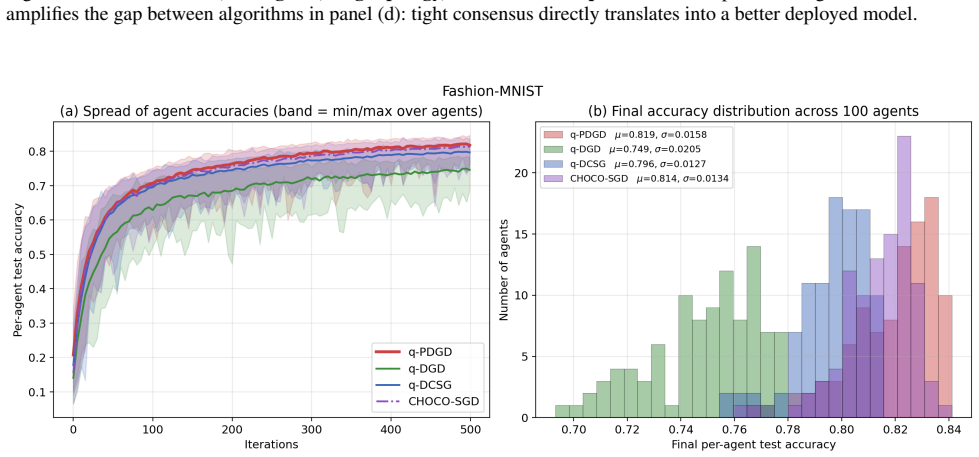
read the original abstract
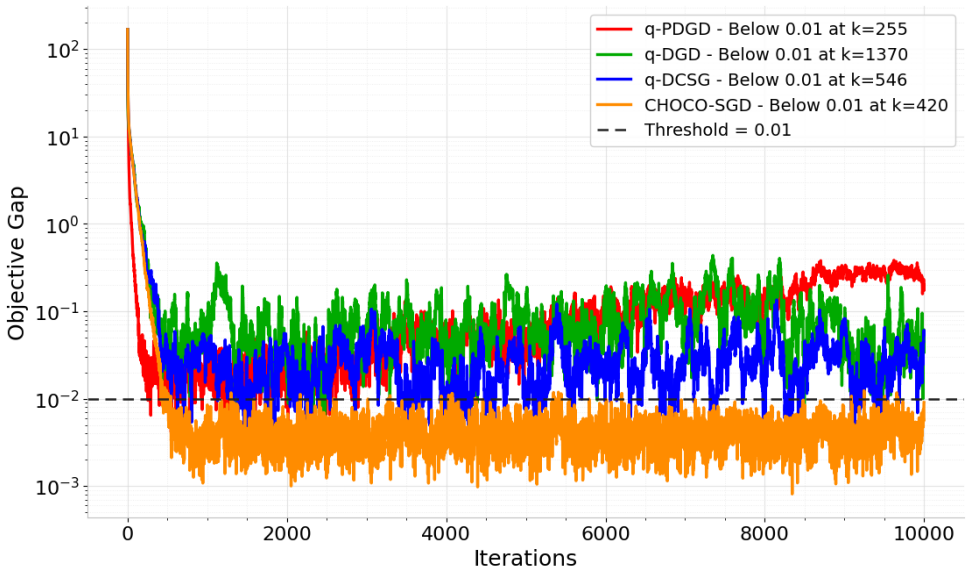
We study distributed optimization with stochastic gradients and finite-bit communication modeled by random (unbiased) quantization. We propose q-PDGD, a quantized stochastic primal-dual method, and analyze it under relaxed global geometry. Under restricted secant inequality (RSI), a constant step-size yields linear contraction to an explicit neighborhood determined by gradient noise, quantization distortion, and network connectivity, while a diminishing step-size achieves O(1/k) convergence without shared-minimizer assumptions. Under Polyak-Lojasiewicz (PL) inequality, we obtain linear-to-neighborhood convergence in the same stochastic quantized setting. Our results match the best-known centralized stochastic rates in oracle complexity, and are supported by experiments demonstrating the predicted tradeoffs between quantization level, step-size choice, and graph structure.
Editorial analysis
A structured set of objections, weighed in public.
Referee Report
Summary. The manuscript proposes q-PDGD, a quantized stochastic primal-dual gradient method for distributed optimization under stochastic gradients and unbiased random quantization for finite-bit communication. Under the restricted secant inequality (RSI), constant step-sizes yield linear contraction to an explicit neighborhood whose radius depends on gradient noise, quantization distortion, and network connectivity; diminishing step-sizes achieve O(1/k) convergence without requiring a shared minimizer. Under the Polyak-Łojasiewicz (PL) inequality the same setting yields linear convergence to a neighborhood. The stated rates recover the best-known centralized stochastic oracle complexities while incorporating quantization and graph effects; numerical experiments illustrate the predicted trade-offs among quantization level, step-size schedule, and graph structure.
Significance. If the supporting derivations are correct, the contribution is significant: it supplies the first explicit neighborhood radii for quantized primal-dual methods under RSI/PL geometry, removes the shared-minimizer hypothesis for the diminishing-step-size regime, and shows that the communication constraint does not degrade the centralized rate order. The explicit dependence of the neighborhood on the quantization variance and the mixing matrix is a concrete, usable result for practitioners designing bit-constrained networks.
minor comments (2)
- [Abstract, §1] Abstract and §1: the phrase 'relaxed global geometry' is used before RSI and PL are formally introduced; a one-sentence parenthetical definition on first appearance would improve readability.
- [Experiments] The experiments section would benefit from a table (or additional rows in an existing table) reporting the measured neighborhood radii versus the theoretically predicted radii for at least two quantization levels.
Simulated Author's Rebuttal
We thank the referee for the positive and constructive review, which accurately captures the main contributions of the manuscript. The recommendation for minor revision is noted; however, the report does not list any specific major comments requiring point-by-point rebuttal.
Circularity Check
No significant circularity; derivation self-contained under standard assumptions
full rationale
The paper derives convergence rates for q-PDGD under the standard restricted secant inequality (RSI) and Polyak-Lojasiewicz (PL) assumptions applied to the global objective, with quantization modeled as unbiased random operators whose distortion enters the neighborhood radius explicitly. These are external geometric conditions independent of the algorithm or its analysis; the stated linear-to-neighborhood and O(1/k) rates follow directly from standard Lyapunov arguments without reducing to fitted parameters, self-definitions, or load-bearing self-citations. The abstract and description indicate recovery of centralized oracle complexity as a comparison result rather than a circular premise. No step in the provided derivation chain equates a prediction to its input by construction.
Axiom & Free-Parameter Ledger
axioms (2)
- domain assumption The objective function satisfies the restricted secant inequality (RSI) or Polyak-Lojasiewicz (PL) inequality.
- domain assumption Quantization is modeled as unbiased random quantization with finite bits.
Reference graph
Works this paper leans on
-
[1]
IFAC-PapersOnLine , volume=
Exponential convergence for distributed optimization under the restricted secant inequality condition , author=. IFAC-PapersOnLine , volume=. 2020 , publisher=
2020
-
[2]
Advances in Neural Information Processing Systems , volume=
Information-theoretic lower bounds on the oracle complexity of convex optimization , author=. Advances in Neural Information Processing Systems , volume=
-
[3]
2020 59th IEEE Conference on Decision and Control (CDC) , pages=
Linear convergence for distributed optimization without strong convexity , author=. 2020 59th IEEE Conference on Decision and Control (CDC) , pages=. 2020 , organization=
2020
-
[4]
Dutta, Amit and Doan, Thinh T , journal=. On the. 2024 , publisher=
2024
-
[5]
The Journal of Machine Learning Research , volume=
Beyond the regret minimization barrier: optimal algorithms for stochastic strongly-convex optimization , author=. The Journal of Machine Learning Research , volume=. 2014 , publisher=
2014
-
[6]
2016 IEEE International Conference on Acoustics, Speech and Signal Processing (ICASSP) , pages=
Quantized consensus ADMM for multi-agent distributed optimization , author=. 2016 IEEE International Conference on Acoustics, Speech and Signal Processing (ICASSP) , pages=. 2016 , organization=
2016
-
[7]
Advances in neural information processing systems , volume=
QSGD: Communication-efficient SGD via gradient quantization and encoding , author=. Advances in neural information processing systems , volume=
-
[8]
IEEE Transactions on Signal Processing , volume=
Compressed gradient tracking for decentralized optimization over general directed networks , author=. IEEE Transactions on Signal Processing , volume=. 2022 , publisher=
2022
-
[9]
Decentralized deep learning with arbitrary communication compression , author=. arXiv preprint arXiv:1907.09356 , year=
-
[10]
Optimization Methods and Software , volume=
Distributed learning with compressed gradient differences , author=. Optimization Methods and Software , volume=. 2025 , publisher=
2025
-
[11]
Advances in Neural Information Processing Systems , volume=
EF21: A new, simpler, theoretically better, and practically faster error feedback , author=. Advances in Neural Information Processing Systems , volume=
-
[12]
International conference on machine learning , pages=
signSGD: Compressed optimisation for non-convex problems , author=. International conference on machine learning , pages=. 2018 , organization=
2018
-
[13]
Advances in neural information processing systems , volume=
Terngrad: Ternary gradients to reduce communication in distributed deep learning , author=. Advances in neural information processing systems , volume=
-
[14]
IEEE Transactions on Automatic Control , volume=
Quantized primal-dual algorithms for network optimization with linear convergence , author=. IEEE Transactions on Automatic Control , volume=. 2023 , publisher=
2023
-
[15]
IFAC-PapersOnLine , volume=
Distributed optimization with gradient descent and quantized communication , author=. IFAC-PapersOnLine , volume=. 2023 , publisher=
2023
-
[16]
Advances in neural information processing systems , volume=
Double quantization for communication-efficient distributed optimization , author=. Advances in neural information processing systems , volume=
-
[17]
IEEE Transactions on Automatic Control , volume=
Quantization design for distributed optimization , author=. IEEE Transactions on Automatic Control , volume=. 2016 , publisher=
2016
-
[18]
Automatica , volume=
Distributed convex optimization via continuous-time coordination algorithms with discrete-time communication , author=. Automatica , volume=. 2015 , publisher=
2015
-
[19]
SIAM Journal on Optimization , volume=
Extra: An exact first-order algorithm for decentralized consensus optimization , author=. SIAM Journal on Optimization , volume=. 2015 , publisher=
2015
-
[20]
Linear convergence of gradient and proximal-gradient methods under the
Karimi, Hamed and Nutini, Julie and Schmidt, Mark , booktitle=. Linear convergence of gradient and proximal-gradient methods under the. 2016 , organization=
2016
-
[21]
Annual Reviews in Control , volume=
A survey of distributed optimization , author=. Annual Reviews in Control , volume=. 2019 , publisher=
2019
-
[22]
IEEE Transactions on Information Forensics and Security , volume=
Provable privacy advantages of decentralized federated learning via distributed optimization , author=. IEEE Transactions on Information Forensics and Security , volume=. 2024 , publisher=
2024
-
[23]
International Conference on Artificial Intelligence and Statistics , pages=
Efficient distributed hessian free algorithm for large-scale empirical risk minimization via accumulating sample strategy , author=. International Conference on Artificial Intelligence and Statistics , pages=. 2020 , organization=
2020
-
[24]
2018 21st International Conference on Information Fusion (FUSION) , pages=
A review of forty years of distributed estimation , author=. 2018 21st International Conference on Information Fusion (FUSION) , pages=. 2018 , organization=
2018
-
[25]
Annual Review of Control, Robotics, and Autonomous Systems , volume=
Distributed optimization for control , author=. Annual Review of Control, Robotics, and Autonomous Systems , volume=. 2018 , publisher=
2018
-
[26]
SIAM Journal on Optimization , year =
Yuan, Kun and Ling, Qing and Yin, Wotao , title =. SIAM Journal on Optimization , year =
-
[27]
2018 IEEE Conference on Decision and Control (CDC) , pages=
Quantized decentralized consensus optimization , author=. 2018 IEEE Conference on Decision and Control (CDC) , pages=. 2018 , organization=
2018
-
[28]
2019 , eprint=
Decentralized Stochastic Optimization and Gossip Algorithms with Compressed Communication , author=. 2019 , eprint=
2019
discussion (0)
Sign in with ORCID, Apple, or X to comment. Anyone can read and Pith papers without signing in.