Range-Aware Bayesian Optimization for Discovering Diverse Designs within Target Property Windows
Pith reviewed 2026-06-27 10:36 UTC · model grok-4.3
The pith
Range-aware Bayesian optimization scores the posterior probability that candidates satisfy target property ranges to recover more diverse valid designs.
A machine-rendered reading of the paper's core claim, the machinery that carries it, and where it could break.
Core claim
By using an acquisition function defined as the posterior probability of range satisfaction, the range-aware Bayesian optimization framework identifies larger and more diverse collections of valid designs than standard acquisition functions or goal-seeking methods, both on benchmarks and in polymer and oligomer design tasks.
What carries the argument
Range-aware acquisition function that scores the posterior probability a candidate satisfies a target range.
If this is right
- It naturally extends to parallel pursuit of multiple distinct specifications over a shared candidate space.
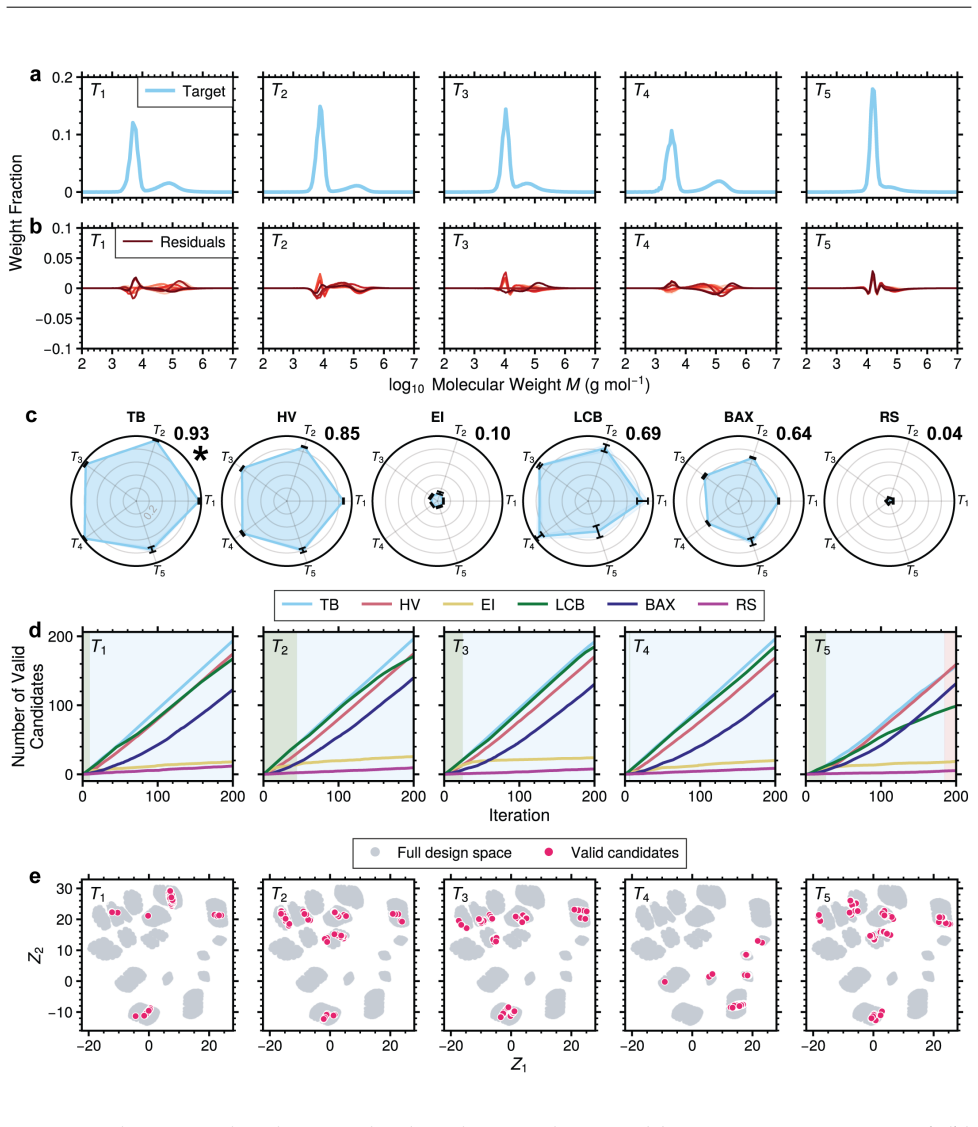
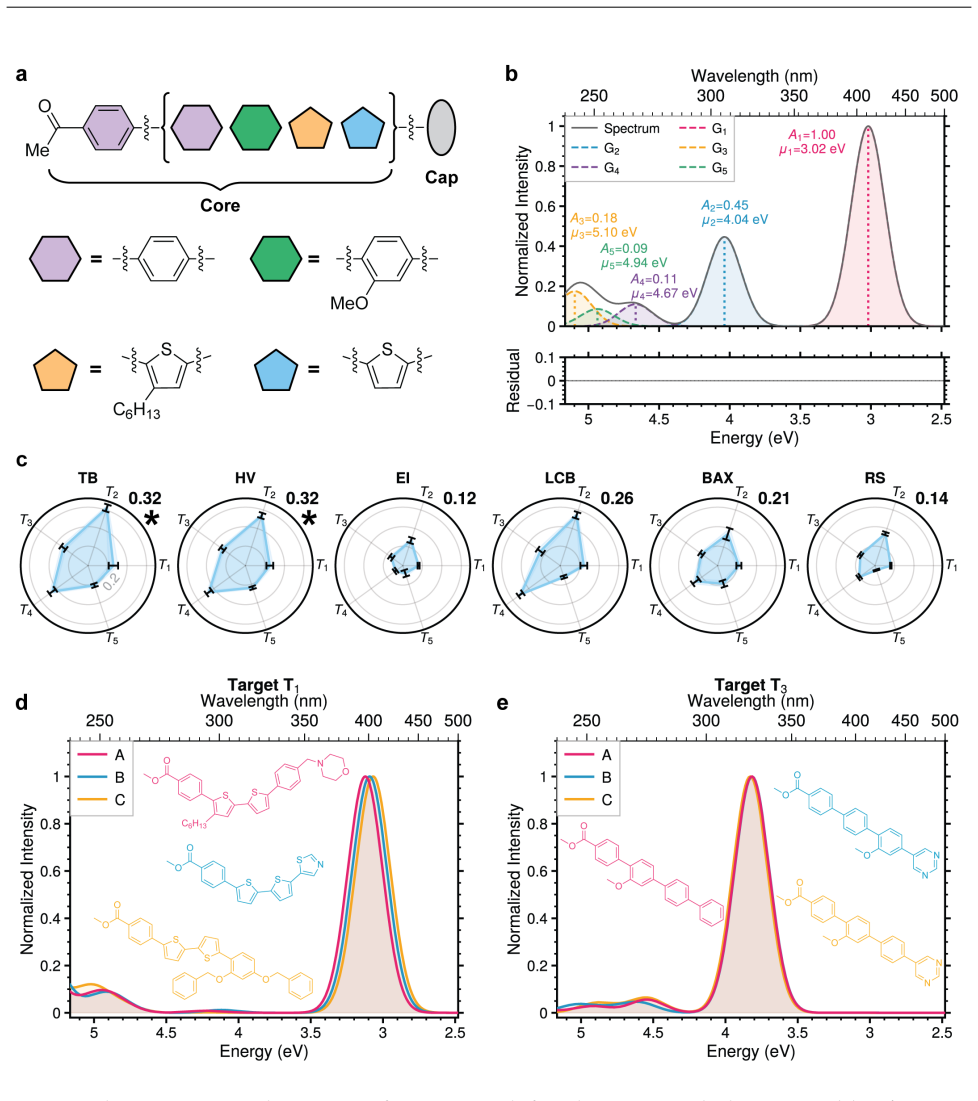
- Across benchmark tasks it recovers larger and more diverse sets of valid designs than standard BO baselines and recent goal-seeking methods.
- It is demonstrated on optimizing reaction conditions for polymer synthesis and sequence-defined oligomer discovery for prescribed optical absorption bands supported by quantum chemical calculations.
Where Pith is reading between the lines
- Designers could later choose among the recovered candidates using secondary criteria such as cost or robustness that were not encoded in the ranges.
- The same probability-based scoring could be applied with surrogate models other than Gaussian processes in domains where uncertainty estimates take a different form.
- Embedding the method inside closed-loop experimental platforms would test whether the diversity gains translate to fewer total experiments in laboratory settings.
Load-bearing premise
The surrogate model provides reliable posterior probabilities for whether candidates satisfy the target ranges.
What would settle it
A direct comparison on the benchmark tasks in which the range-aware method fails to recover larger or more diverse sets of valid designs than the standard Bayesian optimization baselines.
Figures
read the original abstract
In many materials and product design problems, desirable candidates exhibit properties that fall within an acceptable range rather than achieve a single optimum. Recovering multiple, distinct solutions that satisfy such specifications is also practically valuable, as some candidates may be preferred for reasons of cost, processability, or robustness that are difficult to encode directly in an objective function. Here, we develop a range-aware Bayesian optimization (BO) framework in which the acquisition function directly scores the posterior probability that a candidate satisfies a target range. The framework naturally extends to parallel pursuit of multiple distinct specifications over a shared candidate space. Across benchmark tasks, range-aware acquisition consistently recovers larger and more diverse sets of valid designs than standard BO baselines and recent goal-seeking methods. Its utility is further demonstrated in two practically motivated design case studies involving optimizing reaction conditions for polymer synthesis and sequence-defined oligomer discovery for prescribed optical absorption bands, supported by quantum chemical calculations. These results suggest that range-aware BO can provide a practical and sample-efficient foundation for specification-driven design, particularly when design flexibility and solution diversity are important considerations.
Editorial analysis
A structured set of objections, weighed in public.
Referee Report
Summary. The paper introduces a range-aware Bayesian optimization framework in which the acquisition function is defined as the Gaussian process posterior probability that a candidate lies inside one or more target property intervals. The method is extended to simultaneous pursuit of multiple distinct range specifications and is evaluated on benchmark tasks plus two case studies (polymer synthesis reaction conditions and sequence-defined oligomers for prescribed optical absorption bands, with quantum-chemical validation). The central claim is that this acquisition recovers larger and more diverse sets of valid designs than standard BO baselines and recent goal-seeking methods.
Significance. If the empirical claims hold after verification of modeling assumptions, the work would offer a practical, sample-efficient tool for specification-driven design problems common in materials and chemistry, where solution diversity within acceptable windows is often more valuable than single-point optimization. The case studies provide concrete application evidence.
major comments (3)
- [Experimental evaluation / benchmarks] The soundness of the range-aware acquisition rests on the assumption that GP posterior probabilities of range satisfaction are well-calibrated (see skeptic note and abstract claim of consistent outperformance). No empirical coverage checks, calibration plots, or held-out predictive-interval diagnostics are reported on the benchmark tasks or case-study landscapes; without these, the reported gains in number and diversity of recovered designs cannot be attributed to the acquisition itself rather than to possible miscalibration bias.
- [Results / benchmarks] The abstract and results claim 'consistent outperformance' and 'larger and more diverse sets,' yet the provided description gives no details on the precise diversity metric(s), the full list of baselines (including any recent goal-seeking methods), the number of independent runs, or statistical significance testing. These omissions make it impossible to assess whether the central empirical claim is load-bearing or sensitive to implementation choices.
- [Method / acquisition function] The parallel multi-specification extension is presented as a natural feature, but the manuscript does not specify how the joint acquisition is normalized or how conflicts between overlapping ranges are resolved when the shared candidate space is queried; this detail is required to reproduce the reported multi-range results.
minor comments (2)
- [Method] Notation for the range-satisfaction probability (e.g., how the indicator function is integrated against the GP posterior) should be written explicitly as an equation rather than described in prose.
- [Case studies] Figure captions for the case-study results should state the exact number of function evaluations used and whether the plotted points are from a single run or aggregated.
Simulated Author's Rebuttal
We thank the referee for the detailed and constructive report. We address each major comment below. Where the manuscript is missing necessary details or diagnostics, we will revise accordingly to improve clarity and strengthen the empirical claims.
read point-by-point responses
-
Referee: [Experimental evaluation / benchmarks] The soundness of the range-aware acquisition rests on the assumption that GP posterior probabilities of range satisfaction are well-calibrated (see skeptic note and abstract claim of consistent outperformance). No empirical coverage checks, calibration plots, or held-out predictive-interval diagnostics are reported on the benchmark tasks or case-study landscapes; without these, the reported gains in number and diversity of recovered designs cannot be attributed to the acquisition itself rather than to possible miscalibration bias.
Authors: We agree that explicit calibration diagnostics are important to substantiate that performance gains arise from the range-aware acquisition rather than from miscalibration. The current manuscript does not include coverage checks or calibration plots. In the revision we will add these diagnostics (e.g., reliability diagrams and interval coverage on held-out points) for the benchmark functions and, where feasible, the case-study landscapes. revision: yes
-
Referee: [Results / benchmarks] The abstract and results claim 'consistent outperformance' and 'larger and more diverse sets,' yet the provided description gives no details on the precise diversity metric(s), the full list of baselines (including any recent goal-seeking methods), the number of independent runs, or statistical significance testing. These omissions make it impossible to assess whether the central empirical claim is load-bearing or sensitive to implementation choices.
Authors: The manuscript is missing these implementation and evaluation details. We will expand the experimental section to (i) define the diversity metric(s) explicitly, (ii) list every baseline including the recent goal-seeking methods, (iii) state the number of independent runs, and (iv) report statistical significance tests (e.g., Wilcoxon signed-rank or paired t-tests with p-values). revision: yes
-
Referee: [Method / acquisition function] The parallel multi-specification extension is presented as a natural feature, but the manuscript does not specify how the joint acquisition is normalized or how conflicts between overlapping ranges are resolved when the shared candidate space is queried; this detail is required to reproduce the reported multi-range results.
Authors: We agree that the normalization of the joint acquisition and the handling of overlapping ranges require explicit description for reproducibility. In the revised manuscript we will add a dedicated paragraph (or subsection) detailing the joint formulation, the normalization procedure, and the logical combination used when ranges overlap. revision: yes
Circularity Check
No circularity; new acquisition defined from standard GP posterior and evaluated on external benchmarks
full rationale
The framework introduces an acquisition function that scores the GP posterior probability of satisfying target ranges, then applies it to benchmark tasks and case studies. No step reduces a claimed prediction or result to a fitted quantity defined by the result itself, nor relies on self-citation chains for uniqueness or ansatz. The derivation is self-contained against external benchmarks; the reader's score of 1.0 is consistent with this assessment.
Axiom & Free-Parameter Ledger
axioms (1)
- domain assumption Gaussian process surrogate provides well-calibrated posterior probabilities for property values
Reference graph
Works this paper leans on
-
[1]
Marcelo Kaminski Lenzi, Michael F Cunningham, Enrique Luis Lima, and José Carlos Pinto. Producing bimodal molecular weight distribution polymer resins using living and conventional free-radical polymerization.Industrial & Engineering Chemistry Research, 44(8):2568–2578, 2005
2005
-
[2]
Fierens, Dagmar R
Stijn K. Fierens, Dagmar R. D’hooge, Paul H. M. Van Steenberge, Marie-Françoise Reyniers, and Guy B. Marin. Mama-sg1 initiated nitroxide mediated polymerization of styrene: From arrhenius parameters to model-based design.Chemical Engineering Journal, 278:407–420, October 2015
2015
-
[3]
Florence Chauvin, Pierre-Emmanuel Dufils, Didier Gigmes, Yohann Guillaneuf, Sylvain R. A. Marque, Paul Tordo, and Denis Bertin. Nitroxide-mediated polymerization: The pivotal role of the kd value of the initiating alkoxyamine and the importance of the experimental conditions. Macromolecules, 39(16):5238–5250, August 2006
2006
-
[4]
Gilbert, Robin A
Michael Buback, Robert G. Gilbert, Robin A. Hutchinson, Bert Klumperman, Frank-Dieter Kuchta, Bart G. Manders, Kenneth F. O’Driscoll, Gregory T. Russell, and Johannes Schweer. Critically evaluated rate coefficients for free-radical polymerization, 1. propagation rate coefficient for styrene.Macromolecular Chemistry and Physics, 196(10):3267–3280, October 1995
1995
-
[5]
Hui and Archie E
Albert W. Hui and Archie E. Hamielec. Thermal polymerization of styrene at high conversions and temperatures. an experimental study.Journal of Applied Polymer Science, 16(3):749–769, March 1972
1972
-
[6]
Marien, Mariya Edeleva, Paul H
Kyann De Smit, Yoshi W. Marien, Mariya Edeleva, Paul H. M. Van Steenberge, and Dagmar R. D’hooge. Roadmap for monomer conversion and chain length-dependent termination reac- tivity algorithms in kinetic monte carlo modeling of bulk radical polymerization.Industrial & Engineering Chemistry Research, 59(52):22422–22439, December 2020
2020
-
[7]
D. S. Achilias and C. Kiparissides. Development of a general mathematical framework for modeling diffusion-controlled free-radical polymerization reactions.Macromolecules, 25(14):3739– 3750, July 1992
1992
-
[8]
Robert G. Gilbert. Critically-evaluated propagation rate coefficients in free radical polymeriza- tions i. styrene and methyl methacrylate (technical report).Pure and Applied Chemistry, 68(7):1491– 1494, July 1996. 19
1996
-
[9]
Termination kinetics of free-radical polymerization of styrene over an extended temperature and pressure range.Macromolecular Chemistry and Physics, 198(5):1455–1480, May 1997
Michael Buback and Frank-Dieter Kuchta. Termination kinetics of free-radical polymerization of styrene over an extended temperature and pressure range.Macromolecular Chemistry and Physics, 198(5):1455–1480, May 1997
1997
-
[10]
Evidence for disproportionation in ter- mination reaction of styrene polymerization by α, α’-azobisisobutyronitrile.Polymer Journal, 17(8):985–989, August 1985
Koichi Hatada, Tatsuki Kitayama, and Fiji Masuda. Evidence for disproportionation in ter- mination reaction of styrene polymerization by α, α’-azobisisobutyronitrile.Polymer Journal, 17(8):985–989, August 1985
1985
-
[11]
Esr study of the radical polymeriza- tion of styrene: 5
Bunichiro Yamada, Masakazu Kageoka, and Takayuki Otsu. Esr study of the radical polymeriza- tion of styrene: 5. temperature dependence of propagation and termination rate constants over a wide temperature range.Polymer Bulletin, 29(3):385–392, September 1992
1992
-
[12]
Davis, and Johannes Schweer
Heidi Kapfenstein-Doak, Christopher Barner-Kowollik, Thomas P . Davis, and Johannes Schweer. A novel method for the measurement of chain transfer to monomer constants in styrene ho- mopolymerizations: The pulsed laser rotating reactor assembly.Macromolecules, 34(9):2822–2829, April 2001. 20
2001
discussion (0)
Sign in with ORCID, Apple, or X to comment. Anyone can read and Pith papers without signing in.