Experimental straintronics in nanotube quantum dots
Pith reviewed 2026-06-27 08:17 UTC · model grok-4.3
The pith
Uniaxial mechanical strain tunes the doping and bandgap of nanotube quantum dots through predictable bandstructure changes.
A machine-rendered reading of the paper's core claim, the machinery that carries it, and where it could break.
Core claim
Elastic uniaxial strain applied to suspended SWCNT quantum dots with channel lengths around 30 nm produces quantitatively predictable bandstructure modifications, including a strain-tunable bandgap, that directly set the quantum dot doping level as confirmed by reversible dI/dV maps agreeing with QTS theory.
What carries the argument
Quantum transport straintronics (QTS) in which elastic uniaxial strain modifies the one-dimensional bandstructure of a single-wall carbon nanotube to control its transport properties.
If this is right
- Mechanical strain provides gate-free control of doping in molecular-scale transistors.
- A strain-tunable bandgap enables formation of homojunctions within a single nanotube.
- The same approach can be used to adjust energy levels in nanotube-based qubits or artificial atoms.
- Reversible strain allows continuous in-situ tuning of quantum transport without changing electrostatic potentials.
Where Pith is reading between the lines
- Mechanical control could reduce charge noise compared with conventional gate electrodes in sensitive quantum devices.
- The method may extend to other narrow-gap one-dimensional conductors where strain alters band edges.
- Integration with MEMS actuators could produce compact, electrically quiet tunable sensors or switches.
- Different nanotube chiralities would shift the strain values needed for a given bandgap change, offering a design handle.
Load-bearing premise
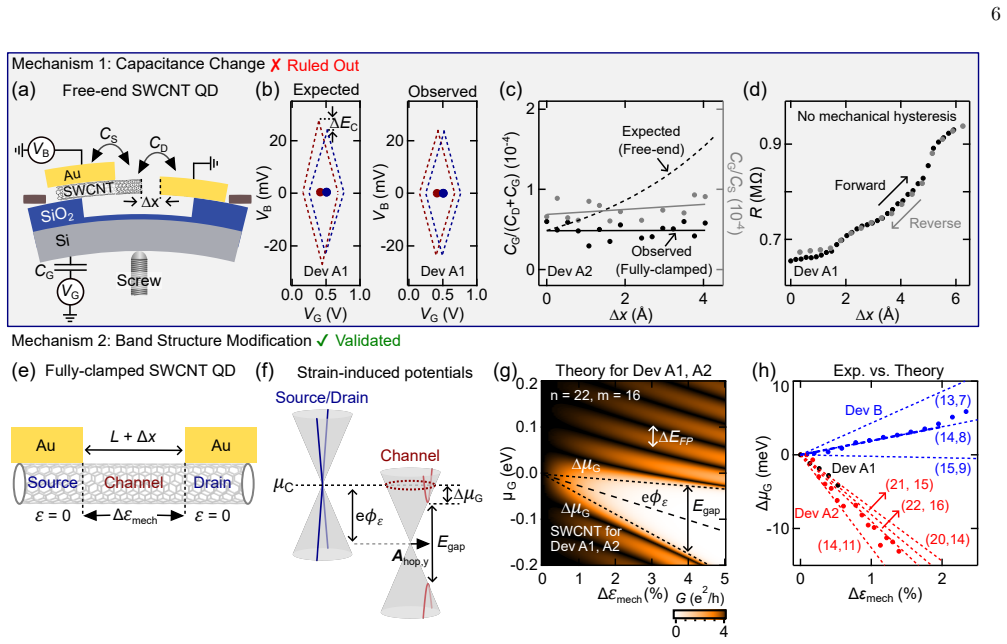
The transport changes are produced by elastic strain altering the nanotube bandstructure rather than by capacitive gating or other non-elastic mechanisms.
What would settle it
Transport data that fail to reverse when mechanical strain is released or that deviate from the bandgap shift predicted by QTS theory for the applied strain values.
Figures
read the original abstract
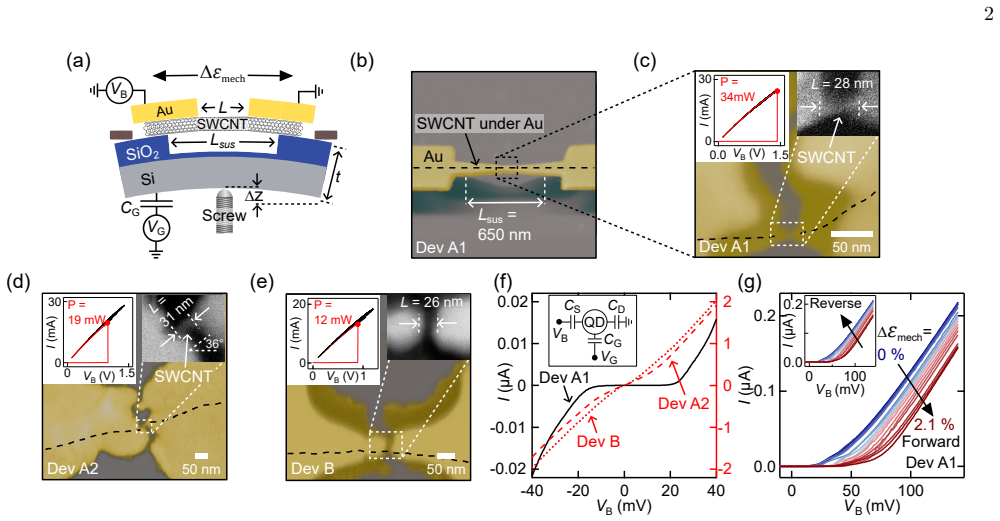
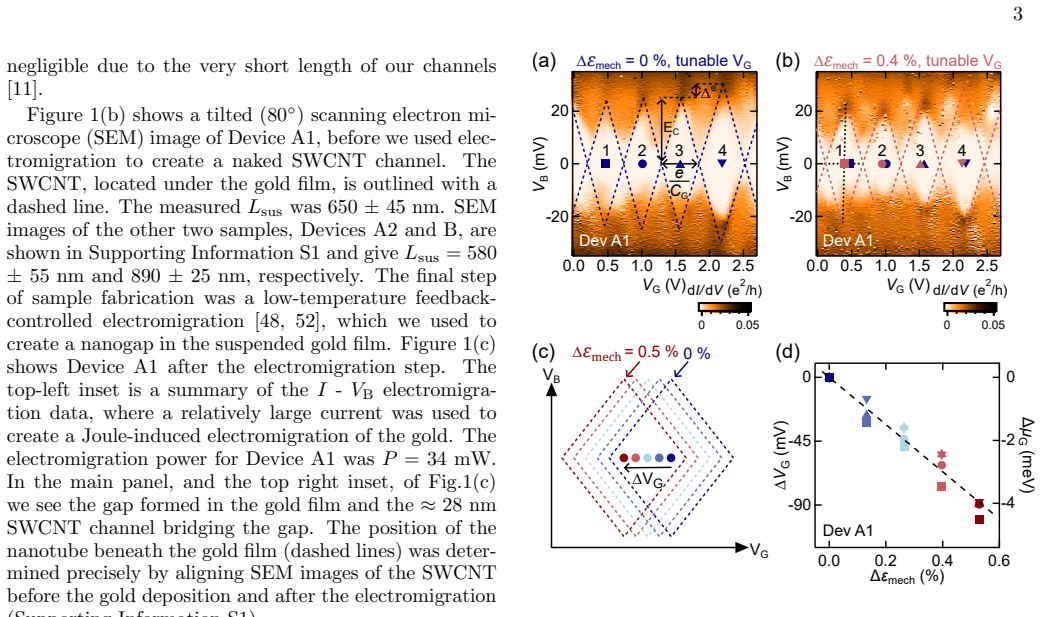
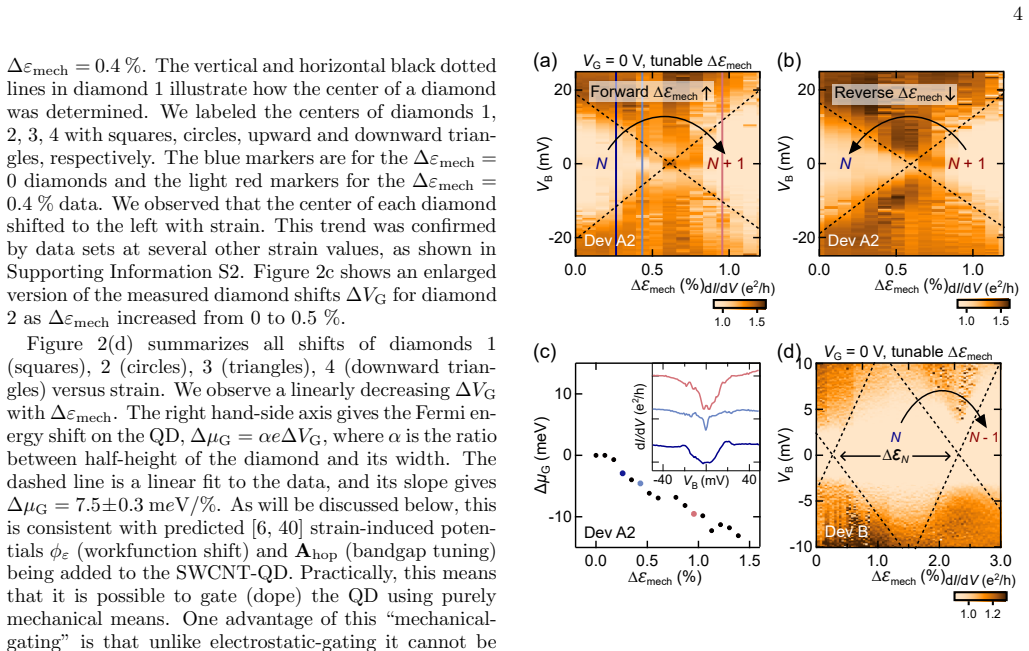
Single-wall carbon nanotubes (SWCNTs) are narrow ribbons of graphene with atomically precise edges and a single quantum transport channel, at experimentally-relevant dopings. This makes them ideal systems to harness quantum transport straintronics (QTS), i.e. using mechanical strain to control accurately quantum transport. We present QTS data from three single-wall carbon nanotube quantum dot (SWCNT-QD) transistors over a broad range of in-situ tunable and reversible uniaxial strain ($\Delta\varepsilon_\text{mech}\approx$ 0 to 3 %). We first present the nanofabrication of the suspended SWCNT transistors whose channel lengths are $\approx$ 30 nm. The channels are strained by moving gold clamps holding firmly the nanotubes. We present detailed charge transport data, $dI/dV_{\text{B}} - V_{\text{B}} - V_{\text{G}}$ and $dI/dV_{\text{B}} - V_{\text{B}} - \Delta\varepsilon_\text{mech}$, showing a large mechanical-gating effect of the SWCNT-QDs. The precise reversibility of the data, and their agreement with QTS theory, confirms that the tubes are strained elastically. We demonstrate that the mechanical control of the QD doping is not due to capacitive-gating effects, but to quantitatively predictable bandstructure changes including a strain-tunable bandgap. This precise mechanical control of the doping and bandgap of SWCNT-QDs could find applications in qubits, condensed matter physics, and homojunction molecular transistors.
Editorial analysis
A structured set of objections, weighed in public.
Referee Report
Summary. The manuscript reports experimental results on quantum transport straintronics (QTS) in single-wall carbon nanotube quantum dots (SWCNT-QDs). Suspended SWCNT transistors with ~30 nm channels are fabricated, and uniaxial strain (0 to ~3%) is applied in situ by displacing gold clamps. Charge transport measurements (dI/dV_B vs. V_B, V_G and vs. strain) show a large mechanical-gating effect on the QD doping. The central claim is that this gating arises from quantitatively predictable, strain-induced bandstructure modifications—including a tunable bandgap—rather than capacitive effects, as supported by the precise reversibility of the data and agreement with QTS theory.
Significance. If the central attribution holds, the work establishes a platform for precise, reversible mechanical control of doping and bandgap in atomically precise SWCNT-QDs. The quantitative match to external QTS theory and the demonstrated elastic reversibility are strengths that support the distinction from capacitive gating. This has potential relevance for qubit implementations, homojunction molecular transistors, and studies of strain-tunable quantum transport.
minor comments (2)
- [Abstract] Abstract: the claim of 'detailed charge transport data' and 'agreement with QTS theory' is stated without reference to error bars, statistical measures, or the precise metric of agreement (e.g., rms deviation or χ^{2}); the main text and figures should supply these to allow quantitative evaluation of the match.
- [Methods / Data Analysis] The manuscript should clarify in § on data analysis or methods how capacitive-gating contributions were quantitatively bounded or subtracted, given that the central claim rests on this distinction.
Simulated Author's Rebuttal
We thank the referee for their positive assessment of the work, the supportive significance statement, and the recommendation for minor revision. No specific major comments were raised in the report.
Circularity Check
No significant circularity detected
full rationale
The paper is an experimental study presenting transport data from strained SWCNT-QD devices, attributing doping shifts to bandstructure changes (including tunable bandgap) via direct comparison to external QTS theory, data reversibility, and exclusion of capacitive gating. No load-bearing steps reduce by definition, fitted parameter, or self-citation chain to the paper's own inputs; the central claim rests on measurements and independent theory agreement rather than internal equivalence.
Axiom & Free-Parameter Ledger
Reference graph
Works this paper leans on
-
[1]
Yamada et al.,Size-selective growth of double-walled carbon nanotube forests from engineered iron catalysts, Nat
T. Yamada et al.,Size-selective growth of double-walled carbon nanotube forests from engineered iron catalysts, Nat. Nanotechnol.1, 131 (2006)
2006
-
[2]
F. A. Chaves, D. Jimenez, A. W. Cummings, and S. Roche,Physical model of the contact resistivity of metal-graphene junctions, J. Appl. Phys.115, 164513 (2014)
2014
-
[3]
Heinze et al.,Carbon nanotubes as Schottky barrier transistors, Phys
S. Heinze et al.,Carbon nanotubes as Schottky barrier transistors, Phys. Rev. Lett.89, 106801 (2002)
2002
-
[4]
A. C. McRae et al.,Mechanical Control of Quantum Transport in Graphene, Adv. Mater.36, 2313629 (2024)
2024
-
[5]
A. C. McRae, V. Tayari, J. M. Porter, and A. R. Champagne,Giant electron-hole transport asymmetry in ultra-short quantum transistors, Nat. Commun.8, 15491 (2017)
2017
-
[6]
A. R. Champagne, A. N. Pasupathy, and D. C. Ralph,Mechanically adjustable and electrically gated single-molecule transistors, Nano Lett.5, 305 (2005)
2005
-
[7]
J. O. Island, V. Tayari, A. C. McRae, and A. R. Champagne,Few-Hundred GHz Carbon Nanotube Nanoelectromechanical Systems (NEMS), Nano Lett.12, 4564 (2012)
2012
-
[8]
Huang, G
L. Huang, G. Wei, and A. R. Champagne,Quantum transport straintronics and mechan- ical Aharonov-Bohm effect in quasimetallic single-wall carbon nanotubes, Phys. Rev. Appl.23(2025)
2025
-
[9]
A. C. McRae, G. Wei, and A. R. Champagne,Graphene Quantum Strain Transistors, Phys. Rev. Appl.11, 054019 (2019)
2019
-
[10]
Amorim et al.,Novel effects of strains in graphene and other two dimensional ma- terials, Phys
B. Amorim et al.,Novel effects of strains in graphene and other two dimensional ma- terials, Phys. Rep.617, 1 (2016)
2016
-
[11]
A. H. Castro Neto, F. Guinea, N. M. R. Peres, K. S. Novoselov, and A. K. Geim,The electronic properties of graphene, Rev. Mod. Phys.81, 109 (2009)
2009
-
[12]
A. L. Kitt, V. M. Pereira, A. K. Swan, and B. B. Goldberg,Lattice-corrected strain- induced vector potentials in graphene, Phys. Rev. B85, 115432 (2012)
2012
-
[13]
F. M. D. Pellegrino, G. G. N. Angilella, and R. Pucci,Transport properties of graphene across strain-induced nonuniform velocity profiles, Phys. Rev. B84, 195404 (2011). 14
2011
-
[14]
G. G. Naumis, S. Barraza-Lopez, M. Oliva-Leyva, and H. Terrones,Electronic and optical properties of strained graphene and other strained 2D materials: a review, Rep. Prog. Phys.80, 096501 (2017)
2017
-
[15]
Tworzydlo, B
J. Tworzydlo, B. Trauzettel, M. Titov, A. Rycerz, and C. W. Beenakker,Sub-Poissonian shot noise in graphene, Phys. Rev. Lett.96, 246802 (2006)
2006
-
[16]
E. A. Laird et al.,Quantum transport in carbon nanotubes, Rev. Mod. Phys.87, 703 (2015). 15
2015
discussion (0)
Sign in with ORCID, Apple, or X to comment. Anyone can read and Pith papers without signing in.