The Fundaments of Unity: {mathcal O}(1) Couplings in Quantum Field Theories
Pith reviewed 2026-06-27 08:57 UTC · model grok-4.3
The pith
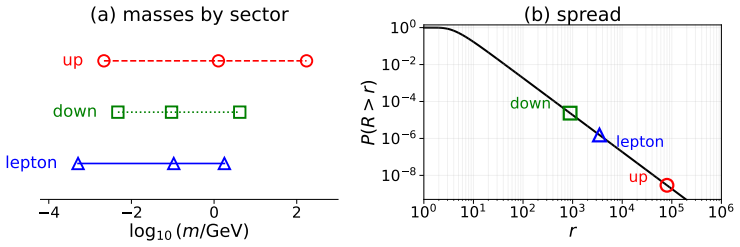
The spread between largest and smallest dimensionless couplings in a QFT can exceed 100 with high probability even when each is drawn from an order-unity distribution.
A machine-rendered reading of the paper's core claim, the machinery that carries it, and where it could break.
Core claim
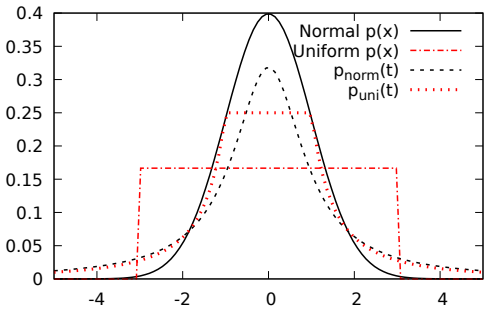
When dimensionless couplings are taken to be independent and identically distributed random variables whose characteristic scale is order unity, the distribution of their spread possesses power-law tails that grow heavier as the number of couplings increases, so that the probability of observing spreads much larger than one is appreciable rather than negligible.
What carries the argument
The spread, defined as the ratio of the largest to the smallest magnitude among the dimensionless couplings appearing in the Lagrangian density.
If this is right
- The requirement that all couplings remain O(1) becomes statistically less probable as the number of independent couplings grows.
- Distributions with exponentially decaying tails still produce power-law tails in the spread, so extreme ratios remain likely.
- The measure supplies a concrete statistical benchmark against which the coupling hierarchies of concrete models can be compared.
- Closed-form expressions for the distribution of the spread allow direct calculation of probabilities without simulation for any chosen number of couplings.
Where Pith is reading between the lines
- The result supplies a null hypothesis for the size of coupling hierarchies that any dynamical explanation must beat.
- In model building, the statistical expectation of large spreads may reduce the perceived need for additional symmetries or mechanisms to enforce uniformity.
- The growth of tail weight with the number of couplings suggests that apparent fine-tuning in coupling values should be assessed relative to this baseline rather than to a fixed O(1) window.
Load-bearing premise
The dimensionless couplings can be modeled as independent identically distributed random variables drawn from a probability distribution whose characteristic scale is order unity.
What would settle it
An explicit Monte Carlo sampling or closed-form integration over twenty independent unit-normal random variables that yields a probability materially different from 0.29 for the event that their spread exceeds 100.
Figures
read the original abstract
We critically examine the expectation that in a fundamental quantum field theory, dimensionless couplings in the Lagrangian density should all be of order unity. We propose a measure to quantify the adherence of a theory to this: the spread (the ratio of the largest to the smallest of the magnitudes) of such dimensionless couplings, obtaining various closed-form results. If we take independent identically distributed (IID) couplings to parameterise our uncertainty on the values of the order unity couplings, the spread can be much larger than one might naively expect. For a theory with 20 IID unit normal couplings, the probability that the spread is greater than 100 is 0.29, for example. Even when the IID couplings have exponentially suppressed tails, the distribution of the spread has fat power-law tails which grow with the number of independent couplings.
Editorial analysis
A structured set of objections, weighed in public.
Referee Report
Summary. The manuscript critically examines the common expectation in quantum field theory that dimensionless couplings should be of order unity. It introduces a 'spread' measure defined as the ratio of the largest to the smallest magnitude among these couplings and derives closed-form expressions for its properties. Modeling the couplings as independent identically distributed (IID) random variables drawn from distributions with characteristic scale O(1), such as unit normals, the paper computes the probability distribution of the spread. For instance, with 20 such couplings, the probability that the spread exceeds 100 is reported as 0.29. The analysis further demonstrates that the distribution of the spread exhibits fat power-law tails even when the underlying distributions have exponentially suppressed tails, with these tails becoming more pronounced as the number of couplings increases.
Significance. This work provides a quantitative statistical framework for assessing the 'naturalness' of coupling values in fundamental theories. If the IID modeling is accepted as a reasonable parameterization of uncertainty, the results indicate that large spreads are not improbable, which could inform debates on fine-tuning and the hierarchy problem in particle physics. The provision of closed-form results and explicit numerical probabilities strengthens the paper's utility as a reference for such discussions. The fat-tail behavior is a notable finding that challenges naive expectations.
minor comments (1)
- [Abstract] Abstract: the phrase 'various closed-form results' is vague; a parenthetical reference to the specific quantities derived (e.g., the cdf of the spread or the tail exponent) would help readers immediately locate the technical contributions.
Simulated Author's Rebuttal
We thank the referee for their positive assessment of the manuscript and their recommendation to accept. The referee's summary accurately captures the key results on the spread of O(1) couplings modeled as IID random variables.
Circularity Check
No significant circularity identified
full rationale
The paper defines spread as the ratio of largest to smallest |dimensionless couplings| and derives closed-form expressions for its distribution under an explicit IID modeling assumption from a probability distribution with O(1) characteristic scale. The example probability (0.29 for spread >100 with 20 unit normals) follows from standard order statistics of the half-normal; no step reduces by construction to a fitted input, self-citation, or self-definition. The claim is conditional on the modeling choice and does not assert dynamical necessity.
Axiom & Free-Parameter Ledger
axioms (1)
- domain assumption Dimensionless couplings may be treated as independent identically distributed random variables from a distribution with characteristic scale of order unity.
Reference graph
Works this paper leans on
-
[1]
Ellis,The superstring: theory of everything, or of nothing?,Nature 323(1986) 595–598
J. Ellis,The superstring: theory of everything, or of nothing?,Nature 323(1986) 595–598
1986
-
[2]
Witten,Dimensional Reduction of Superstring Models,Phys
E. Witten,Dimensional Reduction of Superstring Models,Phys. Lett. B155(1985) 151
1985
-
[3]
V. Kaplunovsky and J. Louis,On Gauge couplings in string theory, Nucl. Phys. B444(1995) 191–244, [hep-th/9502077]
Pith/arXiv arXiv 1995
-
[4]
C. D. Froggatt and H. B. Nielsen,Hierarchy of Quark Masses, Cabibbo Angles and CP Violation,Nucl. Phys. B147(1979) 277–298. 14 [5]Particle Data GroupCollaboration, S. Navas et al.,Review of Particle Physics,Phys. Rev. D110(2024), no. 3 030001
1979
-
[5]
R. C. Geary,The Frequency Distribution of the Quotient of Two Normal Variates,J. Roy. Statist. Soc.93(1930), no. 3 442–446
1930
-
[6]
J. F. Donoghue, K. Dutta, and A. Ross,Quark and lepton masses and mixing in the landscape,Phys. Rev. D73(2006) 113002, [hep-ph/0511219]
Pith/arXiv arXiv 2006
-
[7]
L. J. Hall, H. Murayama, and N. Weiner,Neutrino mass anarchy, Phys. Rev. Lett.84(2000) 2572–2575, [hep-ph/9911341]
Pith/arXiv arXiv 2000
-
[8]
N. Haba and H. Murayama,Anarchy and hierarchy,Phys. Rev. D63 (2001) 053010, [hep-ph/0009174]
Pith/arXiv arXiv 2001
-
[9]
Edelman,Eigenvalues and condition numbers of random matrices, SIAM J
A. Edelman,Eigenvalues and condition numbers of random matrices, SIAM J. Matrix Anal. Appl.9(1988), no. 4 543–560
1988
-
[10]
Wishart,The generalised product moment distribution in samples from a normal multivariate population,Biometrika20A(1928) 32–52
J. Wishart,The generalised product moment distribution in samples from a normal multivariate population,Biometrika20A(1928) 32–52
1928
-
[11]
P. J. Forrester,Log-Gases and Random Matrices. Princeton University Press, 2010
2010
-
[12]
B. C. Allanach and S. F. King,String unification, spaghetti diagrams and infrared fixed points,Nucl. Phys. B507(1997) 91, [hep-ph/9703293]
Pith/arXiv arXiv 1997
-
[13]
B. C. Allanach and J. Davighi,Naturalising the third family hypercharge model for neutral currentB-anomalies,Eur. Phys. J. C79 (2019), no. 11 908, [arXiv:1905.10327]
arXiv 2019
-
[14]
G. von Gersdorff,Natural Fermion Hierarchies from Random Yukawa Couplings,JHEP09(2017) 094, [arXiv:1705.05430]
Pith/arXiv arXiv 2017
- [15]
-
[16]
L. J. Hall, M. P. Salem, and T. Watari,Statistical Understanding of Quark and Lepton Masses in Gaussian Landscapes,Phys. Rev. D76 (2007) 093001, [arXiv:0707.3446]
Pith/arXiv arXiv 2007
-
[17]
K. S. Babu, A. Khanov, and S. Saad,Anarchy with Hierarchy: A Probabilistic Appraisal,Phys. Rev. D95(2017), no. 5 055014, [arXiv:1612.07787]. 16
Pith/arXiv arXiv 2017
discussion (0)
Sign in with ORCID, Apple, or X to comment. Anyone can read and Pith papers without signing in.