The Khipu Problem: Institutional Legibility Under Distributed Cognition
Pith reviewed 2026-06-30 23:18 UTC · model grok-4.3
The pith
Distributed AI creates records that later institutions cannot read even when the data survives.
A machine-rendered reading of the paper's core claim, the machinery that carries it, and where it could break.
Core claim
The khipu problem for distributed AI is that the record can survive while the reading practice needed to interpret it as part of one coherent cognitive episode decays, creating a structural mismatch between what can be represented and what institutions must still decide under consequential conditions.
What carries the argument
The khipu problem: survival of logs, traces, model versions, and approval artifacts without the institutional capacity to read them as a single distributed cognitive episode.
If this is right
- Institutions must treat structurally unreadable evidence as a distinct category alongside missing and ambiguous evidence.
- Consequential outcomes are better understood as distributed cognitive episodes than as outputs of bounded models.
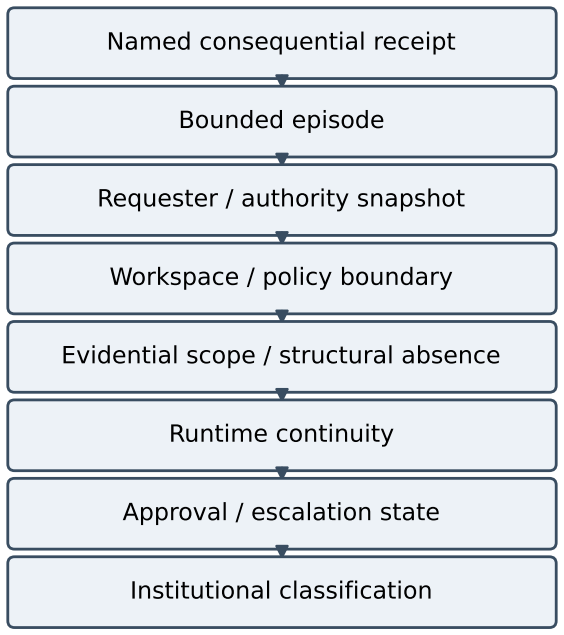
- Governance workspaces together with receipt-bearing governance surfaces can preserve action identity, authority, boundary truth, evidential scope, and consequential outcomes.
Where Pith is reading between the lines
- The same decay of interpretive capacity could affect accountability in any long-lived socio-technical system that distributes decision-making across changing components.
- Current emphasis on data retention policies may need explicit requirements for maintaining the surrounding scaffolding that allows later readers to treat traces as one episode.
Load-bearing premise
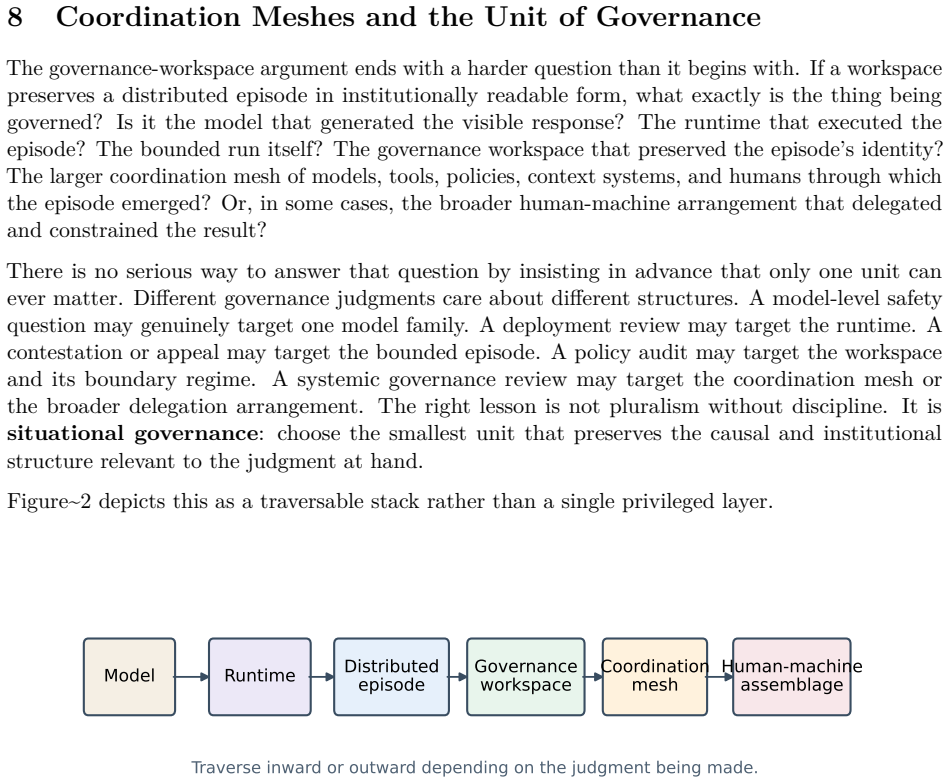
The premise that the relevant object of governance is a distributed cognitive episode whose legibility depends on surrounding interpretive scaffolding rather than a bounded model or agent.
What would settle it
A documented case in which every model version, tool call, log, and approval artifact remains available yet no subsequent institution can reconstruct the authority, boundaries, or evidential basis of the outcome because the required interpretive practices have decayed.
Figures
read the original abstract
AI governance still tends to assume that the relevant object is a bounded model or a bounded agent. That assumption is getting weaker. Real systems increasingly distribute cognition across models, tools, humans, context stores, retrieval layers, runtime policies, authorization boundaries, and delegated institutional roles. In such systems, the central governance problem is no longer only what the system did, but whether later institutions can still read what the system was. This paper introduces the khipu problem for distributed AI: the record can survive while the reading practice needed to interpret it decays. Logs, traces, model versions, tool calls, outputs, and approval artifacts may remain available while the institutional capacity to read them as parts of one coherent cognitive episode disappears. We argue that this failure is better understood as loss of interpretive continuity than as ordinary lack of observability. The result is a distinct governance failure. Institutions must classify, trust, audit, and constrain systems whose relevant identity is distributed across components and whose legibility depends on surrounding interpretive scaffolding. The problem is not merely missing data. It is a structural mismatch between what can be represented and what must still be decided under consequential conditions. We therefore argue that governance for distributed AI requires preservation of interpretive continuity, not only trace retention. The paper distinguishes missing evidence, ambiguous evidence, and structurally unreadable evidence; argues that many consequential outcomes are better understood as distributed cognitive episodes than as bounded model outputs; and proposes governance workspaces together with receipt-bearing governance surfaces as interpretive infrastructure for preserving action identity, authority, boundary truth, evidential scope, and consequential outcomes.
Editorial analysis
A structured set of objections, weighed in public.
Referee Report
Summary. The manuscript introduces the 'khipu problem' for distributed AI governance: records, logs, and traces may persist while the institutional reading practices required to interpret them as coherent cognitive episodes decay. It reframes the core issue as loss of interpretive continuity rather than ordinary observability failures, distinguishes missing/ambiguous/structurally unreadable evidence, treats consequential outcomes as distributed cognitive episodes rather than bounded model outputs, and proposes governance workspaces plus receipt-bearing governance surfaces to preserve action identity, authority, boundary truth, evidential scope, and outcomes.
Significance. If the proposed distinctions and infrastructure prove operationalizable, the reframing could usefully shift AI governance discussions from trace retention toward institutional interpretive scaffolding. The paper receives credit for cleanly separating three evidence categories and for identifying a structural mismatch between representable data and decision requirements under consequential conditions.
major comments (2)
- [Abstract] Abstract: the claim that loss of interpretive continuity constitutes a distinct governance failure (distinct from ordinary lack of observability) rests on the unelaborated premise that distributed systems possess a coherent 'cognitive episode' whose identity can be lost; no criteria for identifying episode boundaries or for measuring continuity decay are supplied, rendering the distinction definitional rather than diagnostic.
- [Abstract] Abstract (opening paragraphs): the assertion that 'the relevant object of governance is no longer a bounded model or agent but a distributed cognitive episode' is load-bearing for all subsequent recommendations, yet the manuscript supplies neither a formal characterization of such episodes nor a concrete test (e.g., application to a retrieval-augmented multi-agent workflow) that would allow the claim to be evaluated or falsified.
minor comments (1)
- [Abstract] The historical analogy motivating the term 'khipu problem' is invoked but not explained or referenced, leaving readers without the intended interpretive bridge.
Simulated Author's Rebuttal
We thank the referee for their constructive comments, which correctly identify places where the abstract would benefit from greater precision on the diagnostic criteria and testability of the proposed reframing. We respond to each major comment below.
read point-by-point responses
-
Referee: [Abstract] Abstract: the claim that loss of interpretive continuity constitutes a distinct governance failure (distinct from ordinary lack of observability) rests on the unelaborated premise that distributed systems possess a coherent 'cognitive episode' whose identity can be lost; no criteria for identifying episode boundaries or for measuring continuity decay are supplied, rendering the distinction definitional rather than diagnostic.
Authors: We agree that the abstract presents the distinction without explicit criteria for episode boundaries or continuity decay. The manuscript develops the distinction via the three evidence categories and the argument that consequential outcomes require interpretive scaffolding to maintain action identity, authority, and evidential scope. To strengthen the diagnostic character, we will revise the abstract and add a short subsection outlining preliminary criteria based on preservation of those properties, including indicators for when decay constitutes a governance failure. revision: yes
-
Referee: [Abstract] Abstract (opening paragraphs): the assertion that 'the relevant object of governance is no longer a bounded model or agent but a distributed cognitive episode' is load-bearing for all subsequent recommendations, yet the manuscript supplies neither a formal characterization of such episodes nor a concrete test (e.g., application to a retrieval-augmented multi-agent workflow) that would allow the claim to be evaluated or falsified.
Authors: The manuscript treats the shift to distributed cognitive episodes as a reframing that motivates the subsequent distinctions and infrastructure proposals rather than a fully axiomatized theory. We acknowledge that a formal characterization and a concrete test case would improve evaluability. In revision we will add a brief illustrative application to a retrieval-augmented multi-agent workflow, specifying how episode boundaries are identified through tool calls, authorization logs, and oversight points. revision: yes
Circularity Check
No significant circularity in conceptual reframing
full rationale
The paper is a position piece that introduces the khipu problem as a conceptual distinction between loss of interpretive continuity and ordinary lack of observability in distributed AI systems. It contains no equations, fitted parameters, predictions, or derivation chains. The central argument is presented as a direct interpretive shift from the premise of distributed cognitive episodes, without any self-definitional reductions, fitted inputs renamed as predictions, or load-bearing self-citations. The distinctions (missing/ambiguous/structurally unreadable evidence) and proposed governance workspaces are definitional proposals rather than results derived from prior inputs within the paper.
Axiom & Free-Parameter Ledger
axioms (1)
- domain assumption Real systems increasingly distribute cognition across models, tools, humans, context stores, retrieval layers, runtime policies, authorization boundaries, and delegated institutional roles.
invented entities (1)
-
khipu problem
no independent evidence
Reference graph
Works this paper leans on
-
[1]
doi: 10.1177/1461444816676645. Emily M. Bender and Batya Friedman. Data statements for natural language processing: Toward mitigating system bias and enabling better science. InTransactions of the Association for Computational Linguistics, volume 6, pages 587–604,
-
[2]
doi: 10.1162/tacl_a_00041. Geoffrey C. Bowker and Susan Leigh Star.Sorting Things Out: Classification and Its Consequences. MIT Press, Cambridge, MA,
-
[3]
doi: 10.1093/analys/58.1.7. Finale Doshi-Velez and Been Kim. Towards a rigorous science of interpretable machine learning,
-
[4]
Towards A Rigorous Science of Interpretable Machine Learning
URL https://arxiv.org/abs/1702.08608. Timnit Gebru, Jamie Morgenstern, Briana Vecchione, Jennifer Wortman Vaughan, Hanna Wallach, Hal Daumé, and Kate Crawford. Datasheets for datasets,
work page internal anchor Pith review Pith/arXiv arXiv
-
[5]
URL https://doi.org/10.1145/353485.353487
doi: 10.1145/353485.353487. URL https://doi.org/10.1145/353485.353487. 14 Sirui Hong, Mingchen Zhuge, Jingwei Chen, Xiaoxin Zheng, Yuheng Cheng, Chaoyun Zhang, Zijie Wang, Shing-Chi Yau, Zhe Lin, Luping Zhou, Can Ran, Lifu Xiao, Chenhui Wu, and Jürgen Schmidhuber. MetaGPT: Meta programming for a multi-agent collaborative framework,
-
[6]
MetaGPT: Meta Programming for A Multi-Agent Collaborative Framework
URL https://arxiv.org/abs/2308.00352. Edwin Hutchins.Cognition in the Wild. MIT Press, Cambridge, MA,
work page internal anchor Pith review Pith/arXiv arXiv
-
[7]
Model Cards for Model Reporting
URL https://arxiv.org/abs/1810.03993. Joon Sung Park, Joseph C. O’Brien, Carrie J. Cai, Meredith Ringel Morris, Percy Liang, and Michael S. Bernstein. Generative agents: Interactive simulacra of human behavior,
work page internal anchor Pith review Pith/arXiv arXiv
-
[8]
Generative Agents: Interactive Simulacra of Human Behavior
URL https://arxiv.org/abs/2304.03442. Inioluwa Deborah Raji, Andrew Smart, Rebecca N. White, Margaret Mitchell, Timnit Gebru, Ben Hutchinson, Jamila Smith-Loud, Daniel Theron, and Parker Barnes. Closing the AI accountability gap: Defining an end-to-end framework for internal algorithmic auditing,
work page internal anchor Pith review Pith/arXiv arXiv
-
[9]
URL https: //arxiv.org/abs/2001.00973. Timo Schick, Jane Dwivedi-Yu, Roberto Dessì, Roberta Raileanu, Maria Lomeli, Luke Zettlemoyer, Nicola Cancedda, and Thomas Scialom. Toolformer: Language models can teach themselves to use tools,
-
[10]
URL https://arxiv.org/abs/2302.04761. James C. Scott.Seeing Like a State: How Certain Schemes to Improve the Human Condition Have Failed. Yale University Press, New Haven, CT,
work page internal anchor Pith review Pith/arXiv arXiv
-
[11]
doi: 10.1145/3287560.3287598. URL https://doi.org/10.1145/3287560.3287598. Susan Leigh Star and James R. Griesemer. Institutional ecology, ‘translations’ and boundary objects: Amateurs and professionals in berkeley’s museum of vertebrate zoology, 1907–39.Social Studies of Science, 19(3):387–420,
-
[12]
doi: 10.1177/030631289019003001. Lucy A. Suchman.Plans and Situated Actions: The Problem of Human-Machine Communication. Cambridge University Press, Cambridge,
-
[13]
URL https://arxiv.org/abs/1901.10002. Elham Tabassi. Artificial intelligence risk management framework (AI RMF 1.0). Technical report, National Institute of Standards and Technology, January
-
[14]
URL https://doi.org/10.6028/NI ST.AI.100-1. Krti Tallam. Authorization propagation in multi-agent ai systems: Identity governance as infras- tructure, 2026a. Unpublished manuscript, arXiv-ready preprint. Krti Tallam. Execution envelopes: A shared admission contract for backend ai execution requests, 2026b. Unpublished manuscript, arXiv-ready preprint. 15 ...
-
[15]
Voyager: An Open-Ended Embodied Agent with Large Language Models
URL https://arxiv. org/abs/2305.16291. Qingyun Wu, Gagan Bansal, Jieyu Zhang, Yiran Wu, Beibin Li, Erkang Zhu, Li Jiang, Xiaoyun Zhang, Shaokun Zhang, Jiale Liu, Ahmed Hassan Awadallah, Ryen W. White, Doug Burger, and Chi Wang. AutoGen: Enabling next-gen LLM applications via multi-agent conversation,
work page internal anchor Pith review Pith/arXiv arXiv
-
[16]
AutoGen: Enabling Next-Gen LLM Applications via Multi-Agent Conversation
URL https://arxiv.org/abs/2308.08155. Shunyu Yao, Jeffrey Zhao, Dian Yu, Nan Du, Izhak Shafran, Karthik Narasimhan, and Yuan Cao. ReAct: Synergizing reasoning and acting in language models,
work page internal anchor Pith review Pith/arXiv arXiv
-
[17]
URL https://arxiv.org/abs/ 2210.03629. 16
work page internal anchor Pith review Pith/arXiv arXiv
discussion (0)
Sign in with ORCID, Apple, or X to comment. Anyone can read and Pith papers without signing in.