An early look at how gas giants shape small planet bulk compositions
Pith reviewed 2026-06-27 08:00 UTC · model grok-4.3
The pith
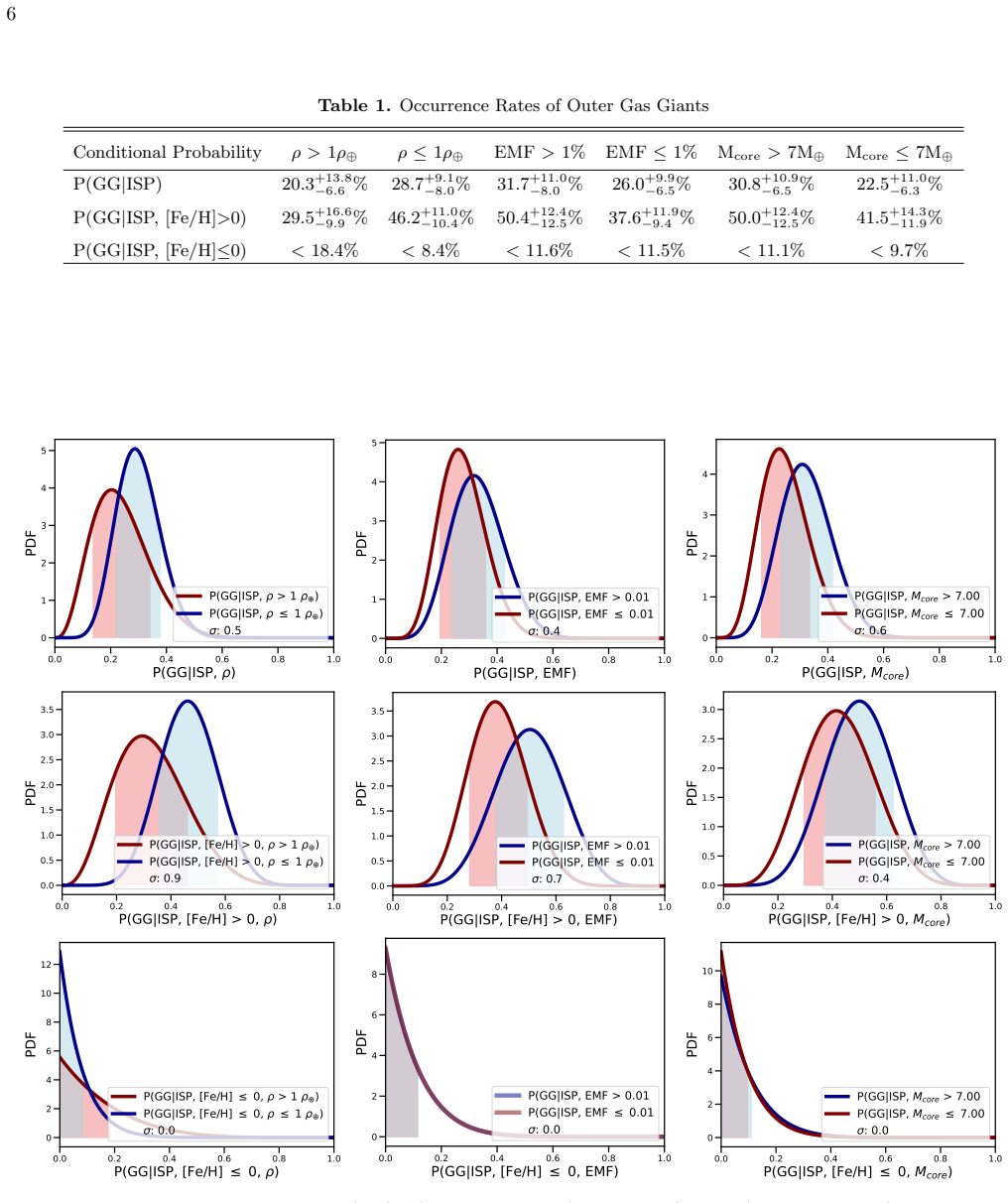
In metal-rich systems gas giants are preferentially found with lower-density inner small planets of similar core mass.
A machine-rendered reading of the paper's core claim, the machinery that carries it, and where it could break.
Core claim
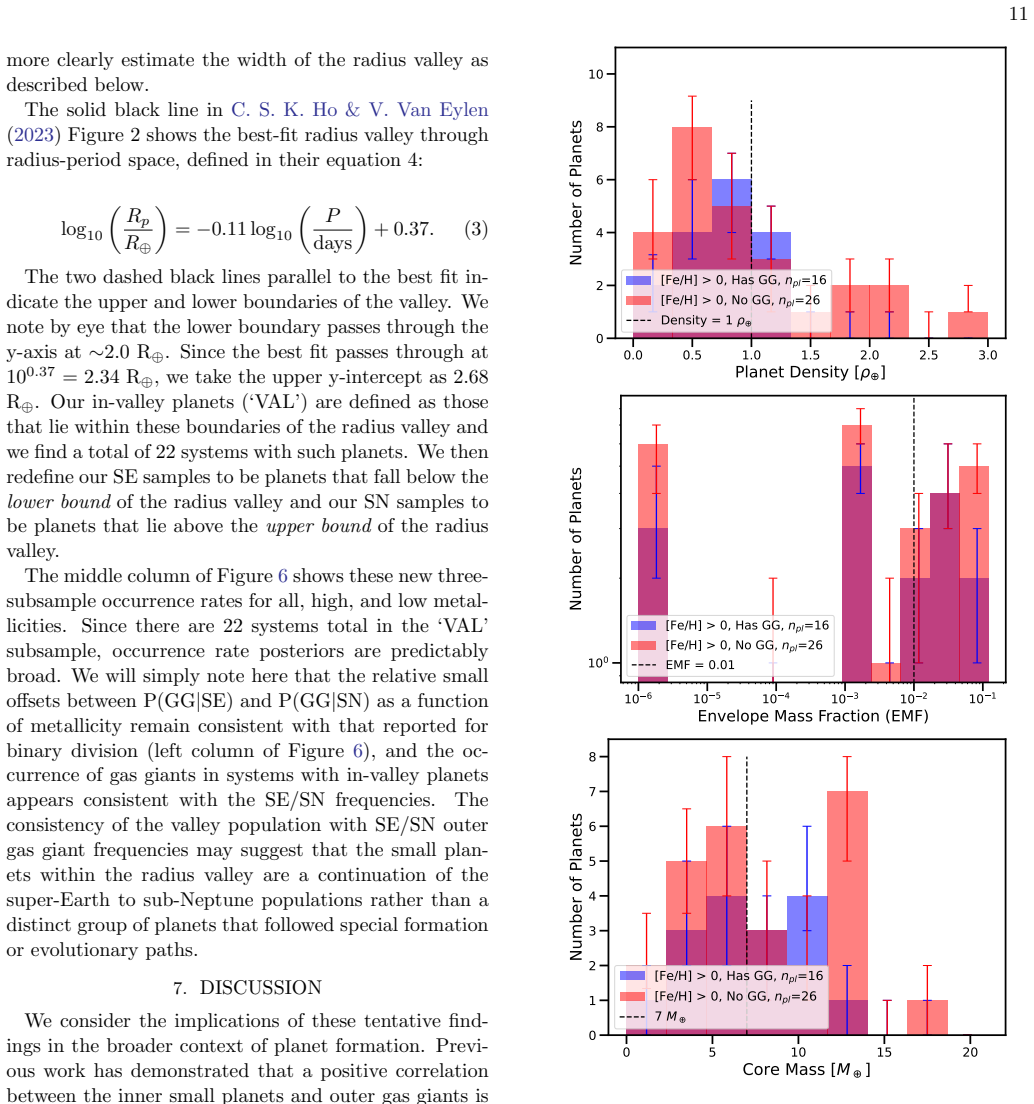
After correcting for heterogeneous detection sensitivities, the gas giant occurrence rate P(GG|ISP) shows no significant dependence on inner small planet density, envelope mass fraction, or core mass across the full sample. In metal-rich systems, however, gas giants are preferentially found with lower density planets that have similar core masses. The result is consistent with metal-enriched disks catalyzing rapid core assembly and kickstarting gas accretion early, while muted differences with respect to core mass may indicate contamination by post-formation photoevaporation.
What carries the argument
The conditional gas-giant occurrence rate P(GG|ISP) computed after system-by-system sensitivity corrections, evaluated separately inside the metal-rich subset.
If this is right
- Metal-enriched disks enable rapid core assembly that triggers early gas accretion.
- Inner small planets in such systems retain lower densities while core masses stay comparable.
- Photoevaporation after formation can mask true core-mass trends in occurrence statistics.
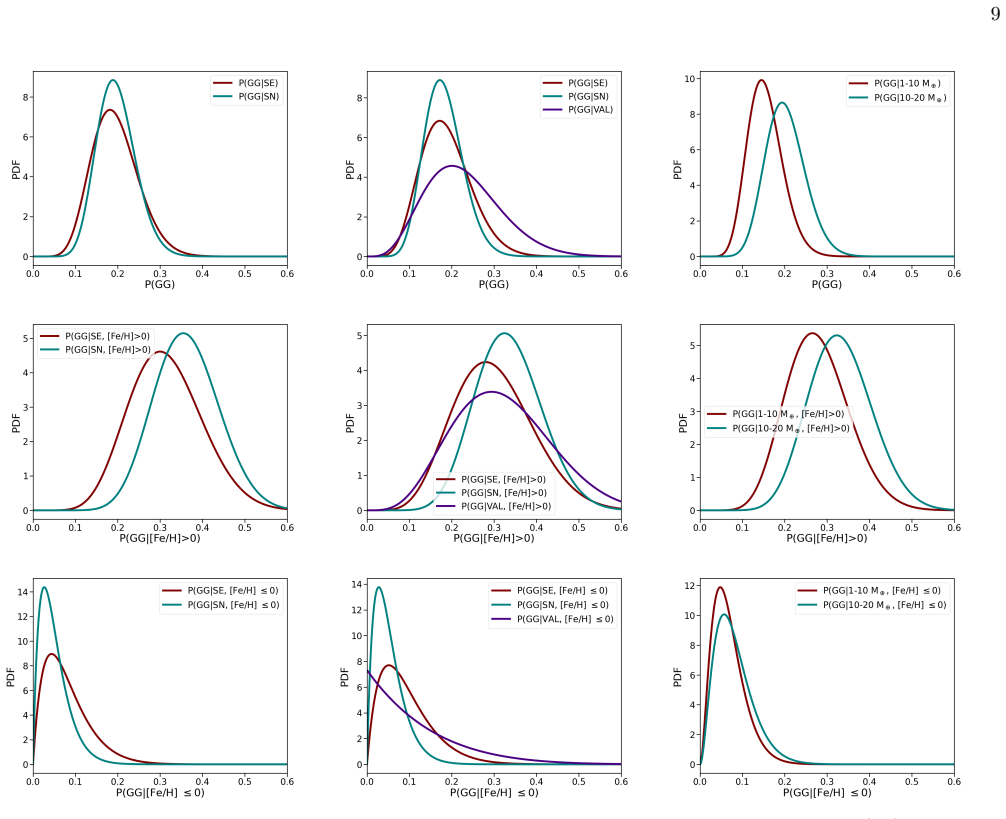
- The same preference appears when larger radius samples are split across the radius valley.
- The same preference appears when larger mass samples are split at 10 Earth masses.
Where Pith is reading between the lines
- If confirmed, the trend would imply that disk metallicity sets a timing offset between inner and outer planet growth phases.
- Future occurrence studies could test whether the density offset disappears in low-metallicity hosts.
- Models that tie core growth speed directly to solid surface density could be calibrated against the observed density split.
Load-bearing premise
The heterogeneous detection-sensitivity corrections applied to the 43 systems accurately recover the true underlying gas-giant occurrence rate without residual bias.
What would settle it
A larger sample of metal-rich systems, after uniform high-precision sensitivity corrections, shows no preference for lower-density inner planets around those that host gas giants.
Figures
read the original abstract
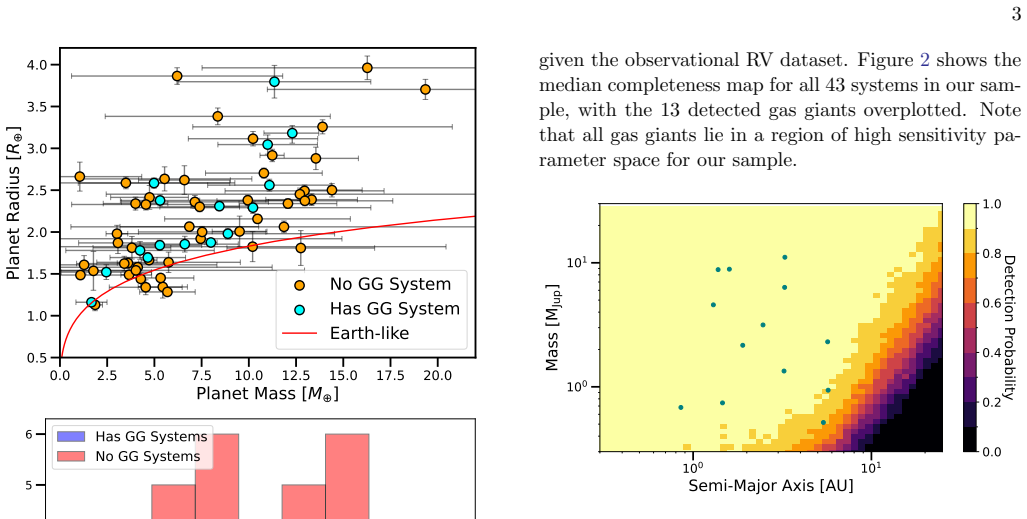
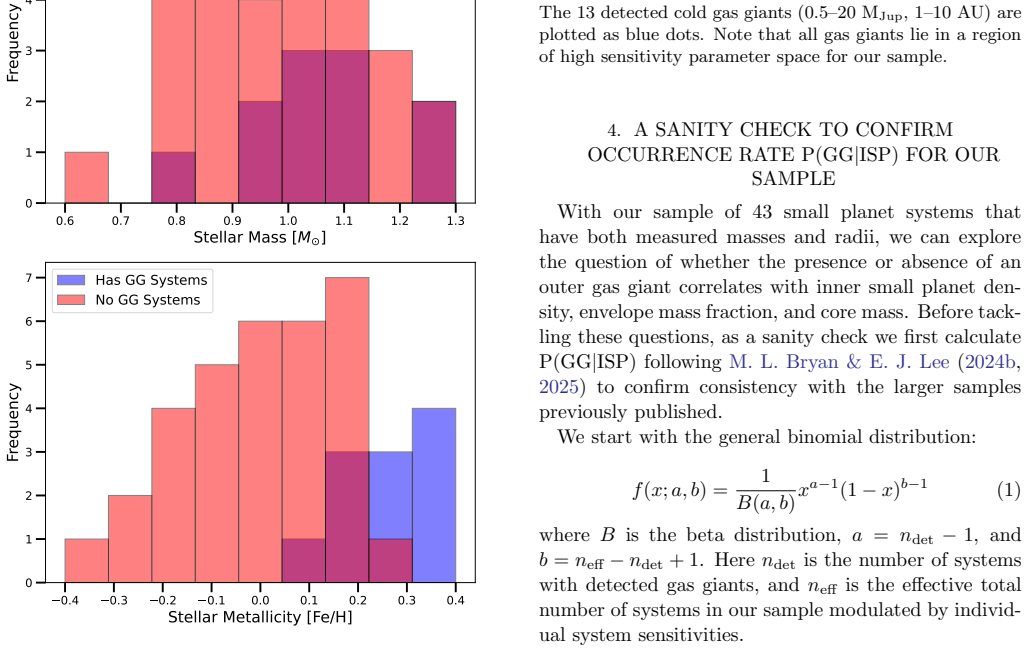
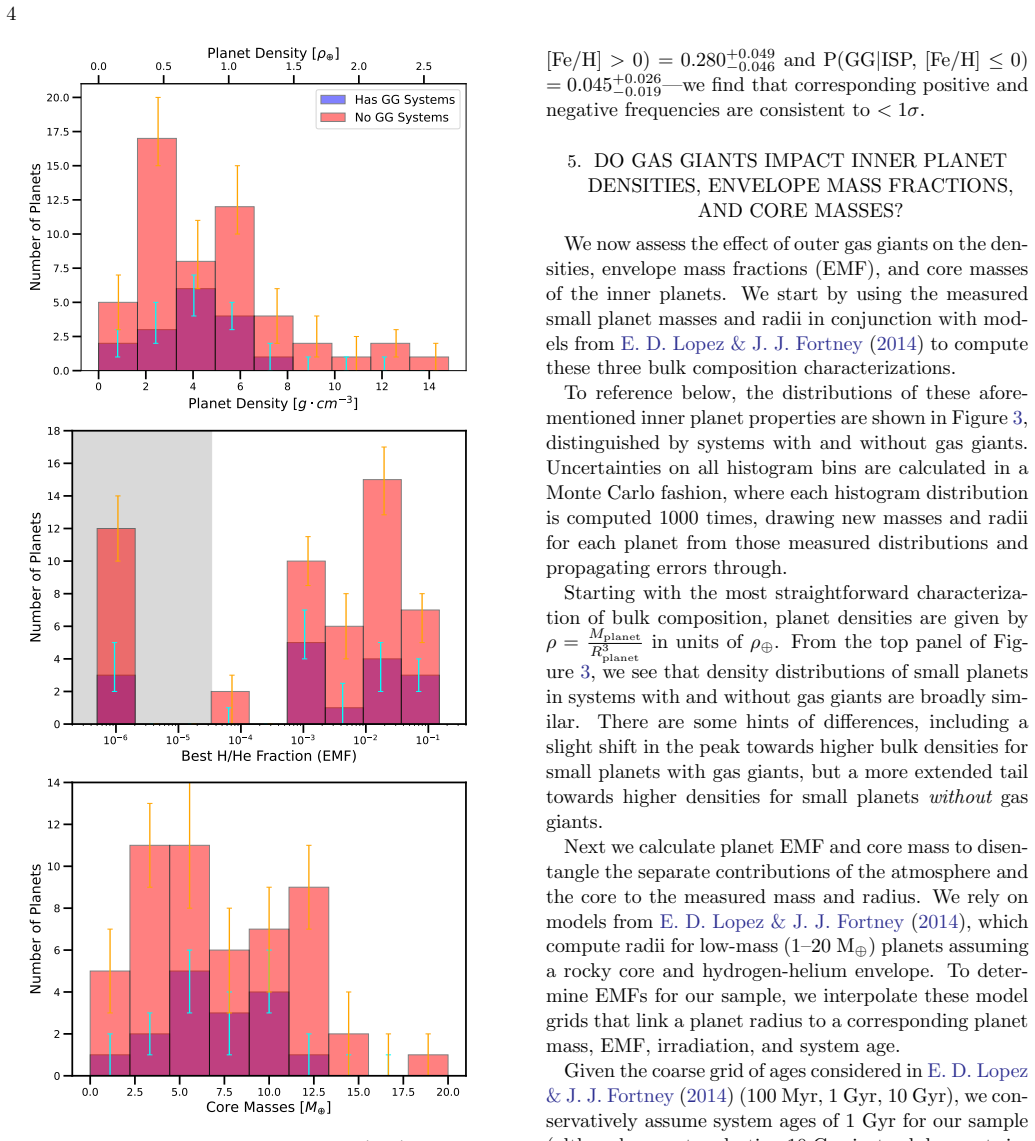
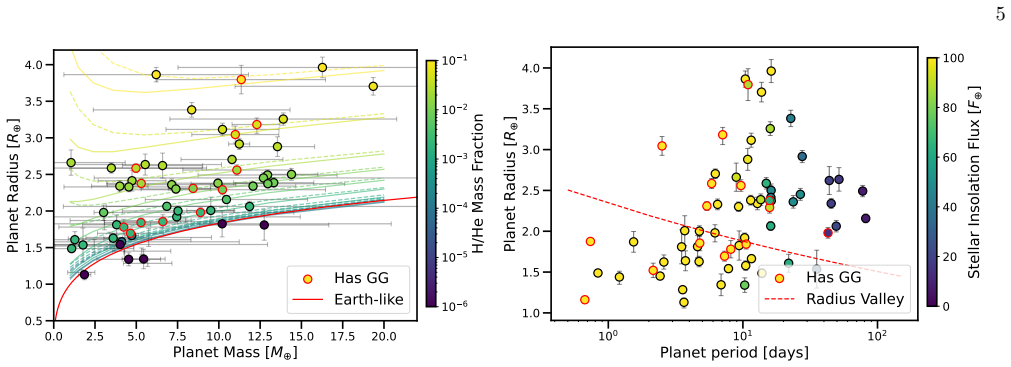
Gas giants may shape the reservoir of solids and gas in the inner disk in which the small planets assemble. To test this possibility, we collect a sample of 43 exoplanetary systems containing 68 inner small planets (ISP) with both measured masses (1-20 M$_{\oplus}$) and radii (1-4 R$_{\oplus}$). After correcting for heterogeneous individual system sensitivities to distant gas giants, we calculate the gas giant occurrence rate in ISP systems P(GG$|$ISP) as a function of inner small planet density, envelope mass fraction (EMF), and core mass. While we find no significant difference between P(GG$|$ISP) given high/low small planet density, EMF, or core mass, we see hints of a trend when only looking at the metal-rich systems. Despite the substantial limitations due to small sample sizes, we find that gas giants in metal-rich systems are preferentially found with lower density planets with similar core masses. We find consistent hints of trends using larger samples of inner planets with measured radii divided across the radius valley or with measured masses divided across 10 $M_\oplus$. Our result is consistent with more metal-enriched disks catalyzing rapid core assembly and kickstarting the gas accretion early, while the muted difference in the outer giant occurrence rate with respect to core mass may indicate contamination by post-formation photoevaporation.
Editorial analysis
A structured set of objections, weighed in public.
Referee Report
Summary. The paper assembles a sample of 43 systems hosting 68 inner small planets (1-20 M⊕, 1-4 R⊕) with measured masses and radii. After applying heterogeneous sensitivity corrections for distant gas giants, it computes the conditional occurrence rate P(GG|ISP) versus inner-planet density, envelope mass fraction, and core mass. No overall difference is found, but a post-hoc split into metal-rich hosts yields a reported hint that gas giants prefer lower-density inner planets of comparable core mass; the authors interpret this as evidence that metal-rich disks enable rapid core growth and early gas accretion, with photoevaporation possibly contaminating the core-mass trend. Larger radius- or mass-selected samples are cited as yielding consistent hints.
Significance. If the reported trend survives larger samples and validated sensitivity corrections, it would link outer giant-planet occurrence to inner-planet bulk composition in a metallicity-dependent way, offering a testable signature of disk solid/gas reservoir modification by gas giants. The work supplies no machine-checked proofs or parameter-free derivations, and the small-sample, post-hoc nature limits immediate impact.
major comments (3)
- [Abstract] Abstract and main text: the central claim is a 'hint' of a trend only after an overall null result and only within the metal-rich subset; no p-values, bootstrap uncertainties, or quantitative significance are supplied for this subdivision, so the strength of evidence for the stated preference cannot be evaluated.
- [Abstract] Abstract and methods: the calculation of P(GG|ISP) after heterogeneous sensitivity corrections is presented without any test or quantification showing that the correction factors are uncorrelated with the binning variables (density, metallicity); residual bias correlated with these quantities would produce the observed pattern without physical origin.
- [Abstract] Abstract: the metal-rich trend rests on post-hoc subdivision of an already modest sample of 43 systems; the authors themselves note 'substantial limitations due to small sample sizes,' yet the manuscript offers no power analysis or minimum-sample requirement to support reporting the trend.
minor comments (1)
- [Abstract] The abstract states 'we find consistent hints of trends using larger samples' but does not specify how those samples avoid the same sensitivity-correction issues or how they are selected relative to the primary 43-system sample.
Simulated Author's Rebuttal
We thank the referee for their constructive and detailed comments. We address each major comment point by point below, providing the strongest honest defense of the manuscript while agreeing to revisions where the concerns are valid and addressable.
read point-by-point responses
-
Referee: [Abstract] Abstract and main text: the central claim is a 'hint' of a trend only after an overall null result and only within the metal-rich subset; no p-values, bootstrap uncertainties, or quantitative significance are supplied for this subdivision, so the strength of evidence for the stated preference cannot be evaluated.
Authors: We agree that quantitative measures would allow readers to better assess the evidence. Although the result is presented as a 'hint' due to the exploratory post-hoc nature and small sample, we will add bootstrap resampling to report uncertainties on P(GG|ISP) in the metal-rich subset and compute associated p-values or significance levels in the revised manuscript. revision: yes
-
Referee: [Abstract] Abstract and methods: the calculation of P(GG|ISP) after heterogeneous sensitivity corrections is presented without any test or quantification showing that the correction factors are uncorrelated with the binning variables (density, metallicity); residual bias correlated with these quantities would produce the observed pattern without physical origin.
Authors: This is a fair point on potential residual bias. In the revised methods section, we will include explicit quantification (e.g., Spearman rank correlations or scatter plots) between the individual sensitivity correction factors and the binning variables (density, metallicity, core mass). We will discuss any detected correlations and their possible impact on the trends. revision: yes
-
Referee: [Abstract] Abstract: the metal-rich trend rests on post-hoc subdivision of an already modest sample of 43 systems; the authors themselves note 'substantial limitations due to small sample sizes,' yet the manuscript offers no power analysis or minimum-sample requirement to support reporting the trend.
Authors: We already emphasize the small-sample limitations in the text. To address the request for justification of reporting the trend, we will add a simple power analysis (e.g., using binomial or bootstrap-based simulations) estimating the sample size required to detect the observed effect size at higher significance, while still framing the current result as a hint. revision: yes
Circularity Check
No circularity: direct statistical comparison of occurrence rates
full rationale
The paper assembles an observational sample of 43 systems, applies heterogeneous sensitivity corrections to compute P(GG|ISP), and bins the resulting rates by measured inner-planet density, EMF, and core mass. No equation reduces any reported trend to a quantity defined by a fitted parameter, no self-citation supplies a load-bearing uniqueness theorem or ansatz, and the central result is an empirical pattern extracted from the corrected data rather than a renaming or self-referential construction. The derivation chain is therefore self-contained against external benchmarks.
Axiom & Free-Parameter Ledger
axioms (2)
- domain assumption Heterogeneous individual system sensitivities to distant gas giants can be corrected to yield an unbiased occurrence rate P(GG|ISP).
- domain assumption The distinction between metal-rich and metal-poor systems is sufficiently clean that post-hoc subdivision does not introduce selection bias.
Reference graph
Works this paper leans on
-
[1]
Ahrer, E.-M., Radica, M., Piaulet-Ghorayeb, C., et al. 2025, arXiv. https://arxiv.org/abs/2504.20428
arXiv 2025
-
[2]
2015, Proceedings of the National Academy of Science, 112, 4214, doi: 10.1073/pnas.1423252112
Batygin, K., & Laughlin, G. 2015, Proceedings of the National Academy of Science, 112, 4214, doi: 10.1073/pnas.1423252112
-
[3]
S., Naponiello, L., Pezzetta, E., et al
Bonomo, A. S., Naponiello, L., Pezzetta, E., et al. 2025, A&A, 700, A126, doi: 10.1051/0004-6361/202452523
-
[4]
No excess of cold Jupiters in small planet systems
Bonomo, A. S., Dumusque, X., Massa, A., et al. 2023, Astronomy and Astrophysics, 677, A33, doi: 10.1051/0004-6361/202346211
-
[5]
Bryan, M. L., Knutson, H. A., Lee, E. J., et al. 2019, The Astronomical Journal, 157, 52, doi: 10.3847/1538-3881/aaf57f
-
[7]
Bryan, M. L., & Lee, E. J. 2024b, The Astrophysical Journal Letters, 968, L25, doi: 10.3847/2041-8213/ad5013
-
[8]
Bryan, M. L., & Lee, E. J. 2025, Resolving the Super-Earth/Gas Giant Connection in Stellar Mass and Metallicity, arXiv, doi: 10.48550/arXiv.2502.01748
-
[9]
Chachan, Y., & Lee, E. J. 2023, The Astrophysical Journal Letters, 952, L20, doi: 10.3847/2041-8213/ace257
-
[10]
Chachan, Y., Dalba, P. A., Knutson, H. A., et al. 2022, ApJ, 926, 62, doi: 10.3847/1538-4357/ac3ed6
-
[11]
Chen, D.-C., Dai, F., Ma, B., Liu, S.-F., & Yu, C. 2026, arXiv e-prints, arXiv:2604.20203, doi: 10.48550/arXiv.2604.20203
work page internal anchor Pith review Pith/arXiv arXiv doi:10.48550/arxiv.2604.20203 2026
-
[12]
Dawson, R. I., Chiang, E., & Lee, E. J. 2015, Monthly Notices of the Royal Astronomical Society, 453, 1471, doi: 10.1093/mnras/stv1639
-
[13]
Fulton, B. J., & Petigura, E. A. 2018, The Astronomical Journal, 156, 264, doi: 10.3847/1538-3881/aae828
-
[14]
Fulton, B. J., Petigura, E. A., Howard, A. W., et al. 2017, The Astronomical Journal, 154, 109, doi: 10.3847/1538-3881/aa80eb
-
[15]
2022, Astronomy and Astrophysics, 658, A176, doi: 10.1051/0004-6361/202141429
Heidari, N., Boisse, I., Orell-Miquel, J., et al. 2022, Astronomy and Astrophysics, 658, A176, doi: 10.1051/0004-6361/202141429
-
[16]
Ho, C. S. K., & Van Eylen, V. 2023, Monthly Notices of the Royal Astronomical Society, 519, 4056, doi: 10.1093/mnras/stac3802
-
[17]
Kane, S. R., Yalcinkaya, S., Osborn, H. P., et al. 2020, VizieR Online Data Catalog, 516, J/AJ/160/129, doi: 10.26093/cds/vizier.51600129
-
[18]
Lambrechts, M., Morbidelli, A., Jacobson, S. A., et al. 2019, A&A, 627, A83, doi: 10.1051/0004-6361/201834229
-
[19]
Lee, E. J. 2019, ApJ, 878, 36, doi: 10.3847/1538-4357/ab1b40
-
[20]
Lee, E. J., & Connors, N. J. 2021, ApJ, 908, 32, doi: 10.3847/1538-4357/abd6c7
-
[21]
Lee, E. J., Karalis, A., & Thorngren, D. P. 2022, ApJ, 941, 186, doi: 10.3847/1538-4357/ac9c66
-
[22]
Lin, J. W., Lee, E. J., & Chiang, E. 2018, MNRAS, 480, 4338, doi: 10.1093/mnras/sty2159
-
[23]
Liu, B., & Ormel, C. W. 2018, A&A, 615, A138, doi: 10.1051/0004-6361/201732307
-
[24]
Lopez, E. D., & Fortney, J. J. 2014, The Astrophysical Journal, 792, 1, doi: 10.1088/0004-637X/792/1/1
-
[25]
2023, Astronomy and Astrophysics, 680, A84, doi: 10.1051/0004-6361/202347744
Martioli, E., H´ ebrard, G., de Almeida, L., et al. 2023, Astronomy and Astrophysics, 680, A84, doi: 10.1051/0004-6361/202347744
-
[26]
2023, AJ, 165, 265, doi: 10.3847/1538-3881/acd175
Ment, K., & Charbonneau, D. 2023, AJ, 165, 265, doi: 10.3847/1538-3881/acd175
-
[27]
2015, Icarus, 258, 418, doi: 10.1016/j.icarus.2015.06.003
Morbidelli, A., Lambrechts, M., Jacobson, S., & Bitsch, B. 2015, Icarus, 258, 418, doi: 10.1016/j.icarus.2015.06.003
-
[28]
Ohno, K., Schlawin, E., Bell, T. J., et al. 2025, ApJL, 979, L7, doi: 10.3847/2041-8213/ada02c
-
[29]
Ormel, C. W. 2017, in Astrophysics and Space Science
2017
-
[30]
445, Formation, Evolution, and Dynamics of Young Solar Systems, ed
Library, Vol. 445, Formation, Evolution, and Dynamics of Young Solar Systems, ed. M. Pessah & O. Gressel, 197, doi: 10.1007/978-3-319-60609-5 7
-
[31]
Owen, J. E., & Jackson, A. P. 2012, MNRAS, 425, 2931, doi: 10.1111/j.1365-2966.2012.21481.x
-
[32]
Kepler planets: a tale of evaporation
Owen, J. E., & Wu, Y. 2013, The Astrophysical Journal, 775, 105, doi: 10.1088/0004-637X/775/2/105
work page internal anchor Pith review doi:10.1088/0004-637x/775/2/105 2013
-
[33]
Owen, J. E., & Wu, Y. 2017, ApJ, 847, 29, doi: 10.3847/1538-4357/aa890a
-
[34]
Parc, L., Bouchy, F., Venturini, J., Dorn, C., & Helled, R. 2024, A&A, 688, A59, doi: 10.1051/0004-6361/202449911
-
[35]
2022, A&A, 664, A65, doi: 10.1051/0004-6361/202142828
Pinamonti, M., Sozzetti, A., Maldonado, J., et al. 2022, A&A, 664, A65, doi: 10.1051/0004-6361/202142828
-
[36]
2025, arXiv e-prints, arXiv:2510.11397, doi: 10.48550/arXiv.2510.11397
Rochon, A., Artigau, ´E., Weisserman, D., et al. 2025, arXiv e-prints, arXiv:2510.11397, doi: 10.48550/arXiv.2510.11397
-
[37]
Rosenthal, L. J., Fulton, B. J., Hirsch, L. A., et al. 2021, The Astrophysical Journal Supplement Series, 255, 8, doi: 10.3847/1538-4365/abe23c Van Eylen, V., Agentoft, C., Lundkvist, M. S., et al. 2018, MNRAS, 479, 4786, doi: 10.1093/mnras/sty1783
-
[38]
J., Morbidelli, A., Raymond, S
Walsh, K. J., Morbidelli, A., Raymond, S. N., O’Brien, D. P., & Mandell, A. M. 2011, Nature, 475, 206, doi: 10.1038/nature10201
work page internal anchor Pith review doi:10.1038/nature10201 2011
-
[39]
Weiss, L. M., Isaacson, H., Howard, A. W., et al. 2024, The Astrophysical Journal Supplement Series, 270, 8, doi: 10.3847/1538-4365/ad0cab 18
-
[40]
Zeng, L., Jacobsen, S. B., Sasselov, D. D., et al. 2019, Proceedings of the National Academy of Sciences, 116, 9723, doi: 10.1073/pnas.1812905116
-
[41]
2024, Research in Astronomy and Astrophysics, 24, 045013, doi: 10.1088/1674-4527/ad3132
Zhu, W. 2024, Research in Astronomy and Astrophysics, 24, 045013, doi: 10.1088/1674-4527/ad3132
-
[42]
2018, ApJ, 860, 101, doi: 10.3847/1538-4357/aac6d5
Zhu, W., Petrovich, C., Wu, Y., Dong, S., & Xie, J. 2018, ApJ, 860, 101, doi: 10.3847/1538-4357/aac6d5
-
[43]
2018, AJ, 156, 92, doi: 10.3847/1538-3881/aad22a
Zhu, W., & Wu, Y. 2018, The Astronomical Journal, 156, 92, doi: 10.3847/1538-3881/aad22a
discussion (0)
Sign in with ORCID, Apple, or X to comment. Anyone can read and Pith papers without signing in.