Higher Dimensional Loop Quantum Black hole in de Sitter Spacetime: Quasinormal Modes and Shadow Signatures
Pith reviewed 2026-06-27 08:42 UTC · model grok-4.3
The pith
Higher-dimensional loop-quantum-corrected de Sitter black holes are stable to scalar perturbations and their shadow sizes yield bounds on the model parameters from M87* data.
A machine-rendered reading of the paper's core claim, the machinery that carries it, and where it could break.
Core claim
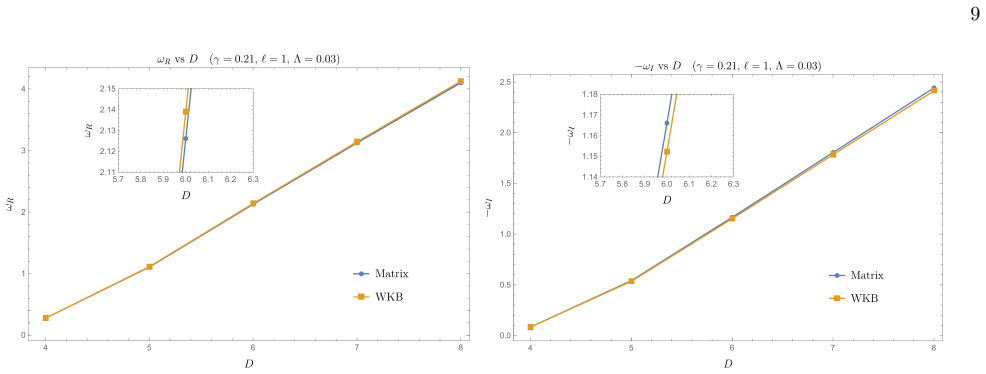
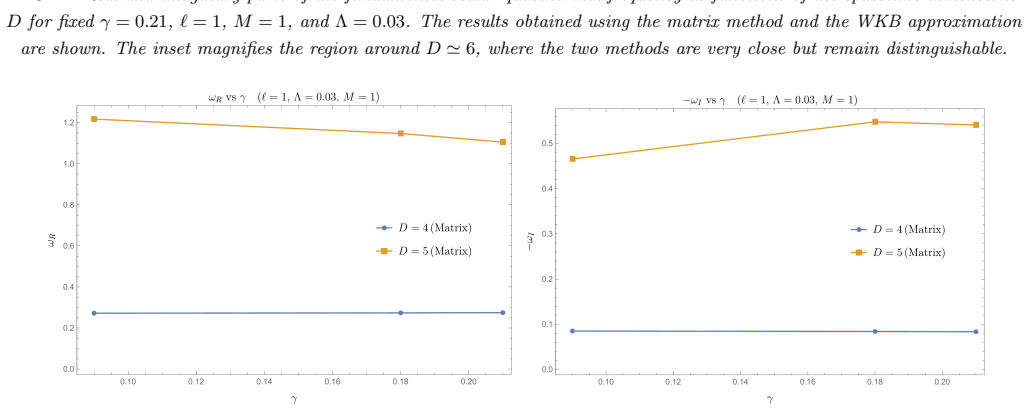
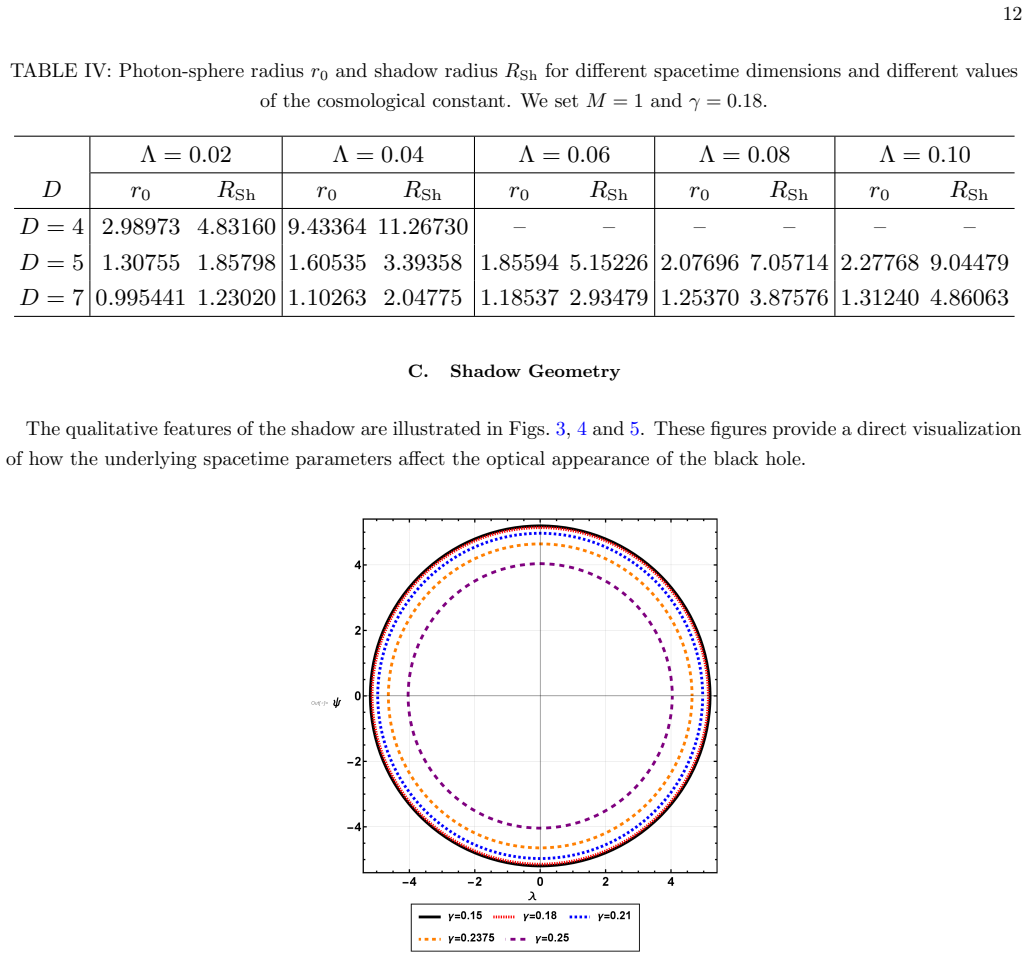
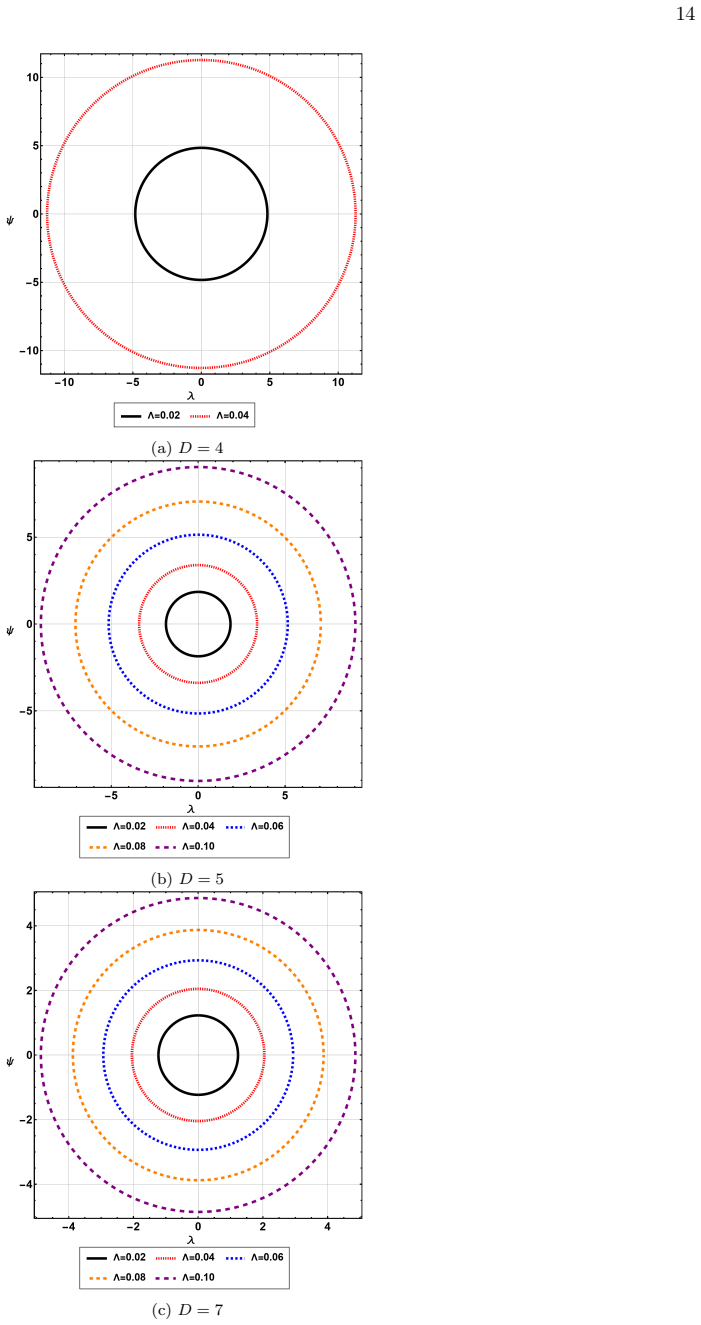
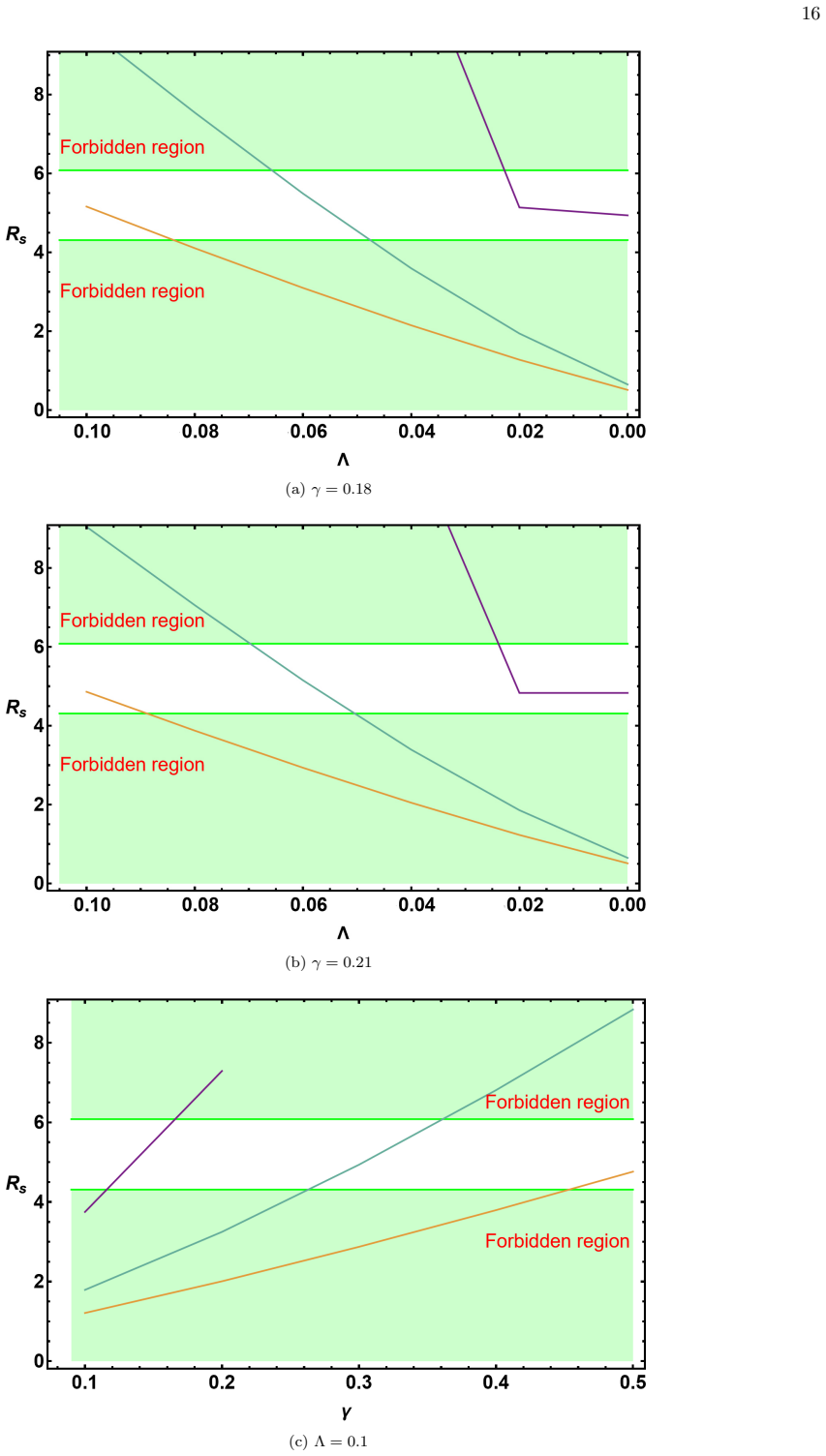
The central claim is that loop quantum corrections produce only moderate changes to the quasinormal spectrum of massless scalar perturbations while the number of spacetime dimensions exerts a stronger influence on both oscillation frequencies and damping rates; all modes display negative imaginary parts, establishing dynamical stability within the explored parameter range; the shadow radius depends sensitively on the loop quantum parameter, the cosmological constant, and dimensionality, and comparison with Event Horizon Telescope constraints for M87* supplies concrete bounds on the model parameters.
What carries the argument
The higher-dimensional loop-quantum-corrected de Sitter black hole metric, employed as the fixed background for deriving the wave equation solved by three numerical methods and for integrating null geodesics that determine the shadow radius.
If this is right
- All quasinormal modes damp with time, confirming dynamical stability against massless scalar perturbations in the studied parameter range.
- Increasing the number of spacetime dimensions raises both the real frequencies and the damping rates of the modes.
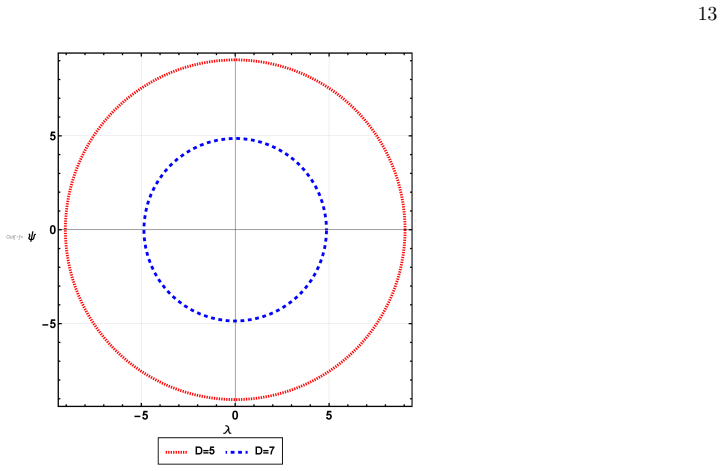
- Extra dimensions reduce the size of the black hole shadow.
- The loop quantum parameter and cosmological constant can be bounded by requiring the theoretical shadow radius to agree with Event Horizon Telescope data for M87*.
Where Pith is reading between the lines
- Tighter future measurements of black hole shadows could narrow the allowed range for loop quantum corrections in strong-gravity regimes.
- The stability result may extend to other field types if the same metric and numerical methods are applied.
- The sensitivity of the shadow to dimensionality offers a potential observational route to test extra-dimension scenarios.
Load-bearing premise
The analysis takes the given higher-dimensional loop-quantum-corrected de Sitter black hole metric as the accurate spacetime geometry for all perturbation and geodesic calculations.
What would settle it
Detection of a positive imaginary part in any quasinormal mode of a massless scalar field on this metric, or measurement of an M87* shadow radius lying outside the range permitted by the derived parameter bounds.
Figures
read the original abstract
We investigate the dynamical and optical properties of a higher-dimensional loop-quantum-corrected black hole in a de Sitter background. The quasinormal modes of massless scalar perturbations are computed using time-domain evolution with Prony extraction, the matrix method, and the WKB approximation, showing good agreement among the three approaches. We find that loop quantum corrections induce moderate shifts in the quasinormal spectrum, whereas the spacetime dimensionality has a much stronger impact, leading to higher oscillation frequencies and damping rates. The negative imaginary parts of all modes indicate dynamical stability against massless scalar perturbations within the explored parameter range. We also analyze null geodesics and construct the corresponding black hole shadow. The shadow radius depends sensitively on the loop quantum parameter, the cosmological constant, and the number of spacetime dimensions, with extra dimensions generally reducing the shadow size. By comparing the theoretical shadow radius with the Event Horizon Telescope constraints for M87$^{\ast}$, we obtain bounds on the parameter space of the model. These results suggest that quasinormal modes and black hole shadow observables can provide complementary probes of loop quantum gravity effects and higher-dimensional spacetime structure in the strong-gravity regime.
Editorial analysis
A structured set of objections, weighed in public.
Referee Report
Summary. The manuscript investigates the quasinormal modes (QNMs) of massless scalar perturbations and the shadow of a higher-dimensional loop-quantum-corrected black hole in de Sitter spacetime. It computes the QNMs using time-domain evolution with Prony extraction, the matrix method, and the WKB approximation, reporting good agreement among the three approaches; finds that loop quantum corrections induce moderate shifts while dimensionality has a stronger effect; concludes dynamical stability from negative imaginary parts of all modes within the explored parameter range; and derives bounds on the model parameters by comparing the theoretical shadow radius to Event Horizon Telescope constraints for M87*.
Significance. If the underlying metric derivation and numerical convergence hold, the work supplies concrete observational constraints on loop quantum gravity parameters in higher-dimensional de Sitter backgrounds using two independent strong-gravity observables. The explicit cross-validation of three distinct QNM extraction techniques is a methodological strength that supports the stability conclusion.
minor comments (3)
- [§3] §3 (or equivalent section on metric): the explicit form of the higher-dimensional loop-quantum-corrected de Sitter metric should be stated with all constants and the loop parameter clearly identified before the perturbation analysis begins.
- [Figure 4] Figure 4 (shadow radius plots): the curves for different spacetime dimensions should include error bands or tabulated values at the EHT-constrained shadow radius to make the derived parameter bounds visually quantitative.
- [Table 1] Table 1 (QNM frequencies): the reported real and imaginary parts for the fundamental mode should be accompanied by the grid resolution or truncation order used in each of the three methods to allow direct assessment of numerical convergence.
Simulated Author's Rebuttal
We thank the referee for the positive assessment of our work on the quasinormal modes and shadows of the higher-dimensional loop-quantum-corrected black hole in de Sitter spacetime. The recommendation for minor revision is appreciated, and we will make the necessary adjustments in the revised manuscript. No specific major comments were provided in the report.
Circularity Check
No significant circularity identified
full rationale
The paper adopts a higher-dimensional loop-quantum-corrected de Sitter metric as background and performs direct numerical computations of quasinormal modes for massless scalar perturbations via three independent methods (time-domain Prony, matrix, WKB) plus null-geodesic shadow construction, then compares the resulting shadow radius to external EHT constraints on M87*. These steps are standard numerical extractions and observational comparisons; they do not reduce by the paper's own equations to self-defined quantities, fitted inputs renamed as predictions, or load-bearing self-citation chains. The stability conclusion follows immediately from the sign of computed imaginary parts within the explored range, with no self-definitional or ansatz-smuggling patterns in the central claims.
Axiom & Free-Parameter Ledger
free parameters (1)
- loop quantum parameter
axioms (1)
- domain assumption The background spacetime is described by the higher-dimensional loop-quantum-corrected de Sitter black hole metric.
Reference graph
Works this paper leans on
-
[1]
Rovelli and L
C. Rovelli and L. Smolin, Nuclear Physics B442, 593 (1995)
1995
-
[2]
A. Ashtekar and J. Lewandowski, arXiv preprint gr-qc/9711031 (1997)
Pith/arXiv arXiv 1997
-
[3]
M. Han, Y. Ma, and W. Huang, International Journal of Modern Physics D16, 1397 (2007)
2007
-
[4]
Ashtekar, T
A. Ashtekar, T. Pawlowski, and P. Singh, Physical review letters96, 141301 (2006)
2006
-
[5]
Ashtekar and P
A. Ashtekar and P. Singh, Classical and Quantum Gravity28, 213001 (2011)
2011
-
[6]
Zhang, S
C. Zhang, S. Song, and M. Han, Physical Review D105, 064008 (2022)
2022
-
[7]
Zhang, H
C. Zhang, H. Liu, and M. Han, Classical and Quantum Gravity40, 205022 (2023)
2023
-
[8]
Chiou, Physical Review D—Particles, Fields, Gravitation, and Cosmology78, 064040 (2008)
D.-W. Chiou, Physical Review D—Particles, Fields, Gravitation, and Cosmology78, 064040 (2008)
2008
-
[9]
Gambini and J
R. Gambini and J. Pullin, Physical review letters101, 161301 (2008)
2008
-
[10]
H. M. Haggard and C. Rovelli, Physical Review D92, 104020 (2015)
2015
-
[11]
M. Christodoulou, C. Rovelli, S. Speziale, and I. Vilensky, arXiv preprint arXiv:1605.05268 (2016)
Pith/arXiv arXiv 2016
-
[12]
Ashtekar, J
A. Ashtekar, J. Olmedo, and P. Singh, Physical review letters121, 241301 (2018)
2018
-
[13]
Zhang, Y
C. Zhang, Y. Ma, S. Song, and X. Zhang, Physical Review D102, 041502 (2020)
2020
-
[14]
Zhang, Y
C. Zhang, Y. Ma, S. Song, and X. Zhang, Physical Review D105, 024069 (2022)
2022
-
[15]
Lewandowski, Y
J. Lewandowski, Y. Ma, J. Yang, and C. Zhang, Physical Review Letters130, 101501 (2023)
2023
-
[16]
Husain, J
V. Husain, J. G. Kelly, R. Santacruz, and E. Wilson-Ewing, Physical Review D106, 024014 (2022)
2022
-
[17]
Stachowiak and M
T. Stachowiak and M. Szyd lowski, Physics Letters B646, 209 (2007)
2007
-
[18]
Ashtekar and M
A. Ashtekar and M. Bojowald, Classical and Quantum Gravity23, 391 (2006)
2006
-
[19]
Modesto, Classical and Quantum Gravity23, 5587 (2006)
L. Modesto, Classical and Quantum Gravity23, 5587 (2006)
2006
-
[20]
Bojowald and S
M. Bojowald and S. Brahma, Physical Review D98, 026012 (2018)
2018
-
[21]
Chiou, Physical Review D—Particles, Fields, Gravitation, and Cosmology78, 044019 (2008)
D.-W. Chiou, Physical Review D—Particles, Fields, Gravitation, and Cosmology78, 044019 (2008)
2008
-
[22]
Zhang, Y
C. Zhang, Y. Ma, and J. Yang, Physical Review D108, 104004 (2023)
2023
-
[23]
J. Yang, C. Zhang, and Y. Ma, The European Physical Journal C83, 619 (2023)
2023
-
[24]
C.-Y. Shao, C. Zhang, W. Zhang, and C.-G. Shao, Physical Review D109, 064012 (2024)
2024
-
[25]
P. Horava and E. Witten, Nucl. Phys. B460, 506 (1996), arXiv:hep-th/9510209
Pith/arXiv arXiv 1996
-
[26]
Kaluza, Sitzungsber
T. Kaluza, Sitzungsber. Preuss. Akad. Wiss. Berlin (Math. Phys.)1921, 966 (1921)
1921
-
[27]
Klein, The Oskar Klein Memorial Lectures1, 67 (1999)
O. Klein, The Oskar Klein Memorial Lectures1, 67 (1999)
1999
-
[28]
Bailin and A
D. Bailin and A. Love, Reports on Progress in Physics50, 1087 (1987). 23
1987
-
[29]
Witten, Nuclear Physics B463, 383 (1996)
E. Witten, Nuclear Physics B463, 383 (1996)
1996
-
[30]
Dvali, G
G. Dvali, G. Gabadadze, and M. Porrati, Physics Letters B485, 208 (2000)
2000
-
[31]
Qiang, Y
L.-e. Qiang, Y. Ma, M. Han, and D. Yu, Physical Review D—Particles, Fields, Gravitation, and Cosmology71, 061501 (2005)
2005
-
[32]
Zhang, M
X. Zhang, M. Artymowski, and Y. Ma, Physical Review D—Particles, Fields, Gravitation, and Cosmology87, 084024 (2013)
2013
-
[33]
Regge and J
T. Regge and J. A. Wheeler, Physical Review108, 1063 (1957)
1957
-
[34]
E. W. Leaver, Physical Review D34, 384 (1986)
1986
-
[35]
Berti, V
E. Berti, V. Cardoso, and A. O. Starinets, Classical and Quantum Gravity26, 163001 (2009)
2009
-
[36]
De Simone, S
C. De Simone, S. H. V¨ olkel, K. D. Kokkotas, V. De Falco, and S. Capozziello, Physical Review D113, 104004 (2026)
2026
-
[37]
Abdalla, R
E. Abdalla, R. Konoplya, and A. Zhidenko, Classical and Quantum Gravity24, 5901 (2007)
2007
-
[38]
R. A. Konoplya and A. Zhidenko, Nuclear Physics B777, 182 (2007)
2007
-
[39]
Zhidenko, arXiv preprint arXiv:0802.2262 (2008)
A. Zhidenko, arXiv preprint arXiv:0802.2262 (2008)
Pith/arXiv arXiv 2008
-
[40]
Abdalla, C
E. Abdalla, C. B. Chirenti, and A. Saa, Journal of High Energy Physics2007, 086 (2007)
2007
-
[41]
Bizo´ n, T
P. Bizo´ n, T. Chmaj, and B. G. Schmidt, Physical review letters95, 071102 (2005)
2005
-
[42]
Bizo´ n, T
P. Bizo´ n, T. Chmaj, A. Rostworowski, B. G. Schmidt, and Z. Tabor, Physical Review D—Particles, Fields, Gravitation, and Cosmology72, 121502 (2005)
2005
-
[43]
Panotopoulos, Axioms9, 33 (2020)
G. Panotopoulos, Axioms9, 33 (2020)
2020
-
[44]
Chabab, H
M. Chabab, H. E. Moumni, S. Iraoui, and K. Masmar, The European Physical Journal C76, 676 (2016)
2016
-
[45]
Kanti, International journal of modern physics A19, 4899 (2004)
P. Kanti, International journal of modern physics A19, 4899 (2004)
2004
-
[46]
Hod, Physical Review Letters81, 4293 (1998)
S. Hod, Physical Review Letters81, 4293 (1998)
1998
-
[47]
Kunstatter, Physical Review Letters90, 161301 (2003)
G. Kunstatter, Physical Review Letters90, 161301 (2003)
2003
-
[48]
M. A. Raza, M. Zubair, and E. Maqsood, Journal of Cosmology and Astroparticle Physics2024(05), 047
-
[49]
Atamurotov, M
F. Atamurotov, M. Jamil, and K. Jusufi, Chinese Physics C47, 035106 (2023)
2023
-
[50]
Nozari, S
K. Nozari, S. Saghafi, and F. Aliyan, The European Physical Journal C85, 735 (2025)
2025
-
[51]
Nozari, S
K. Nozari, S. Saghafi, and M. Hassani, Journal of High Energy Astrophysics45, 214 (2025)
2025
-
[52]
Zhong, Z
Z. Zhong, Z. Hu, H. Yan, M. Guo, and B. Chen, Physical Review D104, 104028 (2021)
2021
-
[53]
Nozari and S
K. Nozari and S. Saghafi, The European Physical Journal C83, 588 (2023)
2023
-
[54]
Aktar, N
S. Aktar, N. U. Molla, F. Rahaman, and G. Mustafa, Journal of High Energy Astrophysics47, 100385 (2025)
2025
-
[55]
Akiyamaetal, FirstM87eventhorizon telescope results
K. Akiyamaetal, FirstM87eventhorizon telescope results. III. Data processing and calibration. Astrophys. J. Lett875, L3 (2019)
2019
-
[56]
E. H. T. Collaboration, K. Akiyama, A. Alberdi, W. Alef, K. Asada, R. Azulay, A.-K. Baczko, D. Ball, M. Balokovi´ c, J. Barrett,et al., The Astrophysical Journal Letters875, L2 (2019)
2019
-
[57]
Akiyama, The Shadow of the Supermassive Black Hole, First M87, 875
K. Akiyama, The Shadow of the Supermassive Black Hole, First M87, 875
-
[58]
Akiyama, A
K. Akiyama, A. Alberdi, W. Alef, K. Asada, R. Azulay, A.-K. Baczko, D. Ball, M. Balokovi´ c, J. Barrett, D. Bintley,et al., The Astrophysical Journal Letters875, L4 (2019)
2019
-
[59]
E. H. T. Collaboration, K. Akiyama, A. Alberdi, W. Alef, K. Asada, R. Azulay, A.-K. Baczko, D. Ball, M. Balokovi´ c, J. Barrett,et al., The Astrophysical Journal Letters875, L5 (2019)
2019
-
[60]
E. H. T. Collaboration, K. Akiyama, A. Alberdi, W. Alef, K. Asada, R. Azulay, A.-K. Baczko, D. Ball, M. Balokovi´ c, J. Barrett,et al., The Astrophysical Journal Letters875, L6 (2019)
2019
-
[61]
Psaltis, General Relativity and Gravitation51, 137 (2019)
D. Psaltis, General Relativity and Gravitation51, 137 (2019)
2019
-
[62]
Jafarzade, Z
K. Jafarzade, Z. Bazyar, S. Saghafi, and K. Nozari, The European Physical Journal C85, 869 (2025)
2025
-
[63]
K. Nozari, M. Hajebrahimi, S. Saghafi, G. Mustafa, and E. N. Saridakis, arXiv preprint arXiv:2602.16237 (2026)
Pith/arXiv arXiv 2026
-
[64]
Vagnozzi, R
S. Vagnozzi, R. Roy, Y.-D. Tsai, L. Visinelli, M. Afrin, A. Allahyari, P. Bambhaniya, D. Dey, S. G. Ghosh, P. S. Joshi, et al., Classical and Quantum Gravity40, 165007 (2023)
2023
-
[65]
Battista, S
E. Battista, S. Capozziello, and C.-Y. Chen, Physical Review D113, 104039 (2026)
2026
-
[66]
Capozziello, E
S. Capozziello, E. Battista, and S. De Bianchi, Physical Review D112, 044009 (2025)
2025
-
[67]
Perlick and O
V. Perlick and O. Y. Tsupko, Physics Reports947, 1 (2022)
2022
-
[68]
Amarilla and E
L. Amarilla and E. F. Eiroa, Physical Review D—Particles, Fields, Gravitation, and Cosmology85, 064019 (2012). 24
2012
-
[69]
E. F. Eiroa and C. M. Sendra, The European Physical Journal C78, 91 (2018)
2018
-
[70]
Papnoi, F
U. Papnoi, F. Atamurotov, S. G. Ghosh, and B. Ahmedov, Physical Review D90, 024073 (2014)
2014
-
[71]
B. P. Singh and S. G. Ghosh, Annals of Physics395, 127 (2018)
2018
-
[72]
M. Amir, B. P. Singh, and S. G. Ghosh, The European Physical Journal C78, 399 (2018)
2018
-
[73]
Belhaj, M
A. Belhaj, M. Benali, A. El Balali, H. El Moumni, and S. Ennadifi, Classical and Quantum Gravity37, 215004 (2020)
2020
-
[74]
Z. Shi, X. Zhang, and Y. Ma, Physical Review D110, 104074 (2024)
2024
-
[75]
Ferrari and B
V. Ferrari and B. Mashhoon, Physical Review D30, 295 (1984)
1984
-
[76]
E. W. Leaver, Proceedings of the Royal Society of London. A. Mathematical and Physical Sciences402, 285 (1985)
1985
-
[77]
H. Cho, A. Cornell, J. Doukas, T.-R. Huang, and W. Naylor, Advances in Mathematical Physics2012, 281705 (2012)
2012
-
[78]
Gundlach, R
C. Gundlach, R. H. Price, and J. Pullin, Physical Review D49, 883 (1994)
1994
-
[79]
Berti, V
E. Berti, V. Cardoso, J. A. Gonzalez, and U. Sperhake, Physical Review D—Particles, Fields, Gravitation, and Cosmology 75, 124017 (2007)
2007
-
[80]
Lin and W.-L
K. Lin and W.-L. Qian, Classical and Quantum Gravity34, 095004 (2017)
2017
discussion (0)
Sign in with ORCID, Apple, or X to comment. Anyone can read and Pith papers without signing in.