How alignment controls heat transport in polymer chains with kinks?
Pith reviewed 2026-06-27 07:45 UTC · model grok-4.3
The pith
Molecular kinks scatter phonons in misaligned polymer chains, causing thermal conductivity to decrease with length.
A machine-rendered reading of the paper's core claim, the machinery that carries it, and where it could break.
Core claim
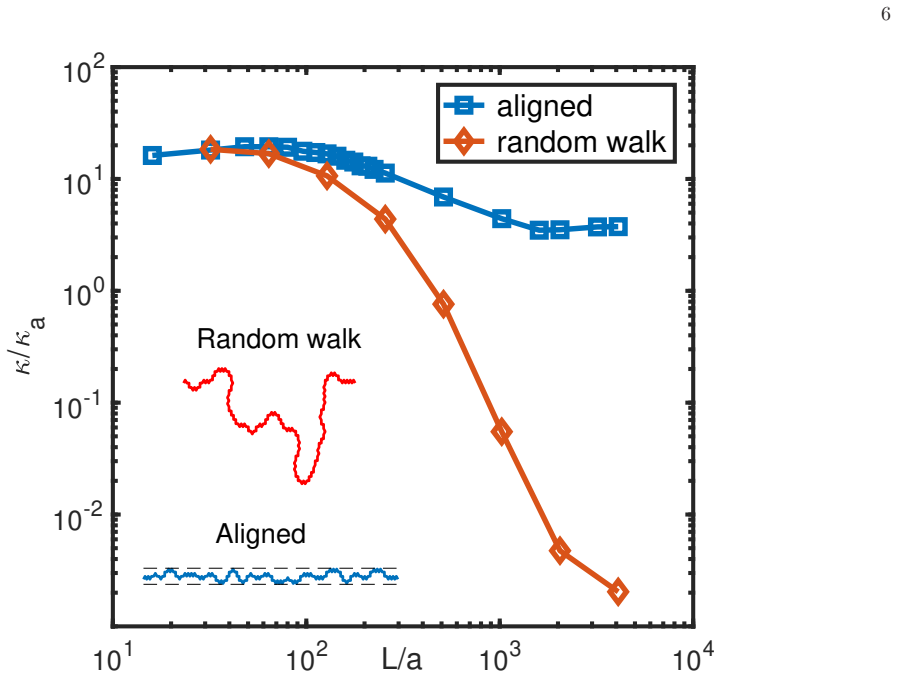
In long polymer molecules, thermal transport is not dominated by ballistic long-wavelength acoustic phonons protected by translational symmetry; instead, molecular kinks scatter phonons strongly because they break translational symmetry for both longitudinal and transverse phonons, resulting in thermal conductivity that decreases rapidly with increasing molecular length when kinks are randomly oriented.
What carries the argument
Phonon scattering by molecular kinks that break translational symmetry for acoustic modes
If this is right
- Randomly oriented kinks produce a rapid decrease in thermal conductivity as molecular length grows.
- Strongly aligned polymers achieve high conductivity because kink scattering is suppressed.
- Tuning alignment through kink engineering provides a route to control thermal transport in polymers.
Where Pith is reading between the lines
- The same kink-scattering logic may apply to other linear molecular or nanoscale chains that contain symmetry-breaking defects.
- Independent control of kink density versus overall alignment in experiments could isolate the contribution of this scattering channel.
- Polymer thermal insulators or conductors might be designed by prioritizing kink orientation statistics over simple chain length.
Load-bearing premise
Kink scattering remains the leading effect on phonon transport in the long-wavelength limit and is not overridden by other sources of disorder or localization.
What would settle it
An experiment measuring thermal conductivity that increases or remains constant with polymer length in samples containing randomly oriented kinks would contradict the predicted length dependence.
Figures
read the original abstract
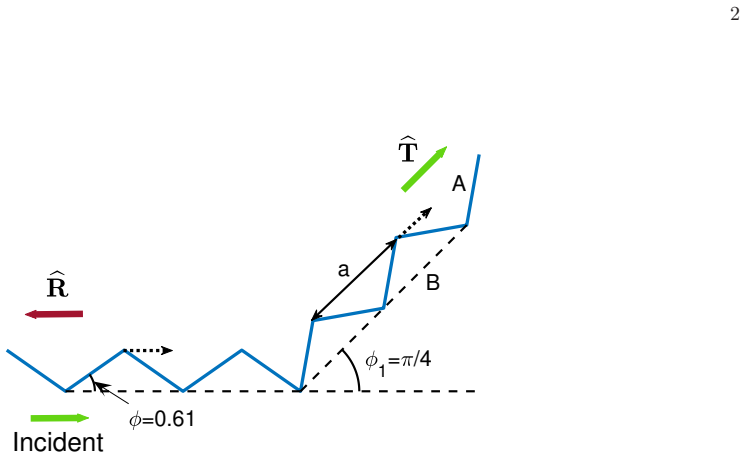
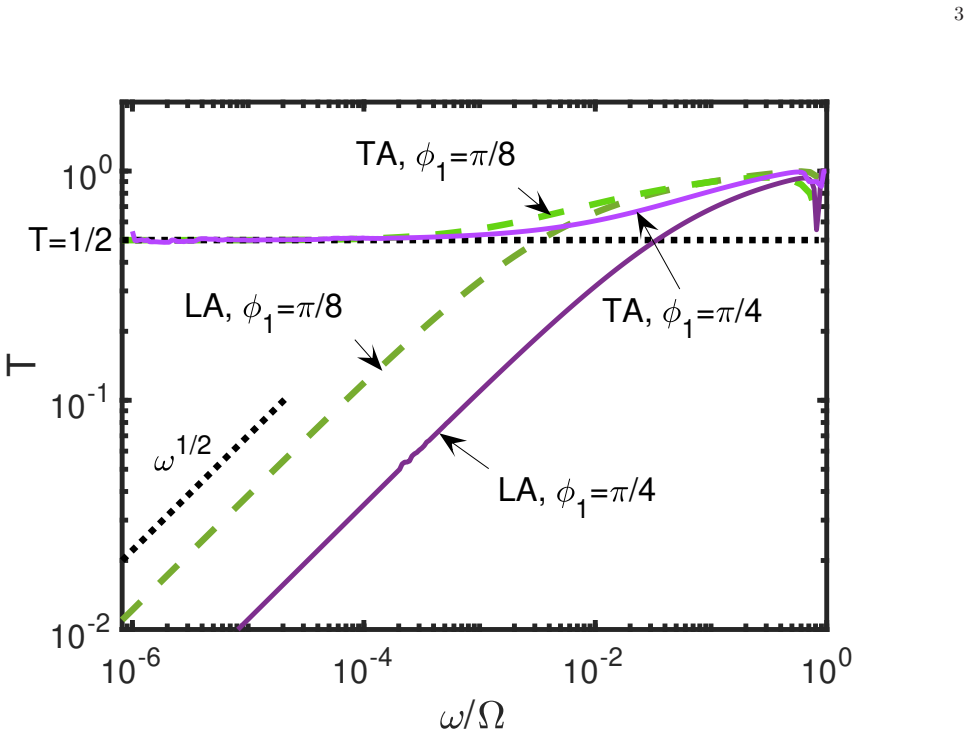
Thermal transport in long polymer molecules is commonly attributed to ballistic propagation of long-wavelength acoustic phonons, which act as Goldstone modes arising from translational symmetry, while the transport of other phonons is suppressed by Anderson localization. This mechanism leads to thermal conductivity that increases with molecular length. Consistent with this picture, strongly aligned polymers exhibit exceptionally high thermal conductivity, whereas poorly aligned polymers are orders of magnitude less conductive and function as thermal insulators. Here we show that this strong sensitivity to molecular alignment originates from phonon scattering by molecular kinks. Even in the long-wavelength limit, the kink scattering remains strong because kinks break translational symmetry both for longitudinal and transverse phonons. As a result, randomly oriented kinks cause a rapid decrease in thermal conductivity with increasing molecular length. These findings identify alignment control by means of kink engineering as a route for tuning thermal transport in polymers.
Editorial analysis
A structured set of objections, weighed in public.
Referee Report
Summary. The manuscript argues that the observed sensitivity of thermal conductivity to molecular alignment in polymer chains arises from phonon scattering by kinks. It claims that kinks break translational symmetry for both longitudinal and transverse phonons, so that scattering remains strong even in the long-wavelength limit; consequently, randomly oriented kinks produce a thermal conductivity that decreases with increasing molecular length, in contrast to the conventional ballistic acoustic-phonon (Goldstone-mode) picture.
Significance. If the central claim is substantiated by explicit calculation, the work would supply a concrete symmetry-based mechanism for alignment-controlled heat transport and identify kink engineering as a design handle, with potential implications for polymer thermal materials.
major comments (2)
- [Theory / Results (scattering-rate derivation)] The central claim requires that the kink-induced scattering rate (or matrix element) remains finite as wavevector k → 0 for both longitudinal and transverse modes. The abstract states this follows from broken translational symmetry, but the manuscript must supply the explicit model Hamiltonian, the scattering calculation, and the k → 0 limit (presumably in the theory or results section) to demonstrate that the rate does not vanish as in standard acoustic-phonon defect scattering; without this step the length dependence does not follow.
- [Discussion / Comparison with ballistic picture] The manuscript must quantify that kink scattering dominates over other disorder or localization mechanisms in the long-wavelength regime and remains the leading effect for the claimed length dependence; bounds or alternative-scenario checks are needed to support the assertion that random kinks cause rapid conductivity decrease.
minor comments (2)
- [Model] Clarify the precise definition of 'kink' (e.g., geometric angle, energy cost) and how it is implemented in the phonon Hamiltonian.
- [Results] Add a figure or table showing the computed scattering rate versus k to make the long-wavelength behavior explicit.
Simulated Author's Rebuttal
We thank the referee for their careful reading of the manuscript and for the constructive comments, which will help clarify and strengthen the presentation of our results. We address each major comment below.
read point-by-point responses
-
Referee: [Theory / Results (scattering-rate derivation)] The central claim requires that the kink-induced scattering rate (or matrix element) remains finite as wavevector k → 0 for both longitudinal and transverse modes. The abstract states this follows from broken translational symmetry, but the manuscript must supply the explicit model Hamiltonian, the scattering calculation, and the k → 0 limit (presumably in the theory or results section) to demonstrate that the rate does not vanish as in standard acoustic-phonon defect scattering; without this step the length dependence does not follow.
Authors: We agree that an explicit derivation is required to fully substantiate the central claim. In the revised manuscript we will add a new subsection (in the Theory/Results section) that presents the model Hamiltonian for a polymer chain containing kinks, the first-order perturbation calculation of the phonon-kink scattering matrix elements, and the explicit evaluation of the k → 0 limit. This will demonstrate that the scattering rate remains finite for both longitudinal and transverse modes because the kink breaks translational symmetry, in contrast to the vanishing rate obtained for conventional acoustic-phonon defect scattering. revision: yes
-
Referee: [Discussion / Comparison with ballistic picture] The manuscript must quantify that kink scattering dominates over other disorder or localization mechanisms in the long-wavelength regime and remains the leading effect for the claimed length dependence; bounds or alternative-scenario checks are needed to support the assertion that random kinks cause rapid conductivity decrease.
Authors: We will expand the Discussion section to include quantitative estimates and bounds. Specifically, we will compare the kink-scattering mean free path with those arising from Anderson localization and other sources of disorder in the long-wavelength limit, providing order-of-magnitude bounds that establish kink scattering as the dominant mechanism for the reported length dependence under random kink orientations. We will also add brief checks of alternative scenarios (e.g., partially aligned kinks) to confirm the robustness of the conductivity decrease. revision: yes
Circularity Check
No significant circularity; abstract presents symmetry-based physical argument without any derivation reducing to inputs by construction.
full rationale
The provided abstract and context contain no equations, fitted parameters, self-citations, or explicit derivation chain. The central claim attributes sensitivity to alignment to kink scattering that remains strong at long wavelengths due to broken translational symmetry. This is stated as a physical consequence rather than derived from a prior result or fit within the paper. No load-bearing step reduces by construction to its own inputs, and the reader's abstract-only review explicitly notes no circularity is visible. Without equations or citations in the visible text, no patterns from the enumerated list apply.
Axiom & Free-Parameter Ledger
Reference graph
Works this paper leans on
-
[1]
author author E. Abrahams , author P. W. \ Anderson , author D. C. \ Licciardello , \ and\ author T. V. \ Ramakrishnan ,\ title title Scaling theory of localization: Absence of quantum diffusion in two dimensions , \ 10.1103/PhysRevLett.42.673 journal journal Phys. Rev. Lett. \ volume 42 ,\ pages 673--676 ( year 1979 ) NoStop
-
[2]
author author Jeffrey \ Goldstone , author Abdus \ Salam , \ and\ author Steven \ Weinberg ,\ title title Broken symmetries , \ 10.1103/PhysRev.127.965 journal journal Phys. Rev. \ volume 127 ,\ pages 965--970 ( year 1962 ) NoStop
-
[3]
Bonetto , author J
author author F. Bonetto , author J. L. \ Lebowitz , \ and\ author L. Rey-Bellet \ ( publisher Published by Imperial College Press, distributed by World Scientific Publishing CO. ,\ year 2000 )\ Chap.\ chapter Fourier's Law: a Challenge to Theorists , pp.\ pages 128--150 ,\ note 0 NoStop
2000
-
[4]
author author David M. \ Leitner ,\ title title Vibrational energy transfer and heat conduction in a one-dimensional glass , \ 10.1103/PhysRevB.64.094201 journal journal Phys. Rev. B \ volume 64 ,\ pages 094201 ( year 2001 ) NoStop
-
[5]
author author Roberto \ Livi ,\ title title Anomalous transport in low-dimensional systems: A pedagogical overview , \ https://doi.org/10.1016/j.physa.2022.127779 journal journal Physica A: Statistical Mechanics and its Applications \ volume 631 ,\ pages 127779 ( year 2023 ) ,\ note lecture Notes of the 15th International Summer School of Fundamental Prob...
-
[6]
author author T. Meier , author F. Menges , author P. Nirmalraj , author H. H\"olscher , author H. Riel , \ and\ author B. Gotsmann ,\ title title Length-dependent thermal transport along molecular chains , \ 10.1103/PhysRevLett.113.060801 journal journal Phys. Rev. Lett. \ volume 113 ,\ pages 060801 ( year 2014 ) NoStop
-
[7]
author author Bohai \ Liu , author Mayank \ Jhalaria , author Eric \ Ruzicka , author Brian C. \ Benicewicz , author Sanat K. \ Kumar , author George \ Fytas , \ and\ author Xiangfan \ Xu ,\ title title Superdiffusive thermal transport in polymer-grafted nanoparticle melts , \ 10.1103/PhysRevLett.133.248101 journal journal Phys. Rev. Lett. \ volume 133 ,\...
-
[8]
author author Jeremie \ Maire , author Roman \ Anufriev , \ and\ author Masahiro \ Nomura ,\ title title Ballistic thermal transport in silicon nanowires , \ 10.1038/srep41794 journal journal Scientific Reports \ volume 7 ,\ pages 41794 ( year 2017 ) NoStop
-
[9]
author author Xuhui \ Duan , author Zehuan \ Li , author Jun \ Liu , author Gang \ Chen , \ and\ author Xiaobo \ Li ,\ title title Roles of kink on the thermal transport in single polyethylene chains , \ 10.1063/1.5086453 journal journal Journal of Applied Physics \ volume 125 ,\ pages 164303 ( year 2019 ) ,\ http://arxiv.org/abs/https://pubs.aip.org/aip/...
-
[10]
author author Mohammadhasan \ Dinpajooh \ and\ author Abraham \ Nitzan ,\ title title Heat conduction in polymer chains with controlled end-to-end distance , \ 10.1063/5.0023085 journal journal The Journal of Chemical Physics \ volume 153 ,\ pages 164903 ( year 2020 ) ,\ http://arxiv.org/abs/https://pubs.aip.org/aip/jcp/article-pdf/doi/10.1063/5.0023085/1...
-
[11]
author author Alexander L. \ Burin ,\ title title Super diffusive length dependent thermal conductivity in one-dimensional materials with structural defects: Longitudinal to transverse phonon scattering leads to l^ 1/3 law , \ 10.1063/5.0267503 journal journal The Journal of Chemical Physics \ volume 162 ,\ pages 165102 ( year 2025 ) ,\ http://arxiv.org/a...
-
[12]
author author Igor V. \ Parshin , author Igor V. \ Rubtsov , \ and\ author Alexander L. \ Burin ,\ https://arxiv.org/abs/2604.25037 title Thermal conductivity of aligned polymers with kinks , \ ( year 2026 ),\ note arXiv at https://arxiv.org/abs/2604.25037 ,\ http://arxiv.org/abs/2604.25037 arXiv:2604.25037 [physics.chem-ph] NoStop
Pith/arXiv arXiv 2026
-
[13]
\ Landau , author E.M
author author L.D. \ Landau , author E.M. \ Lifshitz , author A.M. \ Kosevich , author J.B. \ Sykes , author L.P. \ Pitaevskii , \ and\ author W.H. \ Reid ,\ https://books.google.com/books?id=tpY-VkwCkAIC title Theory of Elasticity: Volume 7 ,\ Course of theoretical physics\ ( publisher Elsevier Science ,\ year 1986 ) NoStop
1986
-
[14]
author author Luis G. C. \ Rego \ and\ author George \ Kirczenow ,\ title title Quantized thermal conductance of dielectric quantum wires , \ 10.1103/PhysRevLett.81.232 journal journal Phys. Rev. Lett. \ volume 81 ,\ pages 232--235 ( year 1998 ) NoStop
-
[15]
author author Dvira \ Segal , author Abraham \ Nitzan , \ and\ author Peter \ H\"anggi ,\ title title Thermal conductance through molecular wires , \ 10.1063/1.1603211 journal journal The Journal of Chemical Physics \ volume 119 ,\ pages 6840--6855 ( year 2003 ) ,\ http://arxiv.org/abs/https://doi.org/10.1063/1.1603211 https://doi.org/10.1063/1.1603211 NoStop
discussion (0)
Sign in with ORCID, Apple, or X to comment. Anyone can read and Pith papers without signing in.