Agentic MPC for Semantic Control System Resynthesis
Pith reviewed 2026-06-27 06:21 UTC · model grok-4.3
The pith
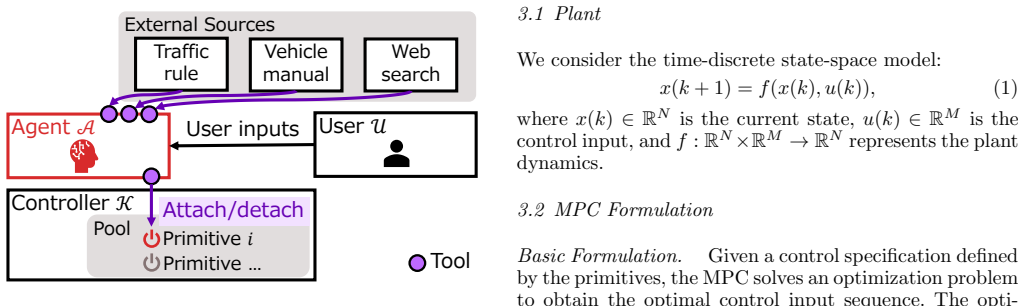
Agentic MPC integrates LLM-based agents to resynthesize control specifications from natural language and contextual inputs.
A machine-rendered reading of the paper's core claim, the machinery that carries it, and where it could break.
Core claim
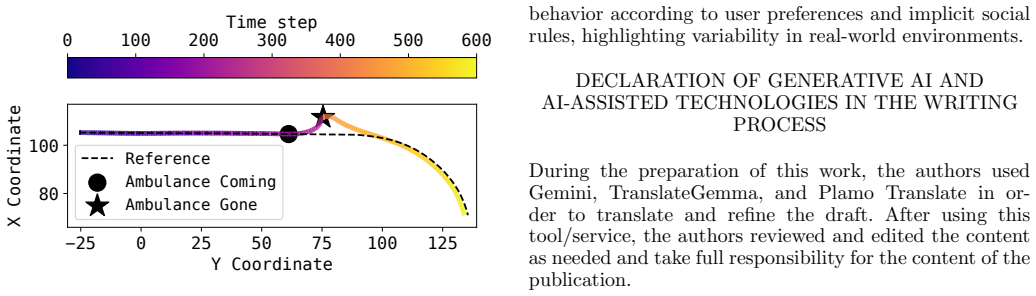
The agentic MPC framework enables context-aware, semantically adaptive control synthesis by integrating with large language model-based agents. The agent interprets heterogeneous inputs, including natural language messages, environmental observations, and external knowledge, to resynthesize the control specifications. Effectiveness is shown in an autonomous driving scenario where the system aligns with personal preferences or responds to social situations such as emergency vehicle yielding.
What carries the argument
The LLM-based agent that interprets inputs and resynthesizes the MPC control specifications.
If this is right
- MPC systems gain the ability to incorporate natural language instructions and social context without manual reprogramming.
- Control specifications become dynamic and can be updated in real time based on changing external knowledge or observations.
- In autonomous driving, the vehicle can adapt its trajectory to user preferences or unexpected social situations.
- The same integration pattern can be applied to other structured control tasks that currently lack semantic flexibility.
Where Pith is reading between the lines
- The approach could be tested in non-driving domains such as robotic manipulation or building climate control where verbal instructions are common.
- Stability guarantees for the resynthesized MPC problem would need separate verification when the agent output contains small interpretation errors.
- Repeated interactions with the same user could allow the agent to build a persistent preference model that influences future resyntheses.
Load-bearing premise
An LLM-based agent can reliably interpret natural language, observations, and knowledge to produce correct, stable updates to MPC specifications without creating unsafe or inconsistent behavior.
What would settle it
A driving simulation in which the agent receives an emergency-vehicle message yet outputs a resynthesized specification that fails to yield, resulting in a collision or rule violation.
Figures
read the original abstract
While MPC effectively handles structured, diverse, and low-level specifications, it lacks the capability to dynamically incorporate high-level contextual information such as social norms, user intent, or natural language instructions. To address this limitation, this manuscript introduces an agentic MPC framework that enables context-aware, semantically adaptive control synthesis by integrating with large language model-based agents. The agent interprets heterogeneous inputs, including natural language messages, environmental observations, and external knowledge, to resynthesize the control specifications. The effectiveness of the framework is demonstrated in an autonomous driving scenario, where the system aligns with personal preferences or responds to social situations such as emergency vehicle yielding.
Editorial analysis
A structured set of objections, weighed in public.
Referee Report
Summary. The manuscript introduces an agentic MPC framework that integrates large language model (LLM)-based agents with model predictive control to enable dynamic resynthesis of control specifications from heterogeneous high-level inputs (natural language, observations, external knowledge). This is positioned as addressing MPC's limitation in handling semantic/contextual information, with a qualitative demonstration in an autonomous driving scenario involving personal preferences and emergency vehicle yielding.
Significance. If the central integration could be shown to preserve MPC's recursive feasibility and closed-loop stability while adding semantic adaptability, the work would offer a novel bridge between symbolic reasoning and continuous control in systems theory. The absence of any formal analysis, invariants, or quantitative validation in the presented manuscript, however, means the result does not yet establish a verifiable advance.
major comments (2)
- [Abstract] Abstract and overall manuscript: The claim that LLM-based agents produce resynthesized MPC specifications that remain recursively feasible and stable is load-bearing for the framework's safety assertions, yet no derivation, invariant, or verification step is supplied showing that the mapping from natural-language/observations to updated cost/constraint sets preserves the original MPC's Lyapunov or feasibility properties.
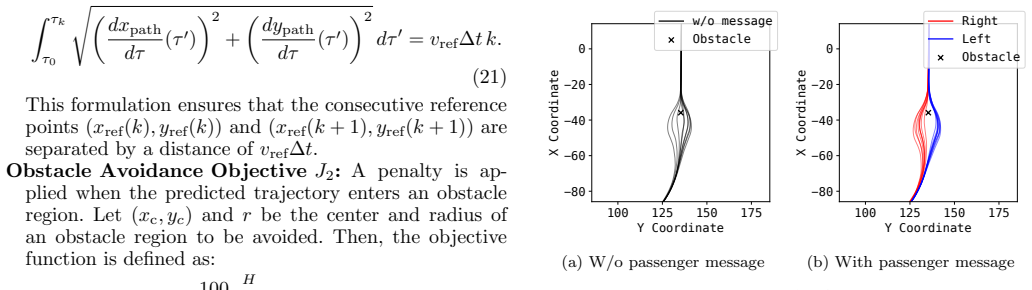
- [Demonstration] Demonstration section: The autonomous-driving scenario is presented only as a qualitative description with no quantitative metrics (tracking error, constraint violation frequency, closed-loop stability margins, or comparison against baseline MPC), so the effectiveness claim cannot be evaluated.
Simulated Author's Rebuttal
We thank the referee for the constructive comments on our manuscript. We address each major comment point by point below, clarifying the scope of our claims.
read point-by-point responses
-
Referee: [Abstract] Abstract and overall manuscript: The claim that LLM-based agents produce resynthesized MPC specifications that remain recursively feasible and stable is load-bearing for the framework's safety assertions, yet no derivation, invariant, or verification step is supplied showing that the mapping from natural-language/observations to updated cost/constraint sets preserves the original MPC's Lyapunov or feasibility properties.
Authors: The manuscript does not advance an explicit claim that LLM-resynthesized specifications preserve recursive feasibility or closed-loop stability. The abstract positions the contribution as enabling semantic adaptability via agentic resynthesis, with the underlying MPC retaining its standard properties for any feasible specification it receives. We acknowledge that no formal derivation or invariant is supplied for the LLM mapping step; this is because LLM outputs are inherently non-deterministic and lack the symbolic structure needed for Lyapunov-style analysis. We will add an explicit limitations paragraph stating that safety guarantees remain conditional on the base MPC and on the (unverified) correctness of the agent's output. revision: partial
-
Referee: [Demonstration] Demonstration section: The autonomous-driving scenario is presented only as a qualitative description with no quantitative metrics (tracking error, constraint violation frequency, closed-loop stability margins, or comparison against baseline MPC), so the effectiveness claim cannot be evaluated.
Authors: The demonstration is deliberately qualitative to illustrate how heterogeneous semantic inputs (preferences, emergency-vehicle context) are translated into updated MPC specifications. Quantitative metrics would require a full simulation benchmark with defined baselines and ground-truth trajectories, which lies outside the scope of a framework-introduction paper. The example serves only to show the end-to-end flow; we do not claim empirical superiority. revision: no
- Formal derivation or invariant proving that LLM-driven resynthesis preserves recursive feasibility and stability
- Quantitative metrics or closed-loop benchmarks for the autonomous-driving demonstration
Circularity Check
No derivation chain or equations present; framework is purely conceptual.
full rationale
The provided manuscript text introduces the agentic MPC framework at a high level, stating that an LLM-based agent 'interprets heterogeneous inputs... to resynthesize the control specifications' and demonstrates it in an autonomous-driving scenario. No equations, parameters, fitted quantities, uniqueness theorems, or derivation steps are quoted or described. Without any claimed mathematical chain that could reduce to its own inputs by construction, self-citation, or renaming, no circularity patterns apply. The central claim rests on the unverified assumption that LLM outputs preserve MPC properties, but this is an external correctness issue, not a circular reduction within a derivation.
Axiom & Free-Parameter Ledger
Reference graph
Works this paper leans on
-
[1]
, journal=
Miyaoka, Yuya and Inoue, Masaki and Maestre, José M. , journal=. 2026 ,volume=
2026
-
[2]
2024 ,volume=
Miyaoka, Yuya and Inoue, Masaki and Nii, Tomotaka ,booktitle=. 2024 ,volume=
2024
-
[3]
Ruixiang Wu and Jiahao Ai and Tongxin Li ,year=. 2504.05946 ,archivePrefix=
-
[4]
Languagempc: Large language models as decision makers for autonomous driving,
Hao Sha and Yao Mu and Yuxuan Jiang and Li Chen and Chenfeng Xu and Ping Luo and Shengbo Eben Li and Masayoshi Tomizuka and Wei Zhan and Mingyu Ding ,year=. 2310.03026 ,archivePrefix=
-
[5]
Kosei Fushimi and Kazunobu Serizawa and Junya Ikemoto and Kazumune Hashimoto ,year=. 2603.28426 ,archivePrefix=
-
[6]
2024 ,volume=
Wang, Yujin and Huang, Zhaoyan and Dong, Shiying and Chu, Hongqing and Yin, Xiang and Gao, Bingzhao ,booktitle=. 2024 ,volume=
2024
-
[7]
Findings of the Association for Computational Linguistics: ACL 2025
Fang, Yue and Jin, Zhi and An, Jie and Chen, Hongshen and Chen, Xiaohong and Zhan, Naijun. Findings of the Association for Computational Linguistics: ACL 2025. 2025. doi:10.18653/v1/2025.findings-acl.544
-
[8]
and McDonald, Craig G
Losey, Dylan P. and McDonald, Craig G. and Battaglia, Edoardo and O'Malley, Marcia K. ,title =. Applied Mechanics Reviews ,volume =. 2018 ,month =
2018
-
[9]
International Journal of Social Robotics ,volume =
Valls Mascaro, Esteve and Lee, Dongheui ,title =. International Journal of Social Robotics ,volume =. 2025 ,month=
2025
-
[10]
Li Siyao and Tianpei Gu and Zhitao Yang and Zhengyu Lin and Ziwei Liu and Henghui Ding and Lei Yang and Chen Change Loy ,year=. 2403.18811 ,archivePrefix=
-
[11]
Stange, Sonja and Hassan, Teena and Schröder, Florian and Konkol, Jacqueline and Kopp, Stefan ,journal=
-
[12]
2024 ,volume=
Zhao, Chenyang and Chu, Duanfeng and Deng, Zejian and Lu, Liping ,journal=. 2024 ,volume=
2024
-
[13]
2021 ,volume=
Hang, Peng and Lv, Chen and Xing, Yang and Huang, Chao and Hu, Zhongxu ,journal=. 2021 ,volume=
2021
-
[14]
2025 ,volume=
Shi, Rui and Li, Tianxing and Yamaguchi, Yasushi and Zhang, Liguo ,journal=. 2025 ,volume=
2025
-
[15]
Crosato, Luca and Shum, Hubert P. H. and Ho, Edmond S. L. and Wei, Chongfeng ,journal=. 2023 ,volume=
2023
-
[16]
Luan and Jiawen Kang and Dusit Niyato , year=
Yuntao Wang and Yanghe Pan and Zhou Su and Yi Deng and Quan Zhao and Linkang Du and Tom H. Luan and Jiawen Kang and Dusit Niyato , year=. 2409.14457 ,archivePrefix=
-
[17]
2023 ,volume=
Honda, Kohei and Okuda, Hiroyuki and Suzuki, Tatsuya and Ito, Akira ,booktitle=. 2023 ,volume=
2023
-
[18]
,title =
Williams, Grady and Aldrich, Andrew and Theodorou, Evangelos A. ,title =. Journal of Guidance, Control, and Dynamics ,volume =
-
[19]
Asmar and Ransalu Senanayake and Shawn Manuel and Mykel J
Dylan M. Asmar and Ransalu Senanayake and Shawn Manuel and Mykel J. Kochenderfer ,year=. 2203.16633 ,archivePrefix=
-
[20]
2017 ,volume=
Polack, Philip and Altché, Florent and d'Andréa-Novel, Brigitte and de La Fortelle, Arnaud ,booktitle=. 2017 ,volume=
2017
-
[21]
Alexey Dosovitskiy and German Ros and Felipe Codevilla and Antonio Lopez and Vladlen Koltun ,booktitle =
-
[22]
Granite 4.1 Language Models ,year =
-
[23]
Able , title=
B.C. Able , title=. Birches. J. , year=
-
[24]
Able , title=
B.C. Able , title=. Nature , year=
-
[25]
Able and R.A
B.C. Able and R.A. Tagg and M. Rush , title=. Advances in Enzymology , address=. 1954 , volume=
1954
-
[26]
Baker , title=
R.C. Baker , title=. 1963 , address=
1963
-
[27]
Baker , title=
R.C. Baker , title=. J. Brit. Med. Assoc. , year=
-
[28]
Dictionary of the American Language
The American Heritage. Dictionary of the American Language
-
[29]
Charlie and M.B
F.H. Charlie and M.B. Routh , title=. J. Am. Chem. Soc. , year=
-
[30]
Dog , title=
P.R. Dog , title=. Chemical Carcinogenesis , publisher=. 1958 , editor=
1958
-
[31]
Keohane , title=
R. Keohane , title=. 1958 , address=
1958
-
[32]
Powers , title=
T. Powers , title=. Harpers , year=
discussion (0)
Sign in with ORCID, Apple, or X to comment. Anyone can read and Pith papers without signing in.