Interference of critical dynamics associated with zero modes
Pith reviewed 2026-06-27 06:30 UTC · model grok-4.3
The pith
Closed quench paths through two critical points in generalized Creutz ladders produce ICDZM patterns in zero-mode transfer probability that either vanish or double in period when the path links two topologically nontrivial phases.
A machine-rendered reading of the paper's core claim, the machinery that carries it, and where it could break.
Core claim
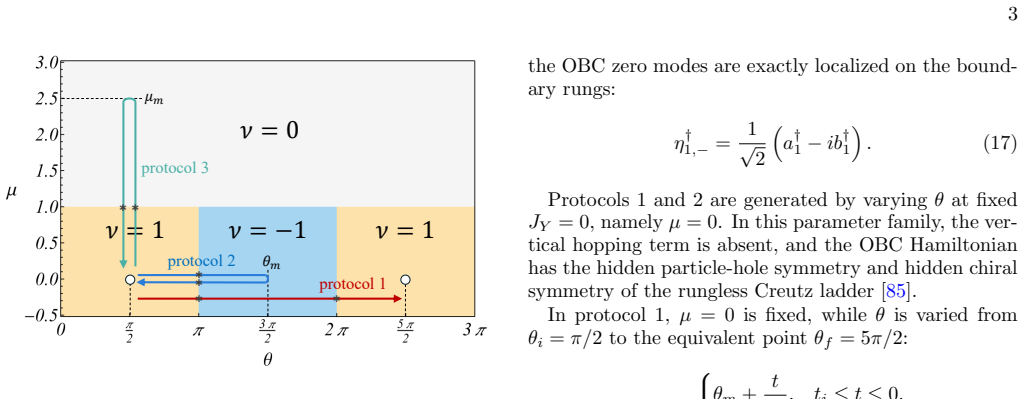
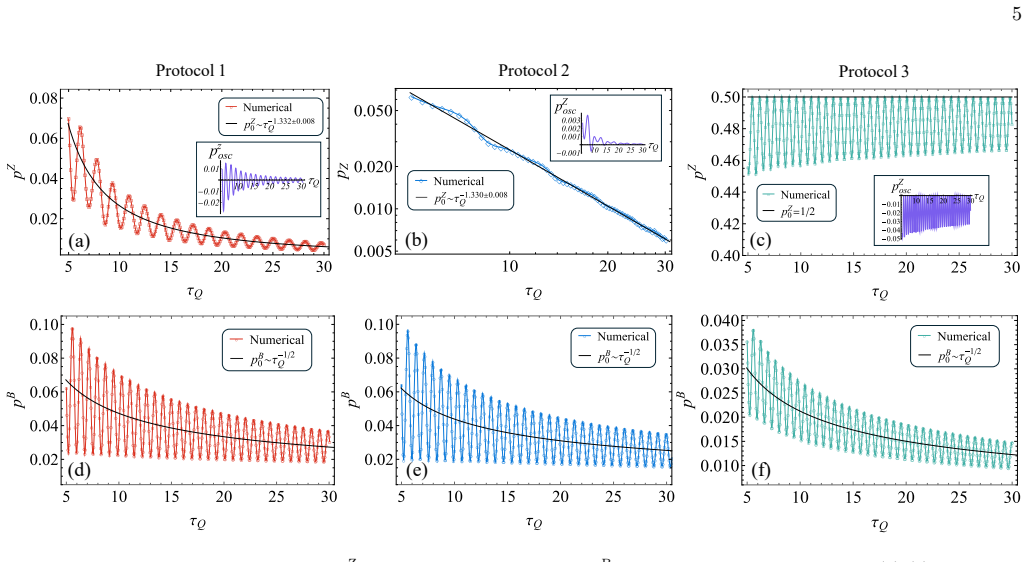
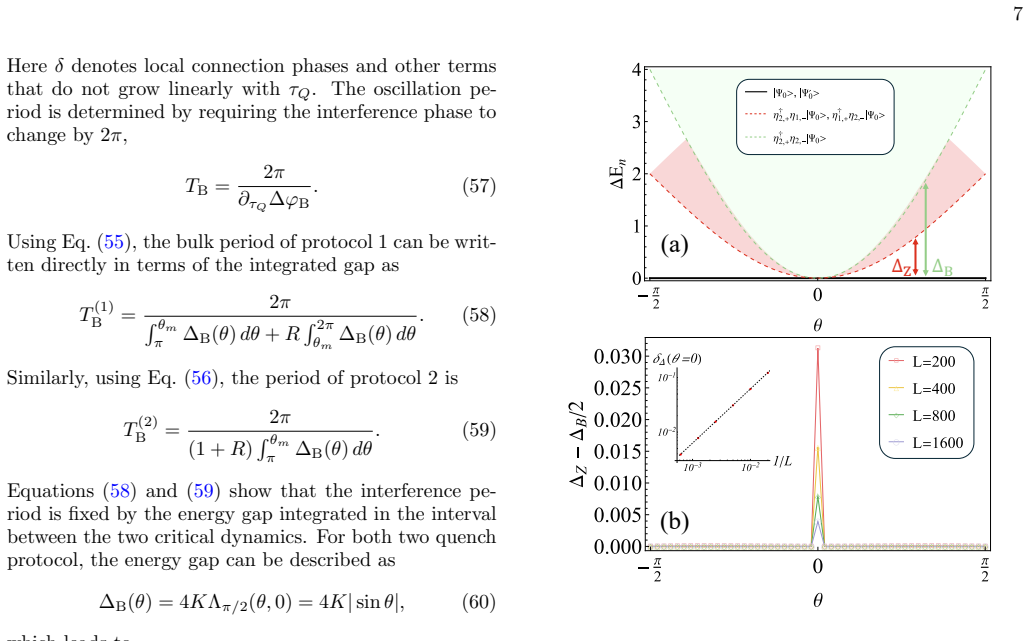
We study the interference of critical dynamics associated with zero modes (ICDZM) in the generalized Creutz ladders using closed quench paths that pass through two critical points successively. By reading out the final zero-mode transfer probability, we find rich ICDZM interference patterns dependent on the quench path. In particular, when the closed path links two topologically nontrivial phases, the ICDZM pattern may either vanish or exhibit period doubling. Within the framework of WKB analysis, this phenomenon is well clarified by the interference phase accumulated in the quench procedure. We also demonstrate that the zero-mode transfer probability can be detected by the deviation of the
What carries the argument
The accumulated interference phase along the closed quench path, extracted via WKB analysis, that controls whether the ICDZM pattern in zero-mode transfer probability vanishes or doubles.
If this is right
- The zero-mode transfer probability appears as a deviation of boundary particle number from its initial fractional value due to bulk-mode blending.
- The probability records both the ICDZM oscillation and anomalous defect production from non-closed paths.
- ICDZM and the edge defect serve as probes for critical dynamics tied to topological zero modes.
Where Pith is reading between the lines
- The same phase-accumulation mechanism could be tested in other one-dimensional topological models that support zero modes under analogous double-critical-point quenches.
- Boundary density measurements in cold-atom realizations of ladder systems offer a direct route to extract the transfer probability without requiring full state tomography.
- The distinction between vanishing and period-doubled patterns may provide a quench-based diagnostic for the relative topological character of the two phases being connected.
Load-bearing premise
The WKB analysis accurately captures the interference phase accumulated along the closed quench path without significant corrections from non-adiabatic or higher-order effects near the two critical points.
What would settle it
An experiment that measures zero-mode transfer probability for a closed quench path connecting two topologically nontrivial phases and finds neither vanishing nor period doubling in the oscillation pattern.
Figures
read the original abstract
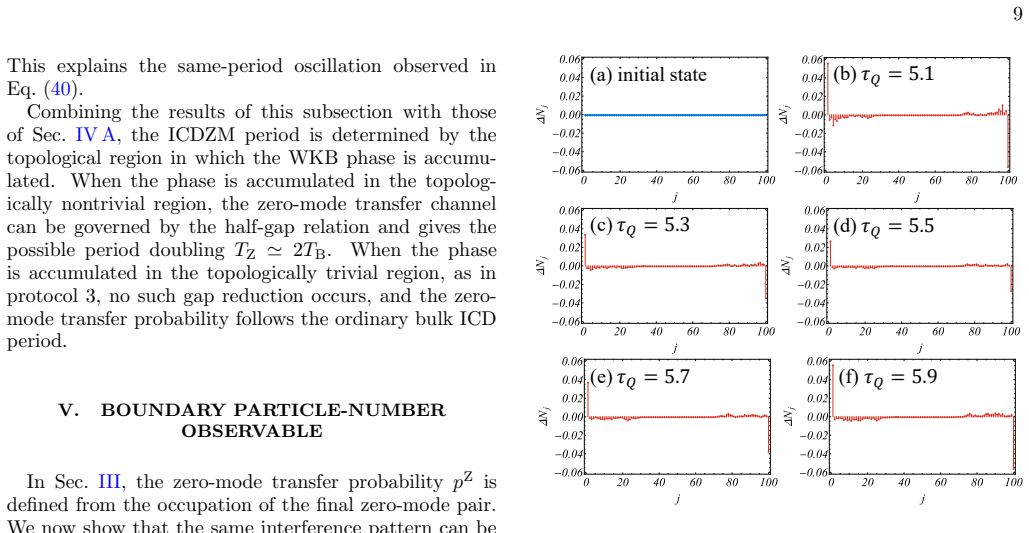
We study the interference of critical dynamics associated with zero modes (ICDZM) in the generalized Creutz ladders using closed quench paths that pass through two critical points successively. By reading out the final zero-mode transfer probability, we find rich ICDZM interference patterns dependent on the quench path. In particular, when the closed path links two topologically nontrivial phases, the ICDZM pattern may either vanish or exhibit period doubling. Within the framework of WKB analysis, this phenomenon is well clarified by the interference phase accumulated in the quench procedure. We also demonstrate that the zero-mode transfer probability can be detected by the deviation of the boundary particle number from its initial fractional value, which arises from the blending of bulk modes in the critical dynamics. As an edge defect, the zero-mode transfer probability captures both the ICDZM oscillation and the known anomalous defect production in a non-closed quench path. These results identify ICDZM and the corresponding edge defect as probes for critical dynamics associated with topological zero modes.
Editorial analysis
A structured set of objections, weighed in public.
Referee Report
Summary. The manuscript studies interference of critical dynamics associated with zero modes (ICDZM) in generalized Creutz ladders along closed quench paths that successively traverse two critical points. The central observations are that the final zero-mode transfer probability exhibits path-dependent interference patterns, which can vanish or show period doubling when the path connects two topologically nontrivial phases; these features are attributed to the accumulated interference phase analyzed via WKB. The authors further show that the transfer probability appears as a deviation of the boundary particle number from its initial fractional value due to bulk-mode blending in the critical dynamics, and position the ICDZM pattern and associated edge defect as experimental probes for topological zero-mode critical dynamics.
Significance. If the central claims hold, the work supplies a concrete interference-based diagnostic for critical dynamics tied to topological zero modes and a practical detection route via boundary observables. The explicit linkage of pattern vanishing/period-doubling to a WKB phase and the identification of an edge defect that encodes both closed-path interference and open-path anomalous production are the main strengths.
major comments (2)
- [Abstract and WKB analysis] Abstract (WKB clarification paragraph) and associated analysis section: the statement that the vanishing or period-doubling 'is well clarified by the interference phase accumulated in the quench procedure' within the WKB framework is load-bearing for the central claim, yet the paths pass through gap-closing critical points where the instantaneous gap vanishes and the adiabatic/WKB assumption is violated; no explicit error bound, Landau-Zener correction estimate, or numerical benchmark against exact dynamics is provided to show that non-adiabatic corrections remain negligible for the chosen ramp speeds and paths.
- [Detection via boundary particle number] Section describing the boundary-particle-number detection: the claim that the zero-mode transfer probability is captured by the deviation of the boundary particle number from its initial fractional value relies on the blending of bulk modes, but the manuscript does not quantify how this deviation isolates the ICDZM contribution from other critical or non-critical bulk effects, nor does it compare the predicted deviation magnitude against the known anomalous defect production in the non-closed case.
minor comments (2)
- [Abstract] The acronym ICDZM is introduced without an explicit expansion on first use in the abstract.
- [Figures] Figure captions for the interference patterns should state the precise quench-path parameters and ramp protocol used, to allow direct comparison with the WKB phase formula.
Simulated Author's Rebuttal
We thank the referee for the careful reading and constructive feedback. We address the two major comments below and will revise the manuscript to incorporate the requested clarifications and supporting analyses.
read point-by-point responses
-
Referee: [Abstract and WKB analysis] Abstract (WKB clarification paragraph) and associated analysis section: the statement that the vanishing or period-doubling 'is well clarified by the interference phase accumulated in the quench procedure' within the WKB framework is load-bearing for the central claim, yet the paths pass through gap-closing critical points where the instantaneous gap vanishes and the adiabatic/WKB assumption is violated; no explicit error bound, Landau-Zener correction estimate, or numerical benchmark against exact dynamics is provided to show that non-adiabatic corrections remain negligible for the chosen ramp speeds and paths.
Authors: We agree that the WKB approximation is formally invalid exactly at the gap-closing points. The phase accumulation we invoke occurs in the gapped segments between the two critical points, while the crossings themselves are treated via the zero-mode transfer probabilities. Nevertheless, the manuscript does not supply explicit error estimates or direct numerical benchmarks comparing the WKB phase to exact time evolution. In the revised version we will add (i) a quantitative estimate of non-adiabatic corrections based on the Landau-Zener formula for the chosen ramp speeds and (ii) direct numerical comparisons of the interference patterns obtained from WKB versus exact diagonalization for representative paths. revision: yes
-
Referee: [Detection via boundary particle number] Section describing the boundary-particle-number detection: the claim that the zero-mode transfer probability is captured by the deviation of the boundary particle number from its initial fractional value relies on the blending of bulk modes, but the manuscript does not quantify how this deviation isolates the ICDZM contribution from other critical or non-critical bulk effects, nor does it compare the predicted deviation magnitude against the known anomalous defect production in the non-closed case.
Authors: We concur that additional quantification is needed to demonstrate isolation of the ICDZM signal. The current text shows that the boundary deviation encodes the zero-mode transfer probability but does not separate the ICDZM oscillatory component from other bulk contributions or benchmark it against the open-path anomalous production. In the revision we will include (i) a decomposition of the boundary deviation into ICDZM and residual bulk terms for several ramp speeds and (ii) a direct magnitude comparison between the closed-path deviation and the known anomalous defect density reported for non-closed quenches. revision: yes
Circularity Check
No circularity; derivation self-contained against external benchmarks
full rationale
The abstract presents numerical observation of ICDZM patterns (vanishing or period-doubling) for closed quench paths linking topological phases, followed by an explanatory appeal to standard WKB phase accumulation along those paths. No equations appear, no parameters are fitted then relabeled as predictions, and no self-citations or uniqueness theorems are invoked. The WKB step is an independent analytic tool whose validity is an external question of approximation quality, not a definitional reduction of the observed patterns to themselves. The paper therefore remains self-contained; any concern about non-adiabatic corrections at gap-closing points is a correctness issue, not circularity.
Axiom & Free-Parameter Ledger
Reference graph
Works this paper leans on
-
[1]
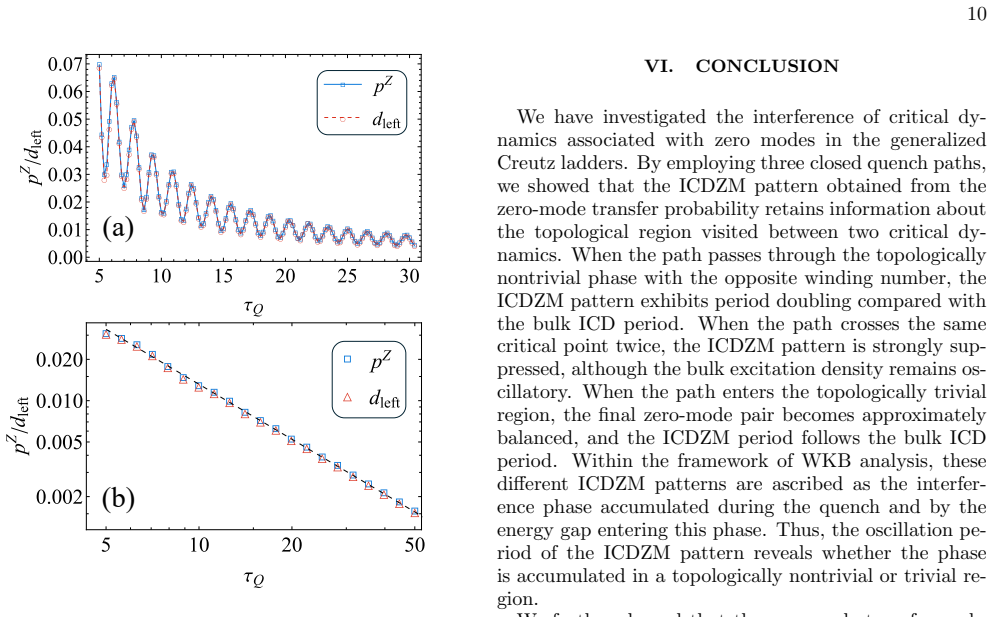
The first-rung value gives dleft, which is the boundary response associated with the initially occupied zero mode in|Ψ 0⟩
The deviation of the particle number is concentrated near the two boundaries, while the bulk rungs remain close to their initial value. The first-rung value gives dleft, which is the boundary response associated with the initially occupied zero mode in|Ψ 0⟩. Together with the pair-occupatthe decrease of the particle number at the left boundary can be inte...
-
[2]
T. W. B. Kibble, Journal of Physics A: Mathematical and General9, 1387 (1976)
1976
-
[3]
W. H. Zurek, Nature317, 505 (1985)
1985
-
[4]
Dziarmaga, Physical Review Letters95, 245701 (2005)
J. Dziarmaga, Physical Review Letters95, 245701 (2005)
2005
-
[5]
W. H. Zurek, U. Dorner, and P. Zoller, Physical Review Letters95, 105701 (2005)
2005
-
[6]
del Campo, G
A. del Campo, G. De Chiara, G. Morigi, M. B. Plenio, and A. Retzker, Physical Review Letters105, 075701 (2010)
2010
-
[7]
Dziarmaga, Advances in Physics59, 1063 (2010)
J. Dziarmaga, Advances in Physics59, 1063 (2010)
2010
-
[8]
del Campo, Phys
A. del Campo, Phys. Rev. Lett.121, 200601 (2018)
2018
-
[9]
M. M. Rams, J. Dziarmaga, and W. H. Zurek, Phys. Rev. Lett.123, 130603 (2019)
2019
-
[10]
F. J. G´ omez-Ruiz and A. del Campo, Physical Review Letters122, 080604 (2019)
2019
-
[11]
Sinha, M
A. Sinha, M. M. Rams, and J. Dziarmaga, Phys. Rev. B 99, 094203 (2019)
2019
-
[12]
R. B. S, V. Mukherjee, U. Divakaran, and A. del Campo, Phys. Rev. Res.2, 043247 (2020)
2020
-
[13]
R. J. Nowak and J. Dziarmaga, Phys. Rev. B104, 075448 (2021)
2021
-
[14]
Kou and P
H.-C. Kou and P. Li, Physical Review B108, 214307 (2023)
2023
-
[15]
S. Ulm, J. Roßnagel, G. Jacob, C. Deg¨ unther, S. T. Dawkins, U. G. Poschinger, R. Nigmatullin, A. Retzker, M. B. Plenio, F. Schmidt-Kaler, and K. Singer, Nature Communications4, 2290 (2013)
2013
-
[16]
K. Pyka, J. Keller, H. L. Partner, R. Nigmatullin, T. Burgermeister, D. M. Meier, K. Kuhlmann, A. Ret- zker, M. B. Plenio, W. H. Zurek, A. del Campo, and T. E. Mehlst¨ aubler, Nature Communications4, 2291 (2013)
2013
-
[17]
Navon, A
N. Navon, A. L. Gaunt, R. P. Smith, and Z. Hadzibabic, Science347, 167 (2015)
2015
-
[18]
Keesling, A
A. Keesling, A. Omran, H. Levine, H. Bernien, H. Pich- ler, S. Choi, R. Samajdar, S. Schwartz, P. Silvi, S. Sachdev, P. Zoller, M. Endres, M. Greiner, V. Vuleti´ c, and M. D. Lukin, Nature568, 207 (2019)
2019
-
[19]
Gherardini, L
S. Gherardini, L. Buffoni, and N. Defenu, Physical Re- view Letters133, 113401 (2024)
2024
-
[20]
Jara, Roy D
J. Jara, Roy D. and J. G. Cosme, Physical Review B110, 064317 (2024)
2024
-
[21]
Jackiw and C
R. Jackiw and C. Rebbi, Physical Review D13, 3398 (1976)
1976
-
[22]
W. P. Su, J. R. Schrieffer, and A. J. Heeger, Physical Review Letters42, 1698 (1979)
1979
-
[23]
Creutz, Phys
M. Creutz, Phys. Rev. Lett.83, 2636 (1999)
1999
-
[24]
A. Y. Kitaev, Physics-Uspekhi44, 131 (2001)
2001
-
[25]
Fu and C
L. Fu and C. L. Kane, Physical Review Letters100, 096407 (2008)
2008
-
[26]
R. M. Lutchyn, J. D. Sau, and S. Das Sarma, Physical Review Letters105, 077001 (2010)
2010
-
[27]
Y. Oreg, G. Refael, and F. von Oppen, Physical Review Letters105, 177002 (2010)
2010
-
[28]
Alicea, Reports on Progress in Physics75, 076501 (2012)
J. Alicea, Reports on Progress in Physics75, 076501 (2012)
2012
-
[29]
C. W. J. Beenakker, Annual Review of Condensed Matter Physics4, 113 (2013)
2013
-
[30]
Kells, D
G. Kells, D. Sen, J. K. Slingerland, and S. Vishveshwara, Phys. Rev. B89, 235130 (2014)
2014
-
[31]
Das Sarma, M
S. Das Sarma, M. Freedman, and C. Nayak, npj Quantum Information1, 15001 (2015)
2015
-
[32]
Sato and Y
M. Sato and Y. Ando, Reports on Progress in Physics 80, 076501 (2017)
2017
-
[33]
R. M. Lutchyn, E. P. A. M. Bakkers, L. P. Kouwenhoven, P. Krogstrup, C. M. Marcus, and Y. Oreg, Nature Re- views Materials3, 52 (2018)
2018
-
[34]
Liou and K
S.-F. Liou and K. Yang, Phys. Rev. B97, 235144 (2018)
2018
-
[35]
Ulˇ cakar, J
L. Ulˇ cakar, J. Mravlje, and T. c. v. Rejec, Phys. Rev. Lett.125, 216601 (2020)
2020
-
[36]
Sadrzadeh, R
M. Sadrzadeh, R. Jafari, and A. Langari, Phys. Rev. B 103, 144305 (2021)
2021
-
[37]
K. Sim, R. Chitra, and P. Molignini, Phys. Rev. B106, 224302 (2022)
2022
-
[38]
Z. Sun, M. Deng, and F. Li, Phys. Rev. B106, 134203 (2022)
2022
-
[39]
H. Yuan, J. Zhang, S. Chen, and X. Nie, Phys. Rev. B 110, 165130 (2024)
2024
-
[40]
Yuan, C.-R
H. Yuan, C.-R. Yi, J.-Y. Guo, X.-C. Cheng, R.-H. Jiao, J. Zhang, S. Chen, and J.-W. Pan, Phys. Rev. Lett.135, 063403 (2025)
2025
-
[41]
Mourik, K
V. Mourik, K. Zuo, S. M. Frolov, S. R. Plissard, E. P. A. M. Bakkers, and L. P. Kouwenhoven, Science336, 1003 (2012). 12
2012
-
[42]
Nadj-Perge, I
S. Nadj-Perge, I. K. Drozdov, J. Li, H. Chen, S. Jeon, J. Seo, A. H. MacDonald, B. A. Bernevig, and A. Yaz- dani, Science346, 602 (2014)
2014
-
[43]
S. M. Albrecht, A. P. Higginbotham, M. Madsen, F. Kuemmeth, T. S. Jespersen, J. Nyg˚ ard, P. Krogstrup, and C. M. Marcus, Nature531, 206 (2016)
2016
-
[44]
Zhang, C.-X
H. Zhang, C.-X. Liu, S. Gazibegovic, D. Xu, J. A. Lo- gan, G. Wang, N. van Loo, J. D. S. Bommer, M. W. A. de Moor, D. Car, R. L. M. Op het Veld, P. J. van Veld- hoven, S. Koelling, M. A. Verheijen, M. Pendharkar, D. J. Pennachio, B. Shojaei, J. S. Lee, C. J. Palmstrøm, E. P. A. M. Bakkers, S. Das Sarma, and L. P. Kouwenhoven, Nature556, 74 (2018)
2018
-
[45]
D. Wang, L. Kong, P. Fan, H. Chen, S. Zhu, W. Liu, L. Cao, Y. Sun, S. Du, J. Schneeloch, R. Zhong, G. Gu, L. Fu, H. Ding, and H.-J. Gao, Science362, 333 (2018)
2018
-
[46]
Hafezi, S
M. Hafezi, S. Mittal, J. Fan, A. Migdall, and J. M. Taylor, Nature Photonics7, 1001 (2013)
2013
-
[47]
M. C. Rechtsman, J. M. Zeuner, Y. Plotnik, Y. Lumer, D. Podolsky, F. Dreisow, S. Nolte, M. Segev, and A. Sza- meit, Nature496, 196 (2013)
2013
-
[48]
Mancini, G
M. Mancini, G. Pagano, G. Cappellini, L. F. Livi, M. Rider, J. Catani, C. Sias, P. Zoller, M. Inguscio, M. Dalmonte, and L. Fallani, Science349, 1510 (2015)
2015
-
[49]
B. K. Stuhl, H.-I. Lu, L. M. Aycock, D. Genkina, and I. B. Spielman, Science349, 1514 (2015)
2015
-
[50]
Imhof, C
S. Imhof, C. Berger, F. Bayer, J. Brehm, L. W. Molenkamp, T. Kiessling, and S. Reitzenstein, Nature Physics14, 925 (2018)
2018
-
[51]
M. A. Bandres, S. Wittek, G. Harari, M. Parto, J. Ren, M. Segev, D. N. Christodoulides, and M. Khajavikhan, Science359, eaar4005 (2018)
2018
-
[52]
Ozawa, H
T. Ozawa, H. M. Price, A. Amo, N. Goldman, M. Hafezi, L. Lu, M. C. Rechtsman, D. Schuster, J. Simon, O. Zil- berberg, and I. Carusotto, Reviews of Modern Physics 91, 015006 (2019)
2019
-
[53]
E. J. Meier, F. A. An, and B. Gadway, Nature Commu- nications7, 13986 (2016)
2016
-
[55]
C. L. Kane and E. J. Mele, Physical Review Letters95, 226801 (2005)
2005
-
[56]
B. A. Bernevig, T. L. Hughes, and S.-C. Zhang, Science 314, 1757 (2006)
2006
-
[57]
K¨ onig, S
M. K¨ onig, S. Wiedmann, C. Br¨ une, A. Roth, H. Buh- mann, L. W. Molenkamp, X.-L. Qi, and S.-C. Zhang, Science318, 766 (2007)
2007
-
[58]
C.-K. Chiu, J. C. Y. Teo, A. P. Schnyder, and S. Ryu, Reviews of Modern Physics88, 035005 (2016)
2016
-
[59]
Bansil, H
A. Bansil, H. Lin, and T. Das, Reviews of Modern Physics 88, 021004 (2016)
2016
-
[60]
Goldman, J
N. Goldman, J. C. Budich, and P. Zoller, Nature Physics 12, 639 (2016)
2016
-
[61]
Aidelsburger, S
M. Aidelsburger, S. Nascimbene, and N. Goldman, Comptes Rendus Physique19, 394 (2018)
2018
-
[62]
N. R. Cooper, J. Dalibard, and I. B. Spielman, Reviews of Modern Physics91, 015005 (2019)
2019
-
[63]
Prada, P
E. Prada, P. San-Jose, M. W. A. de Moor, A. Geresdi, E. J. H. Lee, J. Klinovaja, D. Loss, J. Nyg˚ ard, R. Aguado, and L. P. Kouwenhoven, Nature Reviews Physics2, 575 (2020)
2020
-
[64]
Flensberg, F
K. Flensberg, F. von Oppen, and A. Stern, Nature Re- views Materials6, 944 (2021)
2021
-
[65]
J¨ ack, Y
B. J¨ ack, Y. Xie, and A. Yazdani, Nature Reviews Physics 3, 541 (2021)
2021
-
[66]
S. K. Kanungo, J. D. Whalen, Y. Lu, M. Yuan, S. Das- gupta, F. B. Dunning, K. R. A. Hazzard, and T. C. Kil- lian, Nature Communications13, 972 (2022)
2022
-
[67]
Arg¨ uello-Luengo, U
J. Arg¨ uello-Luengo, U. Bhattacharya, A. Celi, R. W. Chhajlany, T. Grass, M. P lodzie´ n, D. Rakshit, T. Sala- mon, P. Stornati, L. Tarruell, and M. Lewenstein, Com- munications Physics7, 143 (2024)
2024
-
[68]
D. Yu, W. Song, L. Wang, R. Srikanth, S. K. Sridhar, T. Chen, C. Huang, G. Li, X. Qiao, X. Wu, Z. Dong, Y. He, M. Xiao, X. Chen, A. Dutt, B. Gadway, and L. Yuan, Photonics Insights4, R06 (2025)
2025
-
[69]
Bermudez, D
A. Bermudez, D. Patan` e, L. Amico, and M. A. Martin- Delgado, Physical Review Letters102, 135702 (2009)
2009
-
[70]
Bermudez, L
A. Bermudez, L. Amico, and M. A. Martin-Delgado, New Journal of Physics12, 055014 (2010)
2010
-
[71]
M. Lee, S. Han, and M.-S. Choi, Physical Review B92, 035117 (2015)
2015
-
[72]
M. Deng, S. Yang, C. Sun, F. Li, and X.-J. Yu, Anoma- lous dynamical scaling at topological quantum criticality (2026), arXiv:2512.15537 [cond-mat.str-el]
work page internal anchor Pith review Pith/arXiv arXiv 2026
-
[73]
Huang, M
L. Huang, M. Deng, C. Sun, and F. Li, Physical Review B110, 014303 (2024)
2024
-
[74]
Komissarov, T
I. Komissarov, T. Holder, and R. Queiroz, Phys. Rev. Lett.136, 136602 (2026)
2026
-
[75]
S. N. Shevchenko, S. Ashhab, and F. Nori, Physics Re- ports492, 1 (2010)
2010
-
[76]
Kou and P
H.-C. Kou and P. Li, Physical Review B106, 184301 (2022)
2022
-
[77]
Zhang, H.-C
Z.-H. Zhang, H.-C. Kou, and P. Li, Physical Review B 112, 014310 (2025)
2025
-
[78]
Herlach, Reports on Progress in Physics62, 859 (1999)
F. Herlach, Reports on Progress in Physics62, 859 (1999)
1999
-
[79]
Stojchevska, I
L. Stojchevska, I. Vaskivskyi, T. Mertelj, P. Kuˇ sar, D. Svetin, S. Brazovskii, and D. Mihailovic, Science344, 177 (2014)
2014
-
[80]
Kohama and K
Y. Kohama and K. Kindo, Review of Scientific Instru- ments86, 104701 (2015)
2015
-
[81]
D. N. Basov, R. D. Averitt, and D. Hsieh, Nature Mate- rials16, 1077 (2017)
2017
discussion (0)
Sign in with ORCID, Apple, or X to comment. Anyone can read and Pith papers without signing in.