Transport coefficients of strongly interacting quark-gluon plasma including elastic and inelastic scattering within the dynamical quasiparticle model
Pith reviewed 2026-06-27 06:33 UTC · model grok-4.3
The pith
Including radiative gluon radiation in the dynamical quasiparticle model reduces all transport coefficients of the quark-gluon plasma moderately compared to elastic scattering alone.
A machine-rendered reading of the paper's core claim, the machinery that carries it, and where it could break.
Core claim
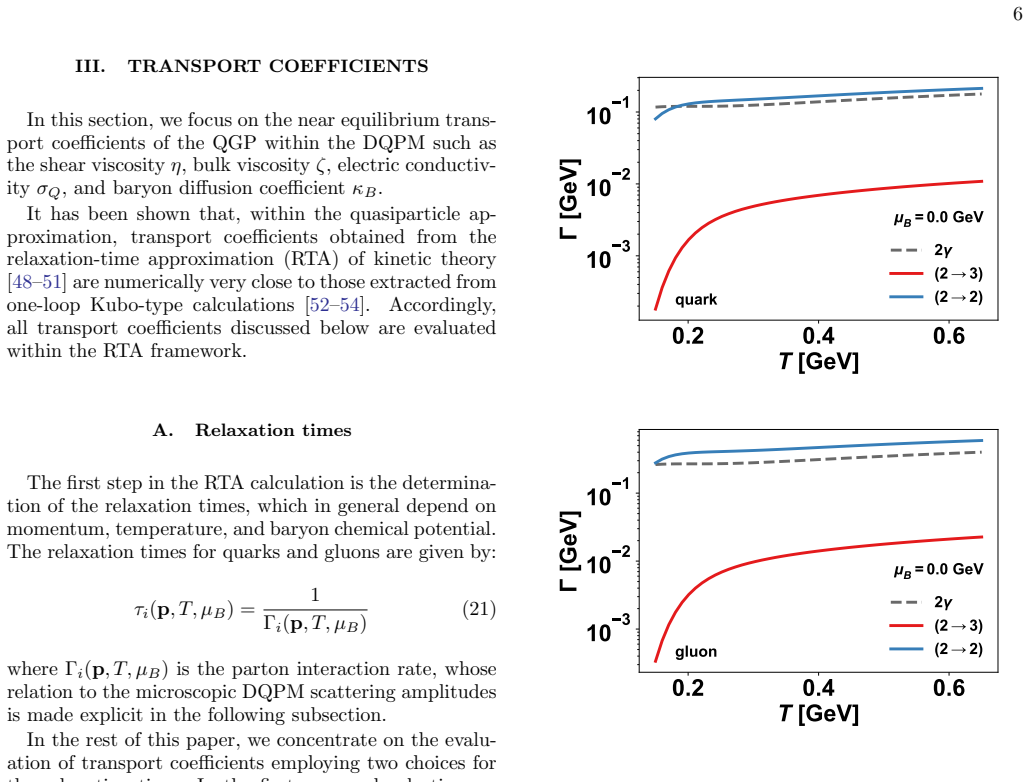
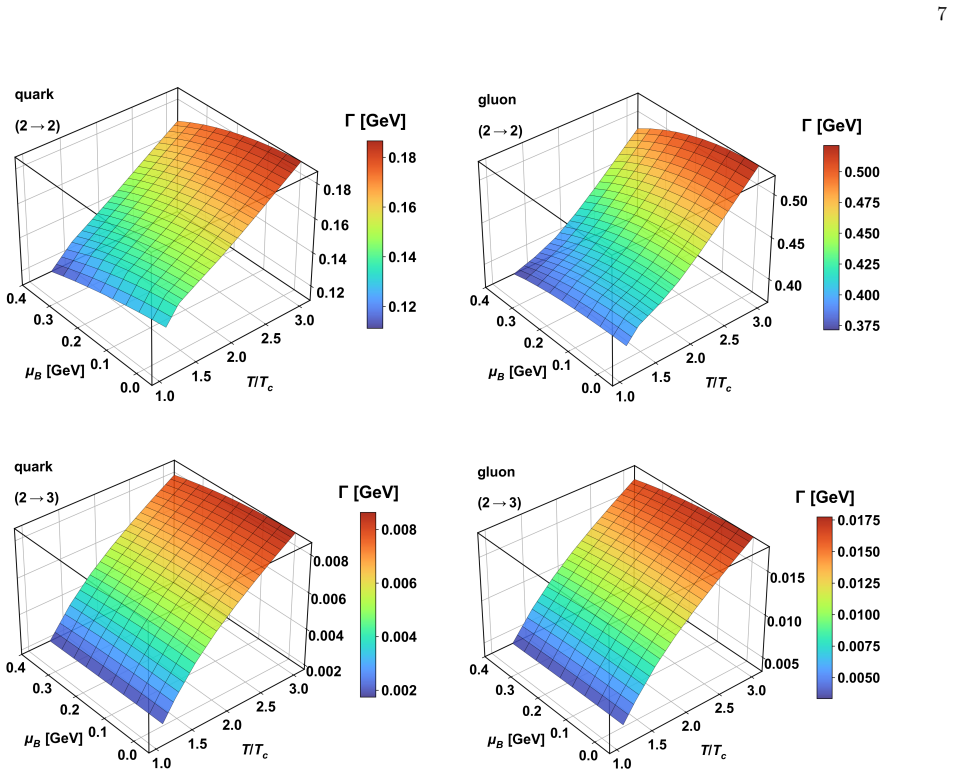
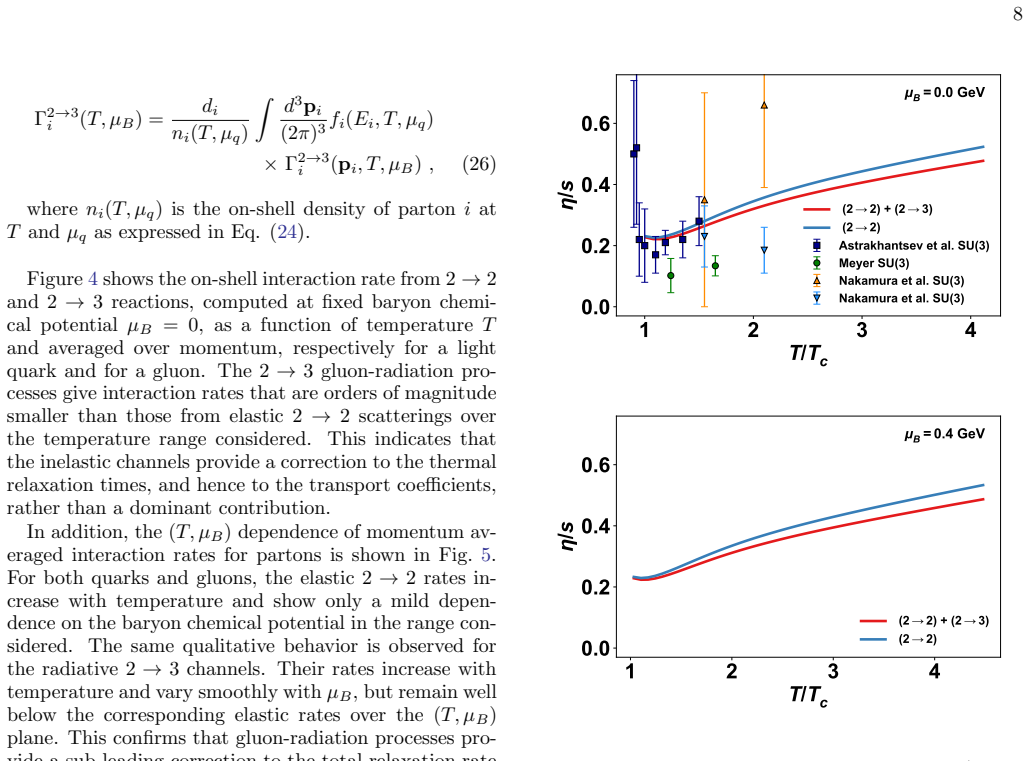
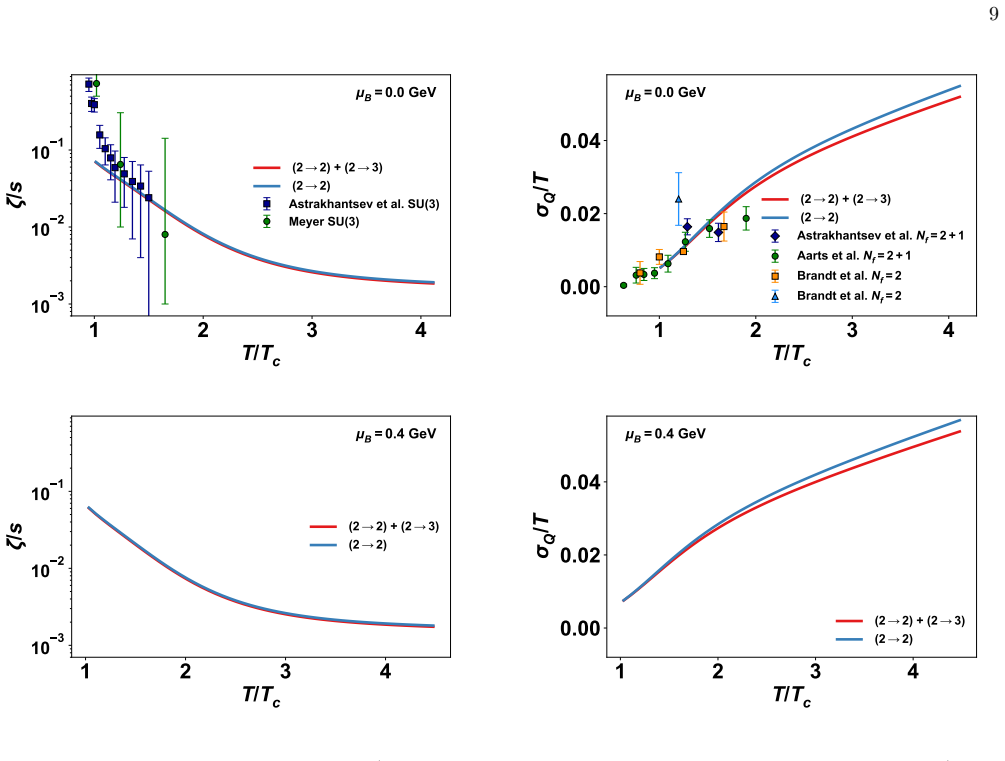
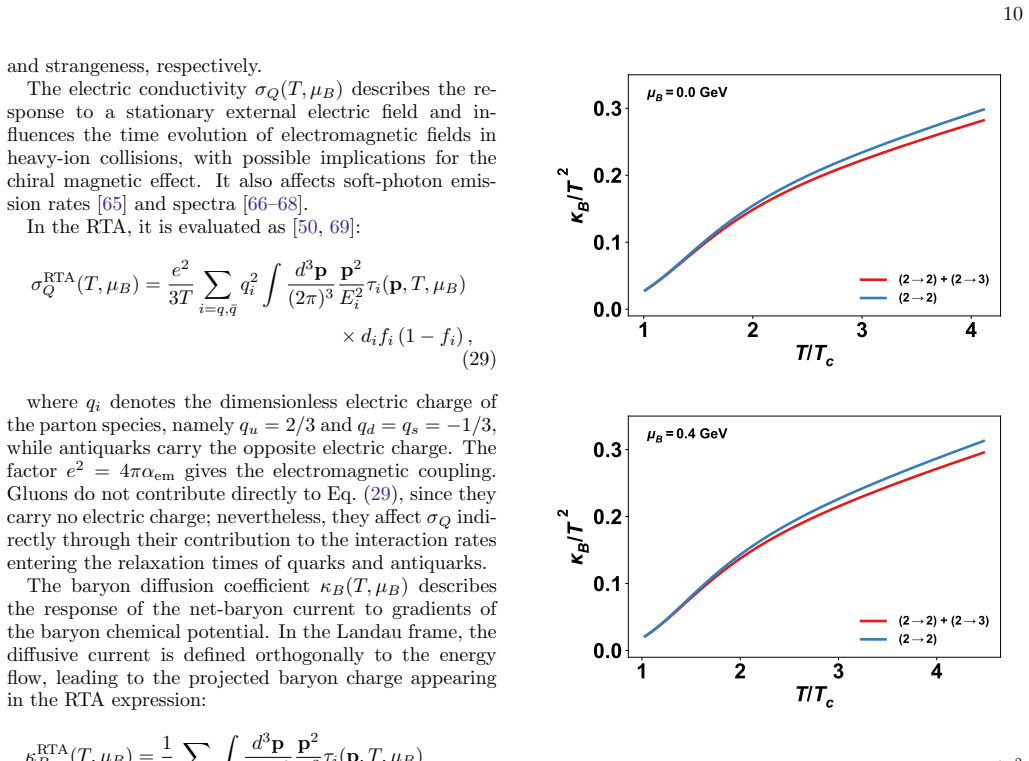
Within the dynamical quasiparticle model, radiative 2-to-3 scattering channels with massive partons and effective DQPM propagators and vertices produce a systematic reduction of the shear viscosity, bulk viscosity, electric conductivity, and baryon diffusion coefficient relative to the elastic-only baseline. This reduction tracks the decrease in relaxation times, but remains moderate because inelastic rates stay below elastic rates over the full (T, μ_B) domain studied. At μ_B = 0 the values of η/s, ζ/s, and σ_Q/T are compatible with lattice-QCD estimates within uncertainties; at finite μ_B the results provide predictions for the transport properties of QCD matter.
What carries the argument
The dynamical quasiparticle model (DQPM) with effective propagators and vertices extended to radiative 2-to-3 channels, together with the relaxation-time approximation applied to the sum of elastic and inelastic interaction rates.
If this is right
- Every transport coefficient decreases once the inelastic channels are included.
- The size of the reduction tracks the drop in relaxation times and stays moderate across the explored thermal regime.
- At zero baryon chemical potential the computed η/s, ζ/s and σ_Q/T agree with lattice-QCD estimates inside uncertainties.
- At finite baryon chemical potential the results supply concrete predictions for beam-energy-scan programs.
Where Pith is reading between the lines
- Elastic scattering continues to dominate the momentum transport in the strongly interacting regime near the QCD transition.
- Radiative processes would become more important at higher parton momenta, which are suppressed in thermal distributions but could matter in non-equilibrium settings.
- The same framework could be used to test whether other inelastic channels, such as quark-antiquark pair production, produce comparable corrections.
Load-bearing premise
The effective DQPM propagators and vertices can be applied unchanged to the radiative 2-to-3 channels, and the relaxation-time approximation remains valid after the elastic and inelastic rates are added together.
What would settle it
A lattice-QCD evaluation or heavy-ion measurement that finds any transport coefficient larger than the elastic-only DQPM result at moderate temperature and chemical potential would falsify the claim that the added radiative channels produce only a moderate further reduction.
Figures
read the original abstract
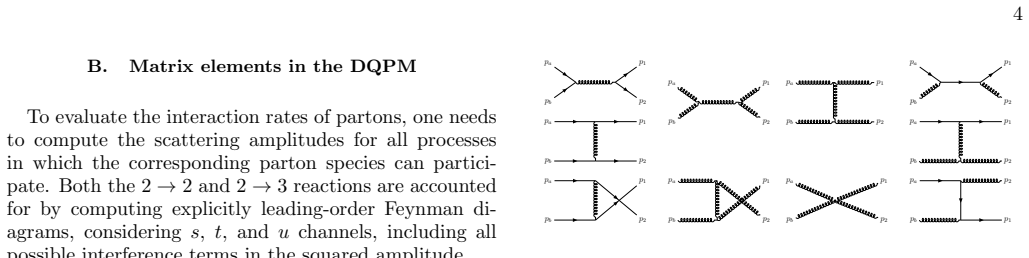
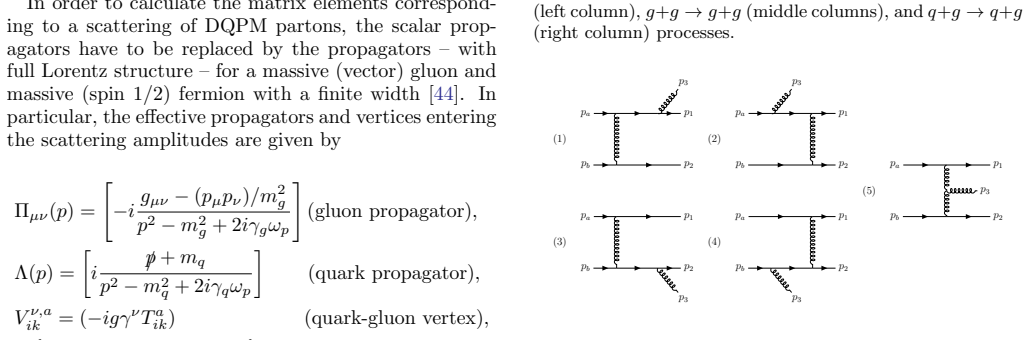
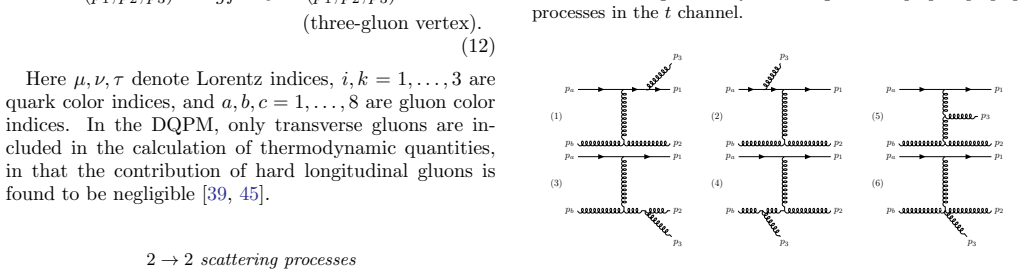
We study the impact of inelastic gluon-radiation processes on the transport coefficients of the quark-gluon plasma within the dynamical quasiparticle model (DQPM) in the temperature-baryon-chemical-potential plane $(T,\mu_B)$. Extending the elastic baseline established in previous DQPM calculations, we include radiative $2\to3$ scattering channels with massive partons and effective DQPM propagators and vertices. The corresponding momentum-dependent interaction rates and relaxation times are used within the relaxation-time approximation to calculate the shear viscosity, bulk viscosity, electric conductivity, and baryon diffusion coefficient as functions of temperature $T$ and baryon chemical potential $\mu_B$. We find that radiative channels systematically reduce all considered transport coefficients relative to the elastic-only results, in accordance with the decrease of the relaxation times. In the thermal regime explored here, however, this reduction remains moderate, since the inelastic rates stay below the elastic ones over the considered $(T,\mu_B)$ range. The radiative channels become more relevant mainly for partonic scatterings at large momenta, which are thermally suppressed in the strongly interacting QGP. At $\mu_B=0$, the resulting $\eta/s$, $\zeta/s$, and $\sigma_Q/T$ are compatible with available lattice-QCD estimates within uncertainties. At finite $\mu_B$, our results provide predictions for the transport properties of QCD matter relevant for beam-energy-scan programs.
Editorial analysis
A structured set of objections, weighed in public.
Referee Report
Summary. The paper extends prior DQPM calculations of QGP transport coefficients by incorporating radiative 2→3 gluon-emission processes with massive partons, using the same effective propagators and vertices as in the elastic 2→2 sector. Within the relaxation-time approximation, it computes shear viscosity η/s, bulk viscosity ζ/s, electric conductivity σ_Q/T, and baryon diffusion as functions of T and μ_B, reporting that inelastic channels produce a moderate reduction relative to the elastic baseline because inelastic rates remain below elastic rates over the explored range; at μ_B=0 the results lie inside lattice uncertainties.
Significance. If the central modeling assumptions hold, the work supplies finite-μ_B predictions relevant to beam-energy-scan programs and quantifies the relative importance of radiative processes in a strongly coupled regime. The explicit statement that the reduction is moderate and that inelastic rates stay sub-dominant is a concrete, falsifiable claim that can be tested against future lattice or other effective-model results.
major comments (3)
- [inelastic scattering rates section] The central claim that inelastic rates remain below elastic rates (and therefore produce only moderate reduction) rests on applying the unmodified DQPM propagators and vertices to the 2→3 channels. The manuscript does not display the explicit matrix elements, infrared regularization, or phase-space integration for these radiative processes, so the numerical ordering of the rates cannot be independently verified.
- [transport coefficient calculation] The relaxation-time approximation is applied directly to the summed elastic+inelastic rates. No test is provided of its accuracy when the momentum dependence of the inelastic contribution differs from the elastic one (e.g., via comparison to a Chapman-Enskog or full Boltzmann solution).
- [results at μ_B=0] Error propagation from the DQPM parameters (fitted to lattice thermodynamics) into the transport coefficients is not shown; the statement that results at μ_B=0 lie inside lattice uncertainties therefore lacks a quantified uncertainty band.
minor comments (2)
- [model definition] Notation for the effective vertices and the precise definition of the DQPM widths should be collected in one place for clarity.
- [figures] Figure captions should explicitly state whether the plotted curves include or exclude the 2→3 channels.
Simulated Author's Rebuttal
We thank the referee for the careful reading of our manuscript and the constructive comments. We address each of the major comments below.
read point-by-point responses
-
Referee: [inelastic scattering rates section] The central claim that inelastic rates remain below elastic rates (and therefore produce only moderate reduction) rests on applying the unmodified DQPM propagators and vertices to the 2→3 channels. The manuscript does not display the explicit matrix elements, infrared regularization, or phase-space integration for these radiative processes, so the numerical ordering of the rates cannot be independently verified.
Authors: We agree that the explicit details of the 2→3 matrix elements, infrared regularization, and phase-space integration were not sufficiently presented in the manuscript. In the revised version, we will add these expressions, including the form of the squared matrix elements based on the DQPM vertices for massive partons, the regularization procedure for the infrared divergence, and the numerical integration method over phase space. This will enable independent verification of the inelastic rates being below the elastic ones. revision: yes
-
Referee: [transport coefficient calculation] The relaxation-time approximation is applied directly to the summed elastic+inelastic rates. No test is provided of its accuracy when the momentum dependence of the inelastic contribution differs from the elastic one (e.g., via comparison to a Chapman-Enskog or full Boltzmann solution).
Authors: The relaxation time approximation is employed consistently with our previous DQPM studies on elastic scattering. Although a full comparison to more advanced methods like Chapman-Enskog expansion or numerical solution of the Boltzmann equation would be valuable, it lies outside the scope of this work focused on the impact of including inelastic channels within the established DQPM framework. We note that the inelastic contributions are subdominant, which supports the applicability of the RTA. revision: no
-
Referee: [results at μ_B=0] Error propagation from the DQPM parameters (fitted to lattice thermodynamics) into the transport coefficients is not shown; the statement that results at μ_B=0 lie inside lattice uncertainties therefore lacks a quantified uncertainty band.
Authors: We concur that providing quantified uncertainty bands from the DQPM parameter variations is necessary to strengthen the comparison with lattice results. In the revised manuscript, we will propagate the uncertainties from the parameters (fitted to lattice thermodynamics) into the transport coefficients and display the resulting bands at μ_B=0. revision: yes
Circularity Check
No significant circularity; transport coefficients derived from model fitted only to thermodynamics
full rationale
The paper fits DQPM parameters to lattice QCD thermodynamics, then independently computes momentum-dependent elastic and inelastic rates using the model's propagators/vertices, sums them, and applies the relaxation-time approximation to obtain shear viscosity, bulk viscosity, conductivity, and diffusion coefficient. The reported moderate reduction from inelastic channels is an explicit numerical outcome of those rates (inelastic < elastic over the (T, μ_B) range), not a definitional identity or statistical forcing. External lattice benchmarks at μ_B=0 are cited for validation, and prior DQPM elastic results are referenced only as a baseline for the new inelastic extension. No step reduces by construction to its inputs, no uniqueness theorem is invoked, and no ansatz is smuggled via self-citation.
Axiom & Free-Parameter Ledger
free parameters (1)
- DQPM quasiparticle masses and widths
axioms (2)
- domain assumption The relaxation-time approximation accurately converts interaction rates into transport coefficients for both elastic and inelastic processes.
- ad hoc to paper Effective DQPM vertices and propagators apply unchanged to the radiative 2-to-3 channels.
Reference graph
Works this paper leans on
- [1]
-
[2]
T. Ablyazimovet al.(CBM), Challenges in qcd mat- ter physics –the scientific programme of the compressed baryonic matter experiment at fair, Eur. Phys. J. A53, 60 (2017), arXiv:1607.01487 [nucl-ex]
Pith/arXiv arXiv 2017
-
[3]
Golovatyuk, V
V. Golovatyuk, V. Kekelidze, V. Kolesnikov, O. Ro- gachevsky, and A. Sorin, The Multi-Purpose Detector (MPD) of the collider experiment, Eur. Phys. J. A52, 212 (2016)
2016
-
[4]
C. Sasaki and K. Redlich, Bulk viscosity in quasi particle models, Phys. Rev. C79, 055207 (2009), arXiv:0806.4745 [hep-ph]
Pith/arXiv arXiv 2009
-
[5]
M. Bluhm, B. Kampfer, and K. Redlich, Bulk and shear viscosities of the gluon plasma in a quasiparticle descrip- tion, Phys. Rev. C84, 025201 (2011), arXiv:1011.5634 [hep-ph]
Pith/arXiv arXiv 2011
-
[6]
R. Marty, E. Bratkovskaya, W. Cassing, J. Aichelin, and H. Berrehrah, Transport coefficients from the Nambu- Jona-Lasinio model forSU(3) f, Phys. Rev. C88, 045204 (2013), arXiv:1305.7180 [hep-ph]
Pith/arXiv arXiv 2013
-
[7]
Zhao, Thermodynamic properties and transport coefficients of QCD matter within the nonextensive Polyakov–Nambu–Jona-Lasinio model, Phys
Y.-P. Zhao, Thermodynamic properties and transport coefficients of QCD matter within the nonextensive Polyakov–Nambu–Jona-Lasinio model, Phys. Rev. D 101, 096006 (2020)
2020
-
[8]
A. Bandyopadhyay and S. Ghosh, Quantum version of transport coefficients in Nambu–Jona-Lasinio model at finite temperature and strong magnetic field, Eur. Phys. J. C83, 489 (2023), arXiv:2305.15844 [hep-ph]
arXiv 2023
-
[9]
D. Singh and A. Kumar, Finite size effects on the trans- port coefficients of strongly interacting QCD matter, Phys. Rev. D111, 074017 (2025), arXiv:2501.15511 [hep- ph]
arXiv 2025
- [10]
-
[11]
S. Madni, L. Thakur, and N. Haque, Electrical conductiv- ity of QGP with quasiparticle quarks and Gribov gluon, Eur. Phys. J. C86, 473 (2026), arXiv:2404.09767 [hep- ph]
Pith/arXiv arXiv 2026
-
[12]
M. Greif, J. A. Fotakis, G. S. Denicol, and C. Greiner, Diffusion of conserved charges in relativistic heavy ion collisions, Phys. Rev. Lett.120, 242301 (2018), arXiv:1711.08680 [hep-ph]
Pith/arXiv arXiv 2018
-
[13]
J. A. Fotakis, M. Greif, C. Greiner, G. S. Deni- col, and H. Niemi, Diffusion processes involving mul- tiple conserved charges: A study from kinetic theory and implications to the fluid-dynamical modeling of heavy ion collisions, Phys. Rev. D101, 076007 (2020), arXiv:1912.09103 [hep-ph]
arXiv 2020
-
[14]
J. A. Fotakis, O. Soloveva, C. Greiner, O. Kaczmarek, and E. Bratkovskaya, Diffusion coefficient matrix of the strongly interacting quark-gluon plasma, Phys. Rev. D 104, 034014 (2021), arXiv:2102.08140 [hep-ph]
arXiv 2021
-
[15]
A. Das, H. Mishra, and R. K. Mohapatra, Diffusion ma- trix associated with the diffusion processes of multiple conserved charges in a hot and dense hadronic mat- ter, Phys. Rev. D106, 014013 (2022), arXiv:2109.01543 [nucl-th]
arXiv 2022
-
[16]
S. Dey, A. Jaiswal, and H. Mishra, Diffusion coefficient matrix for multiple conserved charges: a Kubo approach, JHEP12, 192, arXiv:2404.18718 [hep-ph]
-
[17]
O. Ohanaka and Z.-W. Lin, Chapman-Enskog calcula- tion of the shear viscosity of quark-gluon plasma includ- ing all 2↔2 scatterings at finite temperature (2026), arXiv:2604.25059 [nucl-th]
Pith/arXiv arXiv 2026
- [18]
-
[19]
G. Parisi, V. Nugara, S. U. Arfeen, S. Plumari, and V. Greco, Bulk viscosity of a binary mixture: the role of the intra-species interaction, arXiv:2606.06105 [hep-ph] (2026)
Pith/arXiv arXiv 2026
-
[20]
C. Shen, B. Schenke, and W. Zhao, Viscosities of 12 the Baryon-Rich Quark-Gluon Plasma from Beam En- ergy Scan Data, Phys. Rev. Lett.132, 072301 (2024), arXiv:2310.10787 [nucl-th]
arXiv 2024
-
[21]
S. A. Jahan, H. Roch, and C. Shen, Bayesian analysis of (3+1)D relativistic nuclear dynamics with the RHIC beam energy scan data, Phys. Rev. C110, 054905 (2024), arXiv:2408.00537 [nucl-th]
arXiv 2024
-
[22]
A. Peshier and W. Cassing, The Hot non-perturbative gluon plasma is an almost ideal colored liquid, Phys. Rev. Lett.94, 172301 (2005), arXiv:hep-ph/0502138
Pith/arXiv arXiv 2005
-
[23]
Cassing, From Kadanoff-Baym dynamics to off-shell parton transport, Eur
W. Cassing, From Kadanoff-Baym dynamics to off-shell parton transport, Eur. Phys. J. ST168, 3 (2009), arXiv:0808.0715 [nucl-th]
Pith/arXiv arXiv 2009
- [24]
-
[25]
O. Soloveva, P. Moreau, and E. Bratkovskaya, Trans- port coefficients for the hot quark-gluon plasma at finite chemical potentialµ B, Phys. Rev. C101, 045203 (2020), arXiv:1911.08547 [nucl-th]
arXiv 2020
-
[26]
O. Soloveva, A. Palermo, and E. Bratkovskaya, Extrac- tion of the microscopic properties of quasiparticles using deep neural networks, Phys. Rev. C110, 034908 (2024), arXiv:2311.15984 [hep-ph]
arXiv 2024
-
[27]
Grishmanovskii,Attenuation of jet partons in strongly interacting quark-gluon plasma, Ph.D
I. Grishmanovskii,Attenuation of jet partons in strongly interacting quark-gluon plasma, Ph.D. thesis, Goethe U., Frankfurt (main) (2024)
2024
-
[28]
I. Grishmanovskii, T. Song, C. Greiner, and E. Bratkovskaya, Transport coefficients of heavy quarks by elastic and radiative scatterings in the strongly interacting quark-gluon plasma, Phys. Rev. D 112, 014042 (2025), arXiv:2503.22311 [hep-ph]
arXiv 2025
-
[29]
W. Cassing and E. L. Bratkovskaya, Parton-Hadron- String Dynamics: an off-shell transport approach for relativistic energies, Nucl. Phys. A831, 215 (2009), arXiv:0907.5331 [nucl-th]
Pith/arXiv arXiv 2009
-
[30]
O. Linnyk, E. L. Bratkovskaya, and W. Cassing, Ef- fective QCD and transport description of dilepton and photon production in heavy-ion collisions and elemen- tary processes, Prog. Part. Nucl. Phys.87, 50 (2016), arXiv:1512.08126 [nucl-th]
Pith/arXiv arXiv 2016
-
[31]
O. Soloveva, J. Aichelin, and E. Bratkovskaya, Transport properties and equation-of-state of hot and dense QGP matter near the critical endpoint in the phenomenolog- ical dynamical quasiparticle model, Phys. Rev. D105, 054011 (2022), arXiv:2108.08561 [hep-ph]
arXiv 2022
-
[32]
O. Soloveva, D. Fuseau, J. Aichelin, and E. Bratkovskaya, Shear viscosity and electric conductivity of a hot and dense QGP with a chiral phase transition, Phys. Rev. C 103, 054901 (2021), arXiv:2011.03505 [nucl-th]
arXiv 2021
-
[33]
I. Grishmanovskii, O. Soloveva, T. Song, C. Greiner, and E. Bratkovskaya, Inelastic and elastic parton scattering in the strongly interacting quark-gluon plasma, Phys. Rev. C109, 024911 (2024), arXiv:2308.03105 [hep-ph]
arXiv 2024
- [34]
-
[35]
Cassing, Dynamical quasiparticles properties and ef- fective interactions in the sQGP, Nucl
W. Cassing, Dynamical quasiparticles properties and ef- fective interactions in the sQGP, Nucl. Phys. A795, 70 (2007), arXiv:0707.3033 [nucl-th]
Pith/arXiv arXiv 2007
-
[36]
Cassing, QCD thermodynamics and confinement from a dynamical quasiparticle point of view, Nucl
W. Cassing, QCD thermodynamics and confinement from a dynamical quasiparticle point of view, Nucl. Phys. A791, 365 (2007), arXiv:0704.1410 [nucl-th]
Pith/arXiv arXiv 2007
-
[37]
H. Berrehrah, E. Bratkovskaya, T. Steinert, and W. Cass- ing, A dynamical quasiparticle approach for the QGP bulk and transport properties, Int. J. Mod. Phys. E25, 1642003 (2016), arXiv:1605.02371 [hep-ph]
Pith/arXiv arXiv 2016
-
[38]
B. Vanderheyden and G. Baym, Selfconsistent approxi- mations in relativistic plasmas: Quasiparticle analysis of the thermodynamic properties, J. Statist. Phys.93, 843 (1998), arXiv:hep-ph/9803300
Pith/arXiv arXiv 1998
-
[39]
J. P. Blaizot, E. Iancu, and A. Rebhan, Approximately selfconsistent resummations for the thermodynamics of the quark gluon plasma. 1. Entropy and density, Phys. Rev. D63, 065003 (2001), arXiv:hep-ph/0005003
Pith/arXiv arXiv 2001
-
[40]
M. L. Bellac,Thermal Field Theory, Cambridge Mono- graphs on Mathematical Physics (Cambridge University Press, 2011)
2011
-
[41]
H. Berrehrah, W. Cassing, E. Bratkovskaya, and T. Steinert, Quark susceptibility in a generalized dynam- ical quasiparticle model, Phys. Rev. C93, 044914 (2016), arXiv:1512.06909 [hep-ph]
Pith/arXiv arXiv 2016
-
[42]
S. Borsanyi, G. Endrodi, Z. Fodor, S. D. Katz, S. Krieg, C. Ratti, and K. K. Szabo, QCD equation of state at nonzero chemical potential: continuum results with physical quark masses at ordermu 2, JHEP08, 053, arXiv:1204.6710 [hep-lat]
-
[43]
S. Borsanyi, Z. Fodor, C. Hoelbling, S. D. Katz, S. Krieg, and K. K. Szabo, Full result for the QCD equation of state with 2+1 flavors, Phys. Lett. B730, 99 (2014), arXiv:1309.5258 [hep-lat]
Pith/arXiv arXiv 2014
-
[44]
H. Berrehrah, E. Bratkovskaya, W. Cassing, P. B. Gossi- aux, J. Aichelin, and M. Bleicher, Collisional processes of on-shell and off-shell heavy quarks in vacuum and in the Quark-Gluon-Plasma, Phys. Rev. C89, 054901 (2014), arXiv:1308.5148 [hep-ph]
Pith/arXiv arXiv 2014
-
[45]
Peshier, HTL resummation of the thermodynamic potential, Phys
A. Peshier, HTL resummation of the thermodynamic potential, Phys. Rev. D63, 105004 (2001), arXiv:hep- ph/0011250
arXiv 2001
-
[46]
I. Grishmanovskii, T. Song, O. Soloveva, C. Greiner, and E. Bratkovskaya, Exploring jet transport coeffi- cients by elastic scattering in the strongly interacting quark-gluon plasma, Phys. Rev. C106, 014903 (2022), arXiv:2204.01561 [nucl-th]
arXiv 2022
-
[47]
I. Grishmanovskii, O. Soloveva, T. Song, C. Greiner, and E. Bratkovskaya, Jet transport coefficients by elas- tic and radiative scatterings in the strongly interacting quark-gluon plasma, Phys. Rev. C110, 014908 (2024), arXiv:2402.04923 [hep-ph]
arXiv 2024
-
[48]
Hosoya and K
A. Hosoya and K. Kajantie, Transport Coefficients of QCD Matter, Nucl. Phys. B250, 666 (1985)
1985
-
[49]
P. Chakraborty and J. I. Kapusta, Quasi-Particle Theory of Shear and Bulk Viscosities of Hadronic Matter, Phys. Rev. C83, 014906 (2011), arXiv:1006.0257 [nucl-th]
Pith/arXiv arXiv 2011
-
[50]
M. Albright and J. I. Kapusta, Quasiparticle Theory of Transport Coefficients for Hadronic Matter at Fi- nite Temperature and Baryon Density, Phys. Rev. C93, 014903 (2016), arXiv:1508.02696 [nucl-th]
Pith/arXiv arXiv 2016
-
[51]
Gavin, Transport coefficients in ultrarelativistic heavy- ion collisions, Nucl
S. Gavin, Transport coefficients in ultrarelativistic heavy- ion collisions, Nucl. Phys. A435, 826 (1985)
1985
-
[52]
Kubo, Statistical mechanical theory of irreversible processes
R. Kubo, Statistical mechanical theory of irreversible processes. 1. General theory and simple applications in magnetic and conduction problems, J. Phys. Soc. Jap. 12, 570 (1957). 13
1957
-
[53]
Aarts and J
G. Aarts and J. M. M. Resco, Transport coefficients, spectral functions and the lattice, Journal of High En- ergy Physics2002, 053 (2002)
2002
-
[54]
D. Fernandez-Fraile and A. Gomez Nicola, The Electri- cal conductivity of a pion gas, Phys. Rev. D73, 045025 (2006), arXiv:hep-ph/0512283
Pith/arXiv arXiv 2006
-
[55]
N. Y. Astrakhantsev, V. V. Braguta, and A. Y. Ko- tov, Temperature dependence of shear viscosity of SU(3)- gluodynamics within lattice simulation, JHEP04, 101, arXiv:1701.02266 [hep-lat]
-
[56]
H. B. Meyer, A calculation of the shear viscosity in SU(3) gluodynamics, Phys. Rev. D76, 101701 (2007), arXiv:0704.1801 [hep-lat]
Pith/arXiv arXiv 2007
-
[57]
A. Nakamura and S. Sakai, Transport Coefficients of Gluon Plasma, Phys. Rev. Lett.94, 072305 (2005), arXiv:hep-lat/0406009
Pith/arXiv arXiv 2005
-
[58]
A. Nakamura and S. Sakai, Lattice calculation of the QGP viscosities: Present results and next project, PoS LATTICE2007, 221 (2007), arXiv:0710.3625 [hep-lat]
Pith/arXiv arXiv 2007
-
[59]
N. Y. Astrakhantsev, V. V. Braguta, and A. Y. Kotov, Temperature dependence of bulk viscosity within lat- tice simulation of SU(3) gluodynamics, Phys. Rev. D98, 054515 (2018), arXiv:1804.02382 [hep-lat]
Pith/arXiv arXiv 2018
-
[60]
H. B. Meyer, A calculation of the bulk viscosity in SU(3) gluodynamics, Phys. Rev. Lett.100, 162001 (2008), arXiv:0710.3717 [hep-lat]
Pith/arXiv arXiv 2008
-
[61]
N. Y. Astrakhantsev, V. V. Braguta, M. D’Elia, A. Y. Kotov, A. A. Nikolaev, and F. Sanfilippo, Lattice study of electromagnetic conductivity of quark-gluon plasma in external magnetic field, Phys. Rev. D102, 054516 (2020), arXiv:1910.08516 [hep-lat]
arXiv 2020
-
[62]
G. Aarts, C. Allton, A. Amato, P. Giudice, S. Hands, and J.-I. Skullerud, Electrical conductivity and charge diffusion in thermal QCD from the lattice, JHEP02, 186, arXiv:1412.6411 [hep-lat]
-
[63]
B. B. Brandt, A. Francis, B. Jaeger, and H. B. Meyer, Charge transport and vector meson dissociation across the thermal phase transition in lattice QCD with two light quark flavors, Phys. Rev. D93, 054510 (2016), arXiv:1512.07249 [hep-lat]
Pith/arXiv arXiv 2016
-
[64]
B. B. Brandt, A. Francis, H. B. Meyer, and H. Wittig, Two-flavour lattice QCD correlation functions in the de- confinement transition region, PoSConfinementX, 186 (2012), arXiv:1302.0675 [hep-lat]
Pith/arXiv arXiv 2012
-
[65]
Y. Yin, Electrical conductivity of the quark-gluon plasma and soft photon spectrum in heavy-ion collisions, Phys. Rev. C90, 044903 (2014), arXiv:1312.4434 [nucl-th]
Pith/arXiv arXiv 2014
-
[66]
S. Turbide, R. Rapp, and C. Gale, Hadronic production of thermal photons, Phys. Rev. C69, 014903 (2004), arXiv:hep-ph/0308085
Pith/arXiv arXiv 2004
-
[67]
Y. Akamatsu, H. Hamagaki, T. Hatsuda, and T. Hirano, Can transport peak explain the low-mass enhancement of dileptons at RHIC?, J. Phys. G38, 124184 (2011), arXiv:1106.5870 [nucl-th]
Pith/arXiv arXiv 2011
-
[68]
O. Linnyk, V. Konchakovski, W. Cassing, and E. Bratkovskaya, Photon elliptic flow in relativistic heavy-ion collisions: hadronic versus partonic sources, Phys. Rev. C88, 034904 (2013), arXiv:1304.7030 [nucl- th]
Pith/arXiv arXiv 2013
-
[69]
H. Berrehrah, P.-B. Gossiaux, J. Aichelin, W. Cassing, and E. Bratkovskaya, Dynamical collisional energy loss and transport properties of on- and off-shell heavy quarks in vacuum and in the Quark Gluon Plasma, Phys. Rev. C90, 064906 (2014), arXiv:1405.3243 [hep-ph]
Pith/arXiv arXiv 2014
discussion (0)
Sign in with ORCID, Apple, or X to comment. Anyone can read and Pith papers without signing in.