Natural Supercooling and Reheating along Supersymmetric Flat Directions and Observable Gravitational Waves at the Einstein Telescope and the Cosmic Explorer
Pith reviewed 2026-06-27 06:11 UTC · model grok-4.3
The pith
A supersymmetric hidden sector produces detectable gravitational waves through supercooled phase transitions along flat directions.
A machine-rendered reading of the paper's core claim, the machinery that carries it, and where it could break.
Core claim
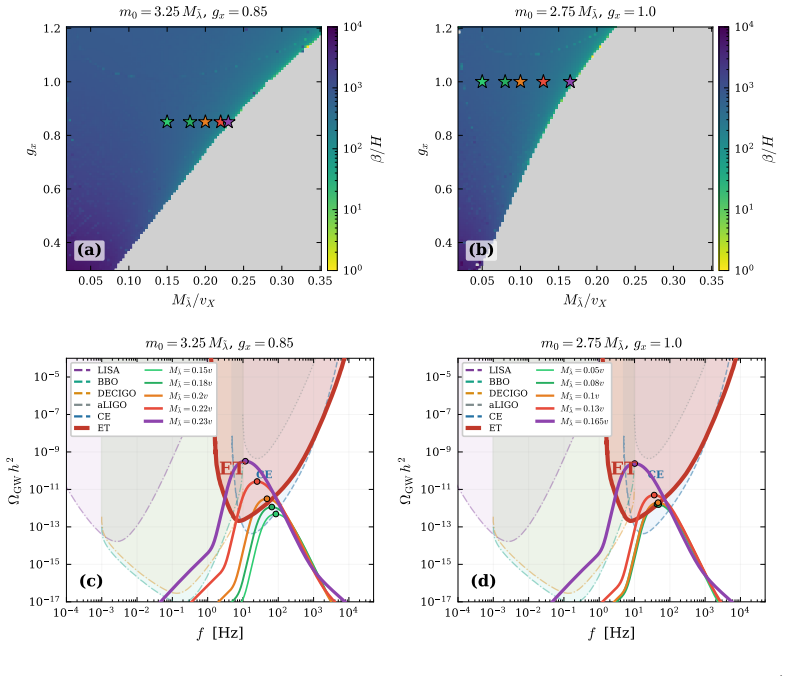
Along the D-flat direction the tree-level quartic vanishes, so the barrier is generated radiatively by soft SUSY-breaking splittings in the DR-bar scheme. In this scheme the gaugino mass sets the barrier depth while the soft scalar mass stabilizes the broken vacuum. For M_lambda tilde over v_X between 0.05 and 0.23 the predicted signal reaches Omega_GW h squared of 3 times 10 to the minus 10 near the percolation boundary, with the amplitude controlled by the hidden-to-visible temperature ratio via the portal coupling delta.
What carries the argument
The D-flat direction where the tree-level quartic vanishes, allowing the barrier to be generated purely by radiative effects from soft supersymmetry breaking.
If this is right
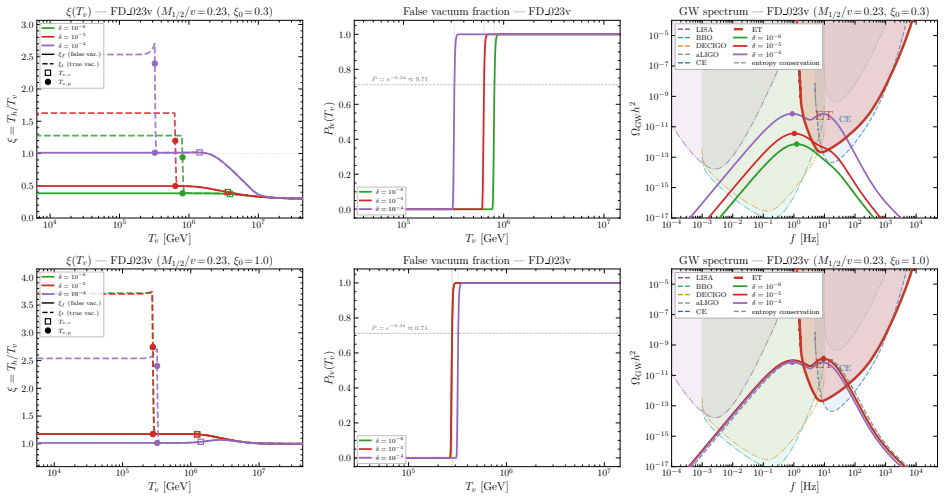
- The gravitational wave amplitude varies with the portal coupling, reaching 7 times 10 to the minus 11 for delta of 10 to the minus 4 in a cold hidden sector.
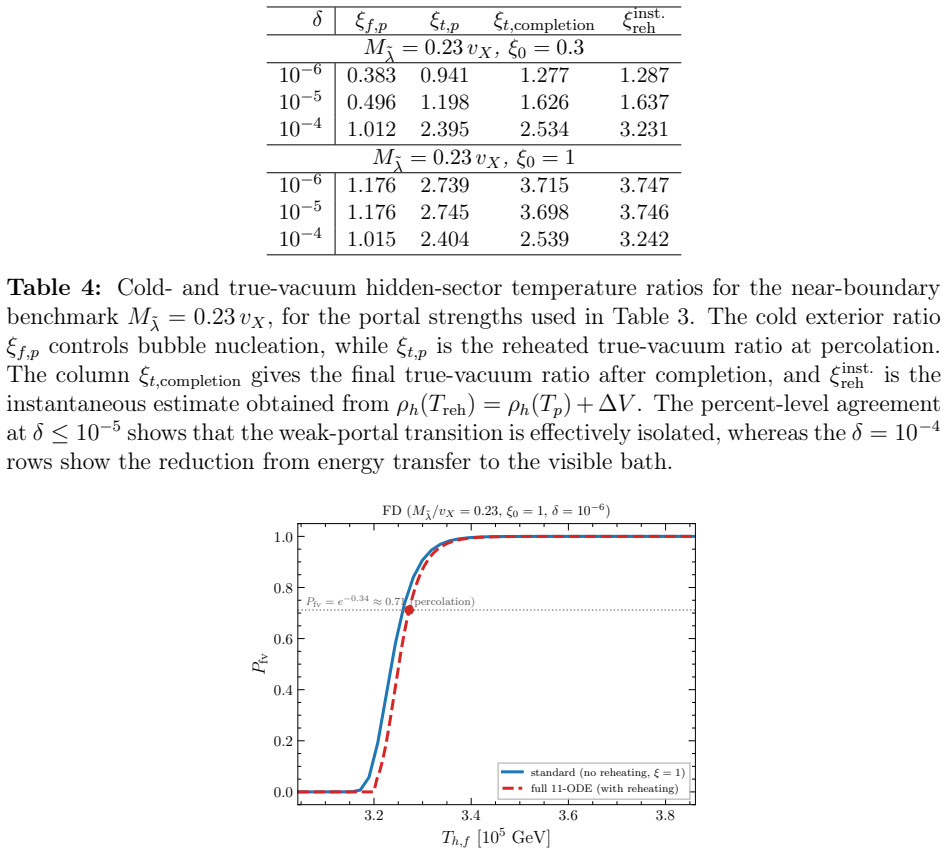
- Reheating is tracked using an 11-variable Boltzmann system that accounts for the energy budget and redshift factors.
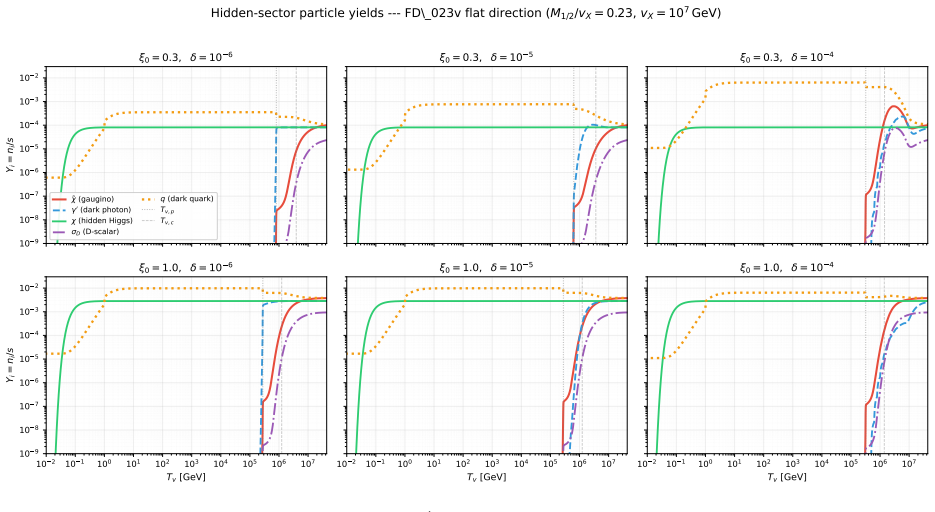
- The hidden sector can match the observed dark matter density with dark quark masses between 30 and 800 keV and negligible effective neutrino species contribution.
Where Pith is reading between the lines
- This links supersymmetric particle models directly to gravitational wave observations.
- The temperature ratio control via portal coupling could be tested by combining GW data with dark matter constraints.
- The radiative barrier mechanism may extend to other supersymmetric or non-supersymmetric flat direction models.
Load-bearing premise
The tree-level quartic vanishes along the D-flat direction so that the barrier is generated purely radiatively by soft SUSY-breaking splittings in the DR-bar scheme.
What would settle it
Non-observation of a gravitational wave signal with Omega_GW h squared around 3 times 10 to the minus 10 in the relevant frequency range at the Einstein Telescope or Cosmic Explorer would falsify the predicted amplitude for those parameter values.
Figures
read the original abstract
We study supercooled first-order phase transitions in a supersymmetric hidden sector with a spontaneously broken $U(1)_X$, focusing on the frequency range of the Einstein Telescope and Cosmic Explorer. Along the D-flat direction the tree-level quartic vanishes, so the barrier is generated radiatively by soft SUSY-breaking splittings. In the $\overline{\rm DR}$ scheme the gaugino mass $M_{\tilde\lambda}$ sets the barrier depth, while the soft scalar mass $m_0$ stabilizes the broken vacuum. For $M_{\tilde\lambda}/v_X\simeq0.05$--$0.23$, the predicted signal reaches $\Omega_{\rm GW}h^2\sim3\times10^{-10}$ near the percolation boundary. The observable amplitude depends sensitively on the portal coupling $\delta$ through the hidden-to-visible temperature ratio at percolation: for a cold initial hidden sector the signal rises from the ET floor at $\delta=10^{-6}$ to $\Omega_{\rm GW}h^2\simeq7\times10^{-11}$ as the sectors approach thermal contact at $\delta=10^{-4}$, while a hotter initial hidden sector gives a large signal already for weak portal coupling. We follow this evolution with an 11-variable Boltzmann system that separates the cold nucleating exterior from the reheated true-vacuum interior; reheating mainly enters through the energy budget and redshift factors. The same hidden sector can reproduce $\Omega_{\rm CDM}h^2=0.12$ through relativistic dark-quark freeze-out followed by entropy dilution from hidden-Higgs decay, with $m_q\simeq30$--$800\;$keV and $N_{\rm eff}\lesssim{\rm few}\times10^{-5}$.
Editorial analysis
A structured set of objections, weighed in public.
Referee Report
Summary. The manuscript studies supercooled first-order phase transitions along D-flat directions in a supersymmetric hidden U(1)_X sector. It asserts that the tree-level quartic vanishes, so the barrier arises purely from one-loop soft SUSY-breaking splittings in the DR-bar scheme, with M_λ̃ setting the depth and m_0 stabilizing the broken vacuum. For M_λ̃/v_X ≃ 0.05–0.23 the predicted GW signal reaches Ω_GW h² ∼ 3×10^{-10} near the percolation boundary, with amplitude set by the hidden-to-visible temperature ratio controlled by portal coupling δ; an 11-variable Boltzmann system tracks the evolution and reheating, while the same sector can yield Ω_CDM h² = 0.12 via relativistic dark-quark freeze-out and entropy dilution for m_q ≃ 30–800 keV.
Significance. If the radiative barrier generation, the temperature-ratio control via δ, and the Boltzmann evolution are validated, the work supplies a concrete parameter window linking SUSY flat directions to detectable GW signals at ET and CE together with a viable DM explanation. The explicit dependence on initial hidden-sector temperature and the separation of nucleating exterior from reheated interior are potentially falsifiable features.
major comments (2)
- [Abstract, paragraph on barrier generation] Abstract, paragraph on barrier generation: the central claim that the tree-level quartic vanishes along the D-flat direction (so the barrier is generated purely radiatively by soft splittings in the DR-bar scheme) is load-bearing for the supercooling depth, percolation temperature ratio, and final GW amplitude, yet no explicit tree-level potential, D-flatness conditions, or one-loop effective-potential derivation is supplied.
- [Abstract] Abstract: the headline amplitude Ω_GW h² ∼ 3×10^{-10} for M_λ̃/v_X ≃ 0.05–0.23 is obtained inside the interval chosen to place the signal near the percolation boundary; the temperature ratio is likewise tuned via δ, and the text supplies neither derivation steps nor error budgets for the 11-variable Boltzmann solver whose output inherits this ratio.
minor comments (1)
- [Abstract] The abstract states ranges for M_λ̃/v_X, δ and m_q but does not indicate how these intervals were obtained from the underlying potential or Boltzmann integration.
Simulated Author's Rebuttal
We thank the referee for the careful reading and for highlighting the load-bearing aspects of the barrier generation and the numerical implementation. We address each major comment below and will revise the manuscript to improve clarity and self-containedness.
read point-by-point responses
-
Referee: [Abstract, paragraph on barrier generation] Abstract, paragraph on barrier generation: the central claim that the tree-level quartic vanishes along the D-flat direction (so the barrier is generated purely radiatively by soft splittings in the DR-bar scheme) is load-bearing for the supercooling depth, percolation temperature ratio, and final GW amplitude, yet no explicit tree-level potential, D-flatness conditions, or one-loop effective-potential derivation is supplied.
Authors: We agree that an explicit derivation strengthens the central claim. Although the vanishing tree-level quartic along the D-flat direction follows from standard SUSY D-term cancellation for the chosen U(1)_X charges, the manuscript would benefit from a self-contained presentation. In the revision we will add a dedicated subsection (or appendix) that (i) states the D-flatness conditions, (ii) writes the tree-level scalar potential along the flat direction, and (iii) derives the one-loop effective potential in the ¯DR scheme, showing explicitly how the gaugino mass M_λ̃ generates the barrier while m_0 stabilizes the broken vacuum. This addition will not change any numerical results but will make the radiative origin of the barrier fully transparent. revision: yes
-
Referee: [Abstract] Abstract: the headline amplitude Ω_GW h^{2} ∼ 3 imes10^{-10} for M_λ̃/v_X ≃ 0.05–0.23 is obtained inside the interval chosen to place the signal near the percolation boundary; the temperature ratio is likewise tuned via δ, and the text supplies neither derivation steps nor error budgets for the 11-variable Boltzmann solver whose output inherits this ratio.
Authors: The interval M_λ̃/v_X ≃ 0.05–0.23 is selected because it simultaneously produces sufficient supercooling for a detectable GW amplitude while still allowing percolation before the hidden sector temperature drops too far; this is quantified in the main text by the nucleation and percolation criteria. The hidden-to-visible temperature ratio is obtained by solving the portal-mediated energy transfer term proportional to δ. The 11-variable Boltzmann system is described in the manuscript, but we acknowledge that explicit step-by-step derivation of the temperature evolution equations and a discussion of numerical convergence are not provided. In the revision we will expand the relevant section with the full set of Boltzmann equations, initial conditions, and a brief convergence/stability analysis. A quantitative error budget for the solver is not currently available and would require additional dedicated numerical work; we will therefore add only a qualitative assessment of the dominant uncertainties (initial temperature ratio, δ range, and redshift factors) while noting that a full Monte-Carlo error propagation lies beyond the present scope. revision: partial
Circularity Check
No significant circularity; derivation self-contained under stated assumptions.
full rationale
The paper states that along the D-flat direction the tree-level quartic vanishes, so the barrier arises radiatively from soft-term splittings in the DR-bar scheme, with M_λ̃ setting the depth. It then reports the resulting GW amplitude Ω_GW h² ∼ 3×10^{-10} for the interval M_λ̃/v_X ≃ 0.05–0.23 and varying δ. These are explicit model inputs and computed outputs, not reductions by construction. No equation equates a fitted quantity to a renamed prediction, no self-citation chain bears the central claim, and no uniqueness theorem is invoked. The 11-variable Boltzmann evolution and temperature-ratio dependence on δ are independent dynamical calculations within the chosen parameter space. The result is therefore a standard parameter scan inside a well-defined SUSY model, not a circular re-statement of its inputs.
Axiom & Free-Parameter Ledger
free parameters (3)
- M_λ̃ / v_X
- δ
- m_q
axioms (2)
- domain assumption Tree-level quartic vanishes along the D-flat direction of the U(1)_X sector.
- domain assumption Barrier depth is set by gaugino mass in the DR-bar scheme.
Forward citations
Cited by 1 Pith paper
-
Supercool with PPO: Exploring Supercooled Phase Transitions via Reinforcement Learning
PPO reinforcement learning accelerates identification of gravitational wave signals from supercooled phase transitions in a minimal dark U(1)_x sector compared to Monte Carlo sampling.
Reference graph
Works this paper leans on
-
[1]
Agazieet al.[NANOGrav], Astrophys
G. Agazieet al.[NANOGrav], Astrophys. J. Lett.951, no.1, L8 (2023) doi:10.3847/2041-8213/acdac6 [arXiv:2306.16213 [astro-ph.HE]]
-
[2]
Antoniadiset al.[EPTA and InPTA:], Astron
J. Antoniadiset al.[EPTA and InPTA:], Astron. Astrophys.678, A50 (2023) doi:10.1051/0004-6361/202346844 [arXiv:2306.16214 [astro-ph.HE]]
-
[3]
D. J. Reardon, A. Zic, R. M. Shannon, G. B. Hobbs, M. Bailes, V. Di Marco, A. Kapur, A. F. Rogers, E. Thrane and J. Askew,et al.Astrophys. J. Lett.951, no.1, L6 (2023) doi:10.3847/2041-8213/acdd02 [arXiv:2306.16215 [astro-ph.HE]]
-
[4]
H. Xu, S. Chen, Y. Guo, J. Jiang, B. Wang, J. Xu, Z. Xue, R. N. Caballero, J. Yuan and Y. Xu,et al.Res. Astron. Astrophys.23, no.7, 075024 (2023) doi:10.1088/1674- 4527/acdfa5 [arXiv:2306.16216 [astro-ph.HE]]
-
[5]
J. Antoniadis, Z. Arzoumanian, S. Babak, M. Bailes, A. S. B. Nielsen, P. T. Baker, C. G. Bassa, B. Becsy, A. Berthereau and M. Bonetti,et al.Mon. Not. Roy. As- tron. Soc.510, no.4, 4873-4887 (2022) doi:10.1093/mnras/stab3418 [arXiv:2201.03980 [astro-ph.HE]]
-
[6]
Gravitational wave astronomy with the SKA
G. Janssen, G. Hobbs, M. McLaughlin, C. Bassa, A. T. Deller, M. Kramer, K. Lee, C. Mingarelli, P. Rosado and S. Sanidas,et al.PoSAASKA14, 037 (2015) doi:10.22323/1.215.0037 [arXiv:1501.00127 [astro-ph.IM]]
work page internal anchor Pith review Pith/arXiv arXiv doi:10.22323/1.215.0037 2015
-
[7]
The NANOGrav 15-year Data Set: Search for Signals from New Physics
A. Afzalet al.[NANOGrav], Astrophys. J. Lett.951, no.1, L11 (2023) [erratum: Astrophys. J. Lett.971, no.1, L27 (2024); erratum: Astrophys. J.971, no.1, L27 (2024)] doi:10.3847/2041-8213/acdc91 [arXiv:2306.16219 [astro-ph.HE]]
work page internal anchor Pith review Pith/arXiv arXiv doi:10.3847/2041-8213/acdc91 2023
-
[8]
Antoniadiset al.[EPTA and InPTA], Astron
J. Antoniadiset al.[EPTA and InPTA], Astron. Astrophys.685, A94 (2024) doi:10.1051/0004-6361/202347433 [arXiv:2306.16227 [astro-ph.CO]]
-
[9]
Gravitational Waves From a Dark (Twin) Phase Transition
P. Schwaller, Phys. Rev. Lett.115, no.18, 181101 (2015) doi:10.1103/PhysRevLett.115.181101 [arXiv:1504.07263 [hep-ph]]
work page internal anchor Pith review Pith/arXiv arXiv doi:10.1103/physrevlett.115.181101 2015
-
[10]
Dark, Cold, and Noisy: Constraining Secluded Hidden Sectors with Gravitational Waves
M. Breitbach, J. Kopp, E. Madge, T. Opferkuch and P. Schwaller, JCAP07, 007 (2019) doi:10.1088/1475-7516/2019/07/007 [arXiv:1811.11175 [hep-ph]]
work page internal anchor Pith review Pith/arXiv arXiv doi:10.1088/1475-7516/2019/07/007 2019
-
[11]
M. Fairbairn, E. Hardy and A. Wickens, JHEP07, 044 (2019) doi:10.1007/JHEP07(2019)044 [arXiv:1901.11038 [hep-ph]]
-
[12]
P. Athron, C. Balázs, A. Fowlie, L. Morris and L. Wu, Prog. Part. Nucl. Phys.135, 104094 (2024) doi:10.1016/j.ppnp.2023.104094 [arXiv:2305.02357 [hep-ph]]. 40
-
[13]
P. Athron, A. Fowlie, C. T. Lu, L. Morris, L. Wu, Y. Wu and Z. Xu, Phys. Rev. Lett. 132, no.22, 221001 (2024) doi:10.1103/PhysRevLett.132.221001 [arXiv:2306.17239 [hep-ph]]
-
[15]
M. Lewicki, O. Pujolàs and V. Vaskonen, Eur. Phys. J. C81, no.9, 857 (2021) doi:10.1140/epjc/s10052-021-09669-6 [arXiv:2106.09706 [astro-ph.CO]]
-
[16]
E. Madge, E. Morgante, C. Puchades-Ibáñez, N. Ramberg, W. Ratzinger, S. Schenk and P. Schwaller, JHEP10, 171 (2023) doi:10.1007/JHEP10(2023)171 [arXiv:2306.14856 [hep-ph]]
-
[18]
Y. Nakai, M. Suzuki, F. Takahashi and M. Yamada, Phys. Lett. B816, 136238 (2021) doi:10.1016/j.physletb.2021.136238 [arXiv:2009.09754 [astro-ph.CO]]
-
[19]
W. Ratzinger and P. Schwaller, SciPost Phys.10, no.2, 047 (2021) doi:10.21468/SciPostPhys.10.2.047 [arXiv:2009.11875 [astro-ph.CO]]
-
[20]
W. Z. Feng, J. Li, P. Nath and Z. H. Ye, Phys. Rev. D113, no.6, 063504 (2026) doi:10.1103/kvq2-glq5 [arXiv:2510.13770 [hep-ph]]
-
[21]
T. Bringmann, T. Konstandin, J. Matuszak, K. Schmidt-Hoberg and C. Tasillo, [arXiv:2602.09092 [hep-ph]]
-
[22]
J. Li and P. Nath, Phys. Rev. D111, no.12, 123007 (2025) doi:10.1103/79cb-rssl [arXiv:2501.14986 [hep-ph]]
-
[23]
M. Punturo, M. Abernathy, F. Acernese, B. Allen, N. Andersson, K. Arun, F. Barone, B. Barr, M. Barsuglia and M. Beker,et al.Class. Quant. Grav.27, 194002 (2010) doi:10.1088/0264-9381/27/19/194002
-
[24]
A. H. Chamseddine, R. L. Arnowitt and P. Nath, Phys. Rev. Lett.49, 970 (1982) doi:10.1103/PhysRevLett.49.970
-
[25]
R. Barbieri, S. Ferrara and C. A. Savoy, Phys. Lett. B119, 343 (1982) doi:10.1016/0370-2693(82)90685-2
-
[26]
L. J. Hall, J. D. Lykken and S. Weinberg, Phys. Rev. D27, 2359-2378 (1983) doi:10.1103/PhysRevD.27.2359
-
[27]
P. Nath, R. L. Arnowitt and A. H. Chamseddine, WSP, 1984, doi:10.1142/0094
-
[28]
H. P. Nilles, Phys. Rept.110, 1-162 (1984) doi:10.1016/0370-1573(84)90008-5
-
[30]
S. P. Martin, Adv. Ser. Direct. High Energy Phys.18, 1-98 (1998) doi:10.1142/9789812839657_0001 [arXiv:hep-ph/9709356 [hep-ph]]
-
[31]
Baer and X
H. Baer and X. Tata, Cambridge University Press, 2006, ISBN 978-0-521-29031-9, 978-0-511-19011-7, 978-0-521-29031-9, 978-0-521-85786-4
2006
-
[32]
P. Nath, Cambridge University Press, 2016, ISBN 978-0-521-19702-1, 978-1-316-98396- 6 doi:10.1017/9781139048118
- [33]
-
[34]
S. Akula and P. Nath, Phys. Rev. D87, no.11, 115022 (2013) doi:10.1103/PhysRevD.87.115022 [arXiv:1304.5526 [hep-ph]]
-
[35]
J. Li, P. Nath and R. M. Syed, JHEP07, 222 (2025) doi:10.1007/JHEP07(2025)222 [arXiv:2503.19871 [hep-ph]]
-
[38]
S. Iso, P. D. Serpico and K. Shimada, Phys. Rev. Lett.119, no.14, 141301 (2017) doi:10.1103/PhysRevLett.119.141301 [arXiv:1704.04955 [hep-ph]]
-
[39]
L. Randall and G. Servant, JHEP05, 054 (2007) doi:10.1088/1126-6708/2007/05/054 [arXiv:hep-ph/0607158 [hep-ph]]
-
[40]
N. Craig, N. Levi, A. Mariotti and D. Redigolo, JHEP21, 184 (2020) doi:10.1007/JHEP02(2021)184 [arXiv:2011.13949 [hep-ph]]
-
[41]
N. Levi, T. Opferkuch and D. Redigolo, JHEP02, 125 (2023) doi:10.1007/JHEP02(2023)125 [arXiv:2212.08085 [hep-ph]]
-
[42]
E. Witten, Phys. Lett. B105, 267 (1981) doi:10.1016/0370-2693(81)90885-6
-
[43]
Salvio, JCAP04, 051 (2023) doi:10.1088/1475-7516/2023/04/051 [arXiv:2302.10212 [hep-ph]]
A. Salvio, JCAP04, 051 (2023) doi:10.1088/1475-7516/2023/04/051 [arXiv:2302.10212 [hep-ph]]
-
[44]
Salvio, JCAP12, 046 (2023) doi:10.1088/1475-7516/2023/12/046 [arXiv:2307.04694 [hep-ph]]
A. Salvio, JCAP12, 046 (2023) doi:10.1088/1475-7516/2023/12/046 [arXiv:2307.04694 [hep-ph]]
-
[45]
T. P. Dutka, T. H. Jung and C. S. Shin, JHEP05, 182 (2025) doi:10.1007/JHEP05(2025)182 [arXiv:2412.15864 [hep-ph]]
-
[46]
N. Haba and T. Yamada, Phys. Rev. D101, no.7, 075027 (2020) doi:10.1103/PhysRevD.101.075027 [arXiv:1911.01292 [hep-ph]]
-
[47]
R. Jinno and M. Takimoto, Phys. Rev. D95, no.1, 015020 (2017) doi:10.1103/PhysRevD.95.015020 [arXiv:1604.05035 [hep-ph]]. 42
-
[48]
L. Marzola, A. Racioppi and V. Vaskonen, Eur. Phys. J. C77, no.7, 484 (2017) doi:10.1140/epjc/s10052-017-4996-1 [arXiv:1704.01034 [hep-ph]]
-
[49]
N. Okada and O. Seto, Phys. Rev. D98, no.6, 063532 (2018) doi:10.1103/PhysRevD.98.063532 [arXiv:1807.00336 [hep-ph]]
-
[50]
B. Holdom, Phys. Lett. B166, 196-198 (1986) doi:10.1016/0370-2693(86)91377-8
-
[51]
K. R. Dienes, C. F. Kolda and J. March-Russell, Nucl. Phys. B492, 104-118 (1997) doi:10.1016/S0550-3213(97)00173-9 [arXiv:hep-ph/9610479 [hep-ph]]
work page internal anchor Pith review Pith/arXiv arXiv doi:10.1016/s0550-3213(97)00173-9 1997
-
[52]
D. Feldman, Z. Liu and P. Nath, Phys. Rev. D75, 115001 (2007) doi:10.1103/PhysRevD.75.115001 [arXiv:hep-ph/0702123 [hep-ph]]
work page internal anchor Pith review Pith/arXiv arXiv doi:10.1103/physrevd.75.115001 2007
-
[53]
B. Kors and P. Nath, JHEP12, 005 (2004) doi:10.1088/1126-6708/2004/12/005 [arXiv:hep-ph/0406167 [hep-ph]]
-
[54]
F. Rescigno and A. Salvio, JCAP02, 021 (2026) doi:10.1088/1475-7516/2026/02/021 [arXiv:2507.21215 [hep-ph]]
- [55]
- [57]
-
[58]
K. Griest and D. Seckel, Phys. Rev. D43, 3191-3203 (1991) doi:10.1103/PhysRevD.43.3191
-
[59]
P. Gondolo and G. Gelmini, Nucl. Phys. B360, 145-179 (1991) doi:10.1016/0550- 3213(91)90438-4
-
[60]
R. J. Scherrer and M. S. Turner, Phys. Rev. D33, 1585 (1986) [erratum: Phys. Rev. D34, 3263 (1986)] doi:10.1103/PhysRevD.33.1585
-
[61]
E. W. Kolb and M. S. Turner, Front. Phys.69, 1-547 (1990) Taylor and Francis, 2019, ISBN 978-0-429-49286-0, 978-0-201-62674-2 doi:10.1201/9780429492860
-
[62]
Wino Cold Dark Matter from Anomaly-Mediated SUSY Breaking
T. Moroi and L. Randall, Nucl. Phys. B570, 455-472 (2000) doi:10.1016/S0550- 3213(99)00748-8 [arXiv:hep-ph/9906527 [hep-ph]]
work page internal anchor Pith review Pith/arXiv arXiv doi:10.1016/s0550- 2000
-
[63]
G. F. Giudice, E. W. Kolb and A. Riotto, Phys. Rev. D64, 023508 (2001) doi:10.1103/PhysRevD.64.023508 [arXiv:hep-ph/0005123 [hep-ph]]
work page internal anchor Pith review Pith/arXiv arXiv doi:10.1103/physrevd.64.023508 2001
-
[64]
Planck 2018 results. VI. Cosmological parameters
N. Aghanimet al.[Planck], Astron. Astrophys.641, A6 (2020) [erratum: Astron. As- trophys.652, C4 (2021)] doi:10.1051/0004-6361/201833910 [arXiv:1807.06209 [astro- ph.CO]]
work page internal anchor Pith review Pith/arXiv arXiv doi:10.1051/0004-6361/201833910 2020
-
[65]
B. D. Fields, K. A. Olive, T. H. Yeh and C. Young, JCAP03, 010 (2020) [erratum: JCAP11, E02 (2020)] doi:10.1088/1475-7516/2020/03/010 [arXiv:1912.01132 [astro- ph.CO]]. 43
-
[66]
R. H. Cyburt, B. D. Fields, K. A. Olive and T. H. Yeh, Rev. Mod. Phys.88, 015004 (2016) doi:10.1103/RevModPhys.88.015004 [arXiv:1505.01076 [astro-ph.CO]]
work page internal anchor Pith review Pith/arXiv arXiv doi:10.1103/revmodphys.88.015004 2016
-
[67]
C. Brust, D. E. Kaplan and M. T. Walters, JHEP12, 058 (2013) doi:10.1007/JHEP12(2013)058 [arXiv:1303.5379 [hep-ph]]
work page internal anchor Pith review Pith/arXiv arXiv doi:10.1007/jhep12(2013)058 2013
-
[68]
T. Bringmann, T. E. Gonzalo, F. Kahlhoefer, J. Matuszak and C. Tasillo, JCAP05, 065 (2024) doi:10.1088/1475-7516/2024/05/065 [arXiv:2311.06346 [astro-ph.CO]]
-
[69]
S. Balan, T. Bringmann, F. Kahlhoefer, J. Matuszak and C. Tasillo, JCAP08, 062 (2025) doi:10.1088/1475-7516/2025/08/062 [arXiv:2502.19478 [hep-ph]]
-
[70]
W. Z. Feng, J. Li and P. Nath, Phys. Rev. D110, no.1, 015020 (2024) doi:10.1103/PhysRevD.110.015020 [arXiv:2403.09558 [hep-ph]]
- [71]
-
[72]
A. Aboubrahim and P. Nath, JHEP09, 084 (2022) doi:10.1007/JHEP09(2022)084 [arXiv:2205.07316 [hep-ph]]
-
[73]
J. Li and P. Nath, Phys. Rev. D108, no.11, 115008 (2023) doi:10.1103/PhysRevD.108.115008 [arXiv:2304.08454 [hep-ph]]
-
[74]
P. Nath and J. Li, LHEP2024, 502 (2024) doi:10.31526/lhep.2024.502 [arXiv:2402.04123 [hep-ph]]
-
[75]
S. R. Coleman and E. J. Weinberg, Phys. Rev. D7, 1888-1910 (1973) doi:10.1103/PhysRevD.7.1888
- [76]
-
[77]
H. H. Patel and M. J. Ramsey-Musolf, JHEP07, 029 (2011) doi:10.1007/JHEP07(2011)029 [arXiv:1101.4665 [hep-ph]]
work page internal anchor Pith review Pith/arXiv arXiv doi:10.1007/jhep07(2011)029 2011
-
[78]
L. Dolan and R. Jackiw, Phys. Rev. D9, 3320-3341 (1974) doi:10.1103/PhysRevD.9.3320
-
[79]
P. B. Arnold and O. Espinosa, Phys. Rev. D47, 3546 (1993) [erratum: Phys. Rev. D 50, 6662 (1994)] doi:10.1103/PhysRevD.47.3546 [arXiv:hep-ph/9212235 [hep-ph]]
work page internal anchor Pith review Pith/arXiv arXiv doi:10.1103/physrevd.47.3546 1993
-
[80]
R. R. Parwani, Phys. Rev. D45, 4695 (1992) [erratum: Phys. Rev. D48, 5965 (1993)] doi:10.1103/PhysRevD.45.4695 [arXiv:hep-ph/9204216 [hep-ph]]
work page internal anchor Pith review Pith/arXiv arXiv doi:10.1103/physrevd.45.4695 1992
-
[81]
M. E. Carrington, Phys. Rev. D45, 2933-2944 (1992) doi:10.1103/PhysRevD.45.2933
-
[82]
Thermal Resummation and Phase Transitions
D. Curtin, P. Meade and H. Ramani, Eur. Phys. J. C78, no.9, 787 (2018) doi:10.1140/epjc/s10052-018-6268-0 [arXiv:1612.00466 [hep-ph]]
work page internal anchor Pith review Pith/arXiv arXiv doi:10.1140/epjc/s10052-018-6268-0 2018
-
[83]
S. R. Coleman, Phys. Rev. D15, 2929-2936 (1977) [erratum: Phys. Rev. D16, 1248 (1977)] doi:10.1103/PhysRevD.15.2929
-
[84]
C. G. Callan, Jr. and S. R. Coleman, Phys. Rev. D16, 1762-1768 (1977) doi:10.1103/PhysRevD.16.1762 44
-
[85]
S. R. Coleman and F. De Luccia, Phys. Rev. D21, 3305 (1980) doi:10.1103/PhysRevD.21.3305
-
[86]
A. D. Linde, Phys. Lett. B100, 37-40 (1981) doi:10.1016/0370-2693(81)90281-1
discussion (0)
Sign in with ORCID, Apple, or X to comment. Anyone can read and Pith papers without signing in.