Supercool with PPO: Exploring Supercooled Phase Transitions via Reinforcement Learning
Pith reviewed 2026-06-26 01:42 UTC · model grok-4.3
The pith
Proximal Policy Optimization efficiently locates parameter points for observable gravitational waves from supercooled phase transitions in a dark U(1) sector.
A machine-rendered reading of the paper's core claim, the machinery that carries it, and where it could break.
Core claim
In the minimal dark U(1)_x sector, the PPO-based reinforcement learning agent provides an efficient goal-directed search that identifies phenomenologically relevant benchmark points for supercooled phase transitions producing detectable gravitational waves, outperforming conventional Monte Carlo methods in both narrow and broad ranges of the vacuum expectation value.
What carries the argument
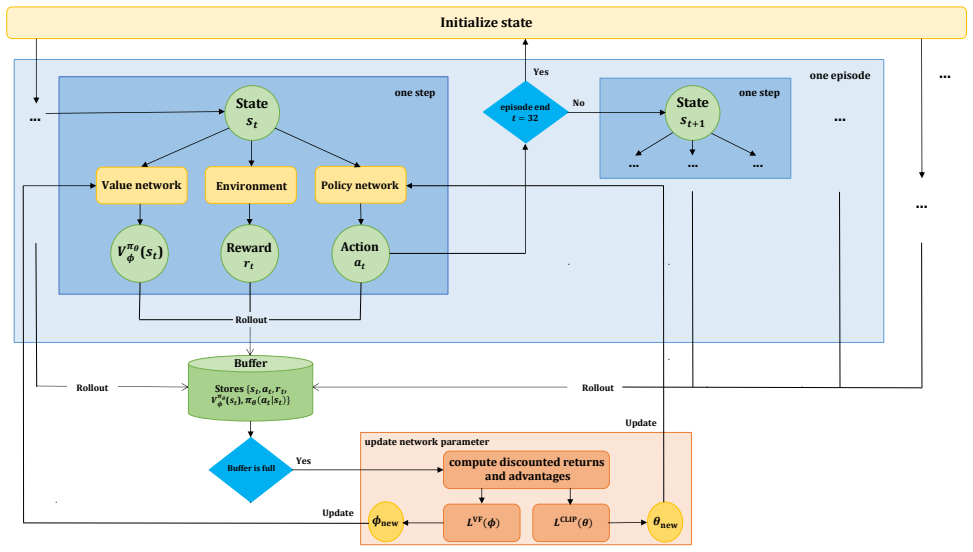
Proximal Policy Optimization (PPO) agent in a numerical reinforcement learning environment that maps microscopic U(1)_x parameters to phase transition and gravitational wave observables via a gauge-independent low-temperature effective action.
If this is right
- PPO serves as an efficient goal-directed search strategy for gravitational wave phenomenology.
- The method offers a broadly applicable framework for learning-assisted exploration of high-dimensional scientific parameter spaces.
- Custom reward designs successfully guide searches toward large gravitational wave amplitudes, broad frequency coverage, and detector-sensitive points.
- The approach reduces the computational effort needed to locate rare viable signals in sparse regions of beyond-Standard-Model parameter space.
Where Pith is reading between the lines
- The same PPO environment could be repurposed to hunt for other cosmological signals such as those from baryogenesis or dark matter production.
- Integration with existing particle physics simulation codes might allow the method to scale to models with even higher-dimensional parameter spaces.
- The technique suggests a route to automate benchmark selection for future gravitational wave observatories by optimizing directly for projected sensitivities.
Load-bearing premise
The numerical reinforcement learning environment accurately maps microscopic model parameters to phase transition and gravitational wave observables.
What would settle it
A side-by-side scan of the same U(1)_x parameter windows where the PPO agent identifies fewer or lower-amplitude gravitational wave signals than a conventional Monte Carlo sampler.
Figures
read the original abstract
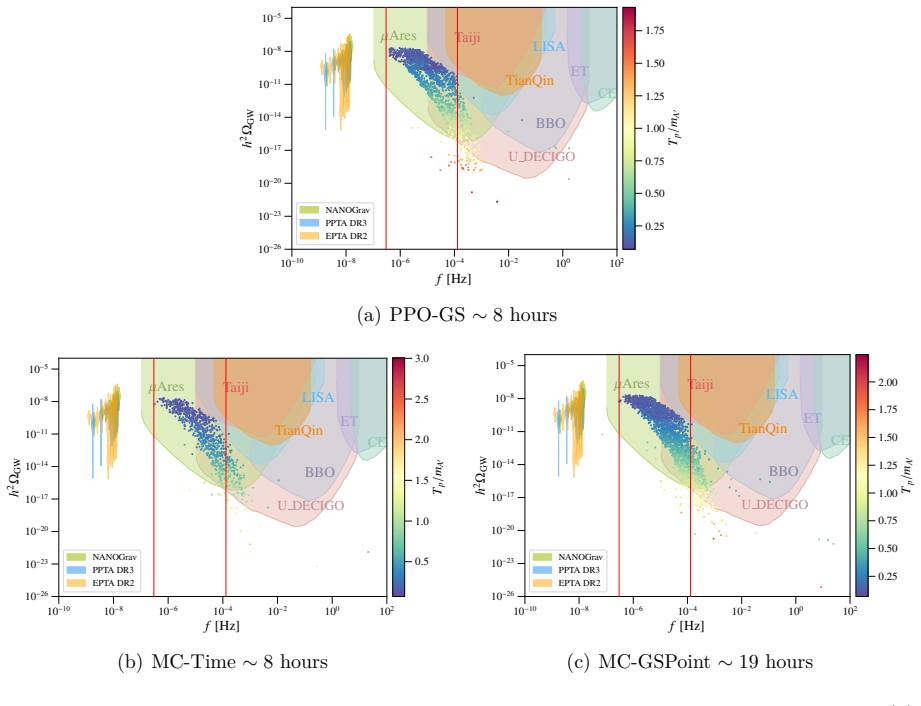
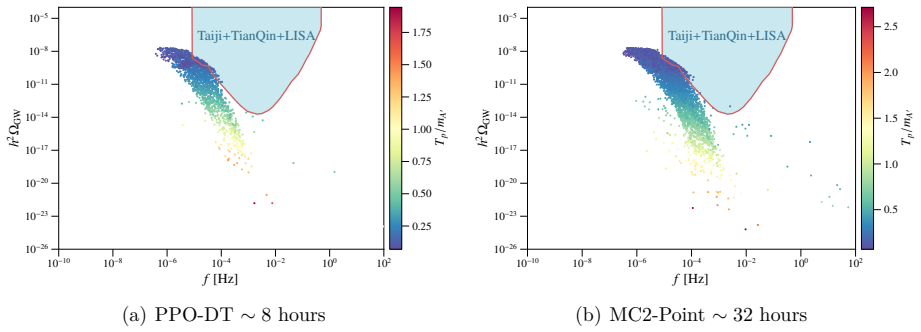
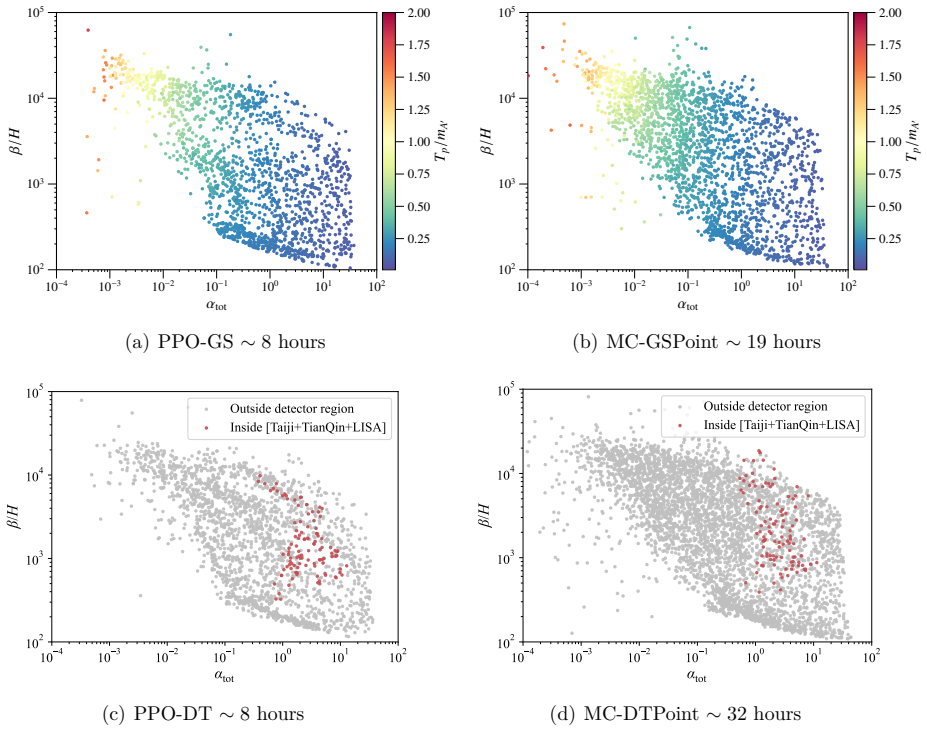
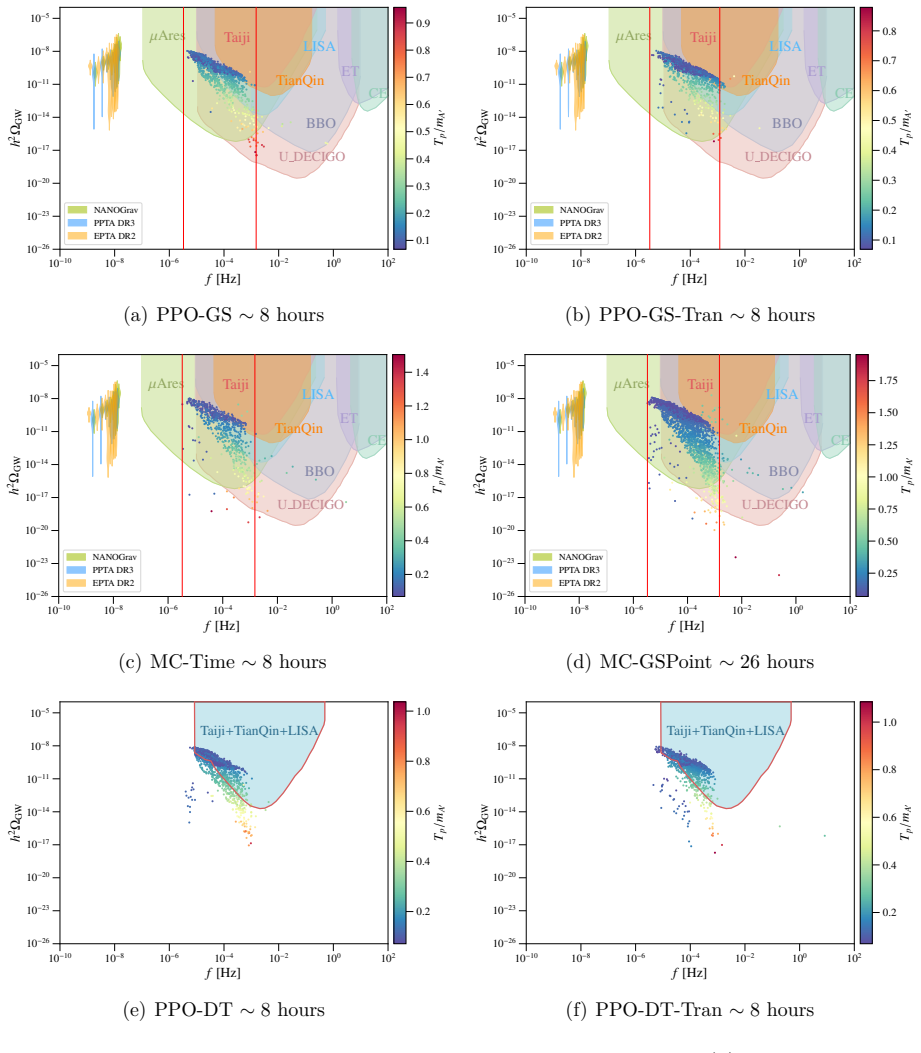
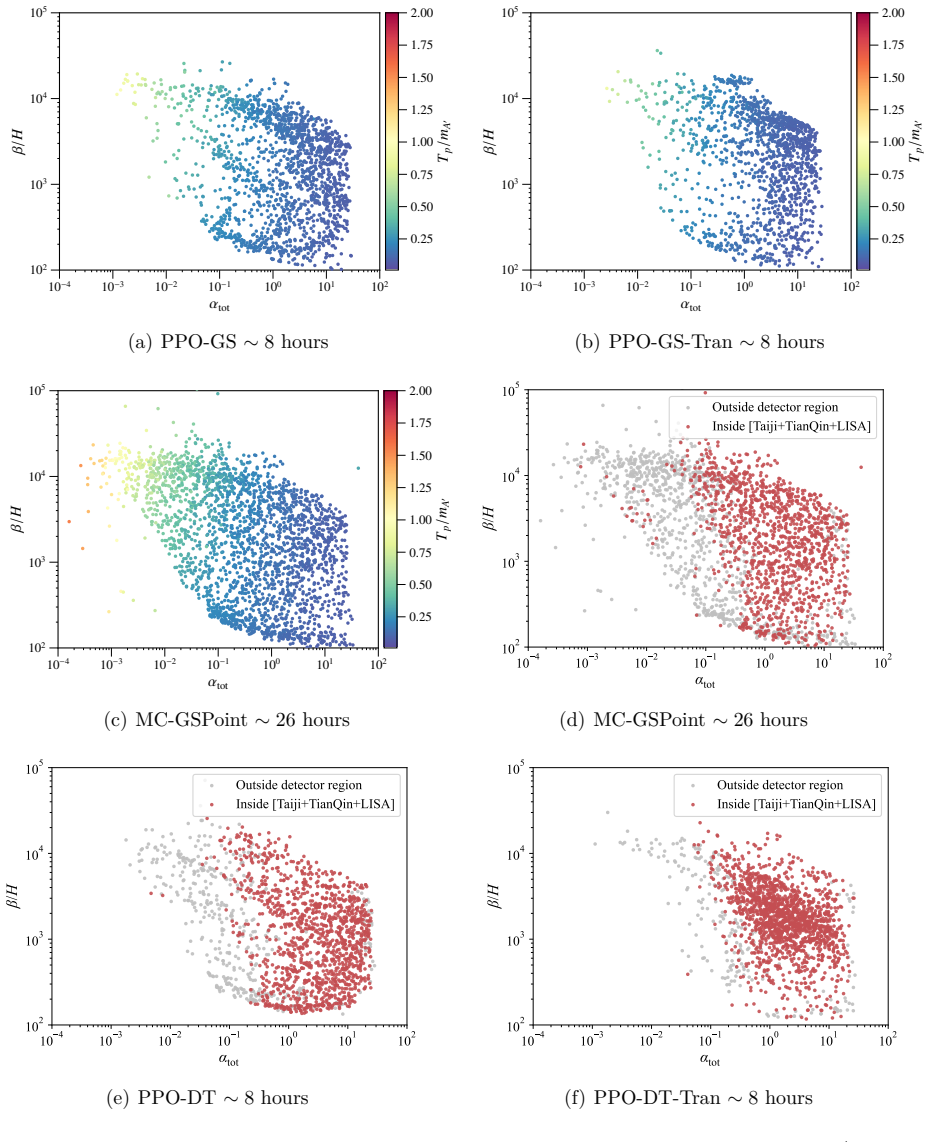
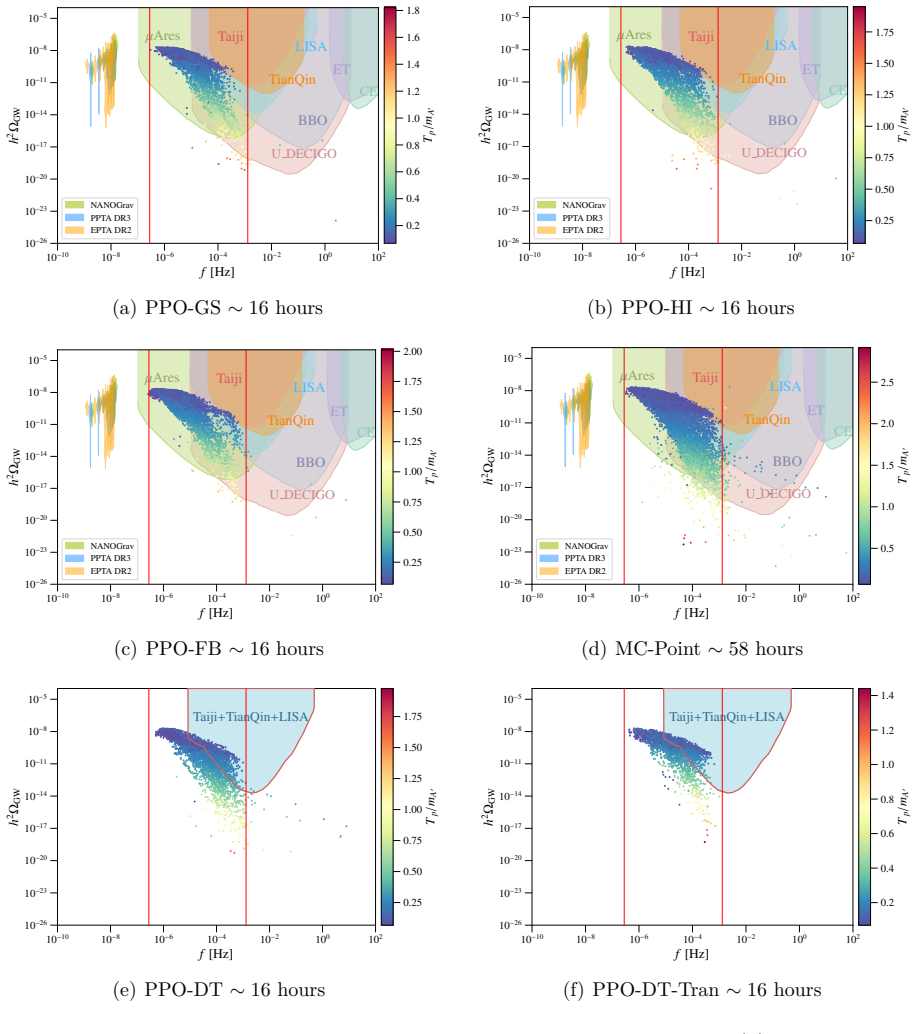
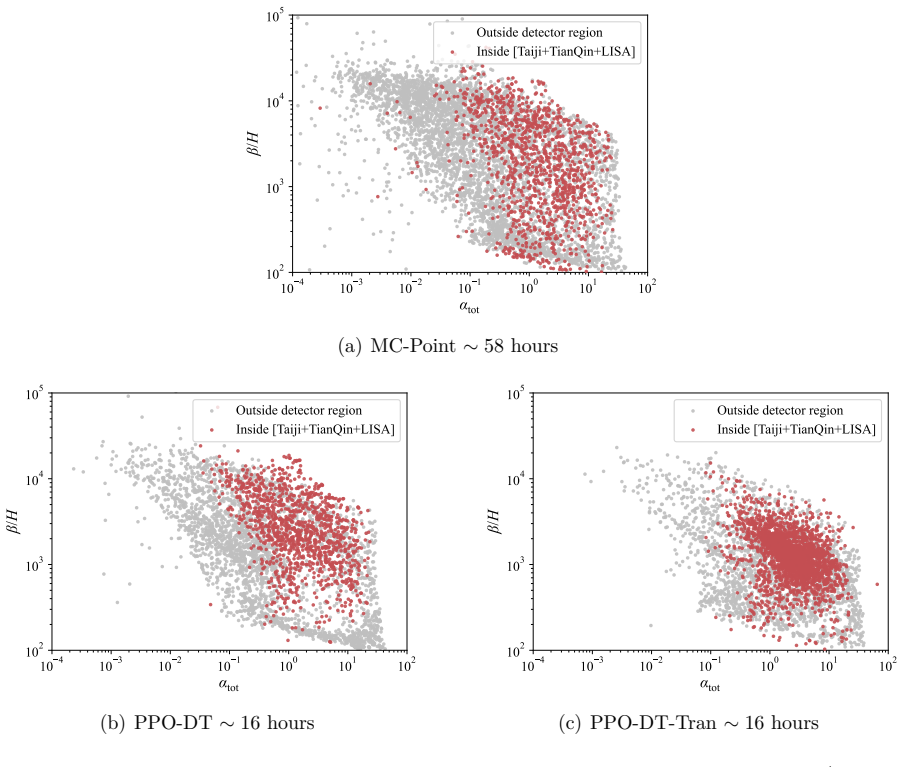
Gravitational waves from cosmological first-order phase transitions provide a powerful probe of hidden sectors and beyond the Standard Model physics. However, identifying phenomenologically relevant benchmark points remains computationally challenging, since viable and detectable signals typically occupy only a small fraction of the scanned parameter space. In this work, we introduce a reinforcement learning strategy based on Proximal Policy Optimization (PPO) to accelerate the search for gravitational wave signals from supercooled phase transitions in a minimal dark $U(1)_x$ sector. We construct a numerical reinforcement learning environment that maps the microscopic model parameters to the corresponding phase transition and gravitational wave observables, using a gauge-independent low-temperature formulation of the effective action. Several reward designs are developed to guide the agent toward parameter regions producing large gravitational wave amplitudes, broad frequency coverage, and detector sensitive benchmark points. We compare the PPO scans with conventional Monte Carlo scans in both narrow and broad windows of the $U(1)_x$ vacuum expectation value. Our results demonstrate that PPO provides an efficient goal-directed search strategy for gravitational wave phenomenology and offers a broadly applicable framework for learning-assisted exploration of high-dimensional scientific parameter spaces.
Editorial analysis
A structured set of objections, weighed in public.
Referee Report
Summary. The manuscript introduces a reinforcement learning approach based on Proximal Policy Optimization (PPO) to accelerate the search for phenomenologically relevant parameter points in a minimal dark U(1)_x sector that yield supercooled first-order phase transitions producing detectable gravitational wave signals. It constructs a numerical RL environment mapping microscopic parameters to phase transition observables (nucleation temperature, alpha, beta/H) and GW spectra via a gauge-independent low-temperature effective action, develops multiple reward designs targeting large GW amplitudes and detector sensitivity, and compares PPO scans against conventional Monte Carlo sampling in both narrow and broad windows of the U(1)_x vacuum expectation value, claiming PPO offers an efficient goal-directed strategy for GW phenomenology.
Significance. If the central efficiency claim holds after validation, the work demonstrates a practical application of goal-directed machine learning to the computationally challenging task of locating rare viable signals in high-dimensional BSM parameter spaces. This framework could be broadly useful for other exploration problems in gravitational wave cosmology and particle physics where viable regions occupy small fractions of parameter space. The paper is credited for attempting to address the rarity of detectable supercooled transitions through tailored rewards rather than brute-force sampling.
major comments (2)
- [Abstract / RL environment description] Abstract and the description of the numerical reinforcement learning environment: The central claim that PPO scans outperform Monte Carlo in locating viable GW signals rests on the accuracy of the environment's mapping from U(1)_x parameters to nucleation temperature, alpha, beta/H, and the GW spectrum. However, the gauge-independent low-temperature formulation of the effective action is used without described cross-checks against full bounce-equation solvers or higher-order thermal resummations; this is load-bearing because extreme supercooling (T_n << T_c) can push the system outside the controlled regime of the low-T expansion, potentially biasing the reward signal and undermining the efficiency comparison.
- [Abstract] Abstract: The statement that 'PPO scans outperform Monte Carlo in narrow and broad vev windows' is presented without any quantitative metrics (e.g., fraction of viable points found, computational cost ratios, success rates, or error bars on the observables), leaving the efficiency claim without direct numerical support in the provided summary of results.
minor comments (1)
- [Abstract] The abstract mentions 'several reward designs' but provides no explicit forms or ablation studies; adding these to a dedicated methods subsection would improve reproducibility.
Simulated Author's Rebuttal
We thank the referee for their detailed and constructive report. The comments identify important points regarding validation of the effective potential and the presentation of quantitative results. We address each major comment below and outline the corresponding revisions.
read point-by-point responses
-
Referee: [Abstract / RL environment description] Abstract and the description of the numerical reinforcement learning environment: The central claim that PPO scans outperform Monte Carlo in locating viable GW signals rests on the accuracy of the environment's mapping from U(1)_x parameters to nucleation temperature, alpha, beta/H, and the GW spectrum. However, the gauge-independent low-temperature formulation of the effective action is used without described cross-checks against full bounce-equation solvers or higher-order thermal resummations; this is load-bearing because extreme supercooling (T_n << T_c) can push the system outside the controlled regime of the low-T expansion, potentially biasing the reward signal and undermining the efficiency comparison.
Authors: We acknowledge that the low-temperature gauge-independent effective action, while standard in the supercooling literature, requires explicit discussion of its regime of validity. The manuscript employs this formulation because it enables efficient, gauge-independent computation of the bounce action across the scanned parameter space. However, we agree that the absence of direct cross-checks against full bounce solvers or higher-order resummations constitutes a limitation for extreme supercooling. In the revised manuscript we will add a new subsection in Section 3 that (i) delineates the expected range of validity of the low-T expansion, (ii) compares a subset of benchmark points against results obtained with CosmoTransitions and a full bounce solver where computationally feasible, and (iii) quantifies the sensitivity of the reward signal to variations in the thermal resummation scheme. These additions will clarify the robustness of the environment mapping. revision: yes
-
Referee: [Abstract] Abstract: The statement that 'PPO scans outperform Monte Carlo in narrow and broad vev windows' is presented without any quantitative metrics (e.g., fraction of viable points found, computational cost ratios, success rates, or error bars on the observables), leaving the efficiency claim without direct numerical support in the provided summary of results.
Authors: We agree that the abstract should contain concrete numerical support for the efficiency comparison. The main text already presents these metrics in Figures 4–7 and Tables II–III (fraction of viable points, wall-clock time ratios, success rates with statistical uncertainties). In the revised manuscript we will condense the key quantitative results—e.g., “PPO discovers 3.2 times more viable points per CPU-hour in the broad vev window with a success rate of 18±2 % versus 5.7±1 % for Monte Carlo”—directly into the abstract while preserving its length constraints. revision: yes
Circularity Check
No circularity: RL search method is self-contained computational exploration
full rationale
The paper defines an RL environment that independently maps U(1)_x parameters to nucleation observables via a gauge-independent low-T effective action, then applies PPO to search for high-reward points and compares directly against Monte Carlo sampling in the same environment. No derivation step reduces by construction to its inputs, no fitted parameters are relabeled as predictions, and no load-bearing claims rest on self-citations or uniqueness theorems. The efficiency result follows from the explicit scan comparison rather than any self-referential mapping.
Axiom & Free-Parameter Ledger
free parameters (1)
- PPO algorithm hyperparameters
axioms (2)
- domain assumption The gauge-independent low-temperature formulation of the effective action correctly computes the phase transition strength and gravitational wave spectrum.
- ad hoc to paper The reward functions successfully guide the agent toward phenomenologically relevant regions of parameter space.
Reference graph
Works this paper leans on
-
[1]
G.Agazieet al.[NANOGrav], Astrophys.J.Lett.951, no.1, L8(2023)doi:10.3847/2041- 8213/acdac6 [arXiv:2306.16213 [astro-ph.HE]]
work page internal anchor Pith review Pith/arXiv arXiv doi:10.3847/2041- 2023
-
[2]
D. J. Reardon, A. Zic, R. M. Shannon, G. B. Hobbs, M. Bailes, V. Di Marco, A. Kapur, A. F. Rogers, E. Thrane and J. Askew,et al.Astrophys. J. Lett.951, no.1, L6 (2023) doi:10.3847/2041-8213/acdd02 [arXiv:2306.16215 [astro-ph.HE]]
work page internal anchor Pith review Pith/arXiv arXiv doi:10.3847/2041-8213/acdd02 2023
-
[3]
J. Antoniadiset al.[EPTA and InPTA:], Astron. Astrophys.678, A50 (2023) doi:10.1051/0004-6361/202346844 [arXiv:2306.16214 [astro-ph.HE]]
work page internal anchor Pith review Pith/arXiv arXiv doi:10.1051/0004-6361/202346844 2023
-
[4]
W. H. Ruan, Z. K. Guo, R. G. Cai and Y. Z. Zhang, Int. J. Mod. Phys. A35, no.17, 2050075 (2020) doi:10.1142/S0217751X2050075X [arXiv:1807.09495 [gr-qc]]
-
[5]
TianQin: a space-borne gravitational wave detector
J. Luoet al.[TianQin], Class. Quant. Grav.33, no.3, 035010 (2016) doi:10.1088/0264- 9381/33/3/035010 [arXiv:1512.02076 [astro-ph.IM]]
work page internal anchor Pith review Pith/arXiv arXiv doi:10.1088/0264- 2016
-
[6]
Amaro-Seoaneet al.[LISA], [arXiv:1702.00786 [astro-ph.IM]]
P. Amaro-Seoaneet al.[LISA], [arXiv:1702.00786 [astro-ph.IM]]
-
[7]
B. P. Abbottet al.[LIGO Scientific], Class. Quant. Grav.34, no.4, 044001 (2017) doi:10.1088/1361-6382/aa51f4 [arXiv:1607.08697 [astro-ph.IM]]
work page internal anchor Pith review Pith/arXiv arXiv doi:10.1088/1361-6382/aa51f4 2017
-
[8]
URL https://doi.org/10.1088/0264-9381/27/19/194002
M. Punturo, M. Abernathy, F. Acernese, B. Allen, N. Andersson, K. Arun, F. Barone, B. Barr, M. Barsuglia and M. Beker,et al.Class. Quant. Grav.27, 194002 (2010) doi:10.1088/0264-9381/27/19/194002
-
[9]
A. J. Larkoski, I. Moult and B. Nachman, Phys. Rept.841, 1-63 (2020) doi:10.1016/j.physrep.2019.11.001 [arXiv:1709.04464 [hep-ph]]
-
[10]
Deep Learning and its Application to LHC Physics
D. Guest, K. Cranmer and D. Whiteson, Ann. Rev. Nucl. Part. Sci.68, 161-181 (2018) doi:10.1146/annurev-nucl-101917-021019 [arXiv:1806.11484 [hep-ex]]
work page internal anchor Pith review Pith/arXiv arXiv doi:10.1146/annurev-nucl-101917-021019 2018
-
[11]
Branes with Brains: Exploring String Vacua with Deep Reinforcement Learning
J. Halverson, B. Nelson and F. Ruehle, JHEP06, 003 (2019) doi:10.1007/JHEP06(2019)003 [arXiv:1903.11616 [hep-th]]. 39
work page internal anchor Pith review Pith/arXiv arXiv doi:10.1007/jhep06(2019)003 2019
-
[12]
T. R. Harvey and A. Lukas, JHEP08, 161 (2021) doi:10.1007/JHEP08(2021)161 [arXiv:2103.04759 [hep-th]]
-
[13]
S. Nishimura, C. Miyao and H. Otsuka, JHEP23, 021 (2020) doi:10.1007/JHEP12(2023)021 [arXiv:2304.14176 [hep-ph]]
-
[14]
G. N. Wojcik, S. T. Eu and L. L. Everett, [arXiv:2407.07184 [hep-ph]]
-
[15]
S. Nishimura, C. Miyao and H. Otsuka, JHEP10, 043 (2025) doi:10.1007/JHEP10(2025)043 [arXiv:2409.10023 [hep-ph]]
-
[16]
F. Carta, A. Gauntlett, F. Griffin and Y. H. He, Phys. Lett. B868, 139646 (2025) doi:10.1016/j.physletb.2025.139646 [arXiv:2501.14863 [hep-th]]
-
[17]
J. B. Baretz, M. Fieg, V. Ganesh, A. Ghosh, V. Knapp-Perez, J. Rudolph and D. White- son, doi:10.1038/s42005-026-02627-2 [arXiv:2506.08080 [hep-ph]]
work page internal anchor Pith review Pith/arXiv arXiv doi:10.1038/s42005-026-02627-2
-
[18]
Gravitational waves from a very strong electroweak phase transition
L. Leitao and A. Megevand, JCAP05, 037 (2016) doi:10.1088/1475-7516/2016/05/037 [arXiv:1512.08962 [astro-ph.CO]]
work page internal anchor Pith review Pith/arXiv arXiv doi:10.1088/1475-7516/2016/05/037 2016
-
[19]
Bubble nucleation and growth in very strong cosmological phase transitions
A. Megevand and S. Ramirez, Nucl. Phys. B919, 74-109 (2017) doi:10.1016/j.nuclphysb.2017.03.009 [arXiv:1611.05853 [astro-ph.CO]]
work page internal anchor Pith review Pith/arXiv arXiv doi:10.1016/j.nuclphysb.2017.03.009 2017
-
[20]
A. Kobakhidze, C. Lagger, A. Manning and J. Yue, Eur. Phys. J. C77, no.8, 570 (2017) doi:10.1140/epjc/s10052-017-5132-y [arXiv:1703.06552 [hep-ph]]
work page internal anchor Pith review Pith/arXiv arXiv doi:10.1140/epjc/s10052-017-5132-y 2017
-
[21]
S. Iso, P. D. Serpico and K. Shimada, Phys. Rev. Lett.119, no.14, 141301 (2017) doi:10.1103/PhysRevLett.119.141301 [arXiv:1704.04955 [hep-ph]]
work page internal anchor Pith review Pith/arXiv arXiv doi:10.1103/physrevlett.119.141301 2017
-
[25]
Y. Nakai, M. Suzuki, F. Takahashi and M. Yamada, Phys. Lett. B816, 136238 (2021) doi:10.1016/j.physletb.2021.136238 [arXiv:2009.09754 [astro-ph.CO]]
-
[26]
A. Addazi, Y. F. Cai, Q. Gan, A. Marciano and K. Zeng, Sci. China Phys. Mech. Astron. 64, no.9, 290411 (2021) doi:10.1007/s11433-021-1724-6 [arXiv:2009.10327 [hep-ph]]
-
[27]
K. Kawana, Phys. Rev. D105, no.10, 103515 (2022) doi:10.1103/PhysRevD.105.103515 [arXiv:2201.00560 [hep-ph]]
-
[28]
K. Freese and M. W. Winkler, Phys. Rev. D106, no.10, 103523 (2022) doi:10.1103/PhysRevD.106.103523 [arXiv:2208.03330 [astro-ph.CO]]. 40
-
[29]
M. Lewicki and V. Vaskonen, Eur. Phys. J. C83, no.2, 109 (2023) doi:10.1140/epjc/s10052-023-11241-3 [arXiv:2208.11697 [astro-ph.CO]]
-
[30]
M. Kierkla, A. Karam and B. Swiezewska, JHEP03, 007 (2023) doi:10.1007/JHEP03(2023)007 [arXiv:2210.07075 [astro-ph.CO]]
-
[31]
L. Sagunski, P. Schicho and D. Schmitt, Phys. Rev. D107, no.12, 123512 (2023) doi:10.1103/PhysRevD.107.123512 [arXiv:2303.02450 [hep-ph]]
-
[32]
E. Madge, E. Morgante, C. Puchades-Ibáñez, N. Ramberg, W. Ratzinger, S. Schenk and P. Schwaller, JHEP10, 171 (2023) doi:10.1007/JHEP10(2023)171 [arXiv:2306.14856 [hep-ph]]
-
[33]
K. Fujikura, S. Girmohanta, Y. Nakai and M. Suzuki, Phys. Lett. B846, 138203 (2023) doi:10.1016/j.physletb.2023.138203 [arXiv:2306.17086 [hep-ph]]
-
[34]
P. Athron, A. Fowlie, C. T. Lu, L. Morris, L. Wu, Y. Wu and Z. Xu, Phys. Rev. Lett. 132, no.22, 221001 (2024) doi:10.1103/PhysRevLett.132.221001 [arXiv:2306.17239 [hep- ph]]
-
[35]
T. Ghosh, A. Ghoshal, H. K. Guo, F. Hajkarim, S. F. King, K. Sinha, X. Wang and G. White, JCAP05, 100 (2024) doi:10.1088/1475-7516/2024/05/100 [arXiv:2307.02259 [astro-ph.HE]]
-
[37]
J. Gonçalves, D. Marfatia, A. P. Morais and R. Pasechnik, JHEP02, 110 (2025) doi:10.1007/JHEP02(2025)110 [arXiv:2412.02645 [hep-ph]]
-
[38]
P. Athron, S. Datta and Z. Y. Zhang, JHEP06, 076 (2026) doi:10.1007/JHEP06(2026)076 [arXiv:2511.10288 [hep-ph]]
-
[39]
F. Costa, J. Hoefken Zink, M. Lucente, S. Pascoli and S. Rosauro-Alcaraz, Phys. Lett. B868, 139634 (2025) doi:10.1016/j.physletb.2025.139634 [arXiv:2501.15649 [hep-ph]]
-
[40]
J. Li and P. Nath, Phys. Rev. D111, no.12, 123007 (2025) doi:10.1103/79cb-rssl [arXiv:2501.14986 [hep-ph]]
-
[41]
W. Z. Feng, J. Li, P. Nath and Z. H. Ye, Phys. Rev. D113, no.6, 063504 (2026) doi:10.1103/kvq2-glq5 [arXiv:2510.13770 [hep-ph]]
work page internal anchor Pith review Pith/arXiv arXiv doi:10.1103/kvq2-glq5 2026
- [42]
- [43]
-
[44]
Supercooled Phase Transitions with Radiative Symmetry Breaking
A. Salvio, doi:10.1142/S0217751X26460048 [arXiv:2602.20246 [hep-ph]]
work page internal anchor Pith review Pith/arXiv arXiv doi:10.1142/s0217751x26460048
-
[45]
W. Z. Feng and Z. H. Zhang, [arXiv:2602.14866 [hep-ph]]
-
[46]
K. P. Xie and C. H. Zhan, [arXiv:2603.09126 [hep-ph]]. 41
- [47]
-
[48]
Gauge independence of the bubble nucleation rate in theories with radiative symmetry breaking
D. Metaxas and E. J. Weinberg, Phys. Rev. D53, 836-843 (1996) doi:10.1103/PhysRevD.53.836 [arXiv:hep-ph/9507381 [hep-ph]]
work page internal anchor Pith review Pith/arXiv arXiv doi:10.1103/physrevd.53.836 1996
-
[49]
H. H. Patel and M. J. Ramsey-Musolf, JHEP07, 029 (2011) doi:10.1007/JHEP07(2011)029 [arXiv:1101.4665 [hep-ph]]
work page internal anchor Pith review Pith/arXiv arXiv doi:10.1007/jhep07(2011)029 2011
-
[50]
On the gauge dependence of vacuum transitions at finite temperature
M. Garny and T. Konstandin, JHEP07, 189 (2012) doi:10.1007/JHEP07(2012)189 [arXiv:1205.3392 [hep-ph]]
work page internal anchor Pith review Pith/arXiv arXiv doi:10.1007/jhep07(2012)189 2012
-
[51]
Consistent Use of Effective Potentials
A. Andreassen, W. Frost and M. D. Schwartz, Phys. Rev. D91, no.1, 016009 (2015) doi:10.1103/PhysRevD.91.016009 [arXiv:1408.0287 [hep-ph]]
work page internal anchor Pith review Pith/arXiv arXiv doi:10.1103/physrevd.91.016009 2015
-
[52]
Consistent Use of the Standard Model Effective Potential
A. Andreassen, W. Frost and M. D. Schwartz, Phys. Rev. Lett.113, no.24, 241801 (2014) doi:10.1103/PhysRevLett.113.241801 [arXiv:1408.0292 [hep-ph]]
work page internal anchor Pith review Pith/arXiv arXiv doi:10.1103/physrevlett.113.241801 2014
-
[53]
S. Arunasalam and M. J. Ramsey-Musolf, JHEP08, 138 (2022) doi:10.1007/JHEP08(2022)138 [arXiv:2105.07588 [hep-ph]]
-
[54]
J. Löfgren, M. J. Ramsey-Musolf, P. Schicho and T. V. I. Tenkanen, Phys. Rev. Lett. 130, no.25, 251801 (2023) doi:10.1103/PhysRevLett.130.251801 [arXiv:2112.05472 [hep- ph]]
-
[55]
J. Hirvonen, J. Löfgren, M. J. Ramsey-Musolf, P. Schicho and T. V. I. Tenkanen, JHEP 07, 135 (2022) doi:10.1007/JHEP07(2022)135 [arXiv:2112.08912 [hep-ph]]
-
[56]
Y. Zhu, J. Liu, R. Qin and L. Bian, Phys. Rev. D112, no.1, 015018 (2025) doi:10.1103/f4gr-hycg [arXiv:2503.19566 [hep-ph]]
-
[57]
J. Liu, R. Qin and L. Bian, [arXiv:2512.05565 [hep-ph]]
-
[58]
J. Liu, R. Qin and L. Bian, [arXiv:2601.05793 [hep-ph]]
-
[59]
J. Schulman, F. Wolski, P. Dhariwal, A. Radford and O. Klimov, [arXiv:1707.06347 [cs.LG]]
-
[60]
S. R. Coleman, Phys. Rev. D15, 2929-2936 (1977) [erratum: Phys. Rev. D16, 1248 (1977)] doi:10.1103/PhysRevD.15.2929
-
[61]
C. G. Callan, Jr. and S. R. Coleman, Phys. Rev. D16, 1762-1768 (1977) doi:10.1103/PhysRevD.16.1762
-
[62]
A. D. Linde, Nucl. Phys. B216, 421 (1983) [erratum: Nucl. Phys. B223, 544 (1983)] doi:10.1016/0550-3213(83)90072-X
-
[63]
O. Gould and J. Hirvonen, Phys. Rev. D104, no.9, 096015 (2021) doi:10.1103/PhysRevD.104.096015 [arXiv:2108.04377 [hep-ph]]
-
[64]
C. L. Wainwright, Comput. Phys. Commun.183, 2006-2013 (2012) doi:10.1016/j.cpc.2012.04.004 [arXiv:1109.4189 [hep-ph]]. 42
work page internal anchor Pith review Pith/arXiv arXiv doi:10.1016/j.cpc.2012.04.004 2006
-
[67]
Dark, Cold, and Noisy: Constraining Secluded Hidden Sectors with Gravitational Waves
M. Breitbach, J. Kopp, E. Madge, T. Opferkuch and P. Schwaller, JCAP07, 007 (2019) doi:10.1088/1475-7516/2019/07/007 [arXiv:1811.11175 [hep-ph]]
work page internal anchor Pith review Pith/arXiv arXiv doi:10.1088/1475-7516/2019/07/007 2019
-
[69]
T. Bringmann, P. F. Depta, T. Konstandin, K. Schmidt-Hoberg and C. Tasillo, JCAP 11, 053 (2023) doi:10.1088/1475-7516/2023/11/053 [arXiv:2306.09411 [astro-ph.CO]]
-
[70]
W. Y. Ai, B. Laurent and J. van de Vis, JCAP07, 002 (2023) doi:10.1088/1475- 7516/2023/07/002 [arXiv:2303.10171 [astro-ph.CO]]
-
[71]
W. Y. Ai, B. Laurent and J. van de Vis, JHEP02, 119 (2025) doi:10.1007/JHEP02(2025)119 [arXiv:2411.13641 [hep-ph]]
-
[72]
F. Giese, T. Konstandin and J. van de Vis, JCAP07, no.07, 057 (2020) doi:10.1088/1475-7516/2020/07/057 [arXiv:2004.06995 [astro-ph.CO]]
-
[73]
F. Giese, T. Konstandin, K. Schmitz and J. van de Vis, JCAP01, 072 (2021) doi:10.1088/1475-7516/2021/01/072 [arXiv:2010.09744 [astro-ph.CO]]
-
[74]
M. Hindmarsh, S. J. Huber, K. Rummukainen and D. J. Weir, Phys. Rev. D92, no.12, 123009 (2015) doi:10.1103/PhysRevD.92.123009 [arXiv:1504.03291 [astro-ph.CO]]
work page internal anchor Pith review Pith/arXiv arXiv doi:10.1103/physrevd.92.123009 2015
-
[75]
A. Kosowsky, M. S. Turner and R. Watkins, Phys. Rev. D45, 4514-4535 (1992) doi:10.1103/PhysRevD.45.4514
-
[76]
Gravitational waves from the sound of a first order phase transition
M. Hindmarsh, S. J. Huber, K. Rummukainen and D. J. Weir, Phys. Rev. Lett.112, 041301 (2014) doi:10.1103/PhysRevLett.112.041301 [arXiv:1304.2433 [hep-ph]]
work page internal anchor Pith review Pith/arXiv arXiv doi:10.1103/physrevlett.112.041301 2014
-
[77]
Gravitational waves from stochastic relativistic sources: primordial turbulence and magnetic fields
C. Caprini and R. Durrer, Phys. Rev. D74, 063521 (2006) doi:10.1103/PhysRevD.74.063521 [arXiv:astro-ph/0603476 [astro-ph]]
work page internal anchor Pith review Pith/arXiv arXiv doi:10.1103/physrevd.74.063521 2006
-
[78]
Unveiling the Gravitational Universe at \mu-Hz Frequencies
A. Sesana, N. Korsakova, M. A. Sedda, V. Baibhav, E. Barausse, S. Barke, E. Berti, M. Bonetti, P. R. Capelo and C. Caprini,et al.Exper. Astron.51, no.3, 1333-1383 (2021) doi:10.1007/s10686-021-09709-9 [arXiv:1908.11391 [astro-ph.IM]]
work page internal anchor Pith review Pith/arXiv arXiv doi:10.1007/s10686-021-09709-9 2021
-
[79]
Gravitational Waves from Phase Transitions at the Electroweak Scale and Beyond
C. Grojean and G. Servant, Phys. Rev. D75, 043507 (2007) doi:10.1103/PhysRevD.75.043507 [arXiv:hep-ph/0607107 [hep-ph]]
work page internal anchor Pith review Pith/arXiv arXiv doi:10.1103/physrevd.75.043507 2007
-
[80]
S. Kuroyanagi, S. Tsujikawa, T. Chiba and N. Sugiyama, Phys. Rev. D90, no.6, 063513 (2014) doi:10.1103/PhysRevD.90.063513 [arXiv:1406.1369 [astro-ph.CO]]. 43
work page internal anchor Pith review Pith/arXiv arXiv doi:10.1103/physrevd.90.063513 2014
discussion (0)
Sign in with ORCID, Apple, or X to comment. Anyone can read and Pith papers without signing in.