Beyond the Commitment Boundary: Probing Epiphenomenal Chain-of-Thought in Large Reasoning Models
Pith reviewed 2026-06-27 07:15 UTC · model grok-4.3
The pith
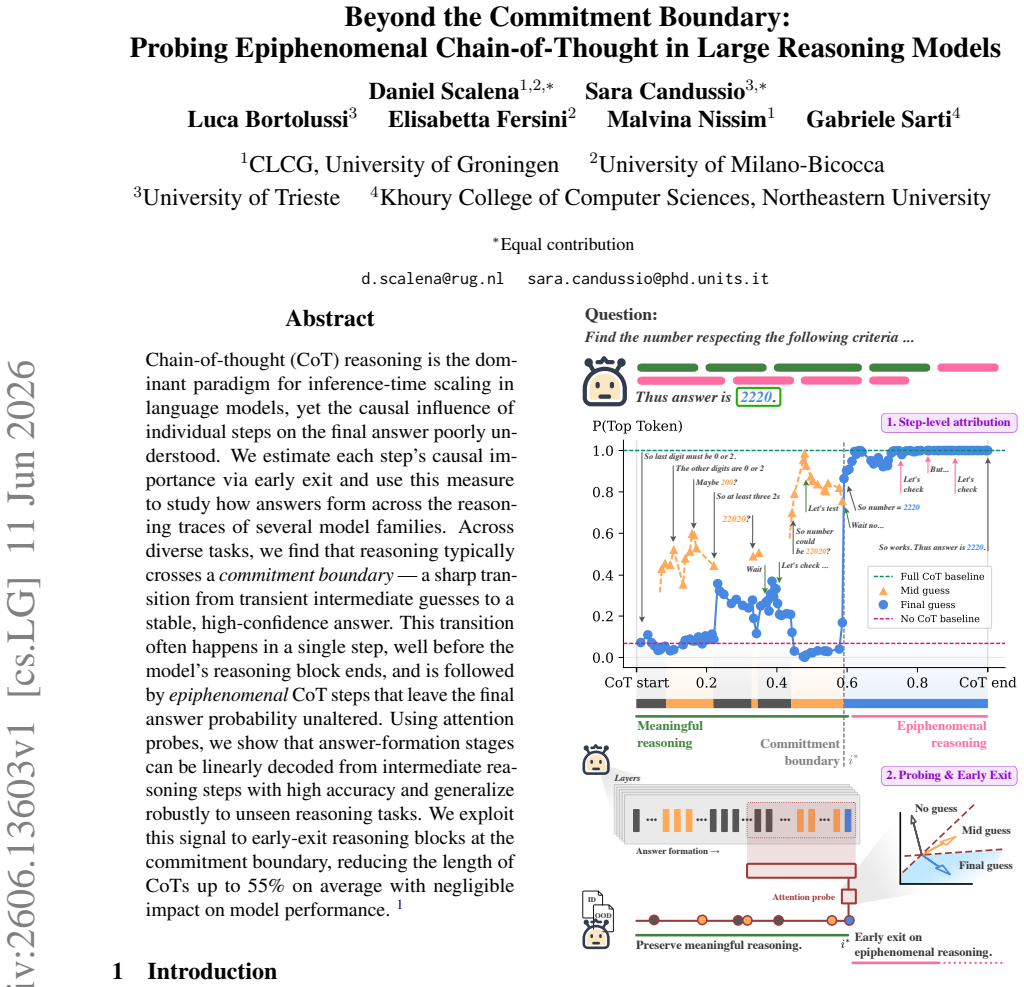
Large reasoning models typically settle on a stable answer early in chain-of-thought, after which further steps do not alter the output probability.
A machine-rendered reading of the paper's core claim, the machinery that carries it, and where it could break.
Core claim
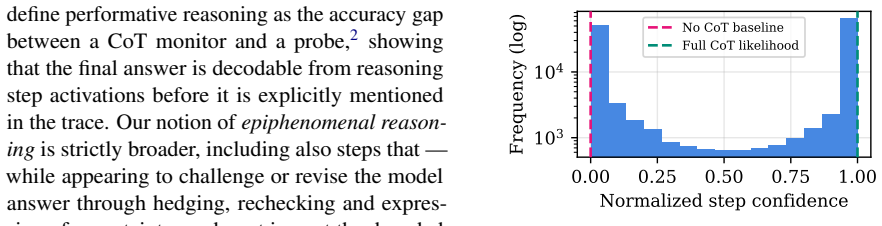
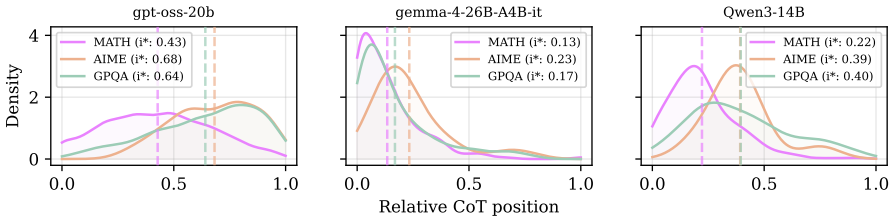
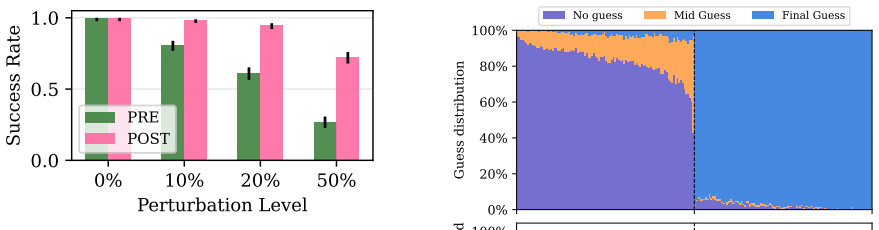
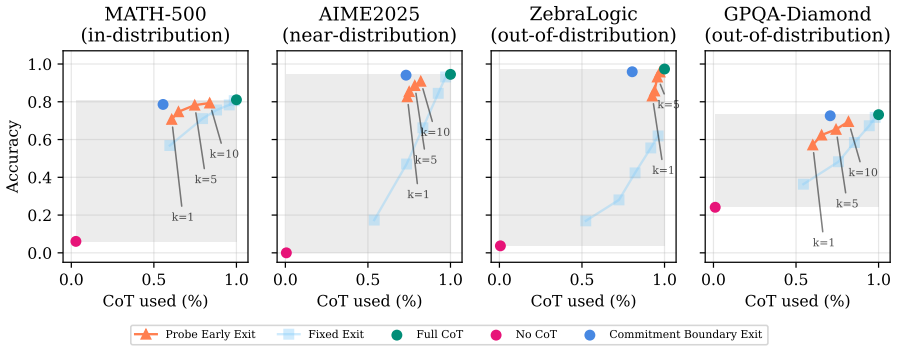
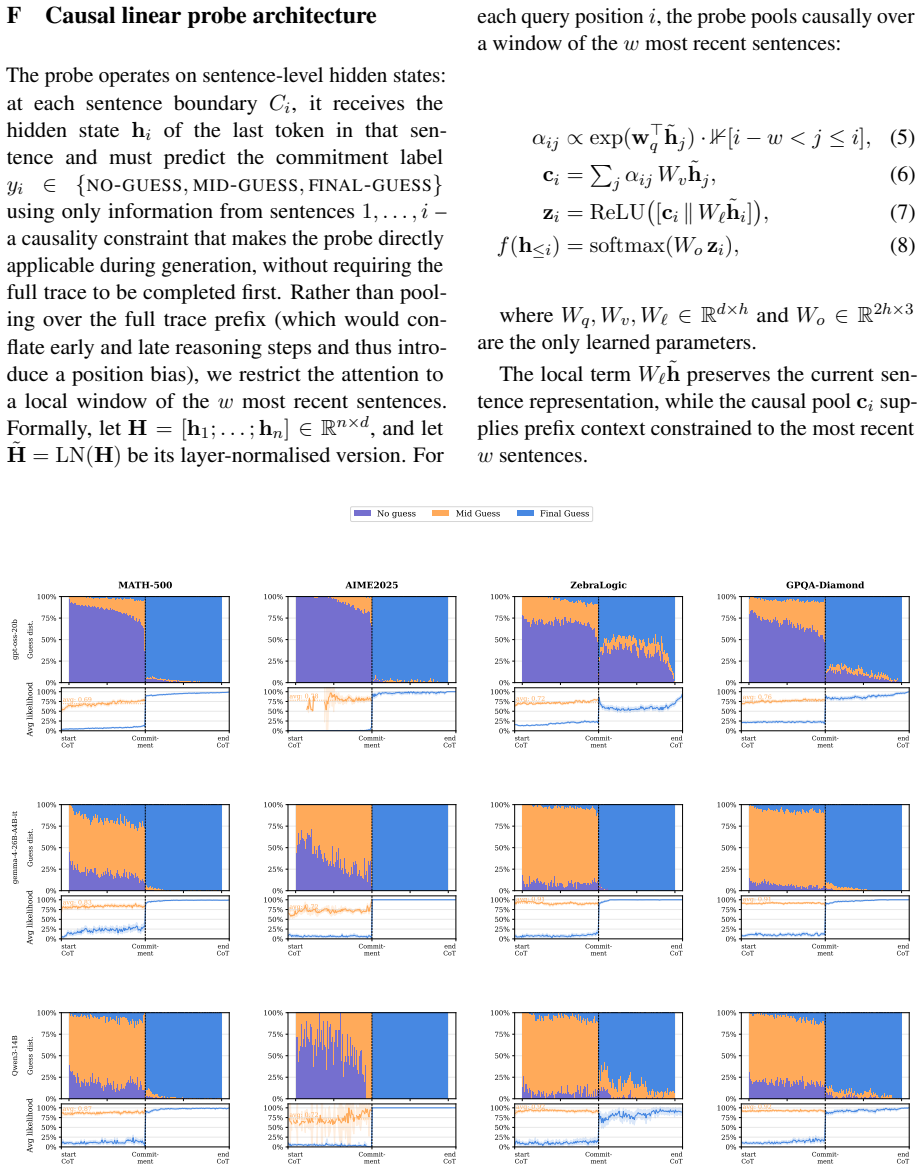
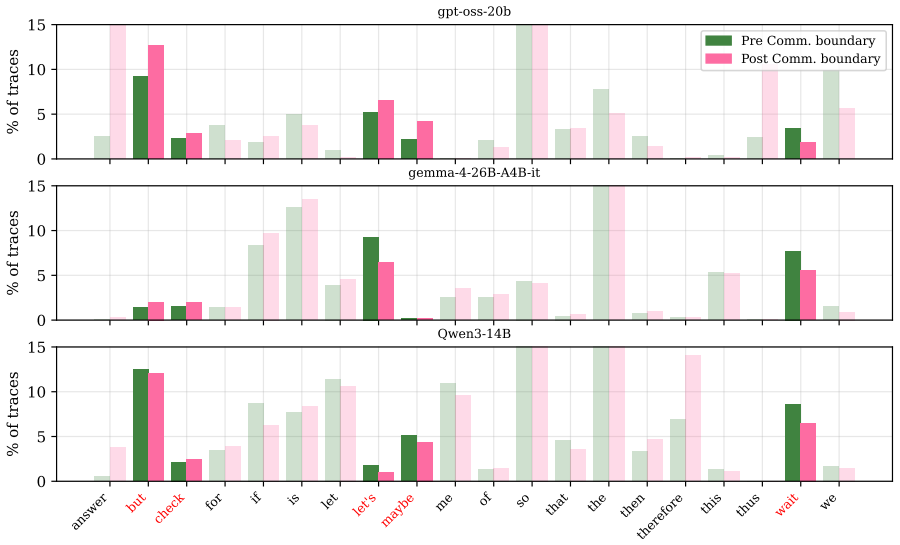
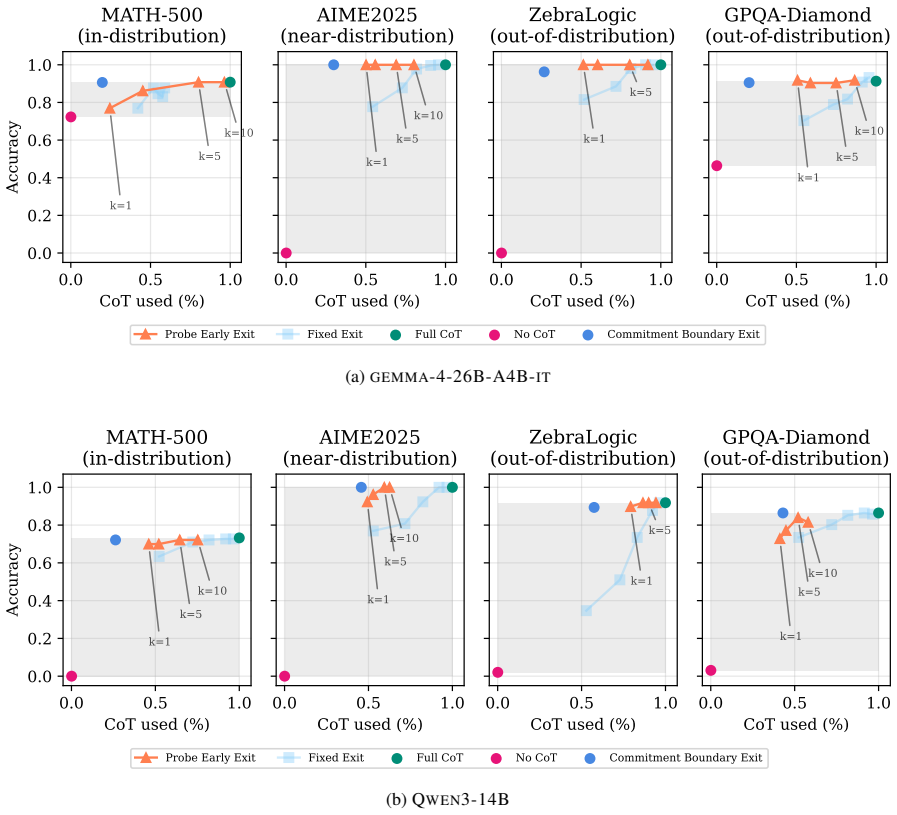
Across diverse tasks and several model families, reasoning crosses a commitment boundary—a sharp transition from transient intermediate guesses to a stable, high-confidence answer. This transition often happens in a single step, well before the model's reasoning block ends, and is followed by epiphenomenal CoT steps that leave the final answer probability unaltered. Answer-formation stages can be linearly decoded from intermediate reasoning steps with high accuracy and generalize to unseen tasks, allowing early exit at the boundary to shorten CoTs by up to 55 percent with negligible performance change.
What carries the argument
The commitment boundary, located by early-exit interventions that quantify each step's causal effect on final answer probability.
If this is right
- Most generated reasoning steps after the commitment boundary exert no causal influence on the answer.
- Linear probes on intermediate activations can recover the timing of answer formation across tasks.
- Early exit at the boundary reduces average CoT length by up to 55 percent while preserving accuracy.
- The linear decoding signal transfers to reasoning tasks not seen during probe training.
Where Pith is reading between the lines
- Training objectives that penalize post-boundary tokens could produce shorter yet equally accurate traces.
- The same early-commitment pattern may appear in non-reasoning generation tasks that involve sequential refinement.
- Attention or activation patterns at the boundary step may expose the internal mechanism that stabilizes the answer.
Load-bearing premise
Early-exit interventions accurately isolate the causal contribution of individual steps without introducing artifacts that alter the model's subsequent internal computation.
What would settle it
An experiment in which continuing the trace past the identified boundary reliably shifts the final answer probability in a manner not produced by the early-exit procedure itself.
Figures
read the original abstract
Chain-of-thought (CoT) reasoning is the dominant paradigm for inference-time scaling in language models, yet the causal influence of individual steps on the final answer poorly understood. We estimate each step's causal importance via early exit and use this measure to study how answers form across the reasoning traces of several model families. Across diverse tasks, we find that reasoning typically crosses a \emph{commitment boundary} -- a sharp transition from transient intermediate guesses to a stable, high-confidence answer. This transition often happens in a single step, well before the model's reasoning block ends, and is followed by \emph{epiphenomenal} CoT steps that leave the final answer probability unaltered. Using attention probes, we show that answer-formation stages can be linearly decoded from intermediate reasoning steps with high accuracy and generalize robustly to unseen reasoning tasks. We exploit this signal to early-exit reasoning blocks at the commitment boundary, reducing the length of CoTs up to 55\% on average with negligible impact on model performance.
Editorial analysis
A structured set of objections, weighed in public.
Referee Report
Summary. The paper claims that chain-of-thought reasoning in large models crosses a commitment boundary—a sharp transition to a stable, high-confidence answer—typically in a single early step, after which subsequent CoT tokens are epiphenomenal and leave final-answer probability unchanged. Early-exit interventions are used to quantify each step’s causal effect on the answer; attention probes show that answer-formation stages can be linearly decoded from intermediate steps and generalize to unseen tasks. The authors exploit the boundary signal to truncate reasoning traces, achieving up to 55% length reduction with negligible performance impact across tasks and model families.
Significance. If the early-exit measurements are causally faithful, the work supplies a concrete, falsifiable account of how answers stabilize during inference-time scaling and a practical compression technique. The linear-decodability result and cross-task generalization are concrete strengths that could inform both mechanistic interpretability and efficient deployment.
major comments (2)
- [Abstract] Abstract (methods paragraph): the central claim that post-boundary steps are epiphenomenal rests on early-exit interventions isolating causal contributions. No quantitative control is described that compares early-exit trajectories against full-trace continuations with post-k tokens masked or replaced, leaving open the possibility that truncation artifacts alter residual-stream or attention dynamics and produce the observed flat probability curve.
- [Abstract] Abstract (results paragraph): the reported 55% average length reduction is presented without accompanying per-task or per-model variance, statistical significance tests, or ablation against simple length baselines (e.g., fixed-step truncation), making it impossible to assess whether the savings are attributable to the commitment-boundary detector rather than generic early stopping.
minor comments (1)
- The term “epiphenomenal” is used without an explicit operational definition tying it to the early-exit probability metric; a short clarifying sentence would prevent ambiguity.
Simulated Author's Rebuttal
We thank the referee for the constructive feedback on methodological controls and statistical reporting. We address each major comment below and will incorporate revisions to strengthen the causal claims and result presentation.
read point-by-point responses
-
Referee: [Abstract] Abstract (methods paragraph): the central claim that post-boundary steps are epiphenomenal rests on early-exit interventions isolating causal contributions. No quantitative control is described that compares early-exit trajectories against full-trace continuations with post-k tokens masked or replaced, leaving open the possibility that truncation artifacts alter residual-stream or attention dynamics and produce the observed flat probability curve.
Authors: We agree that an explicit control for potential truncation artifacts would strengthen the causal interpretation. In the revised manuscript we will add experiments that continue full traces but mask or replace all tokens after the detected commitment boundary, then compare the resulting answer-probability trajectories to those obtained via early exit. This will quantify whether the flat probability curve is an artifact of the intervention or a genuine property of post-boundary steps. revision: yes
-
Referee: [Abstract] Abstract (results paragraph): the reported 55% average length reduction is presented without accompanying per-task or per-model variance, statistical significance tests, or ablation against simple length baselines (e.g., fixed-step truncation), making it impossible to assess whether the savings are attributable to the commitment-boundary detector rather than generic early stopping.
Authors: We concur that variance, significance testing, and baseline ablations are required for proper evaluation. The revision will report per-task and per-model standard deviations, include paired statistical tests on performance differences, and add an ablation that compares boundary-based early exit against fixed-step truncation at equivalent average lengths. These additions will isolate the contribution of the commitment-boundary signal. revision: yes
Circularity Check
Empirical measurement study with no self-referential derivations
full rationale
The paper is an empirical investigation that estimates step importance via early-exit interventions and observes patterns such as the commitment boundary in reasoning traces. No equations, fitted parameters, or derivations are presented that reduce any reported result (boundary location, epiphenomenal steps, or early-exit benefit) to quantities defined or fitted from the same data by construction. Claims rest on direct measurement across model families and tasks rather than self-citation chains or ansatzes smuggled via prior work. The central findings are falsifiable via the described interventions and do not collapse to input definitions.
Axiom & Free-Parameter Ledger
Reference graph
Works this paper leans on
-
[1]
The Proceedings for the 15th Workshop on Computational Approaches to Subjectivity, Sentiment Social Media Analysis ( WASSA 2026). 2026. doi:10.18653/v1/2026.wassa-1.0
-
[2]
Council of LLM s: Evaluating Capability of Large Language Models to Annotate Propaganda
Sharma, Vivek and Jain, Shweta and Shokri, Mohammad and Levitan, Sarah Ita and Filatova, Elena. Council of LLM s: Evaluating Capability of Large Language Models to Annotate Propaganda. The Proceedings for the 15th Workshop on Computational Approaches to Subjectivity, Sentiment Social Media Analysis ( WASSA 2026). 2026. doi:10.18653/v1/2026.wassa-1.1
-
[3]
Emoji Reactions on Telegram: Unreliable Indicators of Emotional Resonance
Tardelli, Serena and Alvisi, Lorenzo and Cima, Lorenzo and Cresci, Stefano and Tesconi, Maurizio. Emoji Reactions on Telegram: Unreliable Indicators of Emotional Resonance. The Proceedings for the 15th Workshop on Computational Approaches to Subjectivity, Sentiment Social Media Analysis ( WASSA 2026). 2026. doi:10.18653/v1/2026.wassa-1.2
-
[4]
Quantifying Social Sentiment in Hostels Using A Domain-Specific Transformer Pipeline
McMurry, Ian W. Quantifying Social Sentiment in Hostels Using A Domain-Specific Transformer Pipeline. The Proceedings for the 15th Workshop on Computational Approaches to Subjectivity, Sentiment Social Media Analysis ( WASSA 2026). 2026. doi:10.18653/v1/2026.wassa-1.3
-
[5]
Predicting Convincingness in Political Speech: How Emotional Tone Shapes Persuasive Strength
Verma, Bhuvanesh and Marreddy, Mounika and Mehler, Alexander. Predicting Convincingness in Political Speech: How Emotional Tone Shapes Persuasive Strength. The Proceedings for the 15th Workshop on Computational Approaches to Subjectivity, Sentiment Social Media Analysis ( WASSA 2026). 2026. doi:10.18653/v1/2026.wassa-1.4
-
[6]
Measuring LLM s' Sensitivity to Paraphrased Opinion Prompts
Alhetelah, Bushra and Ahmad, Irfan. Measuring LLM s' Sensitivity to Paraphrased Opinion Prompts. The Proceedings for the 15th Workshop on Computational Approaches to Subjectivity, Sentiment Social Media Analysis ( WASSA 2026). 2026. doi:10.18653/v1/2026.wassa-1.5
-
[7]
The Impact of Highlighting Subjective Language on Perceived News Trustworthiness
Shokri, Mohammad and Sharma, Vivek and Klapper, Emily and Jain, Shweta and Filatova, Elena and Levitan, Sarah Ita. The Impact of Highlighting Subjective Language on Perceived News Trustworthiness. The Proceedings for the 15th Workshop on Computational Approaches to Subjectivity, Sentiment Social Media Analysis ( WASSA 2026). 2026. doi:10.18653/v1/2026.wassa-1.6
-
[8]
Appraisal Trajectories in Narratives Reveal Distinct Patterns of Emotion Evocation
Sch. Appraisal Trajectories in Narratives Reveal Distinct Patterns of Emotion Evocation. The Proceedings for the 15th Workshop on Computational Approaches to Subjectivity, Sentiment Social Media Analysis ( WASSA 2026). 2026. doi:10.18653/v1/2026.wassa-1.7
-
[9]
Exploring Subjective Tasks in F arsi: A Survey Analysis and Evaluation of Language Model
Rooein, Donya and Plaza-del-Arco, Flor Miriam and Nozza, Debora and Hovy, Dirk. Exploring Subjective Tasks in F arsi: A Survey Analysis and Evaluation of Language Models. The Proceedings for the 15th Workshop on Computational Approaches to Subjectivity, Sentiment Social Media Analysis ( WASSA 2026). 2026. doi:10.18653/v1/2026.wassa-1.8
-
[10]
Iaroshenko, Polina V. and Loukachevitch, Natalia V. Emotional Lexicons: How Large Language Models Predict Emotional Ratings of R ussian Words. The Proceedings for the 15th Workshop on Computational Approaches to Subjectivity, Sentiment Social Media Analysis ( WASSA 2026). 2026. doi:10.18653/v1/2026.wassa-1.9
-
[11]
Emotion-aware text simplification of user generated content using LLM s
Bezobrazova, Anastasiia and Sokova, Daria and Orasan, Constantin. Emotion-aware text simplification of user generated content using LLM s. The Proceedings for the 15th Workshop on Computational Approaches to Subjectivity, Sentiment Social Media Analysis ( WASSA 2026). 2026. doi:10.18653/v1/2026.wassa-1.10
-
[12]
Aranberri, Nora. Crowd-Based Evaluation of Emotion Intensity Preservation in S panish -- B asque Tweet Machine Translation. The Proceedings for the 15th Workshop on Computational Approaches to Subjectivity, Sentiment Social Media Analysis ( WASSA 2026). 2026. doi:10.18653/v1/2026.wassa-1.11
-
[13]
and Markov, Ilia and Vossen, Piek
Schouten, Stefan F. and Markov, Ilia and Vossen, Piek. A Position Paper on Toxic Reasoning: Grounding Categories of Toxic Language in Implications and Attitudes. The Proceedings for the 15th Workshop on Computational Approaches to Subjectivity, Sentiment Social Media Analysis ( WASSA 2026). 2026. doi:10.18653/v1/2026.wassa-1.12
-
[14]
Is Sentiment Banana-Shaped? Exploring the Geometry and Portability of Sentiment Concept Vectors
Lyngbaek, Laurits and Feldkamp, Pascale and Bizzoni, Yuri and Nielbo, Kristoffer and Enevoldsen, Kenneth. Is Sentiment Banana-Shaped? Exploring the Geometry and Portability of Sentiment Concept Vectors. The Proceedings for the 15th Workshop on Computational Approaches to Subjectivity, Sentiment Social Media Analysis ( WASSA 2026). 2026. doi:10.18653/v1/20...
-
[15]
Disentangling Emotion Understanding and Generation in Large Language Models
Jafari, Sadegh and Lefever, Els and Hoste, Veronique. Disentangling Emotion Understanding and Generation in Large Language Models. The Proceedings for the 15th Workshop on Computational Approaches to Subjectivity, Sentiment Social Media Analysis ( WASSA 2026). 2026. doi:10.18653/v1/2026.wassa-1.14
-
[16]
News Credibility Assessment by LLM s and Humans: Implications for Political Bias
Neves, Pia Wenzel and Jakob, Charlott and Schmitt, Vera. News Credibility Assessment by LLM s and Humans: Implications for Political Bias. The Proceedings for the 15th Workshop on Computational Approaches to Subjectivity, Sentiment Social Media Analysis ( WASSA 2026). 2026. doi:10.18653/v1/2026.wassa-1.15
-
[17]
Schwager, Nils and M. Towards Simulating Social Media Users with LLM s: Evaluating the Operational Validity of Conditioned Comment Prediction. The Proceedings for the 15th Workshop on Computational Approaches to Subjectivity, Sentiment Social Media Analysis ( WASSA 2026). 2026. doi:10.18653/v1/2026.wassa-1.16
-
[18]
Label-Consistent Data Generation for Aspect-Based Sentiment Analysis Using LLM Agents
Monfared, Mohammad Hossein Akbari and Flek, Lucie and Karimi, Akbar. Label-Consistent Data Generation for Aspect-Based Sentiment Analysis Using LLM Agents. The Proceedings for the 15th Workshop on Computational Approaches to Subjectivity, Sentiment Social Media Analysis ( WASSA 2026). 2026. doi:10.18653/v1/2026.wassa-1.17
-
[19]
Antisocial Behavior Prediction: A Survey and Practical Guide
Ollagnier, Ana. Antisocial Behavior Prediction: A Survey and Practical Guide. The Proceedings for the 15th Workshop on Computational Approaches to Subjectivity, Sentiment Social Media Analysis ( WASSA 2026). 2026. doi:10.18653/v1/2026.wassa-1.18
-
[20]
Real-Time Mitigation of Negative Emotion in Customer Care Calls
Gangopadhyay, Surupendu and Mehrabani, Mahnoosh. Real-Time Mitigation of Negative Emotion in Customer Care Calls. The Proceedings for the 15th Workshop on Computational Approaches to Subjectivity, Sentiment Social Media Analysis ( WASSA 2026). 2026. doi:10.18653/v1/2026.wassa-1.19
-
[21]
Says Who? Argument Convincingness and Reader Stance Are Correlated with Perceived Author Personality
Weber, Sabine and Greschner, Lynn and Klinger, Roman. Says Who? Argument Convincingness and Reader Stance Are Correlated with Perceived Author Personality. The Proceedings for the 15th Workshop on Computational Approaches to Subjectivity, Sentiment Social Media Analysis ( WASSA 2026). 2026. doi:10.18653/v1/2026.wassa-1.20
-
[22]
A Transformer and Prototype-based Interpretable Model for Contextual Sarcasm Detection
Wen, Ximing and Rezapour, Rezvaneh. A Transformer and Prototype-based Interpretable Model for Contextual Sarcasm Detection. The Proceedings for the 15th Workshop on Computational Approaches to Subjectivity, Sentiment Social Media Analysis ( WASSA 2026). 2026. doi:10.18653/v1/2026.wassa-1.21
-
[23]
Multimodal Claim Extraction for Fact-Checking
Teo, Joycelyn and Cao, Rui and Deng, Zhenyun and Ding, Zifeng and Schlichtkrull, Michael Sejr and Vlachos, Andreas. Multimodal Claim Extraction for Fact-Checking. The Proceedings for the 15th Workshop on Computational Approaches to Subjectivity, Sentiment Social Media Analysis ( WASSA 2026). 2026. doi:10.18653/v1/2026.wassa-1.22
-
[24]
A Multi-Aspect Evaluation Framework for Synthetic Data: Case Study on Irony and Sarcasm
Majer, Laura and Bari \'c , Ana and Sandalj, Florijan and Unkovi \'c , Ivan and Puva c a, Bojan and S najder, Jan. A Multi-Aspect Evaluation Framework for Synthetic Data: Case Study on Irony and Sarcasm. The Proceedings for the 15th Workshop on Computational Approaches to Subjectivity, Sentiment Social Media Analysis ( WASSA 2026). 2026. doi:10.18653/v1/2...
-
[25]
Proceedings of the 13th Workshop on NLP for Similar Languages, Varieties and Dialects. 2026. doi:10.18653/v1/2026.vardial-1.0
-
[26]
Robinson, Nathaniel R. and Abdelmoneim, Shahd and Kantharuban, Anjali and Alsboul, Otba and Lamsiyah, Salima and Marchisio, Kelly and Murray, Kenton. AMIYA Shared Task: A rabic Modeling In Your Accent at V ar D ial 2026. Proceedings of the 13th Workshop on NLP for Similar Languages, Varieties and Dialects. 2026. doi:10.18653/v1/2026.vardial-1.1
-
[27]
Far Out: Evaluating Language Models on Slang in A ustralian and I ndian E nglish
Dilsiz, Deniz Kaya and Srirag, Dipankar and Joshi, Aditya. Far Out: Evaluating Language Models on Slang in A ustralian and I ndian E nglish. Proceedings of the 13th Workshop on NLP for Similar Languages, Varieties and Dialects. 2026. doi:10.18653/v1/2026.vardial-1.2
-
[28]
Kuparinen, Olli. Effects of Speaker Bias in Dialect Identification and Automatic Transcription with Self-Supervised Speech Models. Proceedings of the 13th Workshop on NLP for Similar Languages, Varieties and Dialects. 2026. doi:10.18653/v1/2026.vardial-1.3
-
[29]
O c W iki D ialects: A W ikipedia Dataset With Rich Metadata for O ccitan Dialect Identification
N \'e dey, Oriane and Bawden, Rachel and Cl \'e rice, Thibault and Sagot, Beno \^i t. O c W iki D ialects: A W ikipedia Dataset With Rich Metadata for O ccitan Dialect Identification. Proceedings of the 13th Workshop on NLP for Similar Languages, Varieties and Dialects. 2026. doi:10.18653/v1/2026.vardial-1.4
-
[30]
Irastortza-Urbieta, Xabier and Garc \'i a-Miguel, Jos \'e M. and Garcia, Marcos. Language Mixture to Develop Accurate G alician Dependency Parsers: An Exploration of Its Effects. Proceedings of the 13th Workshop on NLP for Similar Languages, Varieties and Dialects. 2026. doi:10.18653/v1/2026.vardial-1.5
-
[31]
Crowdsourcing Piedmontese to Test LLM s on Non-Standard Orthography
Vico, Gianluca and Libovick \'y , Jind r ich. Crowdsourcing P iedmontese to Test LLM s on Non-Standard Orthography. Proceedings of the 13th Workshop on NLP for Similar Languages, Varieties and Dialects. 2026. doi:10.18653/v1/2026.vardial-1.6
-
[32]
G erman- E nglish Code-Switching in Large Language Models
Aks. G erman- E nglish Code-Switching in Large Language Models. Proceedings of the 13th Workshop on NLP for Similar Languages, Varieties and Dialects. 2026. doi:10.18653/v1/2026.vardial-1.7
-
[33]
Perplexity as a Metric for Dialectal Distance: A Computational Study of G reek Varieties
Chatzikyriakidis, Stergios and Psaltaki, Erofili and Papadakis, Dimitrios and Henriksson, Erik and Laippala, Veronika. Perplexity as a Metric for Dialectal Distance: A Computational Study of G reek Varieties. Proceedings of the 13th Workshop on NLP for Similar Languages, Varieties and Dialects. 2026. doi:10.18653/v1/2026.vardial-1.8
-
[34]
A Subword Embedding Approach for Variation Detection in L uxembourgish User Comments
Lutgen, Anne-Marie and Plum, Alistair and Purschke, Christoph. A Subword Embedding Approach for Variation Detection in L uxembourgish User Comments. Proceedings of the 13th Workshop on NLP for Similar Languages, Varieties and Dialects. 2026. doi:10.18653/v1/2026.vardial-1.9
-
[35]
Onomasiological Sense Alignment Across Dialect Dictionaries
Mederake, Nathalie and Urbach, Nico and Fischer, Hanna and Lameli, Alfred. Onomasiological Sense Alignment Across Dialect Dictionaries. A Taxonomy-Constrained LLM Classification. Proceedings of the 13th Workshop on NLP for Similar Languages, Varieties and Dialects. 2026. doi:10.18653/v1/2026.vardial-1.10
-
[36]
and Uban, Ana Sabina and Marchitan, Teodor-George and Iordache, Ioan-Bogdan and Georgescu, Simona
Dinu, Liviu P. and Uban, Ana Sabina and Marchitan, Teodor-George and Iordache, Ioan-Bogdan and Georgescu, Simona. On the Intelligibility of R omance Language Varieties: S panish and P ortuguese in E urope and A merica. Proceedings of the 13th Workshop on NLP for Similar Languages, Varieties and Dialects. 2026. doi:10.18653/v1/2026.vardial-1.11
-
[37]
Dialect Matters: Cross-Lingual ASR Transfer for Low-Resource I ndic Language Varieties
Dhasmana, Akriti and Srivastava, Aarohi and Chiang, David. Dialect Matters: Cross-Lingual ASR Transfer for Low-Resource I ndic Language Varieties. Proceedings of the 13th Workshop on NLP for Similar Languages, Varieties and Dialects. 2026. doi:10.18653/v1/2026.vardial-1.12
-
[38]
Alabdullah, Abdullah and Han, Lifeng and Lin, Chenghua. Ara- HOPE : Human-Centric Post-Editing Evaluation for Dialectal A rabic to M odern S tandard A rabic Translation. Proceedings of the 13th Workshop on NLP for Similar Languages, Varieties and Dialects. 2026. doi:10.18653/v1/2026.vardial-1.13
-
[39]
I ndic- T uned L ens: Interpreting Multilingual Models in I ndian Languages
Panchal, Mihir and Varshney, Deeksha and ., Mamta and Ekbal, Asif. I ndic- T uned L ens: Interpreting Multilingual Models in I ndian Languages. Proceedings of the 13th Workshop on NLP for Similar Languages, Varieties and Dialects. 2026. doi:10.18653/v1/2026.vardial-1.14
-
[40]
Building ASR Resources for the Hutsul Dialect of U krainian
Kyslyi, Roman and Orlovskyi, Artem and Khomenko, Pavlo and Onyshchenko, Bohdan and Guzii, Zakhar. Building ASR Resources for the Hutsul Dialect of U krainian. Proceedings of the 13th Workshop on NLP for Similar Languages, Varieties and Dialects. 2026. doi:10.18653/v1/2026.vardial-1.15
-
[41]
From F us H a to Folk: Exploring Cross-Lingual Transfer in A rabic Language Models
Khalak, Abdulmuizz and Issam, Abderrahmane and Spanakis, Gerasimos. From F us H a to Folk: Exploring Cross-Lingual Transfer in A rabic Language Models. Proceedings of the 13th Workshop on NLP for Similar Languages, Varieties and Dialects. 2026. doi:10.18653/v1/2026.vardial-1.16
-
[42]
Extending ASR Evaluation Resources for M odern G reek Dialects
Tsoukala, Chara and Bompolas, Stavros and Margariti, Antigoni and Panagiotou, Konstantina and Plaiti, Maria Elisavet and Tzanakaki, Nefeli and Karatsareas, Petros and Ralli, Angela and Anastasopoulos, Antonios and Markantonatou, Stella. Extending ASR Evaluation Resources for M odern G reek Dialects. Proceedings of the 13th Workshop on NLP for Similar Lang...
-
[43]
How Should We Model the Probability of a Language?
Dent, Rasul and Ortiz Suarez, Pedro and Cl \'e rice, Thibault and Sagot, Beno \^i t. How Should We Model the Probability of a Language?. Proceedings of the 13th Workshop on NLP for Similar Languages, Varieties and Dialects. 2026. doi:10.18653/v1/2026.vardial-1.18
-
[44]
Bridging Dialectal Variation: A Phonetic Transcription Tool for T amil
Mahaganapathy, Ahrane and Karunakaran, Sumirtha and Navakulan, Kavitha and Sarveswaran, Kengatharaiyer. Bridging Dialectal Variation: A Phonetic Transcription Tool for T amil. Proceedings of the 13th Workshop on NLP for Similar Languages, Varieties and Dialects. 2026. doi:10.18653/v1/2026.vardial-1.19
-
[45]
Regional Variation in the Performance of ASR Models on C roatian and S erbian
Samard z i \'c , Tanja and Rupnik, Peter and Ljube s i \'c , Nikola. Regional Variation in the Performance of ASR Models on C roatian and S erbian. Proceedings of the 13th Workshop on NLP for Similar Languages, Varieties and Dialects. 2026. doi:10.18653/v1/2026.vardial-1.20
-
[46]
Syllable Structures Across A rabic Varieties
Qaddoumi, Abdelrahim and Kodner, Jordan and Khalifa, Salam and Broselow, Ellen and Rambow, Owen. Syllable Structures Across A rabic Varieties. Proceedings of the 13th Workshop on NLP for Similar Languages, Varieties and Dialects. 2026. doi:10.18653/v1/2026.vardial-1.21
-
[47]
Mekky, Ali and El Zeftawy, Mohamed and Hassan, Lara and Keleg, Amr and Nakov, Preslav. Curriculum Learning and Pseudo-Labeling Improve the Generalization of Multi-Label A rabic Dialect Identification Models. Proceedings of the 13th Workshop on NLP for Similar Languages, Varieties and Dialects. 2026. doi:10.18653/v1/2026.vardial-1.22
-
[48]
Fedorova, Mariia and Arefyev, Nikolay and Buljan, Maja and Helcl, Jind r ich and Oepen, Stephan and R nningstad, Egil and Scherrer, Yves. O pen LID -v3: Improving the Precision of Closely Related Language Identification -- An Experience Report. Proceedings of the 13th Workshop on NLP for Similar Languages, Varieties and Dialects. 2026. doi:10.18653/v1/202...
-
[49]
Improving Dialect Robustness in Large Language Models via L o RA and Mixture-of-Experts
Maheshwari, Sanjh and Rajpoot, Aniket Singh and Cocarascu, Oana and ., Mamta. Improving Dialect Robustness in Large Language Models via L o RA and Mixture-of-Experts. Proceedings of the 13th Workshop on NLP for Similar Languages, Varieties and Dialects. 2026. doi:10.18653/v1/2026.vardial-1.24
-
[50]
Evaluation Framework for Transfer Learning between Closely Related Lects: A Case Study of Lemko
Afanasev, Ilia. Evaluation Framework for Transfer Learning between Closely Related Lects: A Case Study of Lemko. Proceedings of the 13th Workshop on NLP for Similar Languages, Varieties and Dialects. 2026. doi:10.18653/v1/2026.vardial-1.25
-
[51]
Do Large Language Models Adapt to Language Variation across Socioeconomic Status?
Bassignana, Elisa and Zhang, Mike and Hovy, Dirk and Cercas Curry, Amanda. Do Large Language Models Adapt to Language Variation across Socioeconomic Status?. Proceedings of the 13th Workshop on NLP for Similar Languages, Varieties and Dialects. 2026. doi:10.18653/v1/2026.vardial-1.26
-
[52]
Mutal, Jonathan and Al Almaoui, Perla and Hengchen, Simon and Bouillon, Pierrette. Aladdin- FTI @ AMIYA Three Wishes for A rabic NLP : Fidelity, Diglossia, and Multidialectal Generation. Proceedings of the 13th Workshop on NLP for Similar Languages, Varieties and Dialects. 2026. doi:10.18653/v1/2026.vardial-1.27
-
[53]
Alali, Abdulhai and Issam, Abderrahmane. Maastricht University at AMIYA : Adapting LLM s for Dialectal A rabic using Fine-tuning and MBR Decoding. Proceedings of the 13th Workshop on NLP for Similar Languages, Varieties and Dialects. 2026. doi:10.18653/v1/2026.vardial-1.28
-
[54]
SDNLP at AMIYA 2026: S yrian A rabic Dialect Modeling with L o RA
Alkhder, Hasan and Abboush, Mohammad. SDNLP at AMIYA 2026: S yrian A rabic Dialect Modeling with L o RA. Proceedings of the 13th Workshop on NLP for Similar Languages, Varieties and Dialects. 2026. doi:10.18653/v1/2026.vardial-1.29
-
[55]
Gollapalli, Sujatha Das and Hakam, Mouad and Du, Mingzhe and Ng, See-Kiong. NUS - IDS at AMIYA / V ar D ial 2026: Improving A rabic Dialectness in LLM s with Reinforcement Learning. Proceedings of the 13th Workshop on NLP for Similar Languages, Varieties and Dialects. 2026. doi:10.18653/v1/2026.vardial-1.30
-
[56]
MBZUAI at AMIYA Shared Task 2026: Adapting Open-Source LLM s for Dialectal A rabic
Gaber, Rana and Allam, Yara and Amin, Serag and Aly, Ranwa and Alhafni, Bashar. MBZUAI at AMIYA Shared Task 2026: Adapting Open-Source LLM s for Dialectal A rabic. Proceedings of the 13th Workshop on NLP for Similar Languages, Varieties and Dialects. 2026. doi:10.18653/v1/2026.vardial-1.31
-
[57]
A Closed-Track System for Palestinian A rabic in the AMIYA Shared Task
Hamad, Khaleel and Al-Najjar, Ahmad. A Closed-Track System for Palestinian A rabic in the AMIYA Shared Task. Proceedings of the 13th Workshop on NLP for Similar Languages, Varieties and Dialects. 2026. doi:10.18653/v1/2026.vardial-1.32
-
[58]
Proceedings of the Seventh Workshop on Teaching Natural Language Processing ( T each NLP 2026). 2026. doi:10.18653/v1/2026.teachingnlp-1.0
-
[59]
A nimated LLM : Explaining LLM s with Interactive Visualizations
Kasner, Zden e k and Dusek, Ondrej. A nimated LLM : Explaining LLM s with Interactive Visualizations. Proceedings of the Seventh Workshop on Teaching Natural Language Processing ( T each NLP 2026). 2026. doi:10.18653/v1/2026.teachingnlp-1.1
-
[60]
Narra, Sruti. Pedagogic Applications of Argument Maps to Enhance Critical Thinking: Thought Seeds, Argument Mapping, Collaborative Mapping. Proceedings of the Seventh Workshop on Teaching Natural Language Processing ( T each NLP 2026). 2026. doi:10.18653/v1/2026.teachingnlp-1.2
-
[61]
From Code-Centric to Concept-Centric: Teaching NLP with LLM -Assisted ``Vibe Coding''
Al-Khalifa, Hend. From Code-Centric to Concept-Centric: Teaching NLP with LLM -Assisted ``Vibe Coding''. Proceedings of the Seventh Workshop on Teaching Natural Language Processing ( T each NLP 2026). 2026. doi:10.18653/v1/2026.teachingnlp-1.3
-
[62]
Linguistics to LLM s: Teaching with and about Chatbots
Pado, Ulrike and Pampel, Barbara. Linguistics to LLM s: Teaching with and about Chatbots. Proceedings of the Seventh Workshop on Teaching Natural Language Processing ( T each NLP 2026). 2026. doi:10.18653/v1/2026.teachingnlp-1.4
-
[63]
Skadina, Inguna and Kuzmina, Jana and Platonova, Marina and Smirnova, Tatjana and Kruk, Sergei. Language Technology Initiative: Framework for Teaching NLP and Computational Linguistics at the Universities in L atvia. Proceedings of the Seventh Workshop on Teaching Natural Language Processing ( T each NLP 2026). 2026. doi:10.18653/v1/2026.teachingnlp-1.5
-
[64]
Teaching NLP in the AI Era: Experiences from the U niversity of L atvia
Skadina, Inguna and Barzdins, Guntis and Boj \= a rs, Uldis and Gruzitis, Normunds and Paikens, P \= e teris. Teaching NLP in the AI Era: Experiences from the U niversity of L atvia. Proceedings of the Seventh Workshop on Teaching Natural Language Processing ( T each NLP 2026). 2026. doi:10.18653/v1/2026.teachingnlp-1.6
-
[65]
A Hands-on Approach to NLP Fundamentals for External Domain Experts in the LLM Era
Daza, Angel. A Hands-on Approach to NLP Fundamentals for External Domain Experts in the LLM Era. Proceedings of the Seventh Workshop on Teaching Natural Language Processing ( T each NLP 2026). 2026. doi:10.18653/v1/2026.teachingnlp-1.7
-
[66]
and Chervyakov, Artem and Zaytsev, Alexey and Panchenko, Alexander
Tikhonova, Maria and Chekalina, Viktoriia A. and Chervyakov, Artem and Zaytsev, Alexey and Panchenko, Alexander. From Standard Transformers to M odern LLM s: Bringing Dialogue Models, RAG , and Agents to the Classroom. Proceedings of the Seventh Workshop on Teaching Natural Language Processing ( T each NLP 2026). 2026. doi:10.18653/v1/2026.teachingnlp-1.8
-
[67]
Which course? Discourse! Teaching Discourse and Generation in the Era of LLM s
Li, Junyi Jessy and Liu, Yang Janet and Misra, Kanishka and Pyatkin, Valentina and Sheffield, William. Which course? Discourse! Teaching Discourse and Generation in the Era of LLM s. Proceedings of the Seventh Workshop on Teaching Natural Language Processing ( T each NLP 2026). 2026. doi:10.18653/v1/2026.teachingnlp-1.9
-
[68]
From Mixed Backgrounds to NLP Skills
Barak, Libby and Feldman, Anna. From Mixed Backgrounds to NLP Skills. Proceedings of the Seventh Workshop on Teaching Natural Language Processing ( T each NLP 2026). 2026. doi:10.18653/v1/2026.teachingnlp-1.10
-
[69]
Teaching and Critiquing Conceptualization and Operationalization in NLP
Gautam, Vagrant. Teaching and Critiquing Conceptualization and Operationalization in NLP. Proceedings of the Seventh Workshop on Teaching Natural Language Processing ( T each NLP 2026). 2026. doi:10.18653/v1/2026.teachingnlp-1.11
-
[70]
Bridging Applied Experience and Research Contexts in U krainian NLP Education
Paniv, Yurii and Makovska, Viktoriia. Bridging Applied Experience and Research Contexts in U krainian NLP Education. Proceedings of the Seventh Workshop on Teaching Natural Language Processing ( T each NLP 2026). 2026. doi:10.18653/v1/2026.teachingnlp-1.12
-
[71]
Kyslyi, Roman and Bazdyrev, Anton. Teaching M odern NLP and LLM s at Kyiv School of Economics: A Practice-Oriented Course with U krainian Language Focus. Proceedings of the Seventh Workshop on Teaching Natural Language Processing ( T each NLP 2026). 2026. doi:10.18653/v1/2026.teachingnlp-1.13
-
[72]
Practising responsibility: Ethics in NLP as a hands-on course
Nissim, Malvina and Patti, Viviana and Savoldi, Beatrice. Practising responsibility: Ethics in NLP as a hands-on course. Proceedings of the Seventh Workshop on Teaching Natural Language Processing ( T each NLP 2026). 2026. doi:10.18653/v1/2026.teachingnlp-1.14
-
[73]
Abraar, Mohammed and Dandekar, Raj and Dandekar, Rajat and Panat, Sreedath. Beyond Passive Viewing: A Pilot Study of a Hybrid Learning Platform Augmenting Video Lectures with Conversational AI. Proceedings of the Seventh Workshop on Teaching Natural Language Processing ( T each NLP 2026). 2026. doi:10.18653/v1/2026.teachingnlp-1.15
-
[74]
Bilstrup, Karl-Emil Kj r and Degn, Kirstine Nielsen and Schultz, Morten and Conroy, Alexander and Bjerring-Hansen, Jens and Hershcovich, Daniel. From Sentiment to Interpretation: Teaching NLP for Literary Understanding Across Educational Contexts. Proceedings of the Seventh Workshop on Teaching Natural Language Processing ( T each NLP 2026). 2026. doi:10....
-
[75]
Novel or Drivel? Variants of Invariants for Teaching NLP in the LLM Era
Micluța-C \^a mpeanu, Marius. Novel or Drivel? Variants of Invariants for Teaching NLP in the LLM Era. Proceedings of the Seventh Workshop on Teaching Natural Language Processing ( T each NLP 2026). 2026. doi:10.18653/v1/2026.teachingnlp-1.17
-
[76]
A ctive LLM : Large Language Model-Based Active Learning for Textual Few-Shot Scenarios
Bayer, Markus and Lutz, Justin and Reuter, Christian. A ctive LLM : Large Language Model-Based Active Learning for Textual Few-Shot Scenarios. Transactions of the Association for Computational Linguistics. 2026. doi:10.1162/tacl.a.63
-
[77]
M o N a C o: More Natural and Complex Questions for Reasoning Across Dozens of Documents
Wolfson, Tomer and Trivedi, Harsh and Geva, Mor and Goldberg, Yoav and Roth, Dan and Khot, Tushar and Sabharwal, Ashish and Tsarfaty, Reut. M o N a C o: More Natural and Complex Questions for Reasoning Across Dozens of Documents. Transactions of the Association for Computational Linguistics. 2026. doi:10.1162/tacl.a.64
-
[78]
D eep T rans: Deep Reasoning Translation via Reinforcement Learning
Wang, Jiaan and Meng, Fandong and Zhou, Jie. D eep T rans: Deep Reasoning Translation via Reinforcement Learning. Transactions of the Association for Computational Linguistics. 2026. doi:10.1162/tacl.a.65
-
[79]
C oref I nst: Leveraging LLM s for Multilingual Coreference Resolution
Pamay Arslan, Tu. C oref I nst: Leveraging LLM s for Multilingual Coreference Resolution. Transactions of the Association for Computational Linguistics. 2026. doi:10.1162/tacl.a.593
-
[80]
and Josyula, Yasasvi and Choi, Jinho D
Finch, James D. and Josyula, Yasasvi and Choi, Jinho D. Generative Induction of Dialogue Task Schemas with Streaming Refinement and Simulated Interactions. Transactions of the Association for Computational Linguistics. 2026. doi:10.1162/tacl.a.66
discussion (0)
Sign in with ORCID, Apple, or X to comment. Anyone can read and Pith papers without signing in.