REVIEW 4 major objections 6 minor 3 cited by
A full robot-learning stack—from motion-capture data to reward-free post-training—lets one policy transfer across unseen robot bodies.
Reviewed by Pith at T0; open to challenge. T0 means a machine referee read the full paper against a public rubric. the ladder, T0–T4 →
T0 review · deepseek-v4-flash
2026-08-02 11:27 UTC pith:J7S522H6
load-bearing objection A credible full-stack VLA system with real hardware results, but the RoboTwin SOTA claim is statistically thin and rests on uncontrolled baselines and a data filter. the 4 major comments →
Hy-Embodied-0.5-VLA: From Vision-Language-Action Models to a Real-World Robot Learning Stack
The pith
A machine-rendered reading of the paper's core claim, the machinery that carries it, and where it could break.
Core claim
On its own terms, the paper's central discovery is that the bottleneck for generalist robots is not the policy alone but the interface between data, model, and hardware. HyVLA-0.5 shows that a policy trained on end-effector delta chunks, annotated by a motion-capture cage instead of SLAM, can be post-trained on only human hand-held demonstrations and then deployed on morphologically different robots. On a 50-task simulated benchmark it reports the best success rates in both clean (90.9%) and randomized (90.1%) settings, and after FlowPRO post-training four real-robot bimanual tasks reach 94-99% success with shorter completion times than the baselines. The authors interpret this as evidence t
What carries the argument
The central mechanism is the delta-chunk action representation in the end-effector frame: actions are predicted as incremental 3-D position and 6-D rotation changes (plus gripper) relative to the current gripper pose, which decouples the learned policy from embodiment-specific kinematics and lets the same policy be composed with any robot's inverse kinematics at deployment. Around it, the stack uses a compact memory encoder that compresses multi-frame history with interleaved temporal-spatial attention, a flow-matching action expert that regresses continuous velocity fields instead of discretized action tokens, and FlowPRO, a proximalized preference-optimization loss that contrasts paired su
Load-bearing premise
The load-bearing premise is that the external motion-capture system labels every 6-DoF trajectory at sub-millimetre precision in a single globally consistent frame; no calibration or error analysis is provided, so if the true label precision is worse or drifts, the 'high-fidelity' advantage and all cross-embodiment transfer results would need to be reinterpreted.
What would settle it
Measure the motion-capture cage's label error directly against an independent ground-truth tracker in a static and moving gripper test across the full workspace; if the mean pose error is millimetre-scale or shows drift across episodes, the claimed sub-millimetre precision and the transfer benefit attributed to it are falsified. Alternatively, retrain the same pipeline with action labels downsampled or noised to SLAM-level precision; if success rates on Track-B do not drop, the precision claim is not load-bearing.
If this is right
- On a 50-task simulated benchmark, the full model reaches 90.9% success in clean and 90.1% in randomized settings, the highest among compared methods.
- Track-B shows that fine-tuning only on task-specific UMI demonstrations—no target-robot teleoperation—yields effective policies on a fixed-base arm and a humanoid platform.
- FlowPRO post-training lifts four real-robot bimanual tasks to 94-99% success rates and lowers mean completion times, compared to dataset aggregation and an advantage-conditioned regression baseline.
- Removing the memory encoder or the UMI pre-training stage degrades simulated benchmark performance by about 2 points each, indicating both components carry some of the gain.
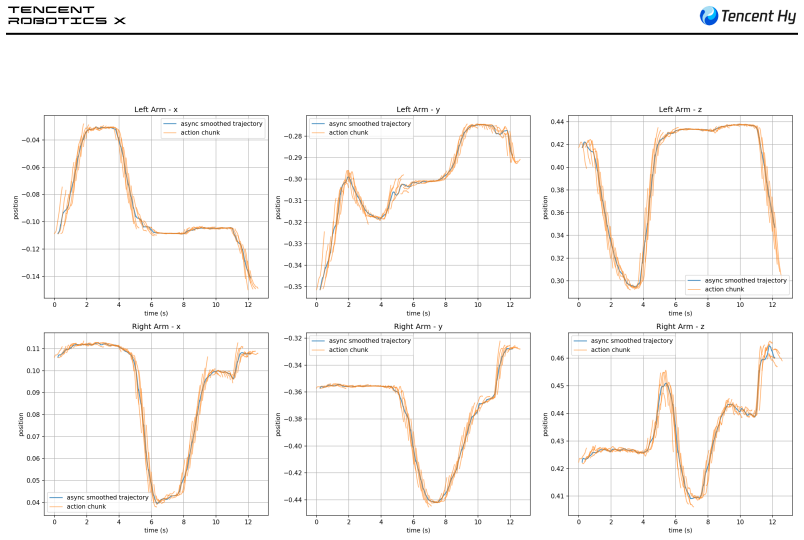
- The same checkpoint can be executed on heterogeneous robots through the embodiment-agnostic platform mapper and asynchronous Bézier smoothing.
Where Pith is reading between the lines
- If the motion-capture label precision holds, a natural test is to inject controlled noise into the UMI action labels and measure the drop in Track-B success; the paper itself proposes this, and it would isolate how much of the benefit comes from label accuracy versus corpus scale and diversity.
- The intervention-and-rollback preference pipeline is generic: it could be applied to other flow-matching policies, and the proximal regularizer promisingly addresses the reward-hacking failure mode common to preference-optimization methods.
- The paper admits the stack does not yet demonstrate zero-shot generalization; a fair next step is to apply the same UMI-only transfer recipe to more robot morphologies and to larger aggregation corpora to see whether the result scales.
- The delta-chunk representation plus the deployment-time mapper effectively turns cross-embodiment transfer into a finite data problem; if it holds, it suggests that target-robot teleoperation can be replaced by cheaper human hand-held collection.
Editorial analysis
A structured set of objections, weighed in public.
Referee Report
Summary. The manuscript presents HyVLA-0.5, an end-to-end vision-language-action robot learning stack covering custom UMI data collection with motion capture, a 4B-parameter MoT-based backbone with a flow-matching action expert and a compact memory encoder, continued pre-training on a 10K-hour UMI corpus, supervised fine-tuning in two tracks (intra-embodiment and cross-embodiment), an offline preference-based RL post-training stage (FlowPRO/RPRO), and an asynchronous deployment pipeline with Bézier chunk stitching. The main empirical claims are: state-of-the-art success rates on RoboTwin2.0 (90.9% Clean, 90.1% Randomized), successful cross-embodiment transfer to JAKA K1 and Astribot S1 using only UMI demonstrations, and FlowPRO raising real-robot bimanual success rates to 94–99% while reducing completion time. The paper positions these results as evidence for a co-designed, deployable generalist-robot stack rather than a single model improvement.
Significance. If the reported results hold, the paper is a useful systems contribution: it integrates data collection, architecture, RL post-training, and deployment in one pipeline and reports real-robot experiments with per-seed variance in the FlowPRO study. Strengths include the full-scale release of model, dataset, and code; a critic-free, reward-free RL post-training objective with a proximal regularizer; a parameter-free memory encoder that reduces exactly to the single-frame encoder at K=1; and real-hardware Track-B experiments that avoid target-robot teleoperation. These elements are credible and likely to be reproduced and built upon. The main scientific risk is in the RoboTwin2.0 headline comparison, which uses externally reported baseline numbers and a data-filtering procedure applied only to the proposed method; the statistical and protocol weaknesses there are load-bearing and need to be fixed before the SOTA claim is accepted.
major comments (4)
- [§6.1, Table 1; Appendix A] The headline claim of best RoboTwin2.0 success rate is fragile. The comparison uses 'each method's officially reported success rates' rather than re-running baselines under one protocol. The margin over the strongest baseline, JoyAI-RA, is 0.4 points Clean and 0.8 points Randomized; with 100 rollouts × 50 tasks ≈ 5,000 rollouts per setting, the standard error of a 90% success rate is roughly 0.42 percentage points, placing the Clean lead within one SE and the Randomized lead under two SEs. No confidence intervals or per-task variances are reported for the baselines. In addition, Appendix A describes an HDBSCAN episode-length filter applied to HyVLA-0.5's training data; the removal rate and the effect of the filter on downstream success rate are not quantified, and the same filter is not applied to the baselines. If the filter preferentially removes difficult or noisy episodes, it can inf
- [§3.1] The paper repeatedly attributes real-robot and cross-embodiment gains to 'sub-millimetre precision' motion-capture labels. However, no metrological validation is provided: there is no calibration error analysis, no RMSE of the mocap system against a held-out reference, and no quantitative comparison against the SLAM baseline that the paper rejects. The claimed advantage of 'high-fidelity' UMI pre-training is load-bearing for the precision-critical-task evidence in §6.2 and for the cross-embodiment transfer story. Please provide a direct measurement of pose-label accuracy (e.g., static and dynamic repeatability, per-axis errors, and drift bounds over a recording session), or explicitly state this precision as an untested assumption and temper the data-quality narrative.
- [§6.2, Track B; Fig. 9] The cross-embodiment transfer claim rests on exactly one task per target robot (Put Away the Accessory on JAKA K1; Clean Up the Table on Astribot S1). The reported per-task success rates in Fig. 9 have no number of rollouts, no confidence intervals, and no per-seed variance. Since the UMI data contain no target-robot reachability guarantee (acknowledged in Appendix B.2) and the Astribot deployment relies on a heuristic torso/chassis mapping (Algorithm 1), the evidence for 'UMI-only cross-embodiment transfer' is thin. Please report rollout counts and uncertainty for these two tasks, and consider framing the claim as a feasibility demonstration rather than a general capability unless more tasks and robots are added.
- [§6.3, Table 2] The conclusion that RPRO 'consistently dominates' DAgger and π0.6* is supported by only three training seeds per method per task. While reporting per-seed SR is commendable, the differences between RPRO and π0.6* on Cap (99 vs 95) and USB (98 vs 95) are not accompanied by a significance test or raw per-seed values, and the completion times are only cross-rollout means without variance. Please provide per-seed raw numbers or a simple test (e.g., paired bootstrap over the 100 rollouts or over the three seeds), or temper the 'consistently dominates' wording to 'outperforms on these runs'.
minor comments (6)
- [Throughout] The manuscript has many missing spaces in the opening paragraphs (e.g., 'Thepastyearhaswitnesseda'), which makes the text hard to read. Please run a typographic pass.
- [Fig. 4] The labels contain typos: 'Contianer Filling' should be 'Container Filling', and 'Kitchen' is split across lines in the task-family panel.
- [§2.3 / Eq. (3)] The use of 'a' for both the action chunk and individual actions is confusing. Define the chunk dimension explicitly, e.g., A_t ∈ R^{H×10} for two arms, and ensure no clash with Eq. (6)'s at notation.
- [Appendix B.1, Algorithm 1] The heuristic mapping depends on parameters α, Δz_C, δ, and θ_0, but their values are not reported. Provide the numerical settings used in the Astribot S1 experiments for reproducibility.
- [§6.2, Fig. 9] Please add the number of rollouts per task and per-seed or confidence intervals to the figure; the text cites only aggregate success-rate numbers.
- [References] Reference [19] is marked 'Under review' and is also a companion paper by the same group; please clarify its status or avoid relying on it for a core algorithmic claim without a stable citation.
Circularity Check
No significant circularity: benchmark claims are externally evaluated; self-citations to Hy-Embodied-0.5 and FlowPRO are transparent lineage, not load-bearing evidence.
full rationale
This is an empirical systems report rather than a formal derivation, and its headline quantities are measured rather than derived. The RoboTwin2.0 success rates (Table 1) and real-robot results (Figs. 9-12, Table 2) are tested against external benchmarks and independent baselines (π0, π0.5, DAgger, π0.6*, etc.), not obtained by fitting a parameter and then renaming it as a prediction. The two main self-citations are [15] (Hy-Embodied-0.5 backbone) and [19] (FlowPRO recipe). Both are explicitly identified as the authors' prior work, and the paper's own ablations (w/o memory encoder, w/o UMI pre-training, RPRO vs DAgger vs π0.6*) provide direct empirical support that does not reduce to those citations. The core equations are standard or transparently borrowed: Eq. 3 is flow matching, Eq. 7 is an explicit Flow-DPO surrogate, Eq. 8 is the resulting loss, and Eqs. 10-11 are kinematic identities for deploying a relative end-effector action representation. The unvalidated motion-capture precision claim (Sec. 3.1) and the RoboTwin SOTA margin/filtering asymmetry (Table 1 vs Appendix A) are evaluation-validity risks, not circularity. No equation or claimed prediction is equivalent to its input by construction.
Axiom & Free-Parameter Ledger
free parameters (4)
- Bézier/trajectory stitching hyperparameters α, γ, σ =
not fully specified; chosen per hardware
- Smooth-interpolation distance weights =
0.5 (geodesic rotation), 0.2 (gripper width), 1.0 (position)
- Heuristic torso/head mapping parameters in Algorithm 1 =
α, Δz_C, θ0, δ, R_align, T_T^H
- HDBSCAN cluster-selection radius and filtering thresholds =
cluster-selection radius 5; mode size <100 episodes; top 5% length tail
axioms (5)
- domain assumption External optical motion capture resolves every 6-DoF trajectory at sub-millimetre precision in a single globally consistent world frame.
- domain assumption The flow-matching regression loss is a tractable surrogate for the negative log-likelihood, hence valid as an implicit reward in Eq. 7.
- domain assumption UMI world frame and Astribot S1 chassis frame are related by a pure translation (identical orientation).
- ad hoc to paper HDBSCAN-flagged episodes are genuinely invalid inverse-kinematics solutions and excluding them does not bias evaluation.
- domain assumption The delta-chunk relative-EEF representation sufficiently decouples policy learning from embodiment-specific kinematics.
read the original abstract
In this report, we present Hy-Embodied-0.5-VLA, abbreviated as HyVLA-0.5, an end-to-end system that spans the full robot learning stack: data collection, model design, continued pre-training and supervised fine-tuning, RL post-training, and real-world deployment. Each component serves a distinct role in this stack.
Figures




Forward citations
Cited by 3 Pith papers
-
Xiaomi-Robotics-1: Scaling Vision-Language-Action Models with over 100K Hours of Real-World Trajectories
Pre-training a VLA model on 100k hours of auto-labeled UMI trajectories, then post-training on robot data, yields SOTA simulated manipulation and data-efficient fine-tuning.
-
RxBrain: Embodied Cognition Foundation Model with Joint Language-Visual Reasoning and Imagination
A unified transformer model generates language-and-image planning sequences for embodied tasks, and shows real-robot manipulation without large-scale action pretraining.
-
ACE-Ego-0: Unifying Egocentric Human and Robotic Data for VLA Pretraining
ACE-Ego-0 is a VLA pretraining framework that turns egocentric human videos into robot-format pseudo-actions via a video-to-action pipeline and trains jointly with robot data under a reliability-aware objective.
Reference graph
Works this paper leans on
-
[1]
Kevin Black, Noah Brown, Danny Driess, Adnan Esmail, Michael Equi, Chelsea Finn, Niccolo Fusai, Lachy Groom, Karol Hausman, Brian Ichter, Szymon Jakubczak, Tim Jones, Liyiming Ke, Sergey Levine, Adrian Li-Bell, Mohith Mothukuri, Suraj Nair, Karl Pertsch, Lucy Xiaoyang Shi, James Tanner, Quan Vuong, Anna Walling, Haohuan Wang, and Ury Zhilinsky.π0: A visio...
Pith/arXiv arXiv 2024
-
[2]
π0.5: A VLA with open-world generalization.arXiv preprint arXiv:2504.16054, 2025
Physical Intelligence. π0.5: A VLA with open-world generalization.arXiv preprint arXiv:2504.16054, 2025
Pith/arXiv arXiv 2025
-
[3]
Gemini robotics: Bringing ai into the physical world.arXiv preprint arXiv:2503.20020, 2025
Gemini Robotics Team, Saminda Abeyruwan, Joshua Ainslie, Jean-Baptiste Alayrac, Montser- rat Gonzalez Arenas, Travis Armstrong, Ashwin Balakrishna, Robert Baruch, Maria Bauza, Michiel Blokzijl, et al. Gemini robotics: Bringing ai into the physical world.arXiv preprint arXiv:2503.20020, 2025
Pith/arXiv arXiv 2025
-
[4]
Johan Bjorck, Fernando Castañeda, Nikita Cherniadev, Xingye Da, Runyu Ding, Linxi Fan, Yu Fang, Dieter Fox, Fengyuan Hu, Spencer Huang, et al. Gr00t n1: An open foundation model for generalist humanoid robots.arXiv preprint arXiv:2503.14734, 2025
Pith/arXiv arXiv 2025
-
[5]
Universal pose pretraining for generalizable vision-language-action policies
Haitao Lin, Hanyang Yu, Jingshun Huang, He Zhang, Yonggen Ling, Ping Tan, Xiangyang Xue, and Yanwei Fu. Universal pose pretraining for generalizable vision-language-action policies. RSS 2026, 2026
2026
-
[6]
Rdt-1b: a diffusion foundation model for bimanual manipulation
Songming Liu, Lingxuan Wu, Bangguo Li, Hengkai Tan, Huayu Chen, Zhengyi Wang, Ke Xu, Hang Su, and Jun Zhu. Rdt-1b: a diffusion foundation model for bimanual manipulation. In International Conference on Learning Representations, volume 2025, pages 29982–30009, 2025
2025
-
[7]
Learningfine-grainedbimanual manipulation with low-cost hardware
TonyZ.Zhao,VikashKumar,SergeyLevine,andChelseaFinn. Learningfine-grainedbimanual manipulation with low-cost hardware. InRobotics: Science and Systems (RSS), 2023
2023
-
[8]
Tony Z Zhao, Vikash Kumar, Sergey Levine, and Chelsea Finn. Learning fine-grained bimanual manipulation with low-cost hardware.arXiv preprint arXiv:2304.13705, 2023
Pith/arXiv arXiv 2023
-
[9]
RuihanYang,QinxiYu,YechengWu,RuiYan,BoruiLi,An-ChiehCheng,XueyanZou,Yunhao Fang, Xuxin Cheng, Ri-Zhao Qiu, et al. Egovla: Learning vision-language-action models from egocentric human videos.arXiv preprint arXiv:2507.12440, 2025
Pith/arXiv arXiv 2025
-
[10]
Qixiu Li, Yu Deng, Yaobo Liang, Lin Luo, Lei Zhou, Chengtang Yao, Lingqi Zeng, Zhiyuan Feng, Huizhi Liang, Sicheng Xu, et al. Scalable vision-language-action model pretraining for robotic manipulation with real-life human activity videos.arXiv preprint arXiv:2510.21571, 2025
arXiv 2025
-
[11]
Universalmanipulationinterface:In-the-wildrobot teachingwithout in-the-wild robots
Cheng Chi, Zhenjia Xu, Chuer Pan, Eric Cousineau, Benjamin Burchfiel, Siyuan Feng, Russ Tedrake,andShuranSong. Universalmanipulationinterface:In-the-wildrobot teachingwithout in-the-wild robots. InRobotics: Science and Systems (RSS), 2024
2024
-
[12]
RT-2:Vision-language-action models transfer web knowledge to robotic control
AnthonyBrohan,NoahBrown,JusticeCarbajal,YevgenChebotar,XiChen,KrzysztofChoroman- ski,TianliDing,DannyDriess,AvinavaDubey,ChelseaFinn,etal. RT-2:Vision-language-action models transfer web knowledge to robotic control. InConference on Robot Learning (CoRL), 2023
2023
-
[13]
OpenVLA: An open-source vision-language-action model
Moo Jin Kim, Karl Pertsch, Siddharth Karamcheti, Ted Xiao, Ashwin Balakrishna, Suraj Nair, Rafael Rafailov, Ethan Foster, Grace Lam, Pannag Sanketi, et al. OpenVLA: An open-source vision-language-action model. InConference on Robot Learning (CoRL), 2024
2024
-
[14]
π∗ 0.6:AVLAthatlearnsfromexperience.arXivpreprintarXiv:2511.14759, 2025
PhysicalIntelligence. π∗ 0.6:AVLAthatlearnsfromexperience.arXivpreprintarXiv:2511.14759, 2025
Pith/arXiv arXiv 2025
-
[15]
Hy-Embodied-0.5: Embodied foundation models for real-world agents
Tencent Robotics X and Tencent HY Vision Team. Hy-Embodied-0.5: Embodied foundation models for real-world agents. Tencent hy technical report, Tencent, 2025. URLhttps: //github.com/Tencent-Hunyuan/HY-Embodied
2025
-
[16]
PaliGemma: A versatile 3B VLM for transfer.arXiv preprint arXiv:2407.07726, 2024
Lucas Beyer, Andreas Steiner, André Susano Pinto, Alexander Kolesnikov, Xiao Wang, Daniel Salz, Maxim Neumann, Ibrahim Alabdulmohsin, Michael Tschannen, Emanuele Bugliarello, et al. PaliGemma: A versatile 3B VLM for transfer.arXiv preprint arXiv:2407.07726, 2024
Pith/arXiv arXiv 2024
-
[17]
Peng Wang, Shuai Bai, Sinan Tan, Shijie Wang, Zhihao Fan, Jinze Bai, Keqin Chen, Xuejing Liu, Jialin Wang, Wenbin Ge, et al. Qwen2-vl: Enhancing vision-language model’s perception of the world at any resolution.arXiv preprint arXiv:2409.12191, 2024
Pith/arXiv arXiv 2024
-
[18]
Zhiqi Li, Guo Chen, Shilong Liu, Shihao Wang, Vibashan VS, Yishen Ji, Shiyi Lan, Hao Zhang, Yilin Zhao, Subhashree Radhakrishnan, et al. Eagle 2: Building post-training data strategies from scratch for frontier vision-language models.arXiv preprint arXiv:2501.14818, 2025. 20
Pith/arXiv arXiv 2025
-
[19]
Yihao Wu, He Zhang, Junbo Tan, Xueqian Wang, and Zhengyou Zhang. Flowpro: Reward-free reinforced fine-tuning of flow-matching vlas via proximalized preference optimization. InarXiv preprint arXiv:2606.05468, 2026. Under review
Pith/arXiv arXiv 2026
-
[20]
Weixin Liang, Lili Yu, Liang Luo, Srinivasan Iyer, Ning Dong, Chunting Zhou, Gargi Ghosh, Mike Lewis, Wen-tau Yih, Luke Zettlemoyer, and Xi Victoria Lin. Mixture-of- transformers: A sparse and scalable architecture for multi-modal foundation models.arXiv preprint arXiv:2411.04996, 2024
Pith/arXiv arXiv 2024
-
[21]
Yaron Lipman, Ricky T. Q. Chen, Heli Ben-Hamu, Maximilian Nickel, and Matt Le. Flow matching for generative modeling. InInternational Conference on Learning Representations (ICLR), 2023
2023
-
[22]
Multi-scale embodied memory for vision-language-action models.arXiv preprint arXiv:2603.03596, 2026
Physical Intelligence. Multi-scale embodied memory for vision-language-action models.arXiv preprint arXiv:2603.03596, 2026
arXiv 2026
-
[23]
Mode-adaptive neural networks for quadruped motion control.ACM Transactions on Graphics (ToG), 37(4):1–11, 2018
He Zhang, Sebastian Starke, Taku Komura, and Jun Saito. Mode-adaptive neural networks for quadruped motion control.ACM Transactions on Graphics (ToG), 37(4):1–11, 2018
2018
-
[24]
Alexey Dosovitskiy, Lucas Beyer, Alexander Kolesnikov, Dirk Weissenborn, Xiaohua Zhai, Thomas Unterthiner, Mostafa Dehghani, Matthias Minderer, Georg Heigold, Sylvain Gelly, et al. An image is worth 16x16 words: Transformers for image recognition at scale.arXiv preprint arXiv:2010.11929, 2020
Pith/arXiv arXiv 2010
-
[25]
Patchn’pack:Navit,avisiontransformerforanyaspectratioandresolution.AdvancesinNeural Information Processing Systems, 36:2252–2274, 2023
Mostafa Dehghani, Basil Mustafa, Josip Djolonga, Jonathan Heek, Matthias Minderer, Mathilde Caron, Andreas Steiner, Joan Puigcerver, Robert Geirhos, Ibrahim M Alabdulmohsin, et al. Patchn’pack:Navit,avisiontransformerforanyaspectratioandresolution.AdvancesinNeural Information Processing Systems, 36:2252–2274, 2023
2023
-
[26]
Decoupled weight decay regularization, 2019
Ilya Loshchilov and Frank Hutter. Decoupled weight decay regularization, 2019. URL https://arxiv.org/abs/1711.05101
Pith/arXiv arXiv 2019
-
[27]
Tianxing Chen, Zanxin Chen, Baijun Chen, Zijian Cai, Yibin Liu, Qiwei Liang, Zixuan Li, Xianliang Lin, Yiheng Ge, Zhenyu Gu, Weiliang Deng, and Yubin Guo. RoboTwin 2.0: A scalable data generator and benchmark with strong domain randomization for robust bimanual robotic manipulation.arXiv preprint arXiv:2506.18088, 2025
Pith/arXiv arXiv 2025
-
[28]
Flow straight and fast: Learning to generate and transfer data with rectified flow.International Conference on Learning Representations (ICLR), 2023
Xingchao Liu, Chengyue Gong, and Qiang Liu. Flow straight and fast: Learning to generate and transfer data with rectified flow.International Conference on Learning Representations (ICLR), 2023
2023
-
[29]
Improving video generation with human feedback.arXiv preprint arXiv:2501.13918, 2025
Jie Liu, Gongye Liu, Jiajun Liang, Zhihao Yuan, Xingchao Liu, Mengnan Zheng, Xuewei Wu, Qian Wang, Wei Qin, Min Xia, et al. Improving video generation with human feedback.arXiv preprint arXiv:2501.13918, 2025
Pith/arXiv arXiv 2025
-
[30]
Proximalized preference optimization for diverse feedback types: A decomposed perspective on DPO
Kuan Guo, Yifan Li, and Zhengyang Chen. Proximalized preference optimization for diverse feedback types: A decomposed perspective on DPO. InAdvances in Neural Information Processing Systems (NeurIPS), volume 38, pages 94533–94576, 2026
2026
-
[31]
FanYangetal. ABot-M0:VLAfoundationmodelforroboticmanipulationwithactionmanifold learning.arXiv preprint arXiv:2602.11236, 2026
Pith/arXiv arXiv 2026
-
[32]
Qwen-vla: Unifying vision-language-action modeling across tasks, environments, and robot embodiments
Qwen Team. Qwen-vla: Unifying vision-language-action modeling across tasks, environments, and robot embodiments. 2026. URLhttps://arxiv.org/abs/2605.30280
Pith/arXiv arXiv 2026
-
[33]
LingBot-VLA: A pragmatic VLA foundation model.arXiv preprint arXiv:2601.18692, 2026
Wei Wu et al. LingBot-VLA: A pragmatic VLA foundation model.arXiv preprint arXiv:2601.18692, 2026
Pith/arXiv arXiv 2026
-
[34]
StarVLA Community. starVLA: A lego-like codebase for vision-language-action model developing.arXiv preprint arXiv:2604.05014, 2026
Pith/arXiv arXiv 2026
-
[35]
Motus: A unified latent action world model.arXiv preprint arXiv:2512.13030, 2025
Dong Bi et al. Motus: A unified latent action world model.arXiv preprint arXiv:2512.13030, 2025
Pith/arXiv arXiv 2025
-
[36]
JoyAI-RA 0.1: A foundation model for robotic autonomy.arXiv preprint arXiv:2604.20100, 2026
Tianle Zhang et al. JoyAI-RA 0.1: A foundation model for robotic autonomy.arXiv preprint arXiv:2604.20100, 2026
Pith/arXiv arXiv 2026
-
[37]
Colin Lea, René Vidal, Austin Reiter, and Gregory D. Hager. Temporal convolutional networks: Aunifiedapproachtoactionsegmentation. InComputerVision–ECCV2016Workshops,pages 47–54. Springer, 2016
2016
-
[38]
Gordon, and J
Stéphane Ross, Geoffrey J. Gordon, and J. Andrew Bagnell. A reduction of imitation learning and structured prediction to no-regret online learning. InInternational Conference on Artificial Intelligence and Statistics (AISTATS), 2011
2011
-
[39]
Abbas Abdolmaleki, Saminda Abeyruwan, Joshua Ainslie, et al. Gemini robotics 1.5: Pushing thefrontierofgeneralistrobotswithadvancedembodiedreasoning,thinking,andmotiontransfer. arXiv preprint arXiv:2510.03342, 2025
Pith/arXiv arXiv 2025
-
[40]
Qwen3-VL technical report.arXiv preprint arXiv:2511.21631, 2025
Shuai Bai, Yuanbo Cai, et al. Qwen3-VL technical report.arXiv preprint arXiv:2511.21631, 2025. 21
Pith/arXiv arXiv 2025
-
[41]
RoboBrain 2.5: Depth insight, time in mind.arXiv preprint arXiv:2601.14352, 2026
HuajieTan et al. RoboBrain 2.5: Depth insight, time in mind.arXiv preprint arXiv:2601.14352, 2026
arXiv 2026
-
[42]
RynnBrain: Open embodied foundation models, 2026
Ronghao Dang, Jiayan Guo, Zixuan Zeng, Kang Yan, Jinpeng Wu, Chenrui Shi, Haifeng Wang, Le Liu, Shiyang Chen, Jin Huang, Ziming Huang, and Deli Zhao. RynnBrain: Open embodied foundation models, 2026. URLhttps://arxiv.org/abs/2602.14979
arXiv 2026
-
[43]
Jose Barreiros, Aditya Bhat, Eric Cousineau, et al. A careful examination of large behavior models for multitask robot manipulation.arXiv preprint arXiv:2507.05331, 2025
Pith/arXiv arXiv 2025
-
[44]
Open X-Embodiment: Robotic learning datasets and RT-X models
Open X-Embodiment Collaboration. Open X-Embodiment: Robotic learning datasets and RT-X models. InIEEE International Conference on Robotics and Automation (ICRA), 2024
2024
-
[45]
DROID: A large-scale in-the-wild robot manipulation dataset
Alexander Khazatsky, Karl Pertsch, Suraj Nair, Ashwin Balakrishna, Sudeep Dasari, Siddharth Karamcheti, Soroush Nasiriany, Mohan Kumar Srirama, Lawrence Yunliang Chen, Kirsty Ellis, et al. DROID: A large-scale in-the-wild robot manipulation dataset. InRobotics: Science and Systems (RSS), 2024
2024
-
[46]
Mengda Xu, Han Zhang, Yifan Hou, Zhenjia Goldie Xu, Linxi Fan, Manuela Veloso, and ShuranSong. DexUMI:Usinghumanhandastheuniversalmanipulationinterfacefordexterous manipulation.arXiv preprint arXiv:2505.21864, 2025
arXiv 2025
-
[47]
Justin Yu, Yide Shentu, Di Wu, Pieter Abbeel, and Ken Goldberg. EgoMI: Learning active vision and whole-body manipulation from egocentric human demonstrations.arXiv preprint arXiv:2511.00153, 2025
arXiv 2025
-
[48]
Xiaomeng Xu, Jisang Park, Han Zhang, Eric Cousineau, Aditya Bhat, Jose Barreiros, Dian Wang, Shuran Song, and Cheng Chi. HoMMI: Learning whole-body mobile manipulation from human demonstrations.arXiv preprint arXiv:2603.03243, 2026
Pith/arXiv arXiv 2026
-
[49]
Wainwright, Pamela Mishkin, Chong Zhang, Sandhini Agarwal, Katarina Slama, Alex Ray, et al
Long Ouyang, Jeffrey Wu, Xu Jiang, Diogo Almeida, Carroll L. Wainwright, Pamela Mishkin, Chong Zhang, Sandhini Agarwal, Katarina Slama, Alex Ray, et al. Training language models to follow instructions with human feedback. InAdvances in Neural Information Processing Systems (NeurIPS), 2022
2022
-
[50]
Proximal policy optimization algorithms.arXiv preprint arXiv:1707.06347, 2017
John Schulman, Filip Wolski, Prafulla Dhariwal, Alec Radford, and Oleg Klimov. Proximal policy optimization algorithms.arXiv preprint arXiv:1707.06347, 2017
Pith/arXiv arXiv 2017
-
[51]
Precise and dexterous robotic manipulationviahuman-in-the-loopreinforcementlearning.ScienceRobotics,10(105):eads5033, 2025
Jianlan Luo, Charles Xu, Jeffrey Wu, and Sergey Levine. Precise and dexterous robotic manipulationviahuman-in-the-loopreinforcementlearning.ScienceRobotics,10(105):eads5033, 2025
2025
-
[52]
Manning, and Chelsea Finn
Rafael Rafailov, Archit Sharma, Eric Mitchell, Stefano Ermon, Christopher D. Manning, and Chelsea Finn. Direct preference optimization: Your language model is secretly a reward model. InAdvances in Neural Information Processing Systems (NeurIPS), 2023
2023
-
[53]
GRAPE: Generalizing robot policy via preference alignment.arXiv preprint arXiv:2411.19309, 2024
Zijian Zhang, Kaiyuan Zheng, Zhaorun Chen, Joel Jang, Yi Li, and Siwei Lyu. GRAPE: Generalizing robot policy via preference alignment.arXiv preprint arXiv:2411.19309, 2024
Pith/arXiv arXiv 2024
-
[54]
Real-time action chunking with large models.arXiv preprint arXiv:2503.07206, 2025
Physical Intelligence. Real-time action chunking with large models.arXiv preprint arXiv:2503.07206, 2025
arXiv 2025
-
[55]
Training-time real-time chunking: Co-training high-frequency action refinement with policies, 2025
Physical Intelligence. Training-time real-time chunking: Co-training high-frequency action refinement with policies, 2025. Physical Intelligence Blog Post
2025
-
[56]
Jiaming Tang, Yufei Sun, Yilong Zhao, et al. VLASH: Real-time VLAs via future-state-aware asynchronous inference.arXiv preprint arXiv:2512.01031, 2025
Pith/arXiv arXiv 2025
-
[57]
Physical Intelligence, Bo Ai, Ali Amin, Raichelle Aniceto, Ashwin Balakrishna, Greg Balke, Kevin Black, George Bokinsky, Shihao Cao, Thomas Charbonnier, et al.π0.7: a steerable generalistroboticfoundationmodelwithemergentcapabilities.arXivpreprintarXiv:2604.15483, 2026. 22 Appendix A RoboTwin2.0 Evaluation Details Per-taskresults.Table3reportstheper-tasks...
Pith/arXiv arXiv 2026
-
[58]
It assumes that the UMI world frame and the robot chassis frame are related by a pure translation (identical orientation), which holds on Astribot S1
Heuristic torso/head pose inference (used in our experiments).A lightweight rule-based estimator consumes bimanual gripper poses{WTGL t ,WTGR t } and infers the world-to-chassis transform, the torso pose, and the head pose such that (i) the torso forward axis aligns with the centroid of the two gripper positions and (ii) the torso height places both gripp...
-
[59]
We document this compatibility for completeness; our AstribotS1 results in §6.2 use the heuristic exclusively
Whole-body IK solvers (alternative).HoMMI-style whole-body IK [48] jointly resolves torso and arm configurations from EE targets and could replace the heuristic above. We document this compatibility for completeness; our AstribotS1 results in §6.2 use the heuristic exclusively. B.2 Track-B Reachability and Data Hygiene Because UMI demonstrations are captu...
discussion (0)
Sign in with ORCID, Apple, or X to comment. Anyone can read and Pith papers without signing in.