REVIEW 3 major objections 4 minor 47 references
Iterative policy updates preserve the probabilistic safety and stability certificates of robust conformal CLF/CBF controllers.
Reviewed by Pith at T0; open to challenge. T0 means a machine referee read the full paper against a public rubric. the ladder, T0–T4 →
T0 review · deepseek-v4-flash
2026-08-02 11:20 UTC pith:3TLTLAAV
load-bearing objection A real idea—iterative ARCP margin updates for CBF/CLF policies with a clean counterexample—but the load-bearing Lipschitz shift budget κ is declared, not certified, and two of three experiments violate the paper's own convergence condition. the 3 major comments →
Robust Conformal CBF and CLF Controllers via Iterative Policy Updates
The pith
A machine-rendered reading of the paper's core claim, the machinery that carries it, and where it could break.
Core claim
The paper proves that adversarially robust conformal prediction can transfer a probabilistic model-error bound from one policy to the next, provided the policy change is charged an offset equal to the worst-case increase in nonconformity score. This offset is computed from closed-loop trajectory sensitivity: with Lipschitz dynamics and controllers, the score deviation between two policies is bounded by β_T times the sup-norm difference of the policies, and when the policy is Lipschitz in the margin r, that bound becomes κ|r′−r|. The resulting explicit update rule (14) yields per-episode validity (Theorem 1), CBF safety and CLF stability certificates (Theorem 2), and convergence to r⋆ when κ<
What carries the argument
The load-bearing object is the distribution-shift budget M_{j+1} := ρ(π_{j+1}, π_j), realized concretely as β_T ∥π_{j+1}−π_j∥_Ω (implicit rule) or κ|r_{j+1}−r_j| with κ=β_T L_U (explicit rule). Here β_T comes from a Grönwall sensitivity bound on the nonconformity score, and L_U from a parametric-QP sensitivity analysis; the explicit update is r_{j+1} = (q_j − κ r_j)/(1−κ) when q_j ≥ r_j and (q_j + κ r_j)/(1+κ) otherwise. This budget converts the conformal threshold q_j from episode j into a valid threshold for episode j+1.
Load-bearing premise
The guarantee rests on Assumptions 2–4: a known, Lipschitz-derived budget that bounds how much the nonconformity score can change when the policy changes, including that trajectories stay in the compact set Ω; in the experiments the κ values are declared rather than computed from verified Lipschitz constants, so a violation of this budget would void the per-episode safety/stability theorems.
What would settle it
Compute the true Lipschitz bounds for the inverted pendulum and check whether the declared κ=0.8 satisfies κ=β_T L_U; if the actual error growth exceeds the budget—or trajectories leave Ω—the per-episode coverage and safety/stability guarantees break down. More directly, run the pendulum experiment with a policy update where q_j + M_{j+1} is replaced by q_j alone and observe that safety is lost, confirming the budget is what carries the guarantee.
If this is right
- Per-episode validity holds: P(P(s_{j+1} ≤ r_{j+1} | D_cal_j) ≥ 1−α) ≥ 1−δ for every episode j if r_{j+1} ≥ q_j + M_{j+1}.
- On the same event, the CBF constraint keeps trajectories in the safe set and the CLF constraint enforces exponential decay with probability at least 1−α, conditional on calibration data.
- With κ < 1/3, the margin r_j tracks the fixed-point quantile r⋆, with limsup error C/(1−3κ) when the quantile-estimation error is bounded by C.
- The explicit rule avoids solving a fixed-point inequality each episode; it is a closed-form update requiring only the current threshold and margin.
- The framework reduces to the classical conformal CBF/CLF result when the distribution shift is zero (M = 0).
Where Pith is reading between the lines
- If the Lipschitz bound is verified rather than declared, the same argument would give a practical algorithm for tuning robustness margins in real systems, since the closed-form update is online and cheap.
- The budget approach suggests an alternative: estimate β_T or κ from data with confidence level, which would make the framework fully data-driven but degrades the outer confidence by δ_β.
- The contraction condition κ<1/3 is sufficient, not necessary; the analysis might be refined to allow larger κ with a more careful quantile-error coupling.
- The same shift-budget mechanism could transfer other conformal certificates (e.g., prediction sets for state estimation) across policy updates in perception-action loops.
Editorial analysis
A structured set of objections, weighed in public.
Referee Report
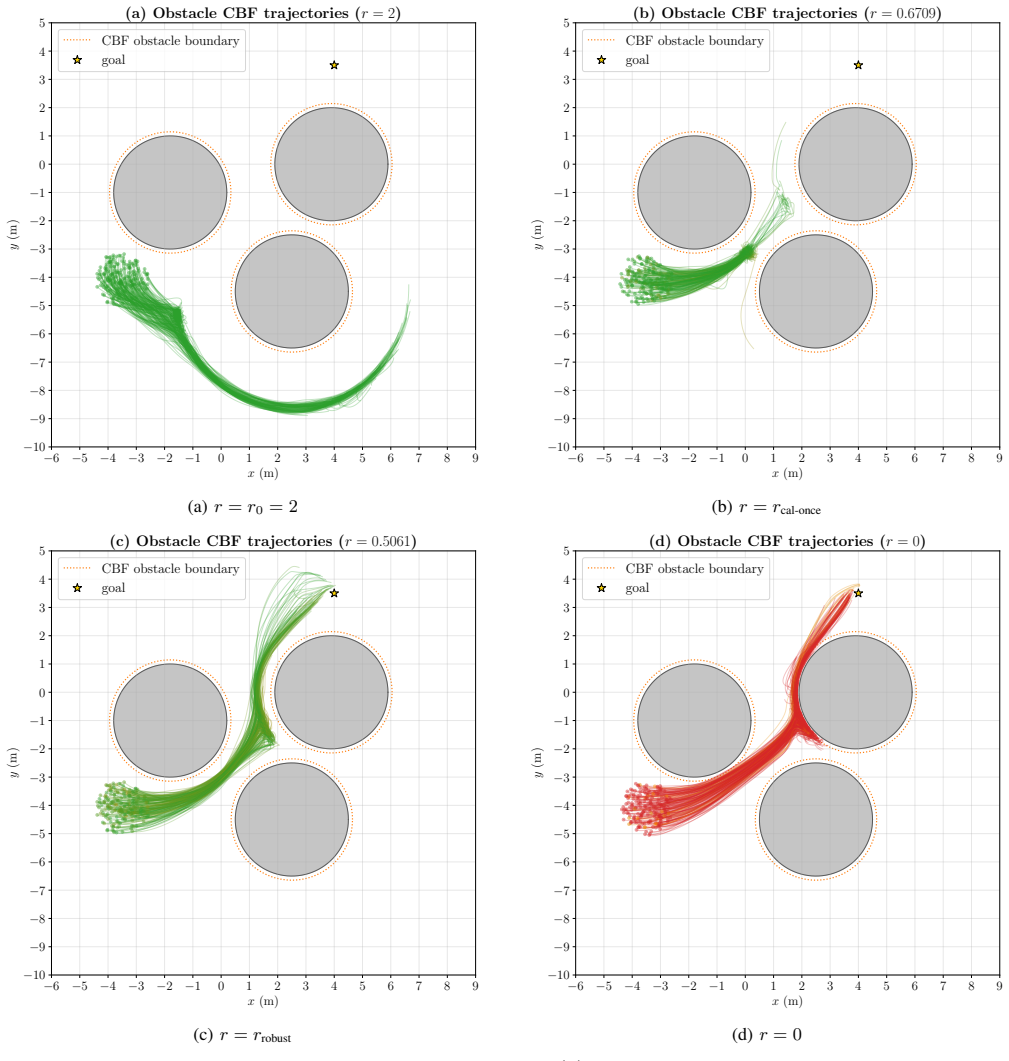
Summary. The paper proposes an episodic framework for robust conformal CBF/CLF control under policy-induced distribution shift. At each episode, a robustness margin r_j is used to synthesize a CBF/CLF-QP policy π_j; calibration data collected under π_j yield a conformal threshold q_j, and a Lipschitz-based distribution-shift budget M_{j+1}=κ|r_{j+1}-r_j| transfers validity to the next policy π_{j+1}. The main results are: (i) per-episode probabilistic safety/stability certificates for the deployed policy (Theorems 1–2), (ii) an explicit update rule for r_j (Eq. 14), and (iii) convergence of r_j to a population quantile fixed point under κ<1/3 (Theorem 3). The claims are validated on an inverted pendulum, a multi-obstacle maze, and a quadcopter obstacle-avoidance task.
Significance. If correct, this is a meaningful step toward data-driven robust control with finite-sample guarantees in the presence of distribution shift. The paper explicitly identifies and analyzes the circular dependence between the robustness margin and the controller, and it offers a concrete mechanism—adversarially robust conformal prediction plus a distribution-shift budget—to preserve guarantees across policy updates. The theoretical chain is largely coherent: the trajectory-level nonconformity argument transfers the deterministic rCBF/rCLF certificates to the stochastic setting, and Lemma 3 supplies the required calibration-conditional coverage. Example 1 is carefully worked out and convincingly demonstrates the failure mode the paper addresses. The appendices contain complete proofs and sensitivity analyses. The main weakness is that the load-bearing constant κ is never certified in the experiments, and the convergence experiments partly run outside the proven κ<1/3 regime.
major comments (3)
- [§III-B, Eq. (10)–(12); §V, Tables II and VI] The distribution-shift budget κ=β_T L_U is the quantity that converts the ARCP guarantee for the old policy into a guarantee for the new deployed policy. Theorem 1 and Theorem 2 rely on the validity of (12). However, the paper provides no operational procedure to compute or certify κ. The sentence in §III-B suggesting estimation of β_T from data [40], [41] with confidence 1−δ_β is not backed by an estimator, sample-complexity bound, or confidence construction. In all three case studies, κ is simply declared (0.8, 0.6, 0.3 in Tables II and VI) with no verification of the Lipschitz bound (12). If the true sensitivity exceeds κ, the event inclusion in Lemma 3 fails and the per-episode safety/stability guarantees of Theorem 2 do not follow. This is load-bearing, not a stylistic point.
- [§IV-B, Theorem 3; §V-A and §V-C, Figs. 3 and 16] The convergence result in Theorem 3 requires κ<1/3 to obtain the limsup bound and almost-sure convergence. The pendulum experiment uses κ=0.8 (Table II) and the quadcopter experiment uses κ=0.6 (Table VI), both violating the theorem's condition. The plots in Figs. 3 and 16 nevertheless display convergence. If the authors wish to claim that these experiments validate Theorem 3, they must either certify a smaller κ or explicitly state that the observed convergence is a heuristic/empirical phenomenon outside the proven regime. As written, the experimental narrative overstates the support for the convergence theory.
- [Assumption 3 and Remark 1 (§III-B)] Assumption 3 requires a compact tube Ω such that trajectories under π_r remain in Ω for every r∈R and every x(0)∈X_0, and that f, f_hat, and π_r are Lipschitz on Ω×U. No procedure is given to choose Ω and R so that this actually holds, nor is it verified in any case study. If a policy update causes trajectories to leave Ω, the Lipschitz bounds (i)–(iii) no longer apply along the true trajectory, and the derivation of (10) and (12) in Appendix G collapses. Since the explicit update rule (14) can make r_{j+1} larger than r_j, tube containment is not automatic. This is another load-bearing premise that needs a concrete validation method or at least an explicit feasibility check in the experiments.
minor comments (4)
- [§I-A (Related work)] Typo: 'acocunt' should be 'account'.
- [§III-B, Eq. (11)] The implicit rule (11) is solved by 'standard scalar root-finding', but no existence guarantee for a feasible r is given. If the feasible set is empty, the policy update is undefined. A brief comment on conditions guaranteeing nonemptiness would help.
- [Appendix K, Figs. 12 and 13] Captions are inconsistent with the main-text figures: Fig. 12 says '21 safe, 79 unsafe' while Fig. 6(a) reports '135 safe, 365 unsafe', and Figs. 13/15 say '100 safe' while Fig. 6(b) reports 500 safe trajectories. These numbers should be reconciled or explained.
- [Lemma 3, footnote 5] The notation P^n{·} is defined, but the distinction between the product measure and the conditional measure P(·|D_cal) could be stated more prominently, since it is central to the calibration-conditional guarantees.
Circularity Check
No circularity: the distribution-shift budget is derived from Lipschitz/trajectory-sensitivity assumptions, not from the target safety/stability guarantees.
full rationale
The derivation chain is self-contained and non-circular. The paper explicitly identifies the circular dependence between the robustness margin r and the policy π (Figure 1, Example 1), and then breaks it by combining adversarially robust conformal prediction (Lemma 3) with an independent distribution-shift budget. Theorem 1 transfers the calibration-conditional validity of q_j to the next policy via M_{j+1} = ρ(π_{j+1},π_j), but ρ is not defined in terms of the predicted event; it is instantiated by Eq. (10)-(12) as β_T ‖π_{r'} − π_r‖_Ω, with β_T obtained from a Grönwall trajectory-sensitivity argument (Appendix G, Proposition 3) and κ = β_T L_U from a parametric-QP sensitivity bound (Appendix F). These constants depend on Lipschitz properties of f, f̂, π_r and the horizon T, not on the calibration scores or on the safety/stability outcomes being certified. Theorem 2 then follows from the event inclusion {s_{j+1} ≤ r_{j+1}} combined with the rCBF/rCLF constraints, and the convergence analysis in Theorem 3 is a standard contraction-plus-quantile-error argument. The self-citations [7] and [9] are not load-bearing: [7] is cited as a summary of the external conditional-CP result [39], and [9] supplies an elementary closed-form solution to the update inequality that is verified directly in the present paper. The strongest caveat in the manuscript is that the experimental values of κ (e.g., κ=0.8, 0.6, 0.3 in Tables II/VI and the quadcopter setup) are declared rather than certified by computing β_T and L_U; this is a rigor/correctness concern about whether Theorem 2's assumptions hold in the case studies, not a circularity, because the theorem's hypotheses are stated independently of the reported experiments.
Axiom & Free-Parameter Ledger
free parameters (1)
- κ = β_T L_U (distribution-shift contraction constant) =
0.8 (pendulum), 0.3 (maze), 0.6 (quadcopter)
axioms (6)
- domain assumption Assumption 1: at each episode, initial conditions and trajectories are i.i.d. and defined on [0,T].
- domain assumption Assumption 2: for any two policies π', π'' there is a bounded ρ(π',π'') with s_ct(x0,π') ≤ s_ct(x0,π'')+ρ a.s.
- domain assumption Assumption 3: f, f_hat, and π_r are Lipschitz on Ω×U, and all trajectories stay in compact Ω for all r∈R.
- domain assumption Assumption 4: π_r is Lipschitz in r with constant L_U, and κ<1 for the explicit update.
- domain assumption Assumption 5: the score distribution has density bounded below by m near the fixed point, and quantile levels lie in a fixed interval.
- standard math Standard CP validity, Massart's DKW inequality, Grönwall's lemma, and KKT regularity of the parametric QP.
read the original abstract
Conformal prediction (CP) has been used to obtain probabilistic bounds on the error between a learned dynamics model and the true but unknown system. Such CP bounds can then be embedded into robust control Lyapunov function (CLF) and control barrier function (CBF) frameworks. However, such an approach does not retain stability/safety guarantees because of the distribution shift between the closed-loop trajectory distribution under the deployed CLF/CBF policy and the trajectory distribution from which the CP bound and its guarantees were derived. To address this issue, we propose an episodic framework that iteratively updates the robust conformal CLF/CBF policy while maintaining stability/safety guarantees across episodes. We achieve this by (1) using adversarially robust conformal prediction, and (2) quantifying a distribution shift budget that allows us to control how much the model error can increase across policy updates. This distribution shift budget is derived via a closed-loop trajectory sensitivity analysis, yielding an implicit and an explicit update rule for the CP bound. We analyze convergence of our algorithm, which we demonstrate on three case studies. To the best of our knowledge, these are the first results that provide stability/safety guarantees for robust conformal CBF/CLF policies.
Figures


Reference graph
Works this paper leans on
-
[1]
E. D. Sontag, “A “universal” construction of artstein’s theorem on nonlinear stabilization,”Syst. Control Lett., vol. 13, no. 2, pp. 117– 123, 1989.DOI:10.1016/0167-6911(89)90028-5
-
[2]
Control barrier function based quadratic programs for safety critical systems,
A. D. Ames, X. Xu, J. W. Grizzle, and P. Tabuada, “Control barrier function based quadratic programs for safety critical systems,”IEEE Trans. Autom. Control, vol. 62, no. 8, pp. 3861–3876, 2017.DOI: 10.1109/TAC.2016.2638961
arXiv 2017
-
[3]
Freeman and P
R. Freeman and P. V . Kokotovi ´c,Robust Nonlinear Control Design: State-Space and Lyapunov Techniques. Springer, 2008
2008
-
[4]
Robustness of control barrier functions for safety critical control,
X. Xu, P. Tabuada, J. W. Grizzle, and A. D. Ames, “Robustness of control barrier functions for safety critical control,”IFAC- PapersOnLine, vol. 48, no. 27, pp. 54–61, 2015.DOI:10.1016/ j.ifacol.2015.11.152
2015
-
[5]
V . V ovk, A. Gammerman, and G. Shafer,Algorithmic Learning in a Random World. Springer, 2005.DOI:10.1007/b106715
doi:10.1007/b106715 2005
-
[6]
Conformal prediction: A gentle introduction,
A. N. Angelopoulos and S. Bates, “Conformal prediction: A gentle introduction,”Found. Trends Mach. Learn., vol. 16, no. 4, pp. 494– 591, 2023.DOI:10.1561/2200000101
-
[7]
L. Lindemann, Y . Zhao, X. Yu, G. J. Pappas, and J. V . Deshmukh, “Formal verification and control with conformal prediction: Practi- cal safety guarantees for autonomous systems,”IEEE Control Syst. Mag., vol. 45, no. 6, pp. 72–122, 2025.DOI:10 . 1109 / MCS . 2025.3611545
arXiv 2025
-
[8]
T.-W. Hsu and H. Tsukamoto, “Statistical guarantees in data-driven nonlinear control: Conformal robustness for stability and safety,” IEEE Control Syst. Lett., vol. 9, pp. 997–1002, 2025.DOI:10 . 1109/LCSYS.2025.3578062
arXiv 2025
-
[9]
O. Mirzaeedodangeh, E. Shekhtman, N. Matni, and L. Lindemann, “Safe planning in interactive environments via iterative policy up- dates and adversarially robust conformal prediction,”arXiv preprint arXiv:2511.10586, 2025
Pith/arXiv arXiv 2025
-
[10]
Adversarially robust conformal prediction,
A. Gendler, T.-W. Weng, L. Daniel, and Y . Romano, “Adversarially robust conformal prediction,” inProc. Int. Conf. Learn. Represent. (ICLR), 2022
2022
-
[11]
Regularity properties of optimization-based controllers,
P. Mestres, A. Allibhoy, and J. Cort ´es, “Regularity properties of optimization-based controllers,”Eur. J. Control, vol. 81, p. 101 098, 2025
2025
-
[12]
Safe planning in dynamic environments using conformal prediction,
L. Lindemann, M. Cleaveland, G. Shim, and G. J. Pappas, “Safe planning in dynamic environments using conformal prediction,” IEEE Robot. Autom. Lett., vol. 8, no. 8, pp. 5116–5123, 2023.DOI: 10.1109/LRA.2023.3292071
arXiv 2023
-
[13]
Probabilistically correct language-based multi-robot planning using conformal prediction,
J. Wang, G. He, and Y . Kantaros, “Probabilistically correct language-based multi-robot planning using conformal prediction,” IEEE Robot. Autom. Lett., vol. 10, no. 1, pp. 160–167, 2025
2025
-
[14]
A. Z. Ren et al.,Robots that ask for help: Uncertainty alignment for large language model planners, 2023. arXiv:2307 . 01928 [cs.RO]
2023
-
[15]
Safe perception-based control under stochastic sensor uncertainty using conformal prediction,
S. Yang, G. J. Pappas, R. Mangharam, and L. Lindemann, “Safe perception-based control under stochastic sensor uncertainty using conformal prediction,” inProc. IEEE Conf. Decis. Control (CDC), 2023, pp. 6072–6078
2023
-
[16]
J. Zhang, B. Hoxha, G. Fainekos, and D. Panagou, “Conformal prediction in the loop: Risk-aware control barrier functions for stochastic systems with data-driven state estimators,”IEEE Control Syst. Lett., vol. 9, pp. 282–287, 2025.DOI:10.1109/LCSYS. 2025.3571828
arXiv 2025
-
[17]
Confor- mal prediction for STL runtime verification,
L. Lindemann, X. Qin, J. V . Deshmukh, and G. J. Pappas, “Confor- mal prediction for STL runtime verification,” inProc. ACM/IEEE Int. Conf. Cyber-Phys. Syst., 2023, pp. 142–153.DOI:10.1145/ 3576841.3585927
arXiv 2023
-
[18]
Conformal quantitative predictive monitoring of STL requirements for stochastic pro- cesses,
F. Cairoli, N. Paoletti, and L. Bortolussi, “Conformal quantitative predictive monitoring of STL requirements for stochastic pro- cesses,” inProc. ACM Int. Conf. Hyb. Syst.: Comp. Cont., 2023, pp. 1–11
2023
-
[19]
Adaptive conformal inference under distribution shift,
I. Gibbs and E. J. Cand `es, “Adaptive conformal inference under distribution shift,” inAdv. Neural Inf. Process. Syst., vol. 34, 2021, pp. 1660–1672
2021
-
[20]
Conformal prediction under covariate shift,
R. J. Tibshirani, R. F. Barber, E. J. Cand `es, and A. Ramdas, “Conformal prediction under covariate shift,” inAdv. Neural Inf. Process. Syst., vol. 32, 2019
2019
-
[21]
Robust validation: Confident predictions even when distributions shift,
M. Cauchois, S. Gupta, A. Ali, and J. C. Duchi, “Robust validation: Confident predictions even when distributions shift,”J. Amer. Statist. Assoc., vol. 119, no. 548, pp. 3033–3044, 2024
2024
-
[22]
Adaptive conformal prediction for motion planning among dynamic agents,
A. Dixit, L. Lindemann, S. X. Wei, M. Cleaveland, G. J. Pappas, and J. W. Burdick, “Adaptive conformal prediction for motion planning among dynamic agents,” inProc. Learn. Dyn. Control Conf. (L4DC), ser. Proc. Mach. Learn. Res. V ol. 211, PMLR, 2023, pp. 300–314
2023
-
[23]
Safe POMDP online planning among dynamic agents via adaptive conformal prediction,
S. Sheng, P. Yu, D. Parker, M. Kwiatkowska, and L. Feng, “Safe POMDP online planning among dynamic agents via adaptive conformal prediction,”IEEE Robot. Autom. Lett., vol. 9, no. 11, pp. 9946–9953, 2024
2024
-
[24]
When environments shift: Safe planning with generative priors and robust conformal prediction,
K. Rahaman, J. V . Deshmukh, A. R. Hota, and L. Lindemann, “When environments shift: Safe planning with generative priors and robust conformal prediction,” inProc. Learn. Dyn. Control Conf. (L4DC), Accepted, 2026. arXiv:2602.12616 [cs.RO]
arXiv 2026
-
[25]
Robust conformal prediction for STL runtime verification under distribution shift,
Y . Zhao, B. Hoxha, G. Fainekos, J. V . Deshmukh, and L. Linde- mann, “Robust conformal prediction for STL runtime verification under distribution shift,” inProc. ACM/IEEE Int. Conf. Cyber-Phys. Syst., 2024, pp. 169–179.DOI:10.1109/ICCPS61052.2024. 00022arXiv:2311.09482 [cs.SY]
arXiv 2024
-
[26]
R. A. D’Silva and H. Tsukamoto,Statistical contraction for chance- constrained trajectory optimization of non-Gaussian stochastic sys- tems, 2026. arXiv:2603.07092 [eess.SY]
arXiv 2026
-
[27]
A. Srinivasan, A. Leeman, and G. Chou, “Safety beyond the training data: Robust out-of-distribution MPC via conformalized system level synthesis,” inProc. Learn. Dyn. Control Conf. (L4DC), Accepted, 2026. arXiv:2602.12047 [eess.SY]
arXiv 2026
-
[28]
Conformal policy learning for sensorimotor control under distribution shifts,
H. Huang, S. Sharma, A. Loquercio, A. Angelopoulos, K. Goldberg, and J. Malik, “Conformal policy learning for sensorimotor control under distribution shifts,” inProc. IEEE Int. Conf. Robot. Autom. (ICRA), 2024, pp. 16 285–16 291
2024
-
[29]
Performative risk control: Calibrating models for reliable deployment under performativity,
V . Li, B. Chen, Y . Mao, Q. Lei, and Z. Deng, “Performative risk control: Calibrating models for reliable deployment under performativity,” inAdv. Neural Inf. Process. Syst., 2025. arXiv: 2505.24097 [stat.ML]
Pith/arXiv arXiv 2025
-
[30]
Safe, out-of- distribution-adaptive MPC with conformalized neural network en- sembles,
J. L. Contreras, O. Shorinwa, and M. Schwager, “Safe, out-of- distribution-adaptive MPC with conformalized neural network en- sembles,” inProc. Learn. Dyn. Control Conf. (L4DC), ser. Proc. Mach. Learn. Res. V ol. 283, PMLR, 2025, pp. 194–207. arXiv: 2406.02436 [cs.RO]
Pith/arXiv arXiv 2025
-
[31]
M. Tayal, A. Singh, P. Jagtap, and S. Kolathaya, “Cp-ncbf: A conformal prediction-based approach to synthesize verified neural control barrier functions,”arXiv:2503.17395, 2025
Pith/arXiv arXiv 2025
-
[32]
CPED-NCBFs: A conformal prediction for expert demonstration-based neural control barrier functions,
M. S. Sumeadh, K. Dsouza, and R. Prakash, “CPED-NCBFs: A conformal prediction for expert demonstration-based neural control barrier functions,” inProc. Ind. Control Conf. (ICC), 2025.DOI: 10.1109/ICC69100.2025.11372429arXiv:2507.15022
arXiv 2025
-
[33]
S. Wang, S. Wang, S. Li, and X. Yin,SPARC: Prediction-based safe control for coupled controllable and uncontrollable agents with conformal predictions, 2025. arXiv:2410.15660 [eess.SY]
Pith/arXiv arXiv 2025
-
[34]
Safety-critical control with uncertainty quantification using adaptive conformal prediction,
H. Zhou, Y . Zhang, and W. Luo, “Safety-critical control with uncertainty quantification using adaptive conformal prediction,” in Proc. Amer. Control Conf. (ACC), 2024, pp. 574–580
2024
-
[35]
H. Zhou, Y . Zhang, and W. Luo,Computationally and sample efficient safe reinforcement learning using adaptive conformal pre- diction, 2025. arXiv:2503.17678 [eess.SY]
Pith/arXiv arXiv 2025
-
[36]
M. Hardt and C. Mendler-D ¨unner,Performative prediction: Past and future, 2023. arXiv:2310.16608 [cs.LG]
Pith/arXiv arXiv 2023
-
[37]
Prinster et al.,Conformal policy control, 2026
D. Prinster et al.,Conformal policy control, 2026. arXiv:2603. 02196 [stat.ML]
2026
-
[38]
Conditional validity of inductive conformal predictors,
V . V ovk, “Conditional validity of inductive conformal predictors,” inProc. Asian Conf. Mach. Learn., ser. Proc. Mach. Learn. Res. V ol. 25, PMLR, 2012, pp. 475–490
2012
-
[39]
Sample-conditional coverage in split-conformal pre- diction,
J. C. Duchi, “Sample-conditional coverage in split-conformal pre- diction,” inAdv. Neural Inf. Process. Syst., 2025
2025
-
[40]
On the sample complexity of Lipschitz constant estimation,
J. W. Huang, S. Roberts, and J.-P. Calliess, “On the sample complexity of Lipschitz constant estimation,”Trans. Mach. Learn. Res., 2023
2023
-
[41]
Efficient and accurate estimation of Lipschitz constants for deep neural networks,
M. Fazlyab, A. Robey, H. Hassani, M. Morari, and G. J. Pappas, “Efficient and accurate estimation of Lipschitz constants for deep neural networks,” inAdv. Neural Inf. Process. Syst., vol. 32, 2019
2019
-
[42]
Z. Huang et al.,QuadSwarm: A modular multi-quadrotor simulator for deep reinforcement learning with direct thrust control, 2023. arXiv:2306.09537 [cs.RO]
Pith/arXiv arXiv 2023
-
[43]
H. K. Khalil,Nonlinear Systems, 3rd ed. Prentice Hall, 2002
2002
-
[44]
Kallenberg,Foundations of Modern Probability(Probability and Its Applications), 2nd ed
O. Kallenberg,Foundations of Modern Probability(Probability and Its Applications), 2nd ed. Springer, 2002
2002
-
[45]
J. F. Bonnans and A. Shapiro,Perturbation Analysis of Optimization Problems. Springer, 2000.DOI:10 . 1007 / 978 - 1 - 4612 - 1394-9
2000
-
[46]
A. L. Dontchev and R. T. Rockafellar,Implicit Functions and So- lution Mappings: A View from Variational Analysis, 2nd. Springer, 2014.DOI:10.1007/978-1-4939-1037-3
-
[47]
The tight constant in the Dvoretzky-Kiefer-Wolfowitz inequality,
P. Massart, “The tight constant in the Dvoretzky-Kiefer-Wolfowitz inequality,”Ann. Probab., vol. 18, no. 3, pp. 1269–1283, 1990.DOI: 10.1214/aop/1176990746 APPENDIXA FORWARDINVARIANCE ANDSTABILITY VIA DETERMINISTIC RCBFAND RCLF This appendix provides invariance and stability results that follow from the rCBF and rCLF formulations in Definition 1 and Defin...
arXiv 1990
discussion (0)
Sign in with ORCID, Apple, or X to comment. Anyone can read and Pith papers without signing in.